
PAGE 1
REF: 1547-33-001 / 4v0
NO MARKING REQUIRED
Material in this document has been sourced from P3M3® . Copyright © RSM UK Consulting LLP and AXELOS Limited 2015. All rights reserved
Based on AXELOS P3M3® material. Material is reproduced under licence from AXELOS
No part of this document may be reproduced in any form without the written permission of both the RSM UK Consulting LLP and AXELOS Limited.
Permission can be requested at andy.murray@rsmuk.com and from AXELOS at licensing@AXELOS.com .
USING P3M3 TO HONE YOUR PMO
PAGE 2
REF: 1547-33-001 / 4v0
NO MARKING REQUIRED
How can PMOs use capability
maturity models, such as
P3M3®, to prioritise and drive
performance improvements?
PAGE 3
REF: 1547-33-001 / 4v0
NO MARKING REQUIRED
A brief history of maturity models
In response to reviews of high profile US Department of Defense project
failures, quality guru Phil Crosby demonstrated that the quality of project
outputs are directly related to the quality of the processes used to create
them
The first Maturity Model was developed by Carnegie Mellon University in the
1980’s and was used by US Government to assess quality of processes of
software suppliers to enable a prediction of output quality
There was no straight “yes/no” answer
Suppliers exhibited different characteristics as they became more capable at
quality management – 5 levels
PAGE 4
REF: 1547-33-001 / 4v0
NO MARKING REQUIRED
A brief history of maturity models
There are now hundreds of maturity models across numerous management
disciplines based on the core Carnegie Melon University concept of 5 maturity
levels. For example:
CMMI’s Data Management Maturity Model
AXELOS’ ITIL Maturity Model
Gartner's Logistics Maturity Model
Change Management Institute’s Organisational Change Maturity Model
The hierarchical nature of maturity models provides framework for benchmarking
capability, diagnosing root-causes, identifying performance inhibitors and
prioritizing improvement initiatives
PAGE 5
REF: 1547-33-001 / 4v0
NO MARKING REQUIRED
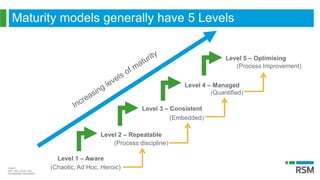
Maturity models generally have 5 Levels
Level 1 – Aware
Level 2 – Repeatable
Level 3 – Consistent
Level 4 – Managed
Level 5 – Optimising
(Quantified)
(Embedded)
(Process discipline)
(Chaotic, Ad Hoc, Heroic)
(Process Improvement)
PAGE 6
REF: 1547-33-001 / 4v0
NO MARKING REQUIRED
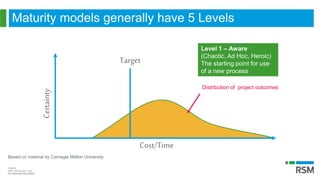
Maturity models generally have 5 Levels
Certainty
Cost/Time
Target
Distribution of project outcomes
Level 1 – Aware
(Chaotic, Ad Hoc, Heroic)
The starting point for use
of a new process
Based on material by Carnegie Mellon University
PAGE 7
REF: 1547-33-001 / 4v0
NO MARKING REQUIRED
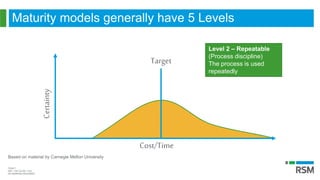
Maturity models generally have 5 Levels
Certainty
Cost/Time
Target
Level 2 – Repeatable
(Process discipline)
The process is used
repeatedly
Based on material by Carnegie Mellon University
PAGE 8
REF: 1547-33-001 / 4v0
NO MARKING REQUIRED
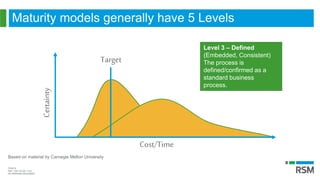
Maturity models generally have 5 Levels
Target
Certainty
Cost/Time
Level 3 – Defined
(Embedded, Consistent)
The process is
defined/confirmed as a
standard business
process.
Based on material by Carnegie Mellon University
PAGE 9
REF: 1547-33-001 / 4v0
NO MARKING REQUIRED
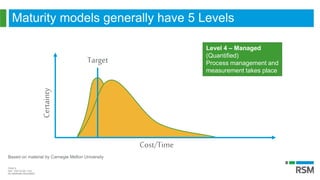
Maturity models generally have 5 Levels
Certainty
Cost/Time
Target
Level 4 – Managed
(Quantified)
Process management and
measurement takes place
Based on material by Carnegie Mellon University
PAGE 10
REF: 1547-33-001 / 4v0
NO MARKING REQUIRED
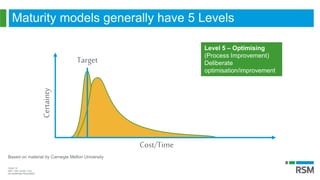
Maturity models generally have 5 Levels
Certainty
Cost/Time
Target
Level 5 – Optimising
(Process Improvement)
Deliberate
optimisation/improvement
Based on material by Carnegie Mellon University
PAGE 11
REF: 1547-33-001 / 4v0
NO MARKING REQUIRED
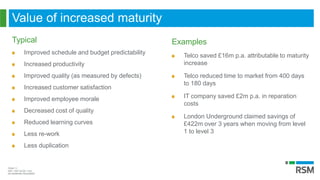
Value of increased maturity
Typical
Improved schedule and budget predictability
Increased productivity
Improved quality (as measured by defects)
Increased customer satisfaction
Improved employee morale
Decreased cost of quality
Reduced learning curves
Less re-work
Less duplication
Examples
Telco saved £16m p.a. attributable to maturity
increase
Telco reduced time to market from 400 days
to 180 days
IT company saved £2m p.a. in reparation
costs
London Underground claimed savings of
£422m over 3 years when moving from level
1 to level 3
PAGE 12
REF: 1547-33-001 / 4v0
NO MARKING REQUIRED
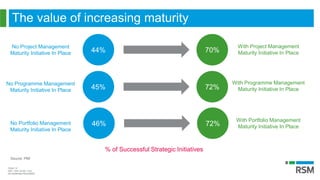
The value of increasing maturity
Source: PMI
44% 70%
With Project Management
Maturity Initiative In Place
45% 72%
46% 72%
No Project Management
Maturity Initiative In Place
No Programme Management
Maturity Initiative In Place
No Portfolio Management
Maturity Initiative In Place
With Programme Management
Maturity Initiative In Place
With Portfolio Management
Maturity Initiative In Place
% of Successful Strategic Initiatives
PAGE 13
REF: 1547-33-001 / 4v0
NO MARKING REQUIRED
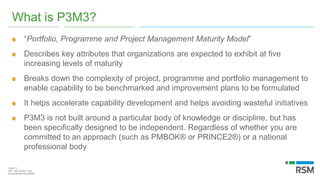
What is P3M3?
“Portfolio, Programme and Project Management Maturity Model”
Describes key attributes that organizations are expected to exhibit at five
increasing levels of maturity
Breaks down the complexity of project, programme and portfolio management to
enable capability to be benchmarked and improvement plans to be formulated
It helps accelerate capability development and helps avoiding wasteful initiatives
P3M3 is not built around a particular body of knowledge or discipline, but has
been specifically designed to be independent. Regardless of whether you are
committed to an approach (such as PMBOK® or PRINCE2®) or a national
professional body
PAGE 14
REF: 1547-33-001 / 4v0
NO MARKING REQUIRED
P3M3 has 6 primary uses
Base-lining current capability (for later comparison)
Benchmarking capability against other organisations
(possibly to harvest best practice from a community)
Discovering capabilities to determine which areas to concentrate on
Diagnosing systemic weaknesses to eliminate route-causes and non-conforming
costs
Prioritising improvement initiatives (based on any of the above)
Certifying capability through independent assessment
PAGE 15
REF: 1547-33-001 / 4v0
NO MARKING REQUIRED
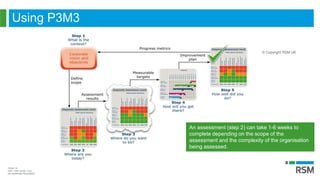
Using P3M3
© Copyright RSM UK
An assessment (step 2) can take 1-6 weeks to
complete depending on the scope of the
assessment and the complexity of the organisation
being assessed.
PAGE 16
REF: 1547-33-001 / 4v0
NO MARKING REQUIRED
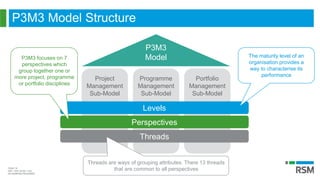
P3M3 Model Structure
P3M3
Model
Project
Management
Sub-Model
Programme
Management
Sub-Model
Portfolio
Management
Sub-Model
Levels
The maturity level of an
organisation provides a
way to characterise its
performance
Perspectives
P3M3 focuses on 7
perspectives which
group together one or
more project, programme
or portfolio disciplines
Threads
Threads are ways of grouping attributes. There 13 threads
that are common to all perspectives
PAGE 17
REF: 1547-33-001 / 4v0
NO MARKING REQUIRED
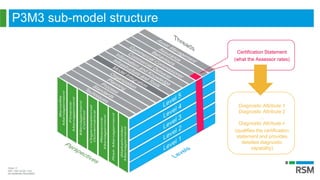
P3M3 sub-model structure
Certification Statement
(what the Assessor rates)
Diagnostic Attribute 1
Diagnostic Attribute 2
…
Diagnostic Attribute n
(qualifies the certification
statement and provides
detailed diagnostic
capability)
PAGE 18
REF: 1547-33-001 / 4v0
NO MARKING REQUIRED
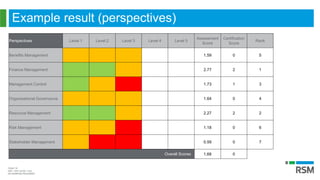
Example result (perspectives)
Perspectives Level 1 Level 2 Level 3 Level 4 Level 5
Assessment
Score
Certification
Score
Rank
Benefits Management 1.59 0 5
Finance Management 2.77 2 1
Management Control 1.73 1 3
Organisational Governance 1.64 0 4
Resource Management 2.27 2 2
Risk Management 1.18 0 6
Stakeholder Management 0.59 0 7
Overall Scores 1.68 0
PAGE 19
REF: 1547-33-001 / 4v0
NO MARKING REQUIRED
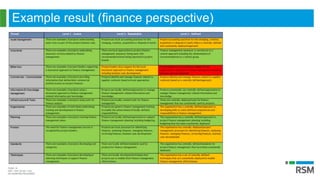
Example result (finance perspective)
PAGE 20
REF: 1547-33-001 / 4v0
NO MARKING REQUIRED
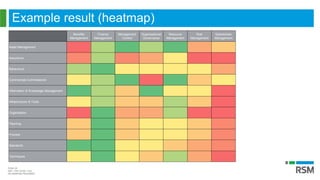
Example result (heatmap)
Benefits
Management
Finance
Management
Management
Control
Organisational
Governance
Resource
Management
Risk
Management
Stakeholder
Management
Asset Management
Assurance
Behaviours
Commercial-Commissioner
Information & Knowledge Management
Infrastructure & Tools
Organisation
Planning
Process
Standards
Techniques
PAGE 21
REF: 1547-33-001 / 4v0
NO MARKING REQUIRED
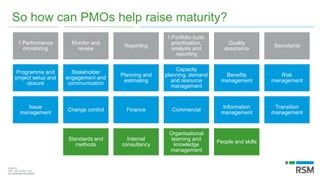
So how can PMOs help raise maturity?
1.Performance
monitoring
Monitor and
review
Reporting
1.Portfolio build,
prioritisation,
analysis and
reporting
Quality
assurance
Secretariat
Programme and
project setup and
closure
Stakeholder
engagement and
communication
Planning and
estimating
Capacity
planning, demand
and resource
management
Benefits
management
Risk
management
Issue
management
Change control Finance Commercial
Information
management
Transition
management
Standards and
methods
Internal
consultancy
Organisational
learning and
knowledge
management
People and skills
PAGE 22
REF: 1547-33-001 / 4v0
NO MARKING REQUIRED
Conclusion
The Portfolio, Programme and Project
Management Maturity Model (P3M3) breaks
down the broad disciplines of portfolio,
programme and project management into a
hierarchy of perspectives.
The hierarchical approach enables
organizations to
– assess their current capability
– plot a roadmap for improvement prioritised by those
perspectives which will make the biggest impact on
performance
– Check progress of improvement initiatives
There is a clear link between capability and
performance
There is also a clear link between PMOs and
capability
PMOs play a vital role in securing Level 3
maturity and enabling the journey to Level 5
How your PMO helps enable or drive
capability improvements depends on your
remit (scope and role)
PAGE 23
REF: 1547-33-001 / 4v0
NO MARKING REQUIRED
Material in this document has been sourced from P3M3® . Copyright © RSM UK Consulting LLP and AXELOS Limited 2015. All rights reserved
Based on AXELOS P3M3® material. Material is reproduced under licence from AXELOS
No part of this document may be reproduced in any form without the written permission of both the RSM UK Consulting LLP and AXELOS Limited.
Permission can be requested at andy.murray@rsmuk.com and from AXELOS at licensing@AXELOS.com .
ANY QUESTIONS?
PAGE 24
REF: 1547-33-001 / 4v0
NO MARKING REQUIRED
http://www.rsmuk.com/
https://www.linkedin.com/company/rsm-uk
https://twitter.com/RSMUK
We help organisations become more capable of delivering their
bids, projects, programmes and portfolios effectively and
efficiently. We help raise confidence among senior executives,
stakeholders, regulators and shareholders that the time and
effort invested will yield the desired results.
Where needed we also provide advice and assistance in
implementing the changes which are necessary to gain the
capability you seek.
Contact Us
+44 (0) 7776 301602
andy.murray@rsmuk.com
Partner
+44 (0) 7796 274640
nigel.bennett@rsmuk.com.
Nigel Bennett
Consulting Director
Andy Murray
PAGE 25
REF: 1547-33-001 / 4v0
NO MARKING REQUIRED
About RSM
The UK group of companies and LLPs trading as RSM is a member of the RSM network. RSM is the trading name used by the members of the RSM
network. Each member of the RSM network is an independent accounting and consulting firm each of which practises in its own right. The RSM
network is not itself a separate legal entity of any description in any jurisdiction. The RSM network is administered by RSM International Limited, a
company registered in England and Wales (company number 4040598) whose registered office is at 50 Cannon Street, London EC4N 6JJ. The brand
and trademark RSM and other intellectual property rights used by members of the network are owned by RSM International Association, an association
governed by article 60 et seq of the Civil Code of Switzerland whose seat is in Zug.
RSM Corporate Finance LLP, RSM Restructuring Advisory LLP, RSM Risk Assurance Services LLP, RSM Tax and Advisory Services LLP, RSM UK
Audit LLP, RSM UK Consulting LLP, RSM Employer Services Limited, RSM Northern Ireland (UK) Limited and RSM UK Tax and Accounting Limited
are not authorised under the Financial Services and Markets Act 2000 but we are able in certain circumstances to offer a limited range of investment
services because we are members of the Institute of Chartered Accountants in England and Wales. We can provide these investment services if they
are an incidental part of the professional services we have been engaged to provide. RSM Legal LLP is authorised and regulated by the Solicitors
Regulation Authority, reference number 626317, to undertake reserved and non-reserved legal activities. It is not authorised under the Financial
Services and Markets Act 2000 but is able in certain circumstances to offer a limited range of investment services because it is authorised and
regulated by the Solicitors Regulation Authority and may provide investment services if they are an incidental part of the professional services that it
has been engaged to provide. Baker Tilly Creditor Services LLP is authorised and regulated by the Financial Conduct Authority for credit-related
regulated activities. RSM & Co (UK) Limited is authorised and regulated by the Financial Conduct Authority to conduct a range of investment business
activities. Whilst every effort has been made to ensure accuracy, information contained in this communication may not be comprehensive and
recipients should not act upon it without seeking professional advice.
© 2017 RSM UK Group LLP, all rights reserved