Presented By
Dr. Swostik Devkota
BDS (T.U)
CONTENTS
 Introduction
 Brief
 Scope
 Important Examples & Terms
 Ethical Aspects of Medical Practice
 Duties of RMP towards professional colleague
 Duties of RMP towards States
 Rights & privileges of RMP
 Rights & privileges of Patients
 Professional Secrets & Confidentiality
 Legal aspects of medical practice
 Doctors & medical records
 Consent
 Types & Importance of Consent
 Medical Negligence
 Types of Medical Negligence
INTRODUCTION
 “Juris”- Law “Prudentia”- Knowledge . Therefore,
Knowledge of Law
-In relation to practice of Medicine
-In relation with legal consequences
 Medical Jurisprudence is also known as legal medicine.
 Medical jurisprudence or legal medicine is the branch
of science and medicine involving the study and application
of scientific and medical knowledge to legal problems, such
as inquests and in the field of law.
 Simply, Medical jurisprudence is the branch of the law that
deals with the application of law to medicine or, conversely,
the application of medical science to legal problems.
BRIEF
 As modern medicine is a legal creation, regulated by
the state, and medico legal cases
involving death, rape, paternity, etc. require a medical
practitioner to produce evidence and appear as
an expert witness, these two fields have traditionally
been interdependent.
 Medical jurisprudence may be involved in cases
concerning genetic relationships (e.g.; paternity
testing) or injury or death resulting from violence.
 An autopsy may be done to help determine the agent of
death (e.g. a gun shot, poison) and how long the person has
been dead. Forensic medicine is also important in cases
involving rape. Modern techniques use such specimens as
semen, blood, and hair to identify the body of a victim and
to compare the DNA of the criminal to that of the defendant
through DNA fingerprinting.
 Forensic medicine, which includes forensic pathology, is a
narrower frontline field which involves the collection,
documentation, analysis and presentation of objective
information (medical evidence) for use in the legal system.
SCOPE
 Medical jurisprudence is concerned with a broad range of
medical, legal, and ethical issues, as well as human
rights and rights of individual.
 Physicians have a duty to act in their patients best interest and
can be charged in a court of law if they fail to do so. On the
other hand, a physician may be required to act in the interest of
third parties if his patient is a danger to others. Failure to do so
may lead to legal action against the physician.
 Medical jurisprudence includes:
 questions of the legal and ethical duties of physicians;
 questions affecting the civil
 Under the second heading, there are many aspects, including:
 questions of competence or sanity in civil or criminal
proceedings;
 questions of competence of minors in matters affecting their own
health; and,
 questions of lawful fitness or safety to drive a motor vehicle, pilot
an aeroplane, use scuba gear, play certain sports, or to join certain
occupations.
 Under the third heading, there are also many aspects, including:
 assessment of illness or injuries that may be work-related
(see worker’s compensation or occupational safety and health) or
otherwise compensable;
 assessment of injuries of minors that may relate to neglect
or abuse; and,
 Certification of Death or else the assessment of possible causes of
death. This, however, is the more commonly understood, albeit
narrow, meaning of forensic medicine.
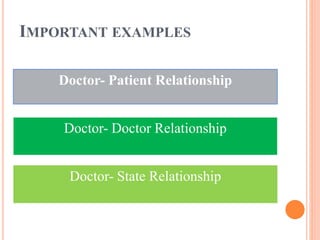
IMPORTANT EXAMPLES
Doctor- Patient Relationship
Doctor- Doctor Relationship
Doctor- State Relationship
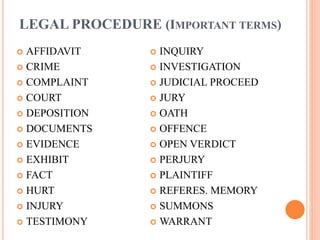
LEGAL PROCEDURE (IMPORTANT TERMS)
 AFFIDAVIT
 CRIME
 COMPLAINT
 COURT
 DEPOSITION
 DOCUMENTS
 EVIDENCE
 EXHIBIT
 FACT
 HURT
 INJURY
 TESTIMONY
 INQUIRY
 INVESTIGATION
 JUDICIAL PROCEED
 JURY
 OATH
 OFFENCE
 OPEN VERDICT
 PERJURY
 PLAINTIFF
 REFERES. MEMORY
 SUMMONS
 WARRANT
ETHICAL ASPECTS OF MEDICAL PRACTICE
Ethics- Manner and habit of man relates to
understanding of moral principles
Medical Etiquette- Sense of Courtesy and
Mutual Relationship between members of
Medical Profession.
 Qualified & registered medical
Practitioner (RMP)
-Realise his responsibity to the society.
 A RMP- Allowed to use knife on the body (or)
- Toxic medicine on his patient.
ETHICAL ASPECTS OF MEDICAL PRACTICE
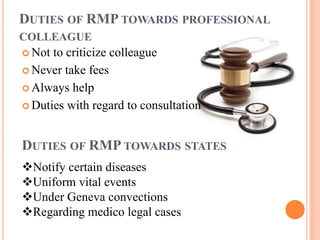
DUTIES OF RMP TOWARDS PROFESSIONAL
COLLEAGUE
 Not to criticize colleague
 Never take fees
 Always help
 Duties with regard to consultation
DUTIES OF RMP TOWARDS STATES
Notify certain diseases
Uniform vital events
Under Geneva convections
Regarding medico legal cases
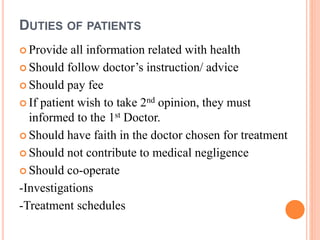
DUTIES OF PATIENTS
 Provide all information related with health
 Should follow doctor’s instruction/ advice
 Should pay fee
 If patient wish to take 2nd opinion, they must
informed to the 1st Doctor.
 Should have faith in the doctor chosen for treatment
 Should not contribute to medical negligence
 Should co-operate
-Investigations
-Treatment schedules
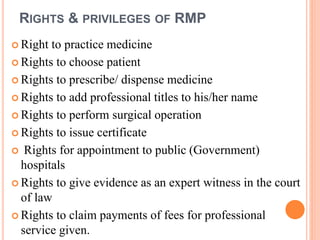
RIGHTS & PRIVILEGES OF RMP
 Right to practice medicine
 Rights to choose patient
 Rights to prescribe/ dispense medicine
 Rights to add professional titles to his/her name
 Rights to perform surgical operation
 Rights to issue certificate
 Rights for appointment to public (Government)
hospitals
 Rights to give evidence as an expert witness in the court
of law
 Rights to claim payments of fees for professional
service given.
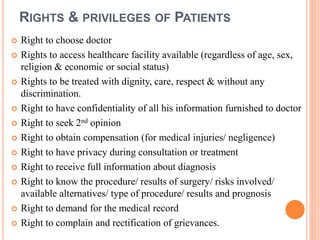
RIGHTS & PRIVILEGES OF PATIENTS
 Right to choose doctor
 Rights to access healthcare facility available (regardless of age, sex,
religion & economic or social status)
 Rights to be treated with dignity, care, respect & without any
discrimination.
 Right to have confidentiality of all his information furnished to doctor
 Right to seek 2nd opinion
 Right to obtain compensation (for medical injuries/ negligence)
 Right to have privacy during consultation or treatment
 Right to receive full information about diagnosis
 Right to know the procedure/ results of surgery/ risks involved/
available alternatives/ type of procedure/ results and prognosis
 Right to demand for the medical record
 Right to complain and rectification of grievances.
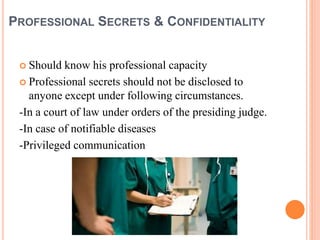
PROFESSIONAL SECRETS & CONFIDENTIALITY
 Should know his professional capacity
 Professional secrets should not be disclosed to
anyone except under following circumstances.
-In a court of law under orders of the presiding judge.
-In case of notifiable diseases
-Privileged communication
LEGAL ASPECTS OF MEDICAL PRACTICE
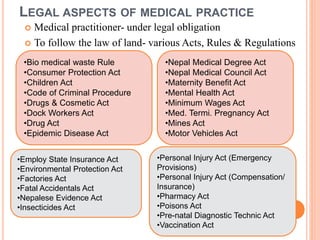
 Medical practitioner- under legal obligation
 To follow the law of land- various Acts, Rules & Regulations
•Bio medical waste Rule
•Consumer Protection Act
•Children Act
•Code of Criminal Procedure
•Drugs & Cosmetic Act
•Dock Workers Act
•Drug Act
•Epidemic Disease Act
•Nepal Medical Degree Act
•Nepal Medical Council Act
•Maternity Benefit Act
•Mental Health Act
•Minimum Wages Act
•Med. Termi. Pregnancy Act
•Mines Act
•Motor Vehicles Act
•Employ State Insurance Act
•Environmental Protection Act
•Factories Act
•Fatal Accidentals Act
•Nepalese Evidence Act
•Insecticides Act
•Personal Injury Act (Emergency
Provisions)
•Personal Injury Act (Compensation/
Insurance)
•Pharmacy Act
•Poisons Act
•Pre-natal Diagnostic Technic Act
•Vaccination Act
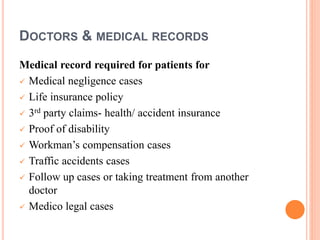
DOCTORS & MEDICAL RECORDS
Medical record required for patients for
 Medical negligence cases
 Life insurance policy
 3rd party claims- health/ accident insurance
 Proof of disability
 Workman’s compensation cases
 Traffic accidents cases
 Follow up cases or taking treatment from another
doctor
 Medico legal cases
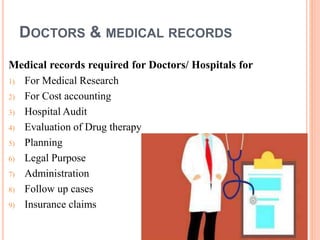
DOCTORS & MEDICAL RECORDS
Medical records required for Doctors/ Hospitals for
1) For Medical Research
2) For Cost accounting
3) Hospital Audit
4) Evaluation of Drug therapy
5) Planning
6) Legal Purpose
7) Administration
8) Follow up cases
9) Insurance claims
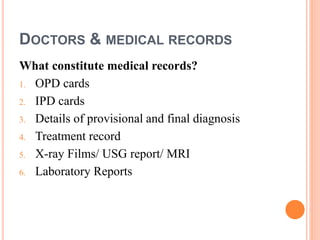
DOCTORS & MEDICAL RECORDS
What constitute medical records?
1. OPD cards
2. IPD cards
3. Details of provisional and final diagnosis
4. Treatment record
5. X-ray Films/ USG report/ MRI
6. Laboratory Reports
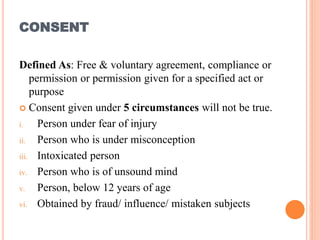
CONSENT
Defined As: Free & voluntary agreement, compliance or
permission or permission given for a specified act or
purpose
 Consent given under 5 circumstances will not be true.
i. Person under fear of injury
ii. Person who is under misconception
iii. Intoxicated person
iv. Person who is of unsound mind
v. Person, below 12 years of age
vi. Obtained by fraud/ influence/ mistaken subjects
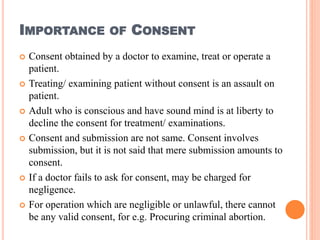
IMPORTANCE OF CONSENT
 Consent obtained by a doctor to examine, treat or operate a
patient.
 Treating/ examining patient without consent is an assault on
patient.
 Adult who is conscious and have sound mind is at liberty to
decline the consent for treatment/ examinations.
 Consent and submission are not same. Consent involves
submission, but it is not said that mere submission amounts to
consent.
 If a doctor fails to ask for consent, may be charged for
negligence.
 For operation which are negligible or unlawful, there cannot
be any valid consent, for e.g. Procuring criminal abortion.
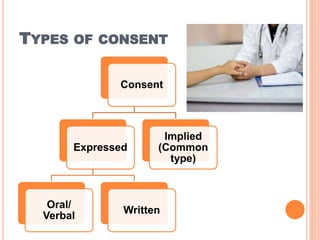
TYPES OF CONSENT
Consent
Expressed
Oral/
Verbal
Written
Implied
(Common
type)
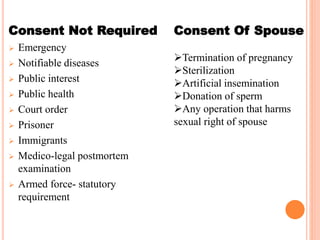
Consent Not Required
 Emergency
 Notifiable diseases
 Public interest
 Public health
 Court order
 Prisoner
 Immigrants
 Medico-legal postmortem
examination
 Armed force- statutory
requirement
Consent Of Spouse
Termination of pregnancy
Sterilization
Artificial insemination
Donation of sperm
Any operation that harms
sexual right of spouse
Consent & Medico- legal cases
 For medico- legal autopsy: Consent not required
 For clinical or pathological autopsy, consent is
must
 Examination of victim: Consent required
 Examination of accused for medico legal
purpose: Consent required
Right to refuse consent
A competent person has a right to refuse treatment & refuse to
consent for medical treatment or procedure
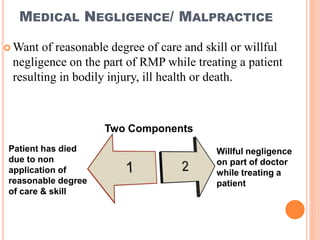
MEDICAL NEGLIGENCE/ MALPRACTICE
 Want of reasonable degree of care and skill or willful
negligence on the part of RMP while treating a patient
resulting in bodily injury, ill health or death.
Two Components
Patient has died
due to non
application of
reasonable degree
of care & skill
Willful negligence
on part of doctor
while treating a
patient
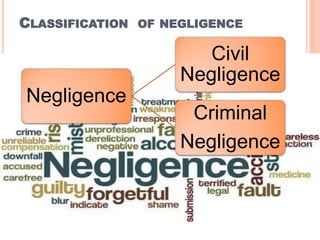
CLASSIFICATION OF NEGLIGENCE
Negligence
Civil
Negligence
Criminal
Negligence
CIVIL NEGLIGENCE
In civil negligence, patient has to approach Consumer Court.
1) Recognized legal right of patient- infringed
2) Existence of a duty of care
3) Dereliction of duty
4) Breach of duty was the cause of injury or harm
5) Patient had suffered damage
Criminal Negligence
In civil negligence, patient brings allegation of criminaling
against a doctor.
1) Operation on wrong limb
2) Removal of wrong organ
3) Wrong blood transfusion
4) Leaving instruments in abdomen
5) Perforating criminal abortion
REFERENCES
 https://en.wikipedia.org/wiki/Medical_jurisprudence
 https://www.slideshare.net/merishunnalae/medical-
jurisprudence-siddha-medicine
 https://www.medicinenet.com/medical_jurisprudenc
e/definition.htm
 www.google.com

Editor's Notes