#3D PRINTING
What is 3d printing?
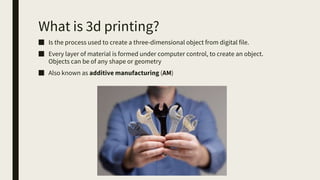
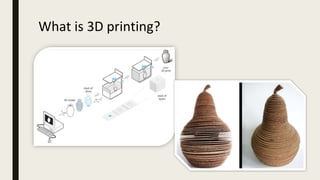
■ Is the process used to create a three-dimensional object from digital file.
■ Every layer of material is formed under computer control, to create an object.
Objects can be of any shape or geometry
■ Also known as additive manufacturing (AM)
What is 3D printing?
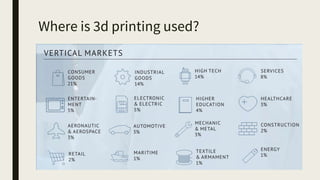
Where is 3d printing used?
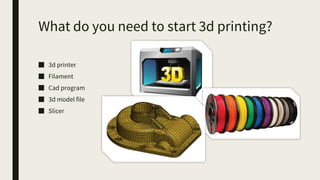
What do you need to start 3d printing?
■ 3d printer
■ Filament
■ Cad program
■ 3d model file
■ Slicer
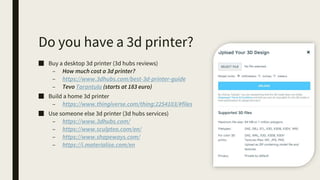
Do you have a 3d printer?
■ Buy a desktop 3d printer (3d hubs reviews)
– How much cost a 3d printer?
– https://www.3dhubs.com/best-3d-printer-guide
– Tevo Tarantula (starts at 183 euro)
■ Build a home 3d printer
– https://www.thingiverse.com/thing:2254103/#files
■ Use someone else 3d printer (3d hubs services)
– https://www.3dhubs.com/
– https://www.sculpteo.com/en/
– https://www.shapeways.com/
– https://i.materialise.com/en
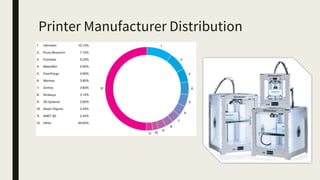
Printer Manufacturer Distribution
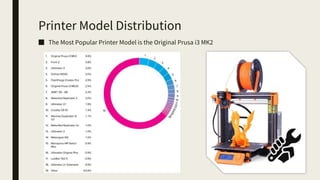
Printer Model Distribution
■ The Most Popular Printer Model is the Original Prusa i3 MK2
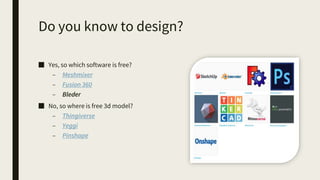
Do you know to design?
■ Yes, so which software is free?
– Meshmixer
– Fusion 360
– Bleder
■ No, so where is free 3d model?
– Thingiverse
– Yeggi
– Pinshape
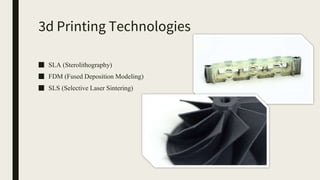
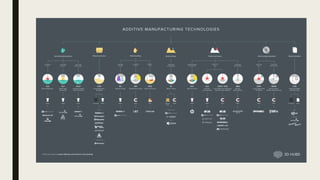
3d Printing Technologies
■ SLA (Sterolithography)
■ FDM (Fused Deposition Modeling)
■ SLS (Selective Laser Sintering)
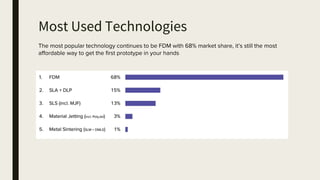
Most Used Technologies
The most popular technology continues to be FDM with 68% market share, it’s still the most
affordable way to get the first prototype in your hands
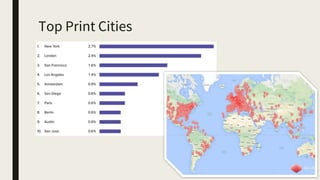
Top Print Cities
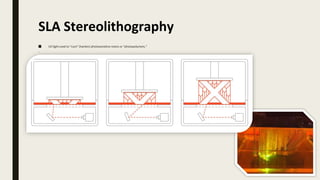
SLA Stereolithography
■ UV light used to “cure” (harden) photosensitive resins or “photopolymers.”
`
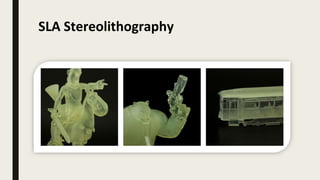
SLA Stereolithography
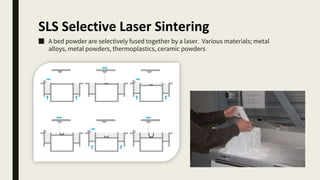
SLS Selective Laser Sintering
■ A bed powder are selectively fused together by a laser. Various materials; metal
alloys, metal powders, thermoplastics, ceramic powders
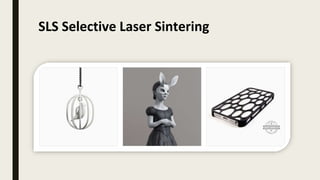
SLS Selective Laser Sintering
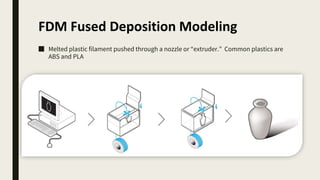
FDM Fused Deposition Modeling
■ Melted plastic filament pushed through a nozzle or “extruder.” Common plastics are
ABS and PLA
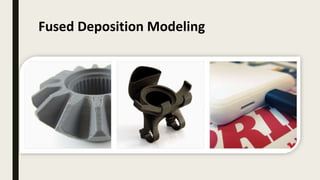
Fused Deposition Modeling
■
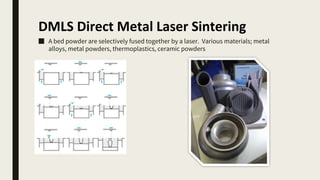
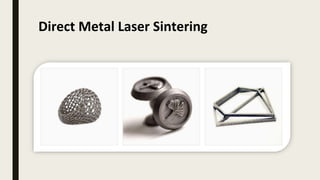
DMLS Direct Metal Laser Sintering
■ A bed powder are selectively fused together by a laser. Various materials; metal
alloys, metal powders, thermoplastics, ceramic powders
Direct Metal Laser Sintering
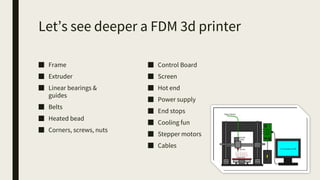
Let’s see deeper a FDM 3d printer
■ Frame
■ Extruder
■ Linear bearings &
guides
■ Belts
■ Heated bead
■ Corners, screws, nuts
■ Control Board
■ Screen
■ Hot end
■ Power supply
■ End stops
■ Cooling fun
■ Stepper motors
■ Cables
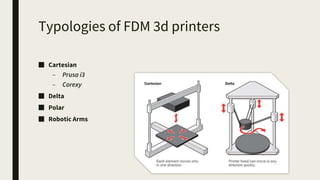
Typologies of FDM 3d printers
■ Cartesian
– Prusa i3
– Corexy
■ Delta
■ Polar
■ Robotic Arms
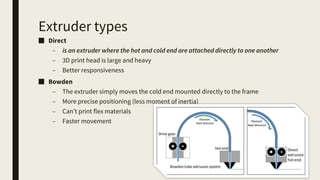
Extruder types
■ Direct
– is an extruder where the hot and cold end are attached directly to one another
– 3D print head is large and heavy
– Better responsiveness
■ Bowden
– The extruder simply moves the cold end mounted directly to the frame
– More precise positioning (less moment of inertia)
– Can’t print flex materials
– Faster movement
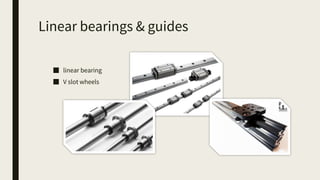
Linear bearings & guides
■ linear bearing
■ V slot wheels
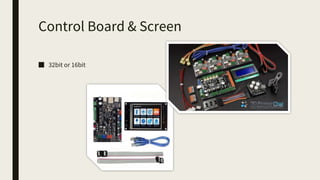
Control Board & Screen
■ 32bit or 16bit
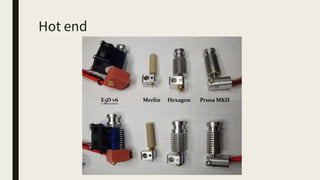
Hot end
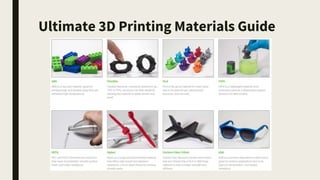
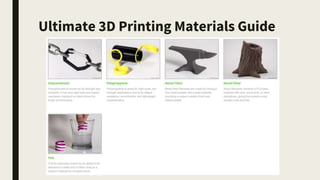
Ultimate 3D Printing Materials Guide
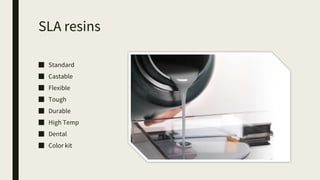
SLA resins
■ Standard
■ Castable
■ Flexible
■ Tough
■ Durable
■ High Temp
■ Dental
■ Color kit
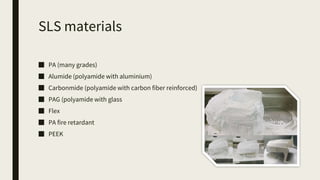
SLS materials
■ PA (many grades)
■ Alumide (polyamide with aluminium)
■ Carbonmide (polyamide with carbon fiber reinforced)
■ PAG (polyamide with glass
■ Flex
■ PA fire retardant
■ PEEK
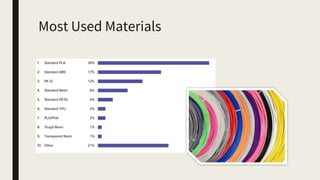
Most Used Materials
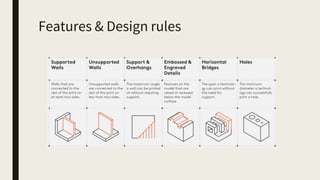
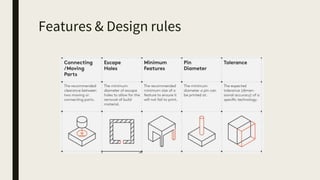
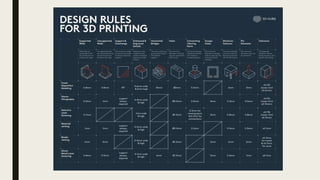
Features & Design rules
Design rules
■ Files must be:
– STL or OBJ format
– watertight, no holes
■ Cannot have:
– Loose Faces
– Inverted Normals
– Intersecting Geometry
Video
■ New Stratasys machine
■ Color printer
■ Dual extruder printer
■ Smart extruder
■ Form 2
■ New resins
■ Black belt
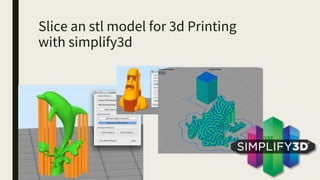
Slice an stl model for 3d Printing
with simplify3d
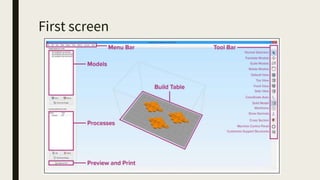
First screen
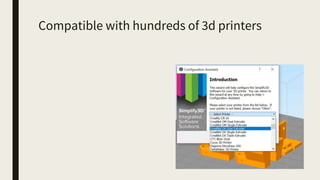
Compatible with hundreds of 3d printers
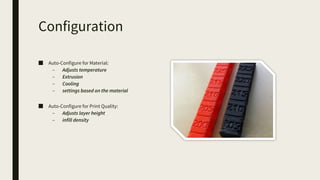
Configuration
■ Auto-Configure for Material:
– Adjusts temperature
– Extrusion
– Cooling
– settings based on the material
■ Auto-Configure for Print Quality:
– Adjusts layer height
– infill density
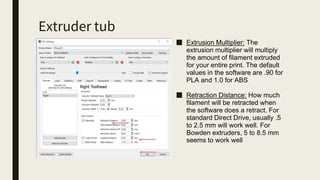
Extruder tub
■ Extrusion Multiplier: The
extrusion multiplier will multiply
the amount of filament extruded
for your entire print. The default
values in the software are .90 for
PLA and 1.0 for ABS
■ Retraction Distance: How much
filament will be retracted when
the software does a retract. For
standard Direct Drive, usually .5
to 2.5 mm will work well. For
Bowden extruders, 5 to 8.5 mm
seems to work well
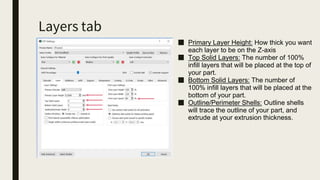
Layers tab
■ Primary Layer Height: How thick you want
each layer to be on the Z-axis
■ Top Solid Layers: The number of 100%
infill layers that will be placed at the top of
your part.
■ Bottom Solid Layers: The number of
100% infill layers that will be placed at the
bottom of your part.
■ Outline/Perimeter Shells: Outline shells
will trace the outline of your part, and
extrude at your extrusion thickness.
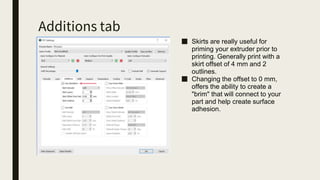
Additions tab
■ Skirts are really useful for
priming your extruder prior to
printing. Generally print with a
skirt offset of 4 mm and 2
outlines.
■ Changing the offset to 0 mm,
offers the ability to create a
"brim" that will connect to your
part and help create surface
adhesion.
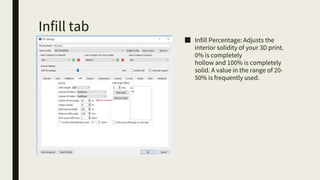
Infill tab
■ Infill Percentage: Adjusts the
interior solidity of your 3D print.
0% is completely
hollow and 100% is completely
solid. A value in the range of 20-
50% is frequently used.
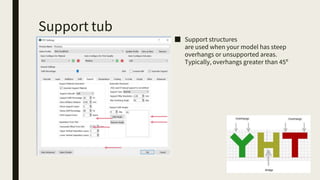
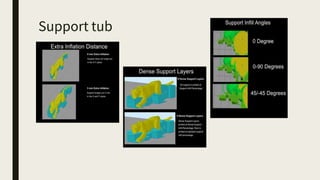
Support tub
■ Support structures
are used when your model has steep
overhangs or unsupported areas.
Typically, overhangs greater than 45º
Support tub
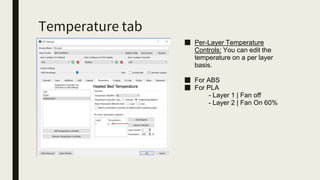
Temperature tab
■ Per-Layer Temperature
Controls: You can edit the
temperature on a per layer
basis.
■ For ABS
■ For PLA
- Layer 1 | Fan off
- Layer 2 | Fan On 60%
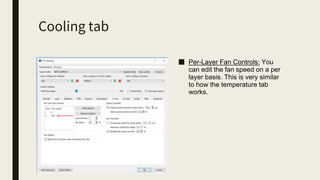
Cooling tab
■ Per-Layer Fan Controls: You
can edit the fan speed on a per
layer basis. This is very similar
to how the temperature tab
works.
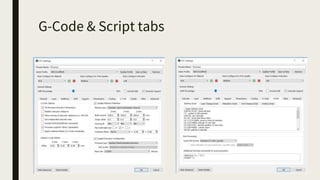
G-Code & Script tabs
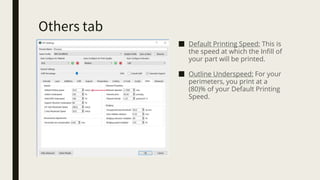
Others tab
■ Default Printing Speed: This is
the speed at which the Infill of
your part will be printed.
■ Outline Underspeed: For your
perimeters, you print at a
(80)% of your Default Printing
Speed.
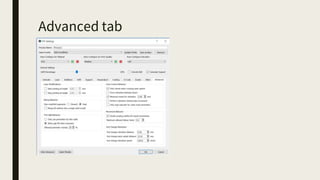
Advanced tab
Prepare to Print
■ After you have finalized your Process settings, click Prepare to Print! This will initiate two
important functions: Simplify3D will “slice” your model and transition to the review Mode.
■ “Slicing” is the term used to describe the process of converting a digital model into line-by-
line printer instructions called G-Code. The lightening-fast slicer in Simplify3D quickly
prepares G-Code based on the variables you selected in the FFF Settings window
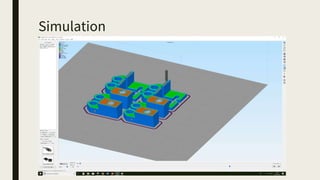
■ The animated Preview Mode allows you to inspect all aspects of
your print operation prior to execution. The software reads the G-Code and displays line-by-
line
or layer-by-layer how your model will be constructed
Simulation
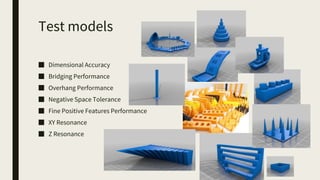
Test models
■ Dimensional Accuracy
■ Bridging Performance
■ Overhang Performance
■ Negative Space Tolerance
■ Fine Positive Features Performance
■ XY Resonance
■ Z Resonance
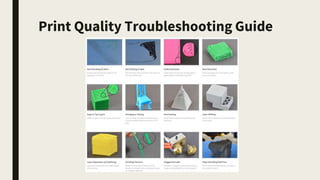
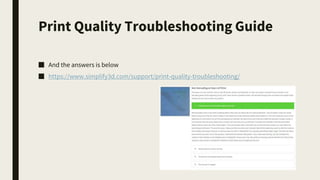
Print Quality Troubleshooting Guide
■ And the answers is below
■ https://www.simplify3d.com/support/print-quality-troubleshooting/
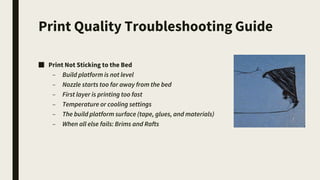
Print Quality Troubleshooting Guide
■ Print Not Sticking to the Bed
– Build platform is not level
– Nozzle starts too far away from the bed
– First layer is printing too fast
– Temperature or cooling settings
– The build platform surface (tape, glues, and materials)
– When all else fails: Brims and Rafts
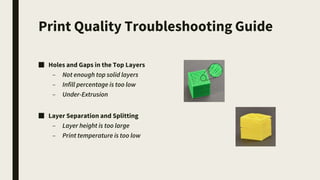
Print Quality Troubleshooting Guide
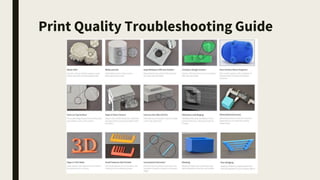
■ Holes and Gaps in the Top Layers
– Not enough top solid layers
– Infill percentage is too low
– Under-Extrusion
■ Layer Separation and Splitting
– Layer height is too large
– Print temperature is too low
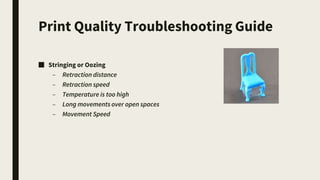
Print Quality Troubleshooting Guide
■ Stringing or Oozing
– Retraction distance
– Retraction speed
– Temperature is too high
– Long movements over open spaces
– Movement Speed

3d Printing technology, materials and slicer

  • 1.
  • 2.
    What is 3dprinting? ■ Is the process used to create a three-dimensional object from digital file. ■ Every layer of material is formed under computer control, to create an object. Objects can be of any shape or geometry ■ Also known as additive manufacturing (AM)
  • 3.
    What is 3Dprinting?
  • 4.
    Where is 3dprinting used?
  • 5.
    What do youneed to start 3d printing? ■ 3d printer ■ Filament ■ Cad program ■ 3d model file ■ Slicer
  • 6.
    Do you havea 3d printer? ■ Buy a desktop 3d printer (3d hubs reviews) – How much cost a 3d printer? – https://www.3dhubs.com/best-3d-printer-guide – Tevo Tarantula (starts at 183 euro) ■ Build a home 3d printer – https://www.thingiverse.com/thing:2254103/#files ■ Use someone else 3d printer (3d hubs services) – https://www.3dhubs.com/ – https://www.sculpteo.com/en/ – https://www.shapeways.com/ – https://i.materialise.com/en
  • 7.
  • 8.
    Printer Model Distribution ■The Most Popular Printer Model is the Original Prusa i3 MK2
  • 9.
    Do you knowto design? ■ Yes, so which software is free? – Meshmixer – Fusion 360 – Bleder ■ No, so where is free 3d model? – Thingiverse – Yeggi – Pinshape
  • 10.
    3d Printing Technologies ■SLA (Sterolithography) ■ FDM (Fused Deposition Modeling) ■ SLS (Selective Laser Sintering)
  • 11.
    Most Used Technologies Themost popular technology continues to be FDM with 68% market share, it’s still the most affordable way to get the first prototype in your hands
  • 13.
  • 14.
    SLA Stereolithography ■ UVlight used to “cure” (harden) photosensitive resins or “photopolymers.” `
  • 15.
  • 16.
    SLS Selective LaserSintering ■ A bed powder are selectively fused together by a laser. Various materials; metal alloys, metal powders, thermoplastics, ceramic powders
  • 17.
  • 18.
    FDM Fused DepositionModeling ■ Melted plastic filament pushed through a nozzle or “extruder.” Common plastics are ABS and PLA
  • 19.
  • 20.
    DMLS Direct MetalLaser Sintering ■ A bed powder are selectively fused together by a laser. Various materials; metal alloys, metal powders, thermoplastics, ceramic powders
  • 21.
  • 22.
    Let’s see deepera FDM 3d printer ■ Frame ■ Extruder ■ Linear bearings & guides ■ Belts ■ Heated bead ■ Corners, screws, nuts ■ Control Board ■ Screen ■ Hot end ■ Power supply ■ End stops ■ Cooling fun ■ Stepper motors ■ Cables
  • 23.
    Typologies of FDM3d printers ■ Cartesian – Prusa i3 – Corexy ■ Delta ■ Polar ■ Robotic Arms
  • 24.
    Extruder types ■ Direct –is an extruder where the hot and cold end are attached directly to one another – 3D print head is large and heavy – Better responsiveness ■ Bowden – The extruder simply moves the cold end mounted directly to the frame – More precise positioning (less moment of inertia) – Can’t print flex materials – Faster movement
  • 25.
    Linear bearings &guides ■ linear bearing ■ V slot wheels
  • 26.
    Control Board &Screen ■ 32bit or 16bit
  • 27.
  • 28.
    Ultimate 3D PrintingMaterials Guide
  • 29.
    Ultimate 3D PrintingMaterials Guide
  • 30.
    SLA resins ■ Standard ■Castable ■ Flexible ■ Tough ■ Durable ■ High Temp ■ Dental ■ Color kit
  • 31.
    SLS materials ■ PA(many grades) ■ Alumide (polyamide with aluminium) ■ Carbonmide (polyamide with carbon fiber reinforced) ■ PAG (polyamide with glass ■ Flex ■ PA fire retardant ■ PEEK
  • 32.
  • 33.
  • 34.
  • 36.
    Design rules ■ Filesmust be: – STL or OBJ format – watertight, no holes ■ Cannot have: – Loose Faces – Inverted Normals – Intersecting Geometry
  • 37.
    Video ■ New Stratasysmachine ■ Color printer ■ Dual extruder printer ■ Smart extruder ■ Form 2 ■ New resins ■ Black belt
  • 38.
    Slice an stlmodel for 3d Printing with simplify3d
  • 39.
  • 40.
  • 41.
    Configuration ■ Auto-Configure forMaterial: – Adjusts temperature – Extrusion – Cooling – settings based on the material ■ Auto-Configure for Print Quality: – Adjusts layer height – infill density
  • 42.
    Extruder tub ■ ExtrusionMultiplier: The extrusion multiplier will multiply the amount of filament extruded for your entire print. The default values in the software are .90 for PLA and 1.0 for ABS ■ Retraction Distance: How much filament will be retracted when the software does a retract. For standard Direct Drive, usually .5 to 2.5 mm will work well. For Bowden extruders, 5 to 8.5 mm seems to work well
  • 43.
    Layers tab ■ PrimaryLayer Height: How thick you want each layer to be on the Z-axis ■ Top Solid Layers: The number of 100% infill layers that will be placed at the top of your part. ■ Bottom Solid Layers: The number of 100% infill layers that will be placed at the bottom of your part. ■ Outline/Perimeter Shells: Outline shells will trace the outline of your part, and extrude at your extrusion thickness.
  • 44.
    Additions tab ■ Skirtsare really useful for priming your extruder prior to printing. Generally print with a skirt offset of 4 mm and 2 outlines. ■ Changing the offset to 0 mm, offers the ability to create a "brim" that will connect to your part and help create surface adhesion.
  • 45.
    Infill tab ■ InfillPercentage: Adjusts the interior solidity of your 3D print. 0% is completely hollow and 100% is completely solid. A value in the range of 20- 50% is frequently used.
  • 46.
    Support tub ■ Supportstructures are used when your model has steep overhangs or unsupported areas. Typically, overhangs greater than 45º
  • 47.
  • 48.
    Temperature tab ■ Per-LayerTemperature Controls: You can edit the temperature on a per layer basis. ■ For ABS ■ For PLA - Layer 1 | Fan off - Layer 2 | Fan On 60%
  • 49.
    Cooling tab ■ Per-LayerFan Controls: You can edit the fan speed on a per layer basis. This is very similar to how the temperature tab works.
  • 50.
  • 51.
    Others tab ■ DefaultPrinting Speed: This is the speed at which the Infill of your part will be printed. ■ Outline Underspeed: For your perimeters, you print at a (80)% of your Default Printing Speed.
  • 52.
  • 53.
    Prepare to Print ■After you have finalized your Process settings, click Prepare to Print! This will initiate two important functions: Simplify3D will “slice” your model and transition to the review Mode. ■ “Slicing” is the term used to describe the process of converting a digital model into line-by- line printer instructions called G-Code. The lightening-fast slicer in Simplify3D quickly prepares G-Code based on the variables you selected in the FFF Settings window ■ The animated Preview Mode allows you to inspect all aspects of your print operation prior to execution. The software reads the G-Code and displays line-by- line or layer-by-layer how your model will be constructed
  • 54.
  • 55.
    Test models ■ DimensionalAccuracy ■ Bridging Performance ■ Overhang Performance ■ Negative Space Tolerance ■ Fine Positive Features Performance ■ XY Resonance ■ Z Resonance
  • 56.
  • 57.
  • 58.
    Print Quality TroubleshootingGuide ■ And the answers is below ■ https://www.simplify3d.com/support/print-quality-troubleshooting/
  • 59.
    Print Quality TroubleshootingGuide ■ Print Not Sticking to the Bed – Build platform is not level – Nozzle starts too far away from the bed – First layer is printing too fast – Temperature or cooling settings – The build platform surface (tape, glues, and materials) – When all else fails: Brims and Rafts
  • 60.
    Print Quality TroubleshootingGuide ■ Holes and Gaps in the Top Layers – Not enough top solid layers – Infill percentage is too low – Under-Extrusion ■ Layer Separation and Splitting – Layer height is too large – Print temperature is too low
  • 61.
    Print Quality TroubleshootingGuide ■ Stringing or Oozing – Retraction distance – Retraction speed – Temperature is too high – Long movements over open spaces – Movement Speed