SMASHING INTO WINDOWS:
The Limits of Consumer
Sovereignty in Health Care
Barry R. Furrow
Professor of Law
Thomas R. Kline School of Law
Drexel University
Philadelphia, Pa. 19081
THE FLOWERING OF CONSUMERISM
It is an economic idea at its core: consumers can engage in rational
decision making and wisely choose among services and products.
How? By shopping for services and products that give good value
(high quality and low price). This rewards competitors who develop
quality innovations at low prices, thus rewarding competitors who
best serve consumers.
This flowering of consumerism has spread to medicine, imagining
model patients -- skeptical, aggressive, and self-reliant. These “new
sick” can manage their own illness, process all information, and
partner with the doctor.
THE PATIENT IS IN CHARGE
Eric Topol, The Patient Will See You Know: The Future of Medicine
Is In Your Hands.
Patients will be increasingly in charge through iPhone and laptop
apps, armed with evidence based information about health
problems……Information and expertise will be readily available to
all, without having to go to the doctor's office, and new
technologies will make it possible to "predict and preempt" many
major ills — all of which ultimately will contribute to the
"emancipation" of consumers.
I. GOALS OF MEDICAL TRANSPARENCY
A. PROMOTING PATIENT AUTONOMY THROUGH
CHOICE
Bioethics begins with patient rights and strong versions of autonomy.
Autonomy is “… the ground of the dignity of human nature and of every
rational nature.” Immanuel Kant. Autonomy is grounded in the right and
ability to make choices. Surely then the language of consumer sovereignty in
health care makes sense—if we allow individuals more and more spheres of
decisionmaking, from treatment elections to insurance selections, then we
maximize their autonomy in the health care setting at least.
B. IMPROVING MEDICAL DECISIONMAKING
► Monitor errors and mismanagement, inattention, staff foul-ups
► Control costs by detecting wasteful ideas, profitable only to the
hospital
► Detect gaming and medical actions based on external financial
reasons.
II. LIMITS ON PATIENT HEALTH CARE CHOICES
A. PROVIDER LIMITS: TREATMENT RISKS
1. Unnecessary Treatments. Medical practice variation and
medical uncertainty create barriers to accurate communication of treatment necessity and
risk assessment. Providers too often offer care that is not “trustworthy”, i.e., it is of
uncertain and therefore questionable value. Many drug therapies and most dietary
supplements are wasteful of resources and without proven benefit.
2. Low Quality Treatments. Americans receive appropriate,
evidence-based care when they need it around half the time. All Americans are at risk of
receiving poor care— regardless of where they live, how much money they have, or their
race, education or health insurance. Tens of thousands of Americans die each year as a
result of preventable hospital errors. Legally driven conversations between doctor and
patient hardly begin to address the preexisting problems of unnecessary and poor quality
treatments offered by providers.
3. Unaffordable Treatments. Patient care is often denied
because of high cost. Even beneficial treatments may be too costly for either patient or
insurer to pay for.
B. PROVIDER POWER: THWARTING PATIENT DECISIONS
1. Doctors Direct Patient Decisions. Overstate the benefits;
overstate experience with a procedure; intimidate patients through a range of
psychological devices.
2. Doctors Misuse Consent Forms. The formality of legal
compliance protects providers while obfuscating risks and alternatives.
3. Doctors Don’t Communicate Well. Doctors often lack
empathy, are poor listeners, are rushed in their clinical encounters; have distaste for or
have unconscious biases against certain classes of patients. And at the same time they
believe they are doing well.
4. Doctors Can Be Bribed to Prescribe Brand Name Drugs and
Devices. A $15 sandwich given by a drug or device manufacturer to a doctor changes
prescribing patterns, and the more costly the sandwich, the bigger the change.
5. Doctors Resist Disclosure of Error Rates and Personal
Performance Data. Disclosure to a patient of a medical error that has resulted in serious
harm is considered a bioethical imperative that informs patients about the particular risks
that a doctor may pose. Yet full error disclosures are rare.
꞊꞊
C. HOSPITALAVOIDANCE OF CONSENT OBLIGATIONS
Hospitals have no legal duty to obtain a patient’s consent to surgery,
nor to conduct any kind of inquiry into the quality of the plaintiff’s
consent.
Hospital are supposed to help their independent medical staffs use
consent forms, but typically such forms are little more than a ritual,
without no real conversation about risks.
These hospital consent forms are treated in many states as
presumptively valid consent to the treatment at issue, with the
burden on the patient to rebut the presumption.
David E. Ness, MD, MA, Scott F. Kiesling, PhD, and Charles W. Lidz, Why
Does Informed Consent Fail? A Discourse Analytic Approach. 37 J Am
Acad Psychiatry Law 349 (2009)
D. PATIENT LIMITS: BOUNDED RATIONALITY
1. Patients Struggle to Process Medical Information. Average
functional health literacy and numeracy in the United States are extremely low. Social
class and income level matters in terms of rational decisionmaking. Health information is
hard to process even when providers make serious attempts to communicate. Most
patients neither understand nor remember information even when well communicated to
them.
2. Patients Refuse Treatments Because of Belief Structures.
Patients may be anxious about effective treatments for irrational reasons such as fears of
the knife or phobic feelings about diseases such as cancer.
3. Disclosure May Not Matter to Patients. Studies suggest that
risk information will go unused in any event, since patients rarely change their minds.
Patients also tend to make one-reason decisions when considering treatment options for
serious ailments, where multiple factors should be considered.
4. Patients as Consumers Can Be Seduced by Powerful
Marketing. Vendors of drugs, supplements and medical devices market to circumvent
patient rationality. Vendors market to doctors as agents of patients, and sometimes they
sell doctors a bill of goods. And direct-to-consumer advertising of drugs can, like sugar, be
addictive and dangerous as patients push doctors to prescribe unnecessarily.
Patients face the problem of bounded rationality. “Health care decisions are, by
their nature, choices in which the stakes are high, the potential for regret
substantial, and the emotional overlays pervasive…. “Bounded Rationality and the
Conceptual Underpinnings of Health Policy: A Rationale and Roadmap for Addressing the Challenges
of Choice in Medical Settings” Mark Schlesinger and Brian Elbel (2006)
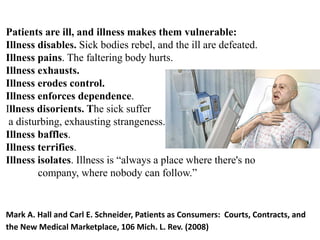
Patients are ill, and illness makes them vulnerable:
Illness disables. Sick bodies rebel, and the ill are defeated.
Illness pains. The faltering body hurts.
Illness exhausts.
Illness erodes control.
Illness enforces dependence.
Illness disorients. The sick suffer
a disturbing, exhausting strangeness.
Illness baffles.
Illness terrifies.
Illness isolates. Illness is “always a place where there's no
company, where nobody can follow.”
Mark A. Hall and Carl E. Schneider, Patients as Consumers: Courts, Contracts, and
the New Medical Marketplace, 106 Mich. L. Rev. (2008)
III. EVOLUTION OF PATIENT DECIONMAKING:
LEGAL PRESSURES
A. GENERATION 1 (Gen1). Informed Consent
and the Doctor-Patient Relationship
The common law mandates that physicians (but not hospitals or institutions
generally) obtain their patients’ informed consent. Crude tools are limited by
both physician and patient rationality limits. Yet the process has some value: the
mandate for physicians to disclose and discuss material risks of a medical
treatment, and alternatives to it, are perhaps the most important pieces of
information for a patient to consider. Harbeson v. Parke Davis, 746 F.2d 517 (9th
Cir.1984).
Gen1 informed consent has clearly advanced the art of giving information to
promote patient choices, but suffers from all the limits discussed previously.
Informed consent doctrine has moved patients into a more important role as a
reasonable patient….but consent has been poorly implemented, largely a
desultory ritual in hospitals in particular.
GENERATION 2 (Gen2) Decision Aids and
Preference Sensitive Care
Reinforced by the ACA, this model promises improvements in patient decisional
sovereignty sometimes. Decision Aids (DAs) are decision support tools that provide
patients with detailed and specific information on options and outcomes, help them clarify
their values, and guide them through the decision making process.
See, e.g., Elie A. Akl, et al., A Decision Aid for COPD Patients Considering Inhaled Steroid Therapy: Development
and Before and After Pilot Testing, 15 BMC Med. Inform. Dec. Mak. 7 (2007).
C. GENERATION 3 (Gen3). Patient
Engagement and Chronic Disease
Goal to improve information at all levels, from patient understanding to
physician access to best evidence information. Patients can benefit from live and
computer-based approaches such as patient navigators, medical avatars, video
games, and mobile apps. Physician ability to explain medical choices to patients
can be enhanced by decision analysis tools such as microrisks. Hospitals may
hire Chief Cognitive Officers.
1. Accountable Care Organizations
2. Virtual Forms of Provider-Patient Contact
3. Health Coaches
4. Social Media Platforms
1. Accountable Care Organizations
Patient engagement is defined as a concept that combines a patient's
knowledge, skills, ability and willingness to manage his own health
and care with interventions designed to increase activation and
promote positive patient behavior.
Cortney Nicolat, Supporting ACO Success with Meaningful Patient Engagement, Becker’s Hospital Review, August 1,
2013
2. Virtual Forms of Provider-Patient Contact
Virtual humans (VHs) improve clinical interviews by increasing
patient willingness to disclose information. Automated VHs can
help overcome a significant barrier to obtaining truthful patient
information.
Gale M. Lucas et al, It’s Only a
Computer: Virtual Humans
Increase Willingness to Disclose,
37 Computers in Human
Behavior 94 (2014)
SWEDISH CLINICS USE VIRTUAL REALITY TO
REDUCE THE STING OF SHOTS
https://www.statnews.com/2016/10/27/virtual-reality-pain-app/?s_campaign=stat:rss
3. Health Coaches
4. Social Media Platforms
TRUSTED VOICES ON SOCIAL MEDIA?
Patient health outcomes may improve if patients are fully
involved in understanding their treatments and their illness,
and in managing their own treatments to a greater extent. We
are moving beyond informed consent to a more robust model
of “patient engagement” and “activation”.
►Costs may be reduced if patients made more informed
health care choices, were better able to manage their own
conditions, and adopted healthier lifestyles.
► Quality of care may improve when patients are engaged in
their own care.
► Patient “voice” may be enhanced if patients are listened to
and allowed wider ranges of choices in tough cases.
CONCLUSION. PROVIDERS NEED TO INCORPORATE
SHARED DECISIONMAKING — DECISION AIDS,
CONVERSATIONAL PROCESSES, AND SO ON — INTO
THEIR RELATIONSHIPS WITH PATIENTS.
How does the law promote such shared decisionmaking.have to
do with such change? Medical standards of care, existing legal
doctrines, and health care institutional practices will have to
change.
My ultimate goal is to see if meaningful transparency can be
achieved with Gen2 and Gen3 tools, to improve patient
understanding and decisions about hard health care risk
decisions. Gen1 is obsolete.
.
Barry Furrow, "Smashing into Windows: The Limits of Consumer Sovereignty in Health Care"

Barry Furrow, "Smashing into Windows: The Limits of Consumer Sovereignty in Health Care"

  • 1.
    SMASHING INTO WINDOWS: TheLimits of Consumer Sovereignty in Health Care Barry R. Furrow Professor of Law Thomas R. Kline School of Law Drexel University Philadelphia, Pa. 19081
  • 2.
    THE FLOWERING OFCONSUMERISM It is an economic idea at its core: consumers can engage in rational decision making and wisely choose among services and products. How? By shopping for services and products that give good value (high quality and low price). This rewards competitors who develop quality innovations at low prices, thus rewarding competitors who best serve consumers. This flowering of consumerism has spread to medicine, imagining model patients -- skeptical, aggressive, and self-reliant. These “new sick” can manage their own illness, process all information, and partner with the doctor.
  • 4.
    THE PATIENT ISIN CHARGE Eric Topol, The Patient Will See You Know: The Future of Medicine Is In Your Hands. Patients will be increasingly in charge through iPhone and laptop apps, armed with evidence based information about health problems……Information and expertise will be readily available to all, without having to go to the doctor's office, and new technologies will make it possible to "predict and preempt" many major ills — all of which ultimately will contribute to the "emancipation" of consumers.
  • 5.
    I. GOALS OFMEDICAL TRANSPARENCY A. PROMOTING PATIENT AUTONOMY THROUGH CHOICE Bioethics begins with patient rights and strong versions of autonomy. Autonomy is “… the ground of the dignity of human nature and of every rational nature.” Immanuel Kant. Autonomy is grounded in the right and ability to make choices. Surely then the language of consumer sovereignty in health care makes sense—if we allow individuals more and more spheres of decisionmaking, from treatment elections to insurance selections, then we maximize their autonomy in the health care setting at least. B. IMPROVING MEDICAL DECISIONMAKING ► Monitor errors and mismanagement, inattention, staff foul-ups ► Control costs by detecting wasteful ideas, profitable only to the hospital ► Detect gaming and medical actions based on external financial reasons.
  • 6.
    II. LIMITS ONPATIENT HEALTH CARE CHOICES A. PROVIDER LIMITS: TREATMENT RISKS 1. Unnecessary Treatments. Medical practice variation and medical uncertainty create barriers to accurate communication of treatment necessity and risk assessment. Providers too often offer care that is not “trustworthy”, i.e., it is of uncertain and therefore questionable value. Many drug therapies and most dietary supplements are wasteful of resources and without proven benefit. 2. Low Quality Treatments. Americans receive appropriate, evidence-based care when they need it around half the time. All Americans are at risk of receiving poor care— regardless of where they live, how much money they have, or their race, education or health insurance. Tens of thousands of Americans die each year as a result of preventable hospital errors. Legally driven conversations between doctor and patient hardly begin to address the preexisting problems of unnecessary and poor quality treatments offered by providers. 3. Unaffordable Treatments. Patient care is often denied because of high cost. Even beneficial treatments may be too costly for either patient or insurer to pay for.
  • 8.
    B. PROVIDER POWER:THWARTING PATIENT DECISIONS 1. Doctors Direct Patient Decisions. Overstate the benefits; overstate experience with a procedure; intimidate patients through a range of psychological devices. 2. Doctors Misuse Consent Forms. The formality of legal compliance protects providers while obfuscating risks and alternatives. 3. Doctors Don’t Communicate Well. Doctors often lack empathy, are poor listeners, are rushed in their clinical encounters; have distaste for or have unconscious biases against certain classes of patients. And at the same time they believe they are doing well. 4. Doctors Can Be Bribed to Prescribe Brand Name Drugs and Devices. A $15 sandwich given by a drug or device manufacturer to a doctor changes prescribing patterns, and the more costly the sandwich, the bigger the change. 5. Doctors Resist Disclosure of Error Rates and Personal Performance Data. Disclosure to a patient of a medical error that has resulted in serious harm is considered a bioethical imperative that informs patients about the particular risks that a doctor may pose. Yet full error disclosures are rare.
  • 12.
  • 13.
    C. HOSPITALAVOIDANCE OFCONSENT OBLIGATIONS Hospitals have no legal duty to obtain a patient’s consent to surgery, nor to conduct any kind of inquiry into the quality of the plaintiff’s consent. Hospital are supposed to help their independent medical staffs use consent forms, but typically such forms are little more than a ritual, without no real conversation about risks. These hospital consent forms are treated in many states as presumptively valid consent to the treatment at issue, with the burden on the patient to rebut the presumption.
  • 15.
    David E. Ness,MD, MA, Scott F. Kiesling, PhD, and Charles W. Lidz, Why Does Informed Consent Fail? A Discourse Analytic Approach. 37 J Am Acad Psychiatry Law 349 (2009)
  • 16.
    D. PATIENT LIMITS:BOUNDED RATIONALITY 1. Patients Struggle to Process Medical Information. Average functional health literacy and numeracy in the United States are extremely low. Social class and income level matters in terms of rational decisionmaking. Health information is hard to process even when providers make serious attempts to communicate. Most patients neither understand nor remember information even when well communicated to them. 2. Patients Refuse Treatments Because of Belief Structures. Patients may be anxious about effective treatments for irrational reasons such as fears of the knife or phobic feelings about diseases such as cancer. 3. Disclosure May Not Matter to Patients. Studies suggest that risk information will go unused in any event, since patients rarely change their minds. Patients also tend to make one-reason decisions when considering treatment options for serious ailments, where multiple factors should be considered. 4. Patients as Consumers Can Be Seduced by Powerful Marketing. Vendors of drugs, supplements and medical devices market to circumvent patient rationality. Vendors market to doctors as agents of patients, and sometimes they sell doctors a bill of goods. And direct-to-consumer advertising of drugs can, like sugar, be addictive and dangerous as patients push doctors to prescribe unnecessarily.
  • 17.
    Patients face theproblem of bounded rationality. “Health care decisions are, by their nature, choices in which the stakes are high, the potential for regret substantial, and the emotional overlays pervasive…. “Bounded Rationality and the Conceptual Underpinnings of Health Policy: A Rationale and Roadmap for Addressing the Challenges of Choice in Medical Settings” Mark Schlesinger and Brian Elbel (2006)
  • 18.
    Patients are ill,and illness makes them vulnerable: Illness disables. Sick bodies rebel, and the ill are defeated. Illness pains. The faltering body hurts. Illness exhausts. Illness erodes control. Illness enforces dependence. Illness disorients. The sick suffer a disturbing, exhausting strangeness. Illness baffles. Illness terrifies. Illness isolates. Illness is “always a place where there's no company, where nobody can follow.” Mark A. Hall and Carl E. Schneider, Patients as Consumers: Courts, Contracts, and the New Medical Marketplace, 106 Mich. L. Rev. (2008)
  • 19.
    III. EVOLUTION OFPATIENT DECIONMAKING: LEGAL PRESSURES A. GENERATION 1 (Gen1). Informed Consent and the Doctor-Patient Relationship The common law mandates that physicians (but not hospitals or institutions generally) obtain their patients’ informed consent. Crude tools are limited by both physician and patient rationality limits. Yet the process has some value: the mandate for physicians to disclose and discuss material risks of a medical treatment, and alternatives to it, are perhaps the most important pieces of information for a patient to consider. Harbeson v. Parke Davis, 746 F.2d 517 (9th Cir.1984). Gen1 informed consent has clearly advanced the art of giving information to promote patient choices, but suffers from all the limits discussed previously. Informed consent doctrine has moved patients into a more important role as a reasonable patient….but consent has been poorly implemented, largely a desultory ritual in hospitals in particular.
  • 20.
    GENERATION 2 (Gen2)Decision Aids and Preference Sensitive Care Reinforced by the ACA, this model promises improvements in patient decisional sovereignty sometimes. Decision Aids (DAs) are decision support tools that provide patients with detailed and specific information on options and outcomes, help them clarify their values, and guide them through the decision making process. See, e.g., Elie A. Akl, et al., A Decision Aid for COPD Patients Considering Inhaled Steroid Therapy: Development and Before and After Pilot Testing, 15 BMC Med. Inform. Dec. Mak. 7 (2007).
  • 21.
    C. GENERATION 3(Gen3). Patient Engagement and Chronic Disease Goal to improve information at all levels, from patient understanding to physician access to best evidence information. Patients can benefit from live and computer-based approaches such as patient navigators, medical avatars, video games, and mobile apps. Physician ability to explain medical choices to patients can be enhanced by decision analysis tools such as microrisks. Hospitals may hire Chief Cognitive Officers. 1. Accountable Care Organizations 2. Virtual Forms of Provider-Patient Contact 3. Health Coaches 4. Social Media Platforms
  • 22.
    1. Accountable CareOrganizations Patient engagement is defined as a concept that combines a patient's knowledge, skills, ability and willingness to manage his own health and care with interventions designed to increase activation and promote positive patient behavior.
  • 24.
    Cortney Nicolat, SupportingACO Success with Meaningful Patient Engagement, Becker’s Hospital Review, August 1, 2013
  • 26.
    2. Virtual Formsof Provider-Patient Contact Virtual humans (VHs) improve clinical interviews by increasing patient willingness to disclose information. Automated VHs can help overcome a significant barrier to obtaining truthful patient information. Gale M. Lucas et al, It’s Only a Computer: Virtual Humans Increase Willingness to Disclose, 37 Computers in Human Behavior 94 (2014)
  • 27.
    SWEDISH CLINICS USEVIRTUAL REALITY TO REDUCE THE STING OF SHOTS https://www.statnews.com/2016/10/27/virtual-reality-pain-app/?s_campaign=stat:rss
  • 28.
  • 29.
    4. Social MediaPlatforms
  • 31.
    TRUSTED VOICES ONSOCIAL MEDIA?
  • 32.
    Patient health outcomesmay improve if patients are fully involved in understanding their treatments and their illness, and in managing their own treatments to a greater extent. We are moving beyond informed consent to a more robust model of “patient engagement” and “activation”. ►Costs may be reduced if patients made more informed health care choices, were better able to manage their own conditions, and adopted healthier lifestyles. ► Quality of care may improve when patients are engaged in their own care. ► Patient “voice” may be enhanced if patients are listened to and allowed wider ranges of choices in tough cases.
  • 33.
    CONCLUSION. PROVIDERS NEEDTO INCORPORATE SHARED DECISIONMAKING — DECISION AIDS, CONVERSATIONAL PROCESSES, AND SO ON — INTO THEIR RELATIONSHIPS WITH PATIENTS. How does the law promote such shared decisionmaking.have to do with such change? Medical standards of care, existing legal doctrines, and health care institutional practices will have to change. My ultimate goal is to see if meaningful transparency can be achieved with Gen2 and Gen3 tools, to improve patient understanding and decisions about hard health care risk decisions. Gen1 is obsolete. .