AETCOM Q&A
Dr. B. Jayapriya
14.12.2024
Summative assessment – 2024 batch
circular
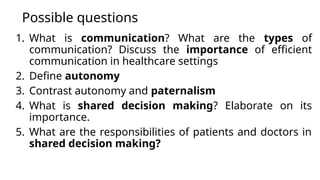
Possible questions
1. What is communication? What are the types of
communication? Discuss the importance of efficient
communication in healthcare settings
2. Define autonomy
3. Contrast autonomy and paternalism
4. What is shared decision making? Elaborate on its
importance.
5. What are the responsibilities of patients and doctors in
shared decision making?
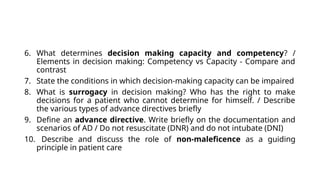
6. What determines decision making capacity and competency? /
Elements in decision making: Competency vs Capacity - Compare and
contrast
7. State the conditions in which decision-making capacity can be impaired
8. What is surrogacy in decision making? Who has the right to make
decisions for a patient who cannot determine for himself. / Describe
the various types of advance directives briefly
9. Define an advance directive. Write briefly on the documentation and
scenarios of AD / Do not resuscitate (DNR) and do not intubate (DNI)
10. Describe and discuss the role of non-maleficence as a guiding
principle in patient care
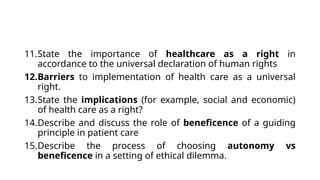
11.State the importance of healthcare as a right in
accordance to the universal declaration of human rights
12.Barriers to implementation of health care as a universal
right.
13.State the implications (for example, social and economic)
of health care as a right?
14.Describe and discuss the role of beneficence of a guiding
principle in patient care
15.Describe the process of choosing autonomy vs
beneficence in a setting of ethical dilemma.
16.Describe and discuss the role of a physician in health care
system
17.Describe the role of doctors in the community and
expectations of society form doctors.
18.Describe and discuss the role of justice as a guiding
principle in patient care
19.What is a team? What is a healthcare team? What are the
types of teams?
20.What are the stages of team building?
21. What is an effective team? What are the benefits of
effective teamwork? Mention some characteristics of making
effective healthcare team. What are the hurdles to effective
teamwork?
22.State the various components of a (a) laboratory team OR
(b) surgical team OR (c) research team
23.State the need of collaborative work in health care. State
the hurdles in the same.
24.Describe the importance of respect in relationship with
patients, fellow team members, superiors and other
health care workers.
25.State how to break bad news to the family using SPIKES
protocol
26. Identify, discuss and defend medico-legal, socio-cultural and ethical
issues as they pertain to refusal of care including do not resuscitate
and withdrawal of life support
27. Identify, discuss and defend, medico-legal, socio-cultural and ethical
issues as they pertain to consent for surgical procedures
28. What is informed consent? 2) What is informed refusal?
29. Explain in details about contents of an informed consent in surgical
procedures or research.
30. What is full and reasonable disclosure?
31. What is empathy? What is the role of empathy in the care of patients?
32. Compare empathy vs equanimity
33. What is sympathy? What is difference between empathy and
sympathy?
34. State few essential elements of communication in medical encounters
in accordance with the Kalamazoo consensus statement
Practical / OSPE / Viva
• Demonstrate ability to communicate to patients in a
patient, respectful, non-threatening, non- judgmental and
empathetic manner
• Demonstrate empathy in patient encounters
• Demonstrate respect in relationship with patients, fellow
team members, superiors and other health care workers
• Demonstrate ability to work in a team of peers and
superiors
1. Communication: A process by which information and understanding is
exchanged between individuals, by
any effective means.
Types – verbal, non verbal, written
Importance – Rapport, trust, effective history taking, diagnosis,
treatment options, counselling, compliance
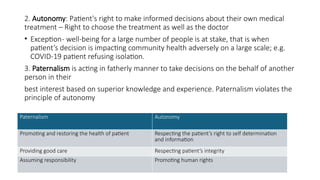
2. Autonomy: Patient's right to make informed decisions about their own medical
treatment – Right to choose the treatment as well as the doctor
• Exception- well-being for a large number of people is at stake, that is when
patient’s decision is impacting community health adversely on a large scale; e.g.
COVID-19 patient refusing isolation.
3. Paternalism is acting in fatherly manner to take decisions on the behalf of another
person in their
best interest based on superior knowledge and experience. Paternalism violates the
principle of autonomy
Paternalism Autonomy
Promoting and restoring the health of patient Respecting the patient’s right to self determination
and information
Providing good care Respecting patient’s integrity
Assuming responsibility Promoting human rights
• Types of Paternalism:
1.Soft Paternalism: This involves intervening in a person's life to prevent them
from making harmful choices, but only when they are not acting rationally or in
their own best interests.
2.Hard Paternalism: This involves intervening in a person's life even when they are
acting rationally and in their own best interests, if the outcome is believed to be
harmful.
Consumerism, a rare and extreme form of patient autonomy, that holds the view
that the physician’s role is limited to providing all the medical information and the
available choices for interventions and treatments while the fully informed patient
selects from the available choices. In this model, the physician’s role is constrained,
and does not permit the full use of his/her knowledge and skills to benefit the
patient, and is tantamount to a form of patient abandonment and therefore is
ethically indefensible.
4. Shared decision-making is a collaborative process between healthcare
providers and patients where they work together to make decisions about the
patient's treatment. This involves the healthcare provider providing information
about the patient's condition, treatment options, risks, and benefits, while the
patient expresses their preferences and values.
• Importance of shared decision-making:
• Empowers patients: It allows patients to feel more involved in their care and
make informed choices.
• Improves patient satisfaction: Patients are more likely to be satisfied with
their care when they feel involved in decision-making.
• Increases adherence to treatment: Patients are more likely to follow
treatment plans when they have a say in the decisions.
• Reduces medical errors: Shared decision-making can help to reduce medical
errors by ensuring that patients understand their treatment options and risks.
• Promotes trust: It can strengthen the relationship between patients and
healthcare providers, fostering trust and open communication
5. In shared decision making, the doctor should:
• Explain the diagnosis
• Avoid using medical jargon
• Explain treatment options
• Not hide information
• Tell pros and cons of every option
• In shared decision making, the patient should:ECOND MBB
• Listen to all medical concerns
• Should put his/her concerns in front of the doctor without hesitation
• Should give full history
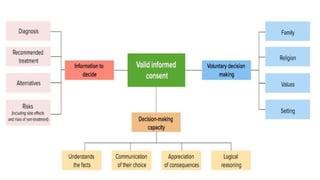
6. Capacity and competency are related concepts that determine an individual's ability
to make informed choices. Capacity is a medical assessment to determine whether an
individual has the capacity to make decisions about their own medical treatment, while
Competency is a legal term that refers to an individual's ability to perform a specific
task or function, typically determined by a court of law, based on expert medical
testimony.
Factors like mental health, cognitive impairments, substance abuse, and age can affect
these abilities.
• Decision-making capacity is a medical term that refers to an individual's ability to
understand and appreciate the nature and consequences of a decision, and to
communicate their choices effectively. It is a clinical assessment that is made by
healthcare providers based on a variety of factors, including:
• Understanding: The ability to comprehend information about the decision.
• Appreciation: The ability to recognize the significance of the decision and its
potential consequences.
• Reasoning: The ability to weigh the pros and cons of different options.
• Communication: The ability to express one's choices and preferences clearly.
7. State the conditions in which decision-making capacity can be impaired
• o Neurological, Psychiatric and developmental conditions
• Mental health conditions: Conditions such as depression, anxiety, or schizophrenia
• Fear, discomfort
• Cognitive impairments: Conditions such as dementia or brain injury
• Substance abuse: Substance abuse can impair an individual's judgment and
decision-making abilities.
• Age: While age does not automatically determine decision-making capacity, older
adults may be more likely to experience cognitive decline that can affect their
decision-making abilities.
• Age less than 18 or more than 85
• Significant cultural or language barriers
8. Who has the right to make decisions for a patient who
cannot determine for himself
In general, the right to make decisions for a patient who
cannot determine for themselves falls to the patient's legal
surrogate. This is typically a designated healthcare proxy,
guardian, or power of attorney. If a patient has not appointed
a legal surrogate, the decision-making authority may fall to a
family member or close relative. The specific order of
precedence can vary depending on local laws and the
patient's circumstances.
• The order of precedence for decision-making if a legal surrogate is not available in India generally
follows the following hierarchy:
1. Spouse: The patient's spouse is typically the first choice to make decisions.
2. Adult Children: If the patient has adult children, they may be authorized to make decisions, usually in
order of age (older children first).
3. Parents: If the patient is an adult and their parents are still living, they may be authorized to make
decisions.
4. Siblings: In some cases, siblings may be authorized to make decisions, especially if they are close to
the patient.
5. Other Relatives: Other close relatives, such as aunts, uncles, or cousins, may be considered in certain
circumstances.
• If there is disagreement among family members, a court may need to intervene to appoint a guardian
or conservator to make decisions for the patient.
• It's important to note that healthcare providers must ensure that the surrogate is acting in the
patient's best interests and is making decisions based on the patient's wishes, if known. In some cases,
a court may need to intervene to appoint a guardian or conservator to make decisions for the patient.
9 . Define an advance directive. Write briefly on the documentation and
scenarios of AD.
• Definition: The term advance directive (AD) refers to treatment preferences and/or the designation of a surrogate decision-maker in the event
that a person becomes unable to make medical decisions on their own behalf.
• Underlying principle: autonomy (self-determination)
• Studies have found that use of ADs decreases use of life-sustaining treatment and increases use of hospice and palliative care services.
When to obtain an advance directive - The best time is often during a routine outpatient visit: Allows time for deliberation in a low pressure
Situation Physicians should start discussions with patients regarding ADs as early as possible, while a patient is healthy and competent. o Advance
directives should be obtained/updated:
• ▪ On hospital admission ▪ Prior to surgery ▪ On diagnosis with: A terminal illness or a disease associated with dementia
• o Desires regarding life-sustaining treatments are not always stable over time and may change. Therefore, ADs should be revisited and updated
periodically.
Common scenarios: Some of the most common scenarios in which ADs are used include:
• o Coma / Persistent vegetative state
• o Severe brain injury / Stroke
• o Dementia or advanced Alzheimer’s disease
• o Critical medical illness affecting mental capacity
Documentation
• o In order for an AD to be honored, it must be prepared before the patient loses medical decision-making capacity.
• o Advance directives must be noted in the medical records.
• o Often requires assistance from the attending physician and an attorney (exact requirements and policies differ between states)
10. Describe and discuss the role of non-maleficence as a guiding principle in patient care
• Non-maleficence is a fundamental principle in medical ethics that requires healthcare
providers to do no harm to their patients. This principle is rooted in the Hippocratic oath,
which states, "First, do no harm."
Key aspects of non-maleficence in patient care:
• Avoiding unnecessary harm: Healthcare providers must take steps to prevent causing
harm to patients, even if the intended outcome is beneficial. This includes avoiding
unnecessary procedures, medications, or treatments that could have harmful side
effects.
• Balancing risks and benefits: When making treatment decisions, healthcare providers
must weigh the potential benefits against the risks of harm. They should choose the
course of action that is most likely to benefit the patient while minimizing harm.
• Considering the patient's overall well-being: Non-maleficence extends beyond physical
harm to include psychological, social, and spiritual well-being. Healthcare providers
must consider the potential impact of treatments on the patient's overall quality of life.
In conclusion, non-maleficence is a cornerstone of medical ethics. By striving to do no
harm, healthcare providers can ensure that their patients receive safe and effective care.
12. Barriers to Implementing Healthcare as a Universal Right
Implementing healthcare as a universal right faces several significant barriers:
• Cost: Providing universal healthcare is expensive. Governments must allocate
substantial resources to fund public healthcare systems, which can strain budgets.
• Infrastructure: Developing and maintaining adequate healthcare infrastructure,
such as hospitals, clinics, and medical equipment, requires significant investment.
• Human Resources: Ensuring a sufficient supply of qualified healthcare
professionals, including doctors, nurses, and other medical staff, can be challenging.
• Inequality: Economic disparities and social inequalities can hinder access to
healthcare for marginalized populations.
• Bureaucracy: Complex healthcare systems can be inefficient and time-consuming,
leading to delays in care and frustration among patients.
• Political Challenges: Implementing universal healthcare often involves significant
political debate and resistance from various stakeholders, including private
healthcare providers and insurers.
Overcoming these barriers requires careful planning,
resource allocation, and strong political will.
Role of a physician in health care team
Key roles of a physician include:
1.
Diagnosis and Treatment: Physicians are responsible for identifying the underlying cause of a patient's
illness or injury. They use a combination of medical history, physical examination, and diagnostic tests to
reach a diagnosis. Once a diagnosis is made, they develop a treatment plan that may involve medication,
surgery, or other interventions.
3.
Patient Education: Physicians play a crucial role in educating patients about their conditions, treatment
options, and self-care. They provide clear and understandable information to empower patients to make
informed decisions about their healthcare.
4.
Advocacy: Physicians advocate for their patients' needs, ensuring they receive appropriate care and
treatment. They may communicate with insurance companies, hospitals, or other healthcare providers to
ensure their patients' best interests are met.
1Research and Education: Physicians contribute to medical research by participating in clinical trials or
conducting studies. They also educate future generations of healthcare professionals by teaching medical
students and residents.
6.
Leadership: Physicians often take on leadership roles within healthcare organizations, such as hospitals
or clinics. They may serve on committees, boards, or in administrative positions,
26. Refusal of care, includes do not resuscitate (DNR) orders and withdrawal of life
support
Medico-Legal Issues:Patient Autonomy, informed Consent
Advance Directives: Patients can express their wishes regarding
end-of-life care through advance directives, such as living wills or durable powers of
attorney for healthcare.
Medical Malpractice: Healthcare providers may be liable for
medical malpractice if they fail to respect a patient's decision to refuse treatment.
Socio-Cultural Issues:Cultural Beliefs, Family Dynamics, Social stigma with refusing
treatment or opting for palliative care, which can influence a patient's decision.
Ethical Issues: Sanctity of Life: Some believe that human life should be preserved at all
costs, regardless of the quality of life.
Autonomy vs. Beneficence: There may be conflicts between a patient's right to
autonomy and the healthcare provider's duty to do good.
Resource Allocation: Decisions about refusing treatment or withdrawing life support can
raise questions about the allocation of limited healthcare resources.
Open communication between healthcare providers, patients, and families is
essential for resolving conflicts and ensuring that the patient's best interests are served.
28. Informed consent is a process whereby a patient
voluntarily agrees to a medical treatment or procedure after
receiving a clear and understandable explanation of the risks,
benefits, and alternatives. This includes information about
the potential complications, side effects, and the possibility of
no benefit.
• Informed refusal is a patient's right to decline a
recommended medical treatment or procedure. This
decision should be made after receiving the same
information as for informed consent. The patient has the
right to refuse treatment, even if it is recommended by their
healthcare provider.
30. Full and reasonable disclosure is a fundamental principle in patient-doctor relationships. It
requires doctors to provide patients with all relevant information about their condition, treatment
options, risks, and benefits. This disclosure is essential for patients to make informed decisions about
their healthcare.
Key elements of full and reasonable disclosure in patient-doctor interactions:
• Diagnosis: Doctors must explain the patient's diagnosis in clear and understandable terms,
avoiding medical jargon.
• Treatment options: Patients should be informed about all available treatment options, including
the potential benefits and risks of each.
• Risks and benefits: Doctors must disclose the potential risks, side effects, and complications
associated with each treatment option.
• Alternatives: If there are alternative treatments or procedures available, patients should be
informed of these as well.
• Informed consent: Patients must provide informed consent before undergoing any medical
procedure or treatment. This means they have a clear understanding of the risks, benefits, and
alternatives, and have voluntarily agreed to the treatment.
31. Exceptions to the principle of full and reasonable disclosure in patient-doctor
interactions. These exceptions are typically based on the following:
1.Therapeutic Privilege: In certain situations, a doctor may withhold information from a patient
if they believe that disclosing it would harm the patient's physical or mental health. This is
known as therapeutic privilege. For example, if a doctor believes that disclosing a terminal
diagnosis would cause severe emotional distress to a patient, they may withhold this
information.
2.Incapacity: If a patient is unable to understand or make decisions about their healthcare due to
factors such as mental incapacity or being under the influence of substances, the doctor may
need to make decisions on their behalf. In these cases, the doctor must act in the patient's best
interests.
3.Emergencies: In emergency situations, when immediate treatment is necessary to save a
patient's life, a doctor may not have time to obtain informed consent before proceeding with
the treatment. In such cases, the doctor is presumed to have the patient's implied consent to
provide life-saving care.
• It is important to note that these exceptions should be used sparingly and only when absolutely
necessary. In general, the principle of full and reasonable disclosure should be followed
whenever possible to ensure that patients have the information they need to make informed
decisions about their healthcare.
Why is full and reasonable disclosure important in patient-doctor
interactions?
• Empowers patients: By providing patients with the necessary information,
doctors empower them to make informed decisions about their healthcare.
• Builds trust: Full and reasonable disclosure helps to build trust between
patients and their doctors.
• Reduces medical errors: When patients have a clear understanding of their
condition and treatment options, they are more likely to follow their
doctor's instructions and avoid medical errors.
• Legal implications: Failure to provide full and reasonable disclosure can
lead to legal consequences, such as medical malpractice lawsuits.
31. understanding and sharing the feelings of another person, particularly in a
compassionate way
Empathy allows healthcare providers to:
Connect with patients: By understanding the patient's emotional state and
perspective, healthcare providers can build trust and rapport, making the patient
feel heard and valued.
Provide compassionate care: Empathy enables healthcare providers to offer
compassionate care that is tailored to the patient's individual needs and
experiences.
Improve patient outcomes: Studies have shown that empathetic care can lead to
better patient outcomes, including improved adherence to treatment plans and
reduced anxiety and depression.
Reduce healthcare disparities: Empathy can help to reduce healthcare disparities
by promoting understanding and respect for patients from diverse backgrounds.
In essence, empathy is essential for providing high-quality, patient-centered care. It
helps to create a healing environment where patients feel supported and cared for.
• Empathy is the ability to understand and share the feelings of another
person. It involves putting oneself in someone else's shoes and
experiencing their emotions. Empathy is essential for building
relationships, fostering understanding, and providing compassionate
care.
• Equanimity is a state of mental calmness, composure, and evenness of
temper. It refers to the ability to remain calm and balanced in the face of
adversity or challenging situations. Equanimity is often associated with
wisdom, resilience, and emotional maturity.While empathy allows us to
connect with others on an emotional level, equanimity helps us to
maintain perspective and respond to challenges with a clear and rational
mind. Both qualities are valuable in personal and professional
relationships.

AETCOM Q&A for pathology University .pptx

  • 1.
    AETCOM Q&A Dr. B.Jayapriya 14.12.2024
  • 3.
    Summative assessment –2024 batch circular
  • 4.
    Possible questions 1. Whatis communication? What are the types of communication? Discuss the importance of efficient communication in healthcare settings 2. Define autonomy 3. Contrast autonomy and paternalism 4. What is shared decision making? Elaborate on its importance. 5. What are the responsibilities of patients and doctors in shared decision making?
  • 5.
    6. What determinesdecision making capacity and competency? / Elements in decision making: Competency vs Capacity - Compare and contrast 7. State the conditions in which decision-making capacity can be impaired 8. What is surrogacy in decision making? Who has the right to make decisions for a patient who cannot determine for himself. / Describe the various types of advance directives briefly 9. Define an advance directive. Write briefly on the documentation and scenarios of AD / Do not resuscitate (DNR) and do not intubate (DNI) 10. Describe and discuss the role of non-maleficence as a guiding principle in patient care
  • 6.
    11.State the importanceof healthcare as a right in accordance to the universal declaration of human rights 12.Barriers to implementation of health care as a universal right. 13.State the implications (for example, social and economic) of health care as a right? 14.Describe and discuss the role of beneficence of a guiding principle in patient care 15.Describe the process of choosing autonomy vs beneficence in a setting of ethical dilemma.
  • 7.
    16.Describe and discussthe role of a physician in health care system 17.Describe the role of doctors in the community and expectations of society form doctors. 18.Describe and discuss the role of justice as a guiding principle in patient care 19.What is a team? What is a healthcare team? What are the types of teams? 20.What are the stages of team building?
  • 8.
    21. What isan effective team? What are the benefits of effective teamwork? Mention some characteristics of making effective healthcare team. What are the hurdles to effective teamwork? 22.State the various components of a (a) laboratory team OR (b) surgical team OR (c) research team 23.State the need of collaborative work in health care. State the hurdles in the same. 24.Describe the importance of respect in relationship with patients, fellow team members, superiors and other health care workers. 25.State how to break bad news to the family using SPIKES protocol
  • 9.
    26. Identify, discussand defend medico-legal, socio-cultural and ethical issues as they pertain to refusal of care including do not resuscitate and withdrawal of life support 27. Identify, discuss and defend, medico-legal, socio-cultural and ethical issues as they pertain to consent for surgical procedures 28. What is informed consent? 2) What is informed refusal? 29. Explain in details about contents of an informed consent in surgical procedures or research. 30. What is full and reasonable disclosure? 31. What is empathy? What is the role of empathy in the care of patients? 32. Compare empathy vs equanimity 33. What is sympathy? What is difference between empathy and sympathy? 34. State few essential elements of communication in medical encounters in accordance with the Kalamazoo consensus statement
  • 10.
    Practical / OSPE/ Viva • Demonstrate ability to communicate to patients in a patient, respectful, non-threatening, non- judgmental and empathetic manner • Demonstrate empathy in patient encounters • Demonstrate respect in relationship with patients, fellow team members, superiors and other health care workers • Demonstrate ability to work in a team of peers and superiors
  • 12.
    1. Communication: Aprocess by which information and understanding is exchanged between individuals, by any effective means. Types – verbal, non verbal, written Importance – Rapport, trust, effective history taking, diagnosis, treatment options, counselling, compliance
  • 13.
    2. Autonomy: Patient'sright to make informed decisions about their own medical treatment – Right to choose the treatment as well as the doctor • Exception- well-being for a large number of people is at stake, that is when patient’s decision is impacting community health adversely on a large scale; e.g. COVID-19 patient refusing isolation. 3. Paternalism is acting in fatherly manner to take decisions on the behalf of another person in their best interest based on superior knowledge and experience. Paternalism violates the principle of autonomy Paternalism Autonomy Promoting and restoring the health of patient Respecting the patient’s right to self determination and information Providing good care Respecting patient’s integrity Assuming responsibility Promoting human rights
  • 14.
    • Types ofPaternalism: 1.Soft Paternalism: This involves intervening in a person's life to prevent them from making harmful choices, but only when they are not acting rationally or in their own best interests. 2.Hard Paternalism: This involves intervening in a person's life even when they are acting rationally and in their own best interests, if the outcome is believed to be harmful. Consumerism, a rare and extreme form of patient autonomy, that holds the view that the physician’s role is limited to providing all the medical information and the available choices for interventions and treatments while the fully informed patient selects from the available choices. In this model, the physician’s role is constrained, and does not permit the full use of his/her knowledge and skills to benefit the patient, and is tantamount to a form of patient abandonment and therefore is ethically indefensible.
  • 15.
    4. Shared decision-makingis a collaborative process between healthcare providers and patients where they work together to make decisions about the patient's treatment. This involves the healthcare provider providing information about the patient's condition, treatment options, risks, and benefits, while the patient expresses their preferences and values. • Importance of shared decision-making: • Empowers patients: It allows patients to feel more involved in their care and make informed choices. • Improves patient satisfaction: Patients are more likely to be satisfied with their care when they feel involved in decision-making. • Increases adherence to treatment: Patients are more likely to follow treatment plans when they have a say in the decisions. • Reduces medical errors: Shared decision-making can help to reduce medical errors by ensuring that patients understand their treatment options and risks. • Promotes trust: It can strengthen the relationship between patients and healthcare providers, fostering trust and open communication
  • 16.
    5. In shareddecision making, the doctor should: • Explain the diagnosis • Avoid using medical jargon • Explain treatment options • Not hide information • Tell pros and cons of every option • In shared decision making, the patient should:ECOND MBB • Listen to all medical concerns • Should put his/her concerns in front of the doctor without hesitation • Should give full history
  • 17.
    6. Capacity andcompetency are related concepts that determine an individual's ability to make informed choices. Capacity is a medical assessment to determine whether an individual has the capacity to make decisions about their own medical treatment, while Competency is a legal term that refers to an individual's ability to perform a specific task or function, typically determined by a court of law, based on expert medical testimony. Factors like mental health, cognitive impairments, substance abuse, and age can affect these abilities. • Decision-making capacity is a medical term that refers to an individual's ability to understand and appreciate the nature and consequences of a decision, and to communicate their choices effectively. It is a clinical assessment that is made by healthcare providers based on a variety of factors, including: • Understanding: The ability to comprehend information about the decision. • Appreciation: The ability to recognize the significance of the decision and its potential consequences. • Reasoning: The ability to weigh the pros and cons of different options. • Communication: The ability to express one's choices and preferences clearly.
  • 18.
    7. State theconditions in which decision-making capacity can be impaired • o Neurological, Psychiatric and developmental conditions • Mental health conditions: Conditions such as depression, anxiety, or schizophrenia • Fear, discomfort • Cognitive impairments: Conditions such as dementia or brain injury • Substance abuse: Substance abuse can impair an individual's judgment and decision-making abilities. • Age: While age does not automatically determine decision-making capacity, older adults may be more likely to experience cognitive decline that can affect their decision-making abilities. • Age less than 18 or more than 85 • Significant cultural or language barriers
  • 19.
    8. Who hasthe right to make decisions for a patient who cannot determine for himself In general, the right to make decisions for a patient who cannot determine for themselves falls to the patient's legal surrogate. This is typically a designated healthcare proxy, guardian, or power of attorney. If a patient has not appointed a legal surrogate, the decision-making authority may fall to a family member or close relative. The specific order of precedence can vary depending on local laws and the patient's circumstances.
  • 20.
    • The orderof precedence for decision-making if a legal surrogate is not available in India generally follows the following hierarchy: 1. Spouse: The patient's spouse is typically the first choice to make decisions. 2. Adult Children: If the patient has adult children, they may be authorized to make decisions, usually in order of age (older children first). 3. Parents: If the patient is an adult and their parents are still living, they may be authorized to make decisions. 4. Siblings: In some cases, siblings may be authorized to make decisions, especially if they are close to the patient. 5. Other Relatives: Other close relatives, such as aunts, uncles, or cousins, may be considered in certain circumstances. • If there is disagreement among family members, a court may need to intervene to appoint a guardian or conservator to make decisions for the patient. • It's important to note that healthcare providers must ensure that the surrogate is acting in the patient's best interests and is making decisions based on the patient's wishes, if known. In some cases, a court may need to intervene to appoint a guardian or conservator to make decisions for the patient.
  • 21.
    9 . Definean advance directive. Write briefly on the documentation and scenarios of AD. • Definition: The term advance directive (AD) refers to treatment preferences and/or the designation of a surrogate decision-maker in the event that a person becomes unable to make medical decisions on their own behalf. • Underlying principle: autonomy (self-determination) • Studies have found that use of ADs decreases use of life-sustaining treatment and increases use of hospice and palliative care services. When to obtain an advance directive - The best time is often during a routine outpatient visit: Allows time for deliberation in a low pressure Situation Physicians should start discussions with patients regarding ADs as early as possible, while a patient is healthy and competent. o Advance directives should be obtained/updated: • ▪ On hospital admission ▪ Prior to surgery ▪ On diagnosis with: A terminal illness or a disease associated with dementia • o Desires regarding life-sustaining treatments are not always stable over time and may change. Therefore, ADs should be revisited and updated periodically. Common scenarios: Some of the most common scenarios in which ADs are used include: • o Coma / Persistent vegetative state • o Severe brain injury / Stroke • o Dementia or advanced Alzheimer’s disease • o Critical medical illness affecting mental capacity Documentation • o In order for an AD to be honored, it must be prepared before the patient loses medical decision-making capacity. • o Advance directives must be noted in the medical records. • o Often requires assistance from the attending physician and an attorney (exact requirements and policies differ between states)
  • 22.
    10. Describe anddiscuss the role of non-maleficence as a guiding principle in patient care • Non-maleficence is a fundamental principle in medical ethics that requires healthcare providers to do no harm to their patients. This principle is rooted in the Hippocratic oath, which states, "First, do no harm." Key aspects of non-maleficence in patient care: • Avoiding unnecessary harm: Healthcare providers must take steps to prevent causing harm to patients, even if the intended outcome is beneficial. This includes avoiding unnecessary procedures, medications, or treatments that could have harmful side effects. • Balancing risks and benefits: When making treatment decisions, healthcare providers must weigh the potential benefits against the risks of harm. They should choose the course of action that is most likely to benefit the patient while minimizing harm. • Considering the patient's overall well-being: Non-maleficence extends beyond physical harm to include psychological, social, and spiritual well-being. Healthcare providers must consider the potential impact of treatments on the patient's overall quality of life. In conclusion, non-maleficence is a cornerstone of medical ethics. By striving to do no harm, healthcare providers can ensure that their patients receive safe and effective care.
  • 23.
    12. Barriers toImplementing Healthcare as a Universal Right Implementing healthcare as a universal right faces several significant barriers: • Cost: Providing universal healthcare is expensive. Governments must allocate substantial resources to fund public healthcare systems, which can strain budgets. • Infrastructure: Developing and maintaining adequate healthcare infrastructure, such as hospitals, clinics, and medical equipment, requires significant investment. • Human Resources: Ensuring a sufficient supply of qualified healthcare professionals, including doctors, nurses, and other medical staff, can be challenging. • Inequality: Economic disparities and social inequalities can hinder access to healthcare for marginalized populations. • Bureaucracy: Complex healthcare systems can be inefficient and time-consuming, leading to delays in care and frustration among patients. • Political Challenges: Implementing universal healthcare often involves significant political debate and resistance from various stakeholders, including private healthcare providers and insurers. Overcoming these barriers requires careful planning, resource allocation, and strong political will.
  • 24.
    Role of aphysician in health care team Key roles of a physician include: 1. Diagnosis and Treatment: Physicians are responsible for identifying the underlying cause of a patient's illness or injury. They use a combination of medical history, physical examination, and diagnostic tests to reach a diagnosis. Once a diagnosis is made, they develop a treatment plan that may involve medication, surgery, or other interventions. 3. Patient Education: Physicians play a crucial role in educating patients about their conditions, treatment options, and self-care. They provide clear and understandable information to empower patients to make informed decisions about their healthcare. 4. Advocacy: Physicians advocate for their patients' needs, ensuring they receive appropriate care and treatment. They may communicate with insurance companies, hospitals, or other healthcare providers to ensure their patients' best interests are met. 1Research and Education: Physicians contribute to medical research by participating in clinical trials or conducting studies. They also educate future generations of healthcare professionals by teaching medical students and residents. 6. Leadership: Physicians often take on leadership roles within healthcare organizations, such as hospitals or clinics. They may serve on committees, boards, or in administrative positions,
  • 25.
    26. Refusal ofcare, includes do not resuscitate (DNR) orders and withdrawal of life support Medico-Legal Issues:Patient Autonomy, informed Consent Advance Directives: Patients can express their wishes regarding end-of-life care through advance directives, such as living wills or durable powers of attorney for healthcare. Medical Malpractice: Healthcare providers may be liable for medical malpractice if they fail to respect a patient's decision to refuse treatment. Socio-Cultural Issues:Cultural Beliefs, Family Dynamics, Social stigma with refusing treatment or opting for palliative care, which can influence a patient's decision. Ethical Issues: Sanctity of Life: Some believe that human life should be preserved at all costs, regardless of the quality of life. Autonomy vs. Beneficence: There may be conflicts between a patient's right to autonomy and the healthcare provider's duty to do good. Resource Allocation: Decisions about refusing treatment or withdrawing life support can raise questions about the allocation of limited healthcare resources. Open communication between healthcare providers, patients, and families is essential for resolving conflicts and ensuring that the patient's best interests are served.
  • 26.
    28. Informed consentis a process whereby a patient voluntarily agrees to a medical treatment or procedure after receiving a clear and understandable explanation of the risks, benefits, and alternatives. This includes information about the potential complications, side effects, and the possibility of no benefit. • Informed refusal is a patient's right to decline a recommended medical treatment or procedure. This decision should be made after receiving the same information as for informed consent. The patient has the right to refuse treatment, even if it is recommended by their healthcare provider.
  • 27.
    30. Full andreasonable disclosure is a fundamental principle in patient-doctor relationships. It requires doctors to provide patients with all relevant information about their condition, treatment options, risks, and benefits. This disclosure is essential for patients to make informed decisions about their healthcare. Key elements of full and reasonable disclosure in patient-doctor interactions: • Diagnosis: Doctors must explain the patient's diagnosis in clear and understandable terms, avoiding medical jargon. • Treatment options: Patients should be informed about all available treatment options, including the potential benefits and risks of each. • Risks and benefits: Doctors must disclose the potential risks, side effects, and complications associated with each treatment option. • Alternatives: If there are alternative treatments or procedures available, patients should be informed of these as well. • Informed consent: Patients must provide informed consent before undergoing any medical procedure or treatment. This means they have a clear understanding of the risks, benefits, and alternatives, and have voluntarily agreed to the treatment.
  • 28.
    31. Exceptions tothe principle of full and reasonable disclosure in patient-doctor interactions. These exceptions are typically based on the following: 1.Therapeutic Privilege: In certain situations, a doctor may withhold information from a patient if they believe that disclosing it would harm the patient's physical or mental health. This is known as therapeutic privilege. For example, if a doctor believes that disclosing a terminal diagnosis would cause severe emotional distress to a patient, they may withhold this information. 2.Incapacity: If a patient is unable to understand or make decisions about their healthcare due to factors such as mental incapacity or being under the influence of substances, the doctor may need to make decisions on their behalf. In these cases, the doctor must act in the patient's best interests. 3.Emergencies: In emergency situations, when immediate treatment is necessary to save a patient's life, a doctor may not have time to obtain informed consent before proceeding with the treatment. In such cases, the doctor is presumed to have the patient's implied consent to provide life-saving care. • It is important to note that these exceptions should be used sparingly and only when absolutely necessary. In general, the principle of full and reasonable disclosure should be followed whenever possible to ensure that patients have the information they need to make informed decisions about their healthcare.
  • 29.
    Why is fulland reasonable disclosure important in patient-doctor interactions? • Empowers patients: By providing patients with the necessary information, doctors empower them to make informed decisions about their healthcare. • Builds trust: Full and reasonable disclosure helps to build trust between patients and their doctors. • Reduces medical errors: When patients have a clear understanding of their condition and treatment options, they are more likely to follow their doctor's instructions and avoid medical errors. • Legal implications: Failure to provide full and reasonable disclosure can lead to legal consequences, such as medical malpractice lawsuits.
  • 30.
    31. understanding andsharing the feelings of another person, particularly in a compassionate way Empathy allows healthcare providers to: Connect with patients: By understanding the patient's emotional state and perspective, healthcare providers can build trust and rapport, making the patient feel heard and valued. Provide compassionate care: Empathy enables healthcare providers to offer compassionate care that is tailored to the patient's individual needs and experiences. Improve patient outcomes: Studies have shown that empathetic care can lead to better patient outcomes, including improved adherence to treatment plans and reduced anxiety and depression. Reduce healthcare disparities: Empathy can help to reduce healthcare disparities by promoting understanding and respect for patients from diverse backgrounds. In essence, empathy is essential for providing high-quality, patient-centered care. It helps to create a healing environment where patients feel supported and cared for.
  • 31.
    • Empathy isthe ability to understand and share the feelings of another person. It involves putting oneself in someone else's shoes and experiencing their emotions. Empathy is essential for building relationships, fostering understanding, and providing compassionate care. • Equanimity is a state of mental calmness, composure, and evenness of temper. It refers to the ability to remain calm and balanced in the face of adversity or challenging situations. Equanimity is often associated with wisdom, resilience, and emotional maturity.While empathy allows us to connect with others on an emotional level, equanimity helps us to maintain perspective and respond to challenges with a clear and rational mind. Both qualities are valuable in personal and professional relationships.

Editor's Notes

  • #4 5. Describe and discuss the role of justice as a guiding principle in patient care Competencies learnt / assessed
  • #6 Beneficience – abortion, suicide, emergency