SECTION 3: MICROBIOLOGY
Modules:
2.5 Bioethics continued: Case studies on autonomy and decision making
2.6 Bioethics continued: Case studies on autonomy and decision making
2.7 Bioethics continued: Case studies on autonomy and decision making
CASE
You are taking care of 78-year-old Mrs. Mythili who was living all alone in an apartment with only a live-in caretaker, 3
streets away from your clinic. She is a widow and her only son emigrated to the US 32 years ago. He visits her once a year.
One year ago, she had a fall with a hip fracture that healed badly. She has hypertension which is reasonably controlled on
medications. She continues to come to your clinic once a month. Four months ago, she spent some time talking about her
sister who recently died following metastatic breast cancer. “My sister suffered a lot, Doctor- they put a tube down her
throat to breathe. Even when her heart stopped they kept thumping her chest- it was awful. If I ever fall sick I don't want
to go through all this. Promise me, doctor, that you won’t do all of this to me. I have lived all alone since my husband died
but I have lived independently- now I don't want to depend on a machine to live”. You had reassured her that she would
be ok and this was just the recent death of her sister affecting her. On subsequent visits she would still bring up this issue
and state that there was no use of her living as a burden to anyone and that no one should endure what her sister had
undergone.
One day you get a call from the Emergency Room of the local hospital stating that Mrs. Mythili has been admitted by the
caretaker. She had developed fever and shortness of breath. She was brought hypoxic to the emergency room and they
had intubated her. Chest X ray revealed a large pneumonic patch. Laboratory testing revealed hyponatremia.
When you visited her she is somewhat drowsy, intubated and restrained. The nurse tells you that she is sometimes lucid;
at other times not even able to recognise her son who was there since this morning. She points out at the ET and makes a
pleading gesture to remove it. Her son accosts you in the hallway. He tells you that he got a call while he was traveling in
Singapore and took the first flight out to be with his mom. He was very distressed at his mother’s health and that he wants
“everything” possible done for her. You ask him if she had ever indicated what she wanted to be done if she were to
require hospitalization and intubation- he says that he used to speak to her every month on the phone and she was always
cheerful and enquiring about her grandchildren but did not talk about her health.
Points for discussion:
1.Extent of patient autonomy.
2.Elements in decision making: Competency vs
Capacity.
3.Surrogacy in decision making.
4.Autonomy vs beneficence.
5.How much does family wishes count?
6.Legal, ethical and social aspects of ‘Do not
resuscitate’.
Autonomy is one of the four principles of bioethics.
Autonomy can be defined simply as patient’s right over his/her own
body.
Principle of autonomy implies that any decision during the course of
diagnosis and treatment of a
patient should not be taken by physician alone without patient’s
permission.
It is the patient and only the patient who can take the ultimate decision
about what happens with his/her own body.
Paternalism is acting in fatherly manner to take decisions on the behalf of
another person in their best interest based on superior knowledge and
experience.
In case of healthcare arena, it is the doctor taking decision on the patient
without their full potential knowledge and consent.
Paternalism violates the principle of autonomy.
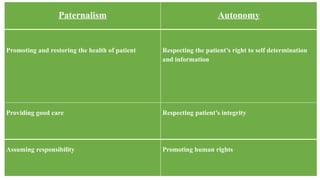
Paternalism Autonomy
Promoting and restoring the health of patient Respecting the patient’s right to self determination
and information
Providing good care Respecting patient’s integrity
Assuming responsibility Promoting human rights
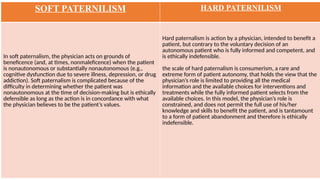
SOFT PATERNILISM HARD PATERNILISM
In soft paternalism, the physician acts on grounds of
beneficence (and, at times, nonmaleficence) when the patient
is nonautonomous or substantially nonautonomous (e.g.,
cognitive dysfunction due to severe illness, depression, or drug
addiction). Soft paternalism is complicated because of the
difficulty in determining whether the patient was
nonautonomous at the time of decision-making but is ethically
defensible as long as the action is in concordance with what
the physician believes to be the patient’s values.
Hard paternalism is action by a physician, intended to benefit a
patient, but contrary to the voluntary decision of an
autonomous patient who is fully informed and competent, and
is ethically indefensible.
the scale of hard paternalism is consumerism, a rare and
extreme form of patient autonomy, that holds the view that the
physician’s role is limited to providing all the medical
information and the available choices for interventions and
treatments while the fully informed patient selects from the
available choices. In this model, the physician’s role is
constrained, and does not permit the full use of his/her
knowledge and skills to benefit the patient, and is tantamount
to a form of patient abandonment and therefore is ethically
indefensible.
Elements in decision making: Competency vs Capacity - Compare and
contrast
.
Health care decision making is a process that includes definable steps in a
desirable sequence.
The process is universally relevant (i.e., it applies in all settings) and enduring
(i.e. it has remained applicable over time and will continue to apply in the
future).
Physicians play an essential role in the health care decision-making process.
The principle of beneficence is the obligation of physician to act for the benefit of the patient
and supports a number of moral rules to protect
and defend the right of others, prevent harm, remove conditions that will cause harm, help
persons with disabilities, and rescue persons in danger.
It is worth emphasizing that, in distinction to nonmaleficence, the language here is one of
positive requirements.
The principle calls for not just avoiding harm, but also to benefit patients and to
promote their welfare.
While physicians’ beneficence conforms to moral rules, and is altruistic, it is also true that in
many instances it can be considered a payback for the debt to society for education (often
subsidized by governments), ranks and privileges, and to the patients themselves (learning
and research).
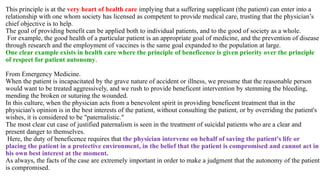
This principle is at the very heart of health care implying that a suffering supplicant (the patient) can enter into a
relationship with one whom society has licensed as competent to provide medical care, trusting that the physician’s
chief objective is to help.
The goal of providing benefit can be applied both to individual patients, and to the good of society as a whole.
For example, the good health of a particular patient is an appropriate goal of medicine, and the prevention of disease
through research and the employment of vaccines is the same goal expanded to the population at large.
One clear example exists in health care where the principle of beneficence is given priority over the principle
of respect for patient autonomy.
From Emergency Medicine.
When the patient is incapacitated by the grave nature of accident or illness, we presume that the reasonable person
would want to be treated aggressively, and we rush to provide beneficent intervention by stemming the bleeding,
mending the broken or suturing the wounded.
In this culture, when the physician acts from a benevolent spirit in providing beneficent treatment that in the
physician's opinion is in the best interests of the patient, without consulting the patient, or by overriding the patient's
wishes, it is considered to be "paternalistic."
The most clear cut case of justified paternalism is seen in the treatment of suicidal patients who are a clear and
present danger to themselves.
Here, the duty of beneficence requires that the physician intervene on behalf of saving the patient's life or
placing the patient in a protective environment, in the belief that the patient is compromised and cannot act in
his own best interest at the moment.
As always, the facts of the case are extremely important in order to make a judgment that the autonomy of the patient
is compromised.
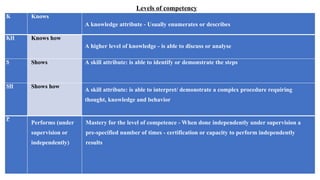
K Knows
A knowledge attribute - Usually enumerates or describes
KH Knows how
A higher level of knowledge - is able to discuss or analyse
S Shows A skill attribute: is able to identify or demonstrate the steps
SH Shows how
A skill attribute: is able to interpret/ demonstrate a complex procedure requiring
thought, knowledge and behavior
P
Performs (under
supervision or
independently)
Mastery for the level of competence - When done independently under supervision a
pre-specified number of times - certification or capacity to perform independently
results
Levels of competency
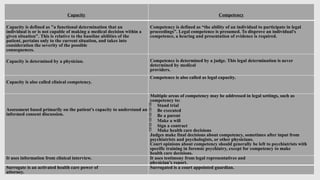
Capacity Competency
Capacity is defined as "a functional determination that an
individual is or is not capable of making a medical decision within a
given situation". This is relative to the baseline abilities of the
patient, pertains only to the current situation, and takes into
consideration the severity of the possible
consequences.
Competency is defined as “the ability of an individual to participate in legal
proceedings”. Legal competence is presumed. To disprove an individual's
competence, a hearing and presentation of evidence is required.
Capacity is determined by a physician. Competence is determined by a judge. This legal determination is never
determined by medical
providers.
Capacity is also called clinical competency.
Competence is also called as legal capacity.
Assessment based primarily on the patient’s capacity to understand an
informed consent discussion.
Multiple areas of competency may be addressed in legal settings, such as
competency to:
 Stand trial
 Be executed
 Be a parent
 Make a will
 Sign a contract
 Make health care decisions
Judges make final decisions about competency, sometimes after input from
psychiatrists and psychologists, or other physicians.
Court opinions about competency should generally be left to psychiatrists with
specific training in forensic psychiatry, except for competency to make
health care decisions.
It uses information from clinical interview. It uses testimony from legal representatives and
physician’s report.
Surrogate is an activated health care power of
attorney.
Surrogated is a court appointed guardian.
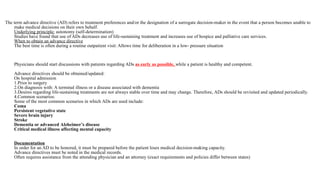
The term advance directive (AD) refers to treatment preferences and/or the designation of a surrogate decision-maker in the event that a person becomes unable to
make medical decisions on their own behalf.
Underlying principle: autonomy (self-determination)
Studies have found that use of ADs decreases use of life-sustaining treatment and increases use of hospice and palliative care services.
When to obtain an advance directive
The best time is often during a routine outpatient visit: Allows time for deliberation in a low- pressure situation
Physicians should start discussions with patients regarding ADs as early as possible, while a patient is healthy and competent.
Advance directives should be obtained/updated:
On hospital admission
1.Prior to surgery
2.On diagnosis with: A terminal illness or a disease associated with dementia
3.Desires regarding life-sustaining treatments are not always stable over time and may change. Therefore, ADs should be revisited and updated periodically.
4.Common scenarios:
Some of the most common scenarios in which ADs are used include:
Coma
Persistent vegetative state
Severe brain injury
Stroke
Dementia or advanced Alzheimer’s disease
Critical medical illness affecting mental capacity
Documentation
In order for an AD to be honored, it must be prepared before the patient loses medical decision-making capacity.
Advance directives must be noted in the medical records.
Often requires assistance from the attending physician and an attorney (exact requirements and policies differ between states)
There are multiple types of Ads
including
A)living wills
B) designation of a health care proxy and/or a durable Power of attorney,
or
C) physician’s orders for life-sustaining treatment.
Living will
Written document that states what medical treatments the patient desires (and which they prefer to omit or
refuse) should the patient become incapacitated.
May be very general or very specific
Includes instructions for things such as:
Rejecting artificial airways (i.e., intubation) and/or ventilators
CPR
Use of feeding tubes and/or IV fluids for nutrition and hydration
Analgesia/pain relief
Use of antibiotics
The most common statement in a living will reads something similar to, “If I suffer an incurable, irreversible
illness, disease, or condition, and my attending physician determines my condition is terminal, I direct that life-
sustaining measures that serve only to prolong my dying be withheld or discontinued.”
Health care proxy
A legal designation in which a patient designates another person (also called a surrogate) to
make health care decisions on their behalf if the patient is rendered incapable of making their
wishes known
The health care proxy has the same rights to request or refuse treatment that the individual
would have if they were capable of communicating their wishes.
The health care proxy is someone who should make decisions (to the best of their ability)
that are consistent with and based on the patient’s will.
Durable power of attorney
A signed legal document authorizing another person to make medical decisions on the
patient’s behalf
Unlike the health care proxy, a power of attorney also allows the designated person the ability to execute certain legal documents
and activities, including:
Make bank transactions
Sign social security cheques
Apply for disability
Write cheques to pay bills
In health care, the POA may be referred to more specifically as a durable power of attorney for health care (DPAHC).
Physician’s orders for life
sustaining treatment
Newer form of AD
Agreement between the doctor and the patient regarding the patient’s
condition that records the patient’s wishes as medical orders
The physician’s orders for life-sustaining treatment could be void if they
contradict a preexisting living will.
Do not resuscitate and do not intubate orders
Do not resuscitate (DNR) and do not intubate (DNI) orders are ADs in the form of a
physician’s order that instruct health care personnel not to perform resuscitation or intubation
for patients in critical condition.
Requested by a patient as part of living will or by the patient’s health care proxy
Order must be written by doctor
Typical DNR/DNI orders prevent health care providers from performing the following
procedures:
CPR (chest compression)
Intubation and mechanical breathing
Electrical cardioversion
Administering antiarrhythmic or cardiac resuscitation medications (e.g., epinephrine)
Although DNR is not yet legally recognized in India; in May 2020, the Indian Council of
Medical Research (ICMR) published its long-awaited ‘do-not-attempt resuscitation’
(DNA-R) guidelines
Ethics committees
Can help in cases where patients left no AD and/or have no health care proxy
Provide both legal and moral support to doctors when there are no further treatment options available

AETCOM MBBS STUDY MATERIAL for medical student

  • 1.
    SECTION 3: MICROBIOLOGY Modules: 2.5Bioethics continued: Case studies on autonomy and decision making 2.6 Bioethics continued: Case studies on autonomy and decision making 2.7 Bioethics continued: Case studies on autonomy and decision making
  • 2.
    CASE You are takingcare of 78-year-old Mrs. Mythili who was living all alone in an apartment with only a live-in caretaker, 3 streets away from your clinic. She is a widow and her only son emigrated to the US 32 years ago. He visits her once a year. One year ago, she had a fall with a hip fracture that healed badly. She has hypertension which is reasonably controlled on medications. She continues to come to your clinic once a month. Four months ago, she spent some time talking about her sister who recently died following metastatic breast cancer. “My sister suffered a lot, Doctor- they put a tube down her throat to breathe. Even when her heart stopped they kept thumping her chest- it was awful. If I ever fall sick I don't want to go through all this. Promise me, doctor, that you won’t do all of this to me. I have lived all alone since my husband died but I have lived independently- now I don't want to depend on a machine to live”. You had reassured her that she would be ok and this was just the recent death of her sister affecting her. On subsequent visits she would still bring up this issue and state that there was no use of her living as a burden to anyone and that no one should endure what her sister had undergone. One day you get a call from the Emergency Room of the local hospital stating that Mrs. Mythili has been admitted by the caretaker. She had developed fever and shortness of breath. She was brought hypoxic to the emergency room and they had intubated her. Chest X ray revealed a large pneumonic patch. Laboratory testing revealed hyponatremia. When you visited her she is somewhat drowsy, intubated and restrained. The nurse tells you that she is sometimes lucid; at other times not even able to recognise her son who was there since this morning. She points out at the ET and makes a pleading gesture to remove it. Her son accosts you in the hallway. He tells you that he got a call while he was traveling in Singapore and took the first flight out to be with his mom. He was very distressed at his mother’s health and that he wants “everything” possible done for her. You ask him if she had ever indicated what she wanted to be done if she were to require hospitalization and intubation- he says that he used to speak to her every month on the phone and she was always cheerful and enquiring about her grandchildren but did not talk about her health.
  • 3.
    Points for discussion: 1.Extentof patient autonomy. 2.Elements in decision making: Competency vs Capacity. 3.Surrogacy in decision making. 4.Autonomy vs beneficence. 5.How much does family wishes count? 6.Legal, ethical and social aspects of ‘Do not resuscitate’.
  • 4.
    Autonomy is oneof the four principles of bioethics. Autonomy can be defined simply as patient’s right over his/her own body. Principle of autonomy implies that any decision during the course of diagnosis and treatment of a patient should not be taken by physician alone without patient’s permission. It is the patient and only the patient who can take the ultimate decision about what happens with his/her own body.
  • 5.
    Paternalism is actingin fatherly manner to take decisions on the behalf of another person in their best interest based on superior knowledge and experience. In case of healthcare arena, it is the doctor taking decision on the patient without their full potential knowledge and consent. Paternalism violates the principle of autonomy.
  • 6.
    Paternalism Autonomy Promoting andrestoring the health of patient Respecting the patient’s right to self determination and information Providing good care Respecting patient’s integrity Assuming responsibility Promoting human rights
  • 7.
    SOFT PATERNILISM HARDPATERNILISM In soft paternalism, the physician acts on grounds of beneficence (and, at times, nonmaleficence) when the patient is nonautonomous or substantially nonautonomous (e.g., cognitive dysfunction due to severe illness, depression, or drug addiction). Soft paternalism is complicated because of the difficulty in determining whether the patient was nonautonomous at the time of decision-making but is ethically defensible as long as the action is in concordance with what the physician believes to be the patient’s values. Hard paternalism is action by a physician, intended to benefit a patient, but contrary to the voluntary decision of an autonomous patient who is fully informed and competent, and is ethically indefensible. the scale of hard paternalism is consumerism, a rare and extreme form of patient autonomy, that holds the view that the physician’s role is limited to providing all the medical information and the available choices for interventions and treatments while the fully informed patient selects from the available choices. In this model, the physician’s role is constrained, and does not permit the full use of his/her knowledge and skills to benefit the patient, and is tantamount to a form of patient abandonment and therefore is ethically indefensible.
  • 8.
    Elements in decisionmaking: Competency vs Capacity - Compare and contrast . Health care decision making is a process that includes definable steps in a desirable sequence. The process is universally relevant (i.e., it applies in all settings) and enduring (i.e. it has remained applicable over time and will continue to apply in the future). Physicians play an essential role in the health care decision-making process.
  • 9.
    The principle ofbeneficence is the obligation of physician to act for the benefit of the patient and supports a number of moral rules to protect and defend the right of others, prevent harm, remove conditions that will cause harm, help persons with disabilities, and rescue persons in danger. It is worth emphasizing that, in distinction to nonmaleficence, the language here is one of positive requirements. The principle calls for not just avoiding harm, but also to benefit patients and to promote their welfare. While physicians’ beneficence conforms to moral rules, and is altruistic, it is also true that in many instances it can be considered a payback for the debt to society for education (often subsidized by governments), ranks and privileges, and to the patients themselves (learning and research).
  • 10.
    This principle isat the very heart of health care implying that a suffering supplicant (the patient) can enter into a relationship with one whom society has licensed as competent to provide medical care, trusting that the physician’s chief objective is to help. The goal of providing benefit can be applied both to individual patients, and to the good of society as a whole. For example, the good health of a particular patient is an appropriate goal of medicine, and the prevention of disease through research and the employment of vaccines is the same goal expanded to the population at large. One clear example exists in health care where the principle of beneficence is given priority over the principle of respect for patient autonomy. From Emergency Medicine. When the patient is incapacitated by the grave nature of accident or illness, we presume that the reasonable person would want to be treated aggressively, and we rush to provide beneficent intervention by stemming the bleeding, mending the broken or suturing the wounded. In this culture, when the physician acts from a benevolent spirit in providing beneficent treatment that in the physician's opinion is in the best interests of the patient, without consulting the patient, or by overriding the patient's wishes, it is considered to be "paternalistic." The most clear cut case of justified paternalism is seen in the treatment of suicidal patients who are a clear and present danger to themselves. Here, the duty of beneficence requires that the physician intervene on behalf of saving the patient's life or placing the patient in a protective environment, in the belief that the patient is compromised and cannot act in his own best interest at the moment. As always, the facts of the case are extremely important in order to make a judgment that the autonomy of the patient is compromised.
  • 11.
    K Knows A knowledgeattribute - Usually enumerates or describes KH Knows how A higher level of knowledge - is able to discuss or analyse S Shows A skill attribute: is able to identify or demonstrate the steps SH Shows how A skill attribute: is able to interpret/ demonstrate a complex procedure requiring thought, knowledge and behavior P Performs (under supervision or independently) Mastery for the level of competence - When done independently under supervision a pre-specified number of times - certification or capacity to perform independently results Levels of competency
  • 12.
    Capacity Competency Capacity isdefined as "a functional determination that an individual is or is not capable of making a medical decision within a given situation". This is relative to the baseline abilities of the patient, pertains only to the current situation, and takes into consideration the severity of the possible consequences. Competency is defined as “the ability of an individual to participate in legal proceedings”. Legal competence is presumed. To disprove an individual's competence, a hearing and presentation of evidence is required. Capacity is determined by a physician. Competence is determined by a judge. This legal determination is never determined by medical providers. Capacity is also called clinical competency. Competence is also called as legal capacity. Assessment based primarily on the patient’s capacity to understand an informed consent discussion. Multiple areas of competency may be addressed in legal settings, such as competency to:  Stand trial  Be executed  Be a parent  Make a will  Sign a contract  Make health care decisions Judges make final decisions about competency, sometimes after input from psychiatrists and psychologists, or other physicians. Court opinions about competency should generally be left to psychiatrists with specific training in forensic psychiatry, except for competency to make health care decisions. It uses information from clinical interview. It uses testimony from legal representatives and physician’s report. Surrogate is an activated health care power of attorney. Surrogated is a court appointed guardian.
  • 13.
    The term advancedirective (AD) refers to treatment preferences and/or the designation of a surrogate decision-maker in the event that a person becomes unable to make medical decisions on their own behalf. Underlying principle: autonomy (self-determination) Studies have found that use of ADs decreases use of life-sustaining treatment and increases use of hospice and palliative care services. When to obtain an advance directive The best time is often during a routine outpatient visit: Allows time for deliberation in a low- pressure situation Physicians should start discussions with patients regarding ADs as early as possible, while a patient is healthy and competent. Advance directives should be obtained/updated: On hospital admission 1.Prior to surgery 2.On diagnosis with: A terminal illness or a disease associated with dementia 3.Desires regarding life-sustaining treatments are not always stable over time and may change. Therefore, ADs should be revisited and updated periodically. 4.Common scenarios: Some of the most common scenarios in which ADs are used include: Coma Persistent vegetative state Severe brain injury Stroke Dementia or advanced Alzheimer’s disease Critical medical illness affecting mental capacity Documentation In order for an AD to be honored, it must be prepared before the patient loses medical decision-making capacity. Advance directives must be noted in the medical records. Often requires assistance from the attending physician and an attorney (exact requirements and policies differ between states)
  • 14.
    There are multipletypes of Ads including A)living wills B) designation of a health care proxy and/or a durable Power of attorney, or C) physician’s orders for life-sustaining treatment.
  • 15.
    Living will Written documentthat states what medical treatments the patient desires (and which they prefer to omit or refuse) should the patient become incapacitated. May be very general or very specific Includes instructions for things such as: Rejecting artificial airways (i.e., intubation) and/or ventilators CPR Use of feeding tubes and/or IV fluids for nutrition and hydration Analgesia/pain relief Use of antibiotics The most common statement in a living will reads something similar to, “If I suffer an incurable, irreversible illness, disease, or condition, and my attending physician determines my condition is terminal, I direct that life- sustaining measures that serve only to prolong my dying be withheld or discontinued.”
  • 16.
    Health care proxy Alegal designation in which a patient designates another person (also called a surrogate) to make health care decisions on their behalf if the patient is rendered incapable of making their wishes known The health care proxy has the same rights to request or refuse treatment that the individual would have if they were capable of communicating their wishes. The health care proxy is someone who should make decisions (to the best of their ability) that are consistent with and based on the patient’s will.
  • 17.
    Durable power ofattorney A signed legal document authorizing another person to make medical decisions on the patient’s behalf Unlike the health care proxy, a power of attorney also allows the designated person the ability to execute certain legal documents and activities, including: Make bank transactions Sign social security cheques Apply for disability Write cheques to pay bills In health care, the POA may be referred to more specifically as a durable power of attorney for health care (DPAHC).
  • 18.
    Physician’s orders forlife sustaining treatment Newer form of AD Agreement between the doctor and the patient regarding the patient’s condition that records the patient’s wishes as medical orders The physician’s orders for life-sustaining treatment could be void if they contradict a preexisting living will.
  • 19.
    Do not resuscitateand do not intubate orders Do not resuscitate (DNR) and do not intubate (DNI) orders are ADs in the form of a physician’s order that instruct health care personnel not to perform resuscitation or intubation for patients in critical condition. Requested by a patient as part of living will or by the patient’s health care proxy Order must be written by doctor Typical DNR/DNI orders prevent health care providers from performing the following procedures: CPR (chest compression) Intubation and mechanical breathing Electrical cardioversion Administering antiarrhythmic or cardiac resuscitation medications (e.g., epinephrine) Although DNR is not yet legally recognized in India; in May 2020, the Indian Council of Medical Research (ICMR) published its long-awaited ‘do-not-attempt resuscitation’ (DNA-R) guidelines
  • 20.
    Ethics committees Can helpin cases where patients left no AD and/or have no health care proxy Provide both legal and moral support to doctors when there are no further treatment options available