AETCOM 2.6
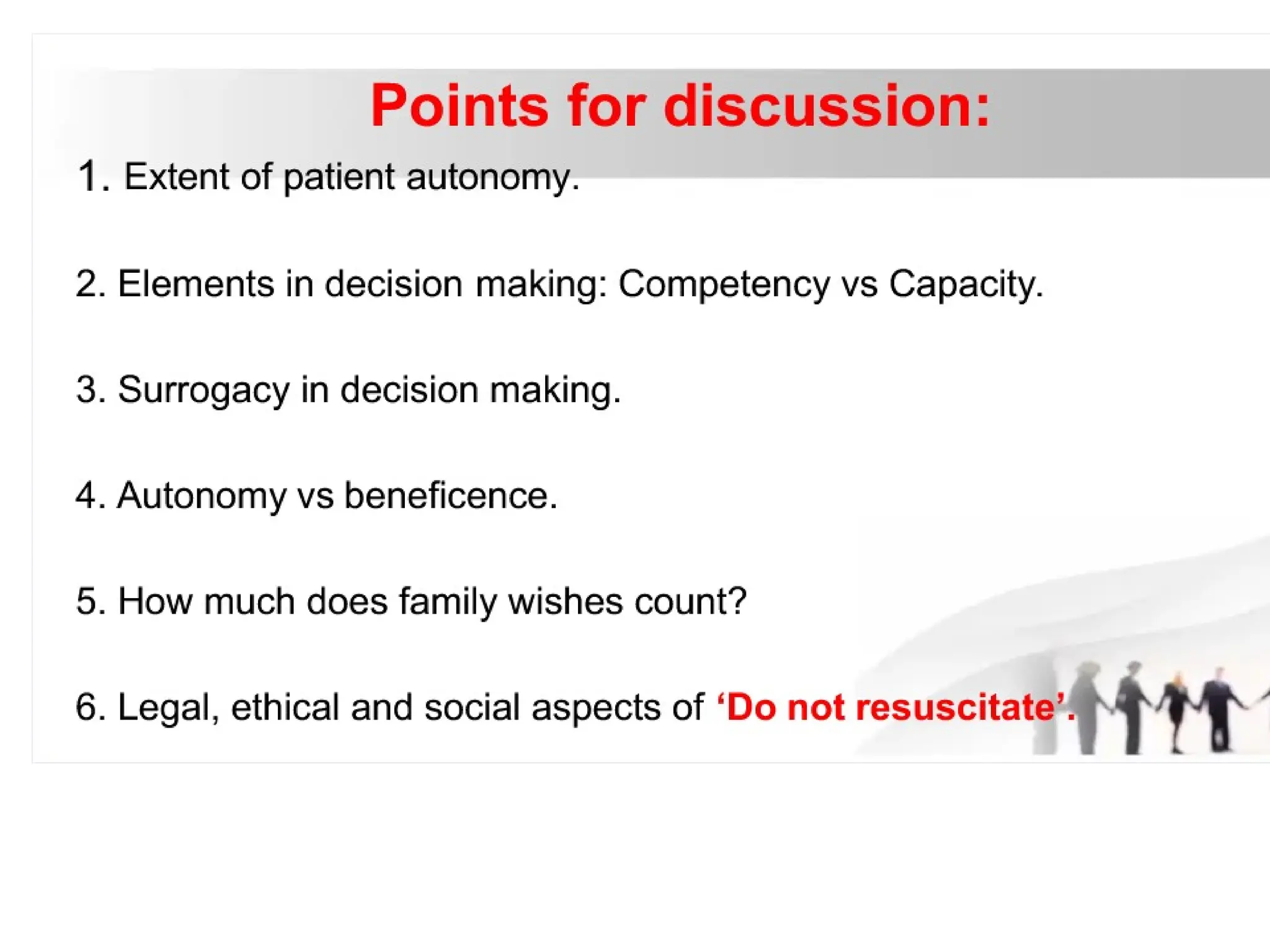
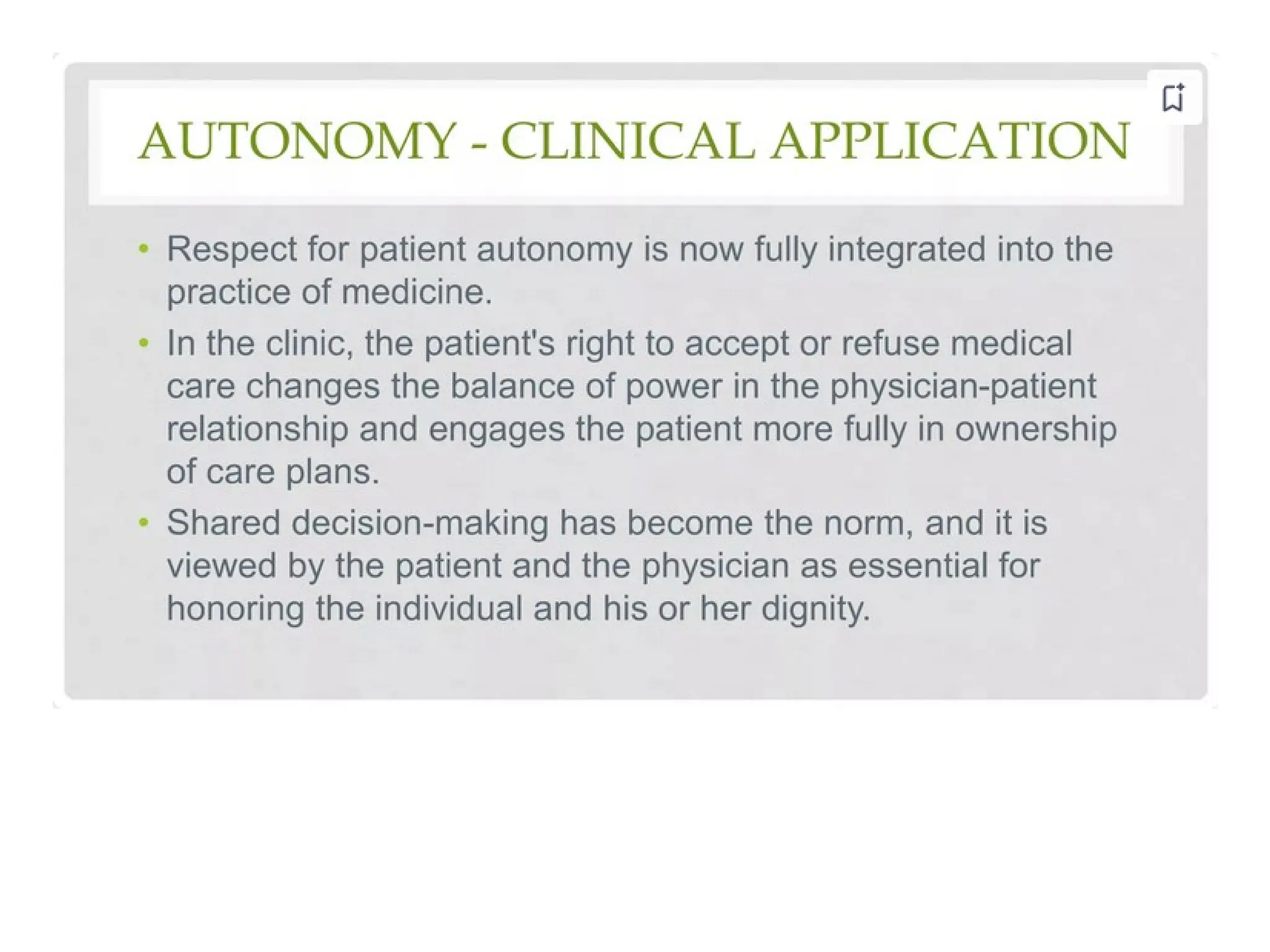
• Extentof patient autonomy
• Elements in decision making
• Surrogacy in decision making
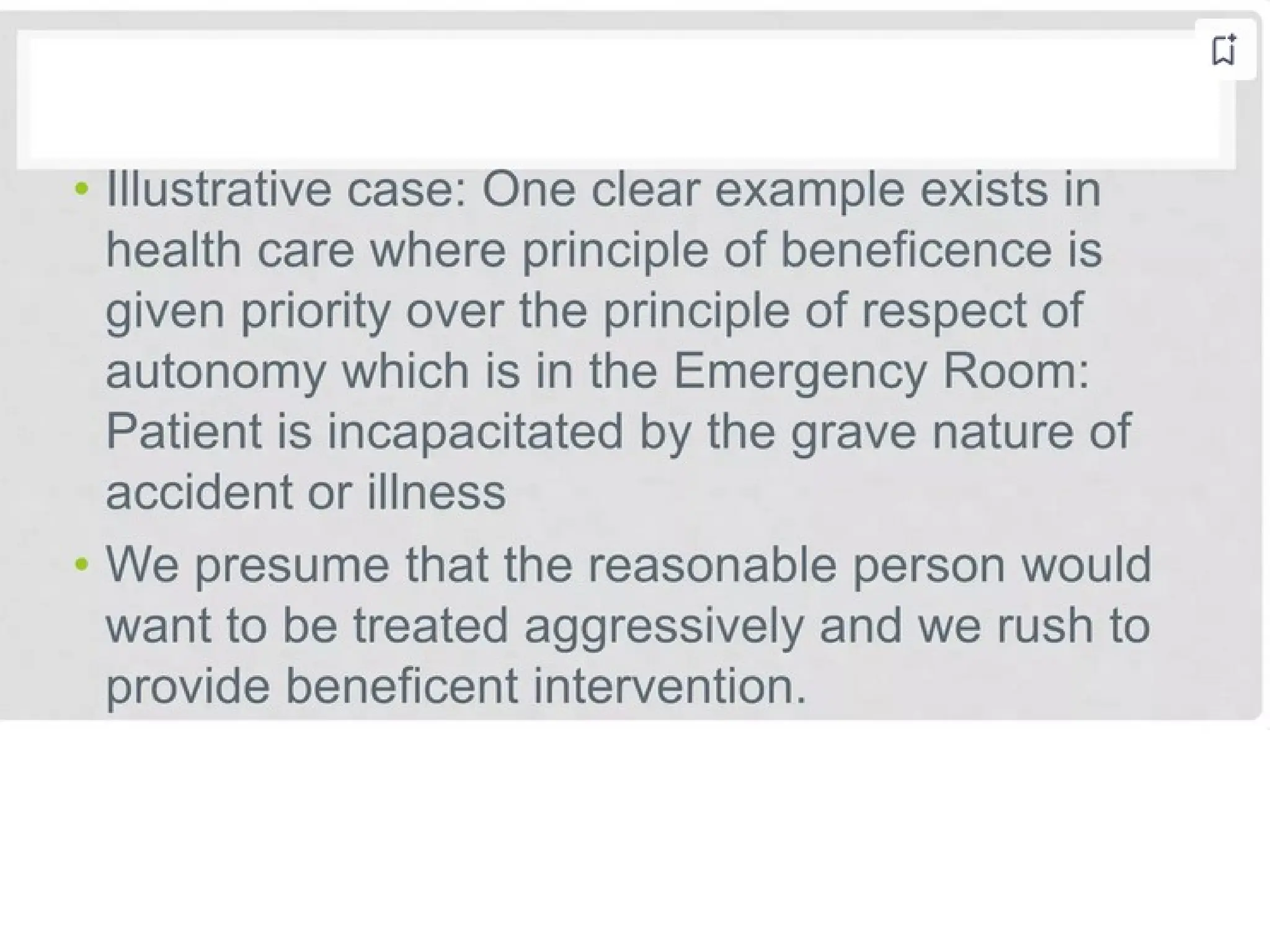
• Autonomy vs beneficence
• How much does family wish count
• DNR
34.
IMPORTANCE OF SURROGATEDECISION MAKERS
• Physicians have a responsibility to help these surrogates make
decisions consistent with the preferences, values, and goals for care
of the patient.
• However, because of the often uncertain and unanticipated nature
of medical illness, even if specific preferences have been laid out in
advance directives, these directives may not address the decision at
hand and may still require interpretation by the surrogate.
• Complicating matters further, older adults may desire that future
decisions be made based on the wishes and interests of family
members, not just their own stated preferences for care.
35.
• Involving surrogatesin advance care planning discussions with
the patient prior to incapacitation may help increase the
chances that the wishes of a patient are known to the
surrogate
• and may help lessen the burden of surrogate decision making.
• These discussions should focus on preparing surrogates for
future decisions
36.
Psychological Significance ofPatient
Preferences: Control
• Six questions must be raised in identifying and assessing
an ethical problem regarding patient preferences:
• Has the patient been informed of benefits and risks of
diagnostic and treatment recommendations, understood
this information, and given consent?
• Is the patient mentally capable and legally competent or
is there evidence of incapacity?
37.
• If mentallycapable, what preferences about treatment
is the patient stating?
• If incapacitated, has the patient expressed prior
preferences?
• Who is the appropriate surrogate to make decisions
for an incapacitated patient? What standards should
govern the surrogate’s decisions?
• Is the patient unwilling or unable to cooperate with
medical treatment? If so, why?
38.
• If aclinician doubts a patient’s decisional capacity to make particular
choices,
• then tests for cognitive functioning, psychiatric disorders, or organic
conditions that may affect decisional capacity can be used.
• Several different tools are used for this purpose. The MacArthur
Competence Assessment Test (MacCAT-T) is a commonly used clinical
assessment tool.
• The Mini-Mental State Examination (MMSE) and the Montreal
Cognitive Assessment (MoCA)
39.
• In somecircumstances, the evidence for incapacity is more complex or
obscure, particularly when psychiatric disorders may be present.
• In such cases, a consultation should be sought from more expert
clinicians, such as psychiatrists, neuropsychologists, and clinical
psychologists.
• Also, local law and policy may require assessment by a mental health
professional, particularly if guardianship proceedings are contemplated.
• When clinical evidence is sufficient to show that a patient is decisionally
incapacitated, an appropriate surrogate decision maker assumes
authority,
41.
THANK YOU
• Reflecton the above topic of autonomy vs
beneficience
• Debate / Reflect
42.
Psychological Significance ofPatient Preferences: Control
• Respect for patient preferences is psychologically significant because
the ability to express preferences and have others respect them is
crucial to a sense of personal worth. The patient, already threatened
by disease, may have a vital need for some sense of control. Indeed,
patients and families often struggle to control situations that are
beyond human control (see Section 1.2.2). When patient
preferences are ignored or devalued, patients are likely to distrust
and perhaps disregard physician recommendations. When patients
are overtly or covertly uncooperative, the effectiveness of therapy is
threatened. Furthermore, patient preferences are important
because their expression may lead to the discovery of other factors,
such as fears, fantasies, or unusual beliefs, that the physician should
consider in dealing with the patient.
43.
Question One—Has thePatient Been Informed of Benefits and Risks of
Diagnostic and Treatment Recommendations, Understood This Information,
and Given Consent?
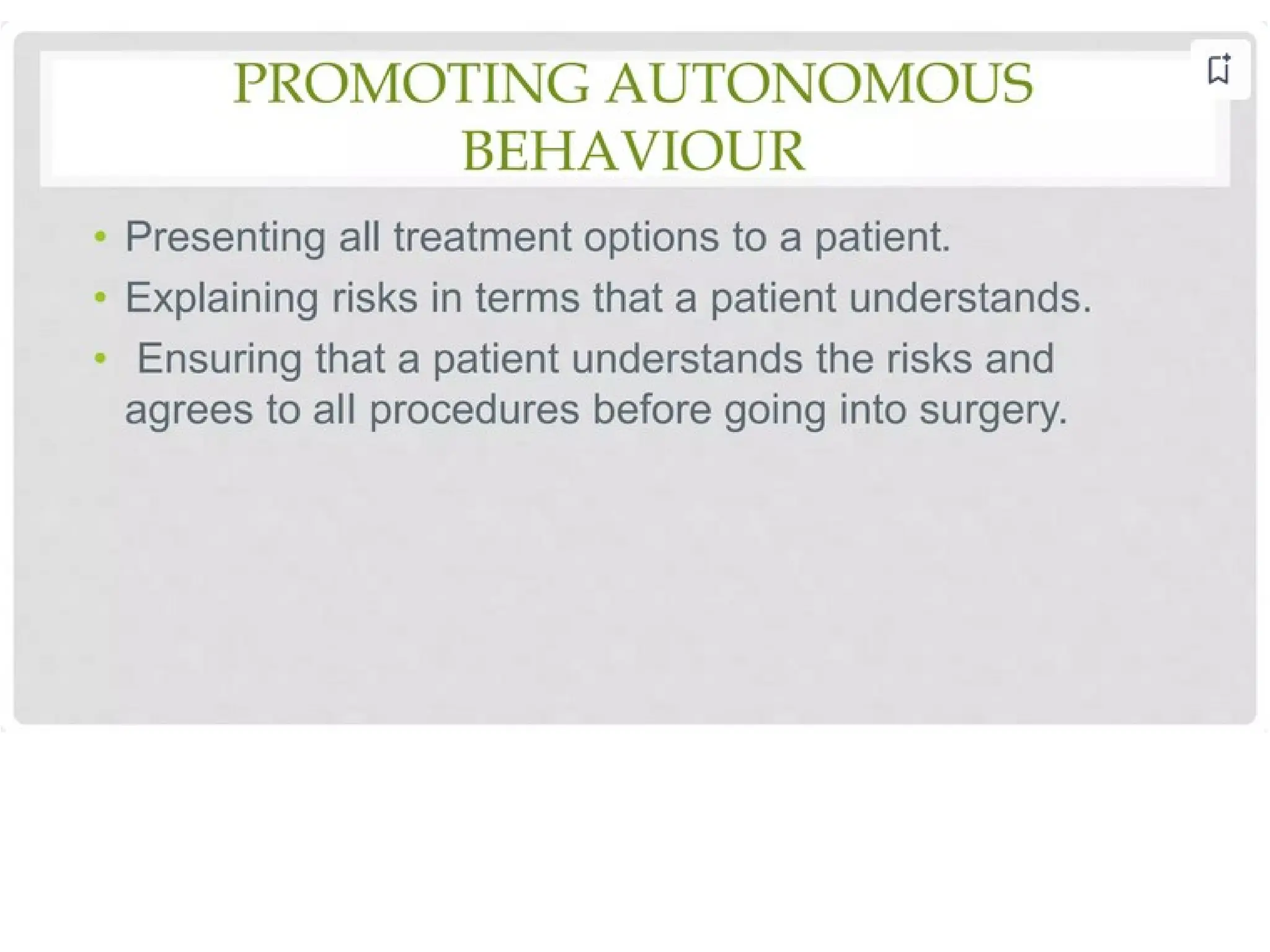
• Informed consent is the central feature of encounters
between physicians and patients, and should be
characterized by mutual participation, good communication,
mutual respect, and shared decision-making. Informed
consent requires a dialogue between the physician and
patient leading to agreement about the course of medical
care. Informed consent establishes a reciprocal relationship
between the physician and patient. After initial consent to
treatment has occurred, an ongoing dialogue between the
patient and physician concerning the patient’s continuing
medical needs reinforces the original consent.
44.
• A properlynegotiated informed consent benefits both
the physician and the patient: a therapeutic alliance is
forged in which the physician’s work is facilitated
because the patient has realistic expectations about
results of the treatment, is prepared for possible
complications, and is more likely to be a willing
collaborator in the treatment. Despite a vast literature in
law and ethics about the importance of informed
consent, many studies reveal that some physicians are
often deficient in both the practice and the spirit of
informed consent.
45.
Definition of DecisionalCapacity
• In a medical setting, a patient’s capacity to consent to or refuse
care requires the ability to understand relevant information, to
appreciate the medical situation and its possible
consequences, to communicate a choice, and to engage in
rational deliberation about one’s own values in relation to the
physician’s recommendations about treatment options.
Patients who obviously possess these abilities may make
decisions about their care and their right to do so should be
respected. Patients who clearly lack these abilities because
they are comatose, unconscious, or seriously demented are
unable to make informed, reasonable choices. For them, a
surrogate decision maker is required.
46.
• When decisionalcapacity is uncertain and the medical
situation is serious, physicians are in a difficult position:
the autonomy principle permits decisionally capacitated
patients to make any choice, including bad choices, but
what should be done if it is unclear whether or not the
patient is incapacitated? In the presence of such doubt, a
physician may intervene in a life-threatening situation on
grounds of “implied consent.” However, in a
nonemergency, non-life-threatening situation, legal
procedures for substitute decision-making should be
followed,
47.
Determining Decisional Capacity
•ecisional capacity refers to the specific acts of
comprehending, evaluating, and choosing
among realistic options. Determining
decisional capacity is a clinical judgment. The
first steps in making a determination of
capacity are to engage the patient in
conversation, to observe the patient’s
behavior, and to talk with third parties—
family, friends, or staff.
48.
• Many personswith mental disease retain the
ability to make reasonable decisions about
particular medical choices that face them.
















![Capacity & Substitute Decision Making [2013]](https://cdn.slidesharecdn.com/ss_thumbnails/capacitysubstitutedecisionmaking2013-170704024851-thumbnail.jpg?width=640&height=640&fit=bounds)


