Patient’s Bill of Right
Prof. Dr. Ram Sharan Mehta
Head, Medical Surgical Nursing Department
BP Koirala Institute of Health Sciences
Errors Due To Human Factors
• Poor Training
• Fatigue
• Staffing level
• Communication
• Distractions
• Punitive culture
Nurses
Many Roles One Profession
Definition
• Patient rights encompass legal and ethical
issues in the provider-patient relationship,
including a person's right to privacy, the
right to quality medical care without
prejudice, the right to make informed
decisions about care and treatment options,
and the right to refuse treatment.
Purposes:
• The purpose of delineating patient
rights is to ensure the ethical treatment
of persons receiving medical or other
professional health care services.
• Without exception, all persons in all
settings are entitled to receive ethical
treatment.
• Many issues comprise the rights of patients
in the medical system, including a person's
ability to sue a health plan provider;
access to emergency and specialty care,
diagnostic testing, and prescription
medication without prejudice;
confidentiality and protection of patient
medical information; and continuity of
care.
Protecting Patient Privacy—
It’s Everyone’s Responsibility
Patients Are Concerned
• Did you know...
– Only 7 percent said they
are willing to store or
transmit personal health
information on the
Internet, and only 8
percent felt a Web site
could be trusted with such
information.
Gallup Poll commissioned by MedicAlert, November 2000
Patients Are Concerned:
• Did you know...
– 90 percent said they would trust their doctor to keep
their personal health information private and secure,
and 66 percent said they would trust a hospital to do
the same.
– Only 42 percent said they would trust an insurance
company, and 35 percent would trust a managed care
company.
Gallup Poll commissioned by MedicAlert, November 2000
What Happens If Patients Don’t Trust Us?
• Quality care is
compromised
– conditions may go
undetected or
untreated
– health information
may not be complete
and accurate
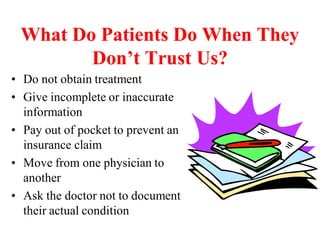
What Do Patients Do When They
Don’t Trust Us?
• Do not obtain treatment
• Give incomplete or inaccurate
information
• Pay out of pocket to prevent an
insurance claim
• Move from one physician to
another
• Ask the doctor not to document
their actual condition
Your Responsibilities
• Maintain human nature
– curiosity
– sharing
• Be sensitive
• Respect the patient’s
right to privacy
• Know your
organization’s policies
Right to Access
• Patients have the right to
– Access or inspect their health record
– Obtain a copy from their healthcare provider
Reasonable fees may be charged for copying?
• Patients have the right to request a list of when
and where their confidential information was
released
Right to File a Complaint
• The patient has the
right to file a
complaint if he or
she believes
privacy rights
were violated*
* Organization must provide contact information for filing a complaint
There Are Penalties
• Both criminal and civil penalties for:
– Knowingly or wrongfully disclosing or
receiving individually identifiable health
information
– Obtaining information with intent to:
– Sell or transfer it
– Use it for commercial advantage
– Use it for personal gain
– Use it for malicious harm
Doing Your Part
• Only access confidential
information if you need it to do your job
• Protect your computer
passwords
• Understand the law and your
organization’s policies
• Attend training and education programs
• Report problems
• Treat your patient’s information the way you would want
your personal information treated
Protect Confidential Information
Providing patients
with quality healthcare
includes protecting
their confidential
information.
The Patient’s Bill of Rights
• A document designed to guarantee
ethical care of clients in terms of their
decision making about treatment
choices and other aspects of their care.
U.S. Patients' Bill of Rights
• A Patient's Bill of Rights is a statement of
the rights to which patients are entitled as
recipients of medical care.
• Typically, a statement articulates the
positive rights which doctors and hospitals
ought to provide patients, thereby
providing information, offering fair
treatment, and granting them autonomy
over medical decisions.
The Senate-passed Patients' Bill of Rights confers a
broad array of rights on patients. The bill would ensure
that patients with health care plans have the right to:
• have their medical decisions made by a doctor;
• see a medical specialist;
• go to the closest emergency room;
• designate a pediatrician as a primary care doctor for their
children;
• keep the same doctor throughout their medical treatment;
• obtain the prescription drugs their doctor prescribes;
• access a fair and independent appeals process if care is
denied; and
• hold their health plan accountable for harm done.
• This bill was passed by the US Senate
since 2002
All patients should be guaranteed the
following freedoms:
• To seek consultation with the physician(s) of
their choice;
• To contract with their physician(s) on mutually
agreeable terms;
• To be treated confidentially, with access to their
records limited to those involved in their care or
designated by the patient;
• To use their own resources to purchase the care
of their choice;
• To refuse medical treatment even if it is
recommended by their physician(s);
• To be informed about their medical condition,
the risks and benefits of treatment and
appropriate alternatives;
• To refuse third-party interference in their
medical care, and to be confident that their
actions in seeking or declining medical care will
not result in third-party-imposed penalties for
patients or physicians;
At issue, besides basic rights of care and
privacy, is the education of patients
concerning what to expect of their health
care facility and its providers.
These basic rights include the right to:
• participate in the development and
implementation in the plan of care
• be treated with respect and dignity
• be informed about condition, treatment
options, and the possible results and side
effects of treatment
• refuse treatment in accordance with the
law, and receive information about the
consequences of refusal
• quality health care without discrimination
because of race, creed, gender, religion,
national origin, or source of payment
• privacy and confidentiality, which
includes access to medical records upon
request
• personal safety
• know the identity of the person treating
the patient, as well as any relationship
between professionals and agencies
involved in the treatment
• informed consent for all procedures
• information, including the medical records
by the patient or by the patient's legally
authorized representative and hospital
charges, except for Medicaid and general
assistance
• consultation and communication
• complain or compliment without the fear of
retaliation or compromise of access or
quality of care
Consumer Bill of Rights and
Responsibilities
1. Information Disclosure.
2. Choice of Providers and Plans.
3. Access to Emergency Services.
4. Participation in Treatment Decisions.
5. Respect and Nondiscrimination.
6. Confidentiality of Health Information.
7. Complaints and Appeals.
8. Consumer Responsibilities.
CONSUMER RIGHTS IN HEALTH
1. Right to be informed
2. Right to be respected as the individual with the
major responsibility for his own health care
3. Right to participate in decision making
affecting his health
4. Right to equal access to care (health education,
prevention, treatment and rehabilitation)
regardless of the individuals economic status,
sex, age, creed, ethnic origin and location.
BILL OF RIGHTS FOR PATIENTS
• American Hospital Association has adopted a
ā€œPatient’s Bill or Rightsā€ as a national policy
statement and distributed it to its member
hospitals throughout the country.
• Summary of 12 rights:
1. The patient has the right to considerate and
respectful care.
2. The patient has the right to obtain from his physician
complete current information concerning his
diagnosis, treatment and prognosis in terms the patient
can be reasonably expected to understand.
3. The patient has the right to receive from his physician
information necessary to give informed consent prior
to the start of any procedure and / or treatment.
4. The patient has the right to refuse treatment to the
extent permitted by law, and to be informed of the
medical consequences of his action.
5. The patient has the right to every consideration of his
privacy concerning his own medical care program.
6. The patient has the right to expect that
communications and records pertaining to his care
should be treated as confidential.
7. The patient has the right to expect that within its
capacity a hospital must make reasonable response
to the request of a patient for services.
8. The patient has the right to obtain information as to any
relationship of his hospital to other health care
and education institutions insofar as his care is
concerned.
9. The patient has the right to be advised if the
hospital proposes to engage in or perform
human experimentation affecting his care
or treatment.
10. The patient has the right to expect
reasonable continuity of care.
11. The patient has the right to examine and
receive an explanation of his bill regardless
of source of payment.
12. The patient has the right to know what
hospital rules and regulations apply to his
conduct as a patient.
Ethics…Principles of
Health Care Ethics
• Autonomy
• Beneficence
• Nonmaleficence
• Justice
• Fidelity (Faithfulness/loyalty)
Ethics…Professional Nursing
• Code of Ethics: principles accepted by
all members of a profession; ANA
• Accountability
• Responsibility
• Confidentiality
• Veracity
• Competence
• Judgment
• Advocacy
Basic Ethical Principles
• Autonomy - The respect for individual liberty
• Justice - The equitable distribution of potential
benefits and risks
• Fidelity - The duty to do what one has promised
• Nonmaleficence - The obligation to do or cause
no harm to another
• Beneficence - The duty to do good to others
• Veracity - The obligation to tell the truth
Ethical Decision Making
EVALUATION
Evaluation of outcome of moral actions
"Were the actions ethical?" "What were the consequences?"
IMPLEMENTATION
Carrying out selected moral actions
PLANNING
Consideration of priorities of claims
Consideration of consequences of alternatives
ANALYSIS & DIAGNOSIS
Identification of problem: Statement of ethical dilemma
ASSESSMENT
Determination of claims and parties
Thank You
EUROPEAN CHARTER OF
PATIENTS’ RIGHTS
• FOURTEEN RIGHTS OF
THE PATIENT
1-Right to Preventive Measures
• Every individual has the right to a
proper service in order to prevent
illness.
2-Right of Access
• Every individual has the right of access to
the health services that his or her health
needs require.
• The health services must guarantee equal
access to everyone, without discriminating
on the basis of
• financial resources, place of residence,
kind of illness or time of access to services.
3-Right to Information
• Every individual has the right to
access to all kind of information
regarding their state of health,
• the health services and how to use
them, and all that scientific
research and technological
• innovation makes available.
4-Right to Consent
• Every individual has the right of access
to all information that might enable
him or her to actively
• participate in the decisions regarding
his or her health; this information is a
prerequisite for any
• procedure and treatment, including the
participation in scientific research.
5-Right to Free Choice
• Each individual has the right to
freely choose from among different
treatment procedures and
• providers on the basis of adequate
information.
6-Right to Privacy and
Confidentiality
• Every individual has the right to the
confidentiality of personal information,
including information
• regarding his or her state of health and
potential diagnostic or therapeutic procedures,
as well as
• the protection of his or her privacy during the
performance of diagnostic exams, specialist
visits,
• and medical/surgical treatments in general.
7-Right to Respect of Patients’
Time
• Each individual has the right to
receive necessary treatment
within a swift and
predetermined period
• of time. This right applies at
each phase of the treatment.
8-Right to the Observance of
Quality Standards
• Each individual has the right of
access to high quality health
services on the basis of the
• specification and observance of
precise standards.
9-Right to Safety
• Each individual has the right to be
free from harm caused by the poor
functioning of health services,
• medical malpractice and errors, and
the right of access to health services
and treatments that meet high safety
standards.
10-Right to Innovation
• Each individual has the right of
access to innovative procedures,
including diagnostic procedures,
• according to international
standards and independently of
economic or financial
considerations.
11-Right to Avoid Unnecessary
Suffering and Pain
• Each individual has the right to
avoid as much suffering and pain
as possible, in each phase of his
• or her illness.
12-Right to Personalized
Treatment
• Each individual has the right to
diagnostic or therapeutic
programmes tailored as much
as possible to his or her
personal needs.
13-Right to Complain
• Each individual has the right to
complain whenever he or she
has suffered a harm and the
right to receive a response or
other feedback.
14-Right to Compensation
• Each individual has the right to
receive sufficient compensation within
a reasonably short time whenever he
or she has suffered physical or moral
and psychological harm caused by a
health service treatment.
Thank You

Patient's Bill of Rights

  • 1.
    Patient’s Bill ofRight Prof. Dr. Ram Sharan Mehta Head, Medical Surgical Nursing Department BP Koirala Institute of Health Sciences
  • 2.
    Errors Due ToHuman Factors • Poor Training • Fatigue • Staffing level • Communication • Distractions • Punitive culture Nurses Many Roles One Profession
  • 3.
    Definition • Patient rightsencompass legal and ethical issues in the provider-patient relationship, including a person's right to privacy, the right to quality medical care without prejudice, the right to make informed decisions about care and treatment options, and the right to refuse treatment.
  • 4.
    Purposes: • The purposeof delineating patient rights is to ensure the ethical treatment of persons receiving medical or other professional health care services. • Without exception, all persons in all settings are entitled to receive ethical treatment.
  • 5.
    • Many issuescomprise the rights of patients in the medical system, including a person's ability to sue a health plan provider; access to emergency and specialty care, diagnostic testing, and prescription medication without prejudice; confidentiality and protection of patient medical information; and continuity of care.
  • 6.
    Protecting Patient Privacy— It’sEveryone’s Responsibility
  • 7.
    Patients Are Concerned •Did you know... – Only 7 percent said they are willing to store or transmit personal health information on the Internet, and only 8 percent felt a Web site could be trusted with such information. Gallup Poll commissioned by MedicAlert, November 2000
  • 8.
    Patients Are Concerned: •Did you know... – 90 percent said they would trust their doctor to keep their personal health information private and secure, and 66 percent said they would trust a hospital to do the same. – Only 42 percent said they would trust an insurance company, and 35 percent would trust a managed care company. Gallup Poll commissioned by MedicAlert, November 2000
  • 9.
    What Happens IfPatients Don’t Trust Us? • Quality care is compromised – conditions may go undetected or untreated – health information may not be complete and accurate
  • 10.
    What Do PatientsDo When They Don’t Trust Us? • Do not obtain treatment • Give incomplete or inaccurate information • Pay out of pocket to prevent an insurance claim • Move from one physician to another • Ask the doctor not to document their actual condition
  • 11.
    Your Responsibilities • Maintainhuman nature – curiosity – sharing • Be sensitive • Respect the patient’s right to privacy • Know your organization’s policies
  • 12.
    Right to Access •Patients have the right to – Access or inspect their health record – Obtain a copy from their healthcare provider Reasonable fees may be charged for copying? • Patients have the right to request a list of when and where their confidential information was released
  • 13.
    Right to Filea Complaint • The patient has the right to file a complaint if he or she believes privacy rights were violated* * Organization must provide contact information for filing a complaint
  • 14.
    There Are Penalties •Both criminal and civil penalties for: – Knowingly or wrongfully disclosing or receiving individually identifiable health information – Obtaining information with intent to: – Sell or transfer it – Use it for commercial advantage – Use it for personal gain – Use it for malicious harm
  • 15.
    Doing Your Part •Only access confidential information if you need it to do your job • Protect your computer passwords • Understand the law and your organization’s policies • Attend training and education programs • Report problems • Treat your patient’s information the way you would want your personal information treated
  • 16.
    Protect Confidential Information Providingpatients with quality healthcare includes protecting their confidential information.
  • 17.
    The Patient’s Billof Rights • A document designed to guarantee ethical care of clients in terms of their decision making about treatment choices and other aspects of their care.
  • 18.
    U.S. Patients' Billof Rights • A Patient's Bill of Rights is a statement of the rights to which patients are entitled as recipients of medical care. • Typically, a statement articulates the positive rights which doctors and hospitals ought to provide patients, thereby providing information, offering fair treatment, and granting them autonomy over medical decisions.
  • 19.
    The Senate-passed Patients'Bill of Rights confers a broad array of rights on patients. The bill would ensure that patients with health care plans have the right to: • have their medical decisions made by a doctor; • see a medical specialist; • go to the closest emergency room; • designate a pediatrician as a primary care doctor for their children; • keep the same doctor throughout their medical treatment; • obtain the prescription drugs their doctor prescribes; • access a fair and independent appeals process if care is denied; and • hold their health plan accountable for harm done.
  • 20.
    • This billwas passed by the US Senate since 2002
  • 21.
    All patients shouldbe guaranteed the following freedoms: • To seek consultation with the physician(s) of their choice; • To contract with their physician(s) on mutually agreeable terms; • To be treated confidentially, with access to their records limited to those involved in their care or designated by the patient; • To use their own resources to purchase the care of their choice;
  • 22.
    • To refusemedical treatment even if it is recommended by their physician(s); • To be informed about their medical condition, the risks and benefits of treatment and appropriate alternatives; • To refuse third-party interference in their medical care, and to be confident that their actions in seeking or declining medical care will not result in third-party-imposed penalties for patients or physicians;
  • 23.
    At issue, besidesbasic rights of care and privacy, is the education of patients concerning what to expect of their health care facility and its providers. These basic rights include the right to: • participate in the development and implementation in the plan of care • be treated with respect and dignity
  • 24.
    • be informedabout condition, treatment options, and the possible results and side effects of treatment • refuse treatment in accordance with the law, and receive information about the consequences of refusal • quality health care without discrimination because of race, creed, gender, religion, national origin, or source of payment
  • 25.
    • privacy andconfidentiality, which includes access to medical records upon request • personal safety • know the identity of the person treating the patient, as well as any relationship between professionals and agencies involved in the treatment • informed consent for all procedures
  • 26.
    • information, includingthe medical records by the patient or by the patient's legally authorized representative and hospital charges, except for Medicaid and general assistance • consultation and communication • complain or compliment without the fear of retaliation or compromise of access or quality of care
  • 27.
    Consumer Bill ofRights and Responsibilities 1. Information Disclosure. 2. Choice of Providers and Plans. 3. Access to Emergency Services. 4. Participation in Treatment Decisions. 5. Respect and Nondiscrimination. 6. Confidentiality of Health Information. 7. Complaints and Appeals. 8. Consumer Responsibilities.
  • 28.
    CONSUMER RIGHTS INHEALTH 1. Right to be informed 2. Right to be respected as the individual with the major responsibility for his own health care 3. Right to participate in decision making affecting his health 4. Right to equal access to care (health education, prevention, treatment and rehabilitation) regardless of the individuals economic status, sex, age, creed, ethnic origin and location.
  • 29.
    BILL OF RIGHTSFOR PATIENTS • American Hospital Association has adopted a ā€œPatient’s Bill or Rightsā€ as a national policy statement and distributed it to its member hospitals throughout the country. • Summary of 12 rights:
  • 30.
    1. The patienthas the right to considerate and respectful care. 2. The patient has the right to obtain from his physician complete current information concerning his diagnosis, treatment and prognosis in terms the patient can be reasonably expected to understand. 3. The patient has the right to receive from his physician information necessary to give informed consent prior to the start of any procedure and / or treatment. 4. The patient has the right to refuse treatment to the extent permitted by law, and to be informed of the medical consequences of his action.
  • 31.
    5. The patienthas the right to every consideration of his privacy concerning his own medical care program. 6. The patient has the right to expect that communications and records pertaining to his care should be treated as confidential. 7. The patient has the right to expect that within its capacity a hospital must make reasonable response to the request of a patient for services. 8. The patient has the right to obtain information as to any relationship of his hospital to other health care and education institutions insofar as his care is concerned.
  • 32.
    9. The patienthas the right to be advised if the hospital proposes to engage in or perform human experimentation affecting his care or treatment. 10. The patient has the right to expect reasonable continuity of care. 11. The patient has the right to examine and receive an explanation of his bill regardless of source of payment. 12. The patient has the right to know what hospital rules and regulations apply to his conduct as a patient.
  • 33.
    Ethics…Principles of Health CareEthics • Autonomy • Beneficence • Nonmaleficence • Justice • Fidelity (Faithfulness/loyalty)
  • 34.
    Ethics…Professional Nursing • Codeof Ethics: principles accepted by all members of a profession; ANA • Accountability • Responsibility • Confidentiality • Veracity • Competence • Judgment • Advocacy
  • 35.
    Basic Ethical Principles •Autonomy - The respect for individual liberty • Justice - The equitable distribution of potential benefits and risks • Fidelity - The duty to do what one has promised • Nonmaleficence - The obligation to do or cause no harm to another • Beneficence - The duty to do good to others • Veracity - The obligation to tell the truth
  • 36.
    Ethical Decision Making EVALUATION Evaluationof outcome of moral actions "Were the actions ethical?" "What were the consequences?" IMPLEMENTATION Carrying out selected moral actions PLANNING Consideration of priorities of claims Consideration of consequences of alternatives ANALYSIS & DIAGNOSIS Identification of problem: Statement of ethical dilemma ASSESSMENT Determination of claims and parties
  • 37.
  • 38.
    EUROPEAN CHARTER OF PATIENTS’RIGHTS • FOURTEEN RIGHTS OF THE PATIENT
  • 39.
    1-Right to PreventiveMeasures • Every individual has the right to a proper service in order to prevent illness.
  • 40.
    2-Right of Access •Every individual has the right of access to the health services that his or her health needs require. • The health services must guarantee equal access to everyone, without discriminating on the basis of • financial resources, place of residence, kind of illness or time of access to services.
  • 41.
    3-Right to Information •Every individual has the right to access to all kind of information regarding their state of health, • the health services and how to use them, and all that scientific research and technological • innovation makes available.
  • 42.
    4-Right to Consent •Every individual has the right of access to all information that might enable him or her to actively • participate in the decisions regarding his or her health; this information is a prerequisite for any • procedure and treatment, including the participation in scientific research.
  • 43.
    5-Right to FreeChoice • Each individual has the right to freely choose from among different treatment procedures and • providers on the basis of adequate information.
  • 44.
    6-Right to Privacyand Confidentiality • Every individual has the right to the confidentiality of personal information, including information • regarding his or her state of health and potential diagnostic or therapeutic procedures, as well as • the protection of his or her privacy during the performance of diagnostic exams, specialist visits, • and medical/surgical treatments in general.
  • 45.
    7-Right to Respectof Patients’ Time • Each individual has the right to receive necessary treatment within a swift and predetermined period • of time. This right applies at each phase of the treatment.
  • 46.
    8-Right to theObservance of Quality Standards • Each individual has the right of access to high quality health services on the basis of the • specification and observance of precise standards.
  • 47.
    9-Right to Safety •Each individual has the right to be free from harm caused by the poor functioning of health services, • medical malpractice and errors, and the right of access to health services and treatments that meet high safety standards.
  • 48.
    10-Right to Innovation •Each individual has the right of access to innovative procedures, including diagnostic procedures, • according to international standards and independently of economic or financial considerations.
  • 49.
    11-Right to AvoidUnnecessary Suffering and Pain • Each individual has the right to avoid as much suffering and pain as possible, in each phase of his • or her illness.
  • 50.
    12-Right to Personalized Treatment •Each individual has the right to diagnostic or therapeutic programmes tailored as much as possible to his or her personal needs.
  • 51.
    13-Right to Complain •Each individual has the right to complain whenever he or she has suffered a harm and the right to receive a response or other feedback.
  • 52.
    14-Right to Compensation •Each individual has the right to receive sufficient compensation within a reasonably short time whenever he or she has suffered physical or moral and psychological harm caused by a health service treatment.
  • 53.