Sensitivity: MZN Internal
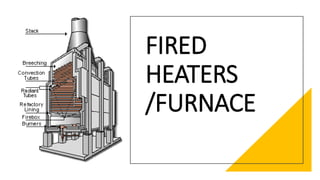
FIRED
HEATERS
/FURNACE
Sensitivity: MZN Internal
FIRED HEATERS/FURNANCE
• Furnace are needed in petroleum process to release heat and transfer
it to material being processed into petroleum products
• It is one of the most important pieces of equipment in the petroleum
industry
• The heat released by the furnace is a form of energy .
Sensitivity: MZN Internal
RADIANT /CONVECTION SECTION
• RADIANT SECTION : The radiant tubes, either horizontal or vertical, are
located along the walls in the radiant section of the heater and receive
radiant heat direct from the burners. The radiant zone with its refractory
lining is the costliest part of the heater and 85% of the heat should be
gained there. This is also called the firebox
• CONVECTION SECTION : Rather than hit the radiant section directly, the
feed charge enters the coil inlet in the convection section where it is
preheated before transferring to the radiant tubes. The convection section
removes heat from the flue gas to preheat the contents of the tubes and
significantly reduces the temperature of the flue gas exiting the stack. Too
much heat picked up in the convection section is a sign of too much draft.
Tube temperature is measured in both convection and radiant sections
Sensitivity: MZN Internal
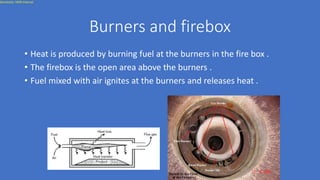
Burners and firebox
• Heat is produced by burning fuel at the burners in the fire box .
• The firebox is the open area above the burners .
• Fuel mixed with air ignites at the burners and releases heat .
Sensitivity: MZN Internal
TUBES & WALLS
• The tubes along the
walls of the fire box are
radiant tubes .
• The tubes which can see
the burners are the
radiant tubes and the
shock bank .
• The walls and roof are
lined with a material
that reduces heat loss
and radiates heat back
to the tubes to increase
the amount of heat
absorbed .
Sensitivity: MZN Internal
INSPECTON OF FURNACE
• PRELIMINARY INSPECTION
• Smoke Test
• Carbon Decoking :
Thermal De-coking
 Mechanical De-coking
 On-Line Spalling
Sensitivity: MZN Internal
INSPECTION OF TUBES RADIANT SECTION
RADIANT SECTION
• IN-Situ Metallography
• UTG on coils(Vertical & U-Bends)
• Spigot Inspection
• Hanger Support Inspection
• Thermocouple Weld Inspection
• Steamated Point Inspection
• Cantilever Support & Locking
Bar Inspection
CONVECTION SECTION
• DRY ICE (CO2)Blasting
• Return bend – Elbow Inspection
• UTG on return bend/Return pass
• End & Intermediated tube sheet
• Header Box Cover Inspection
Sensitivity: MZN Internal
DEFORMATION INSPECTION ON TUBES
• BOWING(Plum-Bob Inspection) : Excessive bowing is generally caused by uneven metal
temperatures that may be due to flame impingement or coke accumulation inside the tube.
Heating on one side of the tube causes greater thermal expansion on the hotter side and bowing
toward the heat source. Bowing may also be caused by binding of the tube in the tube sheets or
improper suspension of the tube so that longitudinal expansion is restricted or by the use of
improper tube lengths when individual tube replacement are made
• SAGGING(Visual Inspection) : Excessive sagging is usually because of a decrease in the
structural strength of the tube caused by overheating. It may also be caused by improper spacing
of hangers, uneven metal temperatures, or failure of one or more tube supports or hangers
• BULGING(Creep Gauge Inspection) : Bulging is generally an indication of overheating.
Continuing under the same temperature and stress conditions eventually lead to creep and stress
rupture. The amount of bulging varies with the specific metal and the type of damage, creep or
overstress. If the bulge is attributed to overstress (short-term overheating), and the temperature
and stress have been returned to normal, typically the life of the tube has not been reduced.
Creep life can be reduced if the bulge is the result of creep damage (long-term overheating)
Sensitivity: MZN Internal
REFRACTORY INSPECTION
• Brick bulging inspection
• Brick Deformation
• Insulate brick & dense brick
• Castable brick Inspection
Sensitivity: MZN Internal
ANCHOR INSPECTION
• V type anchor inspection
• U type anchor inspection
• UV Type anchor inspection
• Anchor Welding
• Hammering on each anchor for Stiffeners
Sensitivity: MZN Internal
TUBE METALLURGIES
• CARBON STEEL : Reboiler/Steam Generator/Super Heater
• 5 Cr/9Cr: Crude/Vacuum/Vis-Breaker/DCU
• SS316/317 L : Crude with high TAN/ Vacuum with high TAN
• SS347 H- Hydrotreater/Hydrocracker/Hydrogen
Sensitivity: MZN Internal
HYDROSTATIC TEST
• To be conducted on each pass individually
• Use DM water for hydrostatic test
• 30 Min Pressure holding time
• MAWP*JE*
Sensitivity: MZN Internal
TUBE
DETERIORATION
MECHANISMS
COMMON TO
SPECIFIC SERVICES
Sensitivity: MZN Internal
TUBE
DETERIORATION
MECHANISMS
COMMON TO
SPECIFIC SERVICES
Sensitivity: MZN Internal
Recommended
Inspection and
Acceptance Criteria for
Deterioration
Mechanisms
Sensitivity: MZN Internal
Recommended
Inspection and
Acceptance Criteria for
Deterioration
Mechanisms
Sensitivity: MZN Internal

Furnace.pptx

  • 1.
  • 2.
    Sensitivity: MZN Internal FIREDHEATERS/FURNANCE • Furnace are needed in petroleum process to release heat and transfer it to material being processed into petroleum products • It is one of the most important pieces of equipment in the petroleum industry • The heat released by the furnace is a form of energy .
  • 3.
    Sensitivity: MZN Internal RADIANT/CONVECTION SECTION • RADIANT SECTION : The radiant tubes, either horizontal or vertical, are located along the walls in the radiant section of the heater and receive radiant heat direct from the burners. The radiant zone with its refractory lining is the costliest part of the heater and 85% of the heat should be gained there. This is also called the firebox • CONVECTION SECTION : Rather than hit the radiant section directly, the feed charge enters the coil inlet in the convection section where it is preheated before transferring to the radiant tubes. The convection section removes heat from the flue gas to preheat the contents of the tubes and significantly reduces the temperature of the flue gas exiting the stack. Too much heat picked up in the convection section is a sign of too much draft. Tube temperature is measured in both convection and radiant sections
  • 4.
    Sensitivity: MZN Internal Burnersand firebox • Heat is produced by burning fuel at the burners in the fire box . • The firebox is the open area above the burners . • Fuel mixed with air ignites at the burners and releases heat .
  • 5.
    Sensitivity: MZN Internal TUBES& WALLS • The tubes along the walls of the fire box are radiant tubes . • The tubes which can see the burners are the radiant tubes and the shock bank . • The walls and roof are lined with a material that reduces heat loss and radiates heat back to the tubes to increase the amount of heat absorbed .
  • 6.
    Sensitivity: MZN Internal INSPECTONOF FURNACE • PRELIMINARY INSPECTION • Smoke Test • Carbon Decoking : Thermal De-coking  Mechanical De-coking  On-Line Spalling
  • 7.
    Sensitivity: MZN Internal INSPECTIONOF TUBES RADIANT SECTION RADIANT SECTION • IN-Situ Metallography • UTG on coils(Vertical & U-Bends) • Spigot Inspection • Hanger Support Inspection • Thermocouple Weld Inspection • Steamated Point Inspection • Cantilever Support & Locking Bar Inspection CONVECTION SECTION • DRY ICE (CO2)Blasting • Return bend – Elbow Inspection • UTG on return bend/Return pass • End & Intermediated tube sheet • Header Box Cover Inspection
  • 8.
    Sensitivity: MZN Internal DEFORMATIONINSPECTION ON TUBES • BOWING(Plum-Bob Inspection) : Excessive bowing is generally caused by uneven metal temperatures that may be due to flame impingement or coke accumulation inside the tube. Heating on one side of the tube causes greater thermal expansion on the hotter side and bowing toward the heat source. Bowing may also be caused by binding of the tube in the tube sheets or improper suspension of the tube so that longitudinal expansion is restricted or by the use of improper tube lengths when individual tube replacement are made • SAGGING(Visual Inspection) : Excessive sagging is usually because of a decrease in the structural strength of the tube caused by overheating. It may also be caused by improper spacing of hangers, uneven metal temperatures, or failure of one or more tube supports or hangers • BULGING(Creep Gauge Inspection) : Bulging is generally an indication of overheating. Continuing under the same temperature and stress conditions eventually lead to creep and stress rupture. The amount of bulging varies with the specific metal and the type of damage, creep or overstress. If the bulge is attributed to overstress (short-term overheating), and the temperature and stress have been returned to normal, typically the life of the tube has not been reduced. Creep life can be reduced if the bulge is the result of creep damage (long-term overheating)
  • 9.
    Sensitivity: MZN Internal REFRACTORYINSPECTION • Brick bulging inspection • Brick Deformation • Insulate brick & dense brick • Castable brick Inspection
  • 10.
    Sensitivity: MZN Internal ANCHORINSPECTION • V type anchor inspection • U type anchor inspection • UV Type anchor inspection • Anchor Welding • Hammering on each anchor for Stiffeners
  • 11.
    Sensitivity: MZN Internal TUBEMETALLURGIES • CARBON STEEL : Reboiler/Steam Generator/Super Heater • 5 Cr/9Cr: Crude/Vacuum/Vis-Breaker/DCU • SS316/317 L : Crude with high TAN/ Vacuum with high TAN • SS347 H- Hydrotreater/Hydrocracker/Hydrogen
  • 12.
    Sensitivity: MZN Internal HYDROSTATICTEST • To be conducted on each pass individually • Use DM water for hydrostatic test • 30 Min Pressure holding time • MAWP*JE*
  • 13.
  • 14.
  • 15.
    Sensitivity: MZN Internal Recommended Inspectionand Acceptance Criteria for Deterioration Mechanisms
  • 16.
    Sensitivity: MZN Internal Recommended Inspectionand Acceptance Criteria for Deterioration Mechanisms
  • 17.