Sensitivity: MZN Internal
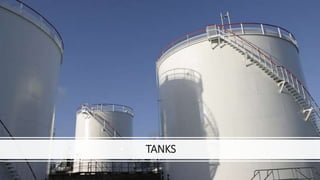
TANKS
Sensitivity: MZN Internal
INTRODUCTION
• Storage tank inspections cover both in- and out-of-service inspections
of vertical and horizontal bulk storage tanks, both above and below
ground. A combination of techniques is used to provide a
comprehensive storage tank inspection, reporting on the overall
condition of tank floors, shells, roofs and structures.
• The inspection reports include engineering calculations in accordance
with API 653 & 650 and other relevant specifications
Sensitivity: MZN Internal
Materials selection criteria
 Materials must have sufficient strength at design condition.
 Materials must be able to with stand variation ( or cycling ) in process condition.
 Materials must have sufficient corrosion resistance to survive in service between inspection intervals.
Commonly Used Materials
 Carbon steel ,killed carbon steel – cheap widely available.
 Low chrome alloys ( < 9% Cr ) better corrosion resistance then carbon steel.
 Stainless Steel : 304 austenitic stainless steel.
316 better corrosion resistance then 304,more expensive.
 Nickel alloy’s : Inconel, Incolloy -high temperature oxidizing environments.
 Monel , Hastelloy- expensive, but high corrosion resistance , used for strong acid.
Corrosion Allowance
 Wall thickness calculated using BPV code equations are for the fully corroded state.
 Usually add a corrosion allowance of 1.6mm to 5mm.
Sensitivity: MZN Internal
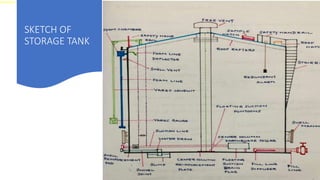
SKETCH OF
STORAGE TANK
Sensitivity: MZN Internal
SKETCH OF
INTERNAL
STORAGE TANK
Sensitivity: MZN Internal
SKETCH OF
FLOATING HEAD
STORAGE TANK
Sensitivity: MZN Internal
TYPES OF INSPECTIONS
• Routine In-Service Inspection
• External Inspection
• Internal Inspection
Sensitivity: MZN Internal
INSPECTION INTERVAL CONSIDERATIONS
Typical factors responsible for determining inspection intervals of storage tanks include the
following:
• The nature of the fluid stored
• The results of routine visual/ external checks
• Corrosion allowances and corrosion rates/ trends
• Corrosion protective coatings
• Conditions at previous inspections
• The location of tanks such as isolated land, high-risk areas
• The potential of air & water pollution
• Corrosion prevention and leak detection systems
• Statutory regulations
• Industry’s quality control requirements
Sensitivity: MZN Internal
EXTERNAL INSPECTION
 Thickness measurement and remaining life calculation
 Shell and roof plates inspection for corrosion and deformation
 Shell and roof plates circumferential and longitudinal welding joints inspection for corrosion and cracking
 Nozzles, man ways, flange welding joints inspection for corrosion and cracking
 Ladder, Stairway, Platform, and Walkway: corroded or broken parts, Ladder rungs and stair treads for wear and corrosion, Welded joints for cracks
 Foundation: Concrete pads, base rings, and piers/footings should be checked for spalling, cracks, and general deterioration
 Anchor Bolt: Corrosion and looseness
 Grounding Connection: Total resistance from tank to earth should not exceed approximately 25 ohms
 Side vents inspection
 Gasket seating surface inspection of nozzles and man ways flange joints
 Top angle, wind girder and stair way inspection for corrosion and deformation
 Roof sump inspection (floating roof only)
 Pontoon and pontoon structure welding joints inspection for corrosion and cracking (floating roof only)
 Weather shield rubber and pontoon doors rubber inspection (floating roof only)
 Pontoon air leak testing (internal floating roof only)
 Painting or insulation inspection
 Concrete foundation inspection for corrosion and cracking
 Earthling system inspection
 Asphalt inspection (around shell)
 Cathodic protection system inspection
Sensitivity: MZN Internal
INTERNAL INSPECTION
PRE INSPECTION :
 Manway condition : Manway cover, Davit arm and flange face
 As found condition of internals deposits
 Visual inspection for any abnormalities for internals as found
condition.
 Defects due to process internal on shell to be notified
Sensitivity: MZN Internal
POST INSEPCTION
Post cleaning inspection to be carried out :
• Internal Inspection-Shell Plate :
 Shell plate inspection for corrosion and deformation
 Shell plate circumferential and longitudinal welding joints inspection for corrosion and cracking
 Internal coating inspection (if any)
• Internal Inspection-Fix Roof :
 Roof plate inspection for corrosion and deformation
 Roof structure members inspection for corrosion and deformation
 Roof plates and structure members welding joints inspection for corrosion and cracking
 Internal coating inspection (if any)
Sensitivity: MZN Internal
POST INSEPCTION
Internal Inspection-Floating Roof :
 Roof plate inspection for corrosion and deformation
 Roof structure members inspection for corrosion and deformation
 Roof plates and structure members welding joints inspection for corrosion and cracking
 Roof sealing system inspection i.e. rubber seal, seal plate, etc.
 Roof leg supports inspection
 Pontoon gasoil leak testing
 Internal coating inspection (if any)
 Roof drain system inspection
Internal Inspection-Internal Equipment :
 Gage pole inspection for corrosion and deformation
 Support and structure members inspection for corrosion and deformation
 Inspection of columns for corrosion and deformation
• Fixed coil inspection and test for corrosion
Sensitivity: MZN Internal
POST INSEPCTION
Internal Inspection – Bottom Plate :
• After the tank has been cleaned off of the sludge, the plates shall be visually inspected to
get the first indication of the condition of the bottom.
 The tank bottom plates shall be visually inspected for pitting, corrosion and weld cracks.
 The weld joints shall be thoroughly cleaned and visually inspected for cracks.
 Suspected cracks may be further checked by Penetrant Test (PT) or Vacuum Box Test or
Magnetic Particle Test (MT).
 Depressions in the bottom plates, bottom plates under the roof supports and area below
heating coil supports shall be checked closely.
 Any water getting into the tank may collect and remain at these points thereby causing
accelerated corrosion.
 Tank bottom shall be checked thoroughly for thickness over the entire area
 Techniques such as Magnetic Flux Leakage (MFL) or Low Frequency Electromagnetic
Testing (LFET) coupled with ultrasonic thickness measurement can be used
Sensitivity: MZN Internal
POST INSEPCTION
Heating Coils :
• Heating coil including the supports shall be hammer tested, particularly at the underside of
coil and bends. Ultrasonic thickness measurement shall be taken.
 Random radiography of bends and piping section shall be taken for evaluation, if
internal corrosion is suspected.
 The heating coil shall be thoroughly inspected for corrosion, erosion, cracks, etc.
 The slope of the heating coils shall be checked for proper draining of condensate.
 Sample pipe piece can be cut & removed for sectioning and assessment of internal
corrosion.
 Coils shall be hydraulically tested at 1.5 times operating pressure and checked for any leaks
•
Sensitivity: MZN Internal
NDT ACCEPTANCE CRITERIA
 The following acceptance standards shall apply unless other more restrictive standards are specified for
specific material or applications within this Division. Unacceptable indications shall be removed or reduced to
an indication of acceptable size. Whenever an indication is removed by chipping or grinding and subsequent
repair by welding is not required, the excavated area shall be blended into the surrounding surface so as to
avoid notches, crevices, or corners. Where welding is required after removal of indications, the repair shall be
done in accordance with 6.2.7.
 (a) All surfaces to be examined shall be free of:
(1) Relevant linear indications
(2) Relevant rounded indications greater than 5 mm (3/16 in.)
(3) Four or more relevant rounded indications in a line separated by 1.5 mm (1/16 in.) or less, edge-
to-edge
 (b) Crack like indications detected, irrespective of surface conditions, are unacceptable
Sensitivity: MZN Internal
CATEGORIES OF
WELD JOINTS
Sensitivity: MZN Internal
CATEGORIES OF
WELD JOINTS
Sensitivity: MZN Internal
SELECTION OF
NDT BASED ON
CATEGORIES OF
WELD JOINTS
Sensitivity: MZN Internal
SELECTION OF
NDT BASED ON
CATEGORIES OF
WELD JOINTS

TANK 13042023.pptx

  • 1.
  • 2.
    Sensitivity: MZN Internal INTRODUCTION •Storage tank inspections cover both in- and out-of-service inspections of vertical and horizontal bulk storage tanks, both above and below ground. A combination of techniques is used to provide a comprehensive storage tank inspection, reporting on the overall condition of tank floors, shells, roofs and structures. • The inspection reports include engineering calculations in accordance with API 653 & 650 and other relevant specifications
  • 3.
    Sensitivity: MZN Internal Materialsselection criteria  Materials must have sufficient strength at design condition.  Materials must be able to with stand variation ( or cycling ) in process condition.  Materials must have sufficient corrosion resistance to survive in service between inspection intervals. Commonly Used Materials  Carbon steel ,killed carbon steel – cheap widely available.  Low chrome alloys ( < 9% Cr ) better corrosion resistance then carbon steel.  Stainless Steel : 304 austenitic stainless steel. 316 better corrosion resistance then 304,more expensive.  Nickel alloy’s : Inconel, Incolloy -high temperature oxidizing environments.  Monel , Hastelloy- expensive, but high corrosion resistance , used for strong acid. Corrosion Allowance  Wall thickness calculated using BPV code equations are for the fully corroded state.  Usually add a corrosion allowance of 1.6mm to 5mm.
  • 4.
  • 5.
    Sensitivity: MZN Internal SKETCHOF INTERNAL STORAGE TANK
  • 6.
    Sensitivity: MZN Internal SKETCHOF FLOATING HEAD STORAGE TANK
  • 7.
    Sensitivity: MZN Internal TYPESOF INSPECTIONS • Routine In-Service Inspection • External Inspection • Internal Inspection
  • 8.
    Sensitivity: MZN Internal INSPECTIONINTERVAL CONSIDERATIONS Typical factors responsible for determining inspection intervals of storage tanks include the following: • The nature of the fluid stored • The results of routine visual/ external checks • Corrosion allowances and corrosion rates/ trends • Corrosion protective coatings • Conditions at previous inspections • The location of tanks such as isolated land, high-risk areas • The potential of air & water pollution • Corrosion prevention and leak detection systems • Statutory regulations • Industry’s quality control requirements
  • 9.
    Sensitivity: MZN Internal EXTERNALINSPECTION  Thickness measurement and remaining life calculation  Shell and roof plates inspection for corrosion and deformation  Shell and roof plates circumferential and longitudinal welding joints inspection for corrosion and cracking  Nozzles, man ways, flange welding joints inspection for corrosion and cracking  Ladder, Stairway, Platform, and Walkway: corroded or broken parts, Ladder rungs and stair treads for wear and corrosion, Welded joints for cracks  Foundation: Concrete pads, base rings, and piers/footings should be checked for spalling, cracks, and general deterioration  Anchor Bolt: Corrosion and looseness  Grounding Connection: Total resistance from tank to earth should not exceed approximately 25 ohms  Side vents inspection  Gasket seating surface inspection of nozzles and man ways flange joints  Top angle, wind girder and stair way inspection for corrosion and deformation  Roof sump inspection (floating roof only)  Pontoon and pontoon structure welding joints inspection for corrosion and cracking (floating roof only)  Weather shield rubber and pontoon doors rubber inspection (floating roof only)  Pontoon air leak testing (internal floating roof only)  Painting or insulation inspection  Concrete foundation inspection for corrosion and cracking  Earthling system inspection  Asphalt inspection (around shell)  Cathodic protection system inspection
  • 10.
    Sensitivity: MZN Internal INTERNALINSPECTION PRE INSPECTION :  Manway condition : Manway cover, Davit arm and flange face  As found condition of internals deposits  Visual inspection for any abnormalities for internals as found condition.  Defects due to process internal on shell to be notified
  • 11.
    Sensitivity: MZN Internal POSTINSEPCTION Post cleaning inspection to be carried out : • Internal Inspection-Shell Plate :  Shell plate inspection for corrosion and deformation  Shell plate circumferential and longitudinal welding joints inspection for corrosion and cracking  Internal coating inspection (if any) • Internal Inspection-Fix Roof :  Roof plate inspection for corrosion and deformation  Roof structure members inspection for corrosion and deformation  Roof plates and structure members welding joints inspection for corrosion and cracking  Internal coating inspection (if any)
  • 12.
    Sensitivity: MZN Internal POSTINSEPCTION Internal Inspection-Floating Roof :  Roof plate inspection for corrosion and deformation  Roof structure members inspection for corrosion and deformation  Roof plates and structure members welding joints inspection for corrosion and cracking  Roof sealing system inspection i.e. rubber seal, seal plate, etc.  Roof leg supports inspection  Pontoon gasoil leak testing  Internal coating inspection (if any)  Roof drain system inspection Internal Inspection-Internal Equipment :  Gage pole inspection for corrosion and deformation  Support and structure members inspection for corrosion and deformation  Inspection of columns for corrosion and deformation • Fixed coil inspection and test for corrosion
  • 13.
    Sensitivity: MZN Internal POSTINSEPCTION Internal Inspection – Bottom Plate : • After the tank has been cleaned off of the sludge, the plates shall be visually inspected to get the first indication of the condition of the bottom.  The tank bottom plates shall be visually inspected for pitting, corrosion and weld cracks.  The weld joints shall be thoroughly cleaned and visually inspected for cracks.  Suspected cracks may be further checked by Penetrant Test (PT) or Vacuum Box Test or Magnetic Particle Test (MT).  Depressions in the bottom plates, bottom plates under the roof supports and area below heating coil supports shall be checked closely.  Any water getting into the tank may collect and remain at these points thereby causing accelerated corrosion.  Tank bottom shall be checked thoroughly for thickness over the entire area  Techniques such as Magnetic Flux Leakage (MFL) or Low Frequency Electromagnetic Testing (LFET) coupled with ultrasonic thickness measurement can be used
  • 14.
    Sensitivity: MZN Internal POSTINSEPCTION Heating Coils : • Heating coil including the supports shall be hammer tested, particularly at the underside of coil and bends. Ultrasonic thickness measurement shall be taken.  Random radiography of bends and piping section shall be taken for evaluation, if internal corrosion is suspected.  The heating coil shall be thoroughly inspected for corrosion, erosion, cracks, etc.  The slope of the heating coils shall be checked for proper draining of condensate.  Sample pipe piece can be cut & removed for sectioning and assessment of internal corrosion.  Coils shall be hydraulically tested at 1.5 times operating pressure and checked for any leaks •
  • 15.
    Sensitivity: MZN Internal NDTACCEPTANCE CRITERIA  The following acceptance standards shall apply unless other more restrictive standards are specified for specific material or applications within this Division. Unacceptable indications shall be removed or reduced to an indication of acceptable size. Whenever an indication is removed by chipping or grinding and subsequent repair by welding is not required, the excavated area shall be blended into the surrounding surface so as to avoid notches, crevices, or corners. Where welding is required after removal of indications, the repair shall be done in accordance with 6.2.7.  (a) All surfaces to be examined shall be free of: (1) Relevant linear indications (2) Relevant rounded indications greater than 5 mm (3/16 in.) (3) Four or more relevant rounded indications in a line separated by 1.5 mm (1/16 in.) or less, edge- to-edge  (b) Crack like indications detected, irrespective of surface conditions, are unacceptable
  • 16.
  • 17.
  • 18.
    Sensitivity: MZN Internal SELECTIONOF NDT BASED ON CATEGORIES OF WELD JOINTS
  • 19.
    Sensitivity: MZN Internal SELECTIONOF NDT BASED ON CATEGORIES OF WELD JOINTS