PLANNING
Karmina A. Amorsolo
Faculty, CBM
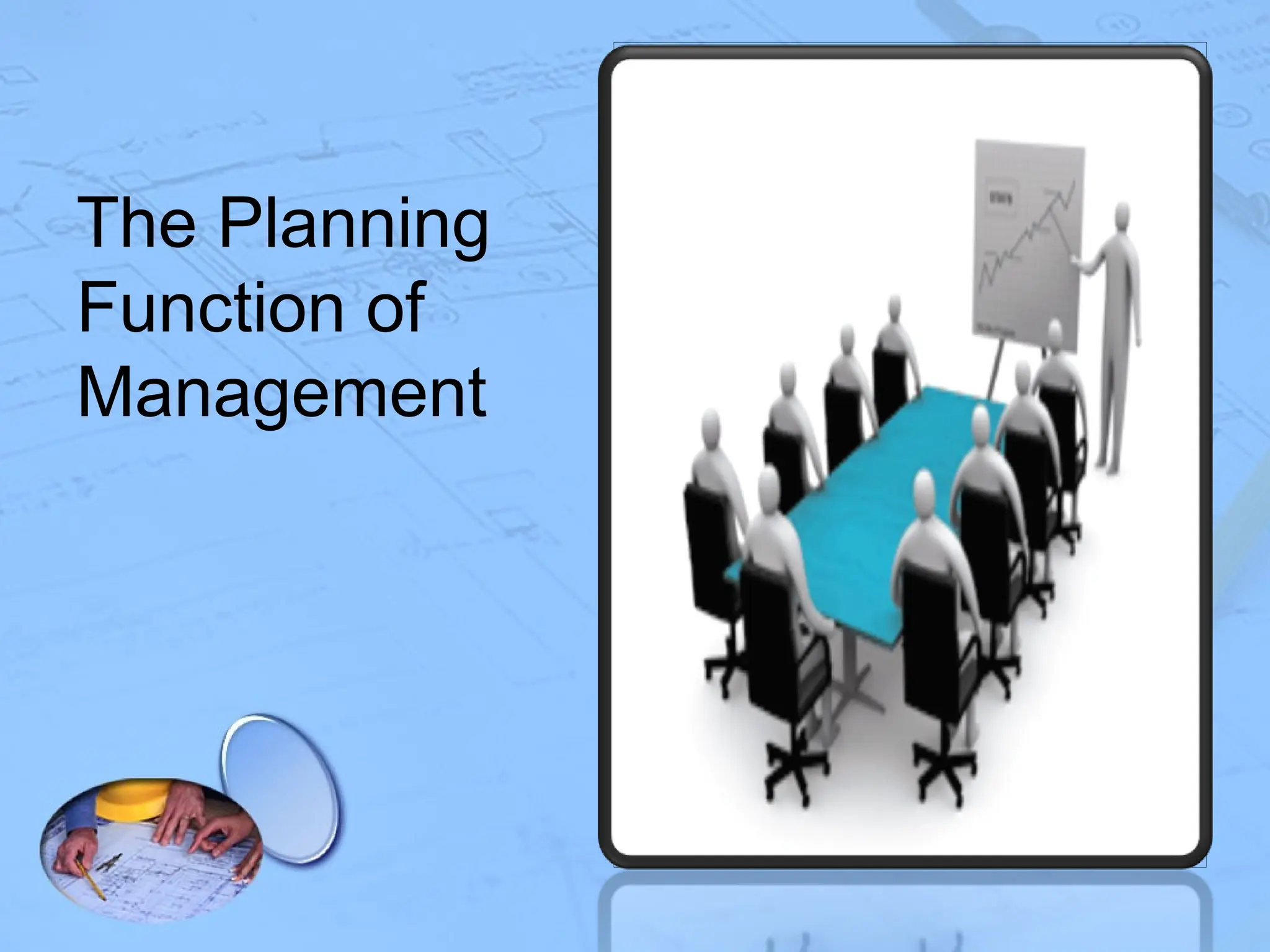
The Planning
Function of
Management
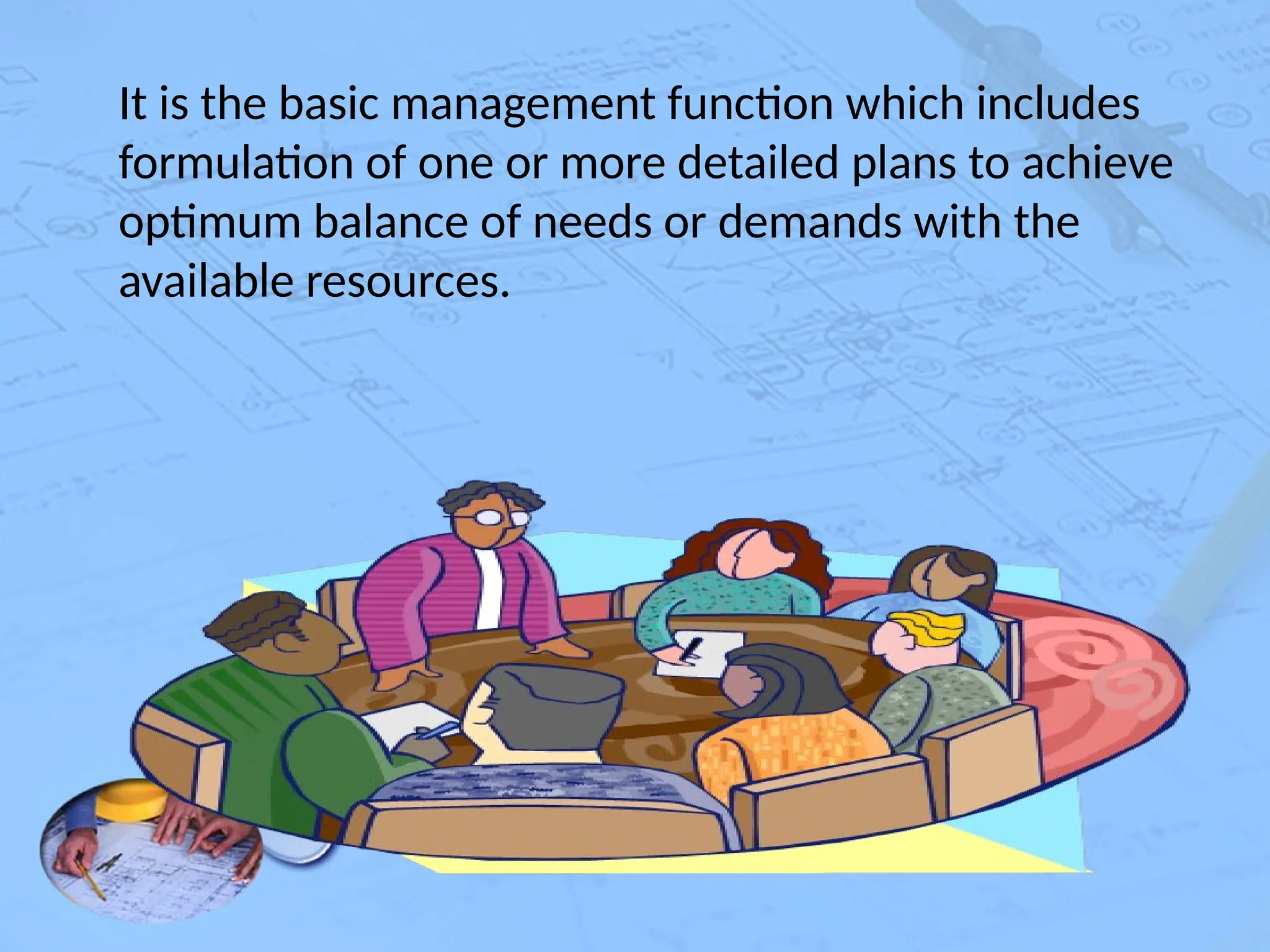
It is the basic management function which includes
formulation of one or more detailed plans to achieve
optimum balance of needs or demands with the
available resources.
• Planning is important in management because it
provides security and organization to the company.
• A manager needs to plan the expectations and
regulations that the company needs.
What is
planning?
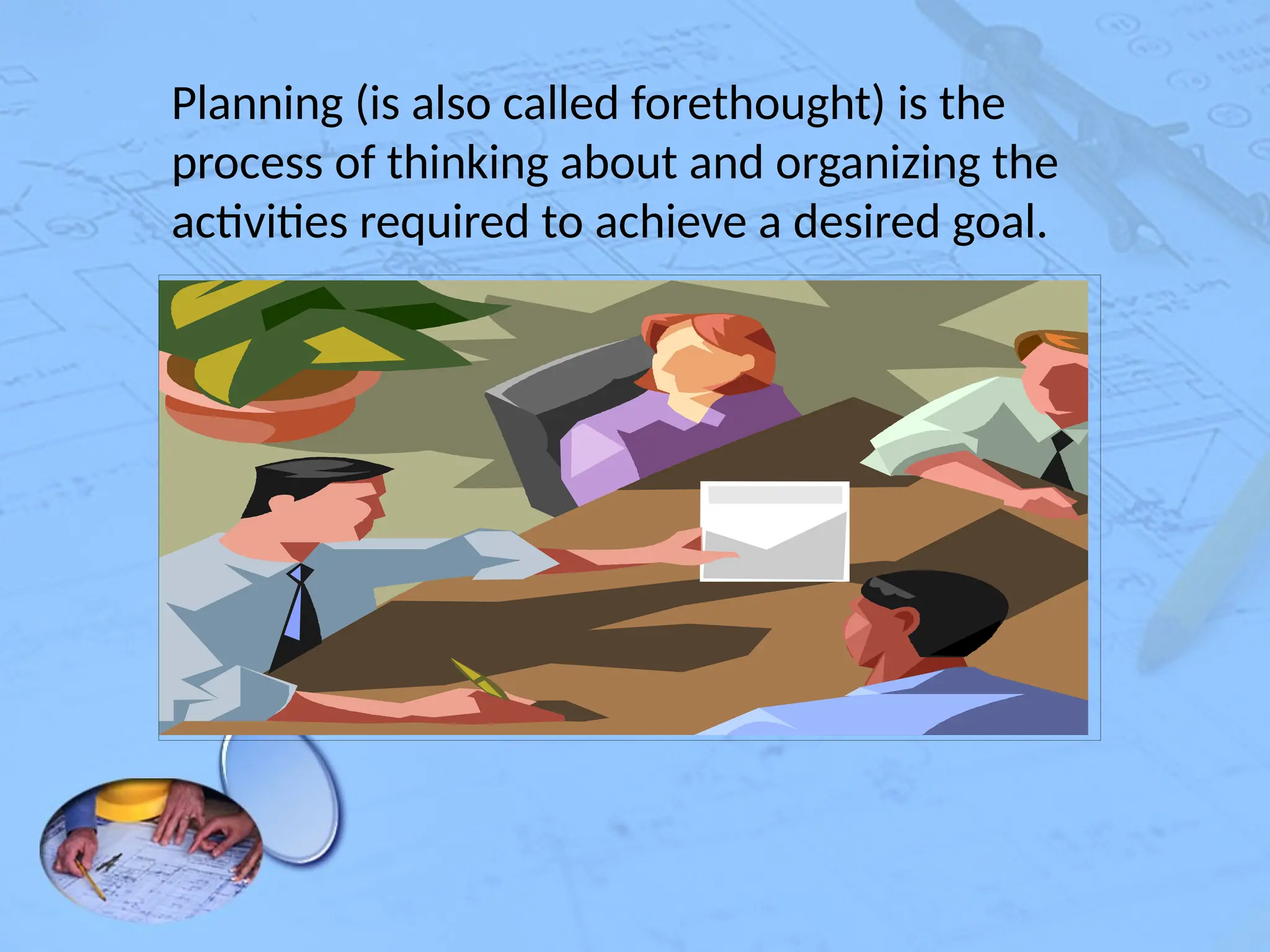
Planning (is also called forethought) is the
process of thinking about and organizing the
activities required to achieve a desired goal.
•Planning is basic or primary function of management.
•Planning is the process of setting goal and selecting
best course of action to reach the goal. It is looking
ahead.
•Planning is deciding in advance, what to do,
who is to do, how to do and when to do.
•Planning bridge the gap between where we are
and where we want to go.
• Planning provide target, they allocate
resources in a coordinate manner.
•Planning also solve as standard for control.
•Planning is mental exercise and intellectual process.
•Planning may be long term and short term.
•Planning may be strategic, tactical and
operational.
•A plan, which is the output of planning provides a
methodological way of achieving desired results.
• Planning at
Various Types of
Management
Levels
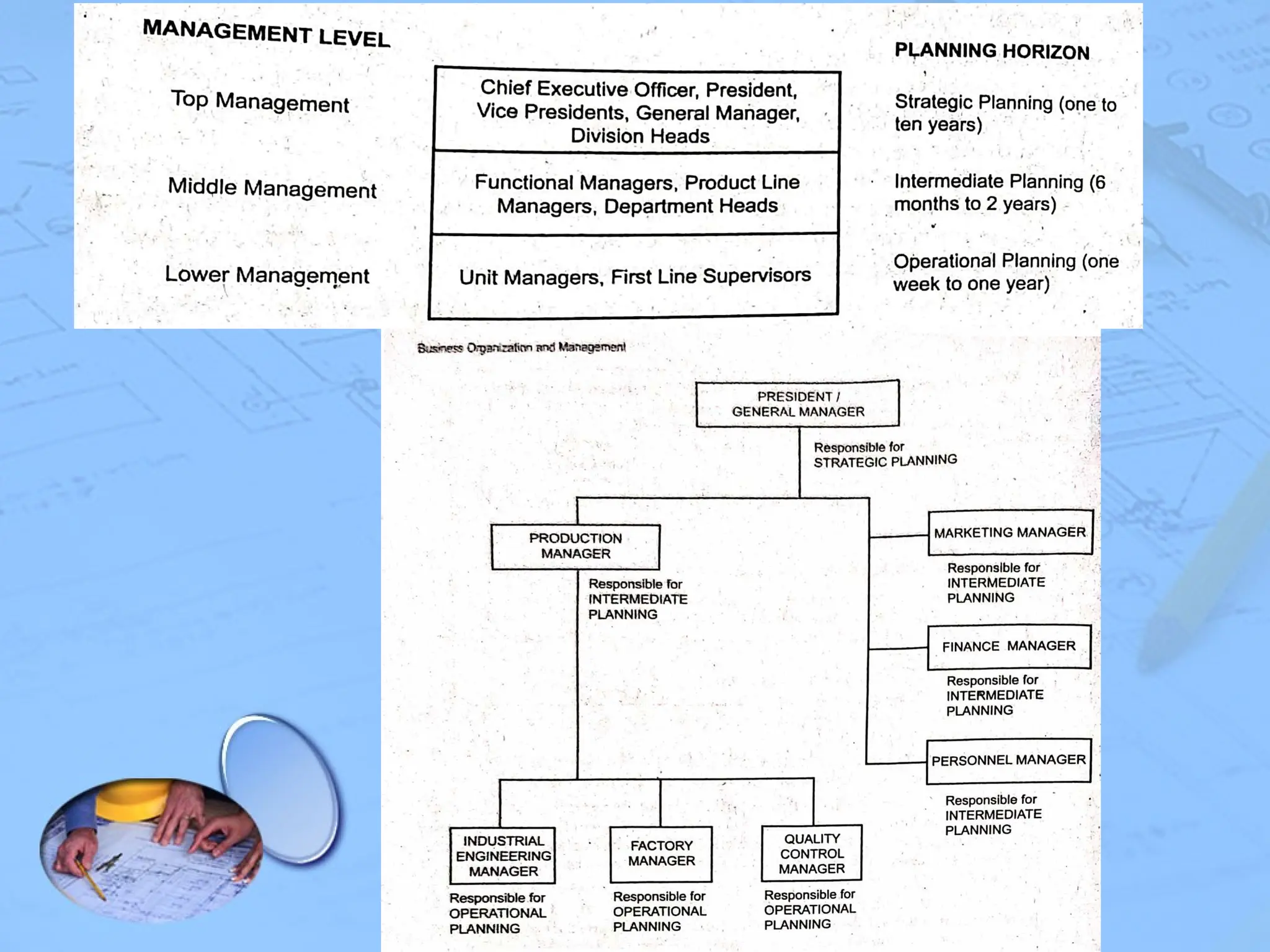
1. Strategic Planning for Top Management - To best
understand the relationship between the different types of
plans, let's start at the top. Strategic plans are designed
with the entire organization in mind and begin with an
organization's mission. Top-level managers, such as CEOs
or presidents, will design and execute strategic plans to
paint a picture of the desired future and long-term goals of
the organization. Essentially, strategic plans look ahead to
where the organization wants to be in three, five, even ten
years. Strategic plans, provided by top-level managers,
serve as the framework for lower-level planning.
STRATEGIC PLANNING FOR TOP
MANAGEMENT
INTERMEDIATE PLANNING FOR MIDDLE
MANAGEMENT
Intermediate planning refers to the process of determining
the contributions that subunits can make with allocated
resources. This type of planning is the concern of middle
management.
Under this planning, the goals of a subunit are determined
and a plan is prepared to provide a guide for the realization
of the goals. The intermediate plan is designed to support
the strategic plan.
Tactical planning for Martha might include
things like testing a new process in making pizzas
that has been proven to shorten the amount of time it
takes for prepping the pizza to be cooked or perhaps
looking into purchasing a better oven that can speed
up the amount of time it takes to cook a pizza or
even considering ways to better map out delivery
routes and drivers. As a tactical planner, Martha
needs to create a set of calculated actions that take a
shorter amount of time and are narrower in scope
than the strategic plan is but still help to bring the
organization closer to the long-term goal.
OPERATIONAL PLANNING FOR LOWER LEVEL
MANAGEMENT
Operational planning is the process of determining how specific tasks
can best be accomplished on time with available resources. This type
of planning is the responsibility of lower management. It must be
performed in support of the strategic and intermediate plans.
Operational plans can be either single-use or ongoing
plans. Single-use plans are those plans that are intended to be
used only once. They include activities that would not be
repeated and often have an expiration. Creating a monthly
budget and developing a promotional advertisement for the
quarter to increase the sales of a certain product are examples
of how Frank would utilize single-use planning.
Operational plans are made by low-level managers.
Ongoing plans are those plans that are built to withstand the
test of time. They are created with the intent to be used
several times and undergo changes when necessary.
•What are the
characteristics of
planning?
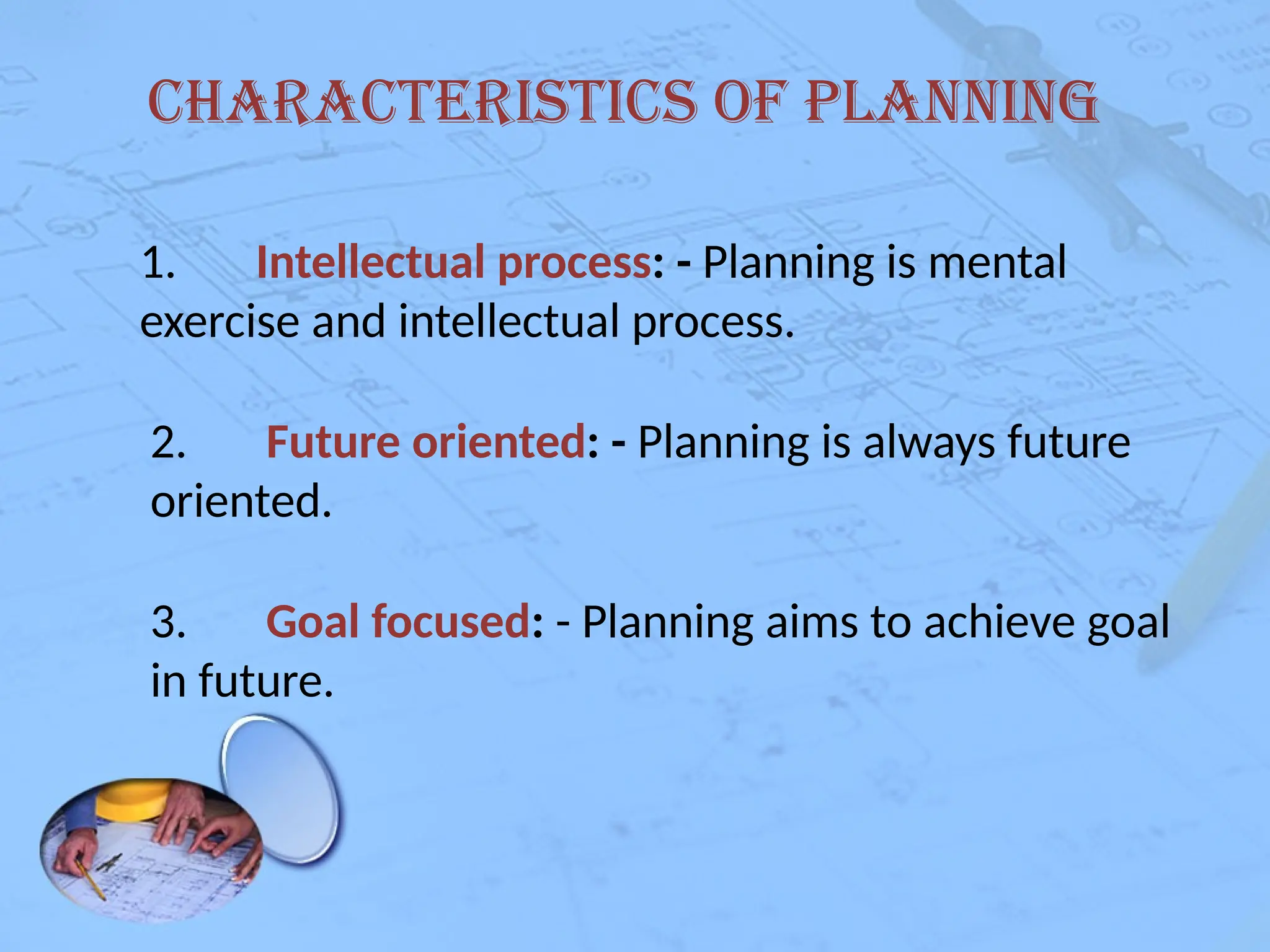
Characteristics of Planning
1. Intellectual process: - Planning is mental
exercise and intellectual process.
2. Future oriented: - Planning is always future
oriented.
3. Goal focused: - Planning aims to achieve goal
in future.
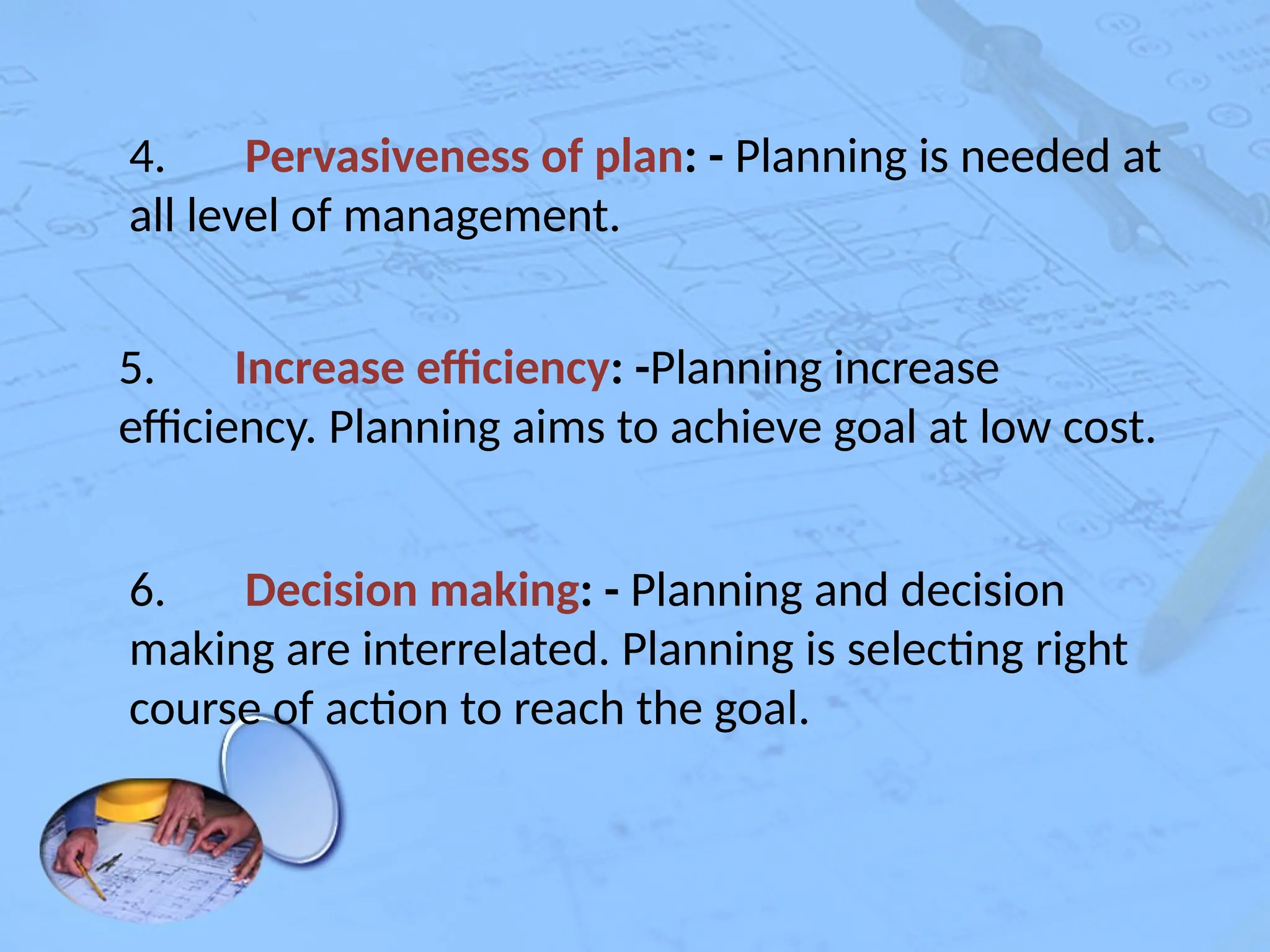
4. Pervasiveness of plan: - Planning is needed at
all level of management.
5. Increase efficiency: -Planning increase
efficiency. Planning aims to achieve goal at low cost.
6. Decision making: - Planning and decision
making are interrelated. Planning is selecting right
course of action to reach the goal.
•What are the
different barriers to
effective planning?
Barriers or Limitations of Planning
1. Planning is an expensive and time consuming process.
-It involves significant amount of money, energy and
also risk, without any assurance of the fulfillment of the
organization’s objectives.
2. Planning sometimes restricts the organization to the
most rational and risk free opportunities.
- It curbs the initiative of the manager and
forces him to operate within the limits set by it.
3. The scope of planning is said to be limited in the
case of organizations with rapidly changing situations.
- For example, it is claimed that for industries
producing fashionable articles or for industries engage
in the publication of textbooks, working on a day-to-
day basis is more economical than plan basis.
4. Flexibility of planning cannot be maintained when
there are unforeseen changes in the environment.
- such as business recession, change in the
government policy, crop failure etc. When such events
take place, the original plan loses its value and there is
a need to draw up a fresh plan.
5. Another limiting factor in planning is the difficulty
of formulating accurate premises.
- Since these premises are the background
against which a set of plan is made, they necessarily
deal with the future. Since the future cannot be
known with accuracy, premising must be subject to a
margin of error.
6. Planning may sometimes face people’s resistance to
it.
- In old, established organizations, managers are
often frustrated in instituting a new plan simply by the
unwillingness or inability of people to accept it.
•THE
PLANNING
PROCESS
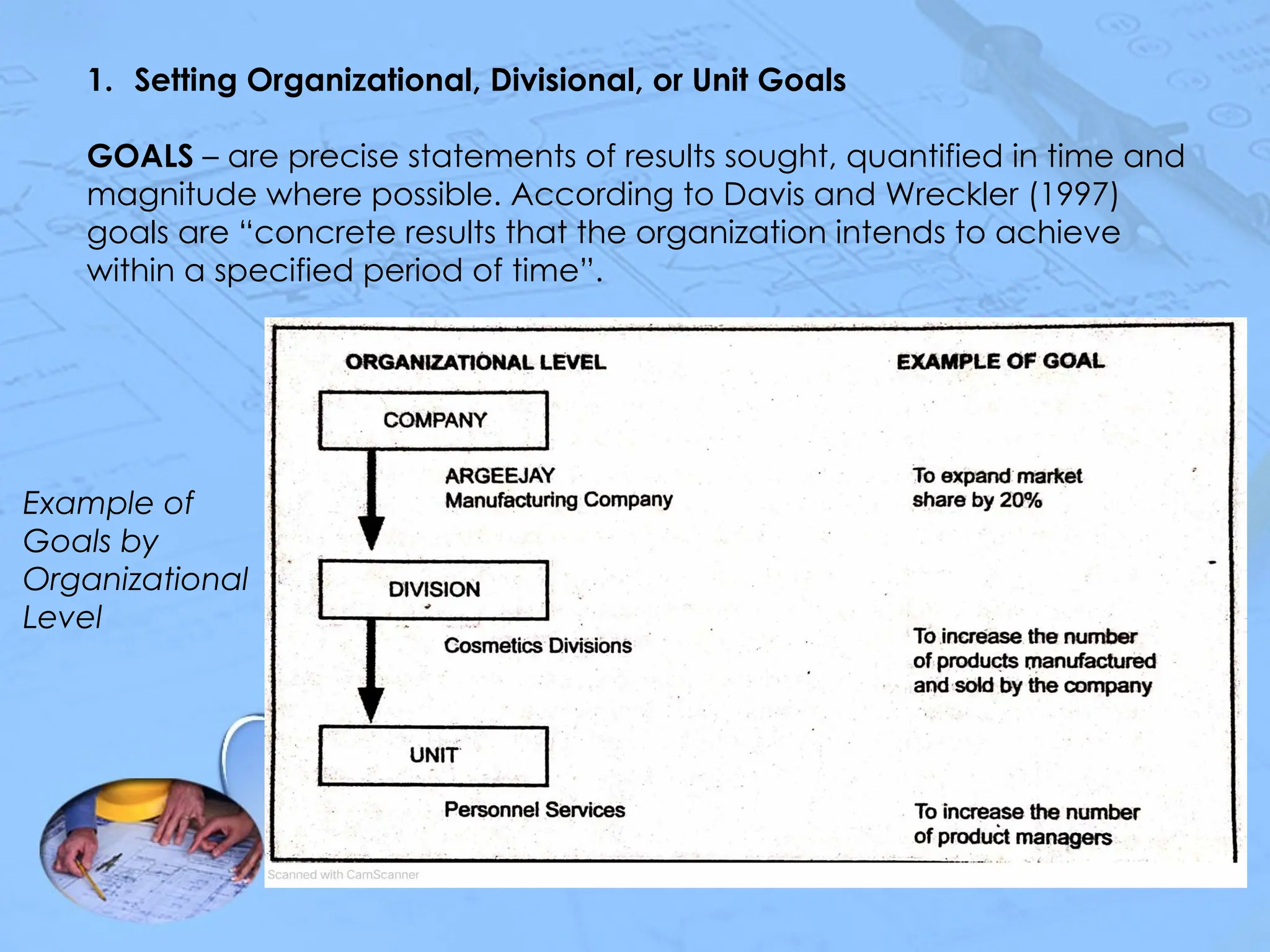
1. Setting Organizational, Divisional, or Unit Goals
GOALS – are precise statements of results sought, quantified in time and
magnitude where possible. According to Davis and Wreckler (1997)
goals are “concrete results that the organization intends to achieve
within a specified period of time”.
Example of
Goals by
Organizational
Level
2. Developing Strategies or Tactics to Reach Goals
Strategy – may be defined as a course of action aimed at ensuring that
the organization will achieve its objectives.
Tactic – is a short-term action by management to adjust to negative or
external influences. They are formulated and implemented in support of
the firm’s strategies.
3. Determining Resources Needed
4. Setting Standards
TYPES OF PLAN
1. FUNCTIONAL AREA PLANS – plans may be prepared according to the
needs of the different functional areas.
Marketing Plan – is a written document or blueprint for implementing
and controlling an organization’s marketing activities related to a
particular marketing strategy.
Production Plan – is a written document that states the quantity of
output a company must produce in broad terms and by product family.
Financial Plan – is a document that summarizes the current financial
situation of the firm, analyzes financial needs, and recommends a
direction for financial activities.
Human Resources Plan – is a document that indicates the human
resource needs of a company detailed in terms if quantity and quality
and based on the requirements of the company’s strategic plan.
TYPES OF PLAN
2. PLAN WITH TIME HORIZON
Short-Range Plans – are plans intended to cover a period of less than
one year. First line supervisors are mostly concerned with these plans.
Long-Range Plans – are plans covering a time span of more than one
year. Middle and top management mostly undertake these.
TYPES OF PLAN
3. PLANS WITH VARIED FREQUENCY OF USE
Standing plans – these are plans that are used again and again, and they focus
on managerial situations that recur repeatedly. This plan are classified as follows:
 Policies – refer to broad guidelines used by managers to help make decisions
and take actions on specific circumstances.
 Procedures – are plans that describe the exact series of actions to be taken in
a given situation.
 Rules – are statements that either required or forbid a certain action.
Single-Use plans – these plans are specifically developed to implement courses
of action that are relatively unique and are unlikely to be repeated. This plan
are classified as follows:
Budget plan – sets forth the projected expenditures for
a certain activity and explains where the required funds will come from.
Program plan – is designed to coordinate a large set of
activities.
Project Plan – is usually more limited in scope than a
program plan and is sometimes prepared to support a program.
COMPANY OR CORPORATE MISSION – refers to the strategic
statements that identify why an organization exists, its philosophy of
management, and its purpose as distinguished from other similar
organizations in terms of products, services and markets.
“Thinking well is wise; planning well, wiser; but doing
well is the wisest and best of all.” - unknown

Planning - Organizations and Management Concepts

  • 1.
  • 3.
  • 4.
    It is thebasic management function which includes formulation of one or more detailed plans to achieve optimum balance of needs or demands with the available resources.
  • 5.
    • Planning isimportant in management because it provides security and organization to the company. • A manager needs to plan the expectations and regulations that the company needs.
  • 6.
  • 7.
    Planning (is alsocalled forethought) is the process of thinking about and organizing the activities required to achieve a desired goal.
  • 8.
    •Planning is basicor primary function of management. •Planning is the process of setting goal and selecting best course of action to reach the goal. It is looking ahead. •Planning is deciding in advance, what to do, who is to do, how to do and when to do.
  • 9.
    •Planning bridge thegap between where we are and where we want to go. • Planning provide target, they allocate resources in a coordinate manner. •Planning also solve as standard for control.
  • 10.
    •Planning is mentalexercise and intellectual process. •Planning may be long term and short term. •Planning may be strategic, tactical and operational. •A plan, which is the output of planning provides a methodological way of achieving desired results.
  • 11.
    • Planning at VariousTypes of Management Levels
  • 12.
    1. Strategic Planningfor Top Management - To best understand the relationship between the different types of plans, let's start at the top. Strategic plans are designed with the entire organization in mind and begin with an organization's mission. Top-level managers, such as CEOs or presidents, will design and execute strategic plans to paint a picture of the desired future and long-term goals of the organization. Essentially, strategic plans look ahead to where the organization wants to be in three, five, even ten years. Strategic plans, provided by top-level managers, serve as the framework for lower-level planning. STRATEGIC PLANNING FOR TOP MANAGEMENT
  • 13.
    INTERMEDIATE PLANNING FORMIDDLE MANAGEMENT Intermediate planning refers to the process of determining the contributions that subunits can make with allocated resources. This type of planning is the concern of middle management. Under this planning, the goals of a subunit are determined and a plan is prepared to provide a guide for the realization of the goals. The intermediate plan is designed to support the strategic plan.
  • 14.
    Tactical planning forMartha might include things like testing a new process in making pizzas that has been proven to shorten the amount of time it takes for prepping the pizza to be cooked or perhaps looking into purchasing a better oven that can speed up the amount of time it takes to cook a pizza or even considering ways to better map out delivery routes and drivers. As a tactical planner, Martha needs to create a set of calculated actions that take a shorter amount of time and are narrower in scope than the strategic plan is but still help to bring the organization closer to the long-term goal.
  • 15.
    OPERATIONAL PLANNING FORLOWER LEVEL MANAGEMENT Operational planning is the process of determining how specific tasks can best be accomplished on time with available resources. This type of planning is the responsibility of lower management. It must be performed in support of the strategic and intermediate plans.
  • 16.
    Operational plans canbe either single-use or ongoing plans. Single-use plans are those plans that are intended to be used only once. They include activities that would not be repeated and often have an expiration. Creating a monthly budget and developing a promotional advertisement for the quarter to increase the sales of a certain product are examples of how Frank would utilize single-use planning. Operational plans are made by low-level managers. Ongoing plans are those plans that are built to withstand the test of time. They are created with the intent to be used several times and undergo changes when necessary.
  • 18.
  • 19.
    Characteristics of Planning 1.Intellectual process: - Planning is mental exercise and intellectual process. 2. Future oriented: - Planning is always future oriented. 3. Goal focused: - Planning aims to achieve goal in future.
  • 20.
    4. Pervasiveness ofplan: - Planning is needed at all level of management. 5. Increase efficiency: -Planning increase efficiency. Planning aims to achieve goal at low cost. 6. Decision making: - Planning and decision making are interrelated. Planning is selecting right course of action to reach the goal.
  • 21.
    •What are the differentbarriers to effective planning?
  • 22.
    Barriers or Limitationsof Planning 1. Planning is an expensive and time consuming process. -It involves significant amount of money, energy and also risk, without any assurance of the fulfillment of the organization’s objectives. 2. Planning sometimes restricts the organization to the most rational and risk free opportunities. - It curbs the initiative of the manager and forces him to operate within the limits set by it.
  • 23.
    3. The scopeof planning is said to be limited in the case of organizations with rapidly changing situations. - For example, it is claimed that for industries producing fashionable articles or for industries engage in the publication of textbooks, working on a day-to- day basis is more economical than plan basis. 4. Flexibility of planning cannot be maintained when there are unforeseen changes in the environment. - such as business recession, change in the government policy, crop failure etc. When such events take place, the original plan loses its value and there is a need to draw up a fresh plan.
  • 24.
    5. Another limitingfactor in planning is the difficulty of formulating accurate premises. - Since these premises are the background against which a set of plan is made, they necessarily deal with the future. Since the future cannot be known with accuracy, premising must be subject to a margin of error. 6. Planning may sometimes face people’s resistance to it. - In old, established organizations, managers are often frustrated in instituting a new plan simply by the unwillingness or inability of people to accept it.
  • 25.
  • 26.
    1. Setting Organizational,Divisional, or Unit Goals GOALS – are precise statements of results sought, quantified in time and magnitude where possible. According to Davis and Wreckler (1997) goals are “concrete results that the organization intends to achieve within a specified period of time”. Example of Goals by Organizational Level
  • 27.
    2. Developing Strategiesor Tactics to Reach Goals Strategy – may be defined as a course of action aimed at ensuring that the organization will achieve its objectives. Tactic – is a short-term action by management to adjust to negative or external influences. They are formulated and implemented in support of the firm’s strategies. 3. Determining Resources Needed 4. Setting Standards
  • 28.
    TYPES OF PLAN 1.FUNCTIONAL AREA PLANS – plans may be prepared according to the needs of the different functional areas. Marketing Plan – is a written document or blueprint for implementing and controlling an organization’s marketing activities related to a particular marketing strategy. Production Plan – is a written document that states the quantity of output a company must produce in broad terms and by product family. Financial Plan – is a document that summarizes the current financial situation of the firm, analyzes financial needs, and recommends a direction for financial activities. Human Resources Plan – is a document that indicates the human resource needs of a company detailed in terms if quantity and quality and based on the requirements of the company’s strategic plan.
  • 29.
    TYPES OF PLAN 2.PLAN WITH TIME HORIZON Short-Range Plans – are plans intended to cover a period of less than one year. First line supervisors are mostly concerned with these plans. Long-Range Plans – are plans covering a time span of more than one year. Middle and top management mostly undertake these.
  • 30.
    TYPES OF PLAN 3.PLANS WITH VARIED FREQUENCY OF USE Standing plans – these are plans that are used again and again, and they focus on managerial situations that recur repeatedly. This plan are classified as follows:  Policies – refer to broad guidelines used by managers to help make decisions and take actions on specific circumstances.  Procedures – are plans that describe the exact series of actions to be taken in a given situation.  Rules – are statements that either required or forbid a certain action. Single-Use plans – these plans are specifically developed to implement courses of action that are relatively unique and are unlikely to be repeated. This plan are classified as follows: Budget plan – sets forth the projected expenditures for a certain activity and explains where the required funds will come from. Program plan – is designed to coordinate a large set of activities. Project Plan – is usually more limited in scope than a program plan and is sometimes prepared to support a program.
  • 31.
    COMPANY OR CORPORATEMISSION – refers to the strategic statements that identify why an organization exists, its philosophy of management, and its purpose as distinguished from other similar organizations in terms of products, services and markets.
  • 32.
    “Thinking well iswise; planning well, wiser; but doing well is the wisest and best of all.” - unknown