CAPE
COMMUNICATION STUDIES
MODULE TWO
LANGUAGE AND COMMUNITY
https://youtu.be/qFYg7Ta97ZY Module 2 Part 1
https://youtu.be/Dwb9U6-cdkc Module 2 Part 2
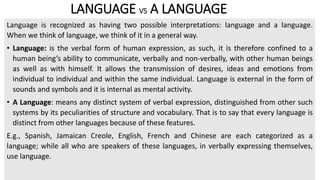
LANGUAGE VS A LANGUAGE
Language is recognized as having two possible interpretations: language and a language.
When we think of language, we think of it in a general way.
• Language: is the verbal form of human expression, as such, it is therefore confined to a
human being’s ability to communicate, verbally and non-verbally, with other human beings
as well as with himself. It allows the transmission of desires, ideas and emotions from
individual to individual and within the same individual. Language is external in the form of
sounds and symbols and it is internal as mental activity.
• A Language: means any distinct system of verbal expression, distinguished from other such
systems by its peculiarities of structure and vocabulary. That is to say that every language is
distinct from other languages because of these features.
E.g., Spanish, Jamaican Creole, English, French and Chinese are each categorized as a
language; while all who are speakers of these languages, in verbally expressing themselves,
use language.
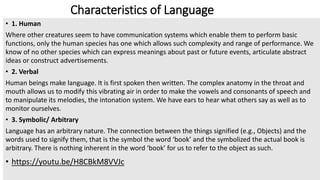
Characteristics of Language
• 1. Human
Where other creatures seem to have communication systems which enable them to perform basic
functions, only the human species has one which allows such complexity and range of performance. We
know of no other species which can express meanings about past or future events, articulate abstract
ideas or construct advertisements.
• 2. Verbal
Human beings make language. It is first spoken then written. The complex anatomy in the throat and
mouth allows us to modify this vibrating air in order to make the vowels and consonants of speech and
to manipulate its melodies, the intonation system. We have ears to hear what others say as well as to
monitor ourselves.
• 3. Symbolic/ Arbitrary
Language has an arbitrary nature. The connection between the things signified (e.g., Objects) and the
words used to signify them, that is the symbol the word ‘book’ and the symbolized the actual book is
arbitrary. There is nothing inherent in the word ‘book’ for us to refer to the object as such.
• https://youtu.be/H8CBkM8VVJc
Characteristics of Language
• 4. Systematic
Language is rule governed. It follows observable patterns that obey certain inherent ‘rules’. To be fluent in
language requires both a mastery of its grammatical rules and competence in the appropriate use of the sentences
that are structured by those rules.
• 5. Maturational
A language is always developing. Most languages do so as they acquire vocabulary.
https://youtu.be/iSSTv8-2358?list=TLPQMTExMDIwMjKz4f81xIiG2g
• 6. Non-instinctive
Language is naturally acquired. It is suggested that there is a built-in mechanism which gives human beings the
ability to acquire and learn language; we are biologically conditioned to learn language.
• 7. Dynamic
Language is not static, it is always changing. Language changes because the lives of speakers change, for example,
as speakers come into contact with other cultures or as new discoveries change their way of life.
Characteristics of Language
• 8. Creative
Humans produce infinite sentences.
• 9. Communicative
Language is used to transfer information.
• 10. Interpersonal
Language builds relations and rapport.
• 11. Non-verbal
Language does not always include speech.
• 12. Community specific
Language contains signs and codes specific to a particular social group.
Functions of Language: Informative
• Informative/Referential - The most obvious function of language is
informative. It is also, in turn, is known as referential. We came across this
function more than other functions in the text. This function of language is
applied to convey a message or information about something in a direct or an
indirect way.
• Examples of informative functions of language include:
• Giving instructions
• Sharing information
• Expressing opinions
• Making requests, offers, or invitations
• Conveying facts and knowledge
Functions of Language: Poetic
• Poetic - It is also known as an aesthetic function of language. It is used to concentrate on the
message itself, using oratorical aspects to illuminate its beauty. These are not only used in
text but also common in use in the form of quotes and sayings.
• The poetic function focuses on the form and style of the language, rather than the content
or context. The poetic function often uses rhetorical figures of speech or “flowery”
language to create imagery, emotion, or rhythm. Examples of the poetic function of
language include:
• The naughty moon watches us in the park.
• Here I am stunned by so much silence.
• Tonight the moon shines high as if it were a diamond.
Functions of Language: Expressive
• Expressive - The function of a language that indicates the emotions, feelings, desires and
moods etc. is known as expressive function. This type of language gives us information
about the moods or emotions of the subject. This gives us information about the tone of
the sender directly.
The expressive function of language is used to share feelings and
emotions. Examples of expressive language include:
• Using grammar correctly when speaking
• Being able to communicate bodily needs, like needing the toilet or being hungry
• Retelling or describing a story
• Passing on messages with accurate details
• Various exclamations, swear words, words of admiration, gratitude, etc.
Functions of Language: Conative
• Directive/Conative - This type of function is used to grab the
attention of others. Its purpose is to prompt a reaction from them.
This language is used to command an order or to ask questions. This
function of language uses interrogative tone.
• Whether a person is experiencing feelings of happiness, sadness,
grief or otherwise, they use this function to express themselves. The
conative function: engages the Addressee (receiver) directly and is
best illustrated by vocatives and imperatives, e.g. "Tom! Come inside
and eat!"
Functions of Language: Phatic
• Phatic - This type of function is exerted to start or stop a discussion. As well as this function
of language is applied to check the connection between a receiver and the sender.
• Phatic function of language is used to establish a social connection without really
communicating any meaningful information. Examples of phatic function of language
include:
• An unusual conversation between two friends during dinner
• Casual discussions of the weather between two speakers
• "Nice day" and "Good morning" which are salutations and greetings that have minimal
content
• "Take care" as a way of terminating a conversation
• Greetings and farewells
Functions of Language: Metalinguistic
• Metalinguistic - This is the last function which describes the language itself. This language
includes the definitions or meanings of words and also the interpretation of the language.
• Metalinguistic function of language refers to using language to refer to itself or discuss
language. Examples include:
• Describing grammar rules
• Recognizing or self-correcting language in verbal and written form
• Categorizing words (e.g., identifying "sofa" as a noun and "sit" as a verb)
• Discussing language features (e.g., capitalization rules, synonyms, stress patterns)
https://youtu.be/bVpyV_ANqHs?list=TLPQMTExMDIwMjKz4f81xIiG2g
THE CARIBBEAN LANGUAGE EXPERIENCE
• Lingua Franca - a language that is adopted as a common language between speakers whose
native languages are different. A third language.
• https://youtu.be/a9ZdC6wZnks lingua franca
• Pidgin - a simplified speech used for communication between people with different
languages.
• https://youtu.be/AjHoFL8pECQ pidgin
• Creole - In its broadest sense, a Creole language is one that develops when people who don't
understand each other's languages spend enough time together that their languages combine
so they can understand each other. That's the simplest Creole language definition. You'll find
there are many types of Creole languages spoken in different areas in the world and each is a
unique combination of various languages.
• https://youtu.be/8IuQCyIdePE Haitian creole
• https://youtu.be/qqJI7SdS9Gg creoles vs pidgins
THE JAMAICAN LANGUAGE SITUATION
The Jamaican language situation is referred to as a continuum. It depicts the
range of languages and language dialects spoken in Jamaica. There are other
Caribbean territories which are described in a similar manner. This range is
represented as a continuum because:
1. Not every point on the continuum is a separate language
2. Jamaicans will switch from one to the other continuously in conversation and
in different situations.
• BASILECT>MESOLECT>ACROLECT
• BASILECT is the form of Creole with more African derived features than other
forms and is said to be the first point on the continuum. It is most often spoken in
rural areas and by uneducated persons.
THE JAMAICAN LANGUAGE SITUATION
• MESOLECT is the form of Creole with more English derived features than the basilect and is
said to be the point on the continuum next to the basilect. It is most often spoken by urban
and educated persons.
• ACROLECT is the Jamaican Standard English and it is the last point on the continuum. It is
most often spoken in formal situations.
Undoubtedly this notion that each form is most often spoken by particular persons is
debatable as the increased accessibility of new technological mediums of communication
throughout the country has enabled Jamaicans to choose even more freely any variety they
wish to use along the continuum.
https://youtu.be/W58MtDzanqA Louise Bennet
https://youtu.be/no5YWKY6eOs Bob Marley
CHARACTERISTICS OF CREOLE LANGUAGE
There are several features of Creoles and Creole-influenced vernacular which make them different from
Standard English. These features may be categorized as grammar, sound, vocabulary and semantics.
• Grammar: Within Creole grammar, for example, nouns, verbs and pronouns are not treated in the same
way in which they are in Standard English (SE). To illustrate plurality as in the noun ‘books’, in Jamaican
Creole (JC) plurality is shown by the use of the word ‘dem’ as in ‘buk dem’. (Polard: 1993)
• Sound: The Creole sound does not use the “th” sound, this is usually substituted by the letter “d”. the “h”
or “ing” sound is normally not pronounced. To illustrate sound formation in JC we generally hear the words
“dem”, “tief”, “comin”, “ungry”.
• Vocabulary: Most of the vocabulary used in JC can only be found in that language. To illustrate this we
often find words like “nyaam” and “pickney”.
• Semantics: In the JC, words that are used may be shared with SE, however, they have different denotative
and connotative meanings. To illustrate this, the word “ignorant” in SE may refer to someone who is lacking
in knowledge. While in JC it refers to someone who gets easily upset/angry.
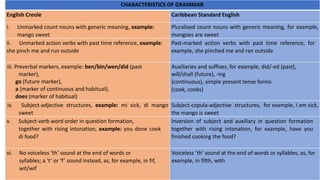
CHARACTERISTICS OF GRAMMAR
English Creole Caribbean Standard English
i. Unmarked count nouns with generic meaning, example:
mango sweet
Pluralised count nouns with generic meaning, for example,
mangoes are sweet
ii. Unmarked action verbs with past time reference, example:
she pinch me and run outside
Past-marked action verbs with past time reference, for
example, she pinched me and ran outside
iii. Preverbal markers, example: ben/bin/wen/did (past
marker),
go (future marker),
a (marker of continuous and habitual),
does (marker of habitual)
Auxiliaries and suffixes, for example, did/-ed (past),
will/shall (future), -ing
(continuous), simple present tense forms
(cook, cooks)
iv. Subject-adjective structures, example: mi sick, di mango
sweet
Subject-copula-adjective structures, for example, I am sick,
the mango is sweet
v. Subject-verb word order in question formation,
together with rising intonation, example: you done cook
di food?
Inversion of subject and auxiliary in question formation
together with rising intonation, for example, have you
finished cooking the food?
vi. No voiceless ‘th’ sound at the end of words or
syllables; a ‘t’ or ‘f’ sound instead, as, for example, in fif,
wit/wif
Voiceless ‘th’ sound at the end of words or syllables, as, for
example, in fifth, with
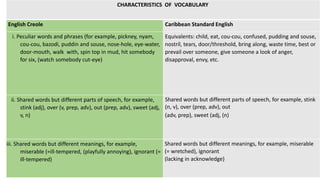
CHARACTERISTICS OF VOCABULARY
English Creole Caribbean Standard English
i. Peculiar words and phrases (for example, pickney, nyam,
cou-cou, bazodi, puddin and souse, nose-hole, eye-water,
door-mouth, walk with, spin top in mud, hit somebody
for six, (watch somebody cut-eye)
Equivalents: child, eat, cou-cou, confused, pudding and souse,
nostril, tears, door/threshold, bring along, waste time, best or
prevail over someone, give someone a look of anger,
disapproval, envy, etc.
ii. Shared words but different parts of speech, for example,
stink (adj), over (v, prep, adv), out (prep, adv), sweet (adj,
v, n)
Shared words but different parts of speech, for example, stink
(n, v), over (prep, adv), out
(adv, prep), sweet (adj, (n)
iii. Shared words but different meanings, for example,
miserable (=ill-tempered, (playfully annoying), ignorant (=
ill-tempered)
Shared words but different meanings, for example, miserable
(= wretched), ignorant
(lacking in acknowledge)
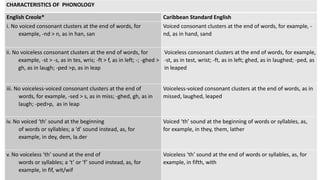
CHARACTERISTICS OF PHONOLOGY
English Creole* Caribbean Standard English
i. No voiced consonant clusters at the end of words, for
example, -nd > n, as in han, san
Voiced consonant clusters at the end of words, for example, -
nd, as in hand, sand
ii. No voiceless consonant clusters at the end of words, for
example, -st > -s, as in tes, wris; -ft > f, as in left; -; -ghed >
gh, as in laugh; -ped >p, as in leap
Voiceless consonant clusters at the end of words, for example,
-st, as in test, wrist; -ft, as in left; ghed, as in laughed; -ped, as
in leaped
iii. No voiceless-voiced consonant clusters at the end of
words, for example, -sed > s, as in miss; -ghed, gh, as in
laugh; -ped>p, as in leap
Voiceless-voiced consonant clusters at the end of words, as in
missed, laughed, leaped
iv. No voiced ‘th’ sound at the beginning
of words or syllables; a ‘d’ sound instead, as, for
example, in dey, dem, la.der
Voiced ‘th’ sound at the beginning of words or syllables, as,
for example, in they, them, lather
v. No voiceless ‘th’ sound at the end of
words or syllables; a ‘t’ or ‘f’ sound instead, as, for
example, in fif, wit/wif
Voiceless ‘th’ sound at the end of words or syllables, as, for
example, in fifth, with

Communication Studies Module 2 Lesson 1.pdf

  • 1.
  • 2.
    https://youtu.be/qFYg7Ta97ZY Module 2Part 1 https://youtu.be/Dwb9U6-cdkc Module 2 Part 2
  • 3.
    LANGUAGE VS ALANGUAGE Language is recognized as having two possible interpretations: language and a language. When we think of language, we think of it in a general way. • Language: is the verbal form of human expression, as such, it is therefore confined to a human being’s ability to communicate, verbally and non-verbally, with other human beings as well as with himself. It allows the transmission of desires, ideas and emotions from individual to individual and within the same individual. Language is external in the form of sounds and symbols and it is internal as mental activity. • A Language: means any distinct system of verbal expression, distinguished from other such systems by its peculiarities of structure and vocabulary. That is to say that every language is distinct from other languages because of these features. E.g., Spanish, Jamaican Creole, English, French and Chinese are each categorized as a language; while all who are speakers of these languages, in verbally expressing themselves, use language.
  • 4.
    Characteristics of Language •1. Human Where other creatures seem to have communication systems which enable them to perform basic functions, only the human species has one which allows such complexity and range of performance. We know of no other species which can express meanings about past or future events, articulate abstract ideas or construct advertisements. • 2. Verbal Human beings make language. It is first spoken then written. The complex anatomy in the throat and mouth allows us to modify this vibrating air in order to make the vowels and consonants of speech and to manipulate its melodies, the intonation system. We have ears to hear what others say as well as to monitor ourselves. • 3. Symbolic/ Arbitrary Language has an arbitrary nature. The connection between the things signified (e.g., Objects) and the words used to signify them, that is the symbol the word ‘book’ and the symbolized the actual book is arbitrary. There is nothing inherent in the word ‘book’ for us to refer to the object as such. • https://youtu.be/H8CBkM8VVJc
  • 5.
    Characteristics of Language •4. Systematic Language is rule governed. It follows observable patterns that obey certain inherent ‘rules’. To be fluent in language requires both a mastery of its grammatical rules and competence in the appropriate use of the sentences that are structured by those rules. • 5. Maturational A language is always developing. Most languages do so as they acquire vocabulary. https://youtu.be/iSSTv8-2358?list=TLPQMTExMDIwMjKz4f81xIiG2g • 6. Non-instinctive Language is naturally acquired. It is suggested that there is a built-in mechanism which gives human beings the ability to acquire and learn language; we are biologically conditioned to learn language. • 7. Dynamic Language is not static, it is always changing. Language changes because the lives of speakers change, for example, as speakers come into contact with other cultures or as new discoveries change their way of life.
  • 6.
    Characteristics of Language •8. Creative Humans produce infinite sentences. • 9. Communicative Language is used to transfer information. • 10. Interpersonal Language builds relations and rapport. • 11. Non-verbal Language does not always include speech. • 12. Community specific Language contains signs and codes specific to a particular social group.
  • 7.
    Functions of Language:Informative • Informative/Referential - The most obvious function of language is informative. It is also, in turn, is known as referential. We came across this function more than other functions in the text. This function of language is applied to convey a message or information about something in a direct or an indirect way. • Examples of informative functions of language include: • Giving instructions • Sharing information • Expressing opinions • Making requests, offers, or invitations • Conveying facts and knowledge
  • 8.
    Functions of Language:Poetic • Poetic - It is also known as an aesthetic function of language. It is used to concentrate on the message itself, using oratorical aspects to illuminate its beauty. These are not only used in text but also common in use in the form of quotes and sayings. • The poetic function focuses on the form and style of the language, rather than the content or context. The poetic function often uses rhetorical figures of speech or “flowery” language to create imagery, emotion, or rhythm. Examples of the poetic function of language include: • The naughty moon watches us in the park. • Here I am stunned by so much silence. • Tonight the moon shines high as if it were a diamond.
  • 9.
    Functions of Language:Expressive • Expressive - The function of a language that indicates the emotions, feelings, desires and moods etc. is known as expressive function. This type of language gives us information about the moods or emotions of the subject. This gives us information about the tone of the sender directly. The expressive function of language is used to share feelings and emotions. Examples of expressive language include: • Using grammar correctly when speaking • Being able to communicate bodily needs, like needing the toilet or being hungry • Retelling or describing a story • Passing on messages with accurate details • Various exclamations, swear words, words of admiration, gratitude, etc.
  • 10.
    Functions of Language:Conative • Directive/Conative - This type of function is used to grab the attention of others. Its purpose is to prompt a reaction from them. This language is used to command an order or to ask questions. This function of language uses interrogative tone. • Whether a person is experiencing feelings of happiness, sadness, grief or otherwise, they use this function to express themselves. The conative function: engages the Addressee (receiver) directly and is best illustrated by vocatives and imperatives, e.g. "Tom! Come inside and eat!"
  • 11.
    Functions of Language:Phatic • Phatic - This type of function is exerted to start or stop a discussion. As well as this function of language is applied to check the connection between a receiver and the sender. • Phatic function of language is used to establish a social connection without really communicating any meaningful information. Examples of phatic function of language include: • An unusual conversation between two friends during dinner • Casual discussions of the weather between two speakers • "Nice day" and "Good morning" which are salutations and greetings that have minimal content • "Take care" as a way of terminating a conversation • Greetings and farewells
  • 12.
    Functions of Language:Metalinguistic • Metalinguistic - This is the last function which describes the language itself. This language includes the definitions or meanings of words and also the interpretation of the language. • Metalinguistic function of language refers to using language to refer to itself or discuss language. Examples include: • Describing grammar rules • Recognizing or self-correcting language in verbal and written form • Categorizing words (e.g., identifying "sofa" as a noun and "sit" as a verb) • Discussing language features (e.g., capitalization rules, synonyms, stress patterns) https://youtu.be/bVpyV_ANqHs?list=TLPQMTExMDIwMjKz4f81xIiG2g
  • 13.
    THE CARIBBEAN LANGUAGEEXPERIENCE • Lingua Franca - a language that is adopted as a common language between speakers whose native languages are different. A third language. • https://youtu.be/a9ZdC6wZnks lingua franca • Pidgin - a simplified speech used for communication between people with different languages. • https://youtu.be/AjHoFL8pECQ pidgin • Creole - In its broadest sense, a Creole language is one that develops when people who don't understand each other's languages spend enough time together that their languages combine so they can understand each other. That's the simplest Creole language definition. You'll find there are many types of Creole languages spoken in different areas in the world and each is a unique combination of various languages. • https://youtu.be/8IuQCyIdePE Haitian creole • https://youtu.be/qqJI7SdS9Gg creoles vs pidgins
  • 14.
    THE JAMAICAN LANGUAGESITUATION The Jamaican language situation is referred to as a continuum. It depicts the range of languages and language dialects spoken in Jamaica. There are other Caribbean territories which are described in a similar manner. This range is represented as a continuum because: 1. Not every point on the continuum is a separate language 2. Jamaicans will switch from one to the other continuously in conversation and in different situations. • BASILECT>MESOLECT>ACROLECT • BASILECT is the form of Creole with more African derived features than other forms and is said to be the first point on the continuum. It is most often spoken in rural areas and by uneducated persons.
  • 15.
    THE JAMAICAN LANGUAGESITUATION • MESOLECT is the form of Creole with more English derived features than the basilect and is said to be the point on the continuum next to the basilect. It is most often spoken by urban and educated persons. • ACROLECT is the Jamaican Standard English and it is the last point on the continuum. It is most often spoken in formal situations. Undoubtedly this notion that each form is most often spoken by particular persons is debatable as the increased accessibility of new technological mediums of communication throughout the country has enabled Jamaicans to choose even more freely any variety they wish to use along the continuum. https://youtu.be/W58MtDzanqA Louise Bennet https://youtu.be/no5YWKY6eOs Bob Marley
  • 16.
    CHARACTERISTICS OF CREOLELANGUAGE There are several features of Creoles and Creole-influenced vernacular which make them different from Standard English. These features may be categorized as grammar, sound, vocabulary and semantics. • Grammar: Within Creole grammar, for example, nouns, verbs and pronouns are not treated in the same way in which they are in Standard English (SE). To illustrate plurality as in the noun ‘books’, in Jamaican Creole (JC) plurality is shown by the use of the word ‘dem’ as in ‘buk dem’. (Polard: 1993) • Sound: The Creole sound does not use the “th” sound, this is usually substituted by the letter “d”. the “h” or “ing” sound is normally not pronounced. To illustrate sound formation in JC we generally hear the words “dem”, “tief”, “comin”, “ungry”. • Vocabulary: Most of the vocabulary used in JC can only be found in that language. To illustrate this we often find words like “nyaam” and “pickney”. • Semantics: In the JC, words that are used may be shared with SE, however, they have different denotative and connotative meanings. To illustrate this, the word “ignorant” in SE may refer to someone who is lacking in knowledge. While in JC it refers to someone who gets easily upset/angry.
  • 17.
    CHARACTERISTICS OF GRAMMAR EnglishCreole Caribbean Standard English i. Unmarked count nouns with generic meaning, example: mango sweet Pluralised count nouns with generic meaning, for example, mangoes are sweet ii. Unmarked action verbs with past time reference, example: she pinch me and run outside Past-marked action verbs with past time reference, for example, she pinched me and ran outside iii. Preverbal markers, example: ben/bin/wen/did (past marker), go (future marker), a (marker of continuous and habitual), does (marker of habitual) Auxiliaries and suffixes, for example, did/-ed (past), will/shall (future), -ing (continuous), simple present tense forms (cook, cooks) iv. Subject-adjective structures, example: mi sick, di mango sweet Subject-copula-adjective structures, for example, I am sick, the mango is sweet v. Subject-verb word order in question formation, together with rising intonation, example: you done cook di food? Inversion of subject and auxiliary in question formation together with rising intonation, for example, have you finished cooking the food? vi. No voiceless ‘th’ sound at the end of words or syllables; a ‘t’ or ‘f’ sound instead, as, for example, in fif, wit/wif Voiceless ‘th’ sound at the end of words or syllables, as, for example, in fifth, with
  • 18.
    CHARACTERISTICS OF VOCABULARY EnglishCreole Caribbean Standard English i. Peculiar words and phrases (for example, pickney, nyam, cou-cou, bazodi, puddin and souse, nose-hole, eye-water, door-mouth, walk with, spin top in mud, hit somebody for six, (watch somebody cut-eye) Equivalents: child, eat, cou-cou, confused, pudding and souse, nostril, tears, door/threshold, bring along, waste time, best or prevail over someone, give someone a look of anger, disapproval, envy, etc. ii. Shared words but different parts of speech, for example, stink (adj), over (v, prep, adv), out (prep, adv), sweet (adj, v, n) Shared words but different parts of speech, for example, stink (n, v), over (prep, adv), out (adv, prep), sweet (adj, (n) iii. Shared words but different meanings, for example, miserable (=ill-tempered, (playfully annoying), ignorant (= ill-tempered) Shared words but different meanings, for example, miserable (= wretched), ignorant (lacking in acknowledge)
  • 19.
    CHARACTERISTICS OF PHONOLOGY EnglishCreole* Caribbean Standard English i. No voiced consonant clusters at the end of words, for example, -nd > n, as in han, san Voiced consonant clusters at the end of words, for example, - nd, as in hand, sand ii. No voiceless consonant clusters at the end of words, for example, -st > -s, as in tes, wris; -ft > f, as in left; -; -ghed > gh, as in laugh; -ped >p, as in leap Voiceless consonant clusters at the end of words, for example, -st, as in test, wrist; -ft, as in left; ghed, as in laughed; -ped, as in leaped iii. No voiceless-voiced consonant clusters at the end of words, for example, -sed > s, as in miss; -ghed, gh, as in laugh; -ped>p, as in leap Voiceless-voiced consonant clusters at the end of words, as in missed, laughed, leaped iv. No voiced ‘th’ sound at the beginning of words or syllables; a ‘d’ sound instead, as, for example, in dey, dem, la.der Voiced ‘th’ sound at the beginning of words or syllables, as, for example, in they, them, lather v. No voiceless ‘th’ sound at the end of words or syllables; a ‘t’ or ‘f’ sound instead, as, for example, in fif, wit/wif Voiceless ‘th’ sound at the end of words or syllables, as, for example, in fifth, with