Assst.Prof. & HOD,
Eng.Dept.,B.P.Arts,S.M.A.Sci.,K.K.C.Comm.College,Chalisgaon Dist.Jalgaon
ravindraborse1@gmail.com
INTRODUCTION
O What is language.
O Definitions of lauguage.
O What are the function of language.
O The Basic or common function of
language.
O Imformative function
O Emotive Function
O Phatic Function
O Directive Function
WHAT IS LANGUAGE?
O Language is an integral part of human life. It is
important so a part of life that language has
been the concern of linguists, creative writer,
philosophers and psychologists.
They have attempted to define language
in different ways.
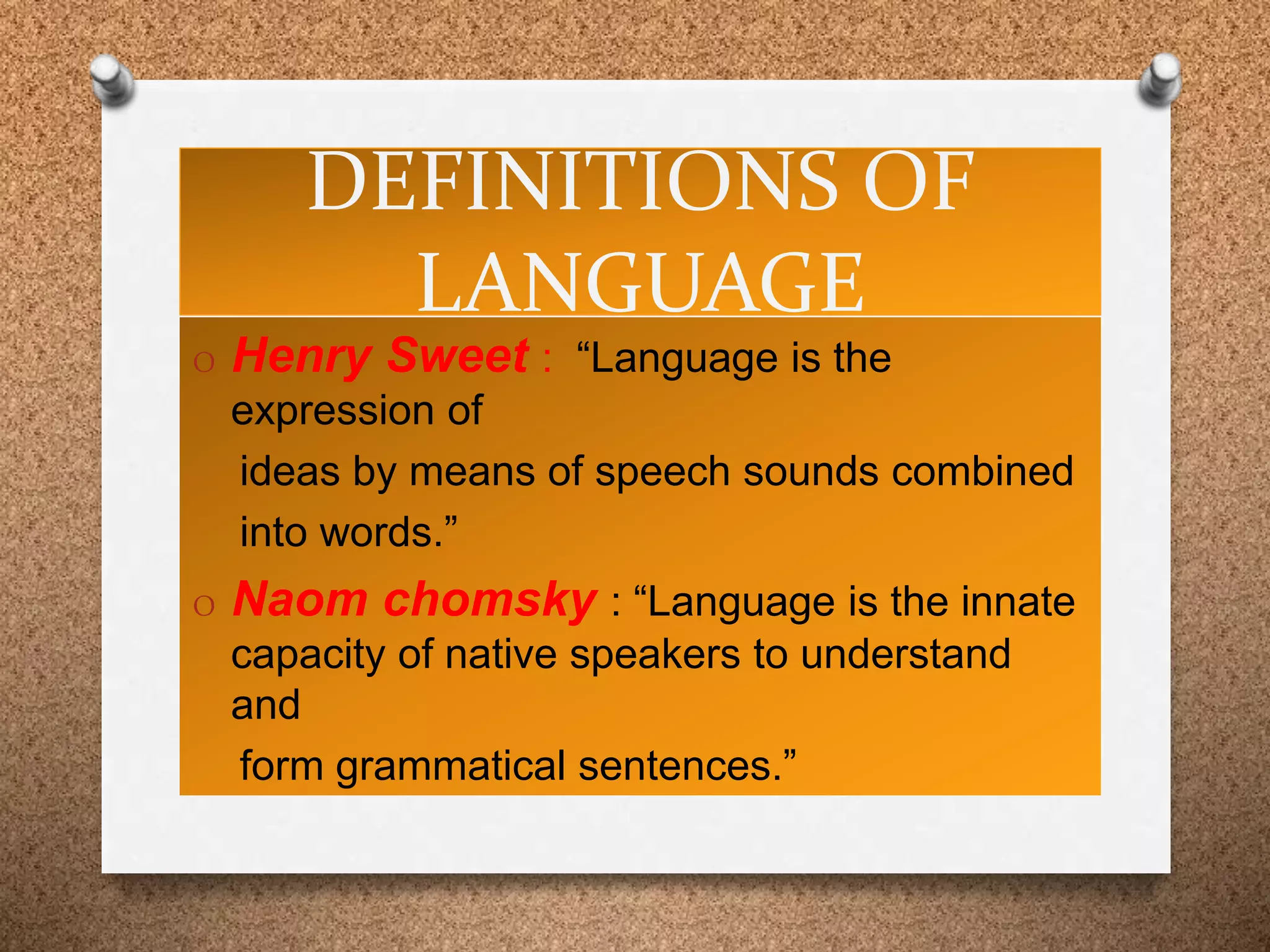
DEFINITIONS OF
LANGUAGE
O Henry Sweet : “Language is the
expression of
ideas by means of speech sounds combined
into words.”
O Naom chomsky : “Language is the innate
capacity of native speakers to understand
and
form grammatical sentences.”
WHAT IS FUNCTIONS
OF LANGUAGE ?
 M.A.K.Halliday (1973) divides the functions of
language in his book ”Explorations in the Functions of
Language” into two categories:-
 Macro- Functions and
 Micro- Functions.
 omnipresent.
 thoughts,
 emotions,
 our dreams and
 religious ceremonies.
In other words, language performs a variety of
functions.
THE BASIC OR COMMON
FUNCTIONSOF LANGUAGE
1. Informative/Communicative function
2. Emotive/Expressive function
3. Phatic or Social function
4. Directive function
INFORMATIVE/COMMUNICATIVE
FUNCTION
This is the use of language for communication of information,
thoughts and ideas. these thoughts, ideas and information are
transmitted either through speech or spoken medium or
through writing or written medium.
 EXAMPLE OF SPOKEN MEDIUM
 Debate
 lecture
 group discussion
 interview
 presentation and
 public speech.
INFORMATIVE/COMMUNICATIVE
FUNCTION
O Example of written medium-
O Letter
report
notice
circular and
pamphlet
In written medium letters are alphabet
and
punctuation marks are used.
EMOTIVE/EXPRESSIVE
FUNCTION
This is the use of language for conveying the emotions
of
emotional experiences of the poet. poetry and other
forms
of literature are the best examples of language for
expressing emotional experiences and evoking those
emotions in the readers.
EMOTIVE/EXPRESSIVE
FUNCTION
They twinkled like the stars in the sky. This
sight made the poet happy.
“And then my heart with pleasure fills
And dances with the daffodils”.
PHATIC OR SOCIAL
FUNCTION
O Language is a entity. We use language for
establishing and maintaining our relationships
with our fellow human beings. we can not
live in society without language. We use different
strategies for establishing and maintaining our
relationship with other.
strategies like –
 Greetings
 Complimenting
 Congratulating
 Thanking
 Blessing.
O example:
 May the soul of the departed (dead) rest
in
peace !
DIRECTIVE FUNCTION
O The directive function of language is the use
of language for giving
command,ordar,advice,
suggestion,threat,warning and direction or
instruction.
DIRECTIVE FUNCTION
1) Close the door (order/command).
2) Close the door,please (request).
3) Do not touch the box.(warning)
4) Go to the college office and submit the
application form for admission.
(instruction/direction).
5) Do not Smoke/No smoking.(advice/warning)
Language

Language

  • 1.
  • 2.
    INTRODUCTION O What islanguage. O Definitions of lauguage. O What are the function of language. O The Basic or common function of language. O Imformative function O Emotive Function O Phatic Function O Directive Function
  • 3.
    WHAT IS LANGUAGE? OLanguage is an integral part of human life. It is important so a part of life that language has been the concern of linguists, creative writer, philosophers and psychologists. They have attempted to define language in different ways.
  • 4.
    DEFINITIONS OF LANGUAGE O HenrySweet : “Language is the expression of ideas by means of speech sounds combined into words.” O Naom chomsky : “Language is the innate capacity of native speakers to understand and form grammatical sentences.”
  • 5.
    WHAT IS FUNCTIONS OFLANGUAGE ?  M.A.K.Halliday (1973) divides the functions of language in his book ”Explorations in the Functions of Language” into two categories:-  Macro- Functions and  Micro- Functions.  omnipresent.  thoughts,  emotions,  our dreams and  religious ceremonies. In other words, language performs a variety of functions.
  • 6.
    THE BASIC ORCOMMON FUNCTIONSOF LANGUAGE 1. Informative/Communicative function 2. Emotive/Expressive function 3. Phatic or Social function 4. Directive function
  • 7.
    INFORMATIVE/COMMUNICATIVE FUNCTION This is theuse of language for communication of information, thoughts and ideas. these thoughts, ideas and information are transmitted either through speech or spoken medium or through writing or written medium.
  • 8.
     EXAMPLE OFSPOKEN MEDIUM  Debate  lecture  group discussion  interview  presentation and  public speech.
  • 9.
    INFORMATIVE/COMMUNICATIVE FUNCTION O Example ofwritten medium- O Letter report notice circular and pamphlet In written medium letters are alphabet and punctuation marks are used.
  • 10.
    EMOTIVE/EXPRESSIVE FUNCTION This is theuse of language for conveying the emotions of emotional experiences of the poet. poetry and other forms of literature are the best examples of language for expressing emotional experiences and evoking those emotions in the readers.
  • 11.
    EMOTIVE/EXPRESSIVE FUNCTION They twinkled likethe stars in the sky. This sight made the poet happy. “And then my heart with pleasure fills And dances with the daffodils”.
  • 12.
    PHATIC OR SOCIAL FUNCTION OLanguage is a entity. We use language for establishing and maintaining our relationships with our fellow human beings. we can not live in society without language. We use different strategies for establishing and maintaining our relationship with other. strategies like –  Greetings  Complimenting  Congratulating  Thanking  Blessing.
  • 13.
    O example:  Maythe soul of the departed (dead) rest in peace !
  • 14.
    DIRECTIVE FUNCTION O Thedirective function of language is the use of language for giving command,ordar,advice, suggestion,threat,warning and direction or instruction.
  • 15.
    DIRECTIVE FUNCTION 1) Closethe door (order/command). 2) Close the door,please (request). 3) Do not touch the box.(warning) 4) Go to the college office and submit the application form for admission. (instruction/direction). 5) Do not Smoke/No smoking.(advice/warning)