Kuliza Social Technology Quarterly Issue 08
Functionality
vs.Aesthetics
in Design
When analysing the
importance of functionality
and aesthetics in design,
we notice that it is the
context that determines
which of the two takes
a dominant role in a
particular instance. But
in the larger picture both
need to complement and
balance each other.
by Anindya Kundu
Photo Credit: Made in Design
the undercurrents of society. However, art
can also have a hidden function, as it often
helps to educate people about nature or
philosophy, and fulfils the emotional and
spiritual needs of human beings.
Form plays a key role in both art and
design. In design, form complements
usability by adding aesthetic appeal,
which helps to motivate the user to use the
product. Hartmut Esslinger, the founder of
Frog Design, sates that form should follow
emotion rather than function or we can
end up with products or architecture that
neither relate to people nor the context.
Hence we meet a paradox of form and
function. Aesthetics and functionality
become intertwined and interdependent of
each other as in the case of the Buddhist
Yin-Yang symbol.
In the debate of form versus function, the
latter can be equated with the aggressive
Broadly, design can be defined as a
process in which form meets function. It
is about planning or configuring from the
initial stages of an idea ultimately leading
to a solution to a problem. Problems
can range from simple ones such as
communicating about an event through
the design of an event poster to ones
as complex as designing a concept to
solve urban transportation problems and
pollution.
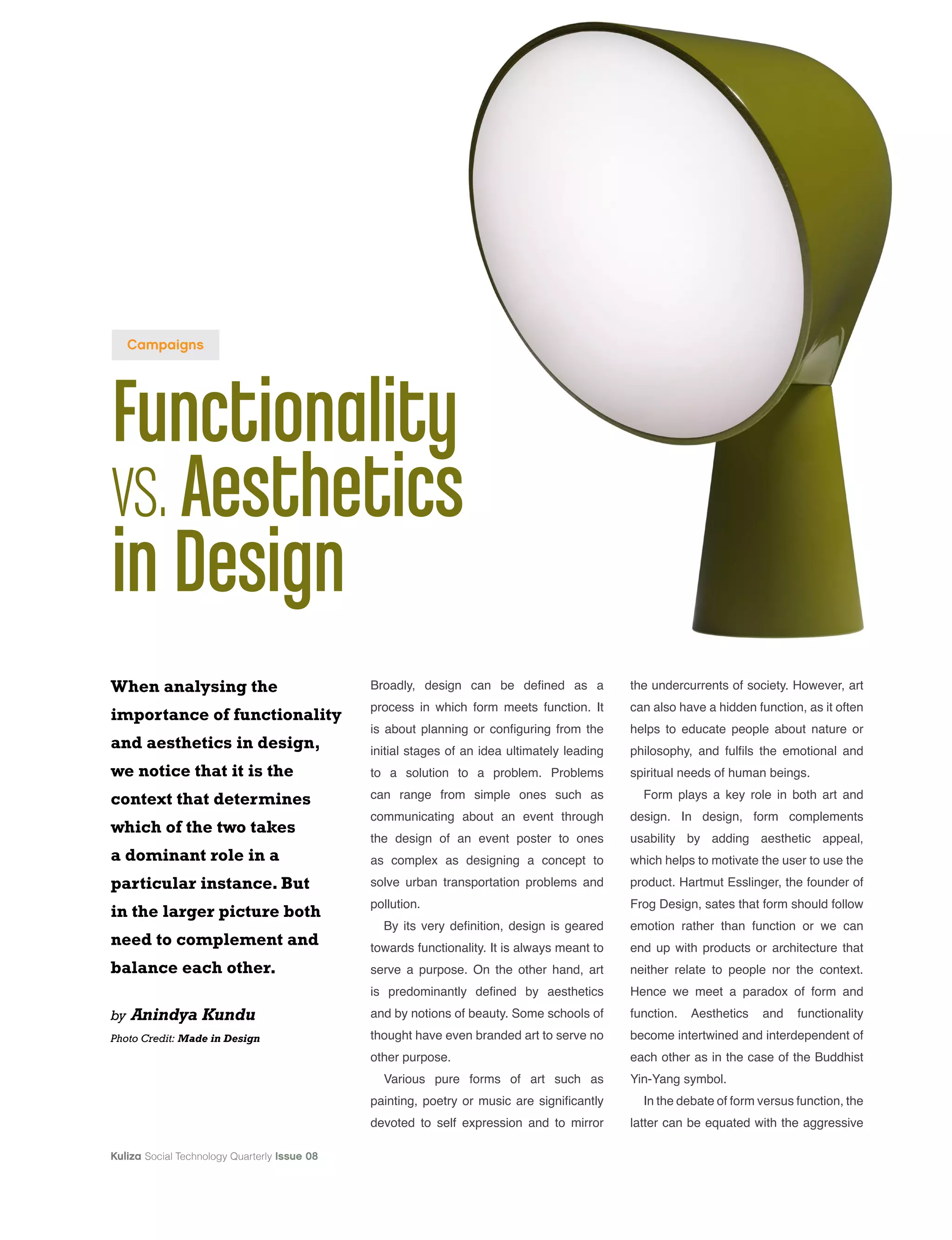
By its very definition, design is geared
towards functionality. It is always meant to
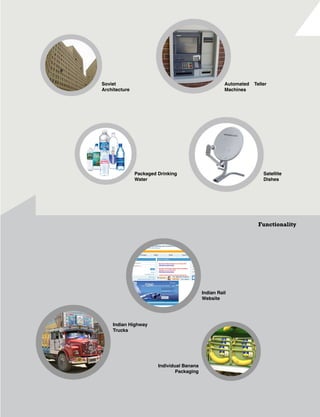
serve a purpose. On the other hand, art
is predominantly defined by aesthetics
and by notions of beauty. Some schools of
thought have even branded art to serve no
other purpose.
Various pure forms of art such as
painting, poetry or music are significantly
devoted to self expression and to mirror
Campaigns
12
Soviet
Architecture
Automated Teller
Machines
Packaged Drinking
Water
Satellite
Dishes
Individual Banana
Packaging
Indian Rail
Website
Indian Highway
Trucks
Functionality
Kuliza Social Technology Quarterly Issue 08 13
Eames Chair
and Ottoman
Christian Bird’s
Ceramic knife
Thonet wooden
bicycle
High Speed
Trains
iPad
Ancient Greek
Vase
Ferrari
Book of
Kells
Aesthetics
Egyptian
Jewellery
Philippe Starck
Juicer
14
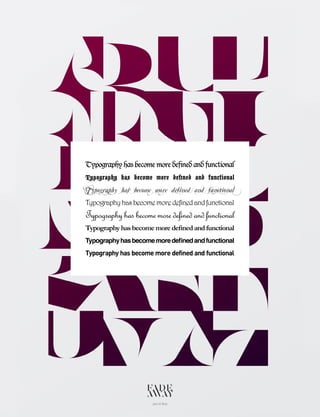
Typography has become more defined and functional
Typographyhasbecomemoredefinedandfunctional
Typography has become more defined and functional
Kuliza Social Technology Quarterly Issue 08
notable example is the ‘Book of Kells’
produced in the late 6th to 9th centuries,
which was adorned with intricately detailed
artwork.
With the development of techniques
such as wood block printing, new
designs evolved. Typography became
more defined and functional. Limited by
the technique, minimalistic black and
white wood-cut prints and the limited
colour but exquisitely detailed Japanese
wood block prints evolved. With modern
laser printing, highly sophisticated
printing methods, high resolution digital
photography, and computer based image
processing software such as Photoshop,
CorelDraw, Illustrator or InDesign, almost
anything can be achieved by modern
print designers. So while technology has
made many aspects of the design process
more standardized and methodical,
designers are also completely liberated
by the freedom offered from the incredible
amount of parameters in their control:
colours, textures and accuracy.
Interactive screen devices are becoming
increasingly popular and print has become
more personalized and exclusive. Hence,
there is an explosion in the field of user-
interface design because of their interactive
nature, dynamism and responsiveness.
Also, it is highly likely that even the screen
will disappear as we enter the new era of
holographic augmented reality. Currently,
UI design is restricted by the display and
interaction capabilities of devices. While
designing a web based app for a tablet,
a designer is limited by the resolution,
aspect ratios and limitations of the touch
functionalities. Hence functionality geared
towards a smoother user experience is
fundamental to the design process. But
in the future when such limitations will
disappear, it is highly likely that aesthetics
will be at the forefront.
Moreover, this is not unexpected. A
look into Maslow’s hierarchy of needs
clears the picture. The lower order needs
masculine energy or the starting point of
design. The former, however, is related
to aesthetics and is similar to feminine
energy which is accepting and imparts
beauty and grace. While we aim to strike
a fine balance between the two, there
are contexts in which either can play a
more dominant role. Graphic design, for
instance, is related more to commercial art
and has tremendous scope for aesthetics
to take the lead when space is not a
constraint. However, in user-interface
design, while developing an interface
for a computer or handheld device,
functionality becomes a priority because
of the limitations posed by the interface.
Similarly in case of automotive design,
functionality is dominant when creating
affordable public transport, while designing
luxury sports cars aesthetics can be at the
forefront.
History grants us evidence and existing
patterns in relation to this. In ancient
civilizations wealth and power were limited
to a privileged few. Aesthetics played a
major role in design. The architecture of
palaces, the furniture and other implements
designed for the royalty, priests or temple
idols were often elaborately decorative. A
look at the ornately carved Indian temples,
artefacts found with Egyptian mummies or
the remnants of Mayan civilization indicate
this. With the advent modern thinking and
more equitable society, there was a shift
towards more functional objects. Most
mass produced items consumed by people
today can be called more ‘functional’ than
‘aesthetic’.
Technology aids this mass production,
and design is intimately related to
technology. With every step ahead in
technology, corresponding design in that
particular medium has furthered it to move
ahead in leaps and bounds. The evolution
of books illustrates this. Before the
advent of printing, every manuscript had
to be tediously handwritten and required
elaborate hand-drawn illustrations. A
can be loosely correlated to functionality,
the higher order needs are associated to
aesthetics. The world is battling it out for
basic needs such as food, shelter, health
and basic human rights, there is also
the need for status, esteem and luxury.
Similarly, both aesthetics and functionality
are ingrained in design. Both remain
prevalent, but for the future we can only
hope for a more harmonious balance.
References
Esslinger,Hartmut.Advice For Designers.2013
Video.
“Yin andYang,”Wikipedia,The Free
Encyclopedia.
Cherry,Kendra.“Hierarch of Needs.”About.com
Psychology.
Poster Credit: Jancso Aron

Functionality vs. Aesthetics in Design

  • 1.
    Kuliza Social TechnologyQuarterly Issue 08 Functionality vs.Aesthetics in Design When analysing the importance of functionality and aesthetics in design, we notice that it is the context that determines which of the two takes a dominant role in a particular instance. But in the larger picture both need to complement and balance each other. by Anindya Kundu Photo Credit: Made in Design the undercurrents of society. However, art can also have a hidden function, as it often helps to educate people about nature or philosophy, and fulfils the emotional and spiritual needs of human beings. Form plays a key role in both art and design. In design, form complements usability by adding aesthetic appeal, which helps to motivate the user to use the product. Hartmut Esslinger, the founder of Frog Design, sates that form should follow emotion rather than function or we can end up with products or architecture that neither relate to people nor the context. Hence we meet a paradox of form and function. Aesthetics and functionality become intertwined and interdependent of each other as in the case of the Buddhist Yin-Yang symbol. In the debate of form versus function, the latter can be equated with the aggressive Broadly, design can be defined as a process in which form meets function. It is about planning or configuring from the initial stages of an idea ultimately leading to a solution to a problem. Problems can range from simple ones such as communicating about an event through the design of an event poster to ones as complex as designing a concept to solve urban transportation problems and pollution. By its very definition, design is geared towards functionality. It is always meant to serve a purpose. On the other hand, art is predominantly defined by aesthetics and by notions of beauty. Some schools of thought have even branded art to serve no other purpose. Various pure forms of art such as painting, poetry or music are significantly devoted to self expression and to mirror Campaigns
  • 2.
    12 Soviet Architecture Automated Teller Machines Packaged Drinking Water Satellite Dishes IndividualBanana Packaging Indian Rail Website Indian Highway Trucks Functionality
  • 3.
    Kuliza Social TechnologyQuarterly Issue 08 13 Eames Chair and Ottoman Christian Bird’s Ceramic knife Thonet wooden bicycle High Speed Trains iPad Ancient Greek Vase Ferrari Book of Kells Aesthetics Egyptian Jewellery Philippe Starck Juicer
  • 4.
    14 Typography has becomemore defined and functional Typography has become more defined and functional Typography has become more defined and functional Typographyhasbecomemoredefinedandfunctional Typographyhasbecomemoredefinedandfunctional Typographyhasbecomemoredefinedandfunctional Typographyhasbecomemoredefinedandfunctional Typography has become more defined and functional
  • 5.
    Kuliza Social TechnologyQuarterly Issue 08 notable example is the ‘Book of Kells’ produced in the late 6th to 9th centuries, which was adorned with intricately detailed artwork. With the development of techniques such as wood block printing, new designs evolved. Typography became more defined and functional. Limited by the technique, minimalistic black and white wood-cut prints and the limited colour but exquisitely detailed Japanese wood block prints evolved. With modern laser printing, highly sophisticated printing methods, high resolution digital photography, and computer based image processing software such as Photoshop, CorelDraw, Illustrator or InDesign, almost anything can be achieved by modern print designers. So while technology has made many aspects of the design process more standardized and methodical, designers are also completely liberated by the freedom offered from the incredible amount of parameters in their control: colours, textures and accuracy. Interactive screen devices are becoming increasingly popular and print has become more personalized and exclusive. Hence, there is an explosion in the field of user- interface design because of their interactive nature, dynamism and responsiveness. Also, it is highly likely that even the screen will disappear as we enter the new era of holographic augmented reality. Currently, UI design is restricted by the display and interaction capabilities of devices. While designing a web based app for a tablet, a designer is limited by the resolution, aspect ratios and limitations of the touch functionalities. Hence functionality geared towards a smoother user experience is fundamental to the design process. But in the future when such limitations will disappear, it is highly likely that aesthetics will be at the forefront. Moreover, this is not unexpected. A look into Maslow’s hierarchy of needs clears the picture. The lower order needs masculine energy or the starting point of design. The former, however, is related to aesthetics and is similar to feminine energy which is accepting and imparts beauty and grace. While we aim to strike a fine balance between the two, there are contexts in which either can play a more dominant role. Graphic design, for instance, is related more to commercial art and has tremendous scope for aesthetics to take the lead when space is not a constraint. However, in user-interface design, while developing an interface for a computer or handheld device, functionality becomes a priority because of the limitations posed by the interface. Similarly in case of automotive design, functionality is dominant when creating affordable public transport, while designing luxury sports cars aesthetics can be at the forefront. History grants us evidence and existing patterns in relation to this. In ancient civilizations wealth and power were limited to a privileged few. Aesthetics played a major role in design. The architecture of palaces, the furniture and other implements designed for the royalty, priests or temple idols were often elaborately decorative. A look at the ornately carved Indian temples, artefacts found with Egyptian mummies or the remnants of Mayan civilization indicate this. With the advent modern thinking and more equitable society, there was a shift towards more functional objects. Most mass produced items consumed by people today can be called more ‘functional’ than ‘aesthetic’. Technology aids this mass production, and design is intimately related to technology. With every step ahead in technology, corresponding design in that particular medium has furthered it to move ahead in leaps and bounds. The evolution of books illustrates this. Before the advent of printing, every manuscript had to be tediously handwritten and required elaborate hand-drawn illustrations. A can be loosely correlated to functionality, the higher order needs are associated to aesthetics. The world is battling it out for basic needs such as food, shelter, health and basic human rights, there is also the need for status, esteem and luxury. Similarly, both aesthetics and functionality are ingrained in design. Both remain prevalent, but for the future we can only hope for a more harmonious balance. References Esslinger,Hartmut.Advice For Designers.2013 Video. “Yin andYang,”Wikipedia,The Free Encyclopedia. Cherry,Kendra.“Hierarch of Needs.”About.com Psychology. Poster Credit: Jancso Aron