Presented by: Erika S. Nicolas, MBA
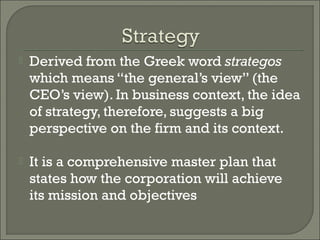
   Derived from the Greek word strategos
    which means “the general’s view” (the
    CEO’s view). In business context, the idea
    of strategy, therefore, suggests a big
    perspective on the firm and its context.

   It is a comprehensive master plan that
    states how the corporation will achieve
    its mission and objectives
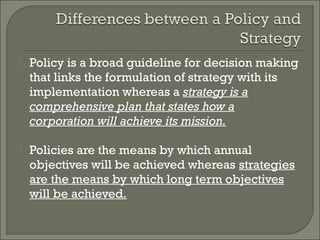
   Policy is a broad guideline for decision making
    that links the formulation of strategy with its
    implementation whereas a strategy is a
    comprehensive plan that states how a
    corporation will achieve its mission.

   Policies are the means by which annual
    objectives will be achieved whereas strategies
    are the means by which long term objectives
    will be achieved.
   Policies are guides to decision making and
    address repetitive/recurring situations whereas
    strategies are potential actions that require top
    management decisions and large amount of the
    firm’s resources.
   Policies include guidelines, rules & procedures
    established to achieved stated objectives
    whereas strategies (business) include,
    geographic expansion, diversification,
    acquisition, product development, market
    penetration, retrenchment, divestiture,
    liquidation and joint venture.
   It is defined as the art and science of
    formulating, implementing, and
    evaluating cross-functional decisions that
    enable an organization to achieve its
    objectives.

   It is synonymous with the term “strategic
    planning” which is commonly use in the
    business world.
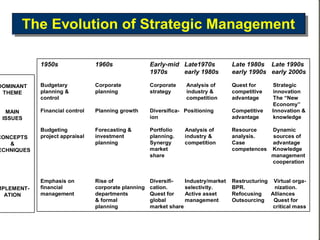
The Evolution of Strategic Management
      The Evolution of Strategic Management

            1950s               1960s                Early-mid Late1970s            Late 1980s Late 1990s
                                                     1970s     early 1980s          early 1990s early 2000s

DOMINANT    Budgetary           Corporate            Corporate    Analysis of       Quest for      Strategic
 THEME      planning &          planning             strategy     industry &        competitive    innovation
            control                                               competition       advantage      The “New
                                                                                                   Economy”
  MAIN      Financial control   Planning growth      Diversifica- Positioning       Competitive    Innovation &
 ISSUES                                              ion                            advantage      knowledge

            Budgeting           Forecasting &        Portfolio    Analysis of       Resource      Dynamic
CONCEPTS    project appraisal   investment           planning.    industry &        analysis.     sources of
   &                            planning             Synergy      competition       Case          advantage
ECHNIQUES                                            market                         competences   Knowledge
                                                     share                                        management
                                                                                                  cooperation


            Emphasis on         Rise of              Diversifi-   Industry/market   Restructuring Virtual orga-
MPLEMENT-   financial           corporate planning   cation.      selectivity.      BPR.            nization.
  ATION     management          departments          Quest for    Active asset      Refocusing    Alliances
                                & formal             global       management        Outsourcing    Quest for
                                planning             market share                                  critical mass
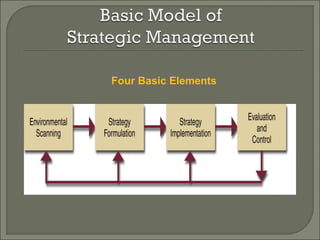
Four Basic Elements
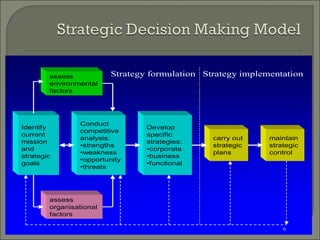
assess            Strategy formulation Strategy implementation
        environmental
        factors


                 Conduct
Identify                          Develop
                 competitive
current                           specific
                 analysis:                       carry out    maintain
mission                           strategies:
                 •strengths                      strategic    strategic
and                               •corporate
                 •weakness                       plans        control
strategic                         •business
                 •opportunity
goals                             •functional
                 •threats


        assess
        organisational
        factors

                                                                  6
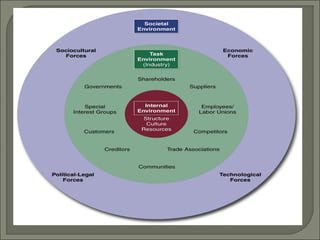
   The process of conducting research and
    gathering and assimilating external
    information.
   It is also called “industry analysis”.
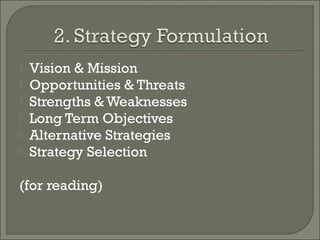
   Vision & Mission
   Opportunities & Threats
   Strengths & Weaknesses
   Long Term Objectives
   Alternative Strategies
   Strategy Selection

(for reading)
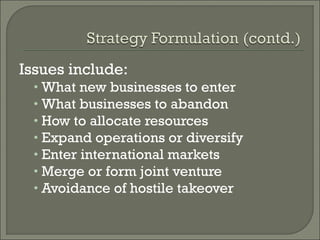
Issues include:
 • What new businesses to enter
 • What businesses to abandon
 • How to allocate resources
 • Expand operations or diversify
 • Enter international markets
 • Merge or form joint venture
 • Avoidance of hostile takeover
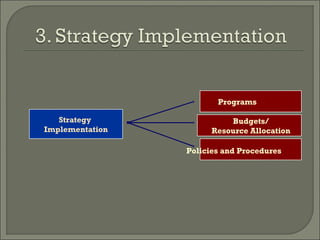
Programs

   Strategy                Budgets/
Implementation         Resource Allocation

                 Policies and Procedures
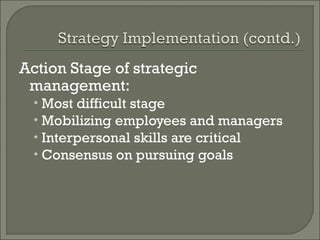
Action Stage of strategic
 management:
  • Most difficult stage
  • Mobilizing employees and managers
  • Interpersonal skills are critical
  • Consensus on pursuing goals
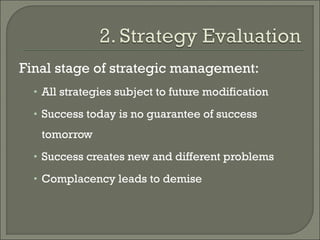
Final stage of strategic management:
  • All strategies subject to future modification

  • Success today is no guarantee of success

   tomorrow
  • Success creates new and different problems

  • Complacency leads to demise
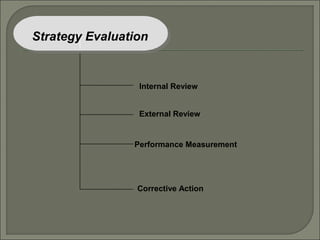
Strategy Evaluation


                 Internal Review


                 External Review


                Performance Measurement


                 Corrective Action
 Allows company to be more proactive
 Allows company to initiate and influence
  activities
 It promotes unity to the organization
 It helps the employees and managers
  understand other’s view and what the
  organization is doing and why. Thus,
  commitment to the company becomes
  stronger.
(require more reading)
   More profitable and successful
   Shows significant improvement in sales,
    profitability and productivity.
   Exhibit long term financial performance
   Good anticipation of short and long term
    consequences.

Bp chap1

  • 1.
    Presented by: ErikaS. Nicolas, MBA
  • 2.
    Derived from the Greek word strategos which means “the general’s view” (the CEO’s view). In business context, the idea of strategy, therefore, suggests a big perspective on the firm and its context.  It is a comprehensive master plan that states how the corporation will achieve its mission and objectives
  • 3.
    Policy is a broad guideline for decision making that links the formulation of strategy with its implementation whereas a strategy is a comprehensive plan that states how a corporation will achieve its mission.  Policies are the means by which annual objectives will be achieved whereas strategies are the means by which long term objectives will be achieved.
  • 4.
    Policies are guides to decision making and address repetitive/recurring situations whereas strategies are potential actions that require top management decisions and large amount of the firm’s resources.  Policies include guidelines, rules & procedures established to achieved stated objectives whereas strategies (business) include, geographic expansion, diversification, acquisition, product development, market penetration, retrenchment, divestiture, liquidation and joint venture.
  • 5.
    It is defined as the art and science of formulating, implementing, and evaluating cross-functional decisions that enable an organization to achieve its objectives.  It is synonymous with the term “strategic planning” which is commonly use in the business world.
  • 6.
    The Evolution ofStrategic Management The Evolution of Strategic Management 1950s 1960s Early-mid Late1970s Late 1980s Late 1990s 1970s early 1980s early 1990s early 2000s DOMINANT Budgetary Corporate Corporate Analysis of Quest for Strategic THEME planning & planning strategy industry & competitive innovation control competition advantage The “New Economy” MAIN Financial control Planning growth Diversifica- Positioning Competitive Innovation & ISSUES ion advantage knowledge Budgeting Forecasting & Portfolio Analysis of Resource Dynamic CONCEPTS project appraisal investment planning. industry & analysis. sources of & planning Synergy competition Case advantage ECHNIQUES market competences Knowledge share management cooperation Emphasis on Rise of Diversifi- Industry/market Restructuring Virtual orga- MPLEMENT- financial corporate planning cation. selectivity. BPR. nization. ATION management departments Quest for Active asset Refocusing Alliances & formal global management Outsourcing Quest for planning market share critical mass
  • 7.
  • 8.
    assess Strategy formulation Strategy implementation environmental factors Conduct Identify Develop competitive current specific analysis: carry out maintain mission strategies: •strengths strategic strategic and •corporate •weakness plans control strategic •business •opportunity goals •functional •threats assess organisational factors 6
  • 9.
    The process of conducting research and gathering and assimilating external information.  It is also called “industry analysis”.
  • 11.
    Vision & Mission  Opportunities & Threats  Strengths & Weaknesses  Long Term Objectives  Alternative Strategies  Strategy Selection (for reading)
  • 12.
    Issues include: •What new businesses to enter • What businesses to abandon • How to allocate resources • Expand operations or diversify • Enter international markets • Merge or form joint venture • Avoidance of hostile takeover
  • 13.
    Programs Strategy Budgets/ Implementation Resource Allocation Policies and Procedures
  • 14.
    Action Stage ofstrategic management: • Most difficult stage • Mobilizing employees and managers • Interpersonal skills are critical • Consensus on pursuing goals
  • 15.
    Final stage ofstrategic management: • All strategies subject to future modification • Success today is no guarantee of success tomorrow • Success creates new and different problems • Complacency leads to demise
  • 16.
    Strategy Evaluation Internal Review External Review Performance Measurement Corrective Action
  • 17.
     Allows companyto be more proactive  Allows company to initiate and influence activities  It promotes unity to the organization  It helps the employees and managers understand other’s view and what the organization is doing and why. Thus, commitment to the company becomes stronger. (require more reading)
  • 18.
    More profitable and successful  Shows significant improvement in sales, profitability and productivity.  Exhibit long term financial performance  Good anticipation of short and long term consequences.