DEPARTMENT OF COMMERCE
Informationand communication
technology
PREPARED BY: NIKITA YADAV
ROLL NO :1700104047019
M.Com(H) 6TH SEM
CONTENTS
 WHAT IS ICT?
 COMONENTS OF ICT
 USAGE OF ICT IN EVERYDAY LIFE
 SCOPE
 DIFFERENT TYPES OF COMMUNICATION IN ICT
 ADVANTAGES OF ICT
 DISADVANTAGES OF ICT
INFORMATION AND COMMUNICATIONS
TECHNOLOGY
 ICT refers to technologies that provide access to
information through telecommunications. It is similar
to Information Technology, but focuses primarily on
communication technologies. This includes
the Internet, wireless networks, cell phones, and other
communication mediums.
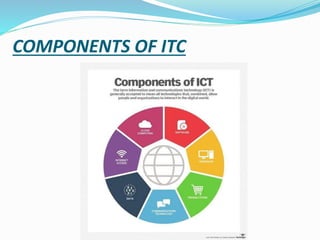
COMPONENTS OF ITC
USAGE OF ICT IN EVERYDAY LIFE
EDUCATION
• Teacher use commuters to research for teaching
materials, participate in online forum and online
conference
• Students use computers as reference tools for looking
information in the internet.
• Researchers use computers to collect and process data.
• School administration use computers for
administrative purposes to ensure that entire operations
run smoothly.
BANKING
• Bank administrators can control the entire banking
system and banking activites.
• To provide electronic banking services for customers.
• Businessman can save their time by using online
services offered by banks.
INDUSTRY
• To help workers operate machines.
• To help researchers analyze and collect research data for
future references.
• To facilitate production planning and control system.
E-COMMERCE
• To make buying and selling activities faster and more
efficient through internet.
• To connect online customers with suppliers to purchase
products . this method can save time and cost.
• To help employs to communicate with their customers
for any inquires and to get the latest updates inventory
to be informed to the customers.
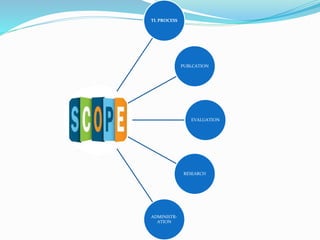
TL PROCESS
PUBLCATION
EVALUATION
RESEARCH
ADMINISTR-
ATION
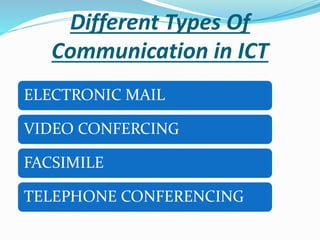
Different Types Of
Communication in ICT
ELECTRONIC MAIL
VIDEO CONFERCING
FACSIMILE
TELEPHONE CONFERENCING
OTHER USE OF ICT
 ICT also plays a key role in the global economy and
poverty reduction. The internet, email, collaboration
software and other ICT tools help connect all local and
central government departments, improve living
standards, assist international economic integration
and more.
 Governments can use this technology to provide
citizens with convenient access to information and
services. ICT also helps strengthen the legal
framework that promotes democracy and enables
information exchange between institutions.
ADVANTAGES OF ICT
 Communication - Speed / time – money can be saved
because it’s much quicker to move information
around. With the help of ICT it has become quicker
and more efficient.
 Globalization - Video conferencing saves money on
flights and accommodation. ICT has not only brought
the countries and people closer together, but it has
allowed the world's economy to become a single
interdependent system to contact either a business or
family member.
 Cost effectiveness - It feels free to send an email
(although it isn’t); it’s without doubt cheaper than
phone calls. ICT has also helped to automate business
practices, thus restructuring businesses to make them
exceptionally cost effective.
 Greater Availability - ICT has made it possible for
businesses to be automated giving clients access to a
website or voicemail 24 hours a day, 7 days a week
 Creation of new jobs - Probably, the best advantage
of ICT has been the creation of new and interesting
jobs.
 Education – Computer’s along with their programs
and the Internet have created educational
opportunities not available to previous generations.
DISADVANTAGES OF ICT
 Education – Computer’s along with their programs and
the Internet have created educational opportunities not
available to previous generations.
 Lack of job security – ICT has made job security a big
issue, since technology keeps on changing nearly every day.
This means that individuals need to be constantly studying
or at least keeping up with changes in their profession.
 Privacy - Though information technology may have made
communication quicker, easier, and more convenient, it
has also brought along privacy issues. From cell phone
signal interceptions to e-mail hacking, people are now
worried about their once private information becoming
public knowledge.
 Lack of experience - hard for teachers to use with a
lack of experience using ICT tools.
 Reliance on Technology – People have more to
remember these days, and they are relying on
technology for their memory but the less you use of
your memory, the poorer it becomes. . people don’t
bother learning to spell because they use spell-
checker, or need a calculator do perform minor
addition or subtraction.
THANKYOU

ICT

  • 1.
  • 2.
    Informationand communication technology PREPARED BY:NIKITA YADAV ROLL NO :1700104047019 M.Com(H) 6TH SEM
  • 3.
    CONTENTS  WHAT ISICT?  COMONENTS OF ICT  USAGE OF ICT IN EVERYDAY LIFE  SCOPE  DIFFERENT TYPES OF COMMUNICATION IN ICT  ADVANTAGES OF ICT  DISADVANTAGES OF ICT
  • 4.
    INFORMATION AND COMMUNICATIONS TECHNOLOGY ICT refers to technologies that provide access to information through telecommunications. It is similar to Information Technology, but focuses primarily on communication technologies. This includes the Internet, wireless networks, cell phones, and other communication mediums.
  • 5.
  • 6.
    USAGE OF ICTIN EVERYDAY LIFE EDUCATION • Teacher use commuters to research for teaching materials, participate in online forum and online conference • Students use computers as reference tools for looking information in the internet. • Researchers use computers to collect and process data. • School administration use computers for administrative purposes to ensure that entire operations run smoothly.
  • 7.
    BANKING • Bank administratorscan control the entire banking system and banking activites. • To provide electronic banking services for customers. • Businessman can save their time by using online services offered by banks. INDUSTRY • To help workers operate machines. • To help researchers analyze and collect research data for future references. • To facilitate production planning and control system.
  • 8.
    E-COMMERCE • To makebuying and selling activities faster and more efficient through internet. • To connect online customers with suppliers to purchase products . this method can save time and cost. • To help employs to communicate with their customers for any inquires and to get the latest updates inventory to be informed to the customers.
  • 9.
  • 10.
    Different Types Of Communicationin ICT ELECTRONIC MAIL VIDEO CONFERCING FACSIMILE TELEPHONE CONFERENCING
  • 11.
    OTHER USE OFICT  ICT also plays a key role in the global economy and poverty reduction. The internet, email, collaboration software and other ICT tools help connect all local and central government departments, improve living standards, assist international economic integration and more.  Governments can use this technology to provide citizens with convenient access to information and services. ICT also helps strengthen the legal framework that promotes democracy and enables information exchange between institutions.
  • 12.
    ADVANTAGES OF ICT Communication - Speed / time – money can be saved because it’s much quicker to move information around. With the help of ICT it has become quicker and more efficient.  Globalization - Video conferencing saves money on flights and accommodation. ICT has not only brought the countries and people closer together, but it has allowed the world's economy to become a single interdependent system to contact either a business or family member.
  • 13.
     Cost effectiveness- It feels free to send an email (although it isn’t); it’s without doubt cheaper than phone calls. ICT has also helped to automate business practices, thus restructuring businesses to make them exceptionally cost effective.  Greater Availability - ICT has made it possible for businesses to be automated giving clients access to a website or voicemail 24 hours a day, 7 days a week  Creation of new jobs - Probably, the best advantage of ICT has been the creation of new and interesting jobs.  Education – Computer’s along with their programs and the Internet have created educational opportunities not available to previous generations.
  • 14.
    DISADVANTAGES OF ICT Education – Computer’s along with their programs and the Internet have created educational opportunities not available to previous generations.  Lack of job security – ICT has made job security a big issue, since technology keeps on changing nearly every day. This means that individuals need to be constantly studying or at least keeping up with changes in their profession.  Privacy - Though information technology may have made communication quicker, easier, and more convenient, it has also brought along privacy issues. From cell phone signal interceptions to e-mail hacking, people are now worried about their once private information becoming public knowledge.
  • 15.
     Lack ofexperience - hard for teachers to use with a lack of experience using ICT tools.  Reliance on Technology – People have more to remember these days, and they are relying on technology for their memory but the less you use of your memory, the poorer it becomes. . people don’t bother learning to spell because they use spell- checker, or need a calculator do perform minor addition or subtraction.
  • 16.