Peter Thomas – Control Specialists Ltd
Chairman PROFIBUS & PROFINET International Training Centre’s
Technical Officer PI UK
Functional Bonding and Shielding of
PROFIBUS and PROFINET
Peter Thomas – Control Specialists Ltd
Chairman PROFIBUS & PROFINET International Training Centre’s
Technical Officer PI UK
Functional Bonding and Shielding of
PROFIBUS and PROFINET
Slide 1 of 301
33
New Guideline Released – March 2018
• PI have released a guideline entitled
“Functional Bonding and Shielding of
PROFIBUS and PROFINET”
• It is available from
https://www.profibus.com/download/funct
ional-earthing-and-shielding/
• The guidelines contain 6 clear
recommendations that network designers
are advised to consider.
PI UK - MTC Coventry - October 2018 © 2018 – PI UK and Control Specialists Ltd
44© 2018 PI UK and Control Specialists Ltd
Coupling Paths
The PI guidelines are associated with
Line-Conducted (Galvanic) and
Nearby Couplings. Distant (Radiated)
emissions are outside the scope of
the guidelines.
• Line-conducted disturbances are
caused by conductive connections
between devices.
• Nearby disturbances are produced
by magnetic or electric fields
causing inductive or capacitive
coupling.
PI UK - MTC Coventry - October 2018
55© 2018 PI UK and Control Specialists Ltd
Assumptions
The guidelines do not specifically mention the following EMC-related activities,
but both remain valid and should be adhered to:
• Adequate separation between “sensitive” cables like PROFIBUS and PROFINET
from higher category cables, i.e. higher voltage and/or higher current.
• Good panel design from an EMC point of view, e.g. all sides rf-bonded to each
other, specific attention paid to cable routing and equipment layout,
awareness of other EMI-mitigation techniques, e.g. termination of shields on
entry/exit to panels, EMC grills for ventilation fans etc.
Note also that the guidelines are for “safe area / non-hazardous” applications
only.
PI UK - MTC Coventry - October 2018
66© 2018 PI UK and Control Specialists Ltd
EMC is a topic full of misunderstandings …….. “Earthing of cable shield”
PI UK - MTC Coventry - October 2018
Earthing and EMC
77PI UK - MTC Coventry - October 2018 © 2017
Earthing and EMC
• Earthing (grounding) and EMC are completely separate issues.
• We often talk about “earthing or grounding” cable shields, but the important
aspect from an EMC point of view is that the shields are connected to a
common, low impedance, reference.
• The fact that this common reference is usually connected to earth (ground) is
a safety-related matter and nothing whatsoever to do with EMC.
• However, we have to accept that the linking of the two terms is common
practice, often in published documents, even though technically it is
incorrect.
88© 2018 PI UK and Control Specialists Ltd
Potential Sources of Disturbances
PI UK - MTC Coventry - October 2018
99
R1 – Equipotential Bonding and Functional Earthing
via a Common Bonded Network (CBN)
PI UK - MTC Coventry - October 2018 © 2018 – PI UK and Control Specialists Ltd
• Whilst safety will always be paramount, the fact remains that many earth
systems are far from ideal from an EMI point of view.
• The UK Requirements for Electrical Installations (BS7671) state that a
potential of <50v ac can exist between exposed metal parts in a potential
equalisation system.
• However several IT and telecommunication standards stipulate a much
lower value of <1v ac, with others also stating that the impedance of the
earth should be low at the “frequencies of concern”.
1010
R1 – Equipotential Bonding and Functional Earthing
via a Common Bonded Network (CBN)
• The increasing use of high-
frequency switching devices can
result in the Bonding cables carrying
currents at frequencies much higher
than 50 Hz.
• The impedance of these cables at
higher frequencies can result in the
currents flowing back to earth via
lower impedance routes not
designed to carry these currents.
PI UK - MTC Coventry - October 2018 © 2018 – PI UK and Control Specialists Ltd
1111
R1 – Equipotential Bonding and Functional Earthing
via a Common Bonded Network (CBN)
• Whilst star earthing (Type A) is adequate for safety
purposes, it is considered poor for EMC purposes.
• For example, if we were to connect a network
cable, whose shield is connected to ground at both
ends, between equipment on different limbs of the
star, the cable shield will become part of the
bonding network increasing the possibility of
excessive screen currents flowing.
• The practice of creating separate “clean” and “dirty”
earths is also considered an out of date practice
and impossible to achieve.
PI UK - MTC Coventry - October 2018 © 2018 – PI UK and Control Specialists Ltd
Type A
1212
R2 – Ensure that your low voltage distribution
system is TN-S
• TN-C systems are
considered very bad
for EMC.
• The main advantage of
TN-S over TN-C in this
respect are the
separation of Earth
and Neutral currents.
PI UK - MTC Coventry - October 2018 © 2018 – PI UK and Control Specialists Ltd
1313
R3 – The CBN should be part of a MESH-BN
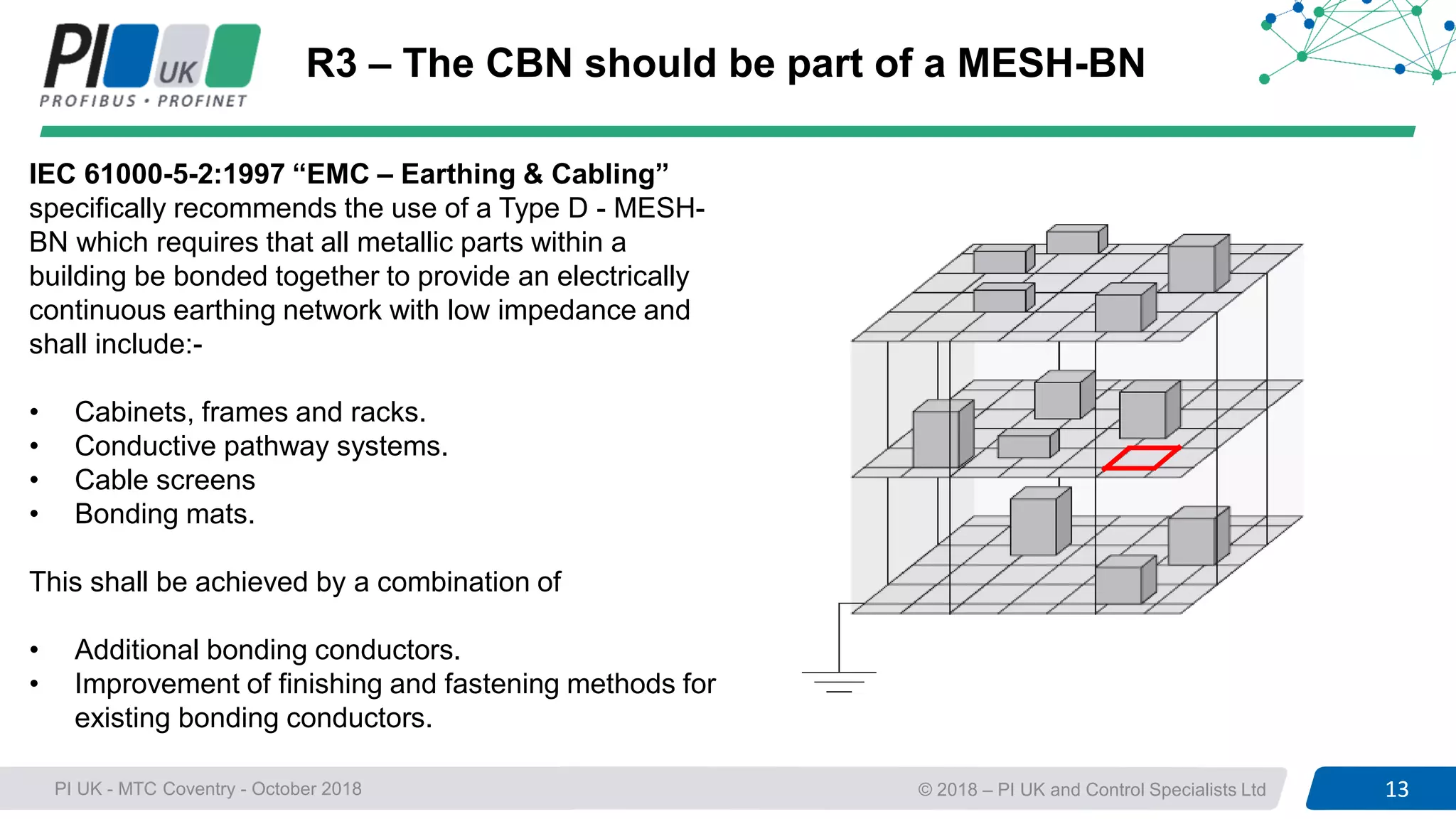
IEC 61000-5-2:1997 “EMC – Earthing & Cabling”
specifically recommends the use of a Type D - MESH-
BN which requires that all metallic parts within a
building be bonded together to provide an electrically
continuous earthing network with low impedance and
shall include:-
• Cabinets, frames and racks.
• Conductive pathway systems.
• Cable screens
• Bonding mats.
This shall be achieved by a combination of
• Additional bonding conductors.
• Improvement of finishing and fastening methods for
existing bonding conductors.
PI UK - MTC Coventry - October 2018 © 2018 – PI UK and Control Specialists Ltd
1414PI UK - MTC Coventry - October 2018 © 2017
R4 – Terminate the cable shields at both ends
• Confusion still remains as to whether the shields (screens) of PROFIBUS
and PROFINET cables should be terminated to a common reference
(usually ground) at one end only or at both ends.
• Electrical Interference takes two forms, electrostatic and electromagnetic.
• To protect against both, the shield MUST be terminated at both ends to a
common reference.
1515
R4 – Terminate the cable shields at both ends
• Electromagnetic interference is
associated with proximity to current-
carrying cables which generate a
magnetic field.
• Any data cables within this field are
susceptible to interference.
• To protect against electromagnetic
interference, the screen of the
PROFIBUS (or PROFINET) cable
must be terminated at both ends to a
low impedance reference (ground).
• This induces current in the screen
with generates an opposing
magnetic field.
PI UK - MTC Coventry - October 2018 © 2018 – PI UK and Control Specialists Ltd
1616
Bad Screen Currents
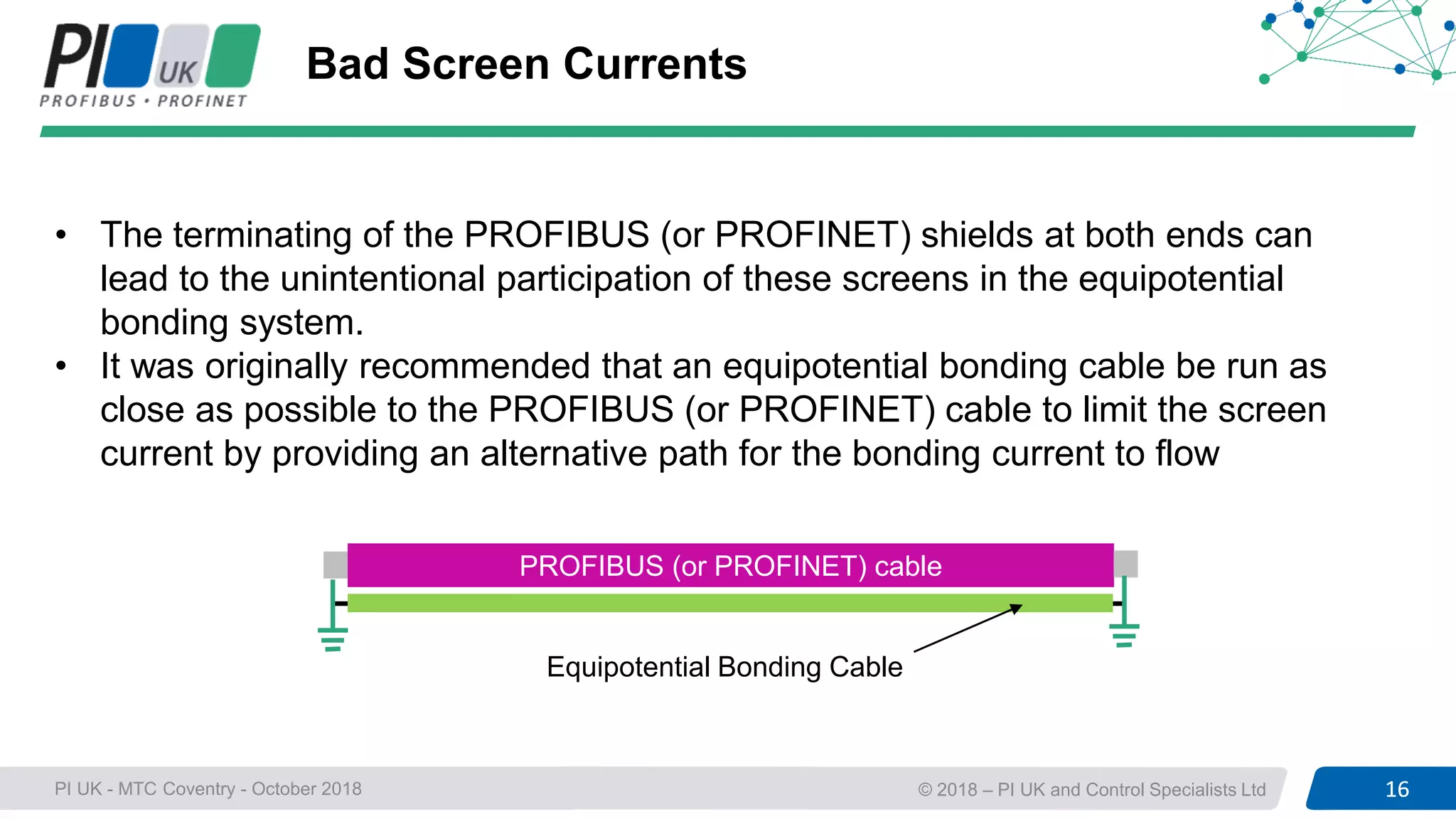
• The terminating of the PROFIBUS (or PROFINET) shields at both ends can
lead to the unintentional participation of these screens in the equipotential
bonding system.
• It was originally recommended that an equipotential bonding cable be run as
close as possible to the PROFIBUS (or PROFINET) cable to limit the screen
current by providing an alternative path for the bonding current to flow
PROFIBUS (or PROFINET) cable
Equipotential Bonding Cable
PI UK - MTC Coventry - October 2018 © 2018 – PI UK and Control Specialists Ltd
1717
Parallel Earth Conductors (PEC’s)
• The equipotential bonding cable mentioned on the previous slide is a form of
PEC.
• However it is now generally considered to be a technique appropriate to
50/60Hz automation systems – max of 150 Hz.
• Most EMC experts will look at alternative PEC’s to overcome this limitation
before recommending a full-blown MESH-BN
• Examples of PEC’s includer the use of cable trays and structural metal work
with RF (low impedance) bonding straps between joints.
• The PI guidelines also contain alternative suggestions for improving the
equipotential bonding on an existing system – see later slides.
© 2018 – PI UK and Control Specialists LtdPI UK - MTC Coventry - October 2018
1818
R5 – Variable Speed Drives
• Variable Speed Drives (VSD’s) are a source of harmonics that can feed
back into the mains supply and also EMI that can be galvanic or
airborne.
• Whilst the manufacturers guidelines should always be followed, they
generally recommend the use of specially designed motor cables
between the VSD and motor and that the shield of that cable should be
terminated at both ends to prevent EMI “leaking out”.
PI UK - MTC Coventry - October 2018 © 2018 – PI UK and Control Specialists Ltd
1919
R5 – Variable Speed Drives
EMI is rapidly increasing in modern industry due to the increasing
use of high-efficiency switching power conversion in DC power
supplies, motor drives, HVAC and lighting.
There is a benefit to having these devices switch faster than they
currently do, which means more EMI.
Unless the installation caters for this reality, there is a real
possibility of intermittent network outages and production loss.
PI UK - MTC Coventry - October 2018 © 2018 – PI UK and Control Specialists Ltd
2020
A common source of high frequency bonding
currents
The four channels of the EMC INspektor
were connected as shown.
PI UK - MTC Coventry - October 2018 © 2018 – PI UK and Control Specialists Ltd
2121
A common source of high frequency bonding
currents
PI UK - MTC Coventry - October 2018 © 2018 – PI UK and Control Specialists Ltd
2222
A common source of high frequency bonding
currents
PI UK - MTC Coventry - October 2018 © 2018 – PI UK and Control Specialists Ltd
Motor Cable
2323
R6 – Be aware of the dangers of multiple grounds
on 24v dc supplies
• The ground (negative) of most 24v dc power supplies are usually
grounded as close as possible to the supply.
• Earth loops can be created by the unintentional grounding of the
negative wire to ground at other points.
PI UK - MTC Coventry - October 2018 © 2018 – PI UK and Control Specialists Ltd
2424
Questions to be answered
1. How much current should be allowed to flow in the screens of
PROFIBUS (or PROFINET) cables?
2. How low does the earth loop impedance need to be to allow active
shielding to work effectively at typical automation frequencies?
3. What about currents / impedances associated with bonding cables
and motor to invertor cables?
4. What tools are available to measure these?
5. How can I improve an existing equipotential system to provide an
improved bonding system from an EMC point of view?
PI UK - MTC Coventry - October 2018 © 2018 – PI UK and Control Specialists Ltd
2525
Indu-Sol Recommended Reference Values
Source: Indu-Sol GmbH
PI UK - MTC Coventry - October 2018 © 2018 – PI UK and Control Specialists Ltd
2626
EMC Measuring Tools -
The leakage current clamp EMCheck
LSMZ I is capable of measuring currents
(mA and A) in the functional earth
circuit and the shields of network cables.
The mesh resistance measuring clamp
EMCheck® MWMZ II is suited for
providing evidence of a low impedance
potential equalisation.
PI UK - MTC Coventry - October 2018 © 2018 – PI UK and Control Specialists Ltd
A spectrum analyser is the
“tool of choice” for EMC
Engineers and consultants.
However, clamps are
available to assist with
potential equalisation issues
2727
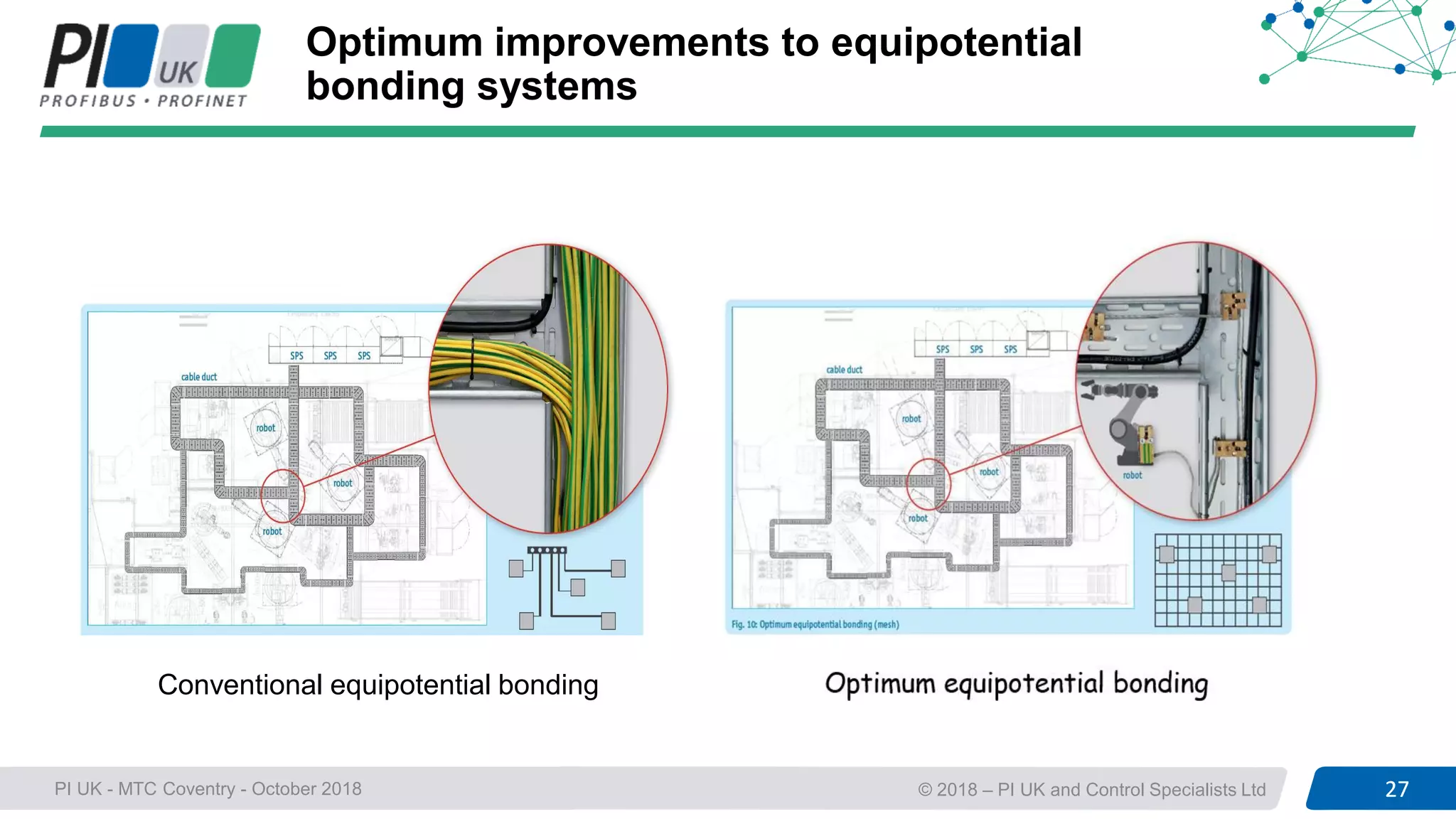
Optimum improvements to equipotential
bonding systems
Conventional equipotential bonding
PI UK - MTC Coventry - October 2018 © 2018 – PI UK and Control Specialists Ltd
2828
Optimum improvements to equipotential
bonding systems - EmClots
EmClots terminals are
fastened by means of
an M 6x9 screw
connection to e.g.
trays or other
conductive system
components.
The terminals have a
female thread for
easy installation.
Sizes up to 16 mm²
have a continuous
female thread.
PI UK - MTC Coventry - October 2018 © 2018 – PI UK and Control Specialists Ltd
2929
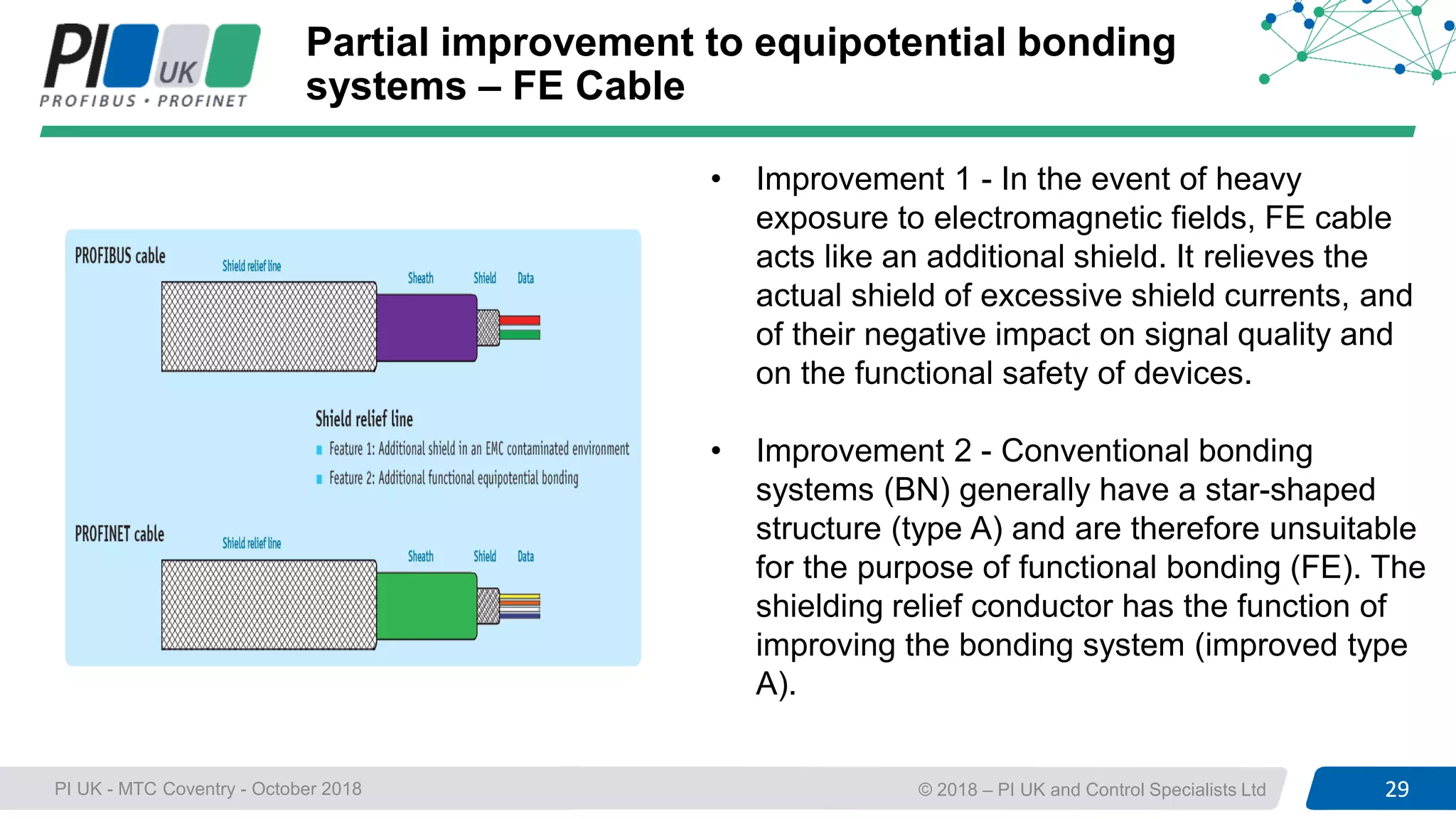
Partial improvement to equipotential bonding
systems – FE Cable
• Improvement 1 - In the event of heavy
exposure to electromagnetic fields, FE cable
acts like an additional shield. It relieves the
actual shield of excessive shield currents, and
of their negative impact on signal quality and
on the functional safety of devices.
• Improvement 2 - Conventional bonding
systems (BN) generally have a star-shaped
structure (type A) and are therefore unsuitable
for the purpose of functional bonding (FE). The
shielding relief conductor has the function of
improving the bonding system (improved type
A).
PI UK - MTC Coventry - October 2018 © 2018 – PI UK and Control Specialists Ltd
3030
Impact on PI Training
• EMC is always a topic that raises many questions and there are
often misunderstandings.
• The existing Certified Training courses for PROFIBUS and
PROFINET will need to be updated to include the techniques
mentioned in the new guidelines.
• PI Instructors may need assistance in gaining sufficient knowledge
to deliver this aspect of training and be able to answer questions
about it.
• This will be handled under a periodic review of the learning
outcomes.
PI UK - MTC Coventry - October 2018 © 2018 – PI UK and Control Specialists Ltd
3131PI UK - MTC Coventry - October 2018 © 2018 – PI UK and Control Specialists Ltd
Additional Information
EN50310-2016 EMC Optimum
Equipotential Bonding
– Indu-Sol
IEC 61000-5-2 1997
3232
Thankyou
Peter Thomas
Chairman of PI Training Centres and Technical Officer – PI UK
www.linkedin.com/in/petermthomas
Control Specialists Ltd
www.controlspecialists.co.uk
Tel +44(0)1925 824003
PI UK - MTC Coventry - October 2018 © 2018 – PI UK and Control Specialists Ltd

Functional bonding and shielding of Profibus and Profinet - Peter Thomas

  • 1.
    Peter Thomas –Control Specialists Ltd Chairman PROFIBUS & PROFINET International Training Centre’s Technical Officer PI UK Functional Bonding and Shielding of PROFIBUS and PROFINET
  • 2.
    Peter Thomas –Control Specialists Ltd Chairman PROFIBUS & PROFINET International Training Centre’s Technical Officer PI UK Functional Bonding and Shielding of PROFIBUS and PROFINET Slide 1 of 301
  • 3.
    33 New Guideline Released– March 2018 • PI have released a guideline entitled “Functional Bonding and Shielding of PROFIBUS and PROFINET” • It is available from https://www.profibus.com/download/funct ional-earthing-and-shielding/ • The guidelines contain 6 clear recommendations that network designers are advised to consider. PI UK - MTC Coventry - October 2018 © 2018 – PI UK and Control Specialists Ltd
  • 4.
    44© 2018 PIUK and Control Specialists Ltd Coupling Paths The PI guidelines are associated with Line-Conducted (Galvanic) and Nearby Couplings. Distant (Radiated) emissions are outside the scope of the guidelines. • Line-conducted disturbances are caused by conductive connections between devices. • Nearby disturbances are produced by magnetic or electric fields causing inductive or capacitive coupling. PI UK - MTC Coventry - October 2018
  • 5.
    55© 2018 PIUK and Control Specialists Ltd Assumptions The guidelines do not specifically mention the following EMC-related activities, but both remain valid and should be adhered to: • Adequate separation between “sensitive” cables like PROFIBUS and PROFINET from higher category cables, i.e. higher voltage and/or higher current. • Good panel design from an EMC point of view, e.g. all sides rf-bonded to each other, specific attention paid to cable routing and equipment layout, awareness of other EMI-mitigation techniques, e.g. termination of shields on entry/exit to panels, EMC grills for ventilation fans etc. Note also that the guidelines are for “safe area / non-hazardous” applications only. PI UK - MTC Coventry - October 2018
  • 6.
    66© 2018 PIUK and Control Specialists Ltd EMC is a topic full of misunderstandings …….. “Earthing of cable shield” PI UK - MTC Coventry - October 2018 Earthing and EMC
  • 7.
    77PI UK -MTC Coventry - October 2018 © 2017 Earthing and EMC • Earthing (grounding) and EMC are completely separate issues. • We often talk about “earthing or grounding” cable shields, but the important aspect from an EMC point of view is that the shields are connected to a common, low impedance, reference. • The fact that this common reference is usually connected to earth (ground) is a safety-related matter and nothing whatsoever to do with EMC. • However, we have to accept that the linking of the two terms is common practice, often in published documents, even though technically it is incorrect.
  • 8.
    88© 2018 PIUK and Control Specialists Ltd Potential Sources of Disturbances PI UK - MTC Coventry - October 2018
  • 9.
    99 R1 – EquipotentialBonding and Functional Earthing via a Common Bonded Network (CBN) PI UK - MTC Coventry - October 2018 © 2018 – PI UK and Control Specialists Ltd • Whilst safety will always be paramount, the fact remains that many earth systems are far from ideal from an EMI point of view. • The UK Requirements for Electrical Installations (BS7671) state that a potential of <50v ac can exist between exposed metal parts in a potential equalisation system. • However several IT and telecommunication standards stipulate a much lower value of <1v ac, with others also stating that the impedance of the earth should be low at the “frequencies of concern”.
  • 10.
    1010 R1 – EquipotentialBonding and Functional Earthing via a Common Bonded Network (CBN) • The increasing use of high- frequency switching devices can result in the Bonding cables carrying currents at frequencies much higher than 50 Hz. • The impedance of these cables at higher frequencies can result in the currents flowing back to earth via lower impedance routes not designed to carry these currents. PI UK - MTC Coventry - October 2018 © 2018 – PI UK and Control Specialists Ltd
  • 11.
    1111 R1 – EquipotentialBonding and Functional Earthing via a Common Bonded Network (CBN) • Whilst star earthing (Type A) is adequate for safety purposes, it is considered poor for EMC purposes. • For example, if we were to connect a network cable, whose shield is connected to ground at both ends, between equipment on different limbs of the star, the cable shield will become part of the bonding network increasing the possibility of excessive screen currents flowing. • The practice of creating separate “clean” and “dirty” earths is also considered an out of date practice and impossible to achieve. PI UK - MTC Coventry - October 2018 © 2018 – PI UK and Control Specialists Ltd Type A
  • 12.
    1212 R2 – Ensurethat your low voltage distribution system is TN-S • TN-C systems are considered very bad for EMC. • The main advantage of TN-S over TN-C in this respect are the separation of Earth and Neutral currents. PI UK - MTC Coventry - October 2018 © 2018 – PI UK and Control Specialists Ltd
  • 13.
    1313 R3 – TheCBN should be part of a MESH-BN IEC 61000-5-2:1997 “EMC – Earthing & Cabling” specifically recommends the use of a Type D - MESH- BN which requires that all metallic parts within a building be bonded together to provide an electrically continuous earthing network with low impedance and shall include:- • Cabinets, frames and racks. • Conductive pathway systems. • Cable screens • Bonding mats. This shall be achieved by a combination of • Additional bonding conductors. • Improvement of finishing and fastening methods for existing bonding conductors. PI UK - MTC Coventry - October 2018 © 2018 – PI UK and Control Specialists Ltd
  • 14.
    1414PI UK -MTC Coventry - October 2018 © 2017 R4 – Terminate the cable shields at both ends • Confusion still remains as to whether the shields (screens) of PROFIBUS and PROFINET cables should be terminated to a common reference (usually ground) at one end only or at both ends. • Electrical Interference takes two forms, electrostatic and electromagnetic. • To protect against both, the shield MUST be terminated at both ends to a common reference.
  • 15.
    1515 R4 – Terminatethe cable shields at both ends • Electromagnetic interference is associated with proximity to current- carrying cables which generate a magnetic field. • Any data cables within this field are susceptible to interference. • To protect against electromagnetic interference, the screen of the PROFIBUS (or PROFINET) cable must be terminated at both ends to a low impedance reference (ground). • This induces current in the screen with generates an opposing magnetic field. PI UK - MTC Coventry - October 2018 © 2018 – PI UK and Control Specialists Ltd
  • 16.
    1616 Bad Screen Currents •The terminating of the PROFIBUS (or PROFINET) shields at both ends can lead to the unintentional participation of these screens in the equipotential bonding system. • It was originally recommended that an equipotential bonding cable be run as close as possible to the PROFIBUS (or PROFINET) cable to limit the screen current by providing an alternative path for the bonding current to flow PROFIBUS (or PROFINET) cable Equipotential Bonding Cable PI UK - MTC Coventry - October 2018 © 2018 – PI UK and Control Specialists Ltd
  • 17.
    1717 Parallel Earth Conductors(PEC’s) • The equipotential bonding cable mentioned on the previous slide is a form of PEC. • However it is now generally considered to be a technique appropriate to 50/60Hz automation systems – max of 150 Hz. • Most EMC experts will look at alternative PEC’s to overcome this limitation before recommending a full-blown MESH-BN • Examples of PEC’s includer the use of cable trays and structural metal work with RF (low impedance) bonding straps between joints. • The PI guidelines also contain alternative suggestions for improving the equipotential bonding on an existing system – see later slides. © 2018 – PI UK and Control Specialists LtdPI UK - MTC Coventry - October 2018
  • 18.
    1818 R5 – VariableSpeed Drives • Variable Speed Drives (VSD’s) are a source of harmonics that can feed back into the mains supply and also EMI that can be galvanic or airborne. • Whilst the manufacturers guidelines should always be followed, they generally recommend the use of specially designed motor cables between the VSD and motor and that the shield of that cable should be terminated at both ends to prevent EMI “leaking out”. PI UK - MTC Coventry - October 2018 © 2018 – PI UK and Control Specialists Ltd
  • 19.
    1919 R5 – VariableSpeed Drives EMI is rapidly increasing in modern industry due to the increasing use of high-efficiency switching power conversion in DC power supplies, motor drives, HVAC and lighting. There is a benefit to having these devices switch faster than they currently do, which means more EMI. Unless the installation caters for this reality, there is a real possibility of intermittent network outages and production loss. PI UK - MTC Coventry - October 2018 © 2018 – PI UK and Control Specialists Ltd
  • 20.
    2020 A common sourceof high frequency bonding currents The four channels of the EMC INspektor were connected as shown. PI UK - MTC Coventry - October 2018 © 2018 – PI UK and Control Specialists Ltd
  • 21.
    2121 A common sourceof high frequency bonding currents PI UK - MTC Coventry - October 2018 © 2018 – PI UK and Control Specialists Ltd
  • 22.
    2222 A common sourceof high frequency bonding currents PI UK - MTC Coventry - October 2018 © 2018 – PI UK and Control Specialists Ltd Motor Cable
  • 23.
    2323 R6 – Beaware of the dangers of multiple grounds on 24v dc supplies • The ground (negative) of most 24v dc power supplies are usually grounded as close as possible to the supply. • Earth loops can be created by the unintentional grounding of the negative wire to ground at other points. PI UK - MTC Coventry - October 2018 © 2018 – PI UK and Control Specialists Ltd
  • 24.
    2424 Questions to beanswered 1. How much current should be allowed to flow in the screens of PROFIBUS (or PROFINET) cables? 2. How low does the earth loop impedance need to be to allow active shielding to work effectively at typical automation frequencies? 3. What about currents / impedances associated with bonding cables and motor to invertor cables? 4. What tools are available to measure these? 5. How can I improve an existing equipotential system to provide an improved bonding system from an EMC point of view? PI UK - MTC Coventry - October 2018 © 2018 – PI UK and Control Specialists Ltd
  • 25.
    2525 Indu-Sol Recommended ReferenceValues Source: Indu-Sol GmbH PI UK - MTC Coventry - October 2018 © 2018 – PI UK and Control Specialists Ltd
  • 26.
    2626 EMC Measuring Tools- The leakage current clamp EMCheck LSMZ I is capable of measuring currents (mA and A) in the functional earth circuit and the shields of network cables. The mesh resistance measuring clamp EMCheck® MWMZ II is suited for providing evidence of a low impedance potential equalisation. PI UK - MTC Coventry - October 2018 © 2018 – PI UK and Control Specialists Ltd A spectrum analyser is the “tool of choice” for EMC Engineers and consultants. However, clamps are available to assist with potential equalisation issues
  • 27.
    2727 Optimum improvements toequipotential bonding systems Conventional equipotential bonding PI UK - MTC Coventry - October 2018 © 2018 – PI UK and Control Specialists Ltd
  • 28.
    2828 Optimum improvements toequipotential bonding systems - EmClots EmClots terminals are fastened by means of an M 6x9 screw connection to e.g. trays or other conductive system components. The terminals have a female thread for easy installation. Sizes up to 16 mm² have a continuous female thread. PI UK - MTC Coventry - October 2018 © 2018 – PI UK and Control Specialists Ltd
  • 29.
    2929 Partial improvement toequipotential bonding systems – FE Cable • Improvement 1 - In the event of heavy exposure to electromagnetic fields, FE cable acts like an additional shield. It relieves the actual shield of excessive shield currents, and of their negative impact on signal quality and on the functional safety of devices. • Improvement 2 - Conventional bonding systems (BN) generally have a star-shaped structure (type A) and are therefore unsuitable for the purpose of functional bonding (FE). The shielding relief conductor has the function of improving the bonding system (improved type A). PI UK - MTC Coventry - October 2018 © 2018 – PI UK and Control Specialists Ltd
  • 30.
    3030 Impact on PITraining • EMC is always a topic that raises many questions and there are often misunderstandings. • The existing Certified Training courses for PROFIBUS and PROFINET will need to be updated to include the techniques mentioned in the new guidelines. • PI Instructors may need assistance in gaining sufficient knowledge to deliver this aspect of training and be able to answer questions about it. • This will be handled under a periodic review of the learning outcomes. PI UK - MTC Coventry - October 2018 © 2018 – PI UK and Control Specialists Ltd
  • 31.
    3131PI UK -MTC Coventry - October 2018 © 2018 – PI UK and Control Specialists Ltd Additional Information EN50310-2016 EMC Optimum Equipotential Bonding – Indu-Sol IEC 61000-5-2 1997
  • 32.
    3232 Thankyou Peter Thomas Chairman ofPI Training Centres and Technical Officer – PI UK www.linkedin.com/in/petermthomas Control Specialists Ltd www.controlspecialists.co.uk Tel +44(0)1925 824003 PI UK - MTC Coventry - October 2018 © 2018 – PI UK and Control Specialists Ltd