Function Templates,Overlaoding Function Templates.pdf
1.
Sanjivani Rural EducationSociety’s
Sanjivani College of Engineering, Kopargaon-423 603
(An Autonomous Institute, Affiliated to Savitribai Phule Pune University, Pune)
NAAC ‘A’Grade Accredited, ISO 9001:2015 Certified
Department of Computer Engineering
(NBA Accredited)
Subject- Object Oriented Programming (CO212)
Unit 4 – Templates and Exception Handling
Topic – 4.1 Function Templates, Overloading Function Templates
Prof. V.N.Nirgude
Assistant Professor
E-mail :
nirgudevikascomp@sanjivani.org.in
Contact No: 9975240215
2.
Introduction
DEPARTMENT OF COMPUTERENGINEERING , SCOE,KOPARGAON 2
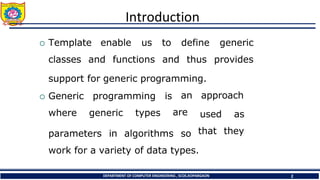
Template enable us
classes and functions
to define
and thus
generic
provides
support for generic programming.
Generic programming is
where generic types
an approach
are used as
that they
parameters in algorithms so
work for a variety of data types.
3.
Introduction
DEPARTMENT OF COMPUTERENGINEERING , SCOE,KOPARGAON 3
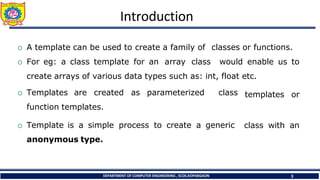
A template can be used to create a family of classes or functions.
For eg: a class template for an array class would enable us to
create arrays of various data types such as: int, float etc.
Templates are created as parameterized class
function templates.
Template is a simple process to create a generic
anonymous type.
templates or
class with an
4.
Function Template
DEPARTMENT OFCOMPUTER ENGINEERING , SCOE,KOPARGAON 4
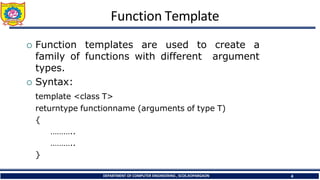
Function templates are used to create a
family of functions with different argument
types.
Syntax:
template <class T>
returntype functionname (arguments of type T)
{
………..
………..
}
5.
Function Template
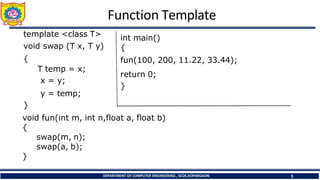
template <classT>
void swap (T x, T y)
{
T temp = x;
x = y;
y = temp;
}
void fun(int m, int n,float a, float b)
{
swap(m, n);
swap(a, b);
}
int main()
{
fun(100, 200, 11.22, 33.44);
return 0;
}
DEPARTMENT OF COMPUTER ENGINEERING , SCOE,KOPARGAON 5
6.
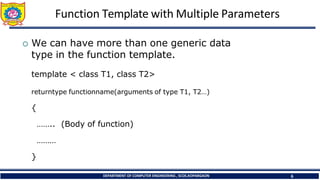
Function Template withMultiple Parameters
DEPARTMENT OF COMPUTER ENGINEERING , SCOE,KOPARGAON 6
We can have more than one generic data
type in the function template.
template < class T1, class T2>
returntype functionname(arguments of type T1, T2…)
{
…….. (Body of function)
………
}
7.
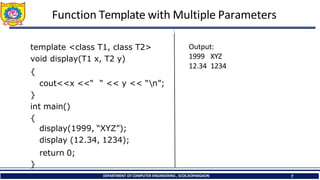
Function Template withMultiple Parameters
template <class T1, class T2>
void display(T1 x, T2 y)
{
cout<<x <<“ “ << y << “n”;
}
int main()
{
display(1999, “XYZ”);
display (12.34, 1234);
return 0;
}
Output:
DEPARTMENT OF COMPUTER ENGINEERING , SCOE,KOPARGAON 7
1999 XYZ
12.34 1234
8.
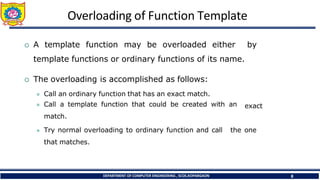
Overloading of FunctionTemplate
DEPARTMENT OF COMPUTER ENGINEERING , SCOE,KOPARGAON 8
A template function may be overloaded either by
template functions or ordinary functions of its name.
The overloading is accomplished as follows:
⚫ Call an ordinary function that has an exact match.
⚫ Call a template function that could be created with an
match.
exact
⚫ Try normal overloading to ordinary function and call the one
that matches.
9.
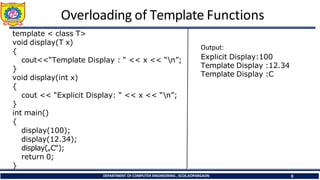
Overloading of TemplateFunctions
template < class T>
void display(T x)
{
cout<<“Template Display : “ << x << “n”;
}
void display(int x)
{
cout << “Explicit Display: “ << x << “n”;
}
int main()
{
display(100);
display(12.34);
display(„C‟);
return 0;
}
Output:
Explicit Display:100
Template Display :12.34
Template Display :C
DEPARTMENT OF COMPUTER ENGINEERING , SCOE,KOPARGAON 9
10.
Non-Type Template Arguments
DEPARTMENTOF COMPUTER ENGINEERING , SCOE,KOPARGAON 10
It is also possible to use non-type arguments.
In addition to the type argument T, we can also use other
arguments such as strings, int, float, built-in types.
Example:
template <class T, int size>
class array
{
T a[size];
……..
………
};
11.
Non-Type Template Arguments
DEPARTMENTOF COMPUTER ENGINEERING , SCOE,KOPARGAON 11
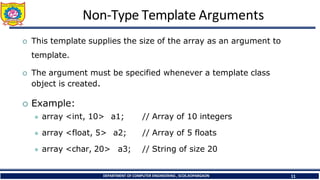
This template supplies the size of the array as an argument to
template.
The argument must be specified whenever a template class
object is created.
Example:
⚫ array <int, 10> a1;
⚫ array <float, 5> a2;
⚫ array <char, 20> a3;
// Array of 10 integers
// Array of 5 floats
// String of size 20
![Non-Type Template Arguments
DEPARTMENT OF COMPUTER ENGINEERING , SCOE,KOPARGAON 10
It is also possible to use non-type arguments.
In addition to the type argument T, we can also use other
arguments such as strings, int, float, built-in types.
Example:
template <class T, int size>
class array
{
T a[size];
……..
………
};](https://image.slidesharecdn.com/4-250805062942-a4bf5a39/85/Function-Templates-Overlaoding-Function-Templates-pdf-10-320.jpg)