Sanjivani Rural EducationSociety’s
Sanjivani College of Engineering, Kopargaon-423 603
(An Autonomous Institute, Affiliated to Savitribai Phule Pune University, Pune)
NAAC ‘A’Grade Accredited, ISO 9001:2015 Certified
Department of Computer Engineering
(NBA Accredited)
Subject- Object Oriented Programming (CO212)
Unit 2 – Overloading and Inheritance
Topic – 2.2 Data Conversion and Type Casting
Prof. V.N.Nirgude
Assistant Professor
E-mail :
nirgudevikascomp@sanjivani.org.in
Contact No: 9975240215
2.
Data Conversion &Type Casting
DEPARTMENT OF COMPUTER ENGINEERING , SCOE,KOPARGAON 2
• Type Casting is used to convert the type of a variable,
function, object, expression or return value to another type.
• It is the process of converting one type into another.
• In other words converting an expression of a given type into
another is called type casting.
• There are two ways of achieving Type Casting
1. Implicit TypeCasting(Conversion)
2. Explicit TypeCasting (Conversion)
3.
Implicit Type Conversion
DEPARTMENTOF COMPUTER ENGINEERING , SCOE,KOPARGAON 3
• Implicit type conversion is not done by
operator.
using any
• In other words, the value that gets
converted to the specific type to which it is
known as implicit type conversion.
automatically
assigned, is
4.
Explicit TypeConversion
DEPARTMENT OFCOMPUTER ENGINEERING , SCOE,KOPARGAON 4
• Explicit conversion can be done using type cast operator.
• In other words, the value that gets converted to the specific
type by using type cast operator is known as explicit type
conversion.
• In C++, type casting can be done in either of the
mentioned below:
• „C‟-style casting
• „C++‟-style casting
two ways
5.
C-styleCasting
DEPARTMENT OF COMPUTERENGINEERING , SCOE,KOPARGAON 5
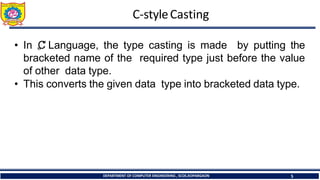
• In „
C
‟ Language, the type casting is made by putting the
bracketed name of the required type just before the value
of other data type.
• This converts the given data type into bracketed data type.
6.
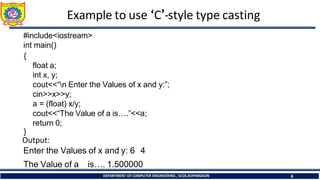
Example to use‘C’-style type casting
DEPARTMENT OF COMPUTER ENGINEERING , SCOE,KOPARGAON 6
#include<iostream>
int main()
{
float a;
int x, y;
cout<<“n Enter the Values of x and y:”;
cin>>x>>y;
a = (float) x/y;
cout<<“The Value of a is….”<<a;
return 0;
}
Output:
Enter the Values of x and y: 6 4
The Value of a is…. 1.500000
7.
‘C++’-style Type Casting
DEPARTMENTOF COMPUTER ENGINEERING , SCOE,KOPARGAON 7
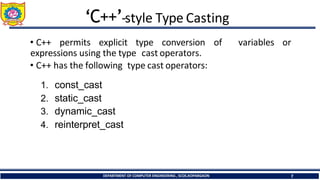
• C++ permits explicit type conversion
expressions using the type cast operators.
• C++ has the following type cast operators:
1. const_cast
2. static_cast
3. dynamic_cast
4. reinterpret_cast
of variables or
8.
The const_cast Operator
DEPARTMENTOF COMPUTER ENGINEERING , SCOE,KOPARGAON 8
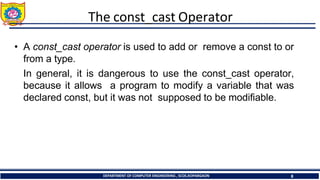
• A const_cast operator is used to add or remove a const to or
from a type.
In general, it is dangerous to use the const_cast operator,
because it allows a program to modify a variable that was
declared const, but it was not supposed to be modifiable.
9.
The static_cast Operator
DEPARTMENTOF COMPUTER ENGINEERING , SCOE,KOPARGAON 9
• The static-cast operator is used to
expression to the specified type.
• static_cast operator can be used to
char.
convert a given
convert an int to a
10.
The dynamic_cast Operator:
•The dynamic_cast operator performs
time.
The reinterpret_cast Operator:
DEPARTMENT OF COMPUTER ENGINEERING , SCOE,KOPARGAON 10
type conversions at run
• The reinterpret_cast operator changes one data type into
another.
• It should be used to cast between incompatible pointer types.
• The reinterpret_cast operator can be used for conversions
such as char* to int*, or One_class* to Unrelated_class*.