1.1 Introduction to procedural, modular, object-oriented and generic programming techniques.pdf
1.
Sanjivani Rural EducationSociety’s
Sanjivani College of Engineering, Kopargaon-423 603
(An Autonomous Institute, Affiliated to Savitribai Phule Pune University, Pune)
NAAC ‘A’Grade Accredited, ISO 9001:2015 Certified
Department of Computer Engineering
(NBA Accredited)
Subject- Object Oriented Programming (CO212)
Unit 1 – Fundamentals of OOP
Topic –1.1 Introduction to procedural, modular, object-
oriented and generic programming techniques
Prof. V.N.Nirgude
Assistant Professor
E-mail :
nirgudevikascomp@sanjivani.org.in
Contact No: 9975240215
2.
Procedural Programming
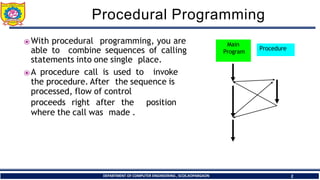
⦿With proceduralprogramming, you are
able to combine sequences of calling
statements into one single place.
⦿A procedure call is used to invoke
the procedure. After the sequence is
processed, flow of control
proceeds right after the position
where the call was made .
Main
Program
Procedure
DEPARTMENT OF COMPUTER ENGINEERING , SCOE,KOPARGAON 2
3.
Procedures
DEPARTMENT OF COMPUTERENGINEERING , SCOE,KOPARGAON 3
⦿Using procedures programs can be written more
structured and error free.
⦿For example, if a procedure is correct, every time it is used it
produces correct results.
⦿Consequently, in cases of errors you can narrow your search to
those places which are not proven to be correct.
4.
Procedure Program View
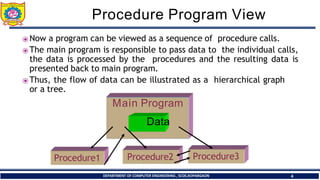
⦿Nowa program can be viewed as a sequence of procedure calls.
⦿The main program is responsible to pass data to the individual calls,
the data is processed by the procedures and the resulting data is
presented back to main program.
⦿Thus, the flow of data can be illustrated as a hierarchical graph
or a tree.
Main Program
Data
Procedure1 Procedure2 Procedure3
DEPARTMENT OF COMPUTER ENGINEERING , SCOE,KOPARGAON 4
5.
Modular Programming
DEPARTMENT OFCOMPUTER ENGINEERING , SCOE,KOPARGAON 5
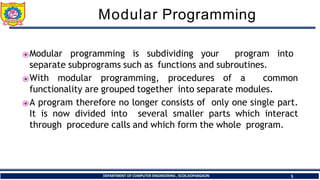
⦿Modular programming is subdividing your program into
separate subprograms such as functions and subroutines.
⦿With modular programming, procedures of a common
functionality are grouped together into separate modules.
⦿A program therefore no longer consists of only one single part.
It is now divided into several smaller parts which interact
through procedure calls and which form the whole program.
6.
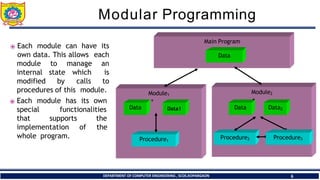
Main Program
Data
Data
Module2
+
Data2
Data
Module1
+
Data1
Procedure1
Procedure2 Procedure3
DEPARTMENTOF COMPUTER ENGINEERING , SCOE,KOPARGAON 6
⦿ Each module can have its
own data. This allows each
module to
internal state
modified by
manage an
which is
calls to
procedures of this module.
⦿ Each module has its own
special functionalities
that supports the
implementation of the
whole program.
Modular Programming
7.
Object Oriented
Programming
DEPARTMENT OFCOMPUTER ENGINEERING , SCOE,KOPARGAON 7
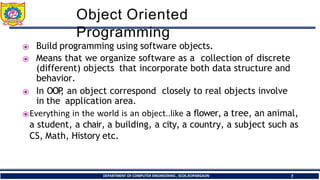
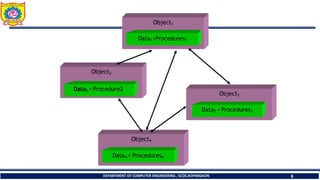
⦿ Build programming using software objects.
⦿ Means that we organize software as a collection of discrete
(different) objects that incorporate both data structure and
behavior.
⦿ In OOP
, an object correspond closely to real objects involve
in the application area.
⦿Everything in the world is an object..like a flower, a tree, an animal,
a student, a chair, a building, a city, a country, a subject such as
CS, Math, History etc.
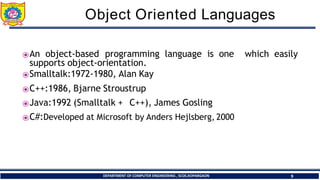
Object Oriented Languages
DEPARTMENTOF COMPUTER ENGINEERING , SCOE,KOPARGAON 9
⦿An object-based programming language is one
supports object-orientation.
⦿Smalltalk:1972-1980, Alan Kay
⦿C++:1986, Bjarne Stroustrup
⦿Java:1992 (Smalltalk + C++), James Gosling
⦿C#:Developed at Microsoft by Anders Hejlsberg, 2000
which easily
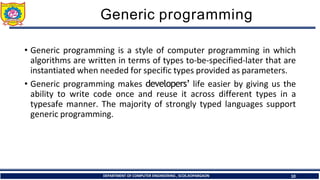
10.
Generic programming
DEPARTMENT OFCOMPUTER ENGINEERING , SCOE,KOPARGAON 10
• Generic programming is a style of computer programming in which
algorithms are written in terms of types to-be-specified-later that are
instantiated when needed for specific types provided as parameters.
• Generic programming makes developers’ life easier by giving us the
ability to write code once and reuse it across different types in a
typesafe manner. The majority of strongly typed languages support
generic programming.
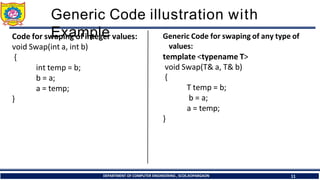
11.
Code for swapingof integer values:
void Swap(int a, int b)
{
int temp = b;
b = a;
a = temp;
}
Generic Code for swaping of any type of
values:
template <typename T>
void Swap(T& a, T& b)
{
T temp = b;
b = a;
a = temp;
}
Generic Code illustration with
Example
DEPARTMENT OF COMPUTER ENGINEERING , SCOE,KOPARGAON 11


![Progecad 2025 Professional Cracked [Latest]](https://cdn.slidesharecdn.com/ss_thumbnails/1-250523110414-1ac543c0-250523121349-2f0f5a8d-thumbnail.jpg?width=640&height=640&fit=bounds)
![[OOP - Lec 03] Programming Paradigms](https://cdn.slidesharecdn.com/ss_thumbnails/lecture-03programmingparadigms-160604055214-thumbnail.jpg?width=640&height=640&fit=bounds)


