Sanjivani Rural Education Society’s
Sanjivani College of Engineering, Kopargaon-423 603
(An Autonomous Institute, Affiliated to Savitribai Phule Pune University, Pune)
NACC ‘A’ Grade Accredited, ISO 9001:2015 Certified
Department of Computer Engineering
(NBA Accredited)
Prof. V.N.Nirgude
Assistant Professor
E-mail : nirgudevikascomp@sanjivani.org.in
Contact No: 9975240215
Subject- Data Structures-II(CO214)
Unit-II Tree
Contents
• Analysis of Algorithms: Recurrences, Master Method
• Tree: Introduction, Tree Terminologies, Binary Tree, Representation, Types of
Binary Tree, Binary Tree Traversals, Binary Search Tree, operations on BST,
Threaded binary tree, Applications – Expression Tree, Huffman Encoding.
DEPARTMENT OF COMPUTER ENGINEERING, Sanjivani COE, Kopargaon 2
Tree Introduction
DEPARTMENT OF COMPUTER ENGINEERING, Sanjivani COE, Kopargaon 3
• It is a Non-linear Data structure
• Trees are mainly used to represent data containing the hierarchical
relationship between elements, example: records, family trees, and
table of contents.
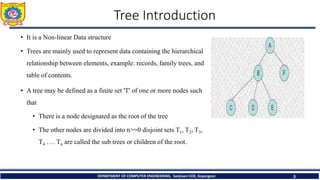
• A tree may be defined as a finite set 'T' of one or more nodes such
that
• There is a node designated as the root of the tree
• The other nodes are divided into n>=0 disjoint sets T1, T2, T3,
T4 …. Tn are called the sub trees or children of the root.
• Example of Tree- Book
Index
• DS-II
o Tree
 Basics
 Binary tree
o Graph
 Basics
 Representation
• List
• Matrix
 Algo.
o Hashing
DEPARTMENT OF COMPUTER ENGINEERING, Sanjivani COE, Kopargaon 4
DS-II
Tree
Graph
Hashi
ng
Basics
Binary
tree
Represe
ntation
Basics
Algo
List
Matr
ix
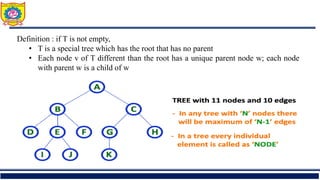
Definition : if T is not empty,
• T is a special tree which has the root that has no parent
• Each node v of T different than the root has a unique parent node w; each node
with parent w is a child of w
Terminologies
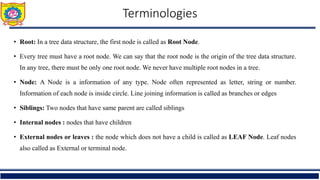
• Root: In a tree data structure, the first node is called as Root Node.
• Every tree must have a root node. We can say that the root node is the origin of the tree data structure.
In any tree, there must be only one root node. We never have multiple root nodes in a tree.
• Node: A Node is a information of any type. Node often represented as letter, string or number.
Information of each node is inside circle. Line joining information is called as branches or edges
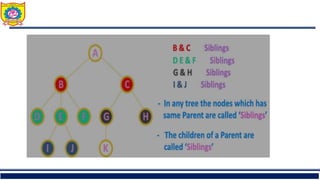
• Siblings: Two nodes that have same parent are called siblings
• Internal nodes : nodes that have children
• External nodes or leaves : the node which does not have a child is called as LEAF Node. Leaf nodes
also called as External or terminal node.
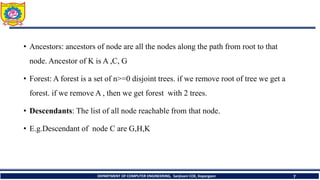
• Ancestors: ancestors of node are all the nodes along the path from root to that
node. Ancestor of K is A ,C, G
• Forest: A forest is a set of n>=0 disjoint trees. if we remove root of tree we get a
forest. if we remove A , then we get forest with 2 trees.
• Descendants: The list of all node reachable from that node.
• E.g.Descendant of node C are G,H,K
DEPARTMENT OF COMPUTER ENGINEERING, Sanjivani COE, Kopargaon 7
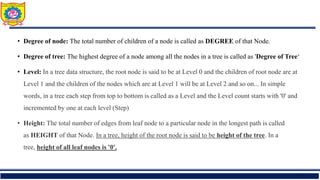
• Degree of node: The total number of children of a node is called as DEGREE of that Node.
• Degree of tree: The highest degree of a node among all the nodes in a tree is called as 'Degree of Tree‘
• Level: In a tree data structure, the root node is said to be at Level 0 and the children of root node are at
Level 1 and the children of the nodes which are at Level 1 will be at Level 2 and so on... In simple
words, in a tree each step from top to bottom is called as a Level and the Level count starts with '0' and
incremented by one at each level (Step)
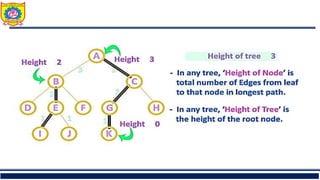
• Height: The total number of edges from leaf node to a particular node in the longest path is called
as HEIGHT of that Node. In a tree, height of the root node is said to be height of the tree. In a
tree, height of all leaf nodes is '0'.
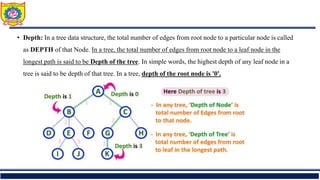
• Depth: In a tree data structure, the total number of edges from root node to a particular node is called
as DEPTH of that Node. In a tree, the total number of edges from root node to a leaf node in the
longest path is said to be Depth of the tree. In simple words, the highest depth of any leaf node in a
tree is said to be depth of that tree. In a tree, depth of the root node is '0'.
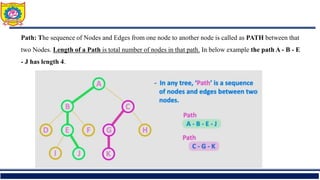
Path: The sequence of Nodes and Edges from one node to another node is called as PATH between that
two Nodes. Length of a Path is total number of nodes in that path. In below example the path A - B - E
- J has length 4.
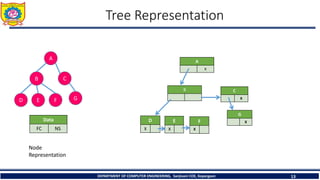
Tree Representation
DEPARTMENT OF COMPUTER ENGINEERING, Sanjivani COE, Kopargaon 13
A
B C
D F
E G
Data
FC NS
A
X
B
F
X
E
X
D
X
C
X
G
X
Node
Representation
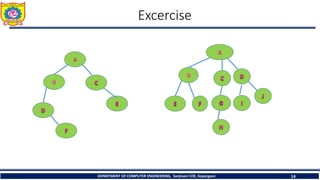
Excercise
DEPARTMENT OF COMPUTER ENGINEERING, Sanjivani COE, Kopargaon 14
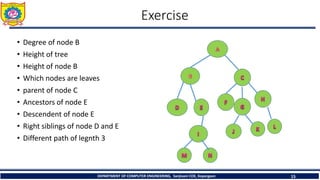
Exercise
• Degree of node B
• Height of tree
• Height of node B
• Which nodes are leaves
• parent of node C
• Ancestors of node E
• Descendent of node E
• Right siblings of node D and E
• Different path of legnth 3
DEPARTMENT OF COMPUTER ENGINEERING, Sanjivani COE, Kopargaon 15

Tree-introduction ,Definition, Types of BT

  • 1.
    Sanjivani Rural EducationSociety’s Sanjivani College of Engineering, Kopargaon-423 603 (An Autonomous Institute, Affiliated to Savitribai Phule Pune University, Pune) NACC ‘A’ Grade Accredited, ISO 9001:2015 Certified Department of Computer Engineering (NBA Accredited) Prof. V.N.Nirgude Assistant Professor E-mail : nirgudevikascomp@sanjivani.org.in Contact No: 9975240215 Subject- Data Structures-II(CO214) Unit-II Tree
  • 2.
    Contents • Analysis ofAlgorithms: Recurrences, Master Method • Tree: Introduction, Tree Terminologies, Binary Tree, Representation, Types of Binary Tree, Binary Tree Traversals, Binary Search Tree, operations on BST, Threaded binary tree, Applications – Expression Tree, Huffman Encoding. DEPARTMENT OF COMPUTER ENGINEERING, Sanjivani COE, Kopargaon 2
  • 3.
    Tree Introduction DEPARTMENT OFCOMPUTER ENGINEERING, Sanjivani COE, Kopargaon 3 • It is a Non-linear Data structure • Trees are mainly used to represent data containing the hierarchical relationship between elements, example: records, family trees, and table of contents. • A tree may be defined as a finite set 'T' of one or more nodes such that • There is a node designated as the root of the tree • The other nodes are divided into n>=0 disjoint sets T1, T2, T3, T4 …. Tn are called the sub trees or children of the root.
  • 4.
    • Example ofTree- Book Index • DS-II o Tree  Basics  Binary tree o Graph  Basics  Representation • List • Matrix  Algo. o Hashing DEPARTMENT OF COMPUTER ENGINEERING, Sanjivani COE, Kopargaon 4 DS-II Tree Graph Hashi ng Basics Binary tree Represe ntation Basics Algo List Matr ix
  • 5.
    Definition : ifT is not empty, • T is a special tree which has the root that has no parent • Each node v of T different than the root has a unique parent node w; each node with parent w is a child of w
  • 6.
    Terminologies • Root: Ina tree data structure, the first node is called as Root Node. • Every tree must have a root node. We can say that the root node is the origin of the tree data structure. In any tree, there must be only one root node. We never have multiple root nodes in a tree. • Node: A Node is a information of any type. Node often represented as letter, string or number. Information of each node is inside circle. Line joining information is called as branches or edges • Siblings: Two nodes that have same parent are called siblings • Internal nodes : nodes that have children • External nodes or leaves : the node which does not have a child is called as LEAF Node. Leaf nodes also called as External or terminal node.
  • 7.
    • Ancestors: ancestorsof node are all the nodes along the path from root to that node. Ancestor of K is A ,C, G • Forest: A forest is a set of n>=0 disjoint trees. if we remove root of tree we get a forest. if we remove A , then we get forest with 2 trees. • Descendants: The list of all node reachable from that node. • E.g.Descendant of node C are G,H,K DEPARTMENT OF COMPUTER ENGINEERING, Sanjivani COE, Kopargaon 7
  • 9.
    • Degree ofnode: The total number of children of a node is called as DEGREE of that Node. • Degree of tree: The highest degree of a node among all the nodes in a tree is called as 'Degree of Tree‘ • Level: In a tree data structure, the root node is said to be at Level 0 and the children of root node are at Level 1 and the children of the nodes which are at Level 1 will be at Level 2 and so on... In simple words, in a tree each step from top to bottom is called as a Level and the Level count starts with '0' and incremented by one at each level (Step) • Height: The total number of edges from leaf node to a particular node in the longest path is called as HEIGHT of that Node. In a tree, height of the root node is said to be height of the tree. In a tree, height of all leaf nodes is '0'.
  • 11.
    • Depth: Ina tree data structure, the total number of edges from root node to a particular node is called as DEPTH of that Node. In a tree, the total number of edges from root node to a leaf node in the longest path is said to be Depth of the tree. In simple words, the highest depth of any leaf node in a tree is said to be depth of that tree. In a tree, depth of the root node is '0'.
  • 12.
    Path: The sequenceof Nodes and Edges from one node to another node is called as PATH between that two Nodes. Length of a Path is total number of nodes in that path. In below example the path A - B - E - J has length 4.
  • 13.
    Tree Representation DEPARTMENT OFCOMPUTER ENGINEERING, Sanjivani COE, Kopargaon 13 A B C D F E G Data FC NS A X B F X E X D X C X G X Node Representation
  • 14.
    Excercise DEPARTMENT OF COMPUTERENGINEERING, Sanjivani COE, Kopargaon 14
  • 15.
    Exercise • Degree ofnode B • Height of tree • Height of node B • Which nodes are leaves • parent of node C • Ancestors of node E • Descendent of node E • Right siblings of node D and E • Different path of legnth 3 DEPARTMENT OF COMPUTER ENGINEERING, Sanjivani COE, Kopargaon 15