


The document provides an overview of software sizing and function point analysis (FPA). It discusses the need for software sizing to estimate size and manage projects. It introduces common sizing methodologies like lines of code and use cases. The bulk of the document then focuses on explaining FPA, including defining what a function point is, categorizing functional requirements into base components, assigning complexity ratings and counts, and determining an adjusted function point count using value adjustment factors.
Introduction of Aparna Naik and DestinationQA regarding software testing.
Outline of topics including software sizing, methodologies, function point analysis, and a case study.
Definition of software sizing as an estimation activity within software engineering.
Reasons for software sizing including productivity, budgeting, resource allocation, and risk assessment.
Overview of common methodologies like Lines of Code and Function Point Analysis.
The evolution of Function Point Analysis (FPA) since the 1970s and its significance in software sizing.
Definition of function points, measuring business functionality, and their significance in software development.
Step-by-step process for counting function points, including categorization and complexity rating. Definitions and evaluations of External Inputs, Outputs, Internal Logical Files, and their types.
Introduction to Value Adjustment Factor (VAF) and how it influences the function point counts.
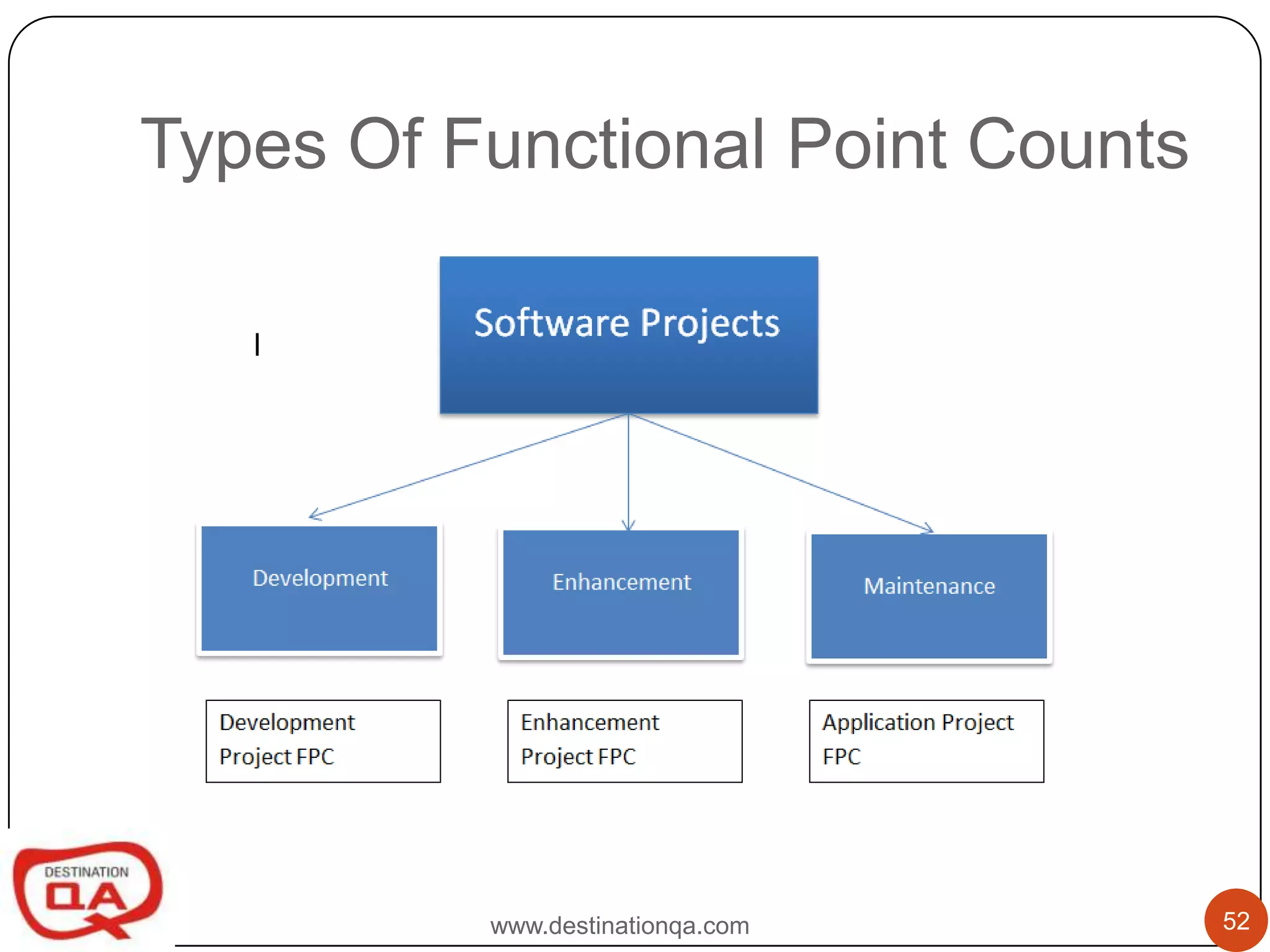
Explanation of different types of FP counts relating to development, enhancements, and applications.
Insights on estimation in software projects and a practical case study on Function Point Analysis.
Detailed explanations of data elements, needs for software metrics, boundaries, and applications of FPA.
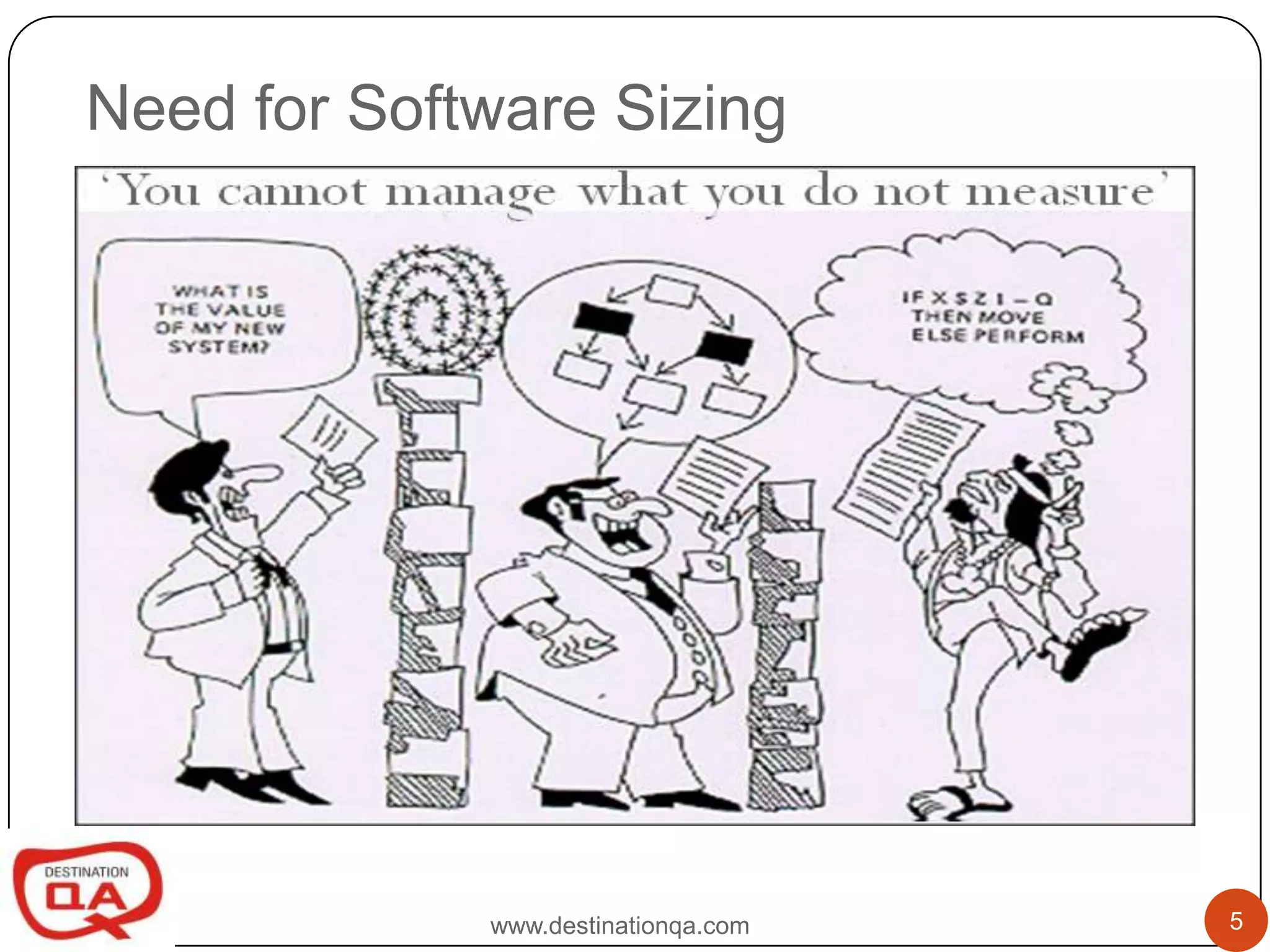
Software SizingSoftware sizingis an activity in software engineering that is used to estimate the size of a software application or component in order to be able to implement other software project management activities (such as estimating or tracking). www.destinationqa.com4Size is an inherent characteristic of a piece of software just like weight is an inherent characteristic of a tangible material.
What do yousee on the Surface?The image represents the tip of an iceberg. The real issue is not the tip, but what is under the surface of the water and can not be seen. The same is true when you design a software application.www.destinationqa.com6
14.
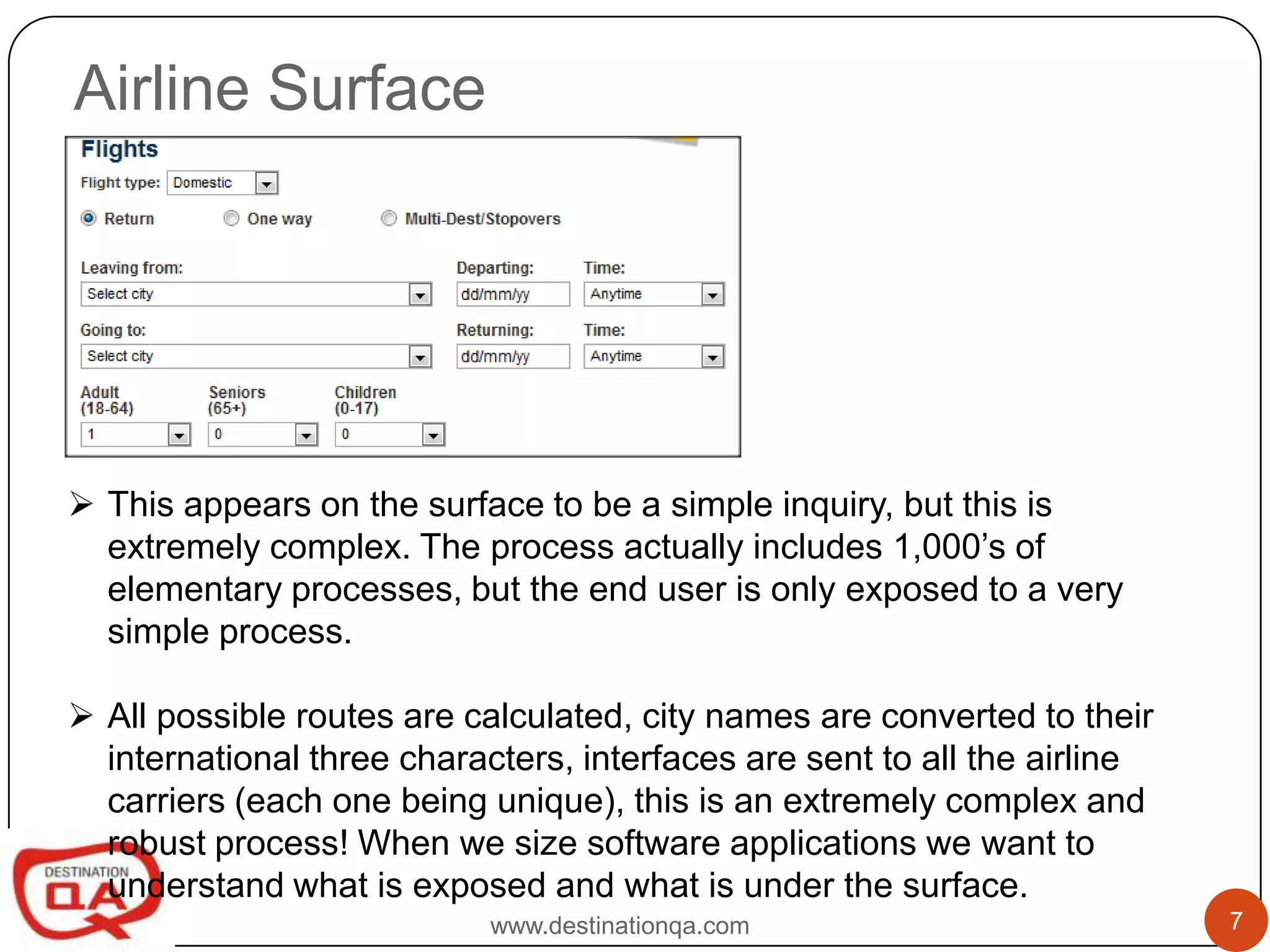
Airline SurfaceThis appearson the surface to be a simple inquiry, but this is extremely complex. The process actually includes 1,000’s of elementary processes, but the end user is only exposed to a very simple process.
15.
All possible routesare calculated, city names are converted to their international three characters, interfaces are sent to all the airline carriers (each one being unique), this is an extremely complex and robust process! When we size software applications we want to understand what is exposed and what is under the surface.www.destinationqa.com7
16.
Need for SoftwareSizingwww.destinationqa.com8Some common reasons for sizing the software are: To Measure and Manage ProductivityEstimation and budgetingMonitoring ProgressEvaluating Requirements coverage for buying new SoftwareBidding for projectsAllocating Testing ResourcesRisk AssessmentPhasing Development WorkPrioritizing WorkSoftware Asset ValuationOutsourcing Software Development, Support or Maintenance.CMMiLevel 2 and 3 require that a valid sizing method be used.
17.
Software Sizing Methodologieswww.destinationqa.com9Someof the common software sizing methodologies are: Lines of Code (Oldest)Use Case based Software SizingCOSMIC - Common Software Measurement International Consortium (ISO)IPFUG Function Point Analysis (ISO)Mk II Function Point Analysis (ISO)
18.
Software Sizing –Lines of Codewww.destinationqa.com10Historically, the most common software sizing methodology has been counting the lines of code written in the application sourceAdvantages:1. Automation of the counting process is possible.2. Intuitive - Can be seen and effect can be visualized.Disadvantages:1. Lack of Accountability - The coding phase is only 30 - 35% of the total effort.2. Very difficult to standardize lines of code for a particular function as it heavily depends on Skill level of the programmer, programming language, etc.3. Lack of counting standards (Do comments count? Data Declarations? etc)Hence a more mature Sizing Algorithm was needed.
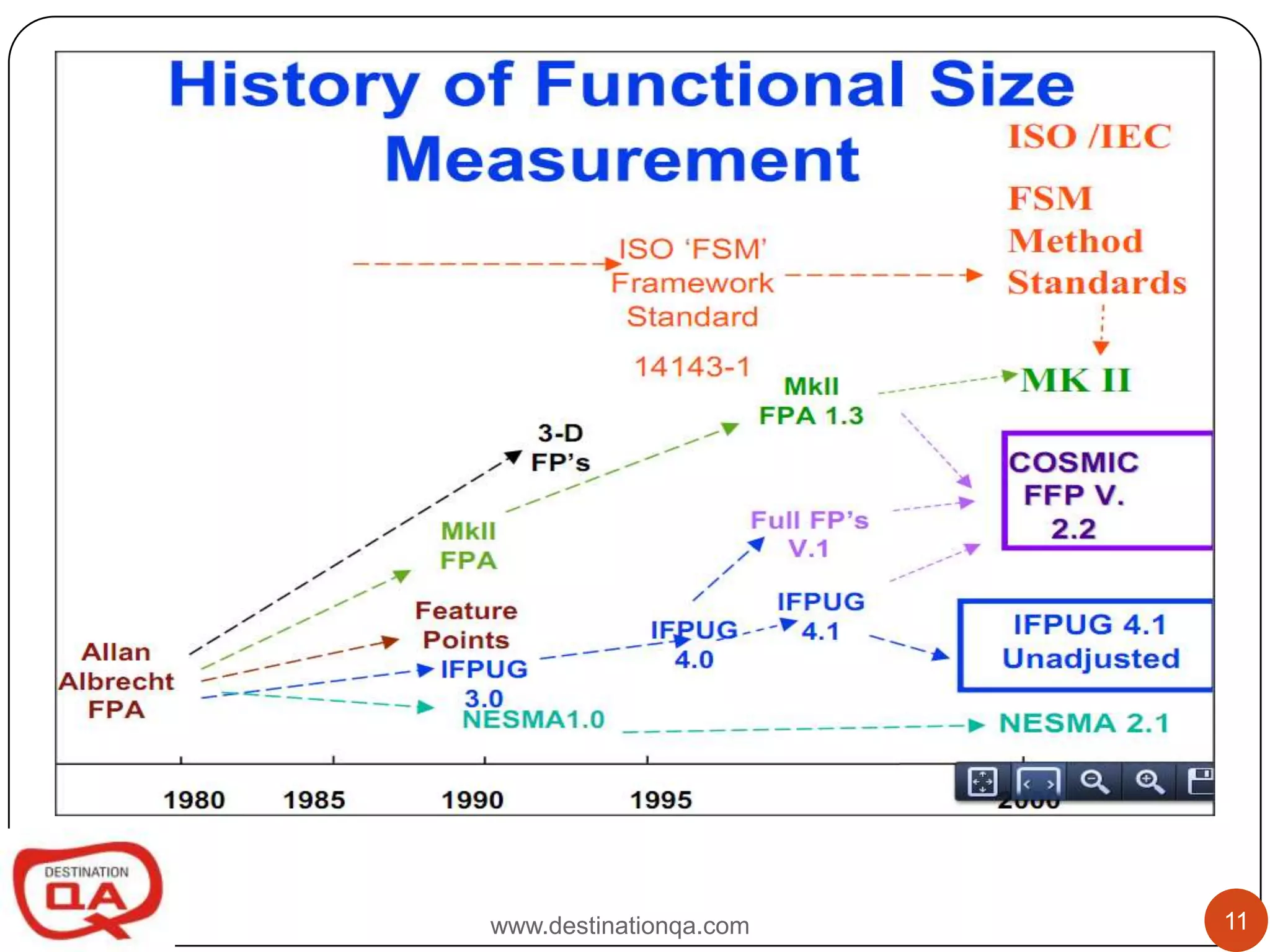
Historywww.destinationqa.com12The idea ofmeasuring a size of software in terms of its ‘functionality’ as opposed to its physical components was first put forward by Allan Albrecht of IBM in 1979
21.
He proposed amethod called ‘Function Point Analysis’ which has since evolved into the ‘IFPUG’ method.
22.
The definition ofthis method is now managed by the International Function Point Users Group.
23.
Albrecht’s clever pieceof lateral thinking laid the foundations for the subject of ‘functional size measurement’.
24.
The IFPUG methodactually has two components, firstly concerned with a measure of functional size and the second concerned with a measure of the contribution to overall size of 14 technical and quality factors.
25.
Albrecht’s original approachhas been refined significantly over the last 30 years, but its basic concepts are unchanged from the mid 1970’s.
26.
Nevertheless, the IFPUGmethod is still the most widely-used FSM method, albeit confined to the domain of business application software. Developments of 1st Generation Methodswww.destinationqa.com13Several developments from the Albrecht/IFPUG approach have been made to improve the size measure, or to extend its domain of applicability. Capers Jones published a method based closely on that of Albrecht, called ‘Feature Points’, with the aim of extending FSM to apply to scientific algorithms. The method has been largely abandoned due to the intrinsic difficulty of sizing mathematical algorithms
27.
Charles Symons developedthe ‘MkII Function Point Method’ which aimed to improve on Albrecht’s approach by better taking into account the internal complexity of ‘data-rich’ business application software.Continuedwww.destinationqa.com14Scott Whitmiredeveloped ‘3D Function Points’ to size business application and real-time software drawing on Albrecht’s general approach.
28.
The Netherlands SoftwareMetrics Users Association(‘NESMA’) published a variant of the IFPUG method which aimed to simplify some of the sizing rules
29.
The University ofQuébec, Montréal and others published the ‘Full Function Point Method’ which used the IFPUG rules for business application software and added extra components for sizing real-time software.It will be seen that all of these methods can trace their roots back to Allan Albrecht’s original ideas. They are what we call ‘1st Generation’ FSM Methods.
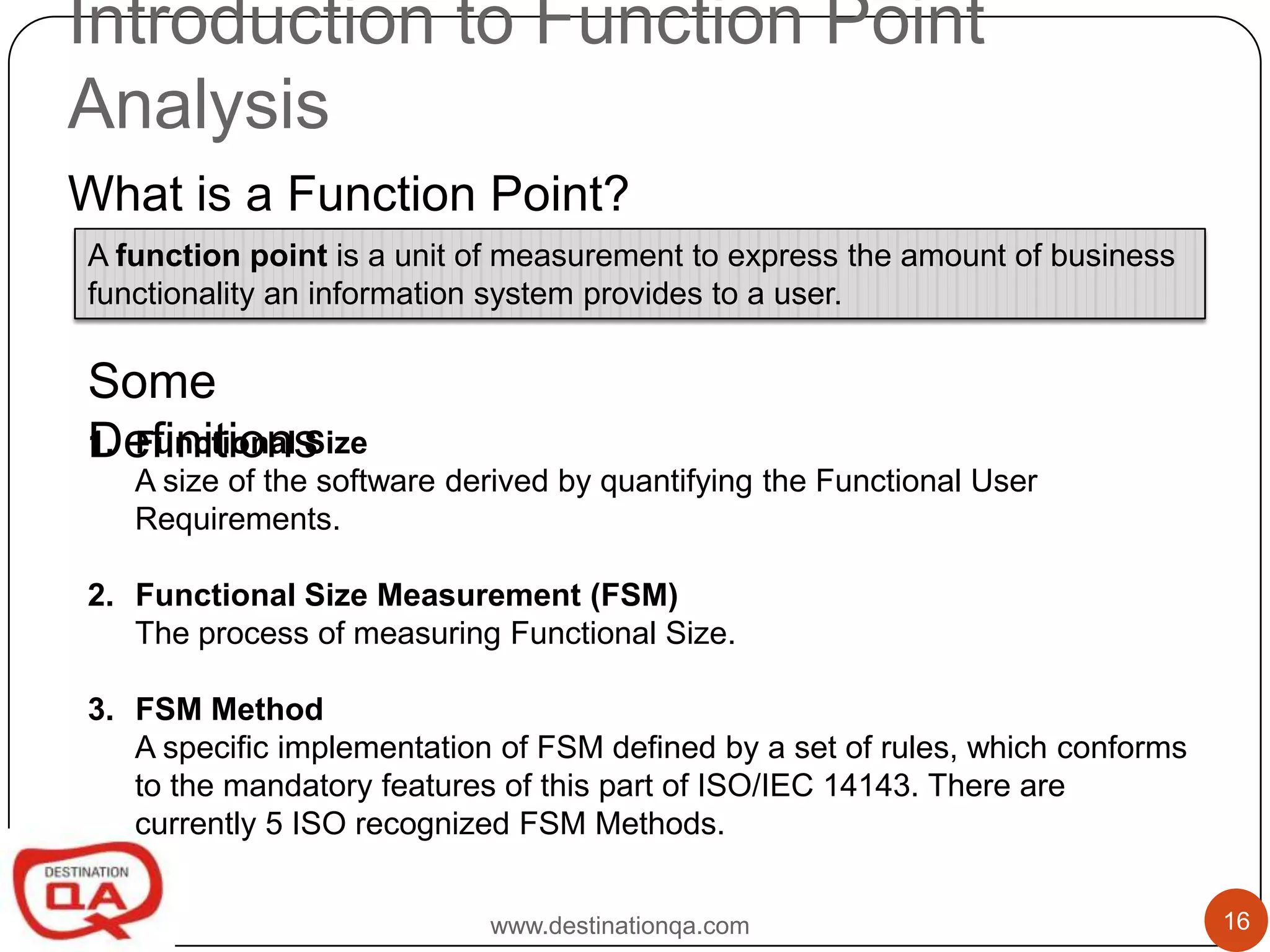
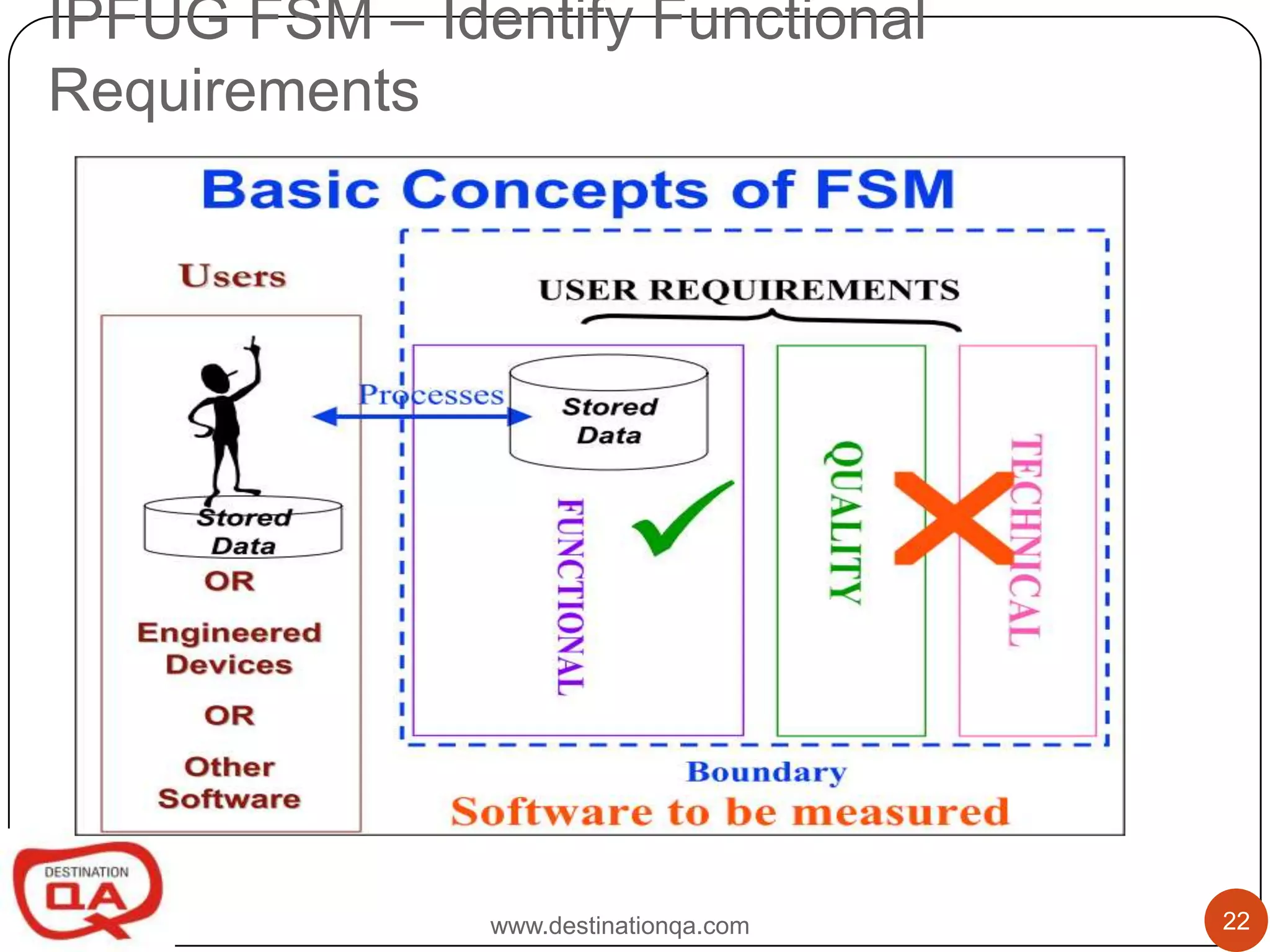
Introduction to FunctionPoint Analysiswww.destinationqa.com16What is a Function Point?A function point is a unit of measurement to express the amount of business functionality an information system provides to a user.Some DefinitionsFunctional SizeA size of the software derived by quantifying the Functional User Requirements.Functional Size Measurement (FSM)Theprocess of measuring Functional Size.FSM MethodA specific implementation of FSM defined by a set of rules, which conforms to the mandatory features of this part of ISO/IEC 14143. There are currently 5 ISO recognized FSM Methods.
32.
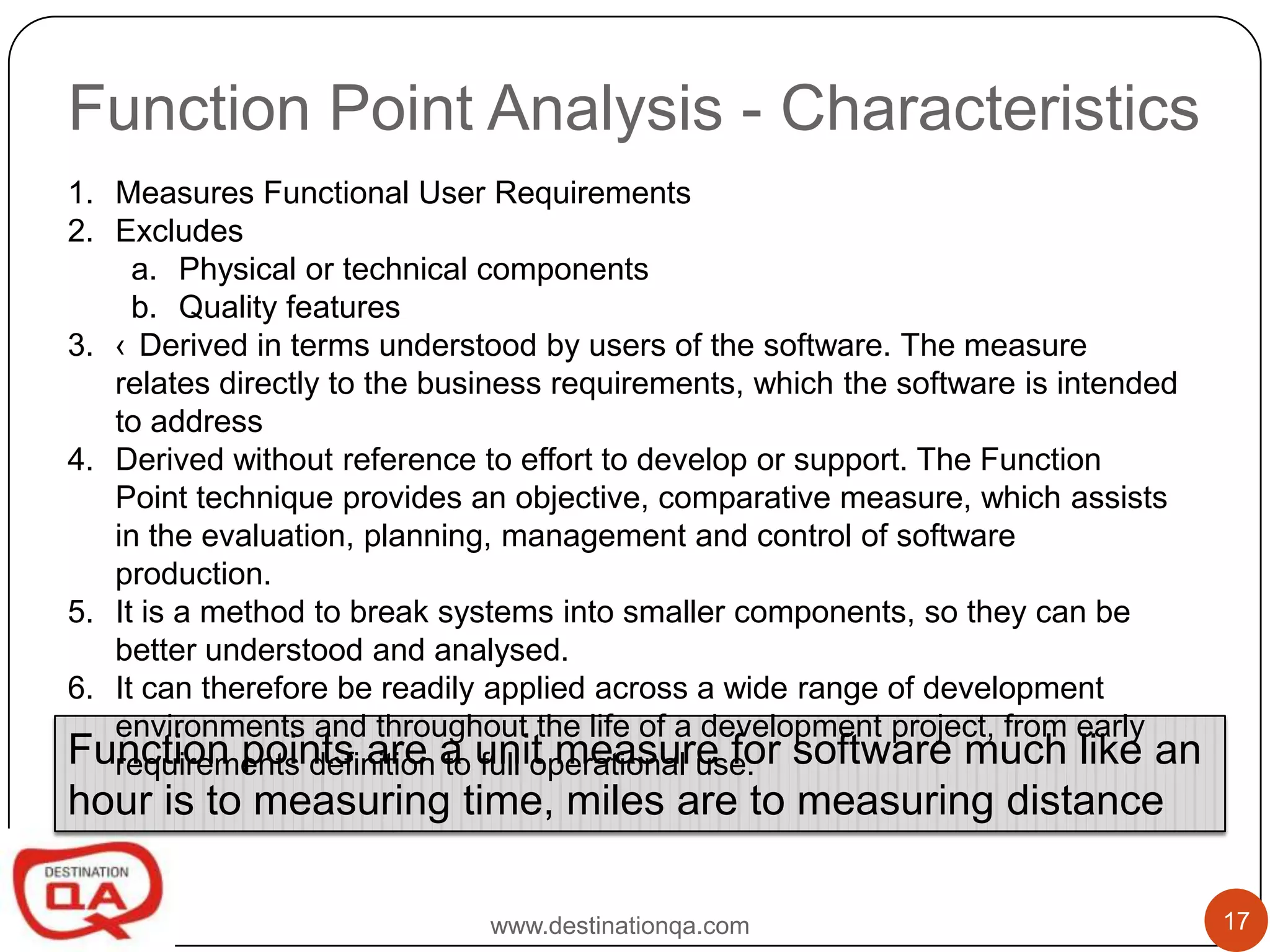
Function Point Analysis- CharacteristicsFunction points are a unit measure for software much like an hour is to measuring time, miles are to measuring distance www.destinationqa.com17Measures Functional User RequirementsExcludesPhysical or technical componentsQuality featuresDerived in terms understood by users of the software. The measure relates directly to the business requirements, which the software is intended to addressDerived without reference toeffort to develop or support. The Function Point technique provides an objective, comparative measure, which assists in the evaluation, planning, management and control of software production. It is a method to break systems into smaller components, so they can be better understood and analysed.It can therefore be readily applied across a wide range of development environments and throughout the life of a development project, from early requirements definition to full operational use.
33.
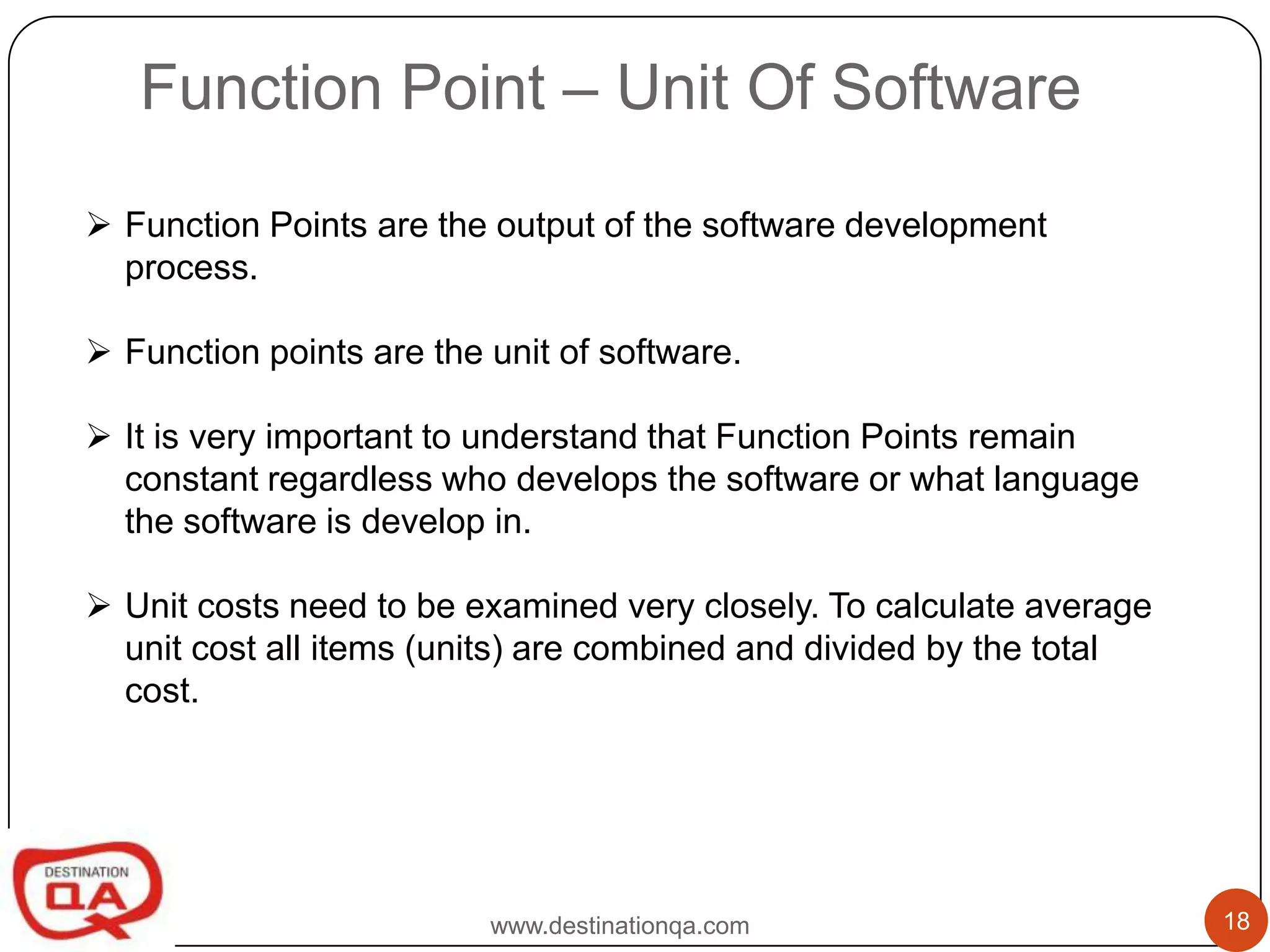
Function Point –Unit Of Softwarewww.destinationqa.com18Function Points are the output of the software development process.
It is veryimportant to understand that Function Points remain constant regardless who develops the software or what language the software is develop in.
36.
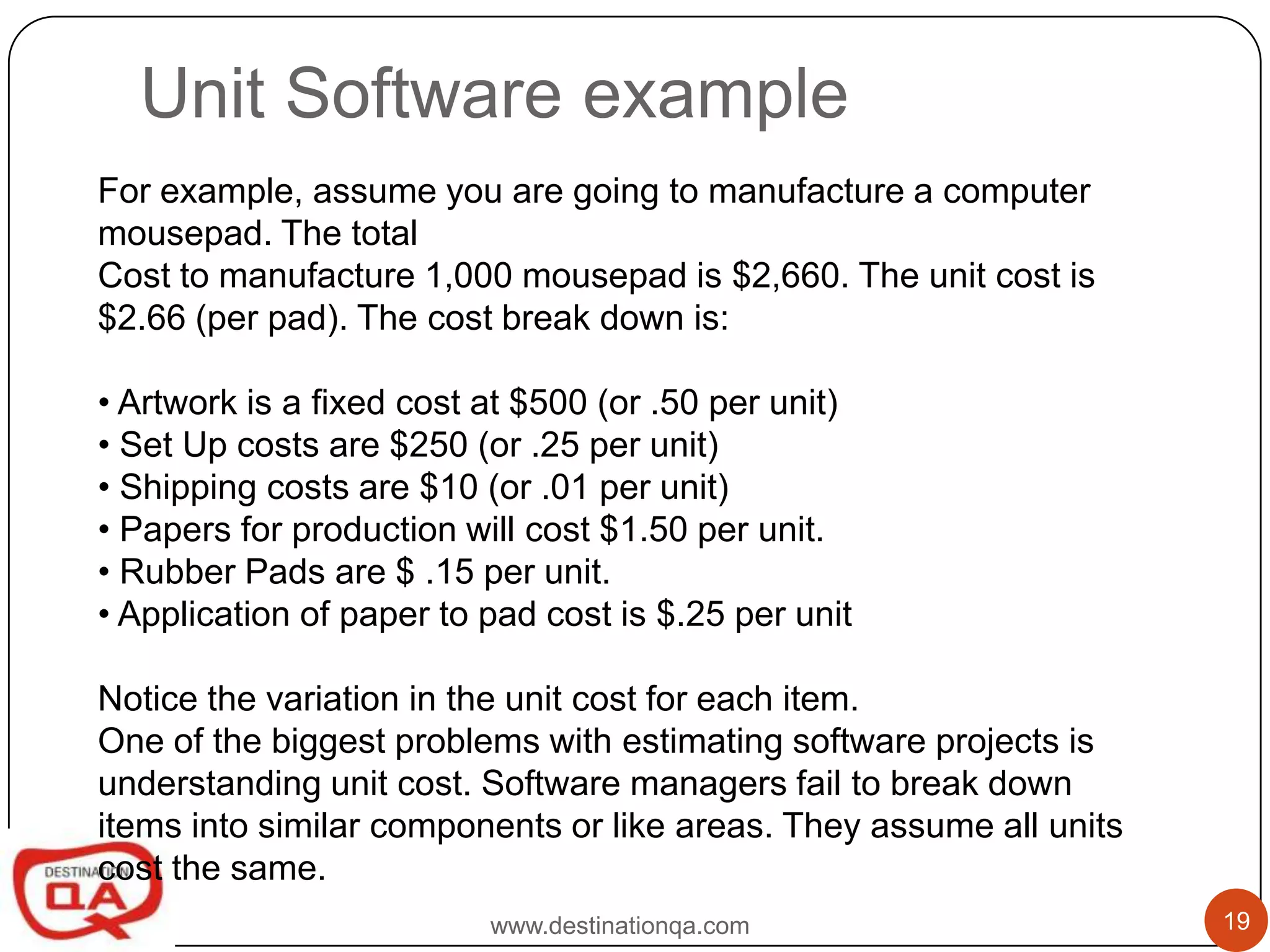
Unit costs needto be examined very closely. To calculate average unit cost all items (units) are combined and divided by the total cost.Unit Software examplewww.destinationqa.com19For example, assume you are going to manufacture a computer mousepad. The totalCost to manufacture 1,000 mousepad is $2,660. The unit cost is $2.66 (per pad). The cost break down is:• Artwork is a fixed cost at $500 (or .50 per unit)• Set Up costs are $250 (or .25 per unit)• Shipping costs are $10 (or .01 per unit)• Papers for production will cost $1.50 per unit.• Rubber Pads are $ .15 per unit.• Application of paper to pad cost is $.25 per unitNotice the variation in the unit cost for each item. One of the biggest problems with estimating software projects is understanding unit cost. Software managers fail to break down items into similar components or like areas. They assume all units cost the same.
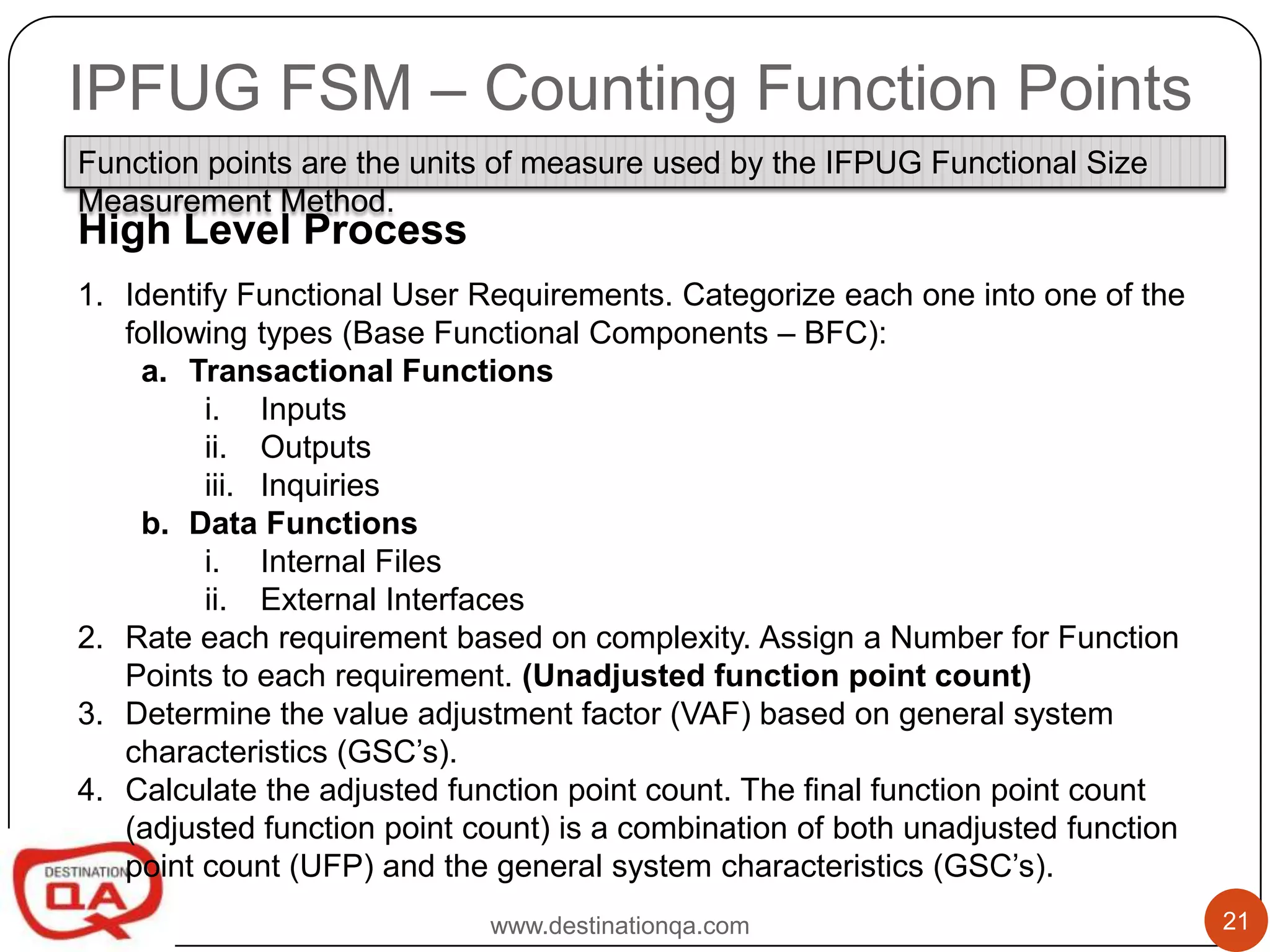
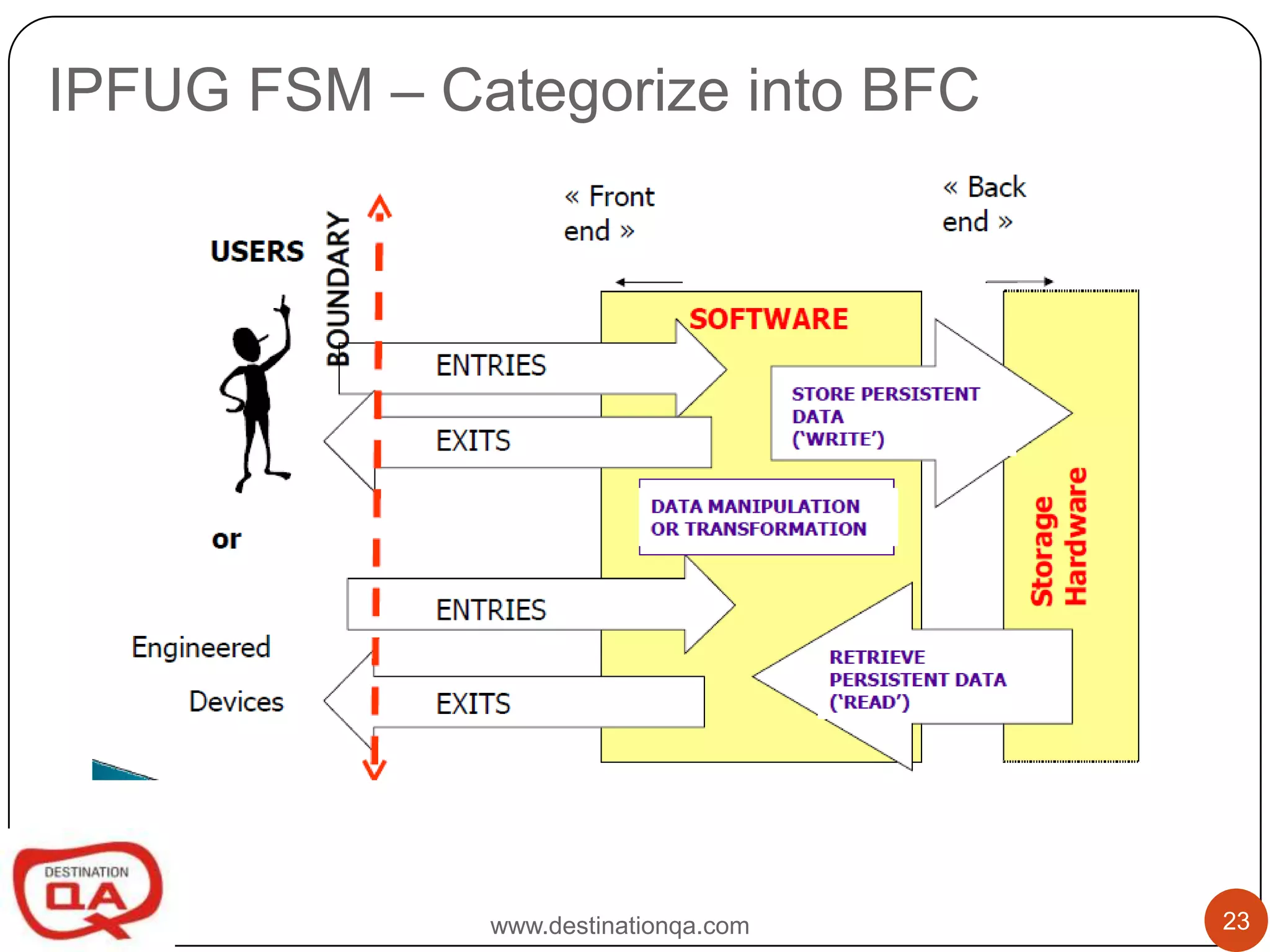
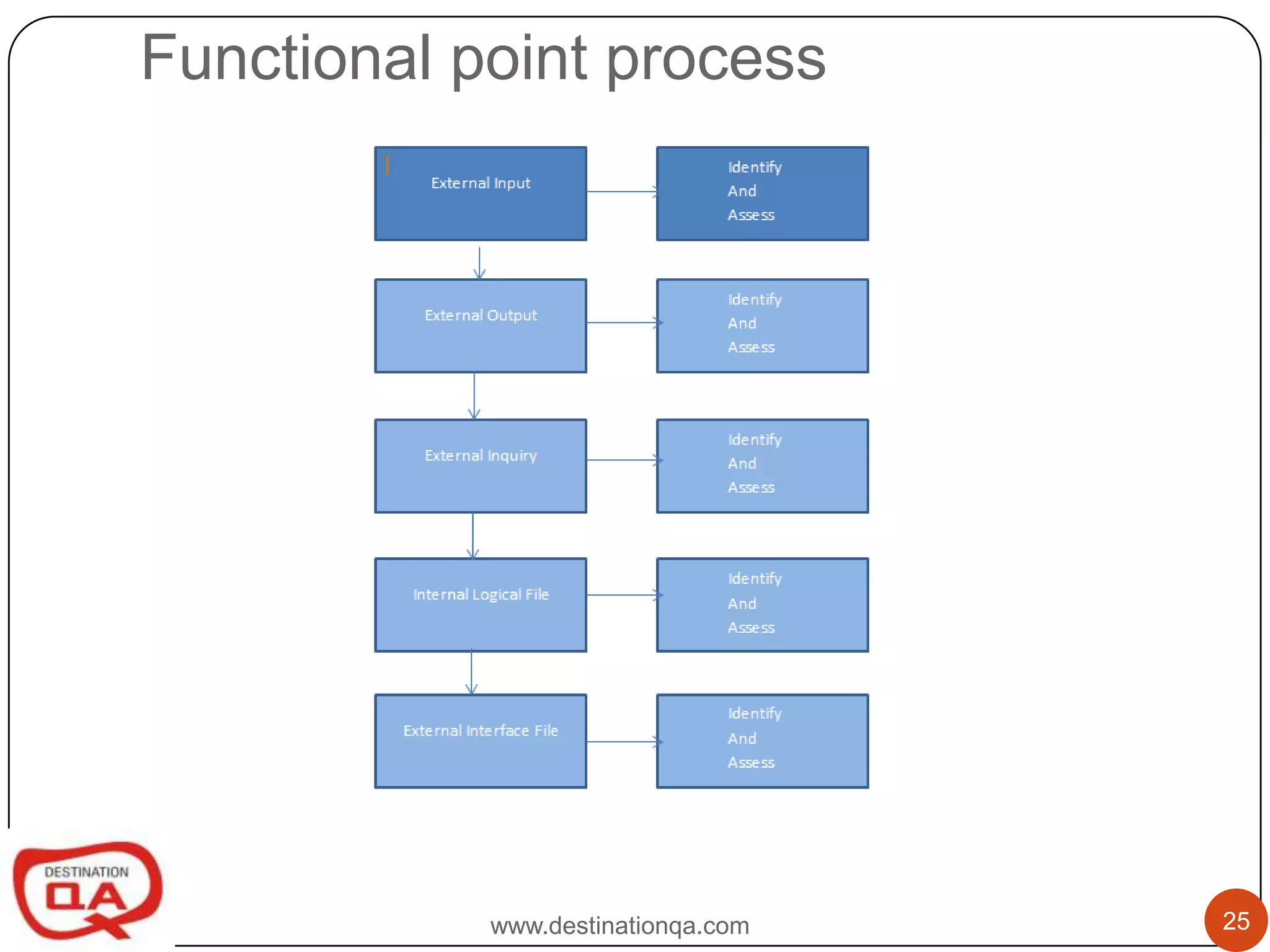
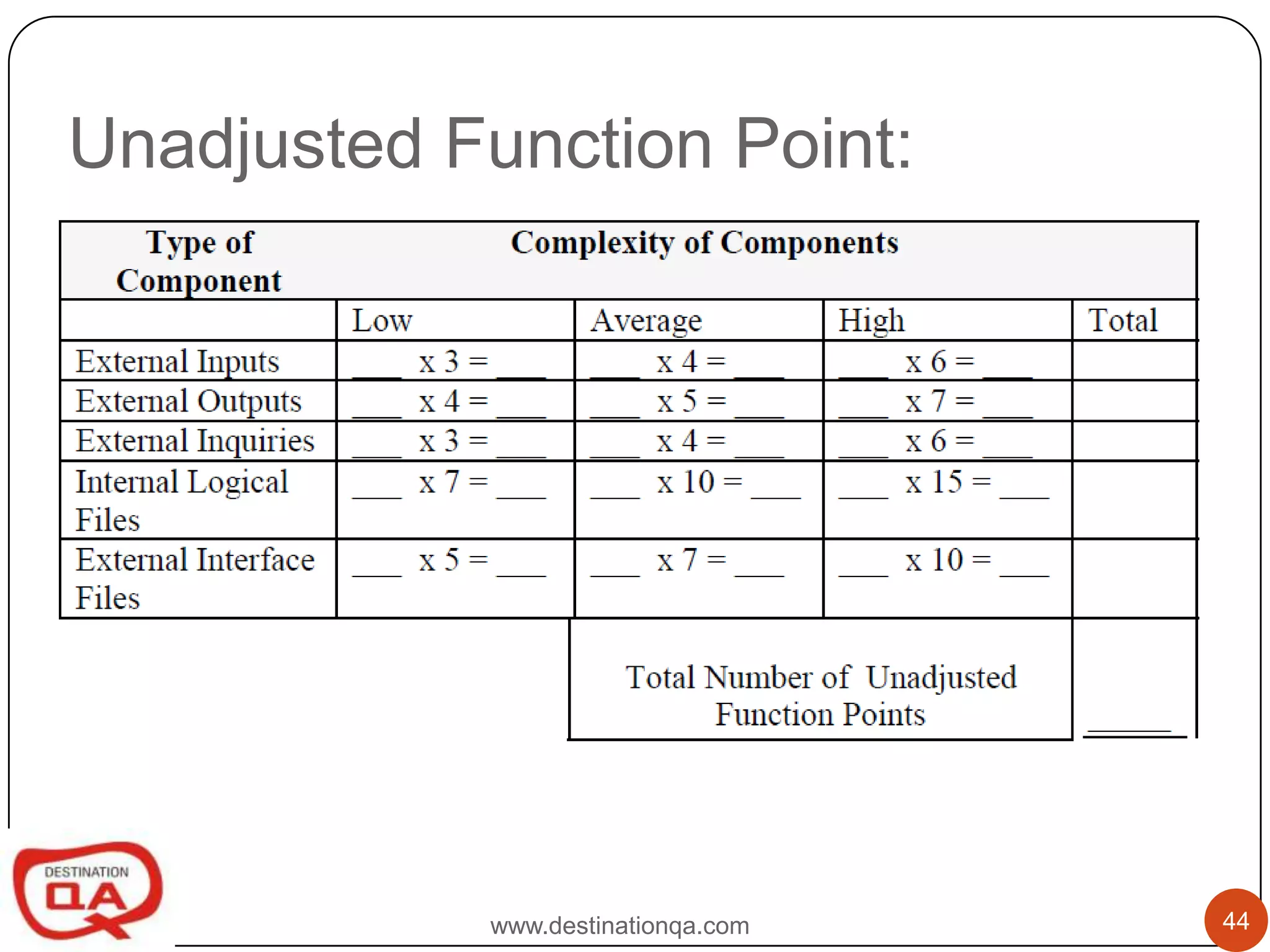
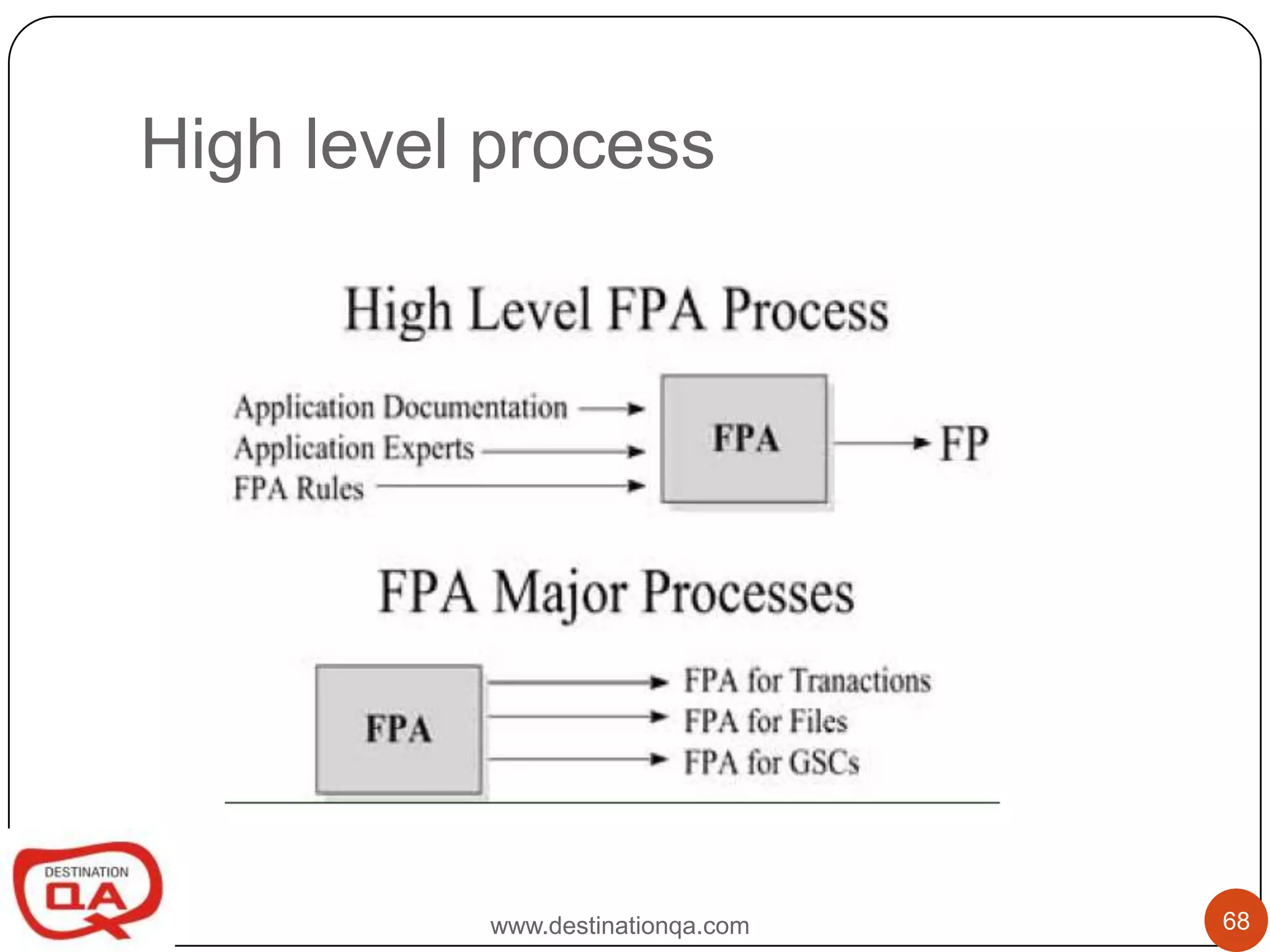
IPFUG FSM –Counting Function PointsHigh Level ProcessIdentify Functional User Requirements. Categorize each one into one of the following types (Base Functional Components – BFC):Transactional FunctionsInputsOutputsInquiriesData FunctionsInternal FilesExternal InterfacesRate each requirement based on complexity. Assign a Number for Function Points to each requirement. (Unadjusted function point count)Determine the value adjustment factor (VAF) based on general system characteristics (GSC’s).Calculate the adjusted function point count. The final function point count (adjusted function point count) is a combination of both unadjusted function point count (UFP) and the general system characteristics (GSC’s).www.destinationqa.com21Function points are the units of measure used by the IFPUG Functional Size Measurement Method.
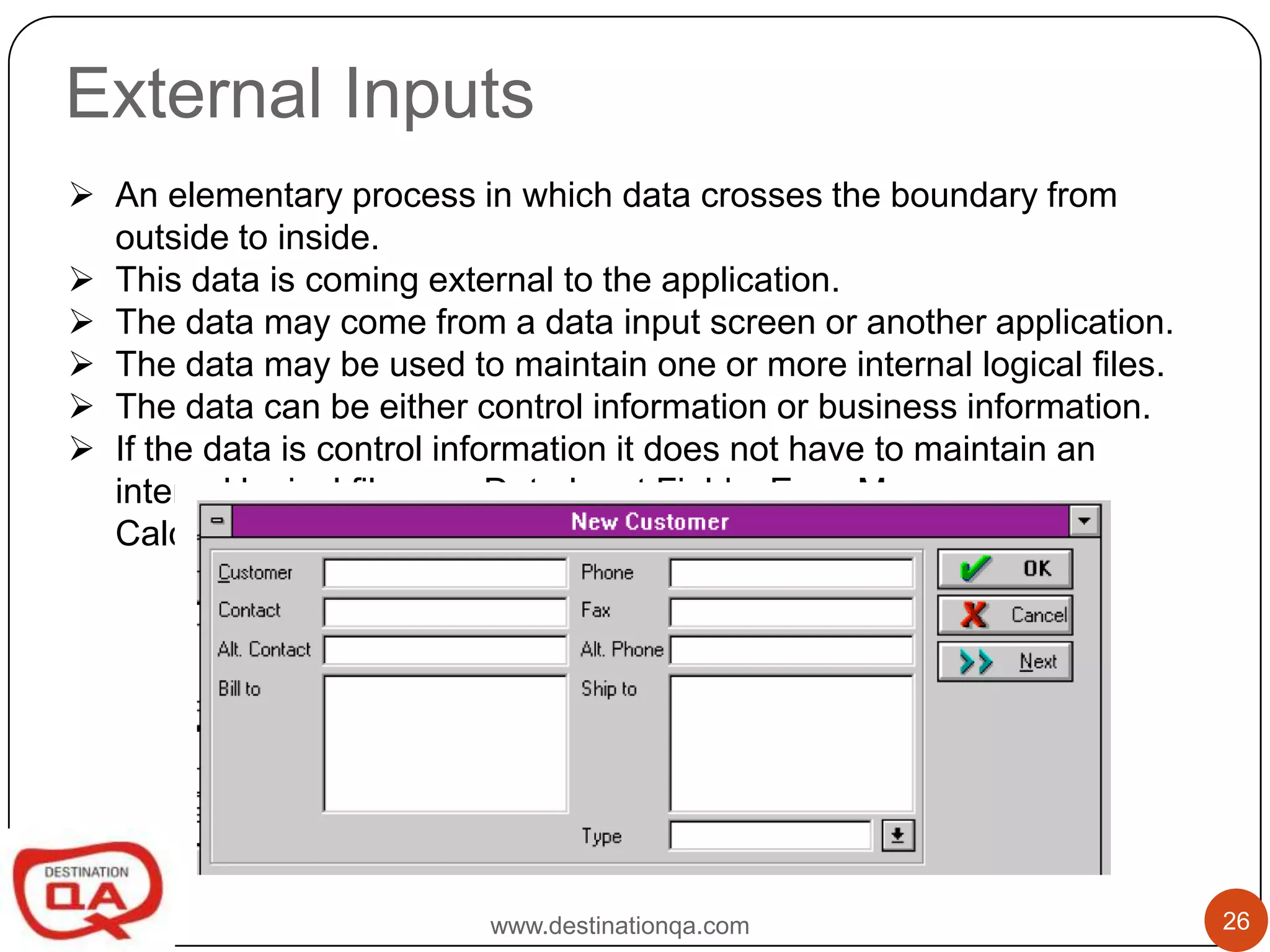
The data maycome from a data input screen or another application.
46.
The data maybe used to maintain one or more internal logical files.
47.
The data canbe either control information or business information.
48.
If the datais control information it does not have to maintain an internal logical file. e.g. Data Input Fields, Error Messages, Calculated Values, Buttonswww.destinationqa.com26
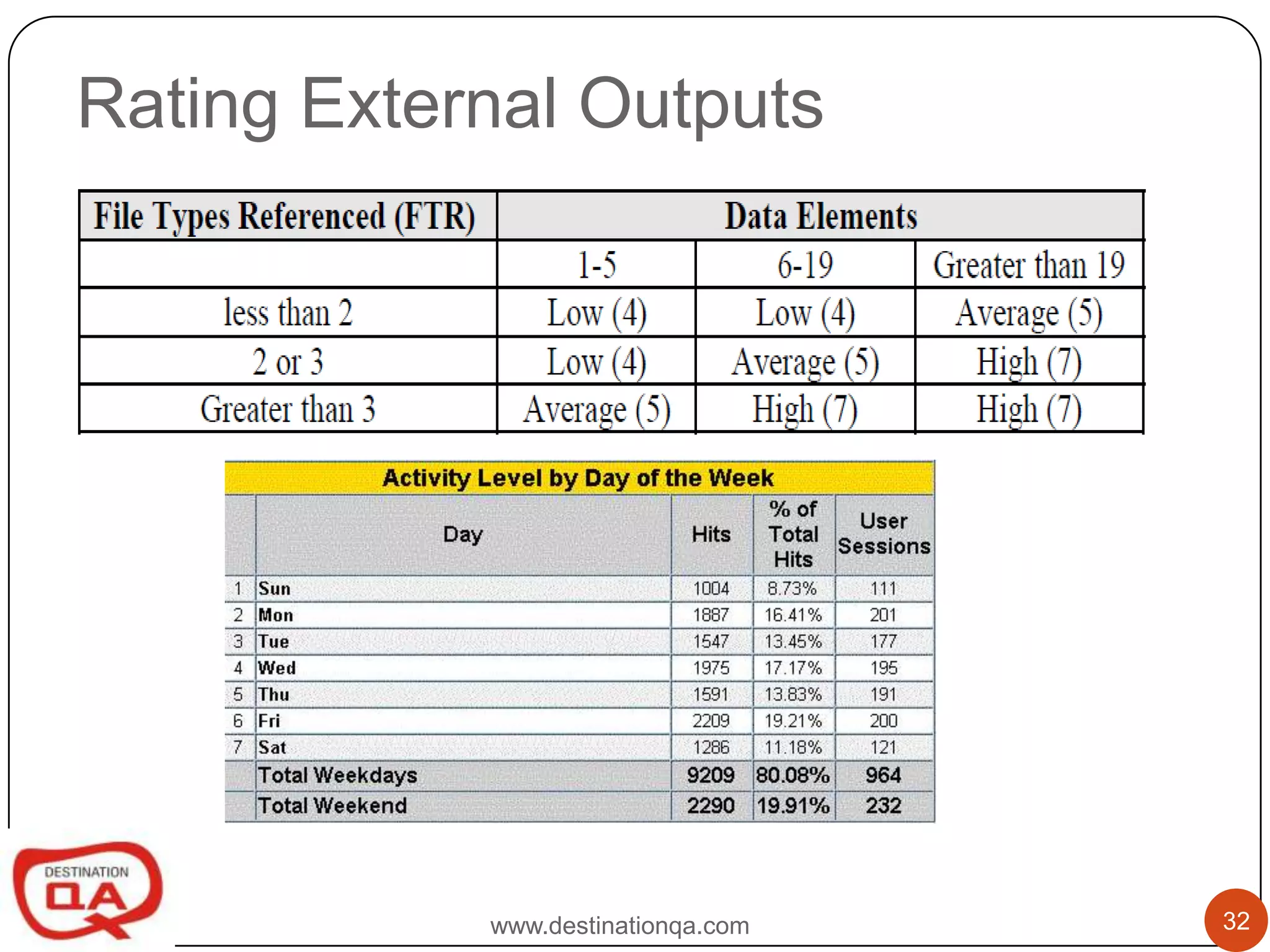
FTRs and DETsTherating of External Input is based upon the number of data element types (DET’s) and the file types referenced (FTR’s).File Type Referenced (FTR): A FTR is a file type referenced by a transaction. An FTR must alsobe an internal logical file or external interface file.Each internal logical file that an external input maintains is counted as an FTRData Element Type (DET): A DET is a unique user recognizable, non-recursive (non-repetitive)field. A DET is information that is dynamic and not static. A dynamic field is read from a fileor created from DET’s contained in a FTR. Additionally, a DET can invoke transactions or canbe additional information regarding transactions.www.destinationqa.com28
51.
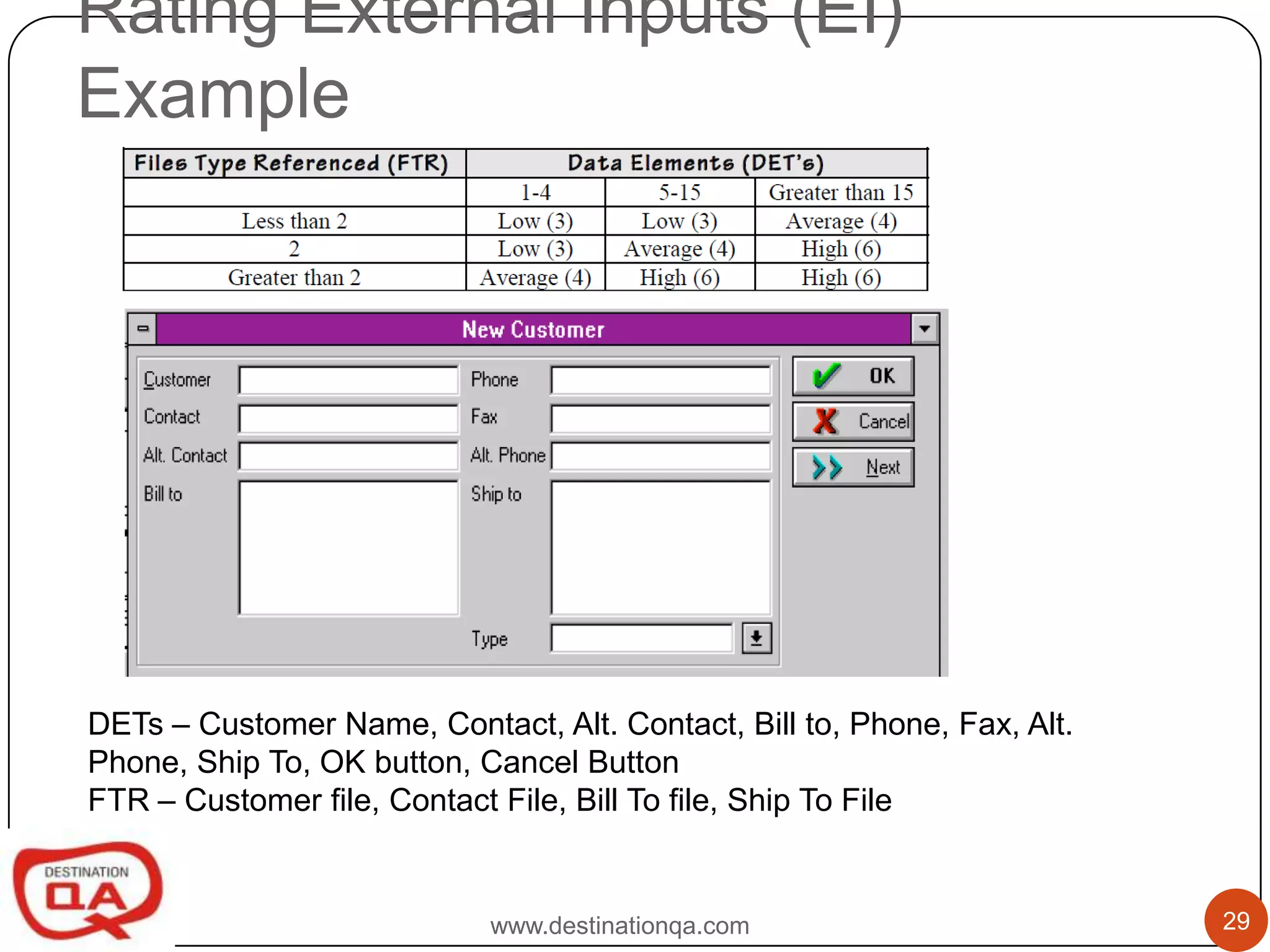
Rating External Inputs(EI) ExampleDETs – Customer Name, Contact, Alt. Contact, Bill to, Phone, Fax, Alt. Phone, Ship To, OK button, Cancel ButtonFTR – Customer file, Contact File, Bill To file, Ship To Filewww.destinationqa.com29
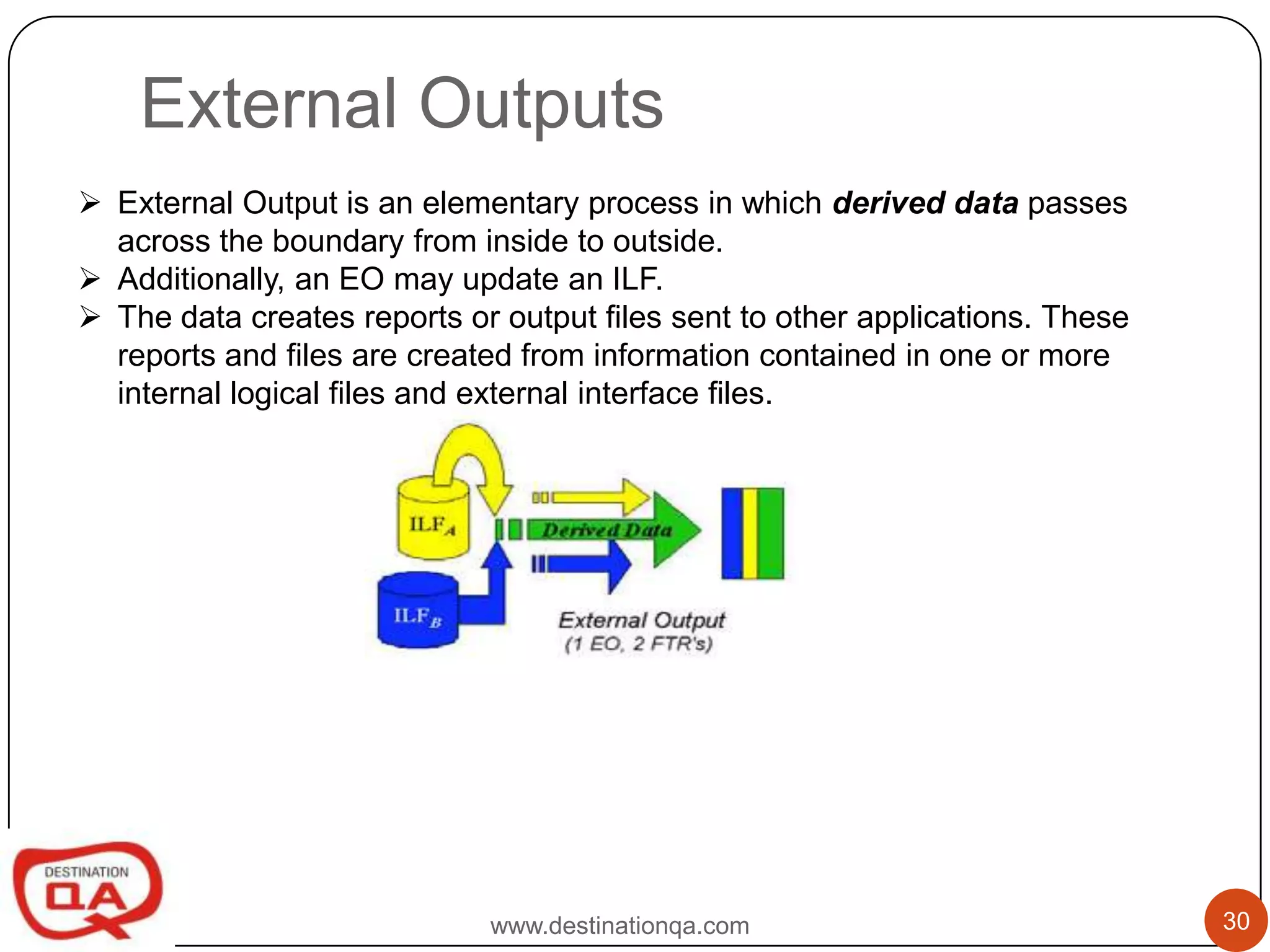
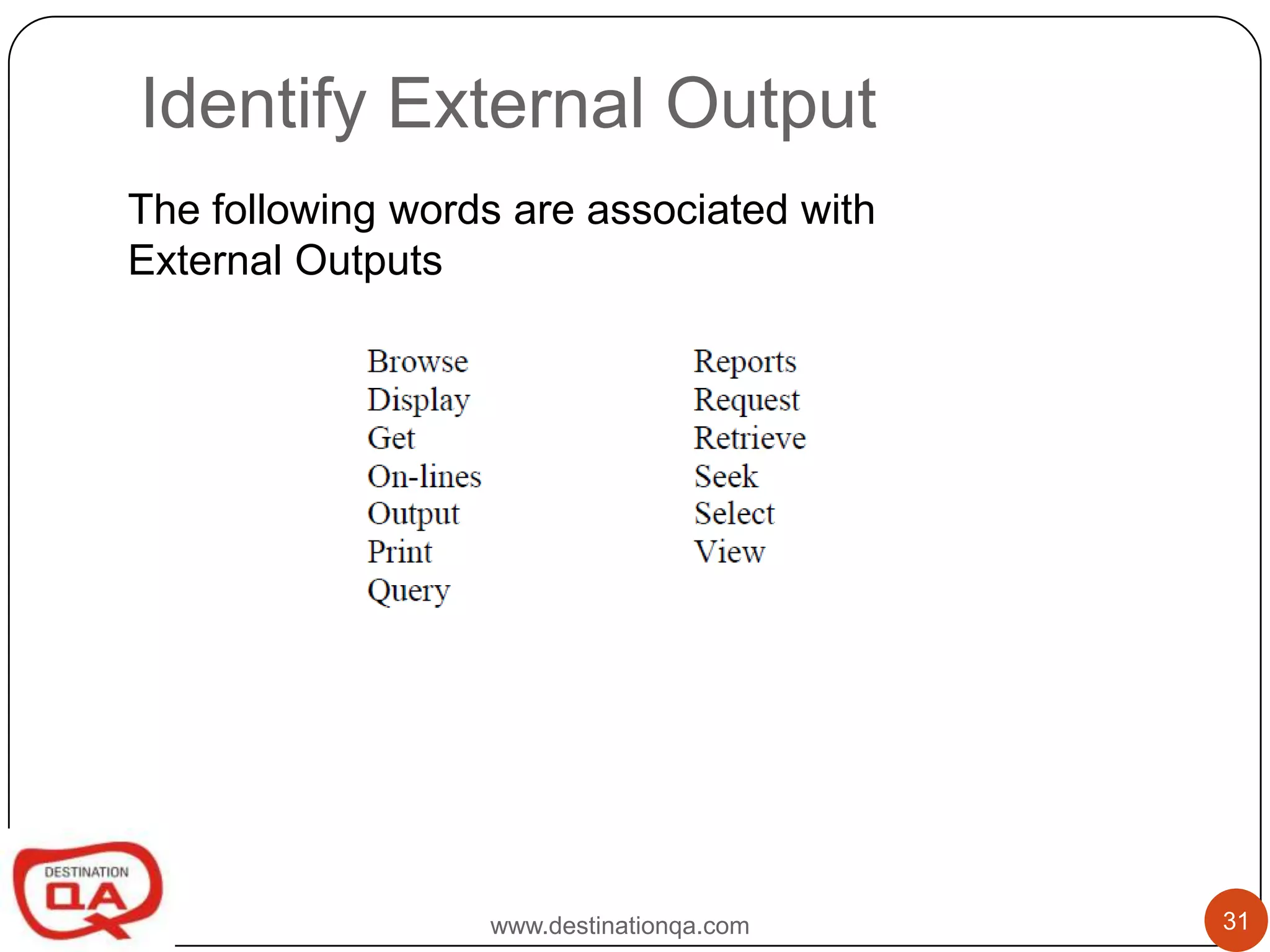
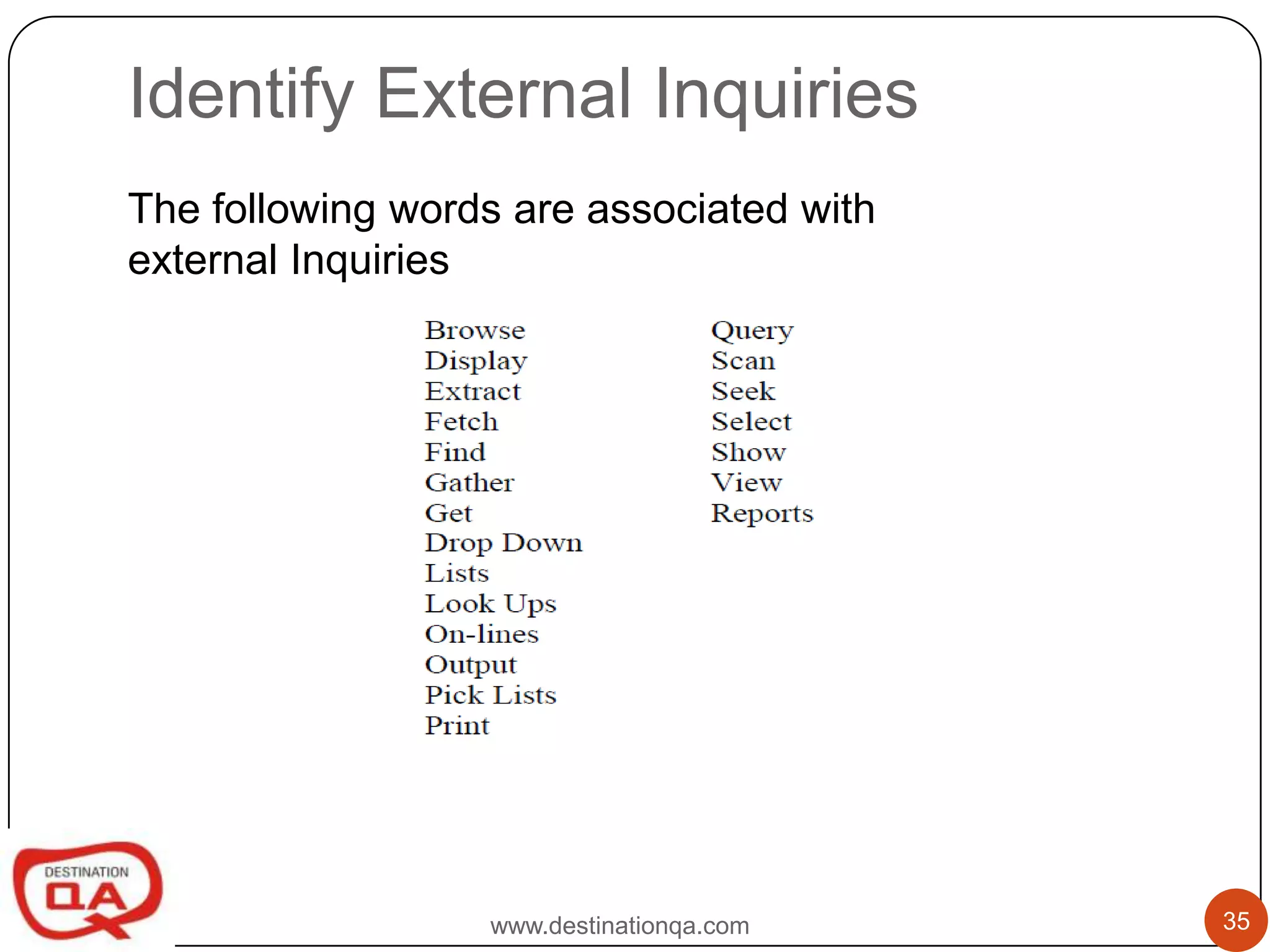
The data createsreports or output files sent to other applications. These reports and files are created from information contained in one or more internal logical files and external interface files.Identify External Outputwww.destinationqa.com31The following words are associated with External Outputs
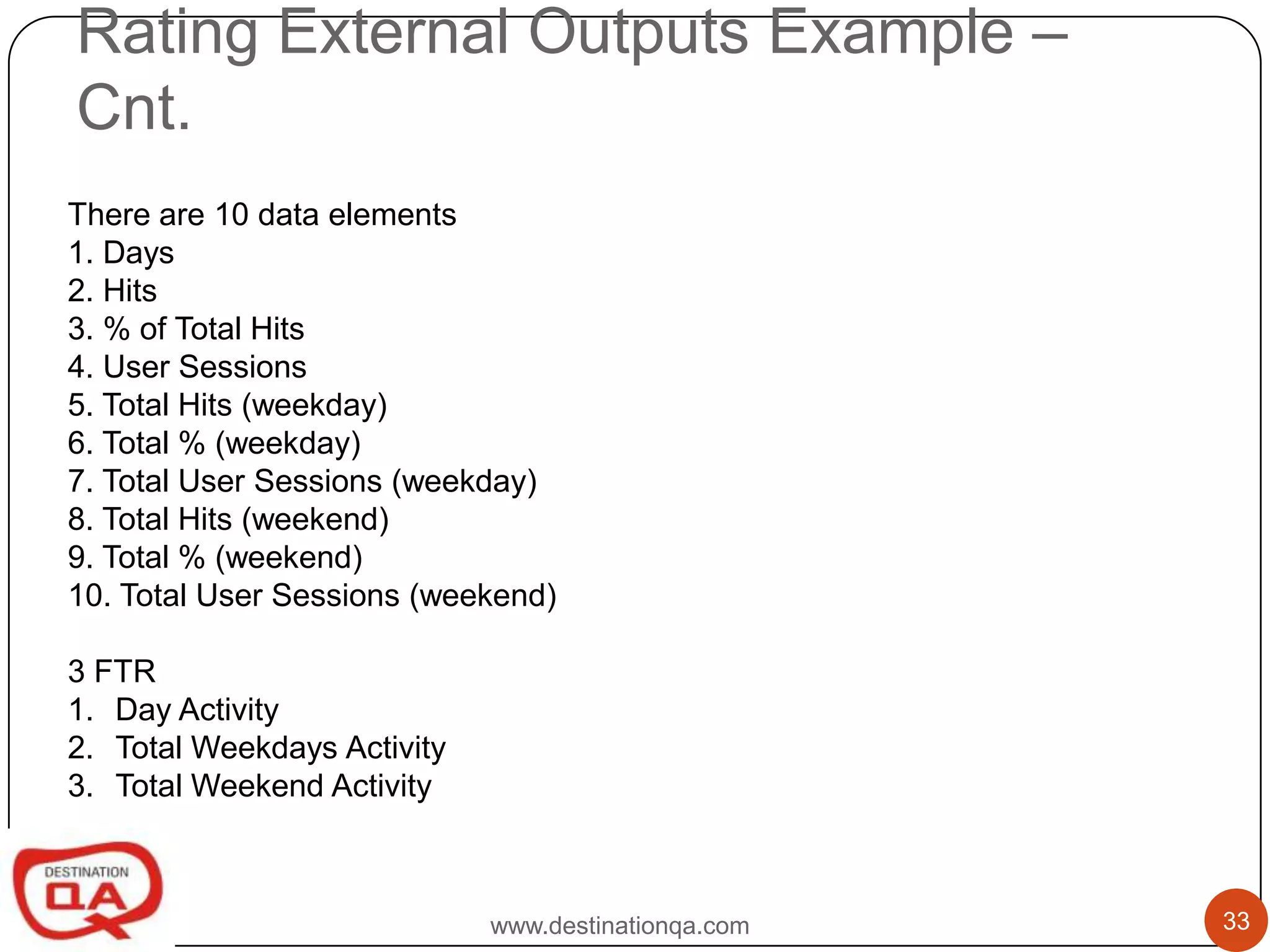
Rating External OutputsExample – Cnt.There are 10 data elements 1. Days2. Hits3. % of Total Hits4. User Sessions5. Total Hits (weekday)6. Total % (weekday)7. Total User Sessions (weekday)8. Total Hits (weekend)9. Total % (weekend)10. Total User Sessions (weekend)3 FTRDay ActivityTotal Weekdays ActivityTotal Weekend Activitywww.destinationqa.com33
57.
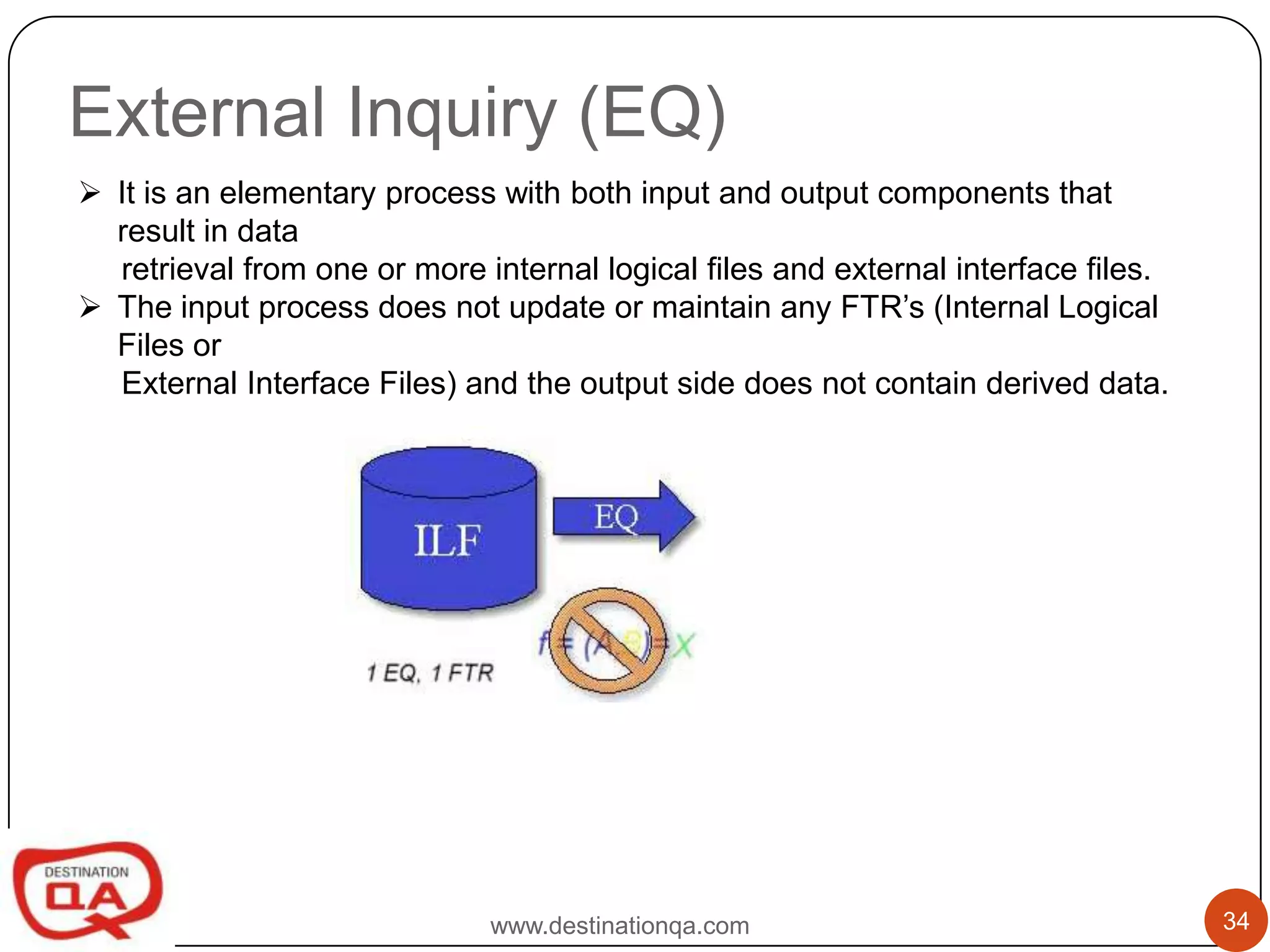
External Inquiry (EQ)www.destinationqa.com34Itis an elementary process with both input and output components that result in data retrieval from one or more internal logical files and external interface files. The input process does not update or maintain any FTR’s (Internal Logical Files or External Interface Files) and the output side does not contain derived data.
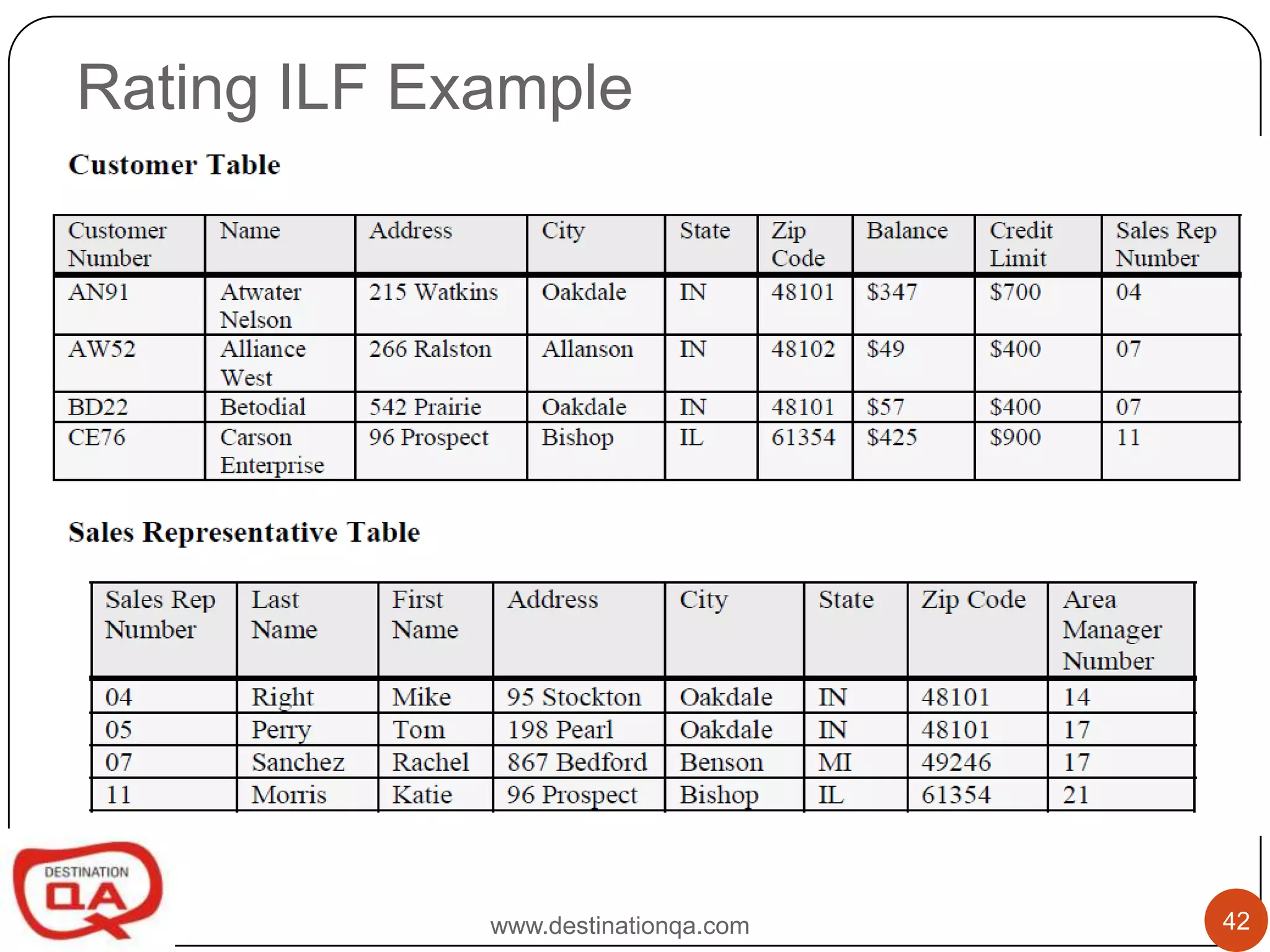
Internal Logical Filewww.destinationqa.com37Itis a user identifiable group of logically related data that resides entirely within the application boundary and is maintained through External Inputs.
61.
An internal logicalfile has the inherent meaning it is internally maintained, it has some logical structure and it is stored in a file.
62.
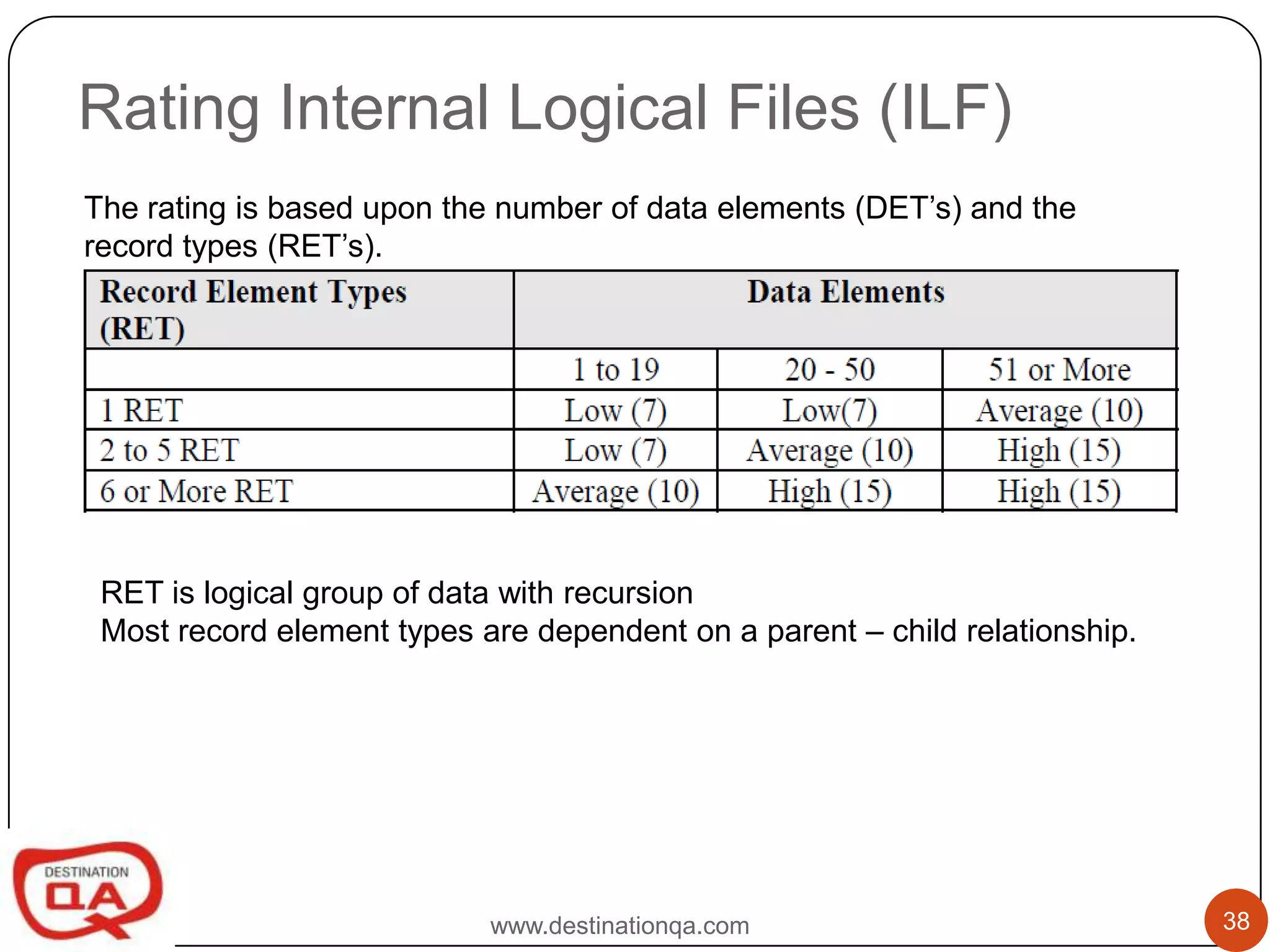
An ILF shouldhave at least one external output and/or external inquiry. That is, at least one external output and/or external inquiry should include the ILF as an FTRAn ILF should also have at least one external input.Rating Internal Logical Files (ILF)The rating is based upon the number of data elements (DET’s) and the record types (RET’s).www.destinationqa.com38RET is logical group of data with recursionMost record element types are dependent on a parent – child relationship.
63.
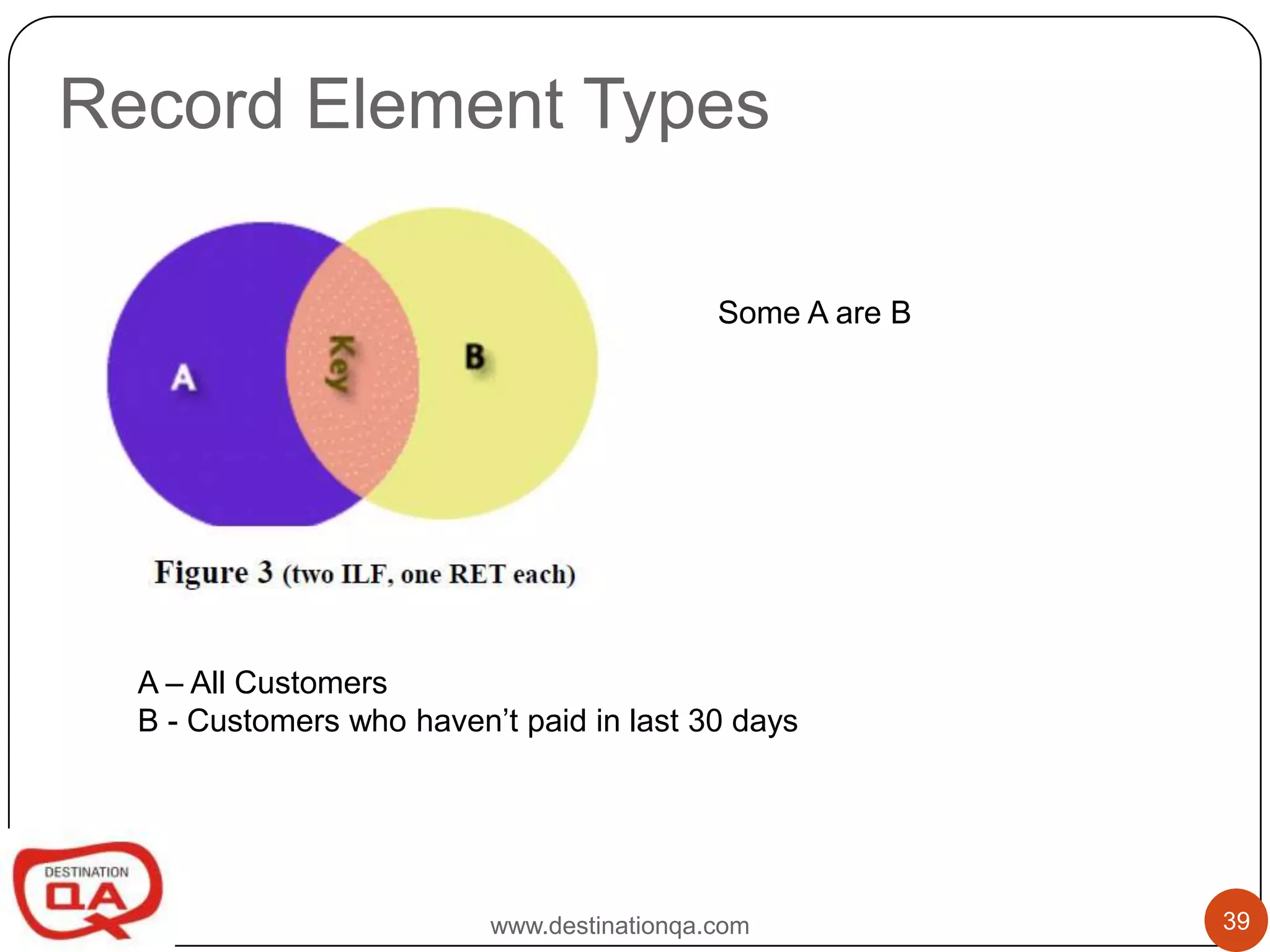
Record Element TypesSomeA are BA – All CustomersB - Customers who haven’t paid in last 30 dayswww.destinationqa.com39
64.
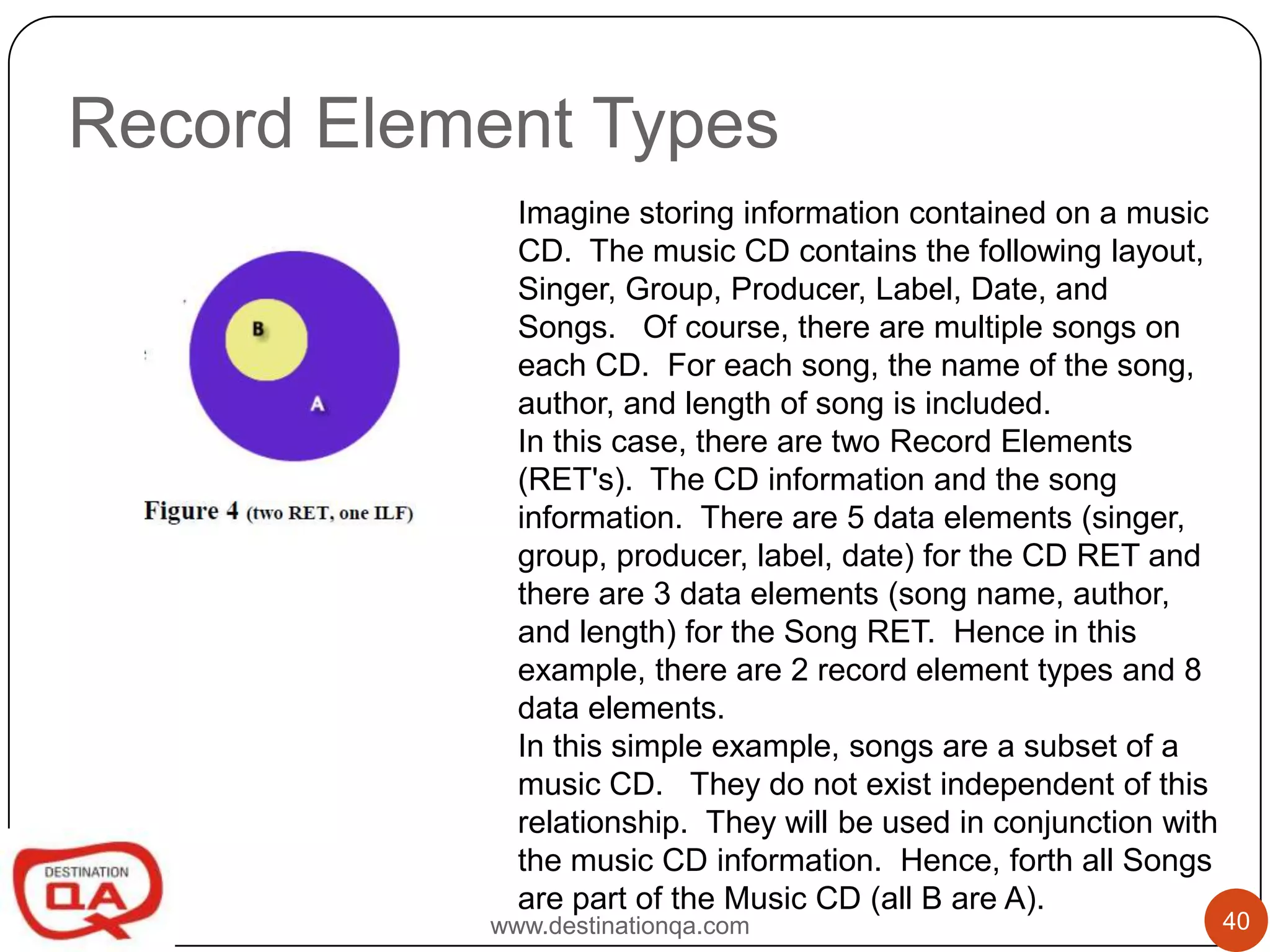
Record Element TypesImaginestoring information contained on a music CD. The music CD contains the following layout, Singer, Group, Producer, Label, Date, and Songs. Of course, there are multiple songs on each CD. For each song, the name of the song, author, and length of song is included.In this case, there are two Record Elements (RET's). The CD information and the song information. There are 5 data elements (singer, group, producer, label, date) for the CD RET and there are 3 data elements (song name, author, and length) for the Song RET. Hence in this example, there are 2 record element types and 8 data elements.In this simple example, songs are a subset of a music CD. They do not exist independent of this relationship. They will be used in conjunction with the music CD information. Hence, forth all Songs are part of the Music CD (all B are A).www.destinationqa.com40
65.
Record Element Typewww.destinationqa.com41Twotypes of data groups are possible RET candidates:File Sub-Types - i.e. Optional/ Mandatory sub groups of data. For example, an Employee can either be a Permanent Employee or a Contract Employee but not both. The Employee File has two sub-types and potentially two RETs. Repeating Groups - where a group of data can be repeated multiple times within the one logical file. For example, Order Header and Order Line Item information. One Order Header can be linked to multiple Order Line Items. The Order File potentially has two RETs.In both of the above examples the word "potentially" has been used intentionally. While in both cases we have RET candidates, the existence of a "subgroup" of information must be demonstrated. IFPUG provides no guidance on how many DETs constitute a subgroup.
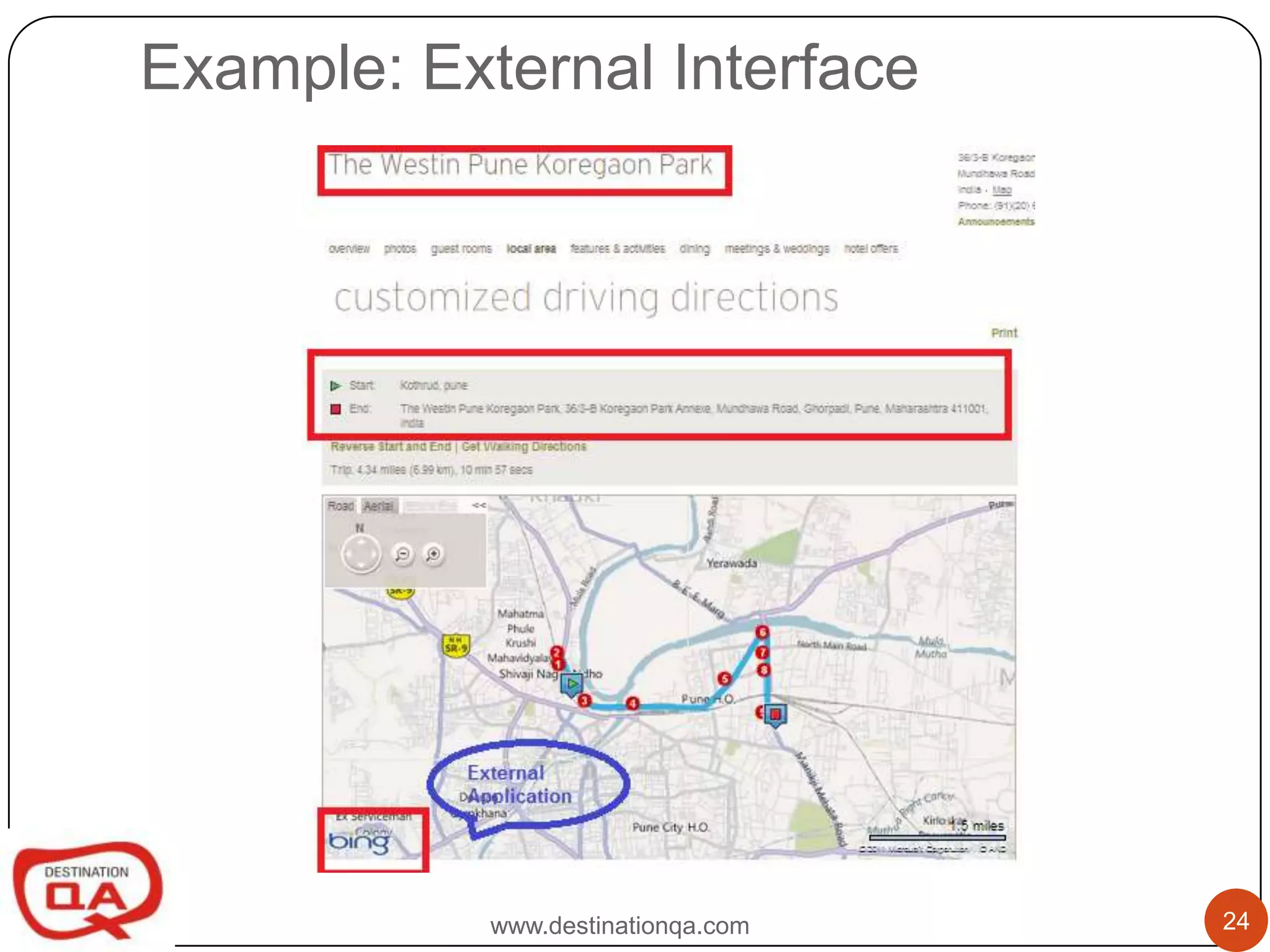
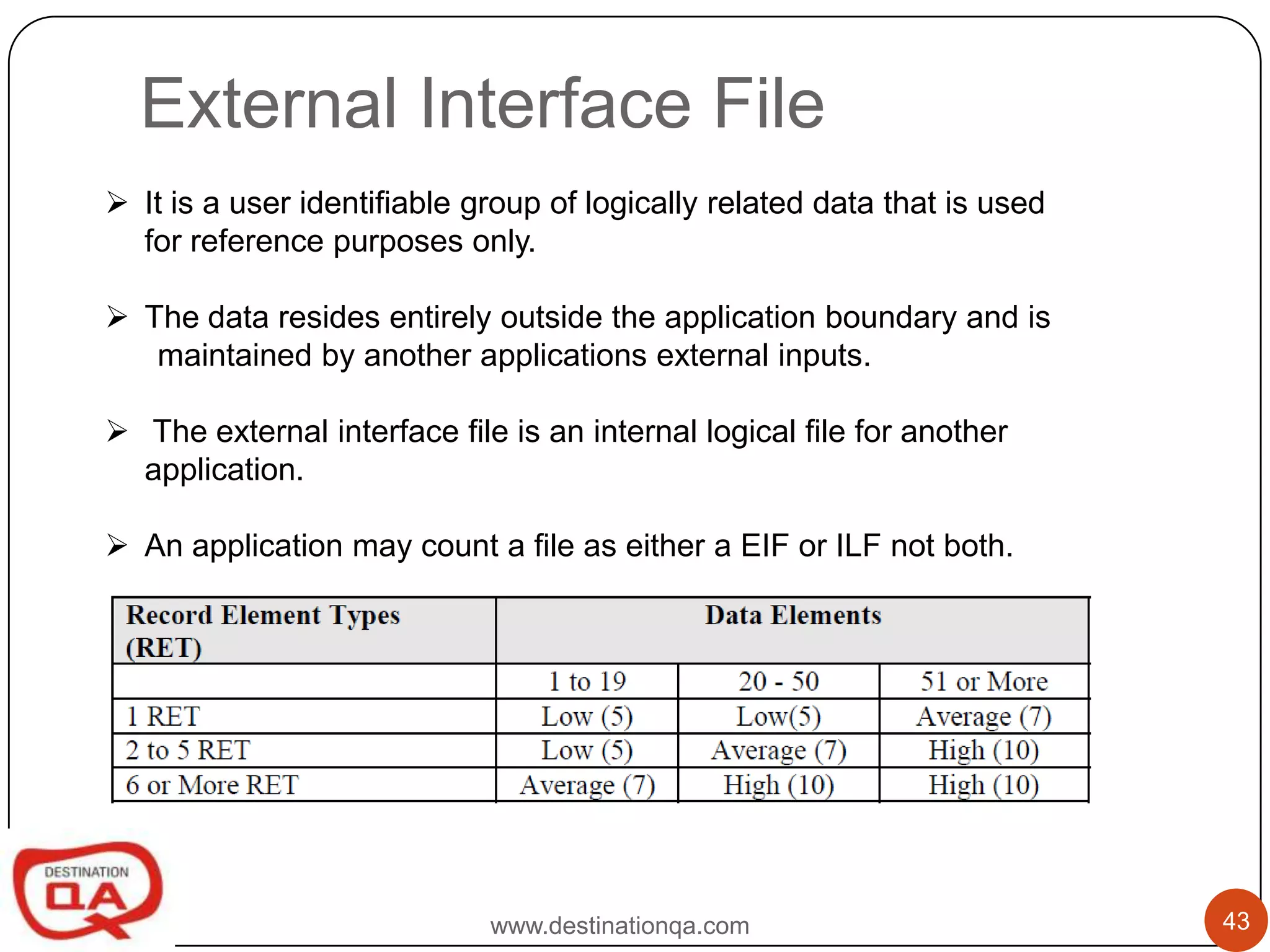
The data residesentirely outside the application boundary and is maintained by another applications external inputs.The external interface file is an internal logical file for another application.
69.
An application maycount a file as either a EIF or ILF not both.Unadjusted Function Point:www.destinationqa.com44
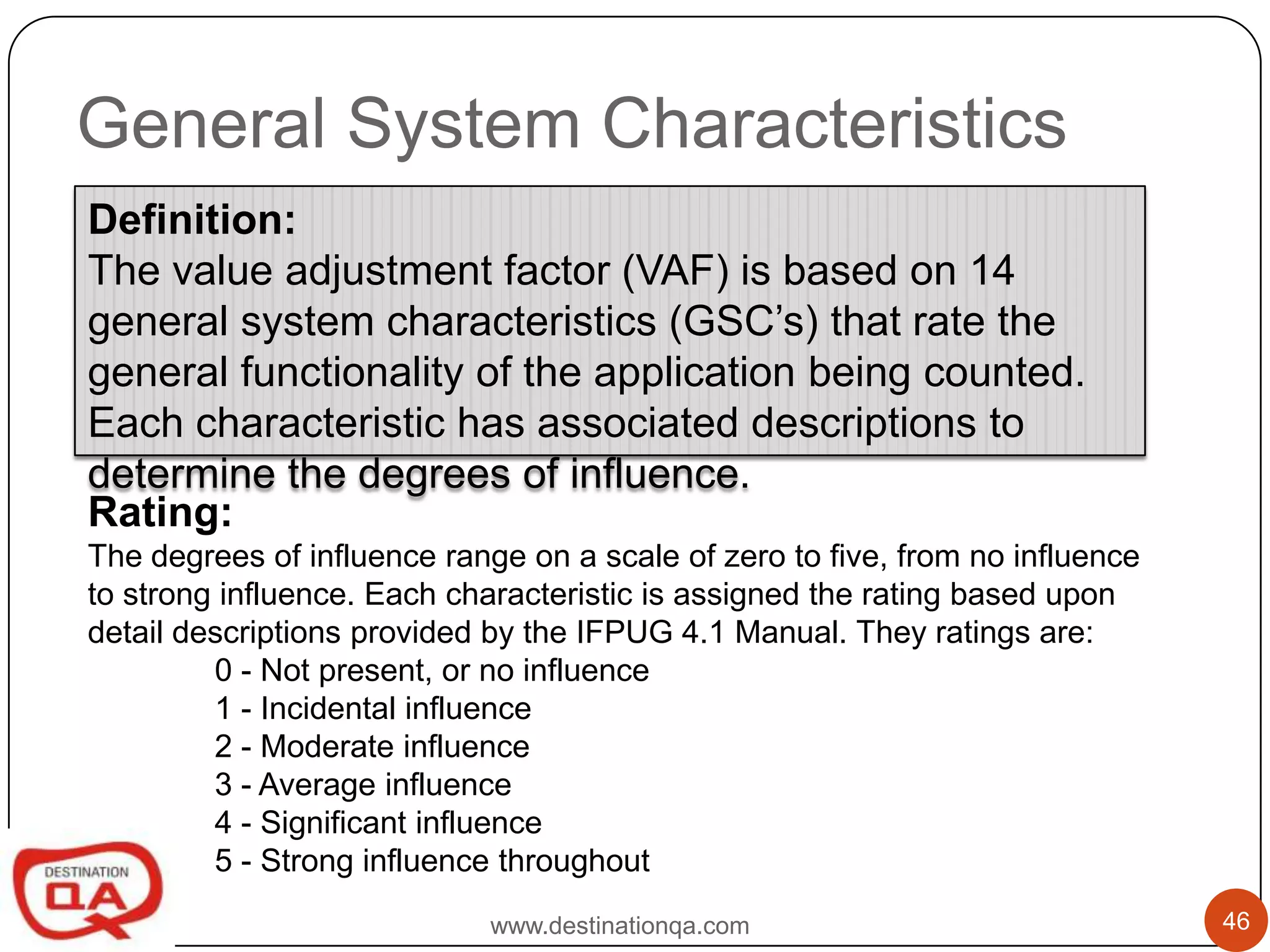
General System CharacteristicsDefinition:Thevalue adjustment factor (VAF) is based on 14 general system characteristics (GSC’s) that rate the general functionality of the application being counted. Each characteristic has associated descriptions to determine the degrees of influence.Rating:The degrees of influence range on a scale of zero to five, from no influence to strong influence. Each characteristic is assigned the rating based upon detail descriptions provided by the IFPUG 4.1 Manual. They ratings are:0 - Not present, or no influence1 - Incidental influence2 - Moderate influence3 - Average influence4 - Significant influence5 - Strong influence throughoutwww.destinationqa.com46
72.
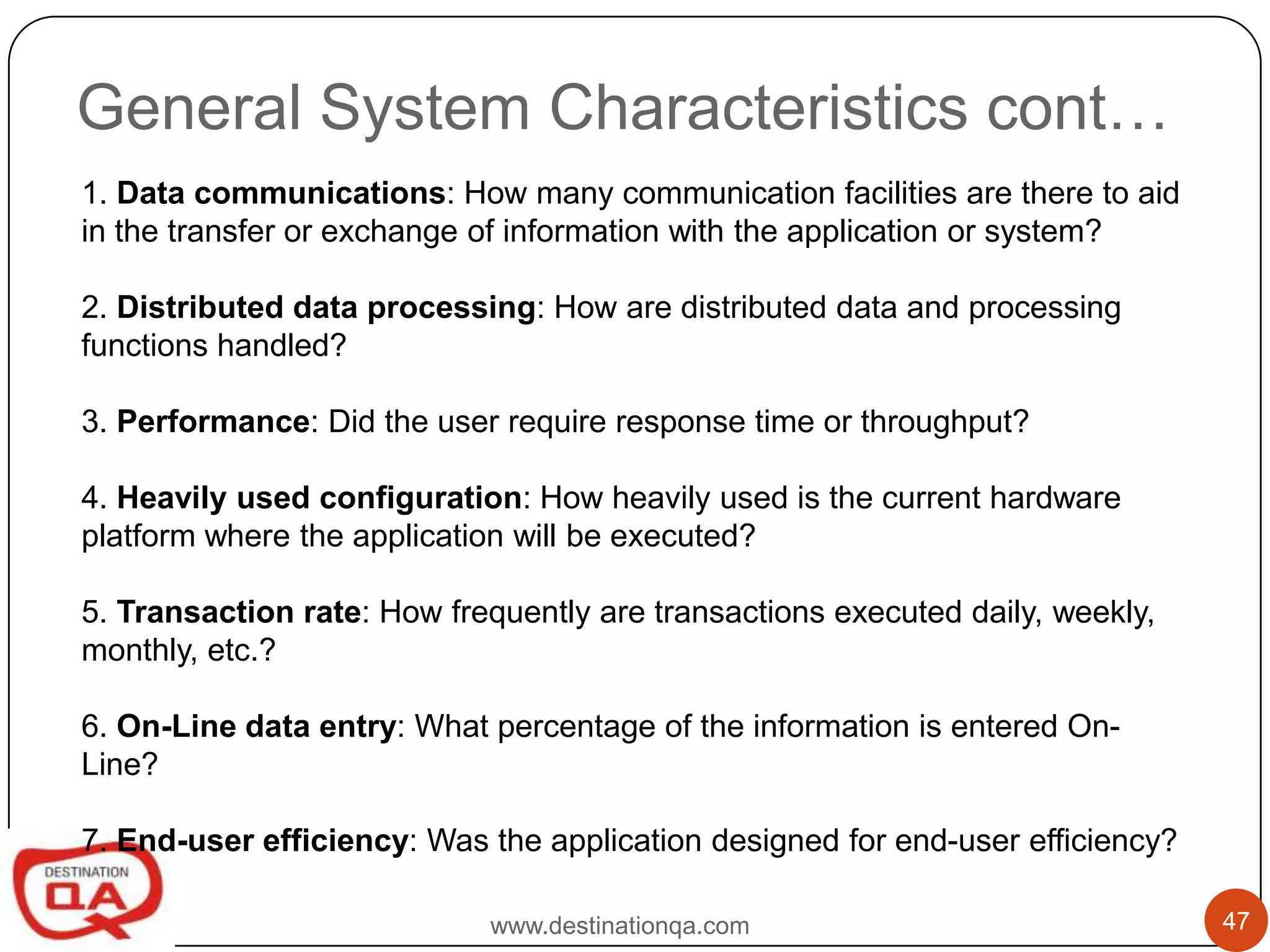
General System Characteristicscont…1. Data communications: How many communication facilities are there to aid in the transfer or exchange of information with the application or system?2. Distributed data processing: How are distributed data and processing functions handled?3. Performance: Did the user require response time or throughput?4. Heavily used configuration: How heavily used is the current hardware platform where the application will be executed?5. Transaction rate: How frequently are transactions executed daily, weekly, monthly, etc.?6. On-Line data entry: What percentage of the information is entered On-Line?7. End-user efficiency: Was the application designed for end-user efficiency?www.destinationqa.com47
73.
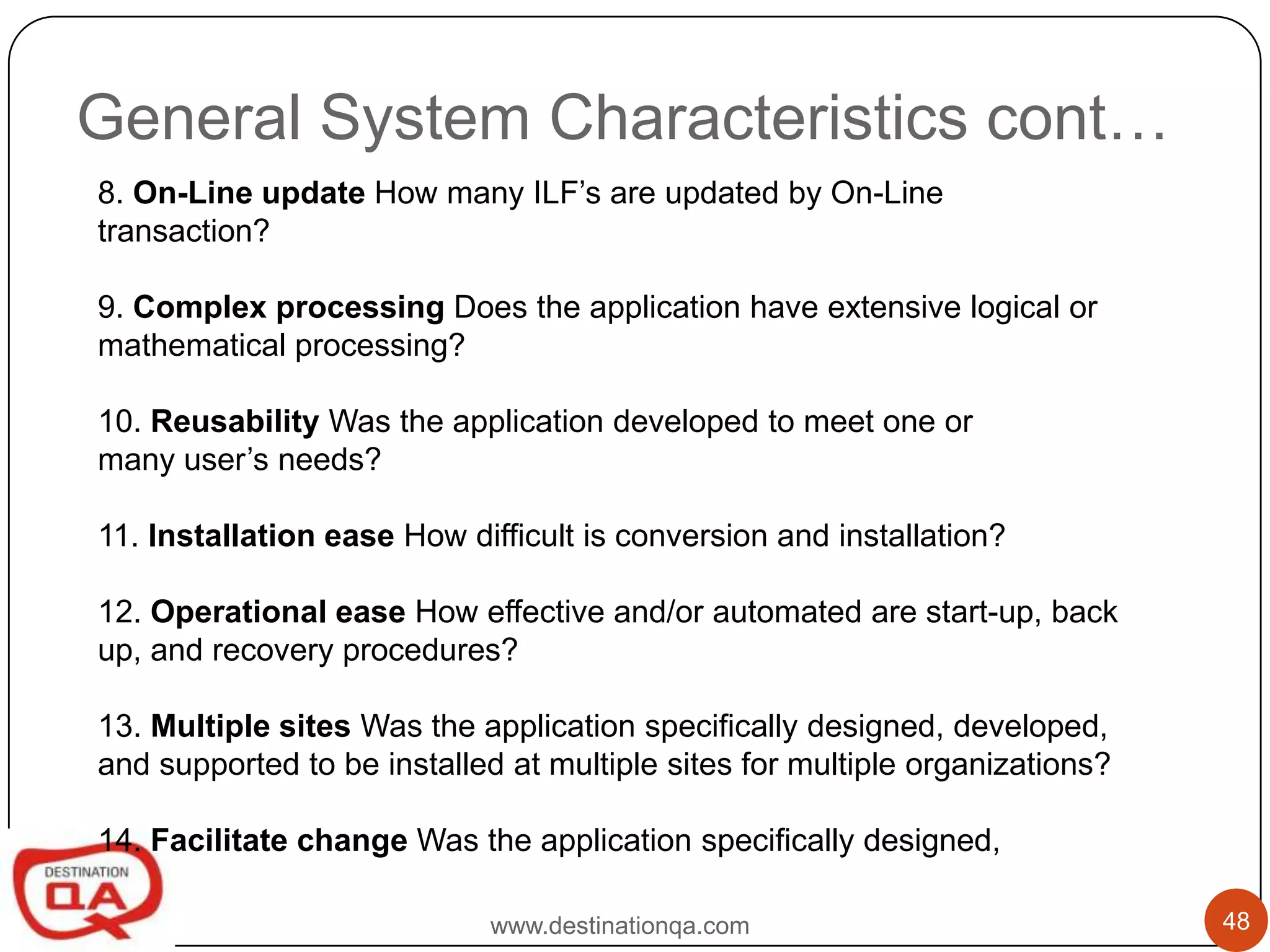
General System Characteristicscont…8. On-Line update How many ILF’s are updated by On-Line transaction?9. Complex processing Does the application have extensive logical ormathematical processing?10. Reusability Was the application developed to meet one ormany user’s needs?11. Installation ease How difficult is conversion and installation?12. Operational ease How effective and/or automated are start-up, backup, and recovery procedures?13. Multiple sites Was the application specifically designed, developed, and supported to be installed at multiple sites for multiple organizations?14. Facilitate change Was the application specifically designed, www.destinationqa.com48
74.
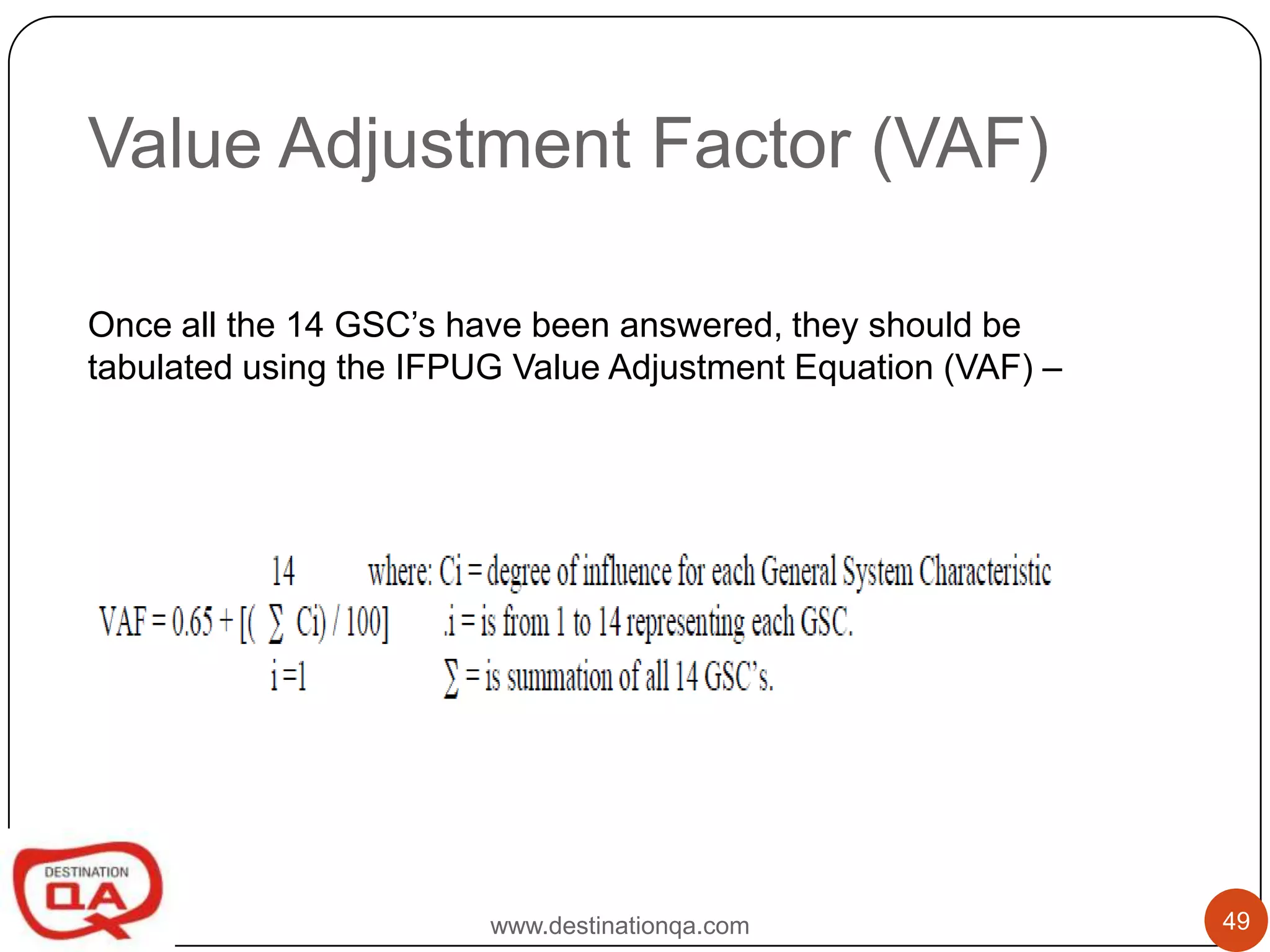
Value Adjustment Factor(VAF)Once all the 14 GSC’s have been answered, they should be tabulated using the IFPUG Value Adjustment Equation (VAF) –www.destinationqa.com49
75.
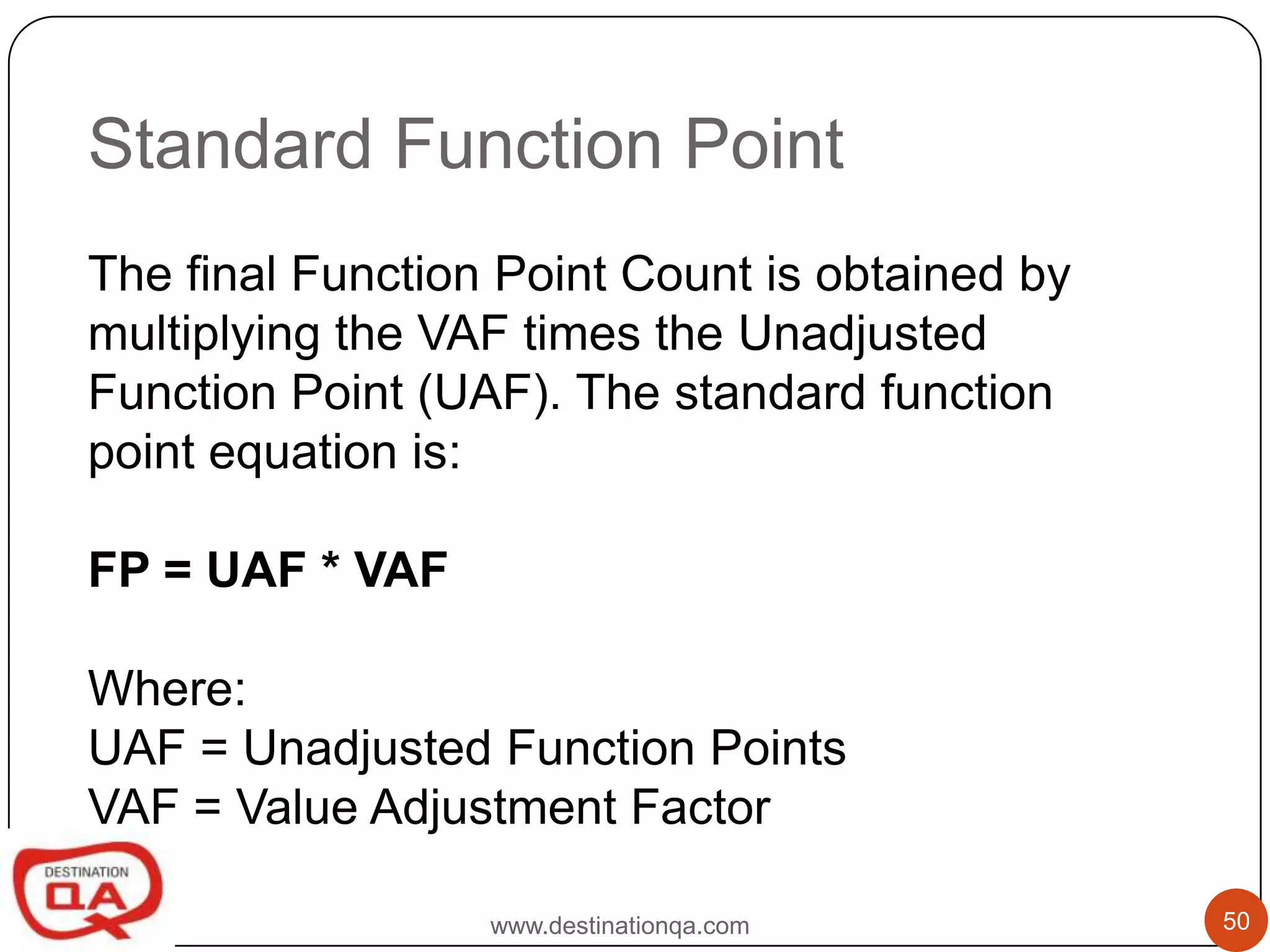
Standard Function PointThefinal Function Point Count is obtained by multiplying the VAF times the Unadjusted Function Point (UAF). The standard function point equation is:FP = UAF * VAFWhere:UAF = Unadjusted Function PointsVAF = Value Adjustment Factorwww.destinationqa.com50
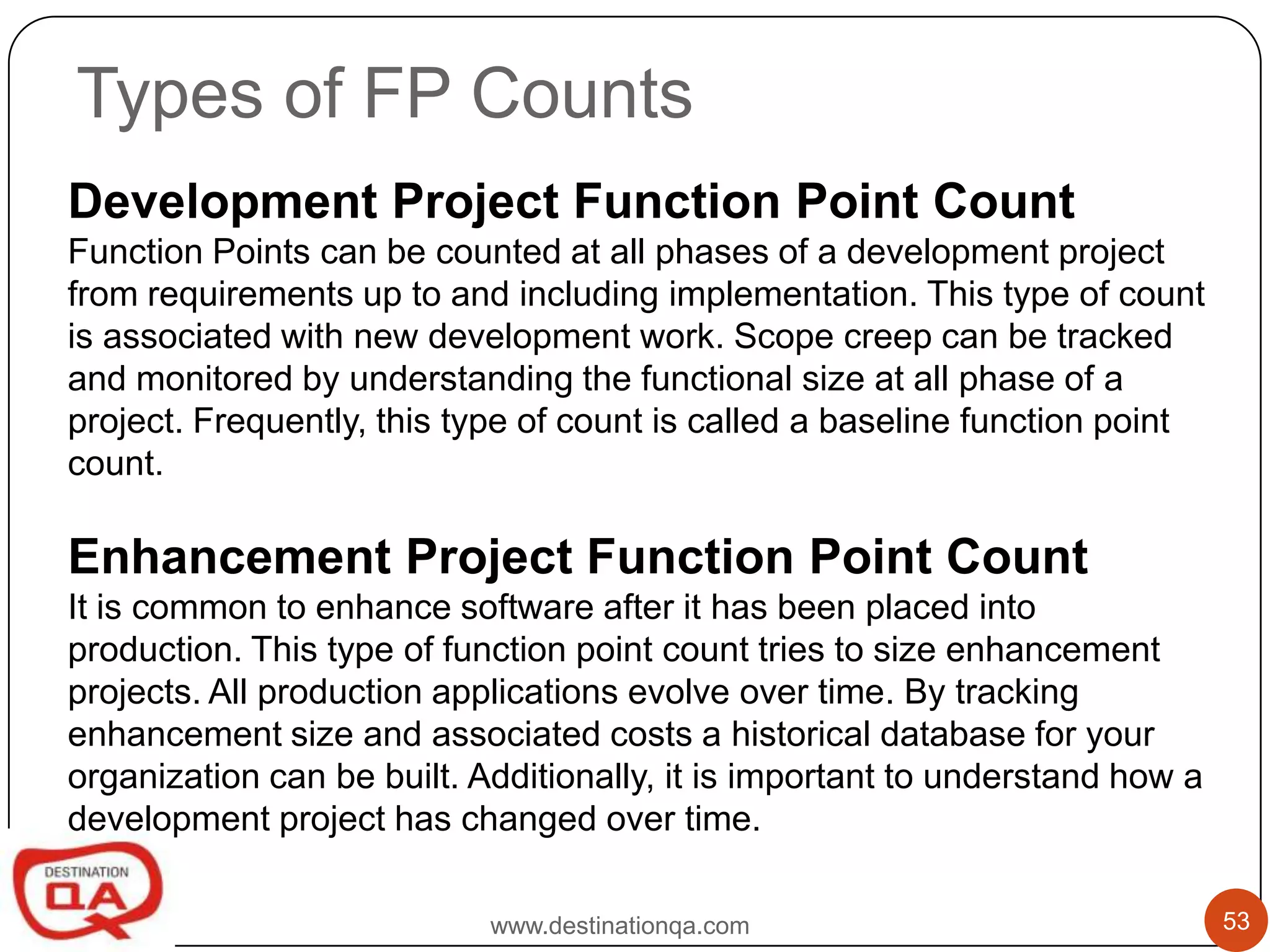
Types of FPCountsDevelopment Project Function Point CountFunction Points can be counted at all phases of a development project from requirements up to and including implementation. This type of count is associated with new development work. Scope creep can be tracked and monitored by understanding the functional size at all phase of a project. Frequently, this type of count is called a baseline function point count.Enhancement Project Function Point CountIt is common to enhance software after it has been placed into production. This type of function point count tries to size enhancement projects. All production applications evolve over time. By tracking enhancement size and associated costs a historical database for your organization can be built. Additionally, it is important to understand how a development project has changed over time.www.destinationqa.com53
79.
www.destinationqa.com54Types of FPCounts cont…Application Function Point CountApplication counts are done on existing production applications. This “baseline count” can be used with overall application metrics like total maintenance hours. This metric can be used to track maintenance hours per function point. This is an example of a normalized metric. It is not enough to examine only maintenance, but one must examine the ratio of maintenance hours to size of the application to get a true picture. Additionally, application counts can assist organizations in understanding the size of the entire corporate portfolio (or inventory). This type of count is analogous to taking an inventory for a store. Like inventory, a dollar value can be associated with any application function point count and for the entire organization portfolio.
80.
Uses of FPA- Software EstimationEstimation is not merely a technique, it’s an artAccuracy of a software project estimate is Predicated on a number of things :The degree to which the planner has properly estimated the size of the product to be built.
81.
The ability totranslate the size estimate into human effort, calendar time, and dollar.
82.
The degree towhich the project plan reflects the abilities of the software team.
83.
The stability ofproduct requirements and the environment that supports the engineering effort.www.destinationqa.com55
84.
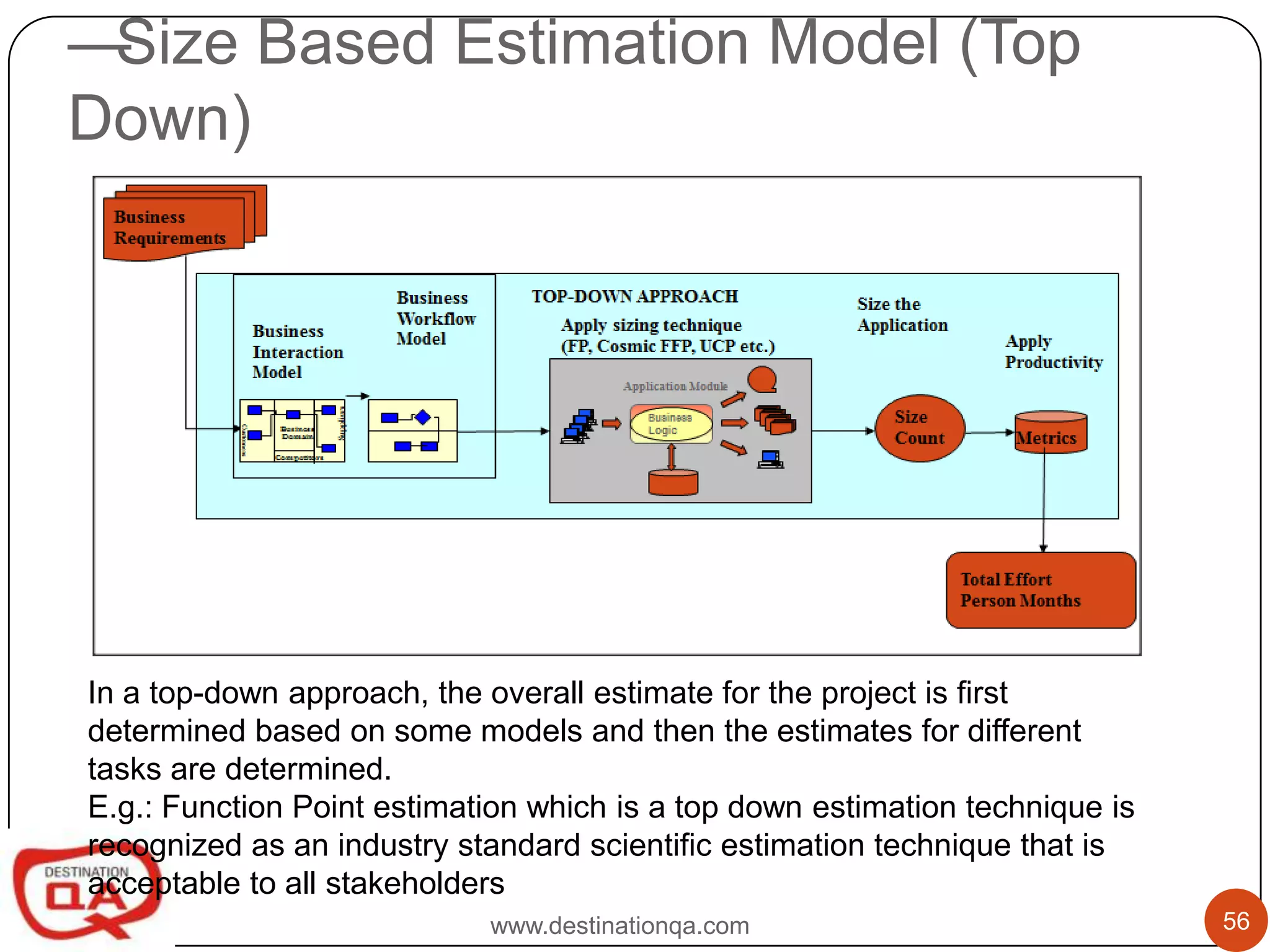
Size Based EstimationModel (Top Down)www.destinationqa.com56In a top-down approach, the overall estimate for the project is first determined based on some models and then the estimates for different tasks are determined.E.g.: Function Point estimation which is a top down estimation technique is recognized as an industry standard scientific estimation technique that is acceptable to all stakeholders
Case Study –Function Point Analysiswww.destinationqa.com59
88.
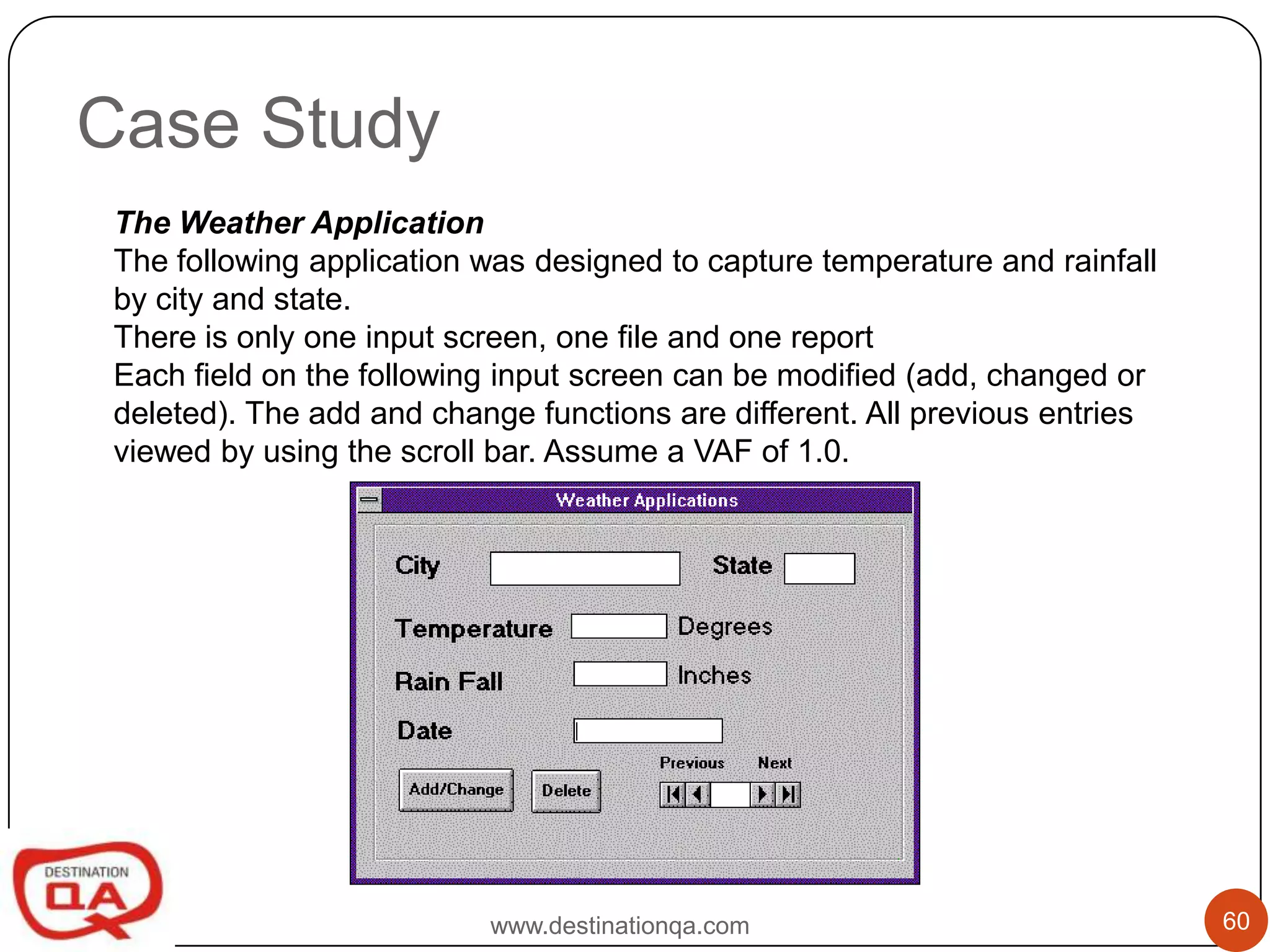
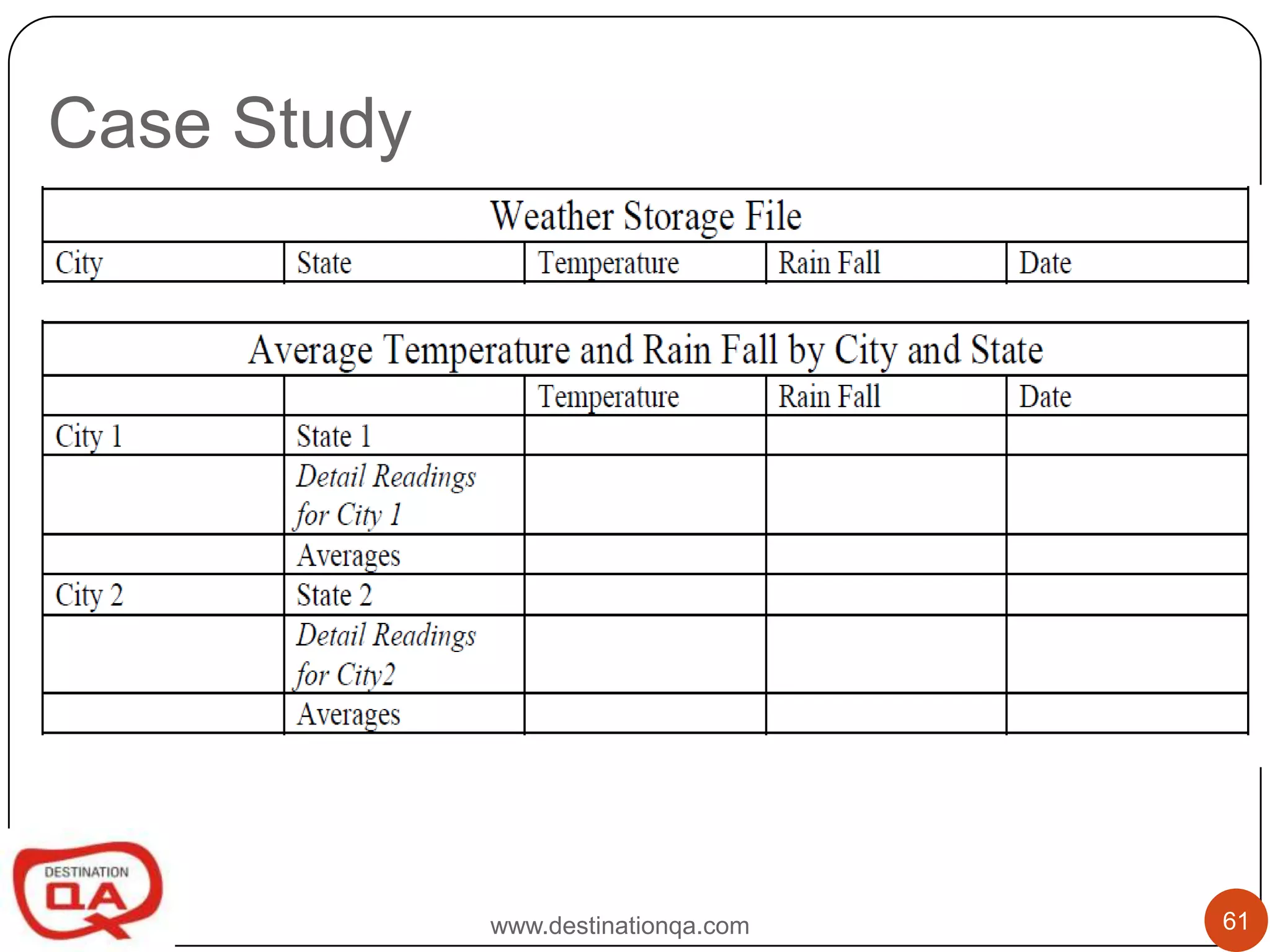
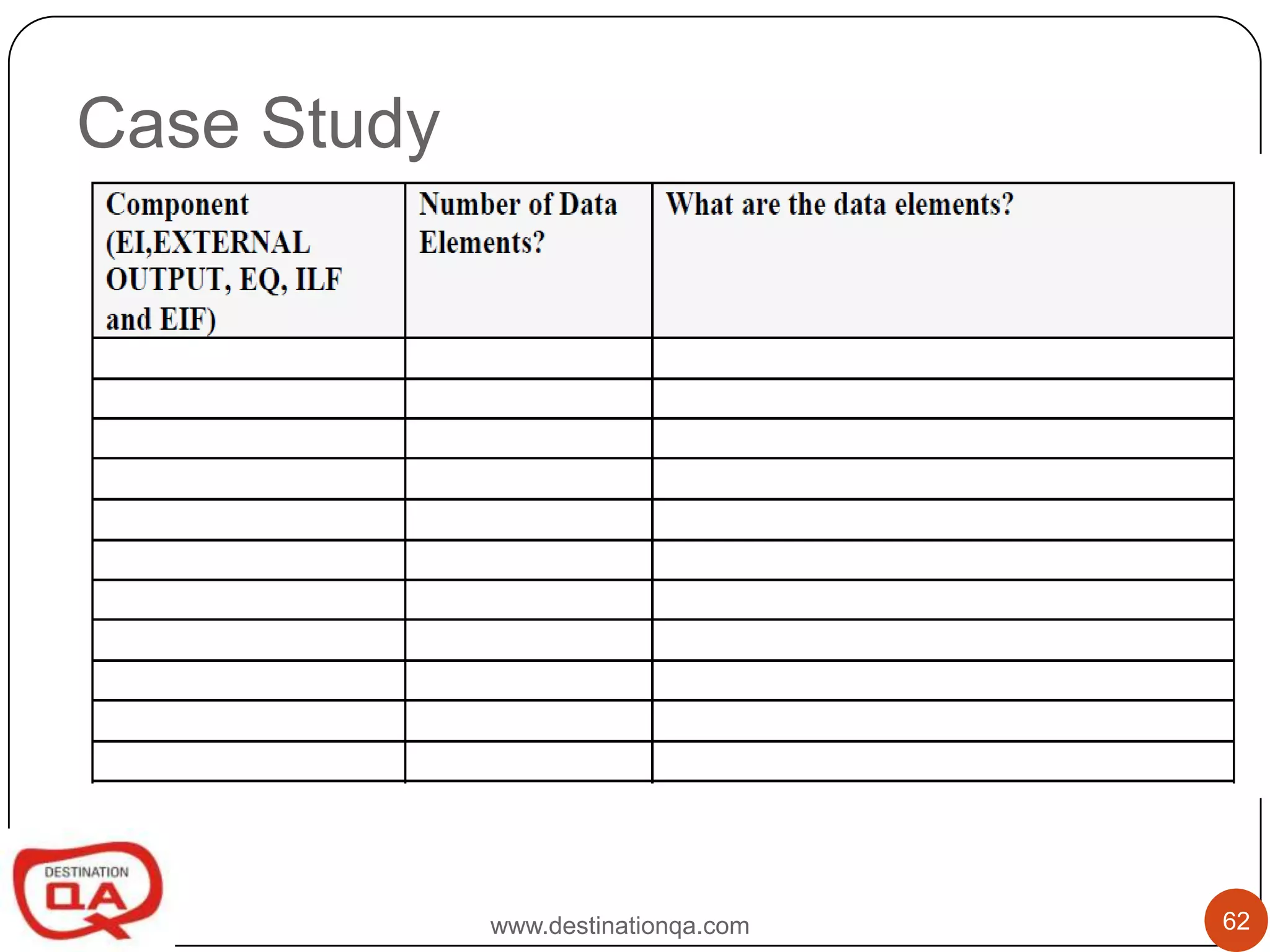
Case StudyThe WeatherApplicationThe following application was designed to capture temperature and rainfall by city and state.There is only one input screen, one file and one reportEach field on the following input screen can be modified (add, changed or deleted). The add and change functions are different. All previous entries viewed by using the scroll bar. Assume a VAF of 1.0.www.destinationqa.com60
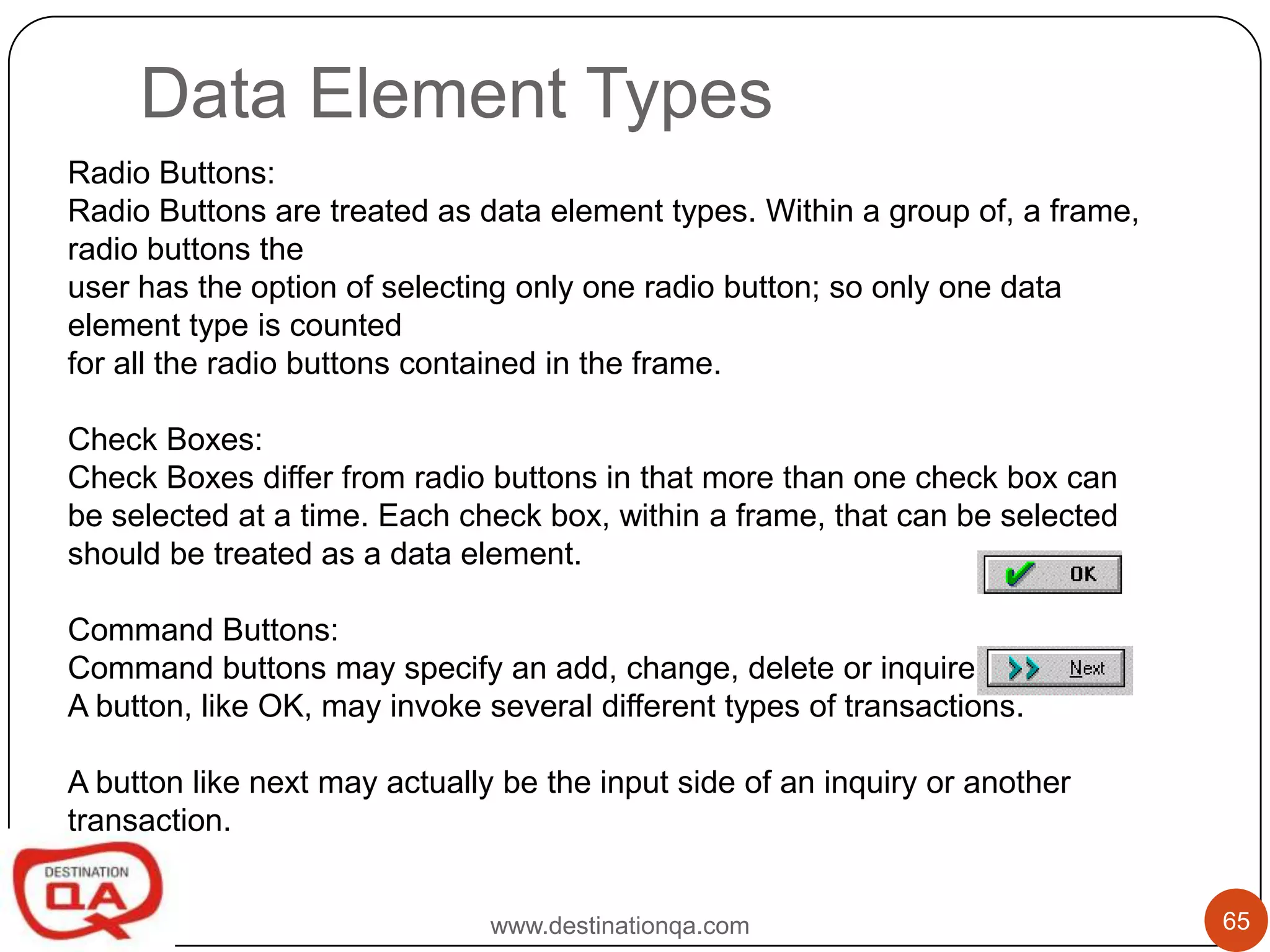
Data Element Typeswww.destinationqa.com65RadioButtons: Radio Buttons are treated as data element types. Within a group of, a frame, radio buttons theuser has the option of selecting only one radio button; so only one data element type is countedfor all the radio buttons contained in the frame.Check Boxes:Check Boxes differ from radio buttons in that more than one check box can be selected at a time. Each check box, within a frame, that can be selected should be treated as a data element.Command Buttons:Command buttons may specify an add, change, delete or inquire action.A button, like OK, may invoke several different types of transactions.A button like next may actually be the input side of an inquiry or anothertransaction.
94.
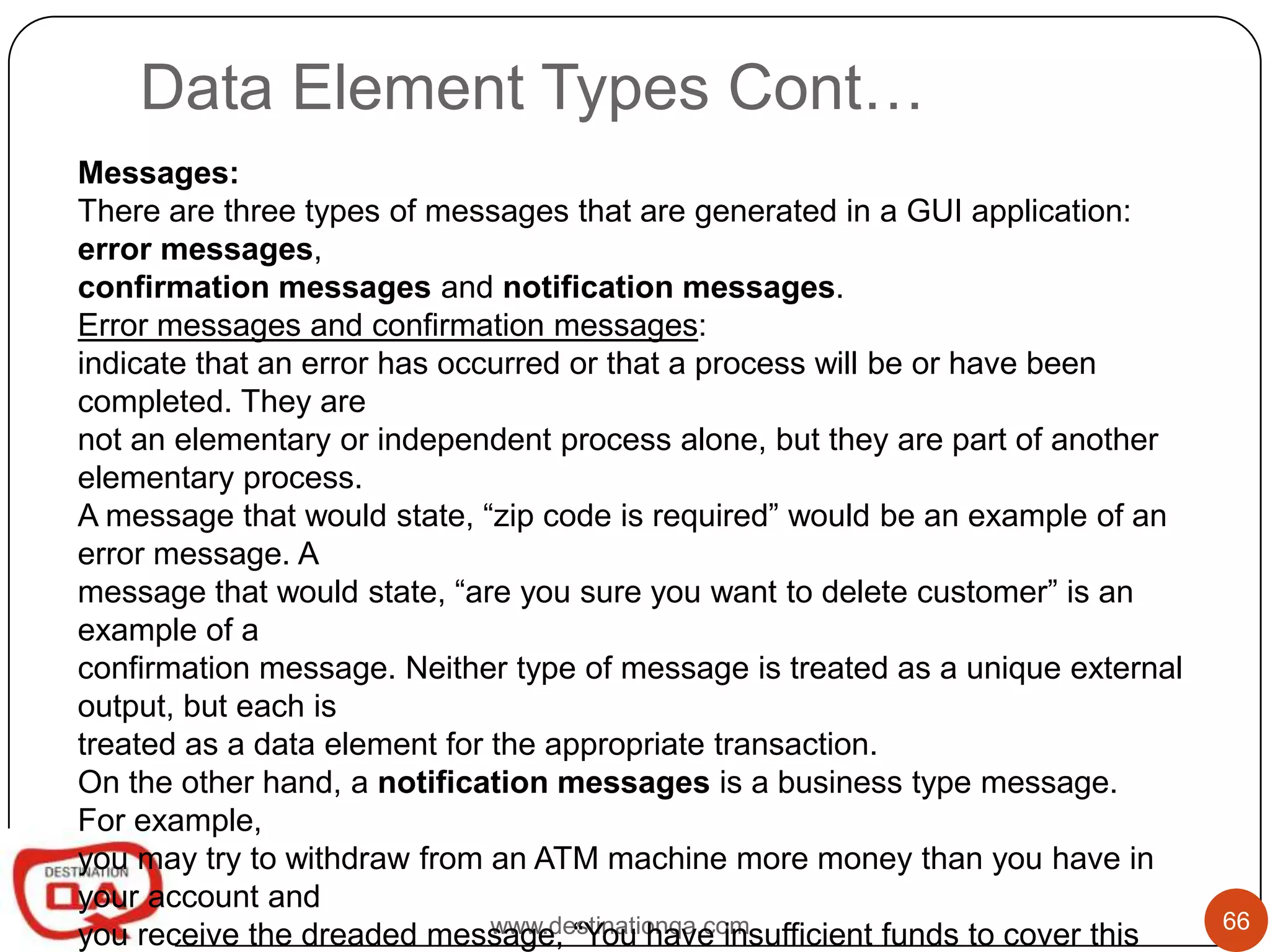
Data Element TypesCont…www.destinationqa.com66Messages:There are three types of messages that are generated in a GUI application: error messages,confirmation messages and notification messages. Error messages and confirmation messages: indicate that an error has occurred or that a process will be or have been completed. They arenot an elementary or independent process alone, but they are part of another elementary process.A message that would state, “zip code is required” would be an example of an error message. Amessage that would state, “are you sure you want to delete customer” is an example of aconfirmation message. Neither type of message is treated as a unique external output, but each istreated as a data element for the appropriate transaction.On the other hand, a notification messages is a business type message. For example,you may try to withdraw from an ATM machine more money than you have in your account andyou receive the dreaded message, “You have insufficient funds to cover this transaction.” This isthe result of information being read from a file regarding your current balance and a conclusionbeing drawn. A notification message is treated as an External Output.
95.
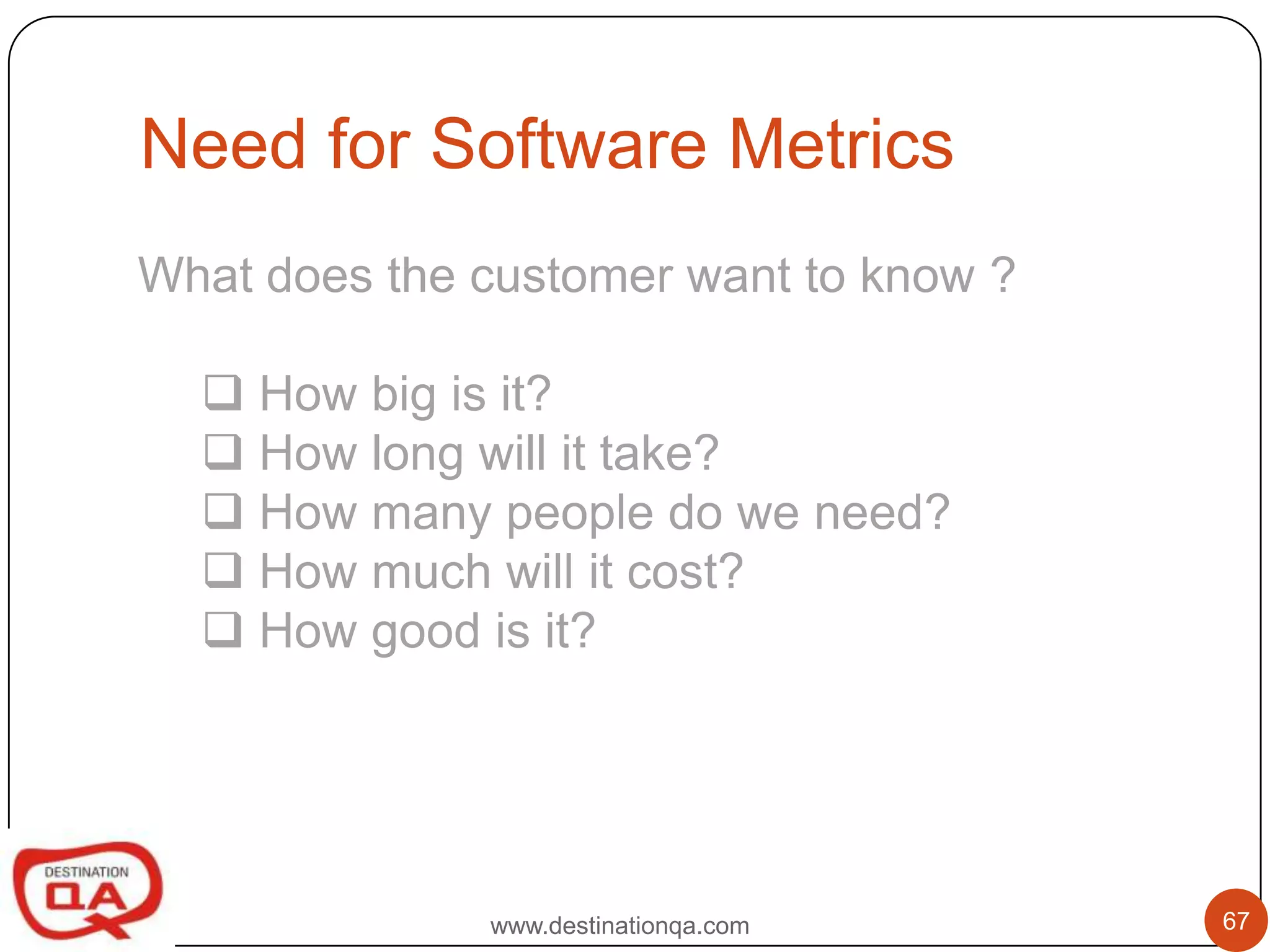
Need for SoftwareMetricsWhat does the customer want to know ? How big is it?
Independence and DependenceSincethe rating of transactions is dependent on both information contained in the transactionsand the number of files referenced, it is recommended that transactions are counted first. At thesame time the transactions are counted a tally should be kept of all FTR’s (file types referenced)that the transactions reference.www.destinationqa.com69
102.
ESTABLISHING THE BOUNDARYIdentifythe Boundary:• Review the purpose of the function point count.• Look at how and which applications maintain data.• Identify the business areas that support the applications.The boundary may need to be adjusted once components have been identified. In practice the boundary may need to be revisited, as the overall application is better understood. Function point counts may need to be adjusted as you learn about the application.Standard Documentation:• General Specification Documents• Interface Documents• Other metric reports• Interviews with the users• User Documentation• Design Documentation• Requirements• Data flow diagramswww.destinationqa.com70
Function points canbe used to establish an inventory of all transactions and files of a current project or application..
105.
Function Points canbe used to size software applications. Sizing is an important component in determining productivity (outputs/inputs), predicting effort, understanding unit cost, so on and so forth.
106.
Unlike some othersoftware metrics, different people can count function points at different times, to obtain the same measure within a reasonable margin of error. That is, the same conclusion will be drawn from the results.
107.
FPA can helporganizations understand the unit cost of a software application or project.
108.
Once unit costis understood tools, languages, platforms can be compared quantitatively instead of subjectively. This type of analysis is much easier to understand than technical information. That is, a non-technical user can easily understand Function Points.www.destinationqa.com71
Editor's Notes
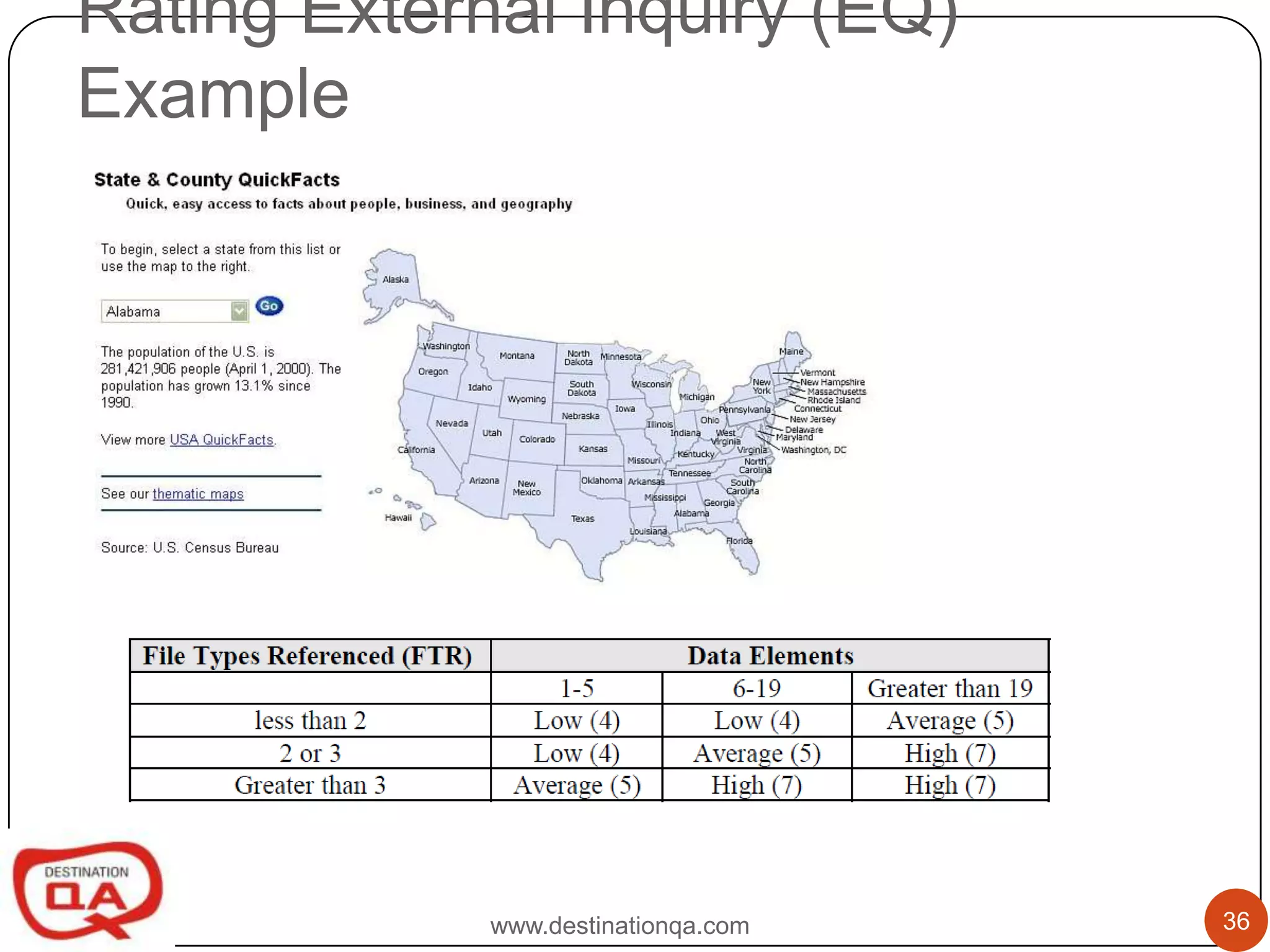
#37 There are two different ways to get the same exact data. One you can click on the specific state or you can use the drop down list. Once you choose a state data is generated and presented to the screen. These two EQ are repetitive and do the same exact thing.
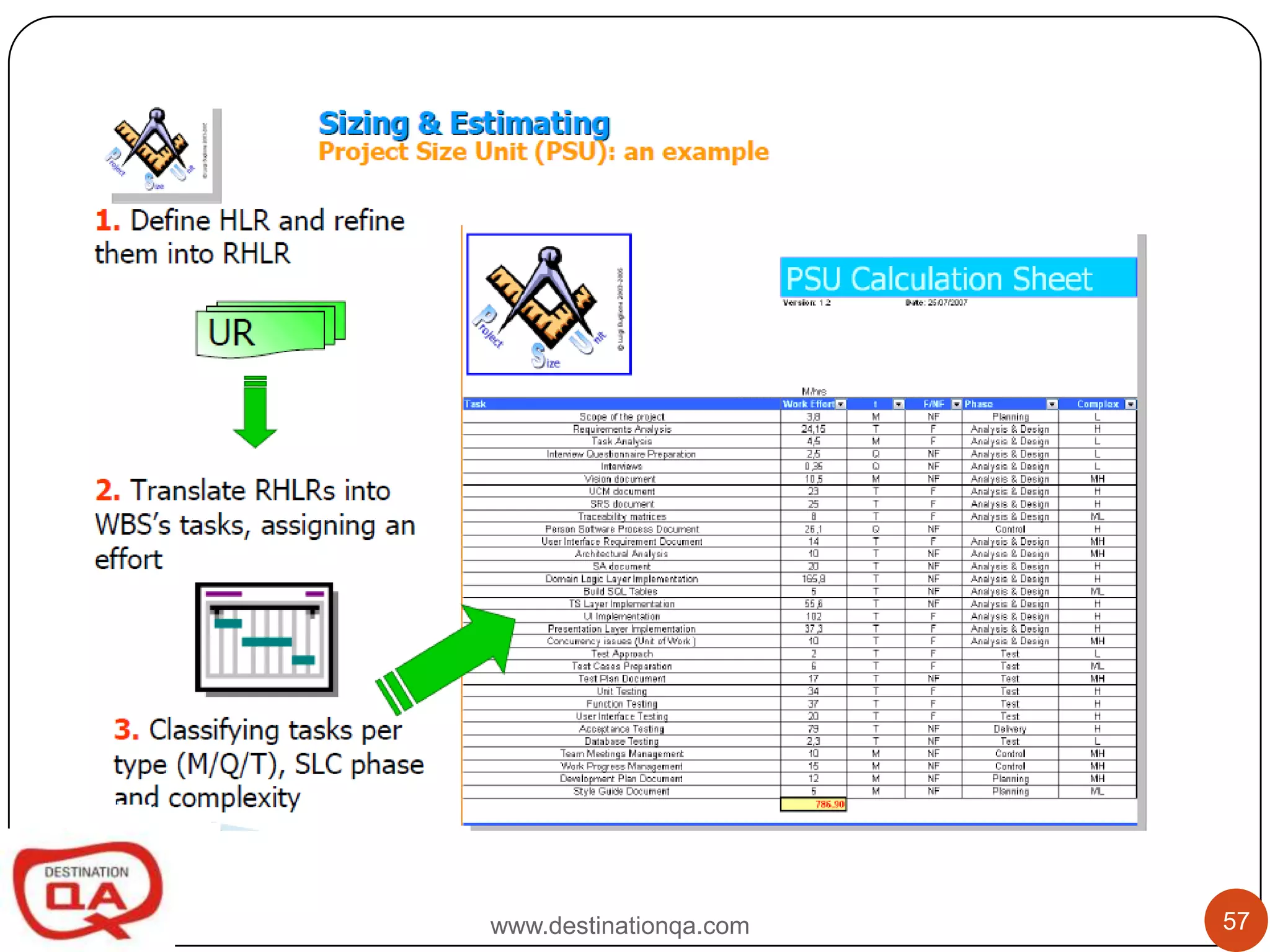
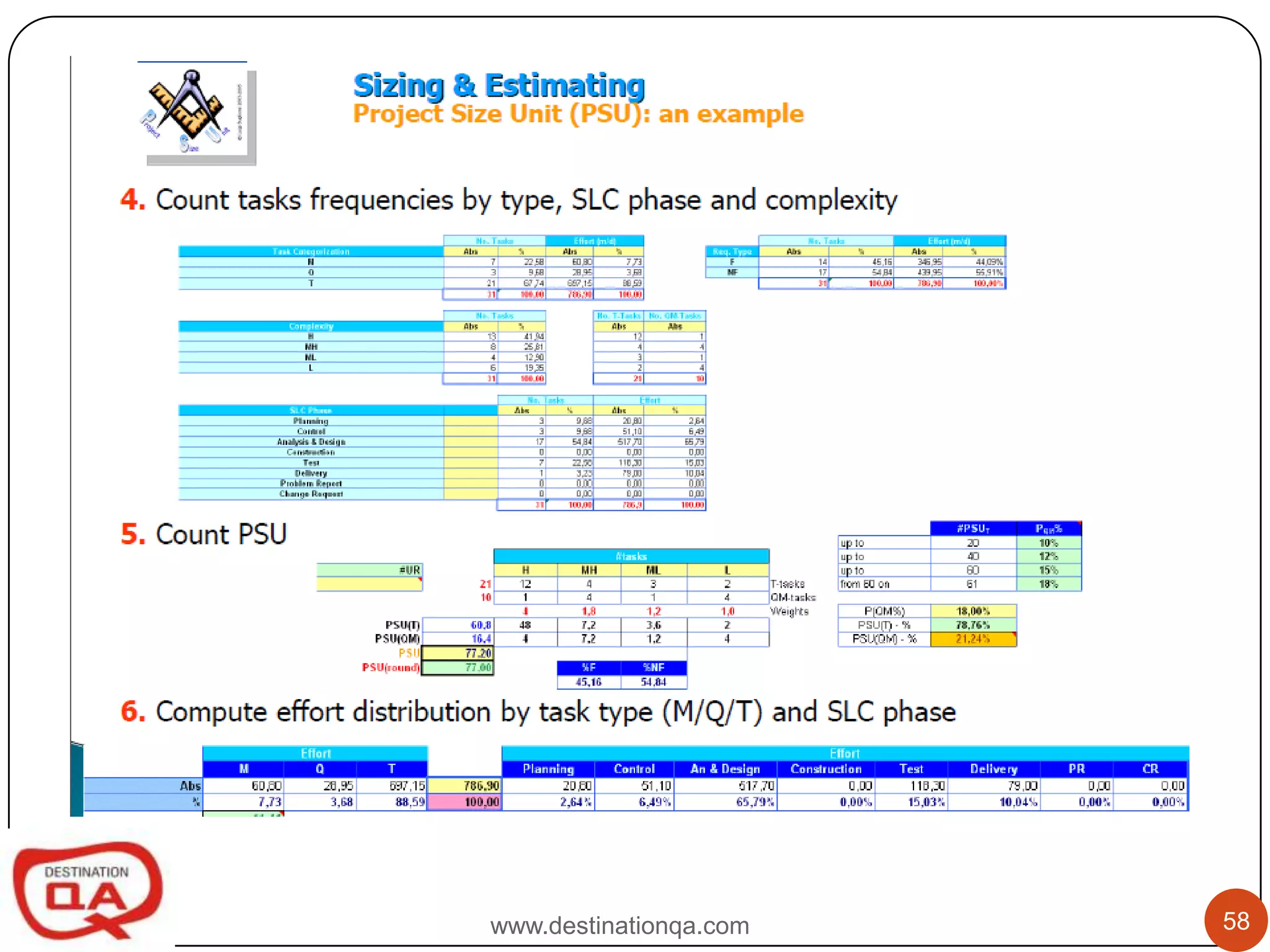
#58 HLR - High Level RequirementRHLR – Refined HLRWBS – Work Breakdown StructureM/Q/T – Management/Quality/Technical
#69 To complete a function point count knowledge of function point rules and applicationdocumentation is needed. Access to an application expert can improve the quality of thecount also.• Once the application boundary has been established, FPA can be broken into three majorparts (FPA for transactional function types, FPA for data function types and FPA for GSCs).