LOC Matric
Function Point Matric
Presented By
Ankush Singh
Software Metric
lA software metric is a quantitative measure of a
degree to which a software system or process
posesses some property.
lThe goal is obtaining objective, reproducible and
quantifiable measurements, which may have
numerous valuable applications in schedule and
budget planning, cost estimation, quality
assurance testing, software debugging, software
performance optimization, and optimal personnel
task assignments.
2 Popular Metrics
lTwo popular metrics used to estimate the size of
software project :
lLine Of Code (LOC)
lFunction Point (FP)
Line Of Code Metric
lLOC matric is a software metric used to measure
the size of a computer program by counting the
number of lines in the text of the program's source
code.
lLines used for commenting the code and header
file are ignored.
lLOC is typically used to predict the amount of
effort that will be required to develop a program,
as well as to estimate programming productivity or
maintainability once the software is produced.
Types of LOC
lTwo major types of LOC :
lPhysical LOC
lNo. of line of code
lLogical LOC
lNo. of executable statements.
Physical LOC
lPhysical LOC is the count of lines in the text of
the program's source code including comment
lines.
lBlank lines are also included unless the lines of
code in a section consists of more than 25% blank
lines.
Logical LOC
Logical LOC attempts to measure the number of
executable statements, but their specific
definitions are tied to specific computer
languages.
Example: Logical LOC measure for C-like
programming languages is the number of
statement-terminating semicolons(;).
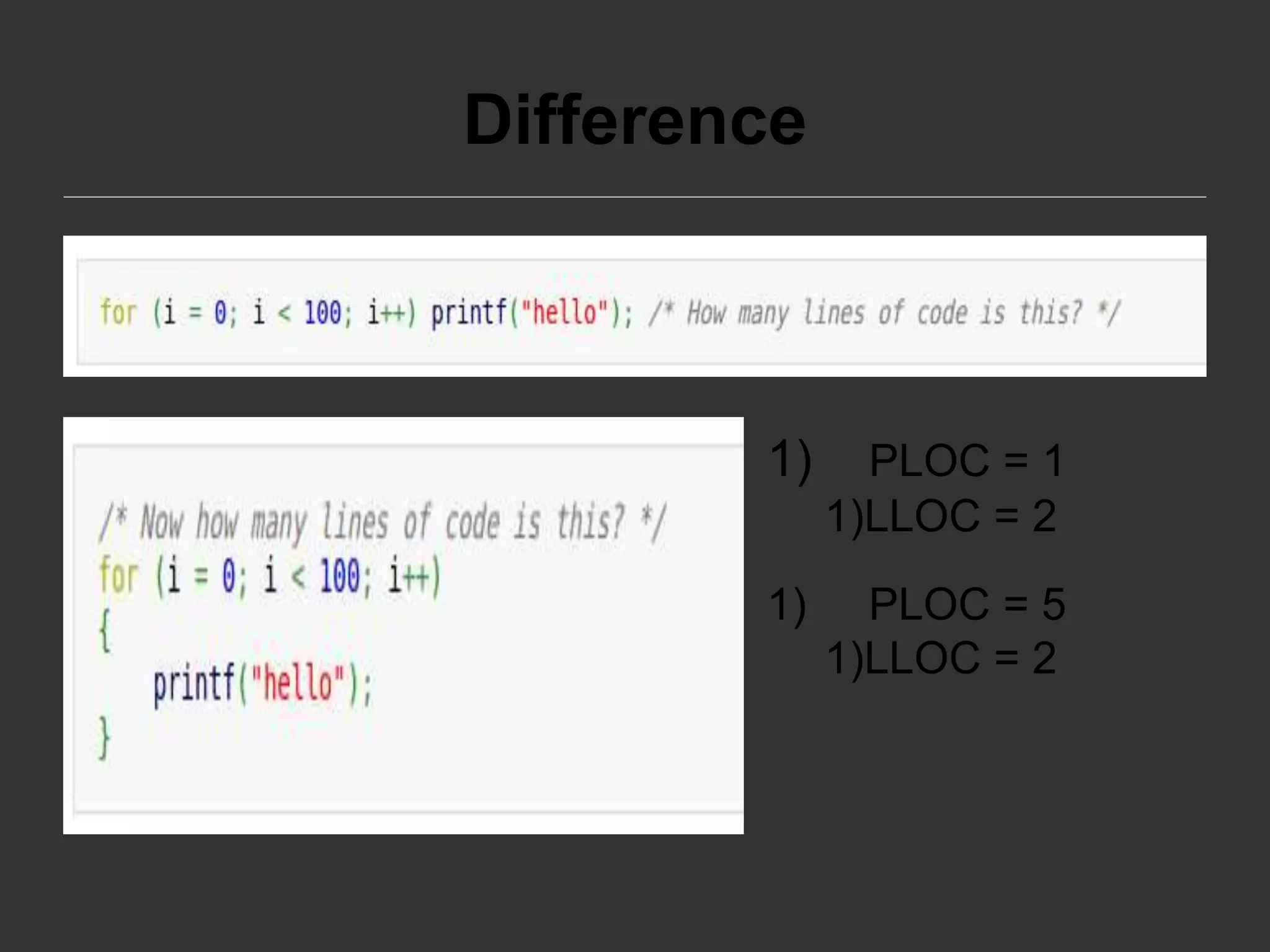
Difference
1) PLOC = 1
1)LLOC = 2
1) PLOC = 5
1)LLOC = 2
Advantage
lScope for Automation of Counting
lAn Intuitive Metric
lUbiquitous Measure
Disadvantage
lLack of Accountability
lLack of Cohesion with Functionality
lAdverse Impact on Estimation
lDeveloper’s Experience
lPsychology
Function Point Matric
lFunction points measure software size.
lA function point is a unit of measurement to
express the amount of business functionality an
information system (as a product) provides to a
user.
lFunction points were defined in 1979 in
Measuring Application Development Productivity
by Allan Albrecht at IBM.
FP Matrics
lThe functional user requirements of the software
are identified and each one is categorized into one
of five types:
linputs,
loutputs,
linquiries,
linternal files, and
lexternal interfaces
Functional Requirements of
Software
lInputs : Each data item given by user except user
inquiries.
lOutput : Reports printed, Screen output, error
message produced etc.
lInquiries : Inquiries are user command whic
require specific action by user.
lInternal Files : It contains data structure and
physical files.
lExternal Interfaces : Interfaces are used to
exchange information with external system or
external data source eg. : CD-ROM
Function Point
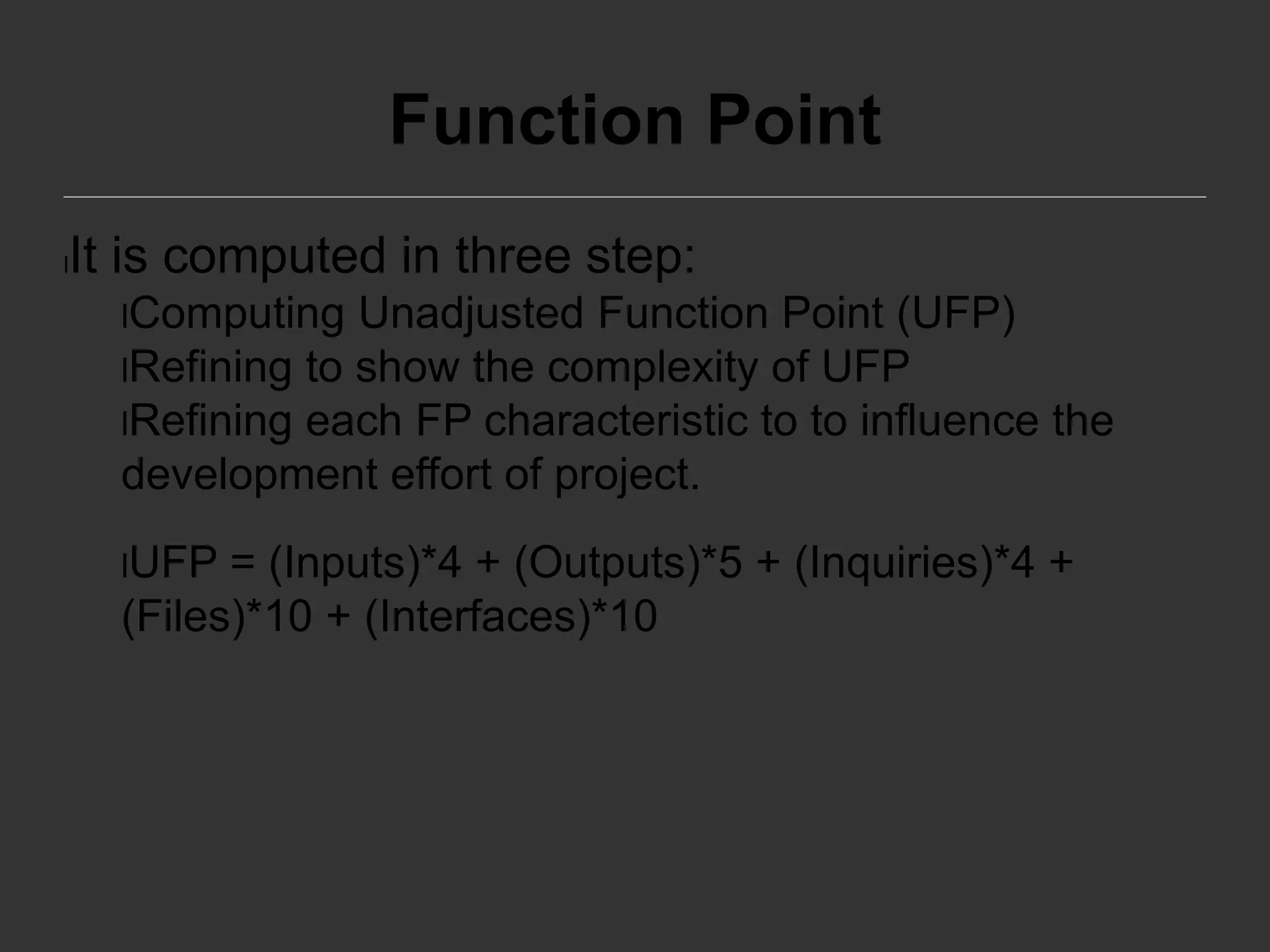
lIt is computed in three step:
lComputing Unadjusted Function Point (UFP)
lRefining to show the complexity of UFP
lRefining each FP characteristic to to influence the
development effort of project.
lUFP = (Inputs)*4 + (Outputs)*5 + (Inquiries)*4 +
(Files)*10 + (Interfaces)*10
Line of Code (LOC) Matric and Function Point Matric

Line of Code (LOC) Matric and Function Point Matric

  • 1.
    LOC Matric Function PointMatric Presented By Ankush Singh
  • 2.
    Software Metric lA softwaremetric is a quantitative measure of a degree to which a software system or process posesses some property. lThe goal is obtaining objective, reproducible and quantifiable measurements, which may have numerous valuable applications in schedule and budget planning, cost estimation, quality assurance testing, software debugging, software performance optimization, and optimal personnel task assignments.
  • 3.
    2 Popular Metrics lTwopopular metrics used to estimate the size of software project : lLine Of Code (LOC) lFunction Point (FP)
  • 4.
    Line Of CodeMetric lLOC matric is a software metric used to measure the size of a computer program by counting the number of lines in the text of the program's source code. lLines used for commenting the code and header file are ignored. lLOC is typically used to predict the amount of effort that will be required to develop a program, as well as to estimate programming productivity or maintainability once the software is produced.
  • 5.
    Types of LOC lTwomajor types of LOC : lPhysical LOC lNo. of line of code lLogical LOC lNo. of executable statements.
  • 6.
    Physical LOC lPhysical LOCis the count of lines in the text of the program's source code including comment lines. lBlank lines are also included unless the lines of code in a section consists of more than 25% blank lines.
  • 7.
    Logical LOC Logical LOCattempts to measure the number of executable statements, but their specific definitions are tied to specific computer languages. Example: Logical LOC measure for C-like programming languages is the number of statement-terminating semicolons(;).
  • 8.
    Difference 1) PLOC =1 1)LLOC = 2 1) PLOC = 5 1)LLOC = 2
  • 9.
    Advantage lScope for Automationof Counting lAn Intuitive Metric lUbiquitous Measure
  • 10.
    Disadvantage lLack of Accountability lLackof Cohesion with Functionality lAdverse Impact on Estimation lDeveloper’s Experience lPsychology
  • 11.
  • 12.
    Function Point Matric lFunctionpoints measure software size. lA function point is a unit of measurement to express the amount of business functionality an information system (as a product) provides to a user. lFunction points were defined in 1979 in Measuring Application Development Productivity by Allan Albrecht at IBM.
  • 13.
    FP Matrics lThe functionaluser requirements of the software are identified and each one is categorized into one of five types: linputs, loutputs, linquiries, linternal files, and lexternal interfaces
  • 14.
    Functional Requirements of Software lInputs: Each data item given by user except user inquiries. lOutput : Reports printed, Screen output, error message produced etc. lInquiries : Inquiries are user command whic require specific action by user. lInternal Files : It contains data structure and physical files. lExternal Interfaces : Interfaces are used to exchange information with external system or external data source eg. : CD-ROM
  • 15.
    Function Point lIt iscomputed in three step: lComputing Unadjusted Function Point (UFP) lRefining to show the complexity of UFP lRefining each FP characteristic to to influence the development effort of project. lUFP = (Inputs)*4 + (Outputs)*5 + (Inquiries)*4 + (Files)*10 + (Interfaces)*10