Spring Ridge Middle School


  How much does a penguin weigh?
          Enough to break the ice!

   Jessie, Stefanie, Ken, and Megan
Justification for our project
   raise student test scores
   decreasing the number of D’s and F’s on
    student assignments
   develop good study habits
   increasing their independence and
    comprehension
   Evidence/reasoning
     Purpose of LINCS: connect familiar knowledge
      with unfamiliar knowledge
     Incorporates different types of learning
Research questions
 Does the use of the LINCS strategy
  improve students’ retention and
  understanding of new
  vocabulary/concepts?
 How do students respond to the use of
  the LINCS strategy?
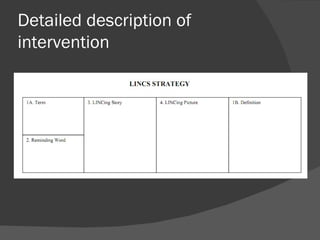
Detailed description of
intervention
Our strategy
   Method
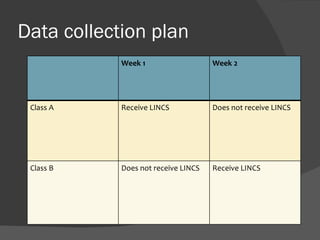
     1st week: class A uses LINCS strategy for
      weeks vocabulary, class B does not
     2nd week: class B uses LINCS strategy for
      weeks vocabulary, class A does not
     After use: affective survey
     At the end of each week: assessment to test
      student retention of key vocabulary and
      concepts
Data collection plan
            Week 1                   Week 2


 Class A    Receive LINCS            Does not receive LINCS


 Class B    Does not receive LINCS   Receive LINCS
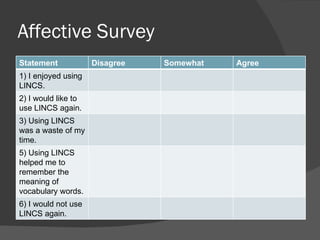
Affective Survey
Statement            Disagree   Somewhat   Agree
1) I enjoyed using
LINCS.
2) I would like to
use LINCS again.
3) Using LINCS
was a waste of my
time.
5) Using LINCS
helped me to
remember the
meaning of
vocabulary words.
6) I would not use
LINCS again.
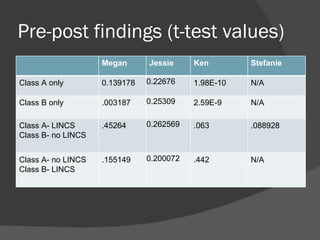
Pre-post findings (t-test values)
                    Megan      Jessie     Ken        Stefanie

Class A only        0.139178   0.22676    1.98E-10   N/A

Class B only        .003187    0.25309    2.59E-9    N/A

Class A- LINCS      .45264     0.262569   .063       .088928
Class B- no LINCS


Class A- no LINCS   .155149    0.200072   .442       N/A
Class B- LINCS
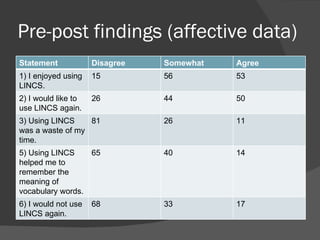
Pre-post findings (affective data)
Statement            Disagree   Somewhat   Agree
1) I enjoyed using   15         56         53
LINCS.
2) I would like to   26         44         50
use LINCS again.
3) Using LINCS    81            26         11
was a waste of my
time.
5) Using LINCS       65         40         14
helped me to
remember the
meaning of
vocabulary words.
6) I would not use   68         33         17
LINCS again.
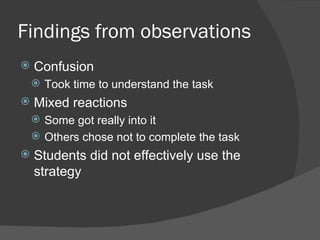
Findings from observations
   Confusion
     Took time to understand the task
   Mixed reactions
     Some got really into it
     Others chose not to complete the task
   Students did not effectively use the
    strategy
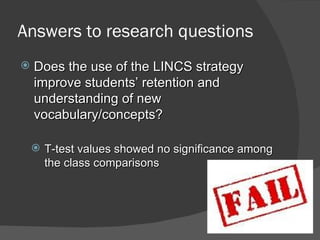
Answers to research questions
   Does the use of the LINCS strategy
    improve students’ retention and
    understanding of new
    vocabulary/concepts?

     T-test values showed no significance among
      the class comparisons
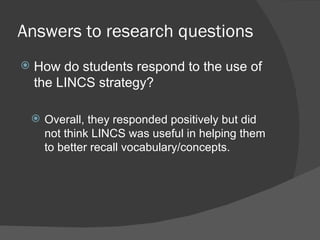
Answers to research questions
   How do students respond to the use of
    the LINCS strategy?

     Overall, they responded positively but did
      not think LINCS was useful in helping them
      to better recall vocabulary/concepts.
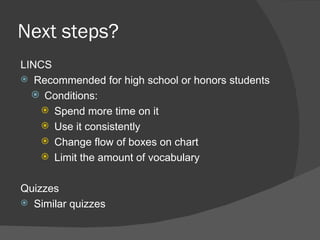
Next steps?
LINCS
 Recommended for high school or honors students
   Conditions:
     Spend more time on it
     Use it consistently
     Change flow of boxes on chart
     Limit the amount of vocabulary


Quizzes
 Similar quizzes
LINCing to the big picture
 Strategy  must be consistent in
  order for it to be effective
 Be more prepared
CARP Powerpoint

CARP Powerpoint

  • 1.
    Spring Ridge MiddleSchool How much does a penguin weigh? Enough to break the ice! Jessie, Stefanie, Ken, and Megan
  • 2.
    Justification for ourproject  raise student test scores  decreasing the number of D’s and F’s on student assignments  develop good study habits  increasing their independence and comprehension  Evidence/reasoning  Purpose of LINCS: connect familiar knowledge with unfamiliar knowledge  Incorporates different types of learning
  • 3.
    Research questions  Doesthe use of the LINCS strategy improve students’ retention and understanding of new vocabulary/concepts?  How do students respond to the use of the LINCS strategy?
  • 4.
  • 5.
    Our strategy  Method  1st week: class A uses LINCS strategy for weeks vocabulary, class B does not  2nd week: class B uses LINCS strategy for weeks vocabulary, class A does not  After use: affective survey  At the end of each week: assessment to test student retention of key vocabulary and concepts
  • 6.
    Data collection plan Week 1 Week 2 Class A Receive LINCS Does not receive LINCS Class B Does not receive LINCS Receive LINCS
  • 7.
    Affective Survey Statement Disagree Somewhat Agree 1) I enjoyed using LINCS. 2) I would like to use LINCS again. 3) Using LINCS was a waste of my time. 5) Using LINCS helped me to remember the meaning of vocabulary words. 6) I would not use LINCS again.
  • 8.
    Pre-post findings (t-testvalues) Megan Jessie Ken Stefanie Class A only 0.139178 0.22676 1.98E-10 N/A Class B only .003187 0.25309 2.59E-9 N/A Class A- LINCS .45264 0.262569 .063 .088928 Class B- no LINCS Class A- no LINCS .155149 0.200072 .442 N/A Class B- LINCS
  • 9.
    Pre-post findings (affectivedata) Statement Disagree Somewhat Agree 1) I enjoyed using 15 56 53 LINCS. 2) I would like to 26 44 50 use LINCS again. 3) Using LINCS 81 26 11 was a waste of my time. 5) Using LINCS 65 40 14 helped me to remember the meaning of vocabulary words. 6) I would not use 68 33 17 LINCS again.
  • 10.
    Findings from observations  Confusion  Took time to understand the task  Mixed reactions  Some got really into it  Others chose not to complete the task  Students did not effectively use the strategy
  • 11.
    Answers to researchquestions  Does the use of the LINCS strategy improve students’ retention and understanding of new vocabulary/concepts?  T-test values showed no significance among the class comparisons
  • 12.
    Answers to researchquestions  How do students respond to the use of the LINCS strategy?  Overall, they responded positively but did not think LINCS was useful in helping them to better recall vocabulary/concepts.
  • 13.
    Next steps? LINCS  Recommendedfor high school or honors students  Conditions:  Spend more time on it  Use it consistently  Change flow of boxes on chart  Limit the amount of vocabulary Quizzes  Similar quizzes
  • 14.
    LINCing to thebig picture  Strategy must be consistent in order for it to be effective  Be more prepared