The NIST Cybersecurity Framework (CSF):
The journey from CSF 1.1 to 2.0
by Andrey Prozorov, CISM, CIPP/E, CDPSE, LA 27001
www.patreon.com/AndreyProzorov
1.0, 08.08.2023 (CSF 2.0 draft)
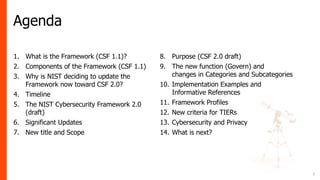
Agenda
2
1. What is the Framework (CSF 1.1)?
2. Components of the Framework (CSF 1.1)
3. Why is NIST deciding to update the
Framework now toward CSF 2.0?
4. Timeline
5. The NIST Cybersecurity Framework 2.0
(draft)
6. Significant Updates
7. New title and Scope
8. Purpose (CSF 2.0 draft)
9. The new function (Govern) and
changes in Categories and Subcategories
10. Implementation Examples and
Informative References
11. Framework Profiles
12. New criteria for TIERs
13. Cybersecurity and Privacy
14. What is next?
3
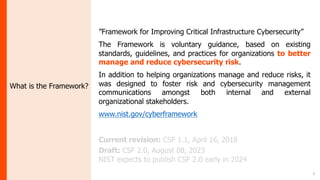
What is the Framework?
”Framework for Improving Critical Infrastructure Cybersecurity”
The Framework is voluntary guidance, based on existing
standards, guidelines, and practices for organizations to better
manage and reduce cybersecurity risk.
In addition to helping organizations manage and reduce risks, it
was designed to foster risk and cybersecurity management
communications amongst both internal and external
organizational stakeholders.
www.nist.gov/cyberframework
Current revision: CSF 1.1, April 16, 2018
Draft: CSF 2.0, August 08, 2023
NIST expects to publish CSF 2.0 early in 2024
4
Components of the
Framework
(CSF 1.1)
The Cybersecurity Framework consists of three main components: the
Core, Implementation Tiers, and Profiles.
The Framework Core provides a set of desired cybersecurity activities
and outcomes using common language that is easy to understand. The
Core guides organizations in managing and reducing their cybersecurity
risks in a way that complements an organization’s existing cybersecurity
and risk management processes.
The Framework Implementation Tiers assist organizations by
providing context on how an organization views cybersecurity risk
management. The Tiers guide organizations to consider the appropriate
level of rigor for their cybersecurity program and are often used as a
communication tool to discuss risk appetite, mission priority, and
budget.
Framework Profiles are an organization’s unique alignment of their
organizational requirements and objectives, risk appetite, and resources
against the desired outcomes of the Framework Core. Profiles are
primarily used to identify and prioritize opportunities for improving
cybersecurity at an organization.
5
Why is NIST deciding to
update the Framework
now toward CSF 2.0?
The NIST Cybersecurity Framework was intended to be a living
document that is refined, improved, and evolves over time.
These updates help the Framework keep pace with technology and
threat trends, integrate lessons learned, and move best practice to
common practice.
NIST initially produced the Framework in 2014 and updated it in April
2018 with CSF 1.1. Based on stakeholder feedback, in order to reflect
the ever-evolving cybersecurity landscape and to help organizations
more easily and effectively manage cybersecurity risk, NIST is working
on a new, more significant update to the Framework: CSF 2.0.
www.nist.gov/cyberframework/updating-nist-cybersecurity-framework-
journey-csf-20
6
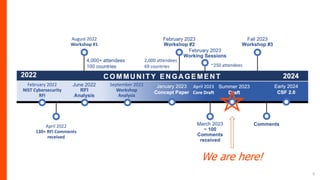
We are here!
7
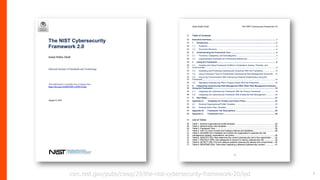
csrc.nist.gov/pubs/cswp/29/the-nist-cybersecurity-framework-20/ipd
8
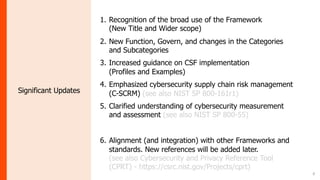
Significant Updates
1. Recognition of the broad use of the Framework
(New Title and Wider scope)
2. New Function, Govern, and changes in the Categories
and Subcategories
3. Increased guidance on CSF implementation
(Profiles and Examples)
4. Emphasized cybersecurity supply chain risk management
(C-SCRM) (see also NIST SP 800-161r1)
5. Clarified understanding of cybersecurity measurement
and assessment (see also NIST SP 800-55)
6. Alignment (and integration) with other Frameworks and
standards. New references will be added later.
(see also Cybersecurity and Privacy Reference Tool
(CPRT) - https://csrc.nist.gov/Projects/cprt)
9
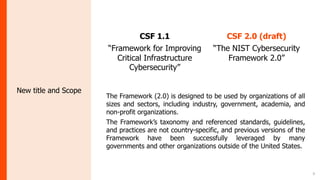
New title and Scope
CSF 1.1 CSF 2.0 (draft)
“Framework for Improving
Critical Infrastructure
Cybersecurity”
“The NIST Cybersecurity
Framework 2.0”
The Framework (2.0) is designed to be used by organizations of all
sizes and sectors, including industry, government, academia, and
non-profit organizations.
The Framework’s taxonomy and referenced standards, guidelines,
and practices are not country-specific, and previous versions of the
Framework have been successfully leveraged by many
governments and other organizations outside of the United States.
10
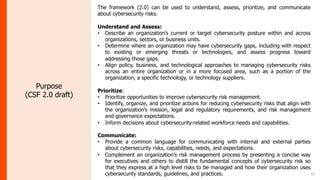
Purpose
(CSF 2.0 draft)
The framework (2.0) can be used to understand, assess, prioritize, and communicate
about cybersecurity risks.
Understand and Assess:
• Describe an organization’s current or target cybersecurity posture within and across
organizations, sectors, or business units.
• Determine where an organization may have cybersecurity gaps, including with respect
to existing or emerging threats or technologies, and assess progress toward
addressing those gaps.
• Align policy, business, and technological approaches to managing cybersecurity risks
across an entire organization or in a more focused area, such as a portion of the
organization, a specific technology, or technology suppliers.
Prioritize:
• Prioritize opportunities to improve cybersecurity risk management.
• Identify, organize, and prioritize actions for reducing cybersecurity risks that align with
the organization’s mission, legal and regulatory requirements, and risk management
and governance expectations.
• Inform decisions about cybersecurity-related workforce needs and capabilities.
Communicate:
• Provide a common language for communicating with internal and external parties
about cybersecurity risks, capabilities, needs, and expectations.
• Complement an organization’s risk management process by presenting a concise way
for executives and others to distill the fundamental concepts of cybersecurity risk so
that they express at a high level risks to be managed and how their organization uses
cybersecurity standards, guidelines, and practices.
11
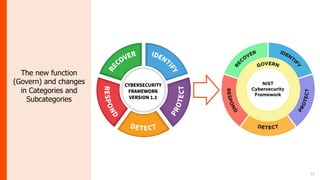
The new function
(Govern) and changes
in Categories and
Subcategories
12
CSF 1.1 CSF 2.0 (draft)
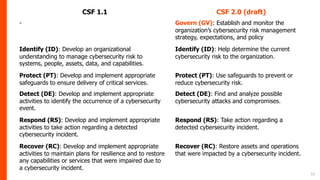
- Govern (GV): Establish and monitor the
organization’s cybersecurity risk management
strategy, expectations, and policy
Identify (ID): Develop an organizational
understanding to manage cybersecurity risk to
systems, people, assets, data, and capabilities.
Identify (ID): Help determine the current
cybersecurity risk to the organization.
Protect (PT): Develop and implement appropriate
safeguards to ensure delivery of critical services.
Protect (PT): Use safeguards to prevent or
reduce cybersecurity risk.
Detect (DE): Develop and implement appropriate
activities to identify the occurrence of a cybersecurity
event.
Detect (DE): Find and analyze possible
cybersecurity attacks and compromises.
Respond (RS): Develop and implement appropriate
activities to take action regarding a detected
cybersecurity incident.
Respond (RS): Take action regarding a
detected cybersecurity incident.
Recover (RC): Develop and implement appropriate
activities to maintain plans for resilience and to restore
any capabilities or services that were impaired due to
a cybersecurity incident.
Recover (RC): Restore assets and operations
that were impacted by a cybersecurity incident.
13
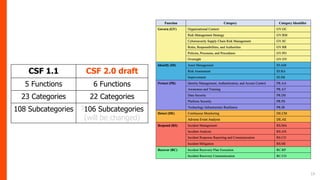
CSF 1.1 CSF 2.0 draft
5 Functions 6 Functions
23 Categories 22 Categories
108 Subcategories ?106 Subcategories
(will be changed)
14
Implementation
Examples and
Informative References
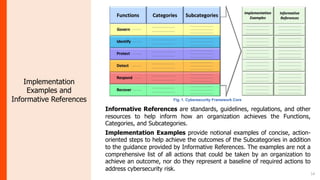
Informative References are standards, guidelines, regulations, and other
resources to help inform how an organization achieves the Functions,
Categories, and Subcategories.
Implementation Examples provide notional examples of concise, action-
oriented steps to help achieve the outcomes of the Subcategories in addition
to the guidance provided by Informative References. The examples are not a
comprehensive list of all actions that could be taken by an organization to
achieve an outcome, nor do they represent a baseline of required actions to
address cybersecurity risk.
15
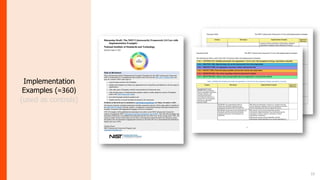
Implementation
Examples (≈360)
(used as controls)
16
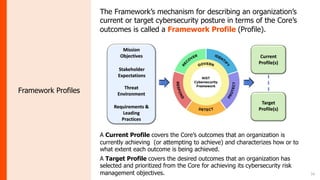
Framework Profiles
The Framework’s mechanism for describing an organization’s
current or target cybersecurity posture in terms of the Core’s
outcomes is called a Framework Profile (Profile).
A Current Profile covers the Core’s outcomes that an organization is
currently achieving (or attempting to achieve) and characterizes how or to
what extent each outcome is being achieved.
A Target Profile covers the desired outcomes that an organization has
selected and prioritized from the Core for achieving its cybersecurity risk
management objectives.
17
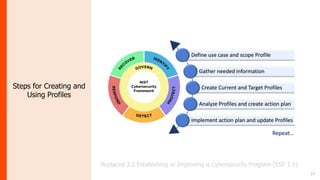
Steps for Creating and
Using Profiles
Replaced 3.2 Establishing or Improving a Cybersecurity Program (CSF 1.1)
18
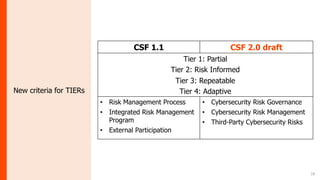
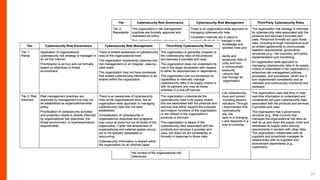
New criteria for TIERs
CSF 1.1 CSF 2.0 draft
Tier 1: Partial
Tier 2: Risk Informed
Tier 3: Repeatable
Tier 4: Adaptive
• Risk Management Process
• Integrated Risk Management
Program
• External Participation
• Cybersecurity Risk Governance
• Cybersecurity Risk Management
• Third-Party Cybersecurity Risks
19
20
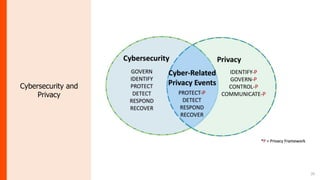
Cybersecurity and
Privacy
21
What is next?
The public draft and Examples are here:
https://www.nist.gov/cyberframework/updating-nist-
cybersecurity-framework-journey-csf-20
Feedback on this CSF 2.0 Public Draft, as well as the related
Implementation Examples draft, may be submitted to
cyberframework@nist.gov by Friday, November 4, 2023
This draft will be discussed at the third CSF workshop, which
will be held this fall.
NIST does not plan to release another draft of CSF 2.0 for
comment. Feedback on this draft will inform development of
the final CSF 2.0 to be published in early 2024.
Thanks, and good luck!
www.linkedin.com/in/andreyprozorov
www.patreon.com/AndreyProzorov
22

From NIST CSF 1.1 to 2.0.pdf

  • 1.
    The NIST CybersecurityFramework (CSF): The journey from CSF 1.1 to 2.0 by Andrey Prozorov, CISM, CIPP/E, CDPSE, LA 27001 www.patreon.com/AndreyProzorov 1.0, 08.08.2023 (CSF 2.0 draft)
  • 2.
    Agenda 2 1. What isthe Framework (CSF 1.1)? 2. Components of the Framework (CSF 1.1) 3. Why is NIST deciding to update the Framework now toward CSF 2.0? 4. Timeline 5. The NIST Cybersecurity Framework 2.0 (draft) 6. Significant Updates 7. New title and Scope 8. Purpose (CSF 2.0 draft) 9. The new function (Govern) and changes in Categories and Subcategories 10. Implementation Examples and Informative References 11. Framework Profiles 12. New criteria for TIERs 13. Cybersecurity and Privacy 14. What is next?
  • 3.
    3 What is theFramework? ”Framework for Improving Critical Infrastructure Cybersecurity” The Framework is voluntary guidance, based on existing standards, guidelines, and practices for organizations to better manage and reduce cybersecurity risk. In addition to helping organizations manage and reduce risks, it was designed to foster risk and cybersecurity management communications amongst both internal and external organizational stakeholders. www.nist.gov/cyberframework Current revision: CSF 1.1, April 16, 2018 Draft: CSF 2.0, August 08, 2023 NIST expects to publish CSF 2.0 early in 2024
  • 4.
    4 Components of the Framework (CSF1.1) The Cybersecurity Framework consists of three main components: the Core, Implementation Tiers, and Profiles. The Framework Core provides a set of desired cybersecurity activities and outcomes using common language that is easy to understand. The Core guides organizations in managing and reducing their cybersecurity risks in a way that complements an organization’s existing cybersecurity and risk management processes. The Framework Implementation Tiers assist organizations by providing context on how an organization views cybersecurity risk management. The Tiers guide organizations to consider the appropriate level of rigor for their cybersecurity program and are often used as a communication tool to discuss risk appetite, mission priority, and budget. Framework Profiles are an organization’s unique alignment of their organizational requirements and objectives, risk appetite, and resources against the desired outcomes of the Framework Core. Profiles are primarily used to identify and prioritize opportunities for improving cybersecurity at an organization.
  • 5.
    5 Why is NISTdeciding to update the Framework now toward CSF 2.0? The NIST Cybersecurity Framework was intended to be a living document that is refined, improved, and evolves over time. These updates help the Framework keep pace with technology and threat trends, integrate lessons learned, and move best practice to common practice. NIST initially produced the Framework in 2014 and updated it in April 2018 with CSF 1.1. Based on stakeholder feedback, in order to reflect the ever-evolving cybersecurity landscape and to help organizations more easily and effectively manage cybersecurity risk, NIST is working on a new, more significant update to the Framework: CSF 2.0. www.nist.gov/cyberframework/updating-nist-cybersecurity-framework- journey-csf-20
  • 6.
  • 7.
  • 8.
    8 Significant Updates 1. Recognitionof the broad use of the Framework (New Title and Wider scope) 2. New Function, Govern, and changes in the Categories and Subcategories 3. Increased guidance on CSF implementation (Profiles and Examples) 4. Emphasized cybersecurity supply chain risk management (C-SCRM) (see also NIST SP 800-161r1) 5. Clarified understanding of cybersecurity measurement and assessment (see also NIST SP 800-55) 6. Alignment (and integration) with other Frameworks and standards. New references will be added later. (see also Cybersecurity and Privacy Reference Tool (CPRT) - https://csrc.nist.gov/Projects/cprt)
  • 9.
    9 New title andScope CSF 1.1 CSF 2.0 (draft) “Framework for Improving Critical Infrastructure Cybersecurity” “The NIST Cybersecurity Framework 2.0” The Framework (2.0) is designed to be used by organizations of all sizes and sectors, including industry, government, academia, and non-profit organizations. The Framework’s taxonomy and referenced standards, guidelines, and practices are not country-specific, and previous versions of the Framework have been successfully leveraged by many governments and other organizations outside of the United States.
  • 10.
    10 Purpose (CSF 2.0 draft) Theframework (2.0) can be used to understand, assess, prioritize, and communicate about cybersecurity risks. Understand and Assess: • Describe an organization’s current or target cybersecurity posture within and across organizations, sectors, or business units. • Determine where an organization may have cybersecurity gaps, including with respect to existing or emerging threats or technologies, and assess progress toward addressing those gaps. • Align policy, business, and technological approaches to managing cybersecurity risks across an entire organization or in a more focused area, such as a portion of the organization, a specific technology, or technology suppliers. Prioritize: • Prioritize opportunities to improve cybersecurity risk management. • Identify, organize, and prioritize actions for reducing cybersecurity risks that align with the organization’s mission, legal and regulatory requirements, and risk management and governance expectations. • Inform decisions about cybersecurity-related workforce needs and capabilities. Communicate: • Provide a common language for communicating with internal and external parties about cybersecurity risks, capabilities, needs, and expectations. • Complement an organization’s risk management process by presenting a concise way for executives and others to distill the fundamental concepts of cybersecurity risk so that they express at a high level risks to be managed and how their organization uses cybersecurity standards, guidelines, and practices.
  • 11.
    11 The new function (Govern)and changes in Categories and Subcategories
  • 12.
    12 CSF 1.1 CSF2.0 (draft) - Govern (GV): Establish and monitor the organization’s cybersecurity risk management strategy, expectations, and policy Identify (ID): Develop an organizational understanding to manage cybersecurity risk to systems, people, assets, data, and capabilities. Identify (ID): Help determine the current cybersecurity risk to the organization. Protect (PT): Develop and implement appropriate safeguards to ensure delivery of critical services. Protect (PT): Use safeguards to prevent or reduce cybersecurity risk. Detect (DE): Develop and implement appropriate activities to identify the occurrence of a cybersecurity event. Detect (DE): Find and analyze possible cybersecurity attacks and compromises. Respond (RS): Develop and implement appropriate activities to take action regarding a detected cybersecurity incident. Respond (RS): Take action regarding a detected cybersecurity incident. Recover (RC): Develop and implement appropriate activities to maintain plans for resilience and to restore any capabilities or services that were impaired due to a cybersecurity incident. Recover (RC): Restore assets and operations that were impacted by a cybersecurity incident.
  • 13.
    13 CSF 1.1 CSF2.0 draft 5 Functions 6 Functions 23 Categories 22 Categories 108 Subcategories ?106 Subcategories (will be changed)
  • 14.
    14 Implementation Examples and Informative References InformativeReferences are standards, guidelines, regulations, and other resources to help inform how an organization achieves the Functions, Categories, and Subcategories. Implementation Examples provide notional examples of concise, action- oriented steps to help achieve the outcomes of the Subcategories in addition to the guidance provided by Informative References. The examples are not a comprehensive list of all actions that could be taken by an organization to achieve an outcome, nor do they represent a baseline of required actions to address cybersecurity risk.
  • 15.
  • 16.
    16 Framework Profiles The Framework’smechanism for describing an organization’s current or target cybersecurity posture in terms of the Core’s outcomes is called a Framework Profile (Profile). A Current Profile covers the Core’s outcomes that an organization is currently achieving (or attempting to achieve) and characterizes how or to what extent each outcome is being achieved. A Target Profile covers the desired outcomes that an organization has selected and prioritized from the Core for achieving its cybersecurity risk management objectives.
  • 17.
    17 Steps for Creatingand Using Profiles Replaced 3.2 Establishing or Improving a Cybersecurity Program (CSF 1.1)
  • 18.
    18 New criteria forTIERs CSF 1.1 CSF 2.0 draft Tier 1: Partial Tier 2: Risk Informed Tier 3: Repeatable Tier 4: Adaptive • Risk Management Process • Integrated Risk Management Program • External Participation • Cybersecurity Risk Governance • Cybersecurity Risk Management • Third-Party Cybersecurity Risks
  • 19.
  • 20.
  • 21.
    21 What is next? Thepublic draft and Examples are here: https://www.nist.gov/cyberframework/updating-nist- cybersecurity-framework-journey-csf-20 Feedback on this CSF 2.0 Public Draft, as well as the related Implementation Examples draft, may be submitted to cyberframework@nist.gov by Friday, November 4, 2023 This draft will be discussed at the third CSF workshop, which will be held this fall. NIST does not plan to release another draft of CSF 2.0 for comment. Feedback on this draft will inform development of the final CSF 2.0 to be published in early 2024.
  • 22.
    Thanks, and goodluck! www.linkedin.com/in/andreyprozorov www.patreon.com/AndreyProzorov 22