Overview of NIST Cybersecurity
Framework (CSF) 2.0
Introduction to NIST Cybersecurity
Framework (CSF) 2.0
• Provides guidance to industry, government, and
organizations on managing cybersecurity risks.
• Aimed at improving organizations' understanding,
assessment, and communication of cybersecurity
efforts.
• Designed for organizations of all sizes, sectors,
and maturity levels.
High-Level Cybersecurity Outcomes
 The CSF 2.0 provides a taxonomy of high-level
cybersecurity outcomes.
 Helps organizations prioritize and assess
cybersecurity efforts.
 Facilitates better understanding and
communication of cybersecurity risks.
Key Features of CSF 2.0
 Flexible: Can be used by any organization,
regardless of size or sector.
 Non-Prescriptive: Does not dictate how to
achieve cybersecurity outcomes.
 Guidance-Based: Links to online resources for
practices and controls to achieve outcomes.
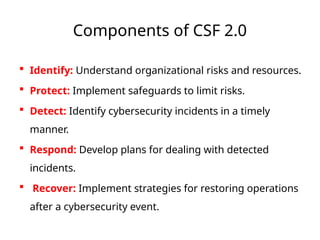
Components of CSF 2.0
 Identify: Understand organizational risks and resources.
 Protect: Implement safeguards to limit risks.
 Detect: Identify cybersecurity incidents in a timely
manner.
 Respond: Develop plans for dealing with detected
incidents.
 Recover: Implement strategies for restoring operations
after a cybersecurity event.
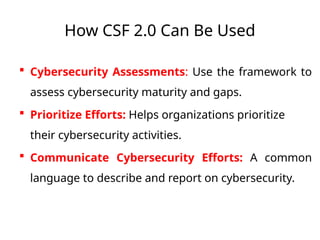
How CSF 2.0 Can Be Used
 Cybersecurity Assessments: Use the framework to
assess cybersecurity maturity and gaps.
 Prioritize Efforts: Helps organizations prioritize
their cybersecurity activities.
 Communicate Cybersecurity Efforts: A common
language to describe and report on cybersecurity.
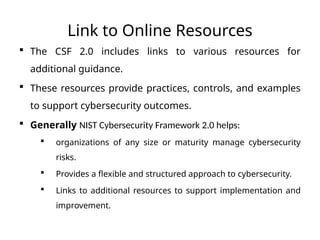
Link to Online Resources
 The CSF 2.0 includes links to various resources for
additional guidance.
 These resources provide practices, controls, and examples
to support cybersecurity outcomes.
 Generally NIST Cybersecurity Framework 2.0 helps:
 organizations of any size or maturity manage cybersecurity
risks.
 Provides a flexible and structured approach to cybersecurity.
 Links to additional resources to support implementation and
improvement.

NIST_Cybersecurity_Framework_2.0.pptxework_2.0.pptx

  • 1.
    Overview of NISTCybersecurity Framework (CSF) 2.0
  • 2.
    Introduction to NISTCybersecurity Framework (CSF) 2.0 • Provides guidance to industry, government, and organizations on managing cybersecurity risks. • Aimed at improving organizations' understanding, assessment, and communication of cybersecurity efforts. • Designed for organizations of all sizes, sectors, and maturity levels.
  • 3.
    High-Level Cybersecurity Outcomes The CSF 2.0 provides a taxonomy of high-level cybersecurity outcomes.  Helps organizations prioritize and assess cybersecurity efforts.  Facilitates better understanding and communication of cybersecurity risks.
  • 4.
    Key Features ofCSF 2.0  Flexible: Can be used by any organization, regardless of size or sector.  Non-Prescriptive: Does not dictate how to achieve cybersecurity outcomes.  Guidance-Based: Links to online resources for practices and controls to achieve outcomes.
  • 5.
    Components of CSF2.0  Identify: Understand organizational risks and resources.  Protect: Implement safeguards to limit risks.  Detect: Identify cybersecurity incidents in a timely manner.  Respond: Develop plans for dealing with detected incidents.  Recover: Implement strategies for restoring operations after a cybersecurity event.
  • 6.
    How CSF 2.0Can Be Used  Cybersecurity Assessments: Use the framework to assess cybersecurity maturity and gaps.  Prioritize Efforts: Helps organizations prioritize their cybersecurity activities.  Communicate Cybersecurity Efforts: A common language to describe and report on cybersecurity.
  • 7.
    Link to OnlineResources  The CSF 2.0 includes links to various resources for additional guidance.  These resources provide practices, controls, and examples to support cybersecurity outcomes.  Generally NIST Cybersecurity Framework 2.0 helps:  organizations of any size or maturity manage cybersecurity risks.  Provides a flexible and structured approach to cybersecurity.  Links to additional resources to support implementation and improvement.