MetiTarski's Menagerie 
of Cooperating Systems 
Lawrence C. Paulson 
Computer Laboratory 
University of Cambridge
1. On Combining Systems
Combining Systems is Hard! 
Example 1: “Integrating decision procedures into 
heuristic theorem provers: A case study of linear 
arithmetic” (Boyer and Moore, 1988) 
Example 2: “Reachability programming in HOL98 using 
BDDs” (MJC Gordon, 2000) 
Example 3: Isabelle’s Sledgehammer (2007) 
Example 4: Resolution + RCF = MetiTarski (2008)
Adding Linear Arithmetic to 
the Boyer/Moore Prover 
Simply adding their (custom-made!) decision procedure 
to the Boyer/Moore prover had little effect. 
Deep integration with the rewriter was necessary: 
their decision procedure was no black box. 
Final version “like the software for the space shuttle”
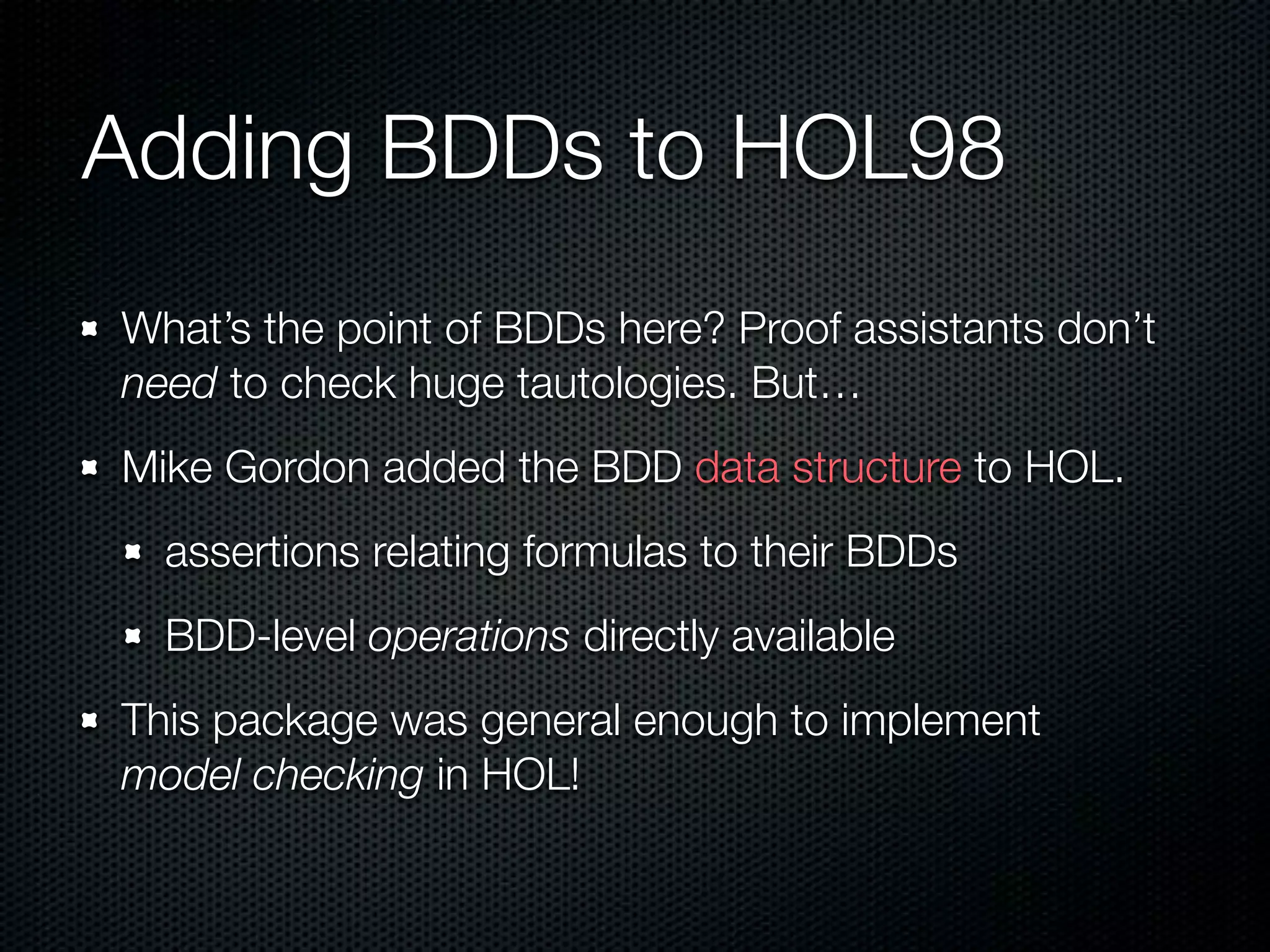
Adding BDDs to HOL98 
What’s the point of BDDs here? Proof assistants don’t 
need to check huge tautologies. But… 
Mike Gordon added the BDD data structure to HOL. 
assertions relating formulas to their BDDs 
BDD-level operations directly available 
This package was general enough to implement 
model checking in HOL!
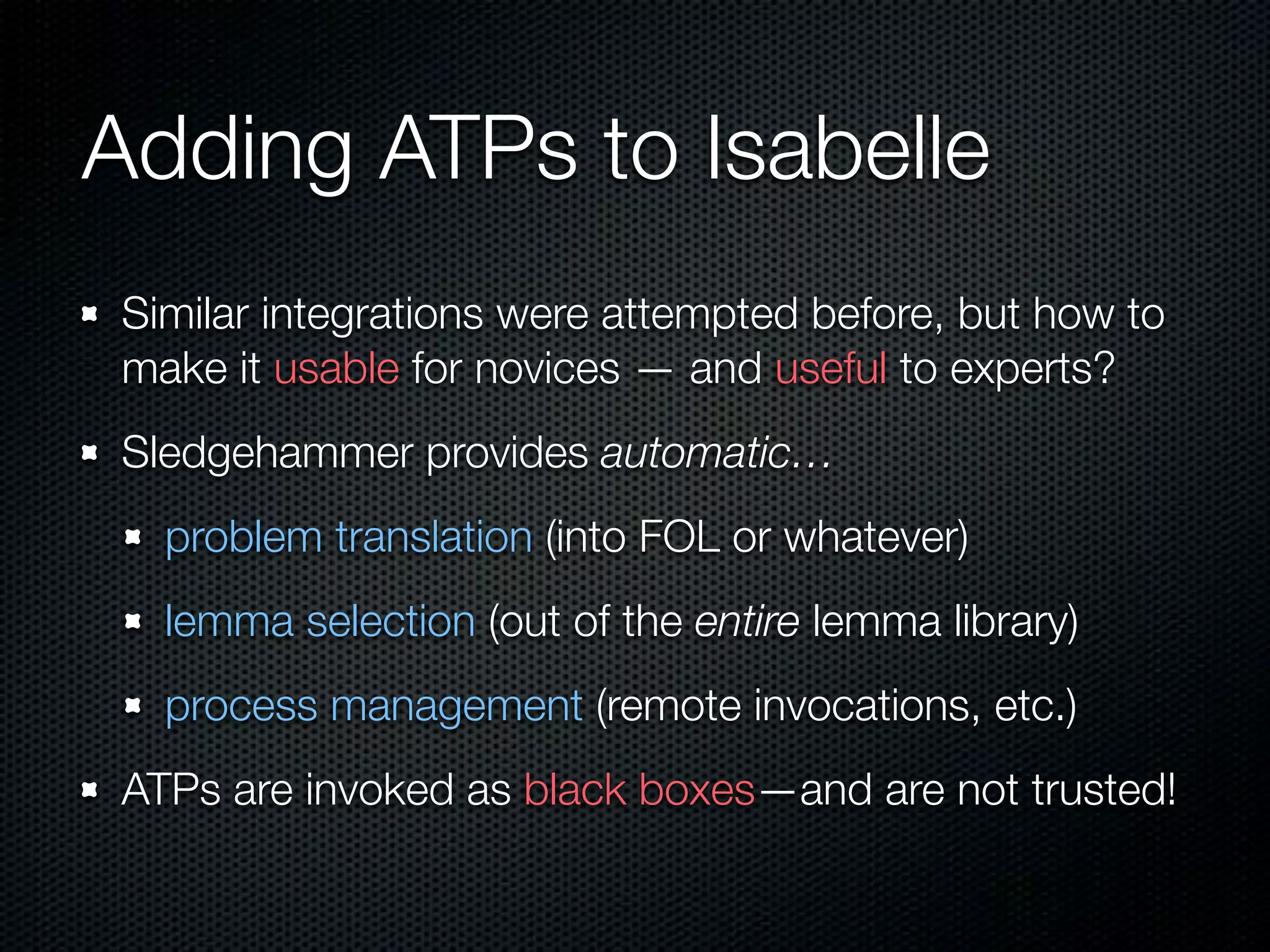
Adding ATPs to Isabelle 
Similar integrations were attempted before, but how to 
make it usable for novices — and useful to experts? 
Sledgehammer provides automatic… 
problem translation (into FOL or whatever) 
lemma selection (out of the entire lemma library) 
process management (remote invocations, etc.) 
ATPs are invoked as black boxes—and are not trusted!
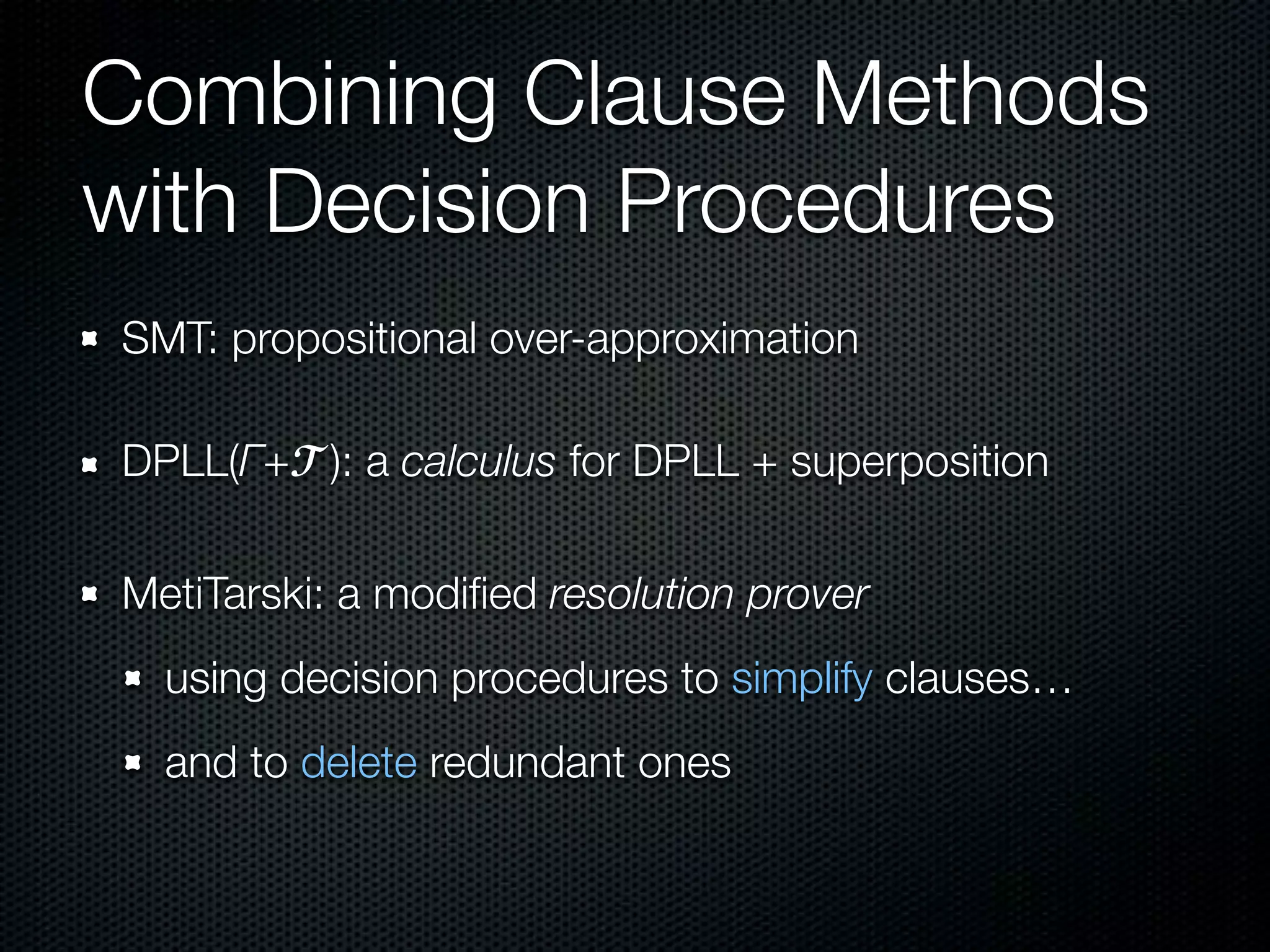
Combining Clause Methods 
with Decision Procedures 
SMT: propositional over-approximation 
DPLL(Γ+!): a calculus for DPLL + superposition 
MetiTarski: a modified resolution prover 
using decision procedures to simplify clauses… 
and to delete redundant ones
2. MetiTarski
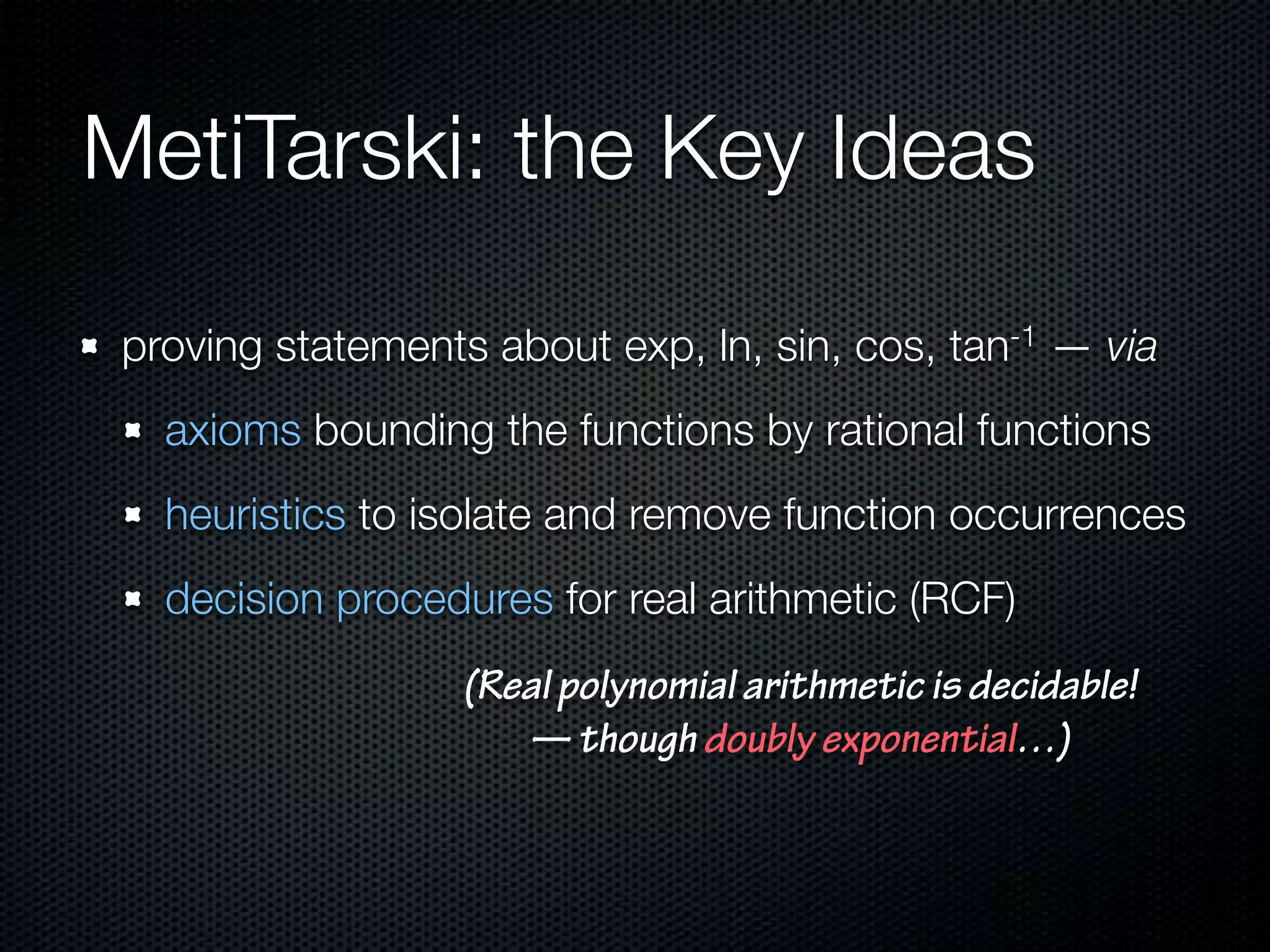
MetiTarski: the Key Ideas 
proving statements about exp, ln, sin, cos, tan-1 — via 
axioms bounding the functions by rational functions 
heuristics to isolate and remove function occurrences 
decision procedures for real arithmetic (RCF) 
(Real polynomial arithmetic is decidable! 
— though doubly exponential…)
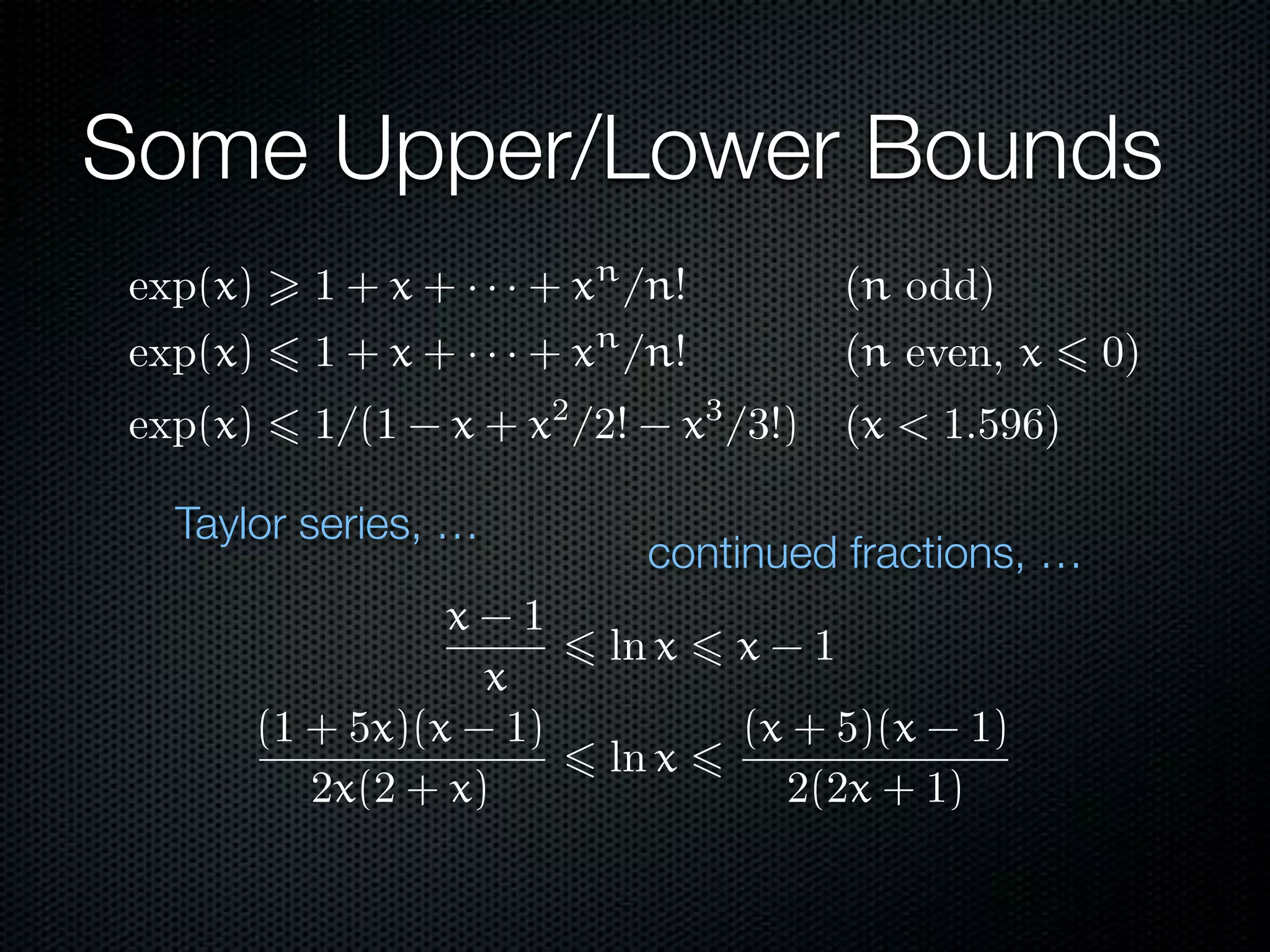
Some Upper/Lower Bounds 
Taylor series, … continued fractions, …
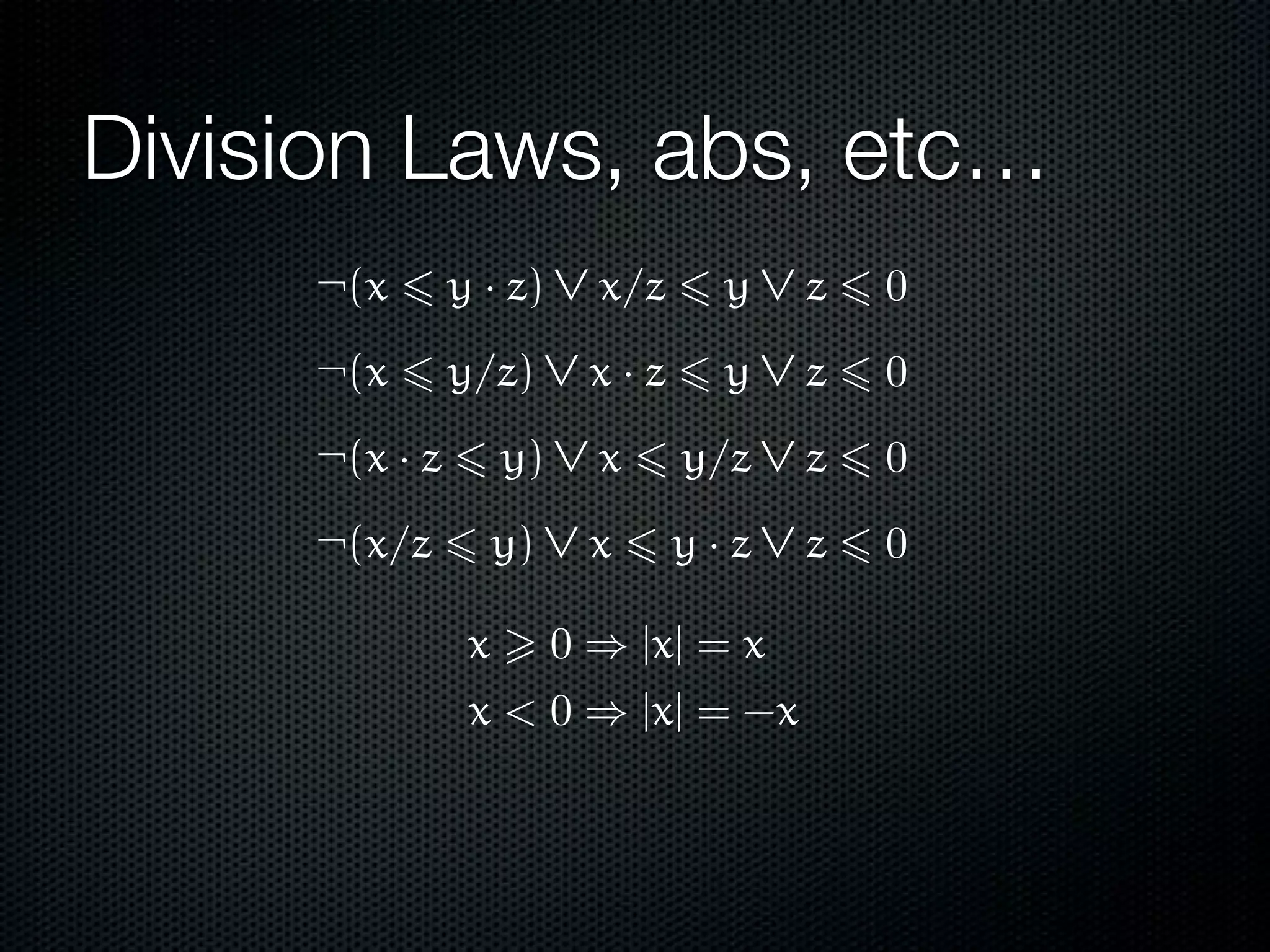
Division Laws, abs, etc… 
x > 0 ) |x| = x 
x < 0 ) |x| = -x
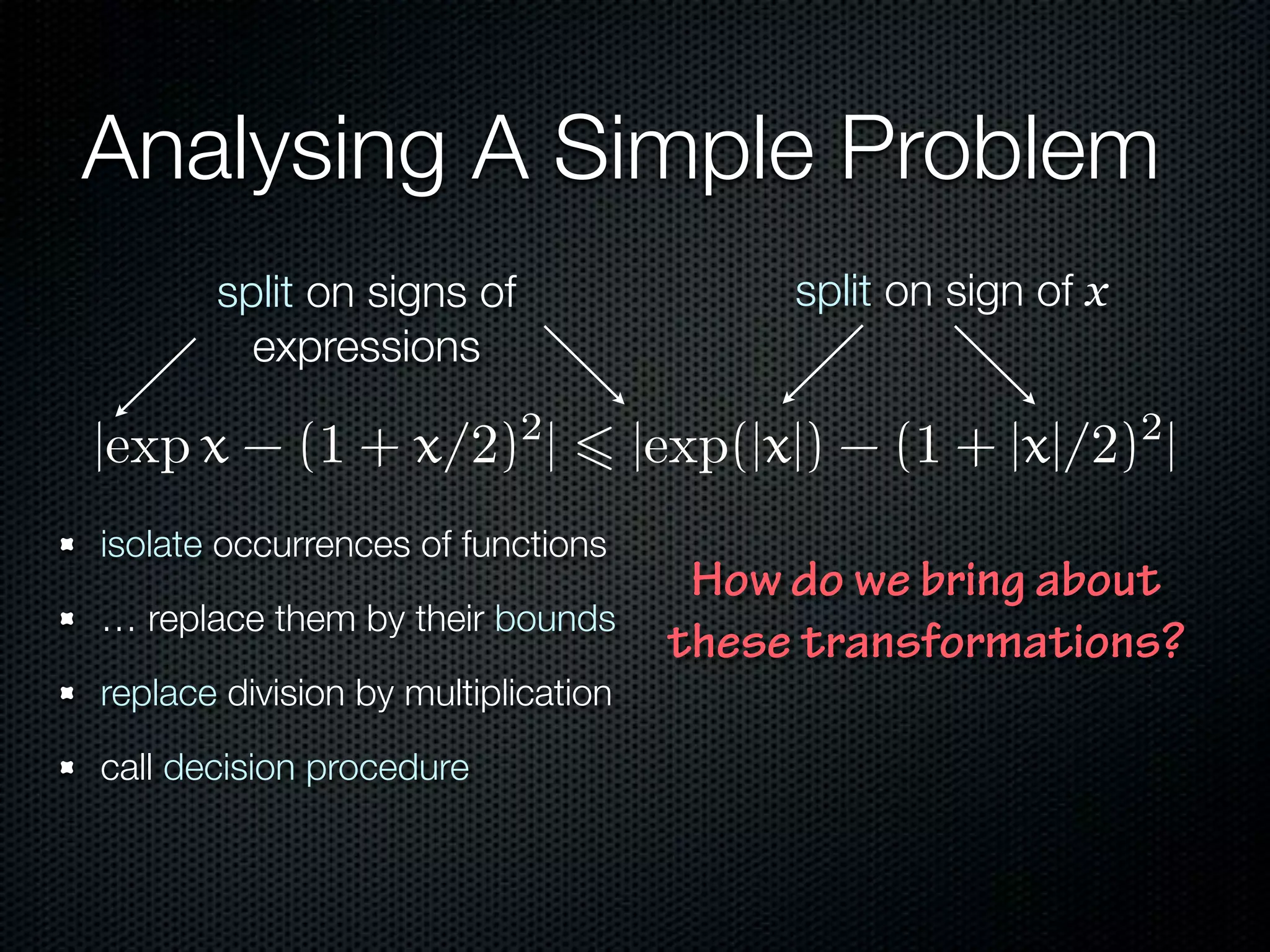
Analysing A Simple Problem 
split on signs of split on sign of x 
expressions 
How do we bring about 
these transformations? 
isolate occurrences of functions 
… replace them by their bounds 
replace division by multiplication 
call decision procedure
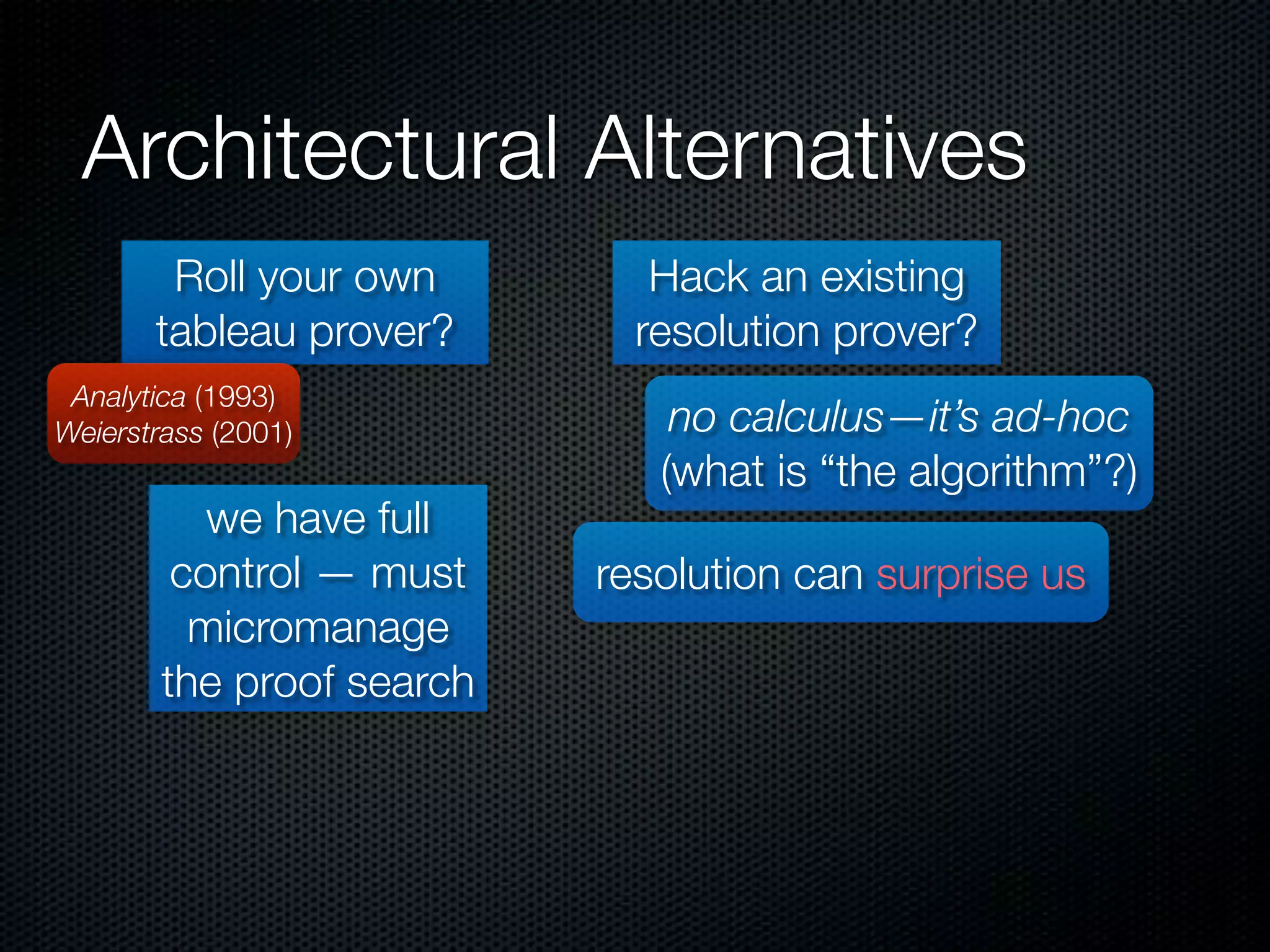
Architectural Alternatives 
Roll your own 
tableau prover? 
Analytica (1993) 
Weierstrass (2001) 
we have full 
control — must 
micromanage 
the proof search 
Hack an existing 
resolution prover? 
no calculus—it’s ad-hoc 
(what is “the algorithm”?) 
resolution can surprise us
3. Details of the Integration
Resolution Refresher Course 
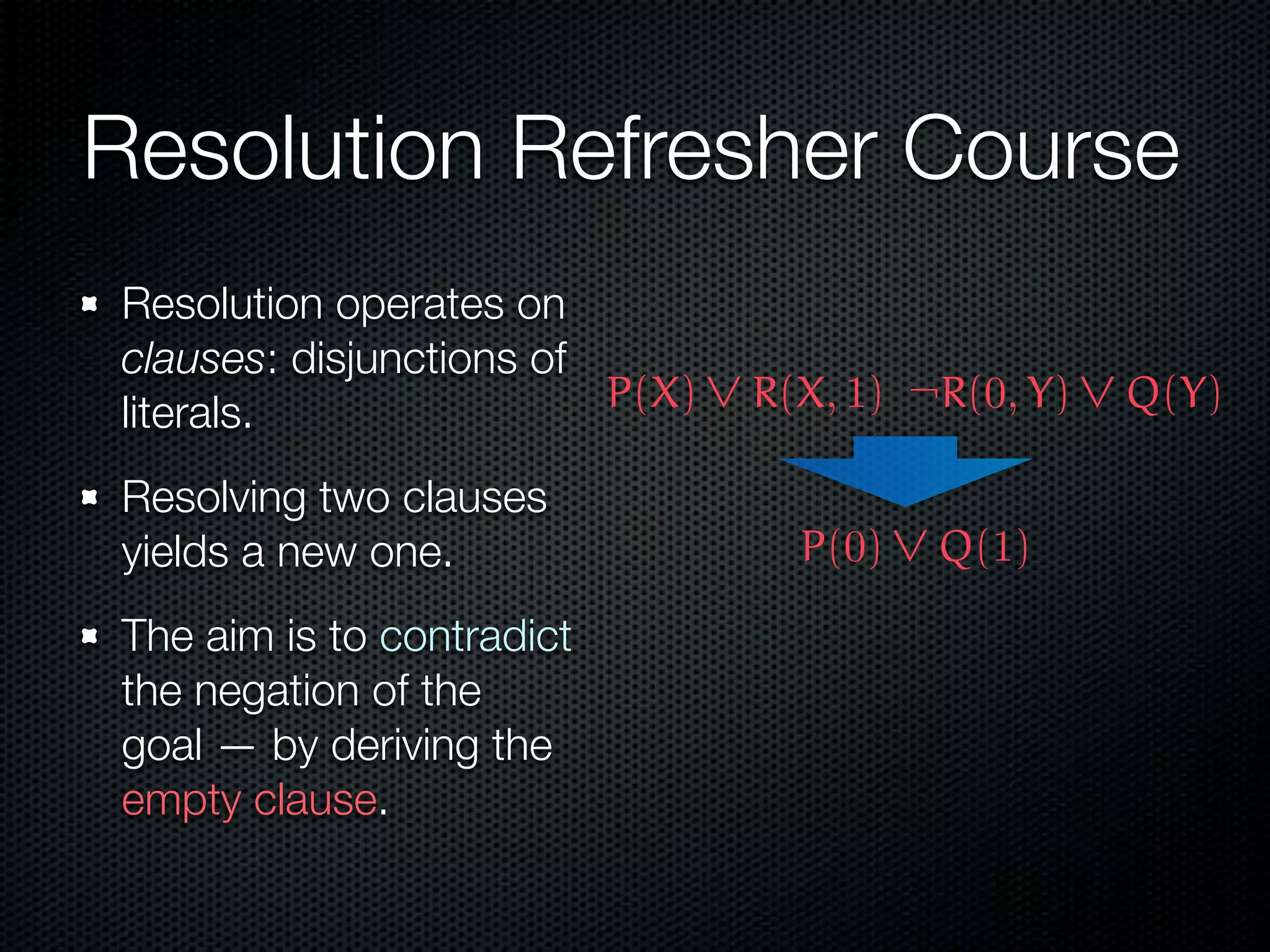
Resolution operates on 
clauses: disjunctions of 
literals. 
Resolving two clauses 
yields a new one. 
The aim is to contradict 
the negation of the 
goal — by deriving the 
empty clause.
Algebraic Literal Deletion 
Retain a list of the 
ground polynomial 
clauses (no variables). 
Delete any literal that is 
inconsistent with them… 
by calling an RCF 
decision procedure. 
Deleting literals helps to 
derive the empty clause. 
This process yields a 
fine-grained integration 
between resolution and a 
decision procedure.
Literal Deletion Examples 
Unsatisfiable literals such as p2 < 0 are deleted. 
If x(y+1) > 1 is known, then x=0 will be deleted. 
The context includes the negations of adjacent literals 
in the clause: z2 > 3 ∨ z > 5 
… the decision procedure reduces 
∃z [z2 ! 3 ∧ z > 5] to false.
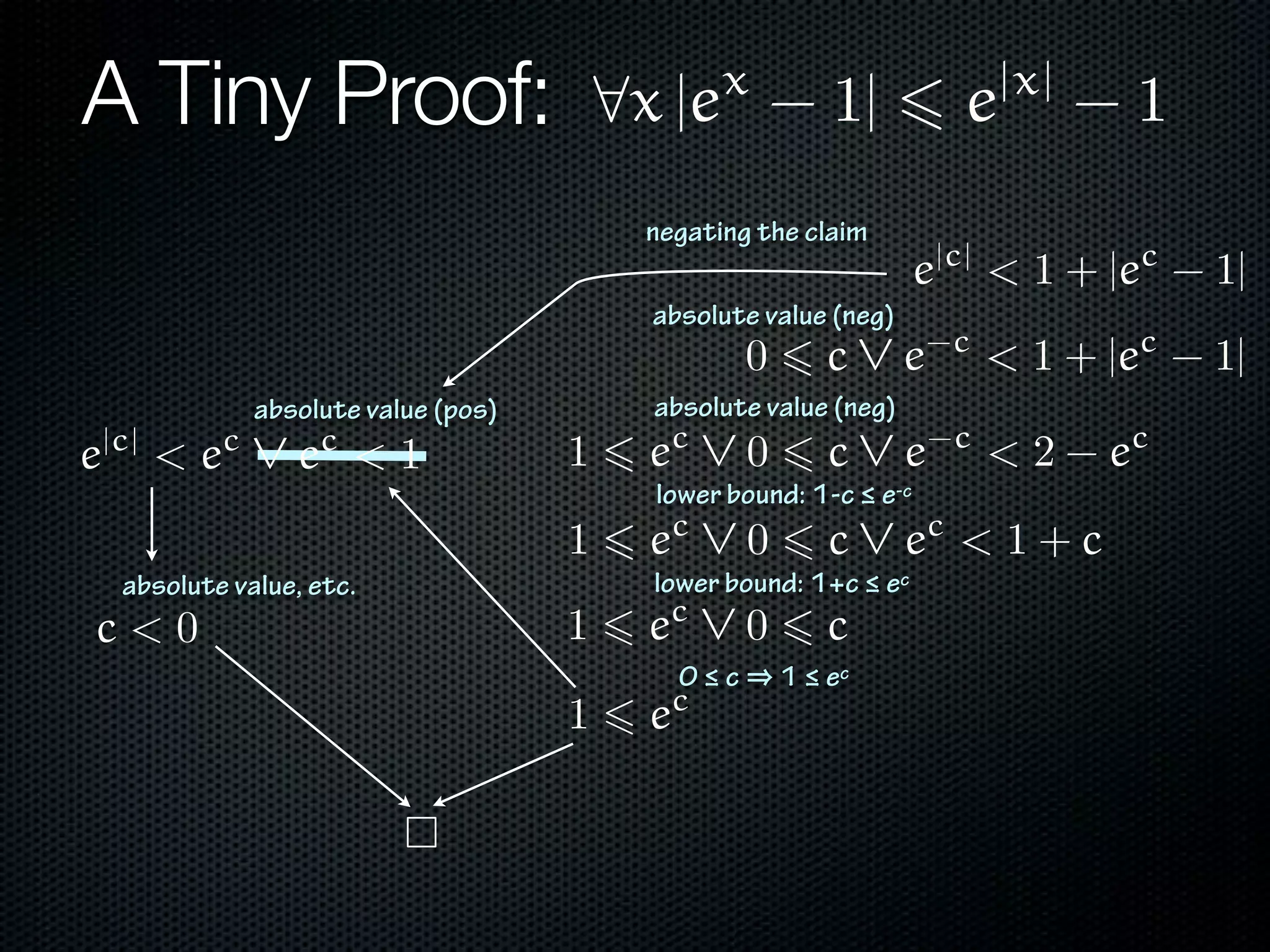
A Tiny Proof: 8x |ex - 1| 6 e|x| - 1 
absolute value (neg) 
0 6 c _ e-c < 1 + |ec - 1| 
absolute value (neg) 
1 6 ec _ 0 6 c _ e-c < 2 - ec 
lower bound: 1-c ! e-c 
1 6 ec _ 0 6 c _ ec < 1 + c 
lower bound: 1+c ! ec 
1 6 ec _ 0 6 c 
0 ! c ⇒ 1 ! ec 
1 6 ec 
absolute value (pos) 
e|c| < ec _ ec < 1 
⇤ 
negating the claim 
e|c| < 1 + |ec - 1| 
absolute value, etc. 
c < 0
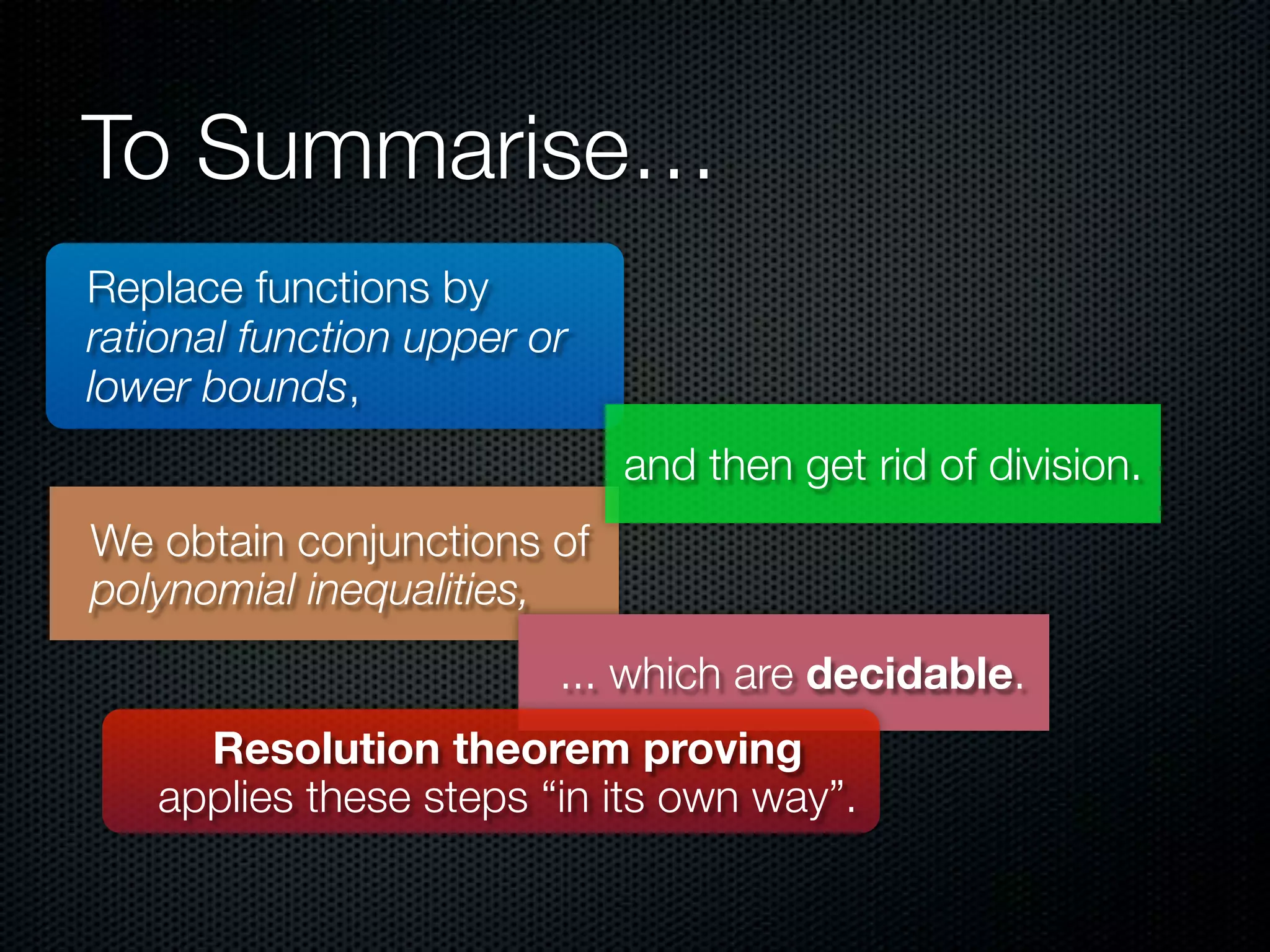
To Summarise… 
Replace functions by 
rational function upper or 
lower bounds, 
We obtain conjunctions of 
polynomial inequalities, 
and then get rid of division. 
... which are decidable. 
Resolution theorem proving 
applies these steps “in its own way”.
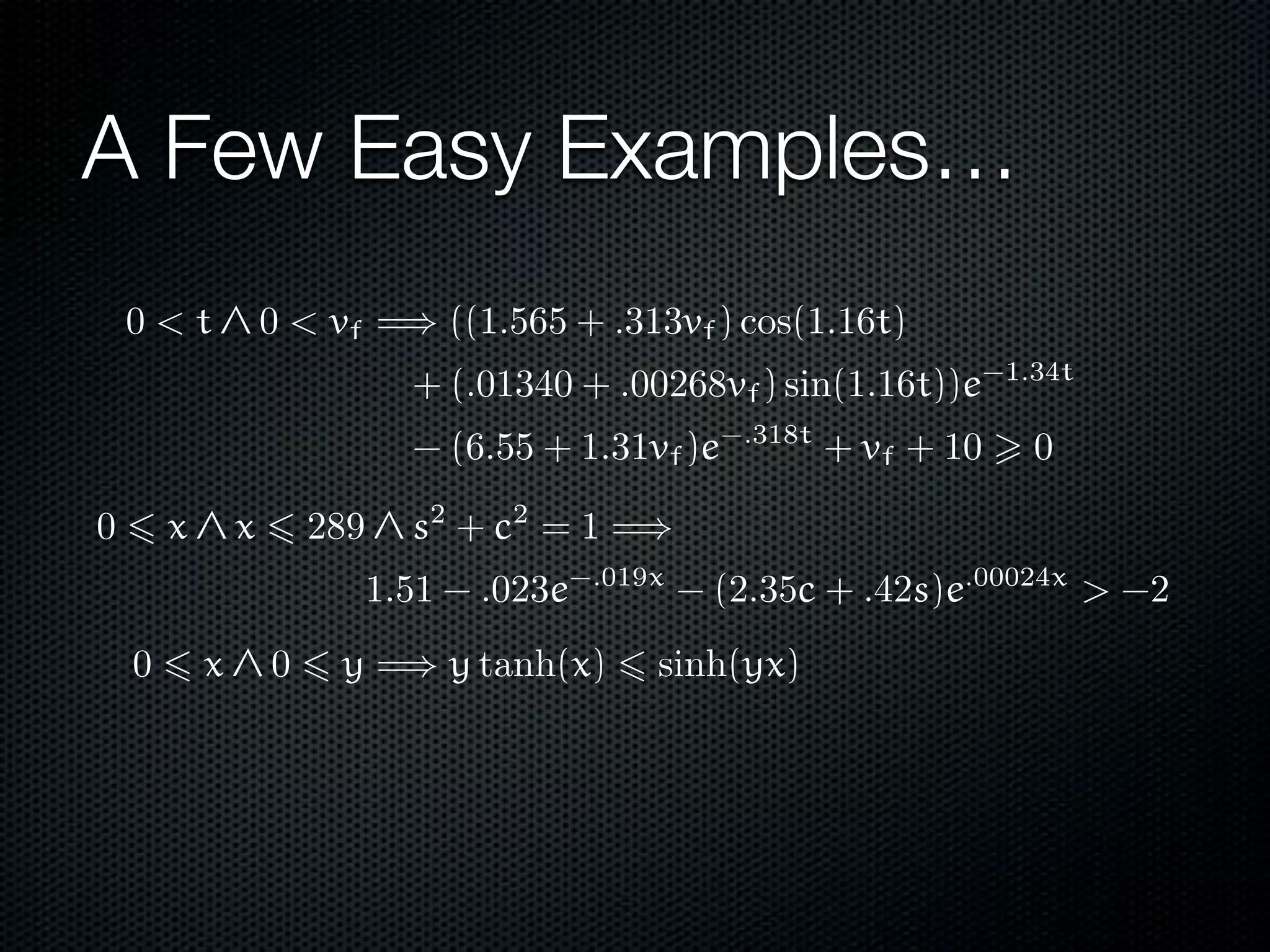
A Few Easy Examples…
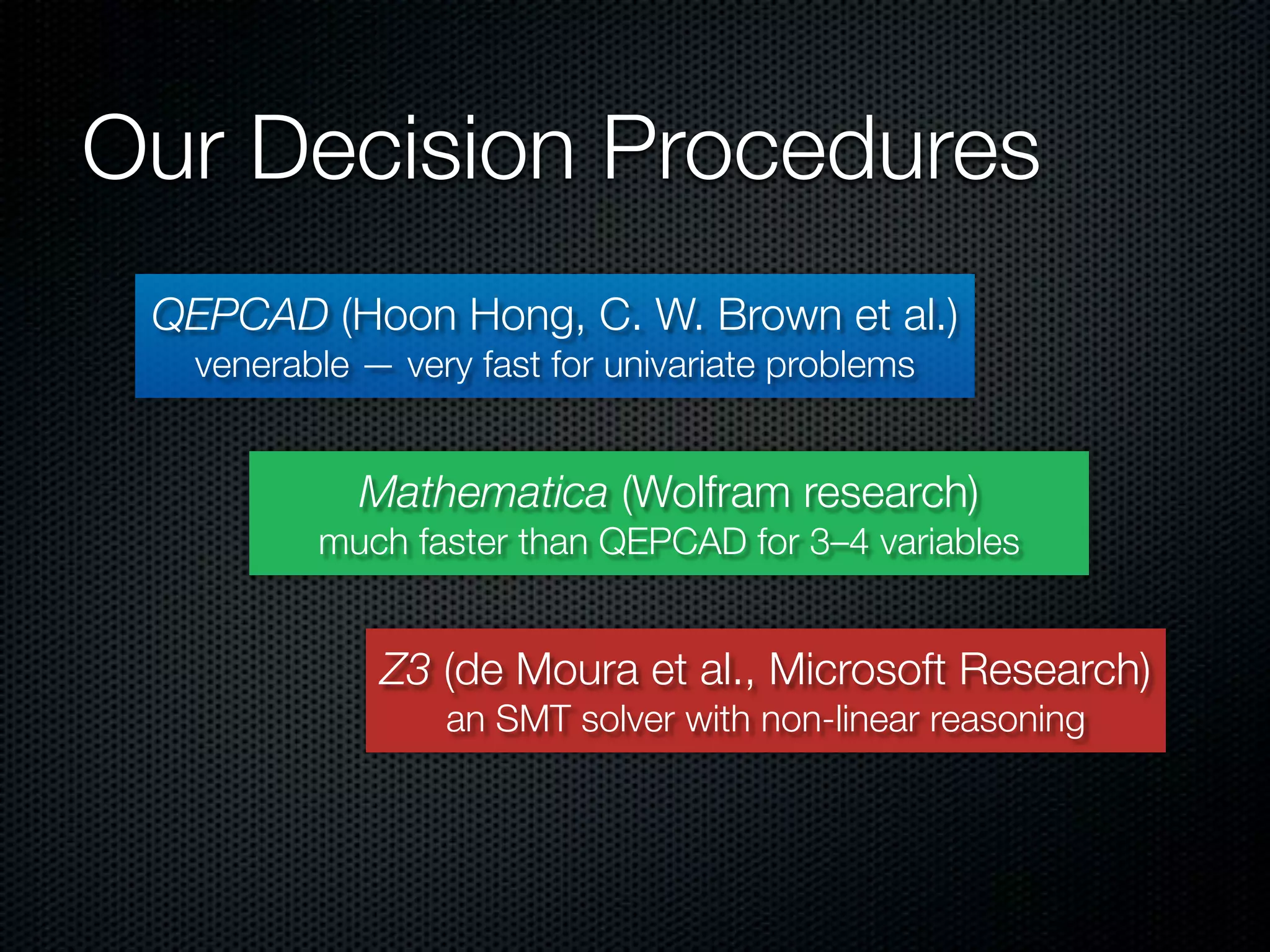
Our Decision Procedures 
QEPCAD (Hoon Hong, C. W. Brown et al.) 
venerable — very fast for univariate problems 
Mathematica (Wolfram research) 
much faster than QEPCAD for 3–4 variables 
Z3 (de Moura et al., Microsoft Research) 
an SMT solver with non-linear reasoning
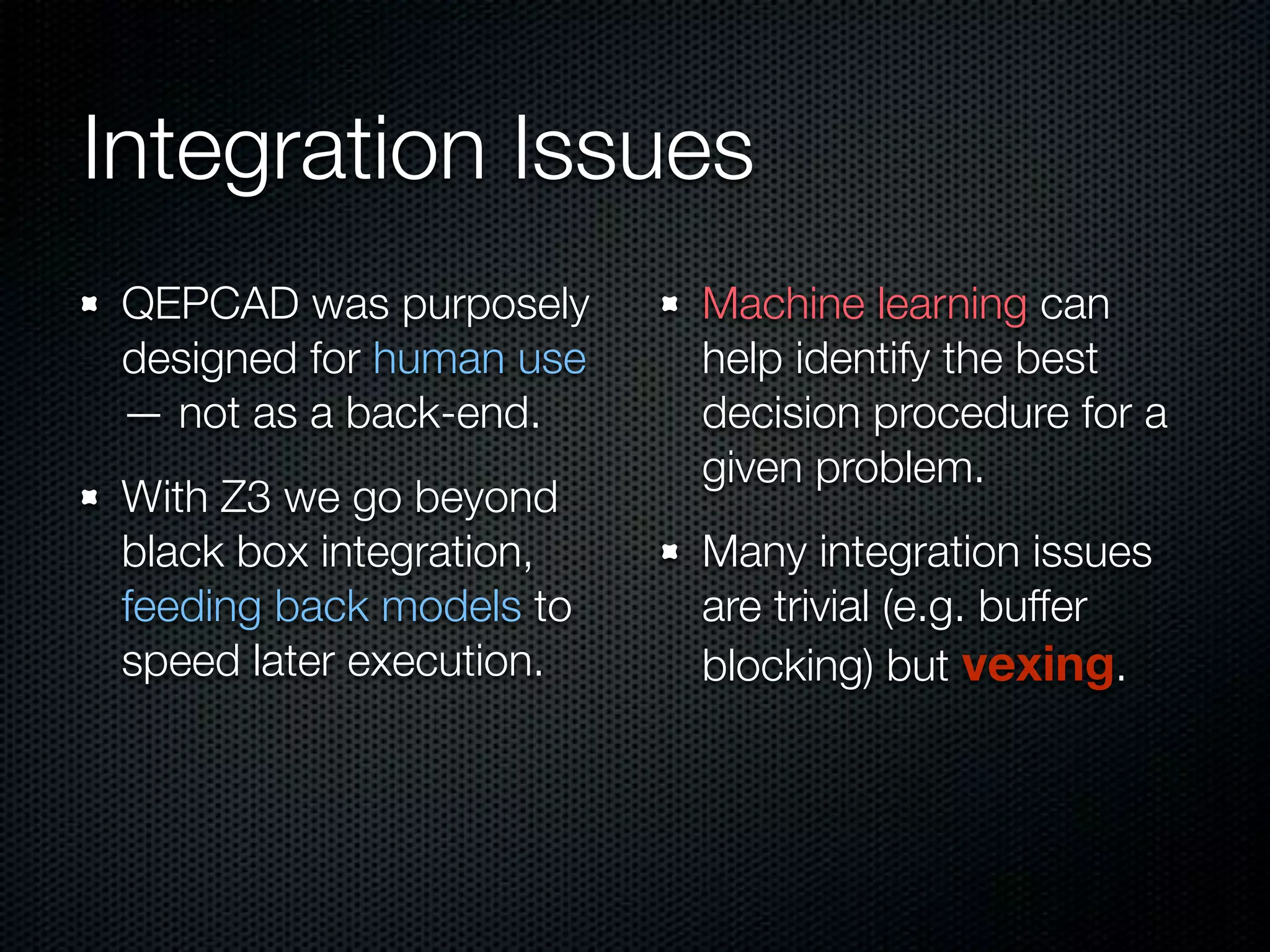
Integration Issues 
QEPCAD was purposely 
designed for human use 
— not as a back-end. 
With Z3 we go beyond 
black box integration, 
feeding back models to 
speed later execution. 
Machine learning can 
help identify the best 
decision procedure for a 
given problem. 
Many integration issues 
are trivial (e.g. buffer 
blocking) but vexing.
4. Applications
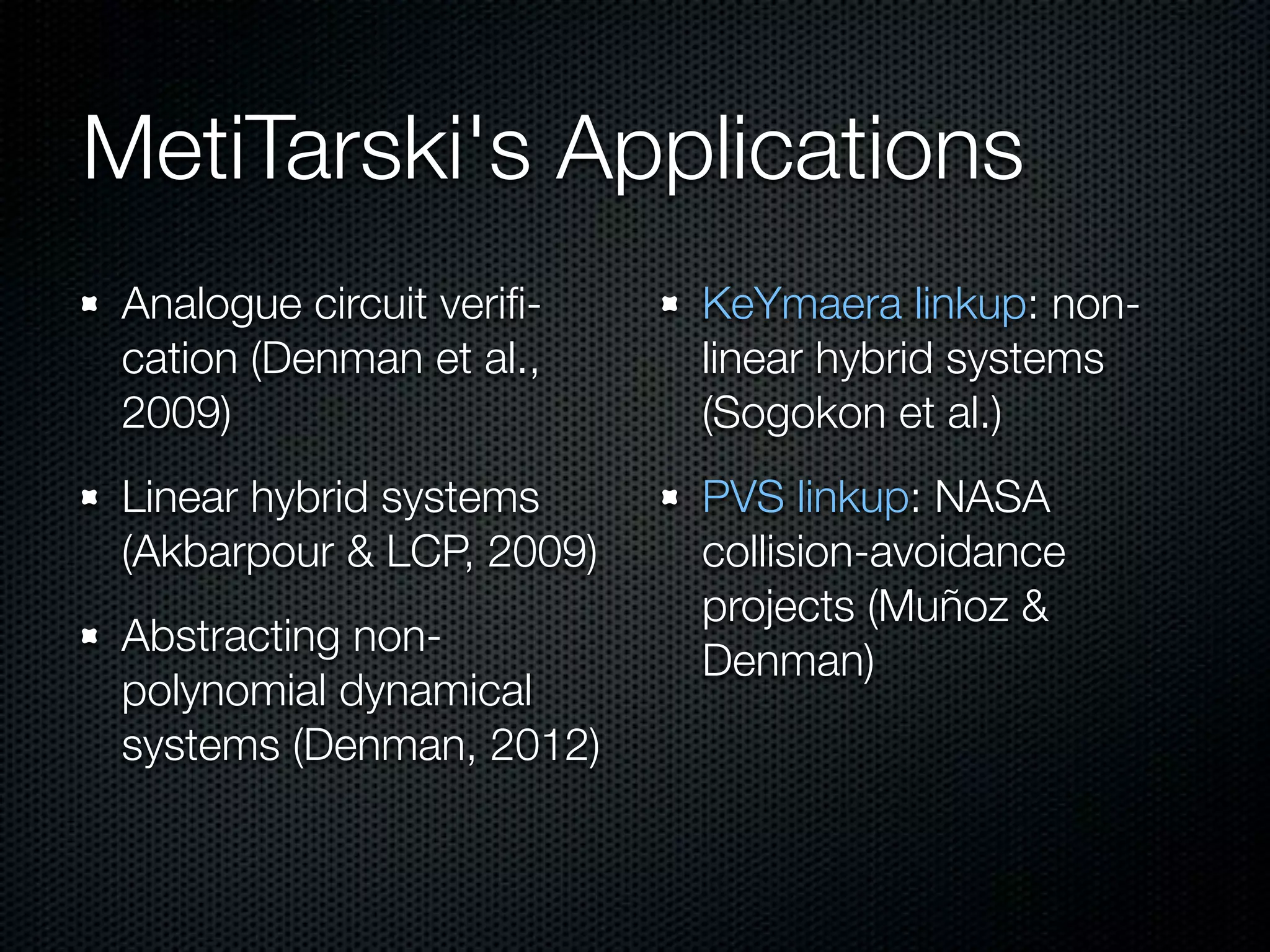
MetiTarski's Applications 
Analogue circuit verifi-cation 
(Denman et al., 
2009) 
Linear hybrid systems 
(Akbarpour & LCP, 2009) 
Abstracting non-polynomial 
dynamical 
systems (Denman, 2012) 
KeYmaera linkup: non-linear 
hybrid systems 
(Sogokon et al.) 
PVS linkup: NASA 
collision-avoidance 
projects (Muñoz & 
Denman)
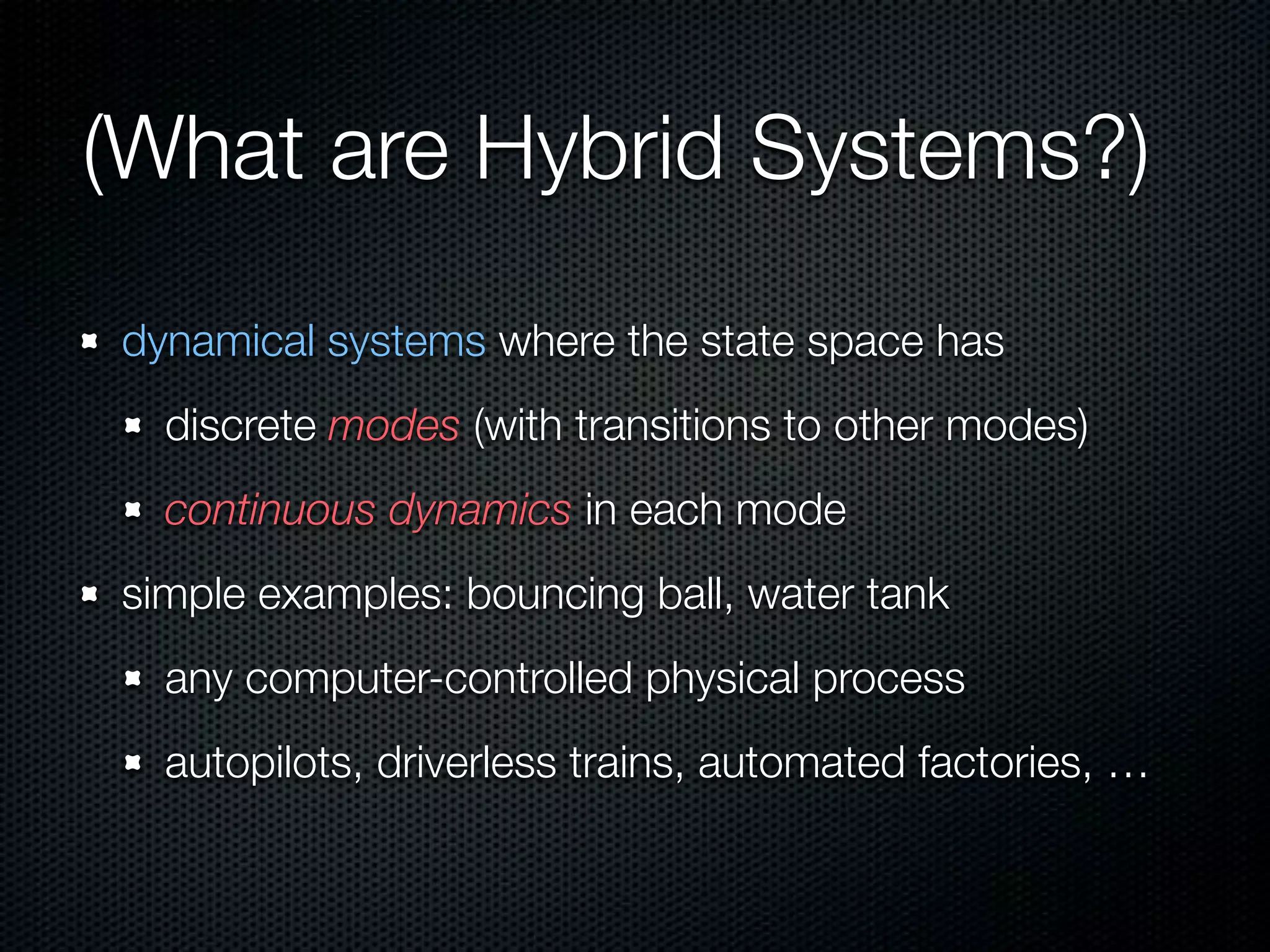
(What are Hybrid Systems?) 
dynamical systems where the state space has 
discrete modes (with transitions to other modes) 
continuous dynamics in each mode 
simple examples: bouncing ball, water tank 
any computer-controlled physical process 
autopilots, driverless trains, automated factories, …
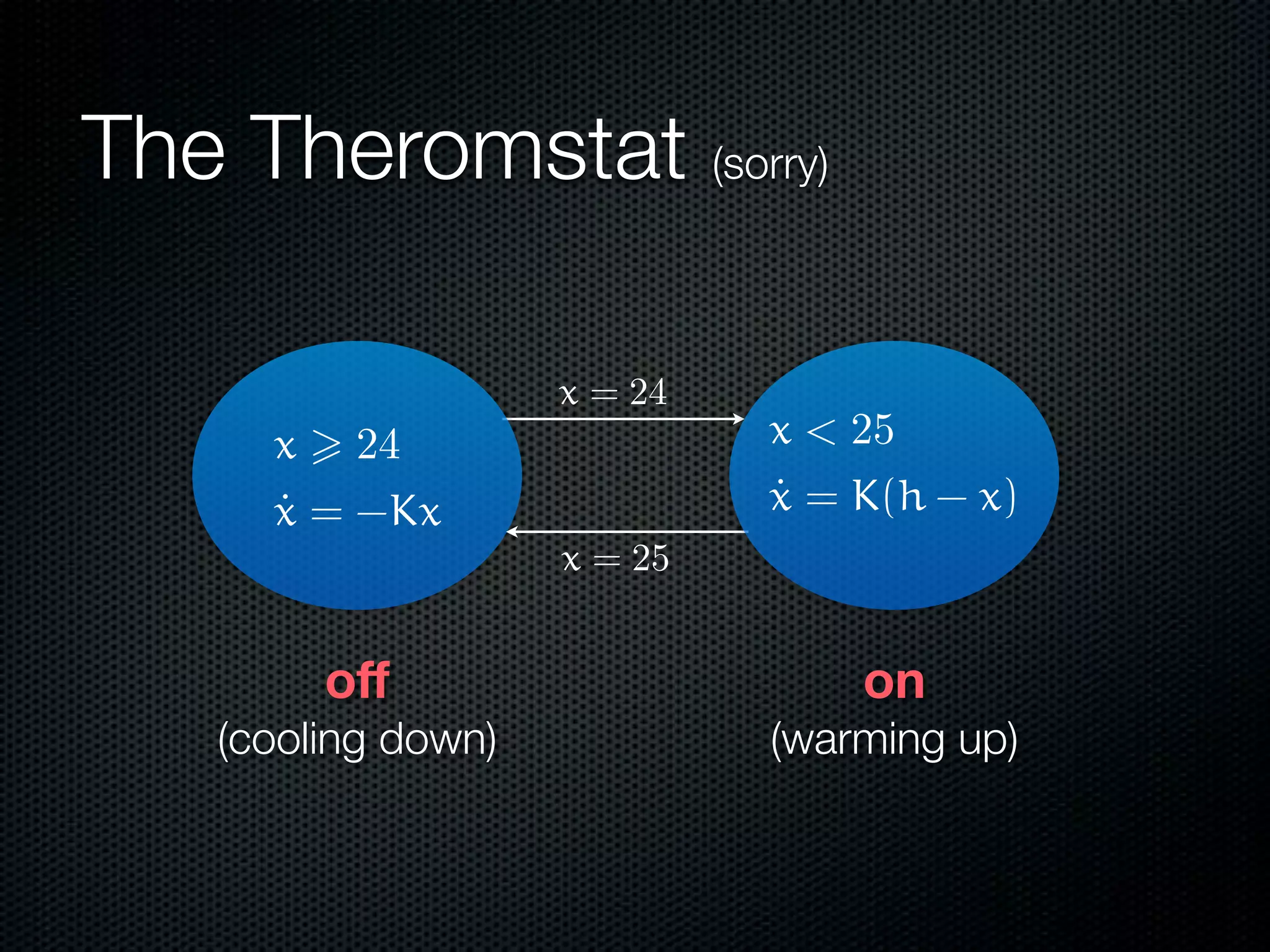
The Theromstat (sorry) 
x > 24 
˙x = -Kx 
x = 24 
x = 25 
off 
(cooling down) 
x < 25 
˙x = K(h - x) 
on 
(warming up)
KeYmaera 
a verification tool for hybrid systems (Platzer) 
extends the KeY interactive prover with a dynamic logic 
a free-variable tableau calculus 
“differential induction” 
integration with RCF decision procedures 
MetiTarski extends its language from polynomials to 
allow transcendental functions.
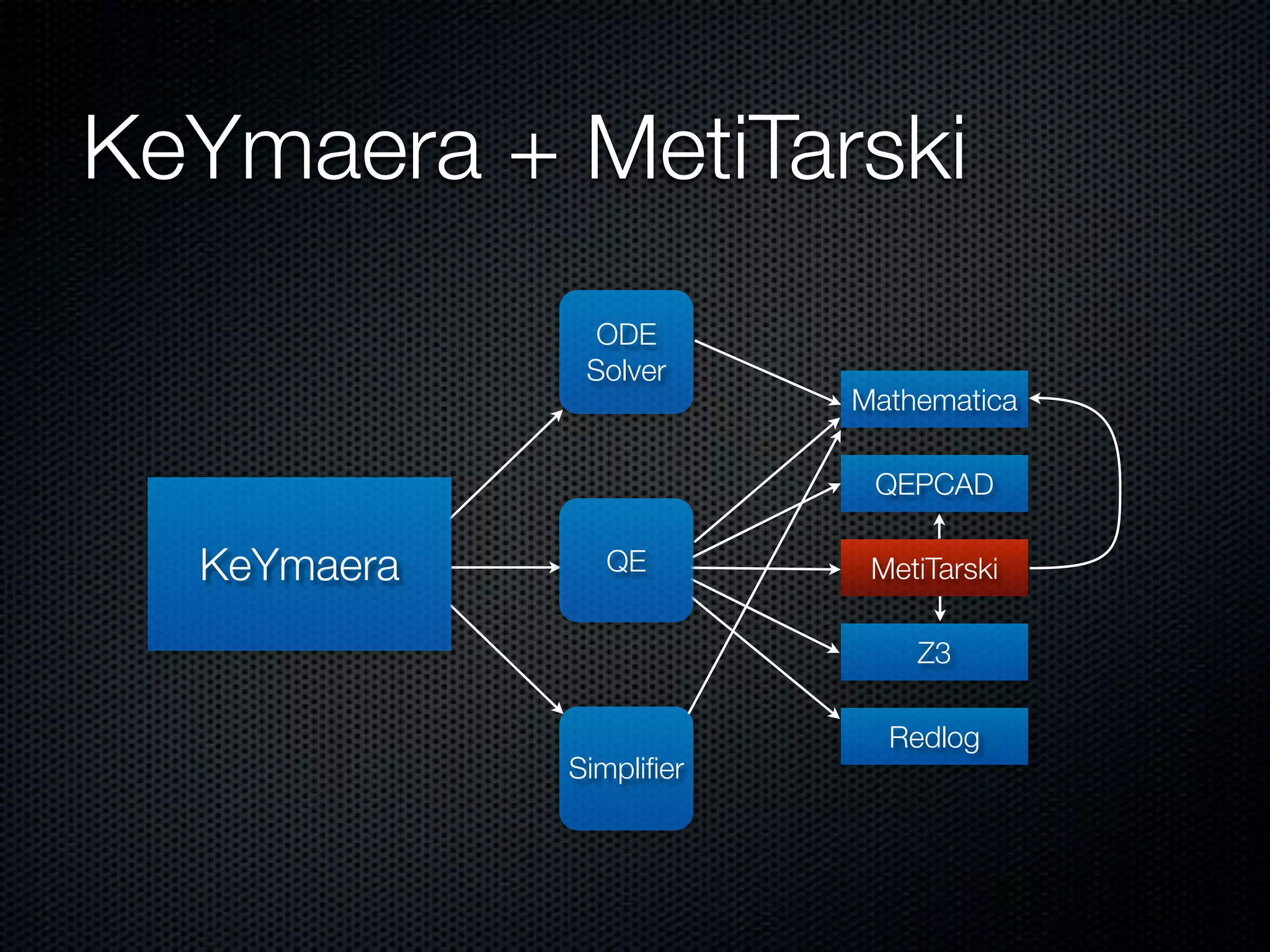
KeYmaera + MetiTarski 
ODE 
Solver 
Simplifier 
Mathematica 
QEPCAD 
MetiTarski 
Z3 
Redlog 
KeYmaera QE
Some KeYmaera Examples 
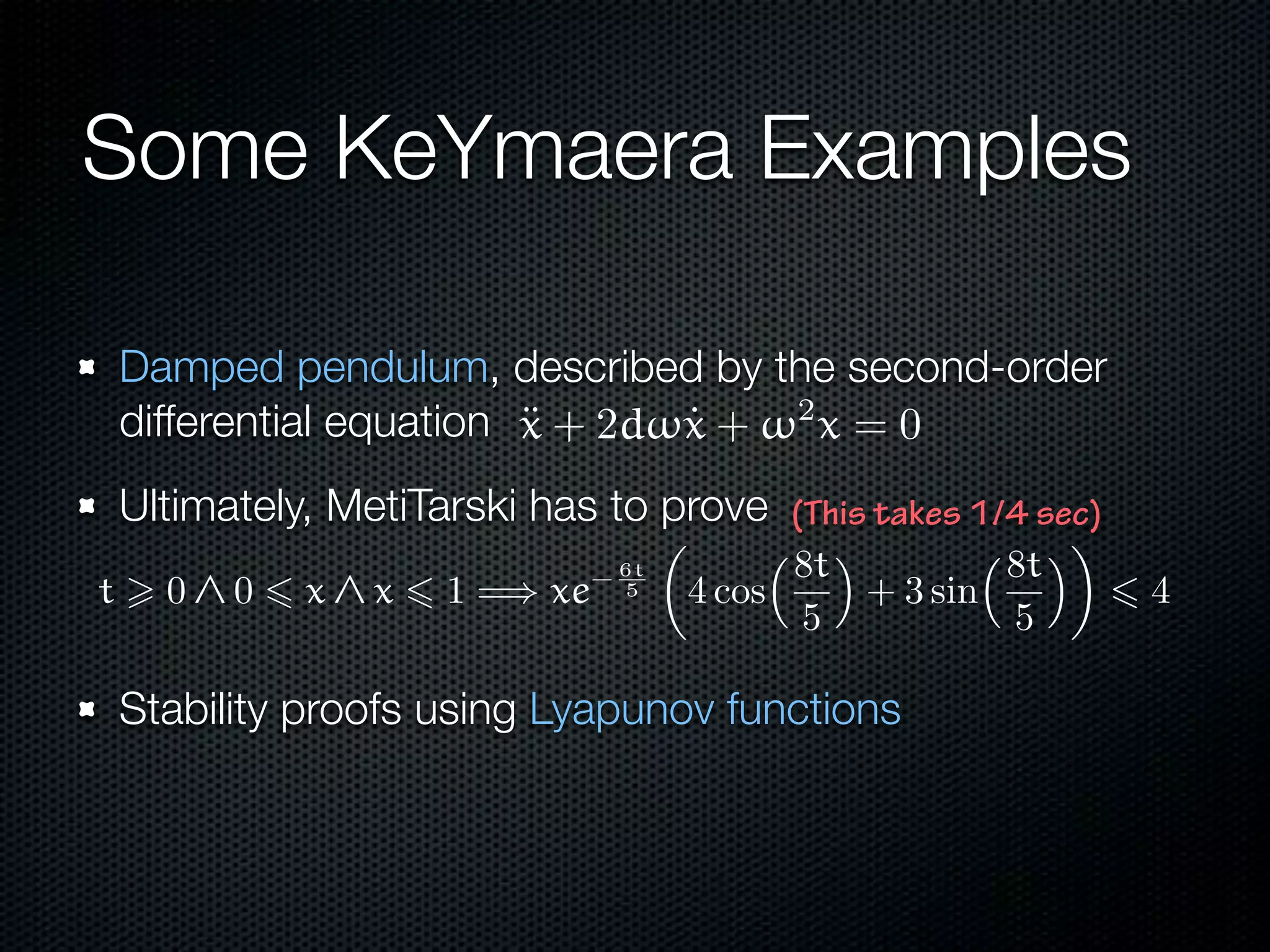
Damped pendulum, described by the second-order 
differential equation 
Ultimately, MetiTarski has to prove 
(This takes 1/4 sec) 
Stability proofs using Lyapunov functions
MetiTarski + PVS 
Trusted interface, complementing PVS support of 
interval methods for polynomial estimation 
It’s being tried within NASA’s ACCoRD project. 
MetiTarski has been effective in early experiments 
… but there’s much more to do.
Future Possibilities 
Refinements to the RCF decision process 
Integration with Isabelle? 
Formal proofs of all upper/lower bounds 
Can decision procedures return certificates? 
Machine learning within the decision procedures
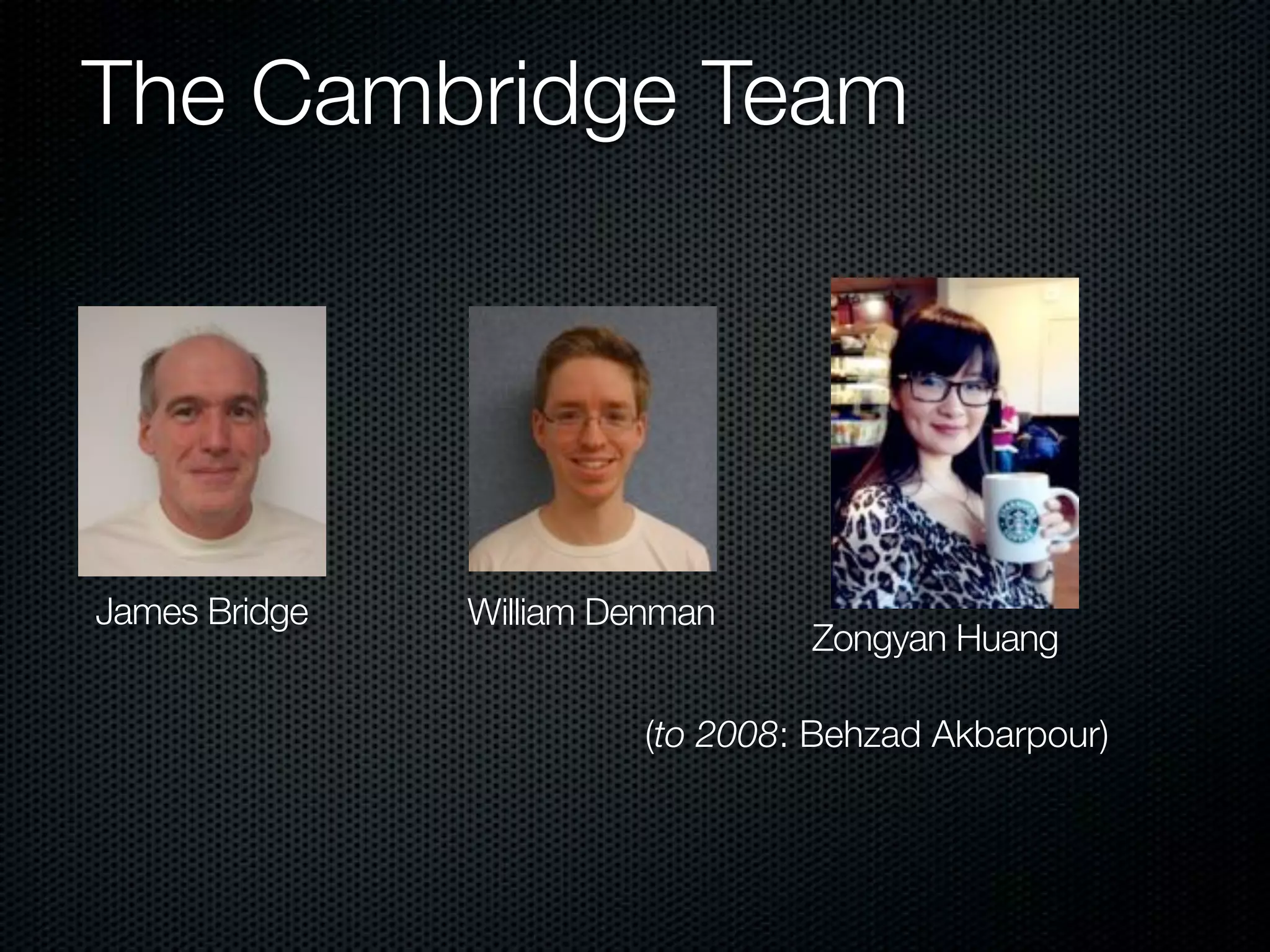
The Cambridge Team 
James Bridge William Denman Zongyan Huang 
(to 2008: Behzad Akbarpour)
Acknowledgements 
Edinburgh: Paul Jackson, G Passmore, A Sogokon; 
Manchester: Eva Navarro 
Assistance from C. W. Brown, A. Cuyt, J. H. Davenport, J. 
Harrison, J. Hurd, D. Lester, C. Muñoz, U. Waldmann, etc. 
The research was supported by the Engineering and 
Physical Sciences Research Council [grant numbers EP/ 
C013409/1,EP/I011005/1,EP/I010335/1].

MetiTarski's menagerie of cooperating systems

  • 1.
    MetiTarski's Menagerie ofCooperating Systems Lawrence C. Paulson Computer Laboratory University of Cambridge
  • 2.
  • 3.
    Combining Systems isHard! Example 1: “Integrating decision procedures into heuristic theorem provers: A case study of linear arithmetic” (Boyer and Moore, 1988) Example 2: “Reachability programming in HOL98 using BDDs” (MJC Gordon, 2000) Example 3: Isabelle’s Sledgehammer (2007) Example 4: Resolution + RCF = MetiTarski (2008)
  • 4.
    Adding Linear Arithmeticto the Boyer/Moore Prover Simply adding their (custom-made!) decision procedure to the Boyer/Moore prover had little effect. Deep integration with the rewriter was necessary: their decision procedure was no black box. Final version “like the software for the space shuttle”
  • 5.
    Adding BDDs toHOL98 What’s the point of BDDs here? Proof assistants don’t need to check huge tautologies. But… Mike Gordon added the BDD data structure to HOL. assertions relating formulas to their BDDs BDD-level operations directly available This package was general enough to implement model checking in HOL!
  • 6.
    Adding ATPs toIsabelle Similar integrations were attempted before, but how to make it usable for novices — and useful to experts? Sledgehammer provides automatic… problem translation (into FOL or whatever) lemma selection (out of the entire lemma library) process management (remote invocations, etc.) ATPs are invoked as black boxes—and are not trusted!
  • 7.
    Combining Clause Methods with Decision Procedures SMT: propositional over-approximation DPLL(Γ+!): a calculus for DPLL + superposition MetiTarski: a modified resolution prover using decision procedures to simplify clauses… and to delete redundant ones
  • 8.
  • 9.
    MetiTarski: the KeyIdeas proving statements about exp, ln, sin, cos, tan-1 — via axioms bounding the functions by rational functions heuristics to isolate and remove function occurrences decision procedures for real arithmetic (RCF) (Real polynomial arithmetic is decidable! — though doubly exponential…)
  • 10.
    Some Upper/Lower Bounds Taylor series, … continued fractions, …
  • 11.
    Division Laws, abs,etc… x > 0 ) |x| = x x < 0 ) |x| = -x
  • 12.
    Analysing A SimpleProblem split on signs of split on sign of x expressions How do we bring about these transformations? isolate occurrences of functions … replace them by their bounds replace division by multiplication call decision procedure
  • 13.
    Architectural Alternatives Rollyour own tableau prover? Analytica (1993) Weierstrass (2001) we have full control — must micromanage the proof search Hack an existing resolution prover? no calculus—it’s ad-hoc (what is “the algorithm”?) resolution can surprise us
  • 14.
    3. Details ofthe Integration
  • 15.
    Resolution Refresher Course Resolution operates on clauses: disjunctions of literals. Resolving two clauses yields a new one. The aim is to contradict the negation of the goal — by deriving the empty clause.
  • 16.
    Algebraic Literal Deletion Retain a list of the ground polynomial clauses (no variables). Delete any literal that is inconsistent with them… by calling an RCF decision procedure. Deleting literals helps to derive the empty clause. This process yields a fine-grained integration between resolution and a decision procedure.
  • 17.
    Literal Deletion Examples Unsatisfiable literals such as p2 < 0 are deleted. If x(y+1) > 1 is known, then x=0 will be deleted. The context includes the negations of adjacent literals in the clause: z2 > 3 ∨ z > 5 … the decision procedure reduces ∃z [z2 ! 3 ∧ z > 5] to false.
  • 18.
    A Tiny Proof:8x |ex - 1| 6 e|x| - 1 absolute value (neg) 0 6 c _ e-c < 1 + |ec - 1| absolute value (neg) 1 6 ec _ 0 6 c _ e-c < 2 - ec lower bound: 1-c ! e-c 1 6 ec _ 0 6 c _ ec < 1 + c lower bound: 1+c ! ec 1 6 ec _ 0 6 c 0 ! c ⇒ 1 ! ec 1 6 ec absolute value (pos) e|c| < ec _ ec < 1 ⇤ negating the claim e|c| < 1 + |ec - 1| absolute value, etc. c < 0
  • 19.
    To Summarise… Replacefunctions by rational function upper or lower bounds, We obtain conjunctions of polynomial inequalities, and then get rid of division. ... which are decidable. Resolution theorem proving applies these steps “in its own way”.
  • 20.
    A Few EasyExamples…
  • 21.
    Our Decision Procedures QEPCAD (Hoon Hong, C. W. Brown et al.) venerable — very fast for univariate problems Mathematica (Wolfram research) much faster than QEPCAD for 3–4 variables Z3 (de Moura et al., Microsoft Research) an SMT solver with non-linear reasoning
  • 22.
    Integration Issues QEPCADwas purposely designed for human use — not as a back-end. With Z3 we go beyond black box integration, feeding back models to speed later execution. Machine learning can help identify the best decision procedure for a given problem. Many integration issues are trivial (e.g. buffer blocking) but vexing.
  • 23.
  • 24.
    MetiTarski's Applications Analoguecircuit verifi-cation (Denman et al., 2009) Linear hybrid systems (Akbarpour & LCP, 2009) Abstracting non-polynomial dynamical systems (Denman, 2012) KeYmaera linkup: non-linear hybrid systems (Sogokon et al.) PVS linkup: NASA collision-avoidance projects (Muñoz & Denman)
  • 25.
    (What are HybridSystems?) dynamical systems where the state space has discrete modes (with transitions to other modes) continuous dynamics in each mode simple examples: bouncing ball, water tank any computer-controlled physical process autopilots, driverless trains, automated factories, …
  • 26.
    The Theromstat (sorry) x > 24 ˙x = -Kx x = 24 x = 25 off (cooling down) x < 25 ˙x = K(h - x) on (warming up)
  • 27.
    KeYmaera a verificationtool for hybrid systems (Platzer) extends the KeY interactive prover with a dynamic logic a free-variable tableau calculus “differential induction” integration with RCF decision procedures MetiTarski extends its language from polynomials to allow transcendental functions.
  • 28.
    KeYmaera + MetiTarski ODE Solver Simplifier Mathematica QEPCAD MetiTarski Z3 Redlog KeYmaera QE
  • 29.
    Some KeYmaera Examples Damped pendulum, described by the second-order differential equation Ultimately, MetiTarski has to prove (This takes 1/4 sec) Stability proofs using Lyapunov functions
  • 30.
    MetiTarski + PVS Trusted interface, complementing PVS support of interval methods for polynomial estimation It’s being tried within NASA’s ACCoRD project. MetiTarski has been effective in early experiments … but there’s much more to do.
  • 31.
    Future Possibilities Refinementsto the RCF decision process Integration with Isabelle? Formal proofs of all upper/lower bounds Can decision procedures return certificates? Machine learning within the decision procedures
  • 32.
    The Cambridge Team James Bridge William Denman Zongyan Huang (to 2008: Behzad Akbarpour)
  • 33.
    Acknowledgements Edinburgh: PaulJackson, G Passmore, A Sogokon; Manchester: Eva Navarro Assistance from C. W. Brown, A. Cuyt, J. H. Davenport, J. Harrison, J. Hurd, D. Lester, C. Muñoz, U. Waldmann, etc. The research was supported by the Engineering and Physical Sciences Research Council [grant numbers EP/ C013409/1,EP/I011005/1,EP/I010335/1].