Gra¸bczewski & Paulson Mechanizing Set Theory 1
Mechanizing Set Theory:
Cardinal Arithmetic and the Axiom of Choice
Krzysztof Gra¸bczewski, Copernicus University, Torun, Poland
Lawrence C Paulson, Computer Laboratory, Cambridge University, UK
Funding: EPSRC grant GR/H40570; TEMPUS Project JEP 3340; ESPRIT Project 6453
Gra¸bczewski & Paulson Mechanizing Set Theory 2
The Generic Proof Assistant Isabelle
many logics higher-order syntax unification
• Expressions are typed λ-terms
• Schematic rules are generalized Horn clauses (like λProlog’s)
• Resolution applies rules for proof checking
• Tactic language allows user-defined automation
• Generic packages include simplifier, tableau prover, ...
Gra¸bczewski & Paulson Mechanizing Set Theory 3
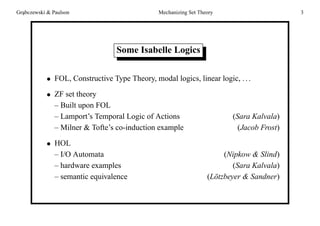
Some Isabelle Logics
• FOL, Constructive Type Theory, modal logics, linear logic, ...
• ZF set theory
– Built upon FOL
– Lamport’s Temporal Logic of Actions (Sara Kalvala)
– Milner & Tofte’s co-induction example (Jacob Frost)
• HOL
– I/O Automata (Nipkow & Slind)
– hardware examples (Sara Kalvala)
– semantic equivalence (L¨otzbeyer & Sandner)
Gra¸bczewski & Paulson Mechanizing Set Theory 4
The Cardinal Proofs
• Aim: justify recursive definitions like D = 1 + D + (ω → D)
• Basis: theories of relations, functions, recursion, ordinals, ...
• Method: mechanize most of Kunen, Set Theory, Chapter I.
– orders
– order-isomorphisms
– order types
– ordinal arithmetic
– cardinality
– infinite cardinals
– AC
Gra¸bczewski & Paulson Mechanizing Set Theory 5
Kunen’s Proof of κ ⊗ κ = κ
“By transfinite induction on κ. Then for α < κ, |α × α| = |α| ⊗ |α| < κ.
Define a wellordering on κ × κ by α, β γ, δ iff
max(α, β) < max(γ, δ) ∨ [max(α, β) = max(γ, δ) ∧
α, β precedes γ, δ lexicographically].
Each α, β ∈ κ × κ has no more than
|(max(α, β)) + 1 × (max(α, β)) + 1| < κ
predecessors in , so type(κ × κ, ) ≤ κ, whence |κ × κ| ≤ κ. Since clearly
|κ × κ| ≥ κ, |κ × κ| = κ.”
Gra¸bczewski & Paulson Mechanizing Set Theory 6
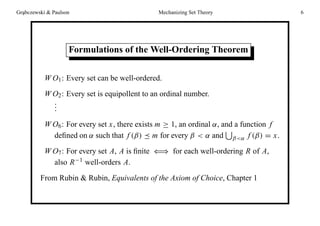
Formulations of the Well-Ordering Theorem
W O1: Every set can be well-ordered.
W O2: Every set is equipollent to an ordinal number.
...
W O6: For every set x, there exists m ≥ 1, an ordinal α, and a function f
defined on α such that f (β) m for every β < α and β<α f (β) = x.
W O7: For every set A, A is finite ⇐⇒ for each well-ordering R of A,
also R−1 well-orders A.
From Rubin & Rubin, Equivalents of the Axiom of Choice, Chapter 1
Gra¸bczewski & Paulson Mechanizing Set Theory 7
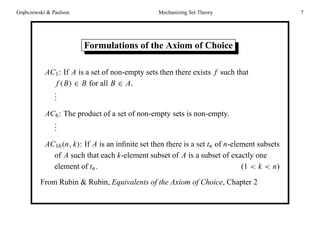
Formulations of the Axiom of Choice
AC1: If A is a set of non-empty sets then there exists f such that
f (B) ∈ B for all B ∈ A.
...
AC6: The product of a set of non-empty sets is non-empty.
...
AC16(n, k): If A is an infinite set then there is a set tn of n-element subsets
of A such that each k-element subset of A is a subset of exactly one
element of tn. (1 < k < n)
From Rubin & Rubin, Equivalents of the Axiom of Choice, Chapter 2
Gra¸bczewski & Paulson Mechanizing Set Theory 8
Proof of W O6 ⇒ W O1
Lemma. If W O6 and y × y ⊆ y then y can be well-ordered.
Proof: by induction using Lemma (ii) below.
Theorem. If W O6 then every set x can be well-ordered.
Proof: Define y such that x ⊆ y and y × y ⊆ y.
y =
n∈ω
zn, where



z0 = x
zn+1 = zn ∪ (zn × zn)
Hence x is a subset of a well-ordered set.
Gra¸bczewski & Paulson Mechanizing Set Theory 9
Lemma for W O6 ⇒ W O1
Let Ny = m : ∃ f,α dom( f ) = α, β<α f (β) = y, ∀β<α f (β) m
Lemma (ii): If m ∈ Ny and m > 1 then m − 1 ∈ Ny.
Proof: Assume y × y ⊆ y and m ∈ N(y). Then f and α exist. Put
uβγ δ
def
= [ f (β) × f (γ )] ∩ f (δ) (β, γ, δ < α)
Clearly uβγ δ m, dom(uβγ δ) m, rng(uβγ δ) m.
Case 1: ∀β<α. f (β) = 0 → ∃γ,δ<α. dom(uβγ δ) = 0 ∧ dom(uβγ δ) m
Case 2: ∃β<α. f (β) = 0 ∧ ∀γ,δ<α. dom(uβγ δ) = 0 → dom(uβγ δ) ≈ m
Complex reasoning reduces m (and doubles α) in both cases.
Gra¸bczewski & Paulson Mechanizing Set Theory 10
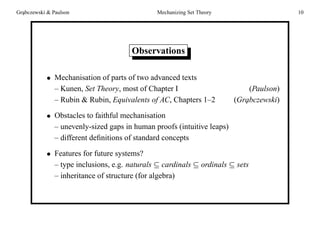
Observations
• Mechanisation of parts of two advanced texts
– Kunen, Set Theory, most of Chapter I (Paulson)
– Rubin & Rubin, Equivalents of AC, Chapters 1–2 (Gra¸bczewski)
• Obstacles to faithful mechanisation
– unevenly-sized gaps in human proofs (intuitive leaps)
– different definitions of standard concepts
• Features for future systems?
– type inclusions, e.g. naturals ⊆ cardinals ⊆ ordinals ⊆ sets
– inheritance of structure (for algebra)

Mechanizing set theory: cardinal arithmetic and the axiom of choice

  • 1.
    Gra¸bczewski & PaulsonMechanizing Set Theory 1 Mechanizing Set Theory: Cardinal Arithmetic and the Axiom of Choice Krzysztof Gra¸bczewski, Copernicus University, Torun, Poland Lawrence C Paulson, Computer Laboratory, Cambridge University, UK Funding: EPSRC grant GR/H40570; TEMPUS Project JEP 3340; ESPRIT Project 6453
  • 2.
    Gra¸bczewski & PaulsonMechanizing Set Theory 2 The Generic Proof Assistant Isabelle many logics higher-order syntax unification • Expressions are typed λ-terms • Schematic rules are generalized Horn clauses (like λProlog’s) • Resolution applies rules for proof checking • Tactic language allows user-defined automation • Generic packages include simplifier, tableau prover, ...
  • 3.
    Gra¸bczewski & PaulsonMechanizing Set Theory 3 Some Isabelle Logics • FOL, Constructive Type Theory, modal logics, linear logic, ... • ZF set theory – Built upon FOL – Lamport’s Temporal Logic of Actions (Sara Kalvala) – Milner & Tofte’s co-induction example (Jacob Frost) • HOL – I/O Automata (Nipkow & Slind) – hardware examples (Sara Kalvala) – semantic equivalence (L¨otzbeyer & Sandner)
  • 4.
    Gra¸bczewski & PaulsonMechanizing Set Theory 4 The Cardinal Proofs • Aim: justify recursive definitions like D = 1 + D + (ω → D) • Basis: theories of relations, functions, recursion, ordinals, ... • Method: mechanize most of Kunen, Set Theory, Chapter I. – orders – order-isomorphisms – order types – ordinal arithmetic – cardinality – infinite cardinals – AC
  • 5.
    Gra¸bczewski & PaulsonMechanizing Set Theory 5 Kunen’s Proof of κ ⊗ κ = κ “By transfinite induction on κ. Then for α < κ, |α × α| = |α| ⊗ |α| < κ. Define a wellordering on κ × κ by α, β γ, δ iff max(α, β) < max(γ, δ) ∨ [max(α, β) = max(γ, δ) ∧ α, β precedes γ, δ lexicographically]. Each α, β ∈ κ × κ has no more than |(max(α, β)) + 1 × (max(α, β)) + 1| < κ predecessors in , so type(κ × κ, ) ≤ κ, whence |κ × κ| ≤ κ. Since clearly |κ × κ| ≥ κ, |κ × κ| = κ.”
  • 6.
    Gra¸bczewski & PaulsonMechanizing Set Theory 6 Formulations of the Well-Ordering Theorem W O1: Every set can be well-ordered. W O2: Every set is equipollent to an ordinal number. ... W O6: For every set x, there exists m ≥ 1, an ordinal α, and a function f defined on α such that f (β) m for every β < α and β<α f (β) = x. W O7: For every set A, A is finite ⇐⇒ for each well-ordering R of A, also R−1 well-orders A. From Rubin & Rubin, Equivalents of the Axiom of Choice, Chapter 1
  • 7.
    Gra¸bczewski & PaulsonMechanizing Set Theory 7 Formulations of the Axiom of Choice AC1: If A is a set of non-empty sets then there exists f such that f (B) ∈ B for all B ∈ A. ... AC6: The product of a set of non-empty sets is non-empty. ... AC16(n, k): If A is an infinite set then there is a set tn of n-element subsets of A such that each k-element subset of A is a subset of exactly one element of tn. (1 < k < n) From Rubin & Rubin, Equivalents of the Axiom of Choice, Chapter 2
  • 8.
    Gra¸bczewski & PaulsonMechanizing Set Theory 8 Proof of W O6 ⇒ W O1 Lemma. If W O6 and y × y ⊆ y then y can be well-ordered. Proof: by induction using Lemma (ii) below. Theorem. If W O6 then every set x can be well-ordered. Proof: Define y such that x ⊆ y and y × y ⊆ y. y = n∈ω zn, where    z0 = x zn+1 = zn ∪ (zn × zn) Hence x is a subset of a well-ordered set.
  • 9.
    Gra¸bczewski & PaulsonMechanizing Set Theory 9 Lemma for W O6 ⇒ W O1 Let Ny = m : ∃ f,α dom( f ) = α, β<α f (β) = y, ∀β<α f (β) m Lemma (ii): If m ∈ Ny and m > 1 then m − 1 ∈ Ny. Proof: Assume y × y ⊆ y and m ∈ N(y). Then f and α exist. Put uβγ δ def = [ f (β) × f (γ )] ∩ f (δ) (β, γ, δ < α) Clearly uβγ δ m, dom(uβγ δ) m, rng(uβγ δ) m. Case 1: ∀β<α. f (β) = 0 → ∃γ,δ<α. dom(uβγ δ) = 0 ∧ dom(uβγ δ) m Case 2: ∃β<α. f (β) = 0 ∧ ∀γ,δ<α. dom(uβγ δ) = 0 → dom(uβγ δ) ≈ m Complex reasoning reduces m (and doubles α) in both cases.
  • 10.
    Gra¸bczewski & PaulsonMechanizing Set Theory 10 Observations • Mechanisation of parts of two advanced texts – Kunen, Set Theory, most of Chapter I (Paulson) – Rubin & Rubin, Equivalents of AC, Chapters 1–2 (Gra¸bczewski) • Obstacles to faithful mechanisation – unevenly-sized gaps in human proofs (intuitive leaps) – different definitions of standard concepts • Features for future systems? – type inclusions, e.g. naturals ⊆ cardinals ⊆ ordinals ⊆ sets – inheritance of structure (for algebra)