The Reflection Theorem
Formalizing Meta-Theoretic Reasoning
Lawrence C. Paulson
Computer Laboratory
Lecture Overview
• Motivation for the Reflection Theorem
• Proving the Theorem in Isabelle
• Applying the Reflection Theorem

2
Why Do Proofs By Machine?
• Claim: too many been done already!
– Gödel’s incompleteness theorem (Shankar)
– thousands of Mizar proofs

• Reply: many types of reasoning are hard to
formalize.
– Algebraic structures (e.g. group theory)
– Meta-level reasoning (e.g. about own proof)
3
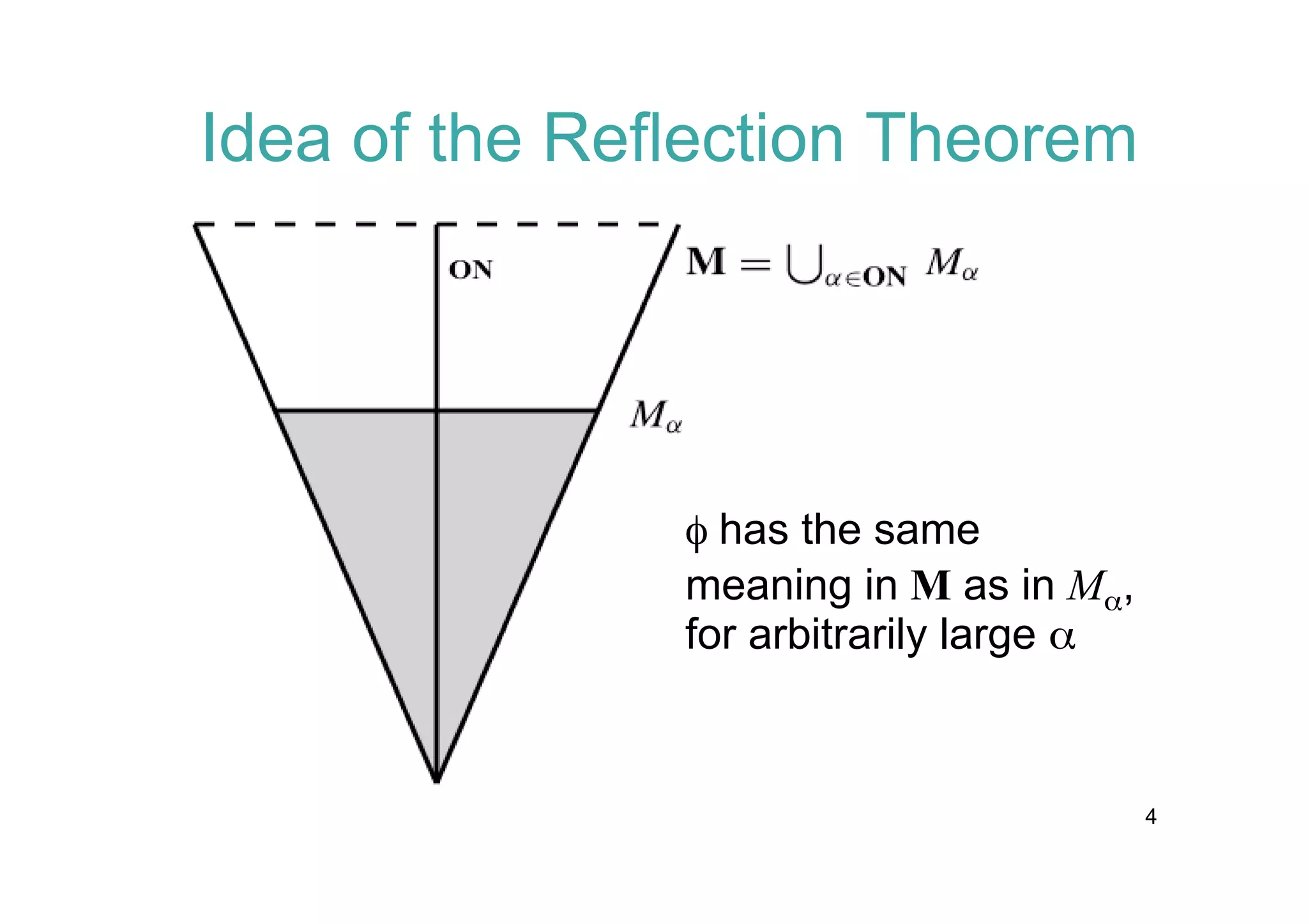
Idea of the Reflection Theorem

f has the same
meaning in M as in Ma,
for arbitrarily large a

4
The Reflection Theorem
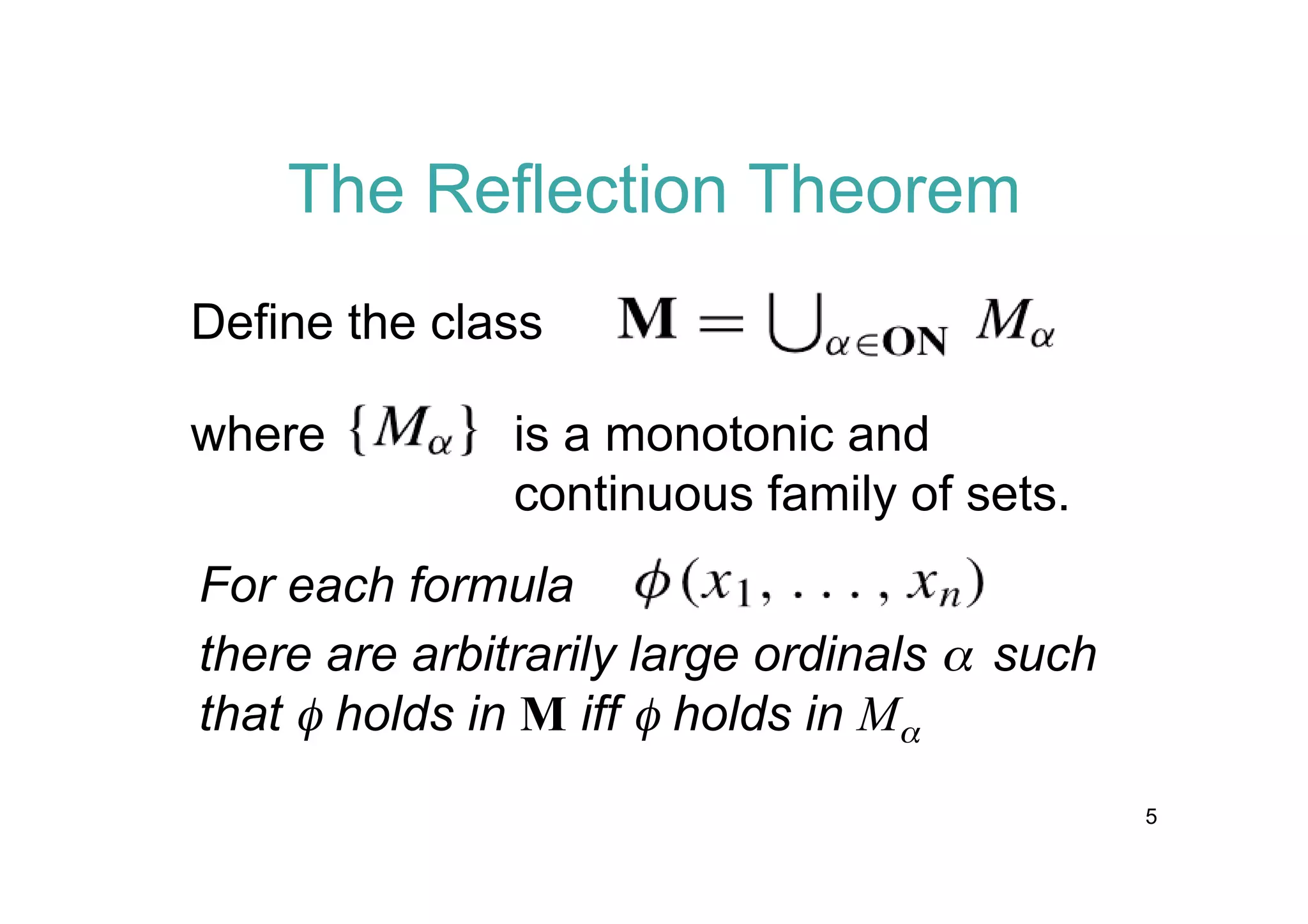
Define the class
where

is a monotonic and
continuous family of sets.

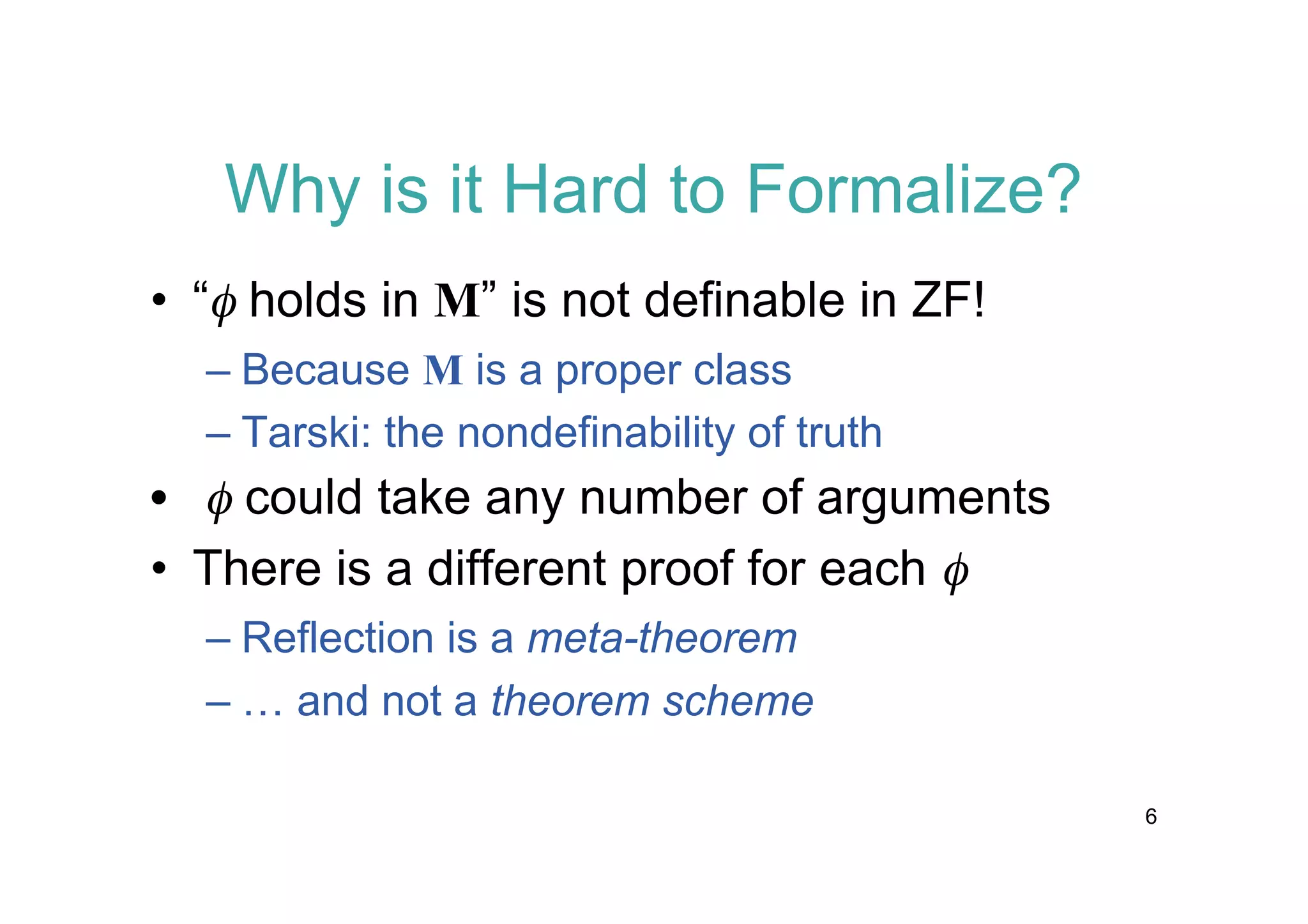
For each formula
there are arbitrarily large ordinals a such
that f holds in M iff f holds in Ma
5
Why is it Hard to Formalize?
• “f holds in M” is not definable in ZF!
– Because M is a proper class
– Tarski: the nondefinability of truth

• f could take any number of arguments
• There is a different proof for each f
– Reflection is a meta-theorem
– … and not a theorem scheme
6
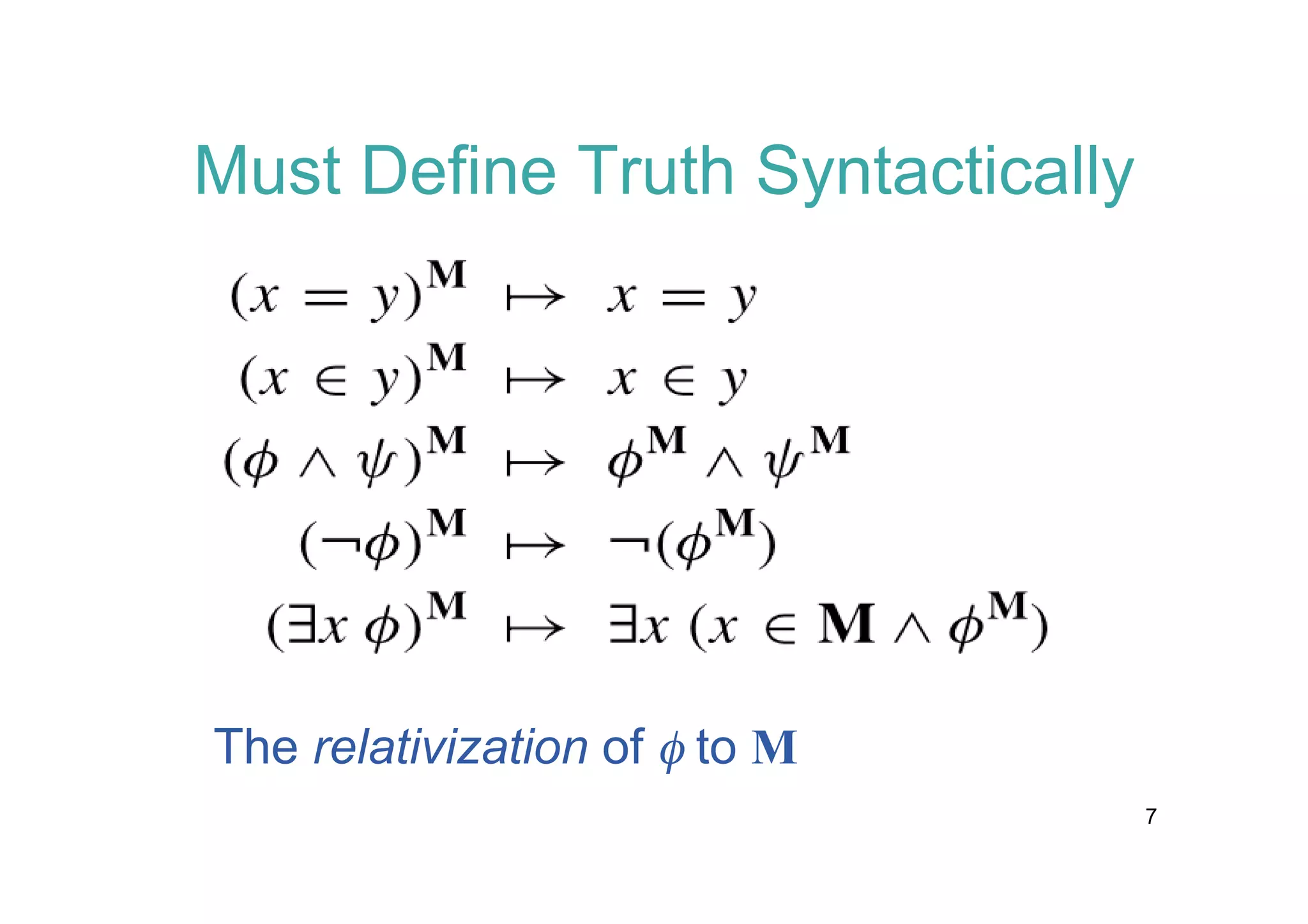
Must Define Truth Syntactically

The relativization of f to M
7
Lecture Overview
• Motivation for the Reflection Theorem
• Proving the Theorem in Isabelle
• Applying the Reflection Theorem

8
Isabelle/ZF
• Same code base as Isabelle/HOL
• Higher-order metalogic, ideal for
– Theorem schemes
– Classes
– Class functions

• Develops set theory from the ZermeloFraenkel axioms to transfinite cardinals
9
Proving the Reflection Theorem
in Isabelle/ZF
• Use a clean proof from Mostowski, 1969
– closed unbounded classes of ordinals
– normal functions (continuous, increasing)

• One lemma for each logical connective
• Isabelle automatically uses the lemmas to
prove instances of the theorem
10
Closed/Unbounded Classes
• Closed means closed under unions (limits)
of ordinals
• If M, N are C.U. then so is M « N
• The fixedpoints of a continuous, increasing
function form a C.U. class
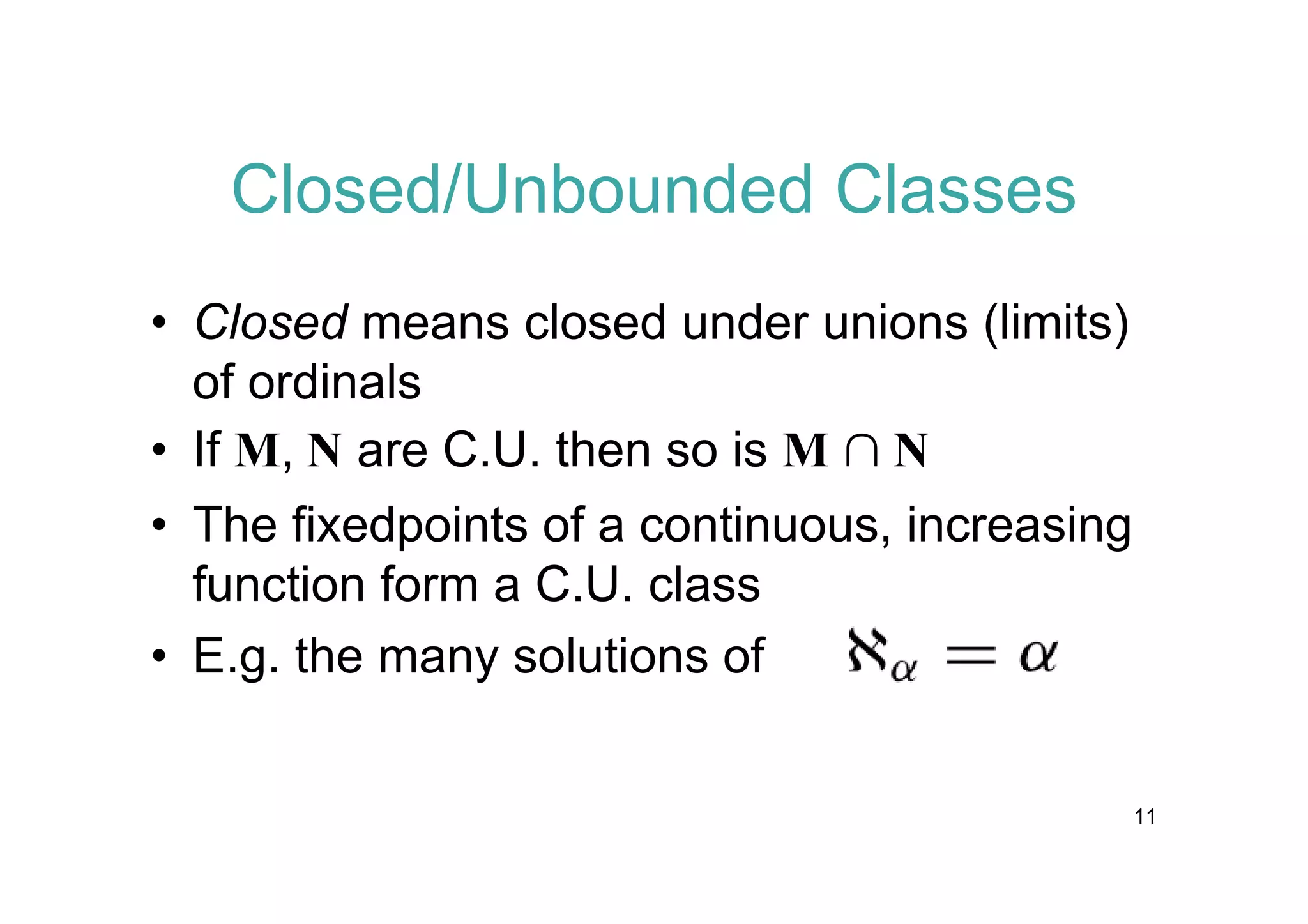
• E.g. the many solutions of
11
Essence of Proof
• “Skolemize” each $ quantifier, obtaining a
normal function, F
– The fixedpoints of F give the desired class of
ordinals

• For f Ÿ y simply intersect the classes
• Negation and atomic cases are trivial

12
Lecture Overview
• Motivation for the Reflection Theorem
• Proving the Theorem in Isabelle
• Applying the Reflection Theorem

13
The Axiom of Choice and the
Generalized Continuum Hypothesis
• Gödel (1940) proved them consistent with
set theory
– A deep and important theorem
– Addressed Hilbert’s First Problem

• Modern treatments (in ZF) require the
Reflection theorem
14
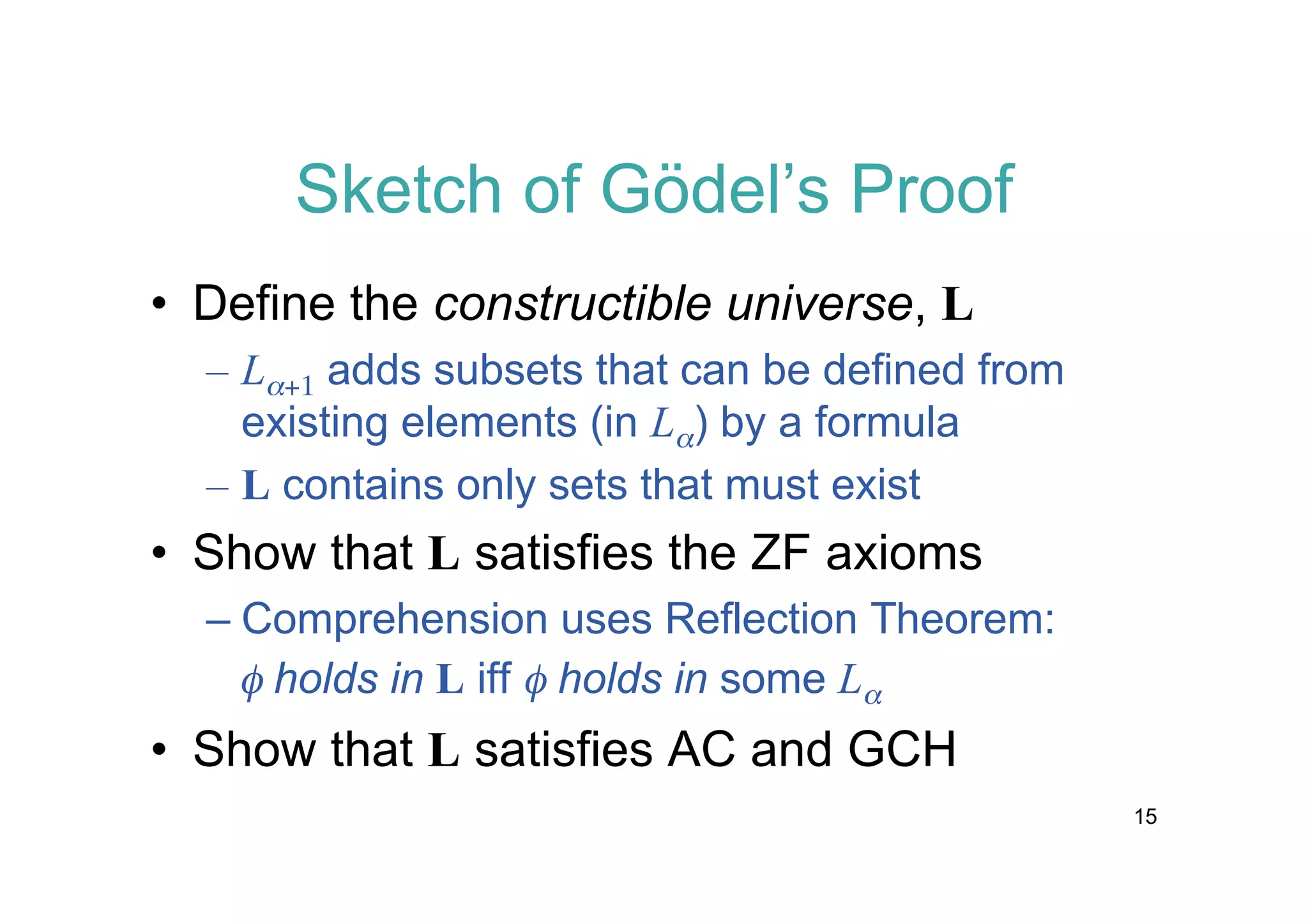
Sketch of Gödel’s Proof
• Define the constructible universe, L
– La+1 adds subsets that can be defined from
existing elements (in La) by a formula
– L contains only sets that must exist

• Show that L satisfies the ZF axioms
– Comprehension uses Reflection Theorem:
f holds in L iff f holds in some La

• Show that L satisfies AC and GCH
15
Showing That L “Thinks” All Sets
are Constructible
• Amounts to showing that the construction of
L is idempotent
• Relies on the concept of absoluteness:
– f is absolute if it’s preserved in all models
– Not absolute: powersets, function spaces,
transfinite cardinals

• Requires analysing L’s definition down to
the last detail
16
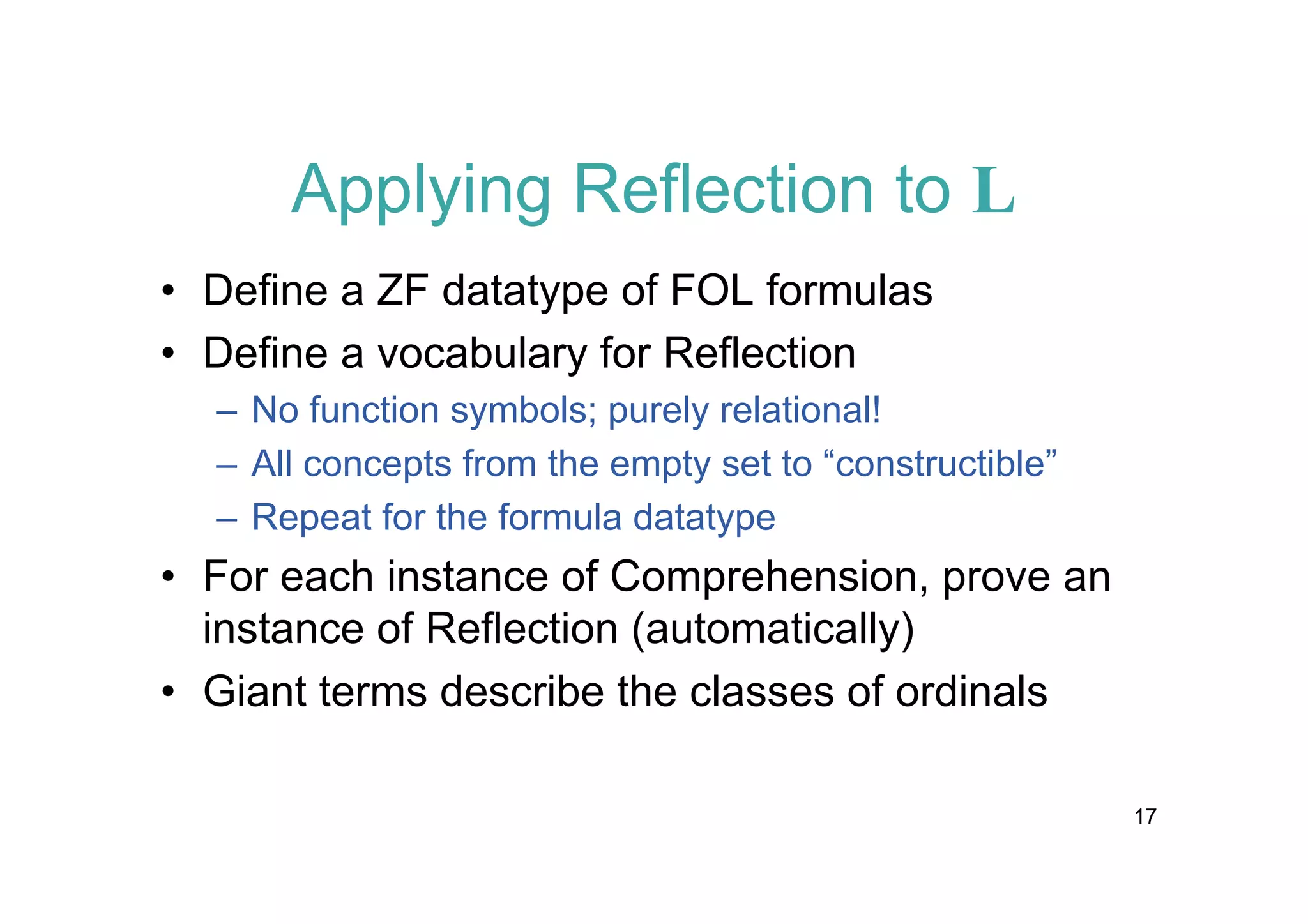
Applying Reflection to L
• Define a ZF datatype of FOL formulas
• Define a vocabulary for Reflection
– No function symbols; purely relational!
– All concepts from the empty set to “constructible”
– Repeat for the formula datatype

• For each instance of Comprehension, prove an
instance of Reflection (automatically)
• Giant terms describe the classes of ordinals
17
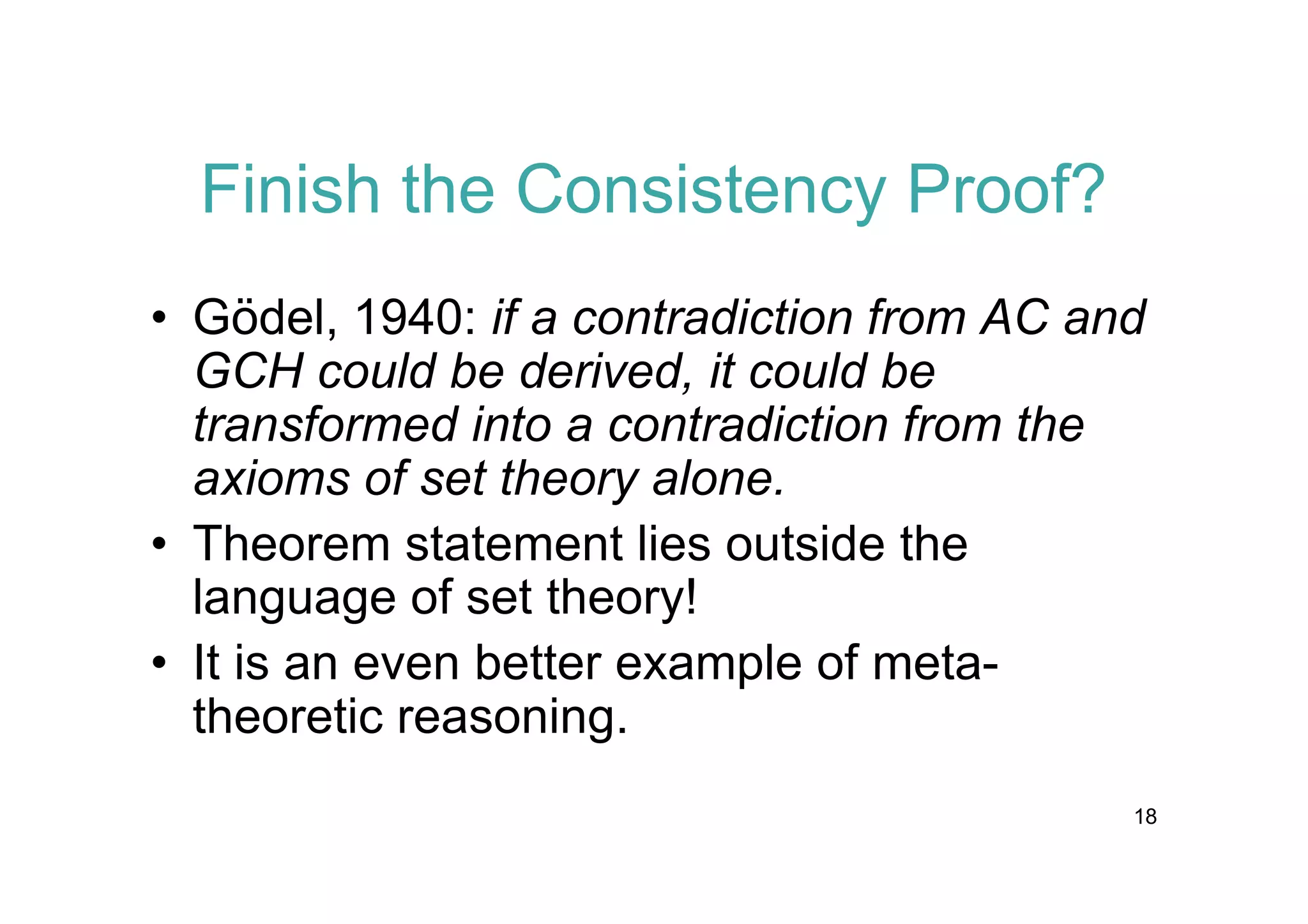
Finish the Consistency Proof?
• Gödel, 1940: if a contradiction from AC and
GCH could be derived, it could be
transformed into a contradiction from the
axioms of set theory alone.
• Theorem statement lies outside the
language of set theory!
• It is an even better example of metatheoretic reasoning.
18

The Reflection Theorem: Formalizing Meta-Theoretic Reasoning

  • 1.
    The Reflection Theorem FormalizingMeta-Theoretic Reasoning Lawrence C. Paulson Computer Laboratory
  • 2.
    Lecture Overview • Motivationfor the Reflection Theorem • Proving the Theorem in Isabelle • Applying the Reflection Theorem 2
  • 3.
    Why Do ProofsBy Machine? • Claim: too many been done already! – Gödel’s incompleteness theorem (Shankar) – thousands of Mizar proofs • Reply: many types of reasoning are hard to formalize. – Algebraic structures (e.g. group theory) – Meta-level reasoning (e.g. about own proof) 3
  • 4.
    Idea of theReflection Theorem f has the same meaning in M as in Ma, for arbitrarily large a 4
  • 5.
    The Reflection Theorem Definethe class where is a monotonic and continuous family of sets. For each formula there are arbitrarily large ordinals a such that f holds in M iff f holds in Ma 5
  • 6.
    Why is itHard to Formalize? • “f holds in M” is not definable in ZF! – Because M is a proper class – Tarski: the nondefinability of truth • f could take any number of arguments • There is a different proof for each f – Reflection is a meta-theorem – … and not a theorem scheme 6
  • 7.
    Must Define TruthSyntactically The relativization of f to M 7
  • 8.
    Lecture Overview • Motivationfor the Reflection Theorem • Proving the Theorem in Isabelle • Applying the Reflection Theorem 8
  • 9.
    Isabelle/ZF • Same codebase as Isabelle/HOL • Higher-order metalogic, ideal for – Theorem schemes – Classes – Class functions • Develops set theory from the ZermeloFraenkel axioms to transfinite cardinals 9
  • 10.
    Proving the ReflectionTheorem in Isabelle/ZF • Use a clean proof from Mostowski, 1969 – closed unbounded classes of ordinals – normal functions (continuous, increasing) • One lemma for each logical connective • Isabelle automatically uses the lemmas to prove instances of the theorem 10
  • 11.
    Closed/Unbounded Classes • Closedmeans closed under unions (limits) of ordinals • If M, N are C.U. then so is M « N • The fixedpoints of a continuous, increasing function form a C.U. class • E.g. the many solutions of 11
  • 12.
    Essence of Proof •“Skolemize” each $ quantifier, obtaining a normal function, F – The fixedpoints of F give the desired class of ordinals • For f Ÿ y simply intersect the classes • Negation and atomic cases are trivial 12
  • 13.
    Lecture Overview • Motivationfor the Reflection Theorem • Proving the Theorem in Isabelle • Applying the Reflection Theorem 13
  • 14.
    The Axiom ofChoice and the Generalized Continuum Hypothesis • Gödel (1940) proved them consistent with set theory – A deep and important theorem – Addressed Hilbert’s First Problem • Modern treatments (in ZF) require the Reflection theorem 14
  • 15.
    Sketch of Gödel’sProof • Define the constructible universe, L – La+1 adds subsets that can be defined from existing elements (in La) by a formula – L contains only sets that must exist • Show that L satisfies the ZF axioms – Comprehension uses Reflection Theorem: f holds in L iff f holds in some La • Show that L satisfies AC and GCH 15
  • 16.
    Showing That L“Thinks” All Sets are Constructible • Amounts to showing that the construction of L is idempotent • Relies on the concept of absoluteness: – f is absolute if it’s preserved in all models – Not absolute: powersets, function spaces, transfinite cardinals • Requires analysing L’s definition down to the last detail 16
  • 17.
    Applying Reflection toL • Define a ZF datatype of FOL formulas • Define a vocabulary for Reflection – No function symbols; purely relational! – All concepts from the empty set to “constructible” – Repeat for the formula datatype • For each instance of Comprehension, prove an instance of Reflection (automatically) • Giant terms describe the classes of ordinals 17
  • 18.
    Finish the ConsistencyProof? • Gödel, 1940: if a contradiction from AC and GCH could be derived, it could be transformed into a contradiction from the axioms of set theory alone. • Theorem statement lies outside the language of set theory! • It is an even better example of metatheoretic reasoning. 18