Friendship
Think about “friendship”
 In your mind, what are friends for?
 “A friend in need is a friend indeed.”
 Let’s see what the American pop singer
Dionne Warwick thinks about “friends”.
Answer questions
 What is a fair weather friend?
 One who is happy to stay with you
when things are going well but
leaves as soon as trouble arrives.
 According to the song, what are
friends for?
 For both good times and bad times.
Forrest Gump---a good friend
 Can you see which war it was? Where
did it take place?
 Vietnam.
 Why did Forrest go back?
 To look for his best friend, Budda.
 What was Budda’s dream.
 To become the shrimping boat
captain.
Text A
All The Cabbie Had Was A
Letter
Text Structure
 Part One
 Paras 1-20

From a conversation with the
cab driver the author learned
how much he regretted failing
to keep up correspondence with
his old friend Ed.
 Part Two
 Paras 21-35

Reading the letter by himself,
the author learned more about
the lifelong friendship between
the driver and Old Ed.
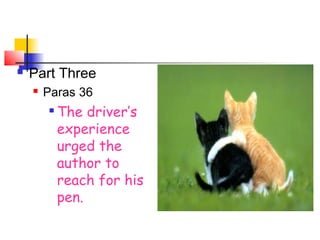
 Part Three
 Paras 36

The driver’s
experience
urged the
author to
reach for his
pen.
Main idea
 Never delay expressing your true
feelings to a friend.
Writing Skills: a surprising
ending
 At first, did you mistake Ed for the writer
of this letter, like the storyteller did?
 Could you find the sentences which first
misleads you?
 --Is the letter from a child or a
grandchild? L11
 --No. Ed was my oldest friend. L13
 Find out more words or sentences that take
on different meanings for the speaker and
the listener.
 For example:
 I’m sorry, but I was reading a letter. L5
 The cabbie actually meant he was reading
a letter he had written to an old friend.
 But the storyteller thought he was reading a
letter he had received from an old friend.
Other misleading sentences
 Go ahead and finish your letter. L6
 I’ve read it several times already. I
guess I almost know it by heart. L7-8
 Thanks, but I don’t want to read your
mail. That’s pretty personal. L40
 …and the first sentence reminded me of
myself. I’ve been meaning to write for
some time, but I’ve always postponed it.
L45-46
 It then went on to say that he often
thought about the good times they had
had together when they both lived in the
same neighborhood. L 46-48
 This is a good part here, where it says
Your friendship over the years has meant
an awful lot to me… L70-71
 That must have made you feel good,
didn’t it? L73
 I know I’d like to receive a letter like that
from my oldest friend. L75-76
 A surprising ending is usually adopted in stories.
Many great writers have tried this writing method.
The most typical one is O.Henry, American writer
of short stories. He was best known for his ironic
plot twists and surprise endings. His style of
storytelling later became a model not only for
short fiction, but also for American motion
pictures and television programs.
 Could you list some of his works with surprising
endings?
 The Last Leaf
 The Gift of the Magi
 Necklace by Maupassant
Ways to keep a conversation going
 Express agreement to show you are an
attentive listener
 L9/ L16 /para.17 , 25/ L 75
 Ask a question to get information
 Para.13, 27,33
 Make guesses
 L 11/ L17/ para.9/para.22/L73
Language points
 tap: v. 1. hit sth. lightly often repeatedly 2.
obtain or make use of 3. fit a listening
device
 1 The branches tapped against the
window./I could hear him tapping his
fingers on the desk.
 2 The scientists are thinking of a new way
of tapping the solar energy.
 3 I guess our telephone has been tapped.
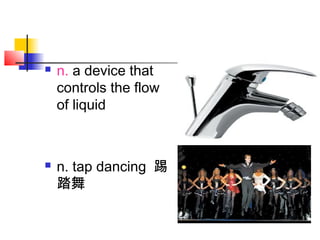
 n. a device that
controls the flow
of liquid
 n. tap dancing 踢
踏舞
 available: able to be obtained; free to
be seen or talked to
 Is this book available in the
bookstore?
 Mr. Morrison will be available in a
minute.
 go ahead: continue; begin; be carried out
 We've received permission to go ahead with
the music festival in spite of opposition from
local residents.
I got so fed up with waiting for him to do it
that I just went ahead and did it myself.
 INFORMAL said to someone in order to
give them permission to start to do
something:
"Could I ask you a rather personal
question?" "Sure, go ahead."
 Cf. go by (para.26)/on/off/over/through
 estimate: form a judgment about (a quantity
or value)
 He estimated the total speed of the winds
from the degree of damage.
 The expert estimated the antique watch
was worth RMB350,000.
 Cf. guess L 11 (more colloquial, =think)
 If you don’t know the answer, just guess.
 我没想到的是它居然会这么冷。
 I would not have guessed that it would be
so cold.
 Cf. I take it that…: expect sb.will do
sth./know sth.
 I take it that you’ll have no trouble with the
visa, since you have been to the country
once.
 我想你俩可能会要求坐在一起。
 I took it (that) you two would like to be put
next to each other in the seating plan.
 might just as well: need to suggest doing
sth. that you do not really want to do
because you have no better ideas
 You might just as well send your resume to
the company and give it a try.
 I might just as well give you the money now
since you’ll be needing it so soon.
 practically: almost, virtually;
 My husband has tried to give up smoking
several times, but he finds it practically
impossible.
 His work is practically unknown before he
died.
 Let’s talk about the problem practically( 讲究
实际的) .
 be on one’s mind: worry about
 My deputy has resigned, so I’ve got a lot
on my mind at the moment.
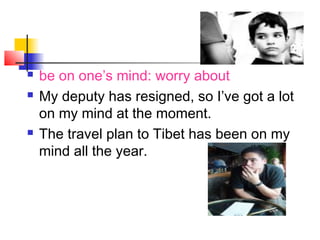
 The travel plan to Tibet has been on my
mind all the year.
 cf. have sth. in one’s mind=be
considering sb./sth. as suitable for
 Who do you have in mind for the job?
 Do you have anything in mind for
Helen's present?
Go over /turn over an event in your
mind=think about it repeatedly
 She would go over the accident again
and again in her mind, wishing that she
could somehow have prevented it.
 hang out: stay in a place, for no particular
reason, not doing very much
 He often hangs out with his friends at the
mall on weekends.
 不要再跟那个人整天混在一起了。
 Don’t hang out with that guy any longer.
 choke up: become speechless, too upset
to speak
 He choked up and couldn’t finish his
story.
 说起他父亲是如何全力支持他学习时,那
男孩子哽咽说不出话来。
 The boy choked up as he mentioned how
his father tried whatever he could to
support him in his studies.
 skip: pass sth. over; omit
 The intelligent boy skipped the second
grade.
 A lot of senior students skip classes for
they are busy with job hunting.
 许多人不吃早饭,因为他们起得晚或者
他们没时间。
 Many people skip breakfast because
they get up late or because they don’t
have time.
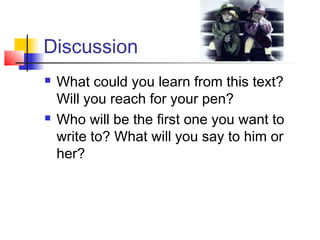
Discussion
 What could you learn from this text?
Will you reach for your pen?
 Who will be the first one you want to
write to? What will you say to him or
her?
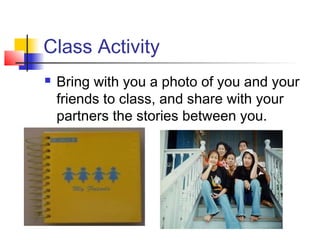
Class Activity
 Bring with you a photo of you and your
friends to class, and share with your
partners the stories between you.
Homework
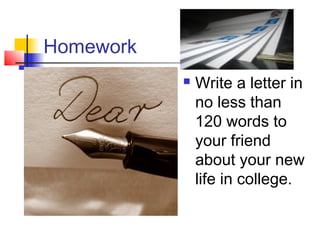
 Write a letter in
no less than
120 words to
your friend
about your new
life in college.
Proverbs about friends
 A friend is easier lost than found.
 Better a good friend than silver and gold.
 He who would have friends must himself be
friendly.
 We can live without a brother, but not
without friends.
 False friends are worse than open enemies.
 Friendship cannot stand always on one side.
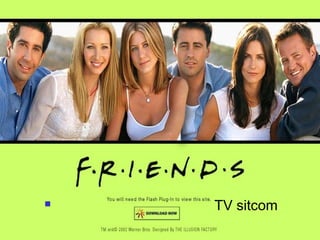
 TV sitcom

Friends

  • 1.
  • 2.
    Think about “friendship” In your mind, what are friends for?  “A friend in need is a friend indeed.”  Let’s see what the American pop singer Dionne Warwick thinks about “friends”.
  • 3.
    Answer questions  Whatis a fair weather friend?  One who is happy to stay with you when things are going well but leaves as soon as trouble arrives.  According to the song, what are friends for?  For both good times and bad times.
  • 4.
    Forrest Gump---a goodfriend  Can you see which war it was? Where did it take place?  Vietnam.  Why did Forrest go back?  To look for his best friend, Budda.  What was Budda’s dream.  To become the shrimping boat captain.
  • 5.
    Text A All TheCabbie Had Was A Letter
  • 6.
    Text Structure  PartOne  Paras 1-20  From a conversation with the cab driver the author learned how much he regretted failing to keep up correspondence with his old friend Ed.
  • 7.
     Part Two Paras 21-35  Reading the letter by himself, the author learned more about the lifelong friendship between the driver and Old Ed.
  • 8.
     Part Three Paras 36  The driver’s experience urged the author to reach for his pen.
  • 9.
    Main idea  Neverdelay expressing your true feelings to a friend.
  • 10.
    Writing Skills: asurprising ending  At first, did you mistake Ed for the writer of this letter, like the storyteller did?  Could you find the sentences which first misleads you?  --Is the letter from a child or a grandchild? L11  --No. Ed was my oldest friend. L13
  • 11.
     Find outmore words or sentences that take on different meanings for the speaker and the listener.  For example:  I’m sorry, but I was reading a letter. L5  The cabbie actually meant he was reading a letter he had written to an old friend.  But the storyteller thought he was reading a letter he had received from an old friend.
  • 12.
    Other misleading sentences Go ahead and finish your letter. L6  I’ve read it several times already. I guess I almost know it by heart. L7-8  Thanks, but I don’t want to read your mail. That’s pretty personal. L40  …and the first sentence reminded me of myself. I’ve been meaning to write for some time, but I’ve always postponed it. L45-46
  • 13.
     It thenwent on to say that he often thought about the good times they had had together when they both lived in the same neighborhood. L 46-48  This is a good part here, where it says Your friendship over the years has meant an awful lot to me… L70-71  That must have made you feel good, didn’t it? L73  I know I’d like to receive a letter like that from my oldest friend. L75-76
  • 14.
     A surprisingending is usually adopted in stories. Many great writers have tried this writing method. The most typical one is O.Henry, American writer of short stories. He was best known for his ironic plot twists and surprise endings. His style of storytelling later became a model not only for short fiction, but also for American motion pictures and television programs.  Could you list some of his works with surprising endings?  The Last Leaf  The Gift of the Magi  Necklace by Maupassant
  • 15.
    Ways to keepa conversation going  Express agreement to show you are an attentive listener  L9/ L16 /para.17 , 25/ L 75  Ask a question to get information  Para.13, 27,33  Make guesses  L 11/ L17/ para.9/para.22/L73
  • 16.
    Language points  tap:v. 1. hit sth. lightly often repeatedly 2. obtain or make use of 3. fit a listening device  1 The branches tapped against the window./I could hear him tapping his fingers on the desk.  2 The scientists are thinking of a new way of tapping the solar energy.  3 I guess our telephone has been tapped.
  • 17.
     n. adevice that controls the flow of liquid  n. tap dancing 踢 踏舞
  • 18.
     available: ableto be obtained; free to be seen or talked to  Is this book available in the bookstore?  Mr. Morrison will be available in a minute.
  • 19.
     go ahead:continue; begin; be carried out  We've received permission to go ahead with the music festival in spite of opposition from local residents. I got so fed up with waiting for him to do it that I just went ahead and did it myself.
  • 20.
     INFORMAL saidto someone in order to give them permission to start to do something: "Could I ask you a rather personal question?" "Sure, go ahead."  Cf. go by (para.26)/on/off/over/through
  • 21.
     estimate: forma judgment about (a quantity or value)  He estimated the total speed of the winds from the degree of damage.  The expert estimated the antique watch was worth RMB350,000.  Cf. guess L 11 (more colloquial, =think)  If you don’t know the answer, just guess.  我没想到的是它居然会这么冷。  I would not have guessed that it would be so cold.
  • 22.
     Cf. Itake it that…: expect sb.will do sth./know sth.  I take it that you’ll have no trouble with the visa, since you have been to the country once.  我想你俩可能会要求坐在一起。  I took it (that) you two would like to be put next to each other in the seating plan.
  • 23.
     might justas well: need to suggest doing sth. that you do not really want to do because you have no better ideas  You might just as well send your resume to the company and give it a try.  I might just as well give you the money now since you’ll be needing it so soon.
  • 24.
     practically: almost,virtually;  My husband has tried to give up smoking several times, but he finds it practically impossible.  His work is practically unknown before he died.  Let’s talk about the problem practically( 讲究 实际的) .
  • 25.
     be onone’s mind: worry about  My deputy has resigned, so I’ve got a lot on my mind at the moment.  The travel plan to Tibet has been on my mind all the year.
  • 26.
     cf. havesth. in one’s mind=be considering sb./sth. as suitable for  Who do you have in mind for the job?  Do you have anything in mind for Helen's present? Go over /turn over an event in your mind=think about it repeatedly  She would go over the accident again and again in her mind, wishing that she could somehow have prevented it.
  • 27.
     hang out:stay in a place, for no particular reason, not doing very much  He often hangs out with his friends at the mall on weekends.  不要再跟那个人整天混在一起了。  Don’t hang out with that guy any longer.
  • 28.
     choke up:become speechless, too upset to speak  He choked up and couldn’t finish his story.  说起他父亲是如何全力支持他学习时,那 男孩子哽咽说不出话来。  The boy choked up as he mentioned how his father tried whatever he could to support him in his studies.
  • 29.
     skip: passsth. over; omit  The intelligent boy skipped the second grade.  A lot of senior students skip classes for they are busy with job hunting.  许多人不吃早饭,因为他们起得晚或者 他们没时间。  Many people skip breakfast because they get up late or because they don’t have time.
  • 30.
    Discussion  What couldyou learn from this text? Will you reach for your pen?  Who will be the first one you want to write to? What will you say to him or her?
  • 31.
    Class Activity  Bringwith you a photo of you and your friends to class, and share with your partners the stories between you.
  • 32.
    Homework  Write aletter in no less than 120 words to your friend about your new life in college.
  • 33.
    Proverbs about friends A friend is easier lost than found.  Better a good friend than silver and gold.  He who would have friends must himself be friendly.  We can live without a brother, but not without friends.  False friends are worse than open enemies.  Friendship cannot stand always on one side.
  • 34.