Basic	
  facts	


Here	
   are	
   five	
   basic	
   facts	
   about	
   the	
   Arabic	
  
alphabet.	
   Read	
   them	
   before	
   you	
   start	
   the	
  
course	
  and	
  everything	
  will	
  make	
  a	
  lot	
  more	
  
sense.	


1)	
  The	
  Arabic	
  alphabet	
  contains	
  28	
  letters.	
  
In	
   addition	
   to	
   the	
   28	
   letters,	
   there	
   are	
   3	
  
special	
   characters	
   that	
   are	
   written	
   above	
  
and	
  below	
  other	
  letters.	


2)	
  Arabic	
  contains	
  5	
  sounds	
  that	
  we	
  do	
  not	
  
use	
  in	
  English.	
  You'll	
  need	
  to	
  try	
  extra	
  hard	
  
to	
  learn	
  to	
  pronounce	
  these	
  sounds.	


3)	
  Arabic	
  is	
  read	
  from	
  right	
  to	
  left	
  and	
  the	
  
letters	
  in	
  words	
  also	
  run	
  from	
  right	
  to	
  left.	
  
Here	
   is	
   an	
   example	
   using	
   the	
   English	
  
alphabet:	
  
English	
  order:	
  This	
  is	
  my	
  new	
  car.	
  
Arabic	
  order:	
  .rac	
  wen	
  ym	
  si	
  sihT	
  
 
4)	
   Each	
   Arabic	
   letter	
   can	
   take	
   a	
   different	
  
form	
   depending	
   whether	
   it's	
   at	
   the	
  
beginning,	
  in	
  the	
  middle	
  or	
  at	
  the	
  end	
  of	
  the	
  
word.	
  
This	
   is	
   not	
   so	
   different	
   to	
   English	
   where	
  
some	
   words	
   take	
   a	
   capital	
   letter	
   at	
   the	
  
beginning.	
   In	
   the	
   English	
   alphabet	
   capital	
  
letters	
   look	
   completely	
   different	
   to	
   lower	
  
case	
  letters:	
  A	
  a	
  /	
  B	
  b	
  When	
  you	
  learnt	
  to	
  
read	
   the	
   English	
   alphabet,	
   you	
   learnt	
   to	
  
recognise	
  the	
  capital	
  letters	
  as	
  well	
  as	
  their	
  
lower	
  case	
  forms.	
  In	
  Arabic	
  you	
  also	
  need	
  to	
  
learn	
  to	
  recognise	
  more	
  than	
  one	
  form	
  of	
  a	
  
letter.	


5)	
   When	
   saying	
   the	
   Arabic	
   alphabet,	
   each	
  
letter	
   has	
   a	
   name.	
   For	
   example,	
   the	
   first	
  
four	
  letters	
  of	
  the	
  Arabic	
  alphabet	
  are	
  alif,	
  
baa,	
  taa,	
  thaa.	
  These	
  names	
  are	
  different	
  to	
  
the	
  sound	
  that	
  the	
  letter	
  makes.	
  
Again,	
   this	
   is	
   the	
   same	
   as	
   English.	
   We	
  
pronounce	
   the	
   first	
   four	
   letters	
   of	
   the	
  
English	
   alphabet	
   ay,	
   bee,	
   see,	
   dee	
   but	
   in	
  
words	
   the	
   letters	
   have	
   different	
   sounds.	
  
Think	
   about	
   how	
   'c'	
   sounds	
   in	
   'cat'	
   -­‐	
   it	
  
sounds	
  different	
  to	
  when	
  we	
  talk	
  about	
  the	
  
letter	
  C	
  ("see").	


ba	


You	
  know	
  this	
  sound	
  from..	


The	
  sound	
  made	
  by	
  'b'	
  in	
  the	
  English	
  word	
  
'boy'	


How	
  does	
  this	
  letter	
  look	
  in	
  words?	


As	
  you	
  read	
  on	
  the	
  page	
  of	
  basic	
  facts,	
  each	
  
Arabic	
  letter	
  takes	
  a	
  different	
  form	
  when	
  it	
  
appears	
  at	
  different	
  places	
  in	
  a	
  word.	
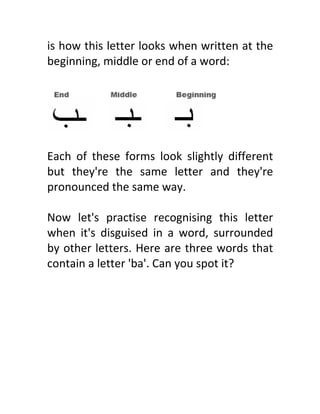
  Here	
  
is	
  how	
  this	
  letter	
  looks	
  when	
  written	
  at	
  the	
  
beginning,	
  middle	
  or	
  end	
  of	
  a	
  word:	


Each	
   of	
   these	
   forms	
   look	
   slightly	
   different	
  
but	
   they're	
   the	
   same	
   letter	
   and	
   they're	
  
pronounced	
  the	
  same	
  way.	


Now	
   let's	
   practise	
   recognising	
   this	
   letter	
  
when	
   it's	
   disguised	
   in	
   a	
   word,	
   surrounded	
  
by	
  other	
  letters.	
  Here	
  are	
  three	
  words	
  that	
  
contain	
  a	
  letter	
  'ba'.	
  Can	
  you	
  spot	
  it?	


Did	
   you	
   find	
   the	
   letter	
   'ba'?	
   Here	
   are	
   the	
  
same	
  words	
  with	
  the	
  letter	
  'ba'	
  highlighted	
  
in	
  blue.	


In	
   Arabic	
   there	
   are	
   three	
   characters	
   that	
  
function	
   differently	
   to	
   the	
   other	
   letters	
   of	
  
the	
   alphabet.	
   These	
   characters	
   are	
   called	
  
fatha,	
  kasrah	
  and	
  dammah.	
  They	
  represent	
  
the	
  sounds	
  'a',	
  'i'	
  and	
  'u'.	


What's	
  different	
  about	
  these	
  characters?	


They're	
  always	
  written	
  the	
  same,	
  no	
  matter	
  
where	
  they	
  are	
  in	
  a	
  word.	
  
They're	
   not	
   written	
   in	
   line	
   with	
   other	
  
letters.	
   They're	
   go	
   above	
   or	
   below	
   the	
  
previous	
  letter.	


fatha	


You	
  know	
  this	
  sound	
  from..	


The	
  sound	
  made	
  by	
  'a'	
  in	
  the	
  English	
  word	
  
'cat'	


How	
  does	
  it	
  look	
  in	
  words?	


The	
   character	
   is	
   written	
   above	
   the	
   letter	
  
before	
   it.	
   Look	
   at	
   the	
   example.	
   The	
  
character	
   is	
   written	
   above	
   a	
   letter	
   'b',	
   to	
  
give	
  the	
  sound	
  'ba'.	


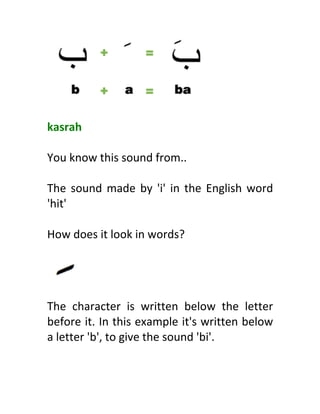
kasrah	


You	
  know	
  this	
  sound	
  from..	


The	
  sound	
  made	
  by	
  'i'	
  in	
  the	
  English	
  word	
  
'hit'	


How	
  does	
  it	
  look	
  in	
  words?	


The	
   character	
   is	
   written	
   below	
   the	
   letter	
  
before	
  it.	
  In	
  this	
  example	
  it's	
  written	
  below	
  
a	
  letter	
  'b',	
  to	
  give	
  the	
  sound	
  'bi'.	


dammah	


You	
  know	
  this	
  sound	
  from..	


The	
  sound	
  made	
  by	
  'u'	
  in	
  the	
  English	
  word	
  
'but'	


How	
  does	
  it	
  look	
  in	
  words?	


The	
   character	
   is	
   written	
   above	
   the	
   letter	
  
before	
  it.	
  In	
  this	
  example	
  it's	
  written	
  above	
  
a	
  letter	
  'b',	
  to	
  give	
  the	
  sound	
  'bu'.	


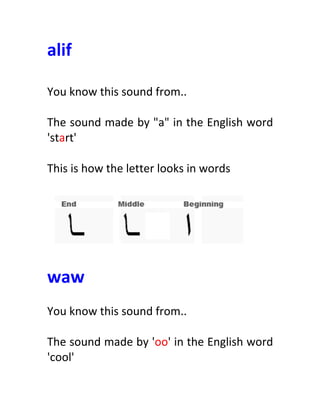
alif	


You	
  know	
  this	
  sound	
  from..	


The	
  sound	
  made	
  by	
  "a"	
  in	
  the	
  English	
  word	
  
'start'	


This	
  is	
  how	
  the	
  letter	
  looks	
  in	
  words	


waw	


You	
  know	
  this	
  sound	
  from..	


The	
  sound	
  made	
  by	
  'oo'	
  in	
  the	
  English	
  word	
  
'cool'	
  
 
This	
  is	
  how	
  the	
  letter	
  looks	
  in	
  words	


ya	


You	
  know	
  this	
  sound	
  from..	


The	
  sound	
  made	
  by	
  'ee'	
  in	
  the	
  English	
  word	
  
'feel'	


This	
  is	
  how	
  the	
  letter	
  looks	
  in	
  words	


ta	


You	
  know	
  this	
  sound	
  from..	


The	
  sound	
  made	
  by	
  't'	
  in	
  the	
  English	
  word	
  
'ten'	


This	
  is	
  how	
  the	
  letter	
  looks	
  in	
  words	


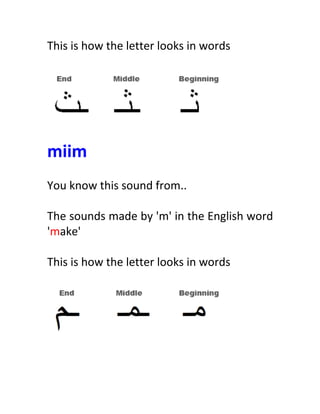
tha	


You	
  know	
  this	
  sound	
  from..	


The	
  sound	
  made	
  by	
  'th'	
  in	
  the	
  English	
  word	
  
'three'	


This	
  is	
  how	
  the	
  letter	
  looks	
  in	
  words	


miim	


You	
  know	
  this	
  sound	
  from..	


The	
  sounds	
  made	
  by	
  'm'	
  in	
  the	
  English	
  word	
  
'make'	


This	
  is	
  how	
  the	
  letter	
  looks	
  in	
  words	


nuun	


You	
  know	
  this	
  sound	
  from..	


The	
  sounds	
  made	
  by	
  'n'	
  in	
  the	
  English	
  word	
  
'now'	


This	
  is	
  how	
  the	
  letter	
  looks	
  in	
  words	


ha	


You	
  know	
  this	
  sound	
  from..	


The	
  sounds	
  made	
  by	
  'h'	
  in	
  the	
  English	
  word	
  
'hot'	


This	
  is	
  how	
  the	
  letter	
  looks	
  in	
  words	


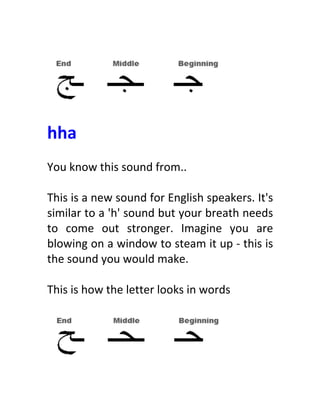
jiim	


You	
  know	
  this	
  sound	
  from..	


The	
  sound	
  made	
  by	
  'j'	
  in	
  the	
  English	
  word	
  
'just'	
  
The	
  sound	
  made	
  by	
  's'	
  in	
  the	
  English	
  word	
  
'leisure'	
  or	
  the	
  'j'	
  in	
  the	
  French	
  word	
  'je'	


Arabic	
   speakers	
   pronounce	
   this	
   letter	
   in	
  
two	
   different	
   ways,	
   depending	
   on	
   their	
  
country.	
   You	
   can	
   use	
   whichever	
  
pronunciation	
  you	
  like.	


This	
  is	
  how	
  the	
  letter	
  looks	
  in	
  words	


hha	


You	
  know	
  this	
  sound	
  from..	


This	
  is	
  a	
  new	
  sound	
  for	
  English	
  speakers.	
  It's	
  
similar	
  to	
  a	
  'h'	
  sound	
  but	
  your	
  breath	
  needs	
  
to	
   come	
   out	
   stronger.	
   Imagine	
   you	
   are	
  
blowing	
  on	
  a	
  window	
  to	
  steam	
  it	
  up	
  -­‐	
  this	
  is	
  
the	
  sound	
  you	
  would	
  make.	


This	
  is	
  how	
  the	
  letter	
  looks	
  in	
  words	


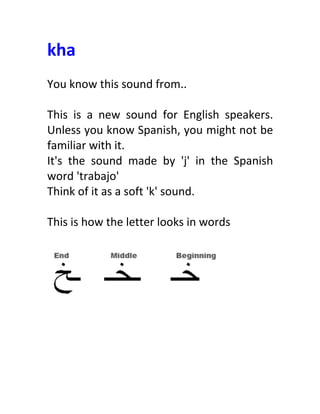
kha	


You	
  know	
  this	
  sound	
  from..	


This	
   is	
   a	
   new	
   sound	
   for	
   English	
   speakers.	
  
Unless	
  you	
  know	
  Spanish,	
  you	
  might	
  not	
  be	
  
familiar	
  with	
  it.	
  
It's	
   the	
   sound	
   made	
   by	
   'j'	
   in	
   the	
   Spanish	
  
word	
  'trabajo'	
  
Think	
  of	
  it	
  as	
  a	
  soft	
  'k'	
  sound.	


This	
  is	
  how	
  the	
  letter	
  looks	
  in	
  words	


daal	


You	
  know	
  this	
  sound	
  from..	


The	
  sound	
  made	
  by	
  'd'	
  in	
  the	
  English	
  word	
  
'dog'	


This	
  is	
  how	
  the	
  letter	
  looks	
  in	
  words	


thaal	


You	
  know	
  this	
  sound	
  from..	


The	
  sound	
  made	
  by	
  'th'	
  in	
  the	
  English	
  word	
  
'then'	


This	
  is	
  how	
  the	
  letter	
  looks	
  in	
  words	


ra	


This	
  is	
  a	
  new	
  sound	
  for	
  English	
  speakers.	
  
If	
  you	
  know	
  Spanish,	
  this	
  is	
  the	
  sound	
  made	
  
by	
  a	
  letter	
  'r'	
  in	
  Spanish.	
  
This	
  is	
  different	
  to	
  the	
  sound	
  of	
  an	
  English	
  
'r',	
  it	
  is	
  pronounced	
  with	
  the	
  tongue	
  further	
  
forward,	
  just	
  behind	
  the	
  teeth.	


This	
  is	
  how	
  the	
  letter	
  looks	
  in	
  words	


zay	


You	
  know	
  this	
  sound	
  from..	


The	
  sound	
  made	
  by	
  'z'	
  in	
  the	
  English	
  word	
  
'zoo'	


This	
  is	
  how	
  the	
  letter	
  looks	
  in	
  words	


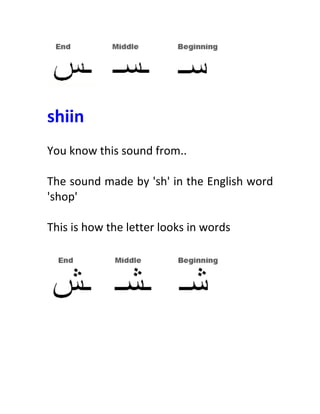
siin	


You	
  know	
  this	
  sound	
  from..	


The	
  sound	
  made	
  by	
  's'	
  in	
  the	
  English	
  word	
  
'six'	


This	
  is	
  how	
  the	
  letter	
  looks	
  in	
  words	


shiin	


You	
  know	
  this	
  sound	
  from..	


The	
  sound	
  made	
  by	
  'sh'	
  in	
  the	
  English	
  word	
  
'shop'	


This	
  is	
  how	
  the	
  letter	
  looks	
  in	
  words	


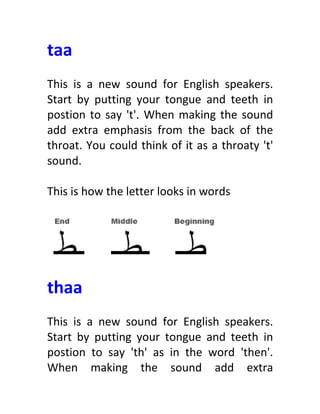
taa	


This	
   is	
   a	
   new	
   sound	
   for	
   English	
   speakers.	
  
Start	
   by	
   putting	
   your	
   tongue	
   and	
   teeth	
   in	
  
postion	
  to	
  say	
  't'.	
  When	
  making	
  the	
  sound	
  
add	
   extra	
   emphasis	
   from	
   the	
   back	
   of	
   the	
  
throat.	
  You	
  could	
  think	
  of	
  it	
  as	
  a	
  throaty	
  't'	
  
sound.	


This	
  is	
  how	
  the	
  letter	
  looks	
  in	
  words	


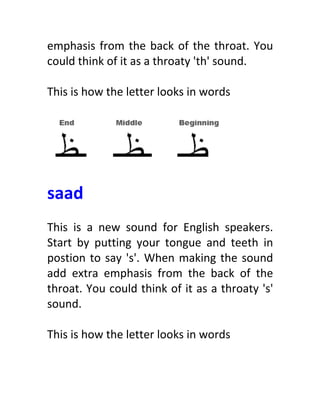
thaa	


This	
   is	
   a	
   new	
   sound	
   for	
   English	
   speakers.	
  
Start	
   by	
   putting	
   your	
   tongue	
   and	
   teeth	
   in	
  
postion	
   to	
   say	
   'th'	
   as	
   in	
   the	
   word	
   'then'.	
  
When	
   making	
   the	
   sound	
   add	
   extra	
  
emphasis	
  from	
  the	
  back	
  of	
  the	
  throat.	
  You	
  
could	
  think	
  of	
  it	
  as	
  a	
  throaty	
  'th'	
  sound.	


This	
  is	
  how	
  the	
  letter	
  looks	
  in	
  words	


saad	


This	
   is	
   a	
   new	
   sound	
   for	
   English	
   speakers.	
  
Start	
   by	
   putting	
   your	
   tongue	
   and	
   teeth	
   in	
  
postion	
  to	
  say	
  's'.	
  When	
  making	
  the	
  sound	
  
add	
   extra	
   emphasis	
   from	
   the	
   back	
   of	
   the	
  
throat.	
  You	
  could	
  think	
  of	
  it	
  as	
  a	
  throaty	
  's'	
  
sound.	


This	
  is	
  how	
  the	
  letter	
  looks	
  in	
  words	


daad	


This	
   is	
   a	
   new	
   sound	
   for	
   English	
   speakers.	
  
Start	
   by	
   putting	
   your	
   tongue	
   and	
   teeth	
   in	
  
postion	
  to	
  say	
  'd'.	
  When	
  making	
  the	
  sound	
  
add	
   extra	
   emphasis	
   from	
   the	
   back	
   of	
   the	
  
throat.	
  You	
  could	
  think	
  of	
  it	
  as	
  a	
  throaty	
  'd'	
  
sound.	


This	
  is	
  how	
  the	
  letter	
  looks	
  in	
  words	


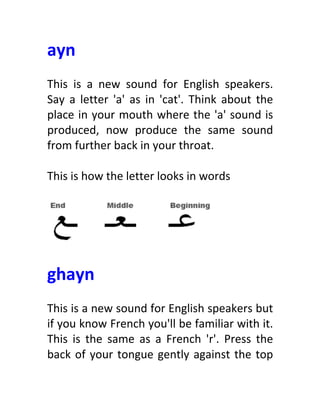
ayn	


This	
   is	
   a	
   new	
   sound	
   for	
   English	
   speakers.	
  
Say	
   a	
   letter	
   'a'	
   as	
   in	
   'cat'.	
   Think	
   about	
   the	
  
place	
  in	
  your	
  mouth	
  where	
  the	
  'a'	
  sound	
  is	
  
produced,	
   now	
   produce	
   the	
   same	
   sound	
  
from	
  further	
  back	
  in	
  your	
  throat.	


This	
  is	
  how	
  the	
  letter	
  looks	
  in	
  words	


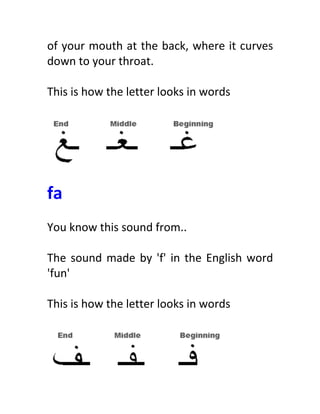
ghayn	


This	
  is	
  a	
  new	
  sound	
  for	
  English	
  speakers	
  but	
  
if	
  you	
  know	
  French	
  you'll	
  be	
  familiar	
  with	
  it.	
  
This	
   is	
   the	
   same	
   as	
   a	
   French	
   'r'.	
   Press	
   the	
  
back	
  of	
  your	
  tongue	
  gently	
  against	
  the	
  top	
  
of	
  your	
  mouth	
  at	
  the	
  back,	
  where	
  it	
  curves	
  
down	
  to	
  your	
  throat.	


This	
  is	
  how	
  the	
  letter	
  looks	
  in	
  words	


fa	


You	
  know	
  this	
  sound	
  from..	


The	
  sound	
  made	
  by	
  'f'	
  in	
  the	
  English	
  word	
  
'fun'	


This	
  is	
  how	
  the	
  letter	
  looks	
  in	
  words	


qaf	


This	
   is	
   a	
   new	
   sound	
   for	
   English	
   speakers.	
  
Think	
  about	
  how	
  you	
  make	
  the	
  sound	
  for	
  a	
  
letter	
   'k'	
   -­‐	
   you	
   make	
   it	
   by	
   pressing	
   the	
  
middle	
   of	
   your	
   tongue	
   to	
   the	
   roof	
   of	
   your	
  
mouth	
  then	
  releasing	
  it	
  suddenly	
  to	
  give	
  a	
  
short	
  explosion	
  of	
  air.	
  To	
  make	
  the	
  sound	
  of	
  
'qaf',	
   make	
   a	
   similar	
   explosion	
   of	
   air	
   by	
  
releasing	
   the	
   back	
   of	
   your	
   tongue	
   at	
   the	
  
back	
  of	
  your	
  mouth,	
  where	
  it	
  curves	
  down	
  
into	
  your	
  throat.	


This	
  is	
  how	
  the	
  letter	
  looks	
  in	
  words	


kaf	


You	
  know	
  this	
  sound	
  from..	


The	
  sound	
  made	
  by	
  'k'	
  in	
  the	
  English	
  word	
  
'keep'	


This	
  is	
  how	
  the	
  letter	
  looks	
  in	
  words	


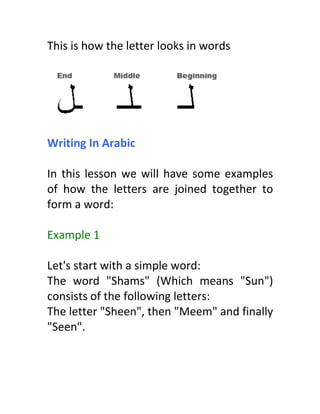
lam	


You	
  know	
  this	
  sound	
  from..	


The	
  sound	
  made	
  by	
  'l'	
  in	
  the	
  English	
  word	
  
'last'	


This	
  is	
  how	
  the	
  letter	
  looks	
  in	
  words	


Writing	
  In	
  Arabic	


In	
  this	
  lesson	
  we	
  will	
  have	
  some	
  examples	
  
of	
   how	
   the	
   letters	
   are	
   joined	
   together	
   to	
  
form	
  a	
  word:	


Example	
  1	


Let's	
  start	
  with	
  a	
  simple	
  word:	
  
The	
   word	
   "Shams"	
   (Which	
   means	
   "Sun")	
  
consists	
  of	
  the	
  following	
  letters:	
  
The	
  letter	
  "Sheen",	
  then	
  "Meem"	
  and	
  finally	
  
"Seen".	


• We	
   start	
   with	
   a	
   "Sheen"	
   	
   in	
   its	
   initial	
  
form..	
  
• Then	
  the	
  "Meem"	
  	
  in	
  the	
  medial	
  form..	
  
• Finally	
  the	
  "Seen"	
  	
  in	
  the	
  final	
  form..	


Remember	
  to	
  start	
  from	
  right	
  to	
  left.	


After	
   joining	
   the	
   letters	
   together	
   we	
   have	
  
the	
  word	
  "Shams":	


Note:	
  Please	
  read	
  “Writing	
  In	
  Arabic”	
  lesson	
  
for	
   more	
   clarity,	
   you	
   can	
   find	
   it	
   in	
   theory	
  
class.	
  

1 theory

  • 1.
    Basic  facts     Here   are   five   basic   facts   about   the   Arabic   alphabet.   Read   them   before   you   start   the   course  and  everything  will  make  a  lot  more   sense.     1)  The  Arabic  alphabet  contains  28  letters.   In   addition   to   the   28   letters,   there   are   3   special   characters   that   are   written   above   and  below  other  letters.     2)  Arabic  contains  5  sounds  that  we  do  not   use  in  English.  You'll  need  to  try  extra  hard   to  learn  to  pronounce  these  sounds.     3)  Arabic  is  read  from  right  to  left  and  the   letters  in  words  also  run  from  right  to  left.   Here   is   an   example   using   the   English   alphabet:   English  order:  This  is  my  new  car.   Arabic  order:  .rac  wen  ym  si  sihT  
  • 2.
      4)   Each   Arabic   letter   can   take   a   different   form   depending   whether   it's   at   the   beginning,  in  the  middle  or  at  the  end  of  the   word.   This   is   not   so   different   to   English   where   some   words   take   a   capital   letter   at   the   beginning.   In   the   English   alphabet   capital   letters   look   completely   different   to   lower   case  letters:  A  a  /  B  b  When  you  learnt  to   read   the   English   alphabet,   you   learnt   to   recognise  the  capital  letters  as  well  as  their   lower  case  forms.  In  Arabic  you  also  need  to   learn  to  recognise  more  than  one  form  of  a   letter.     5)   When   saying   the   Arabic   alphabet,   each   letter   has   a   name.   For   example,   the   first   four  letters  of  the  Arabic  alphabet  are  alif,   baa,  taa,  thaa.  These  names  are  different  to   the  sound  that  the  letter  makes.  
  • 3.
    Again,   this   is   the   same   as   English.   We   pronounce   the   first   four   letters   of   the   English   alphabet   ay,   bee,   see,   dee   but   in   words   the   letters   have   different   sounds.   Think   about   how   'c'   sounds   in   'cat'   -­‐   it   sounds  different  to  when  we  talk  about  the   letter  C  ("see").     ba     You  know  this  sound  from..     The  sound  made  by  'b'  in  the  English  word   'boy'     How  does  this  letter  look  in  words?     As  you  read  on  the  page  of  basic  facts,  each   Arabic  letter  takes  a  different  form  when  it   appears  at  different  places  in  a  word.  Here  
  • 4.
    is  how  this  letter  looks  when  written  at  the   beginning,  middle  or  end  of  a  word:         Each   of   these   forms   look   slightly   different   but   they're   the   same   letter   and   they're   pronounced  the  same  way.     Now   let's   practise   recognising   this   letter   when   it's   disguised   in   a   word,   surrounded   by  other  letters.  Here  are  three  words  that   contain  a  letter  'ba'.  Can  you  spot  it?    
  • 5.
        Did  you   find   the   letter   'ba'?   Here   are   the   same  words  with  the  letter  'ba'  highlighted   in  blue.    
  • 6.
        In  Arabic   there   are   three   characters   that   function   differently   to   the   other   letters   of   the   alphabet.   These   characters   are   called   fatha,  kasrah  and  dammah.  They  represent   the  sounds  'a',  'i'  and  'u'.     What's  different  about  these  characters?    
  • 7.
    They're  always  written  the  same,  no  matter   where  they  are  in  a  word.   They're   not   written   in   line   with   other   letters.   They're   go   above   or   below   the   previous  letter.     fatha     You  know  this  sound  from..     The  sound  made  by  'a'  in  the  English  word   'cat'     How  does  it  look  in  words?         The   character   is   written   above   the   letter   before   it.   Look   at   the   example.   The   character   is   written   above   a   letter   'b',   to   give  the  sound  'ba'.  
  • 8.
        kasrah     You  know  this  sound  from..     The  sound  made  by  'i'  in  the  English  word   'hit'     How  does  it  look  in  words?         The   character   is   written   below   the   letter   before  it.  In  this  example  it's  written  below   a  letter  'b',  to  give  the  sound  'bi'.    
  • 9.
        dammah     You  know  this  sound  from..     The  sound  made  by  'u'  in  the  English  word   'but'     How  does  it  look  in  words?         The   character   is   written   above   the   letter   before  it.  In  this  example  it's  written  above   a  letter  'b',  to  give  the  sound  'bu'.      
  • 10.
    alif     You  know  this  sound  from..     The  sound  made  by  "a"  in  the  English  word   'start'     This  is  how  the  letter  looks  in  words         waw     You  know  this  sound  from..     The  sound  made  by  'oo'  in  the  English  word   'cool'  
  • 11.
      This  is  how  the  letter  looks  in  words         ya     You  know  this  sound  from..     The  sound  made  by  'ee'  in  the  English  word   'feel'     This  is  how  the  letter  looks  in  words        
  • 12.
    ta     You  know  this  sound  from..     The  sound  made  by  't'  in  the  English  word   'ten'     This  is  how  the  letter  looks  in  words         tha     You  know  this  sound  from..     The  sound  made  by  'th'  in  the  English  word   'three'    
  • 13.
    This  is  how  the  letter  looks  in  words         miim     You  know  this  sound  from..     The  sounds  made  by  'm'  in  the  English  word   'make'     This  is  how  the  letter  looks  in  words          
  • 14.
    nuun     You  know  this  sound  from..     The  sounds  made  by  'n'  in  the  English  word   'now'     This  is  how  the  letter  looks  in  words         ha     You  know  this  sound  from..     The  sounds  made  by  'h'  in  the  English  word   'hot'    
  • 15.
    This  is  how  the  letter  looks  in  words         jiim     You  know  this  sound  from..     The  sound  made  by  'j'  in  the  English  word   'just'   The  sound  made  by  's'  in  the  English  word   'leisure'  or  the  'j'  in  the  French  word  'je'     Arabic   speakers   pronounce   this   letter   in   two   different   ways,   depending   on   their   country.   You   can   use   whichever   pronunciation  you  like.     This  is  how  the  letter  looks  in  words  
  • 16.
          hha     You  know  this  sound  from..     This  is  a  new  sound  for  English  speakers.  It's   similar  to  a  'h'  sound  but  your  breath  needs   to   come   out   stronger.   Imagine   you   are   blowing  on  a  window  to  steam  it  up  -­‐  this  is   the  sound  you  would  make.     This  is  how  the  letter  looks  in  words      
  • 17.
    kha     You  know  this  sound  from..     This   is   a   new   sound   for   English   speakers.   Unless  you  know  Spanish,  you  might  not  be   familiar  with  it.   It's   the   sound   made   by   'j'   in   the   Spanish   word  'trabajo'   Think  of  it  as  a  soft  'k'  sound.     This  is  how  the  letter  looks  in  words                
  • 18.
    daal     You  know  this  sound  from..     The  sound  made  by  'd'  in  the  English  word   'dog'     This  is  how  the  letter  looks  in  words         thaal     You  know  this  sound  from..     The  sound  made  by  'th'  in  the  English  word   'then'    
  • 19.
    This  is  how  the  letter  looks  in  words         ra     This  is  a  new  sound  for  English  speakers.   If  you  know  Spanish,  this  is  the  sound  made   by  a  letter  'r'  in  Spanish.   This  is  different  to  the  sound  of  an  English   'r',  it  is  pronounced  with  the  tongue  further   forward,  just  behind  the  teeth.     This  is  how  the  letter  looks  in  words        
  • 20.
    zay     You  know  this  sound  from..     The  sound  made  by  'z'  in  the  English  word   'zoo'     This  is  how  the  letter  looks  in  words     siin     You  know  this  sound  from..     The  sound  made  by  's'  in  the  English  word   'six'     This  is  how  the  letter  looks  in  words    
  • 21.
        shiin     You  know  this  sound  from..     The  sound  made  by  'sh'  in  the  English  word   'shop'     This  is  how  the  letter  looks  in  words              
  • 22.
    taa     This   is   a   new   sound   for   English   speakers.   Start   by   putting   your   tongue   and   teeth   in   postion  to  say  't'.  When  making  the  sound   add   extra   emphasis   from   the   back   of   the   throat.  You  could  think  of  it  as  a  throaty  't'   sound.     This  is  how  the  letter  looks  in  words         thaa     This   is   a   new   sound   for   English   speakers.   Start   by   putting   your   tongue   and   teeth   in   postion   to   say   'th'   as   in   the   word   'then'.   When   making   the   sound   add   extra  
  • 23.
    emphasis  from  the  back  of  the  throat.  You   could  think  of  it  as  a  throaty  'th'  sound.     This  is  how  the  letter  looks  in  words         saad     This   is   a   new   sound   for   English   speakers.   Start   by   putting   your   tongue   and   teeth   in   postion  to  say  's'.  When  making  the  sound   add   extra   emphasis   from   the   back   of   the   throat.  You  could  think  of  it  as  a  throaty  's'   sound.     This  is  how  the  letter  looks  in  words    
  • 24.
        daad     This   is   a   new   sound   for   English   speakers.   Start   by   putting   your   tongue   and   teeth   in   postion  to  say  'd'.  When  making  the  sound   add   extra   emphasis   from   the   back   of   the   throat.  You  could  think  of  it  as  a  throaty  'd'   sound.     This  is  how  the  letter  looks  in  words            
  • 25.
    ayn     This   is   a   new   sound   for   English   speakers.   Say   a   letter   'a'   as   in   'cat'.   Think   about   the   place  in  your  mouth  where  the  'a'  sound  is   produced,   now   produce   the   same   sound   from  further  back  in  your  throat.     This  is  how  the  letter  looks  in  words         ghayn     This  is  a  new  sound  for  English  speakers  but   if  you  know  French  you'll  be  familiar  with  it.   This   is   the   same   as   a   French   'r'.   Press   the   back  of  your  tongue  gently  against  the  top  
  • 26.
    of  your  mouth  at  the  back,  where  it  curves   down  to  your  throat.     This  is  how  the  letter  looks  in  words         fa     You  know  this  sound  from..     The  sound  made  by  'f'  in  the  English  word   'fun'     This  is  how  the  letter  looks  in  words      
  • 27.
    qaf     This   is   a   new   sound   for   English   speakers.   Think  about  how  you  make  the  sound  for  a   letter   'k'   -­‐   you   make   it   by   pressing   the   middle   of   your   tongue   to   the   roof   of   your   mouth  then  releasing  it  suddenly  to  give  a   short  explosion  of  air.  To  make  the  sound  of   'qaf',   make   a   similar   explosion   of   air   by   releasing   the   back   of   your   tongue   at   the   back  of  your  mouth,  where  it  curves  down   into  your  throat.     This  is  how  the  letter  looks  in  words            
  • 28.
    kaf     You  know  this  sound  from..     The  sound  made  by  'k'  in  the  English  word   'keep'     This  is  how  the  letter  looks  in  words         lam     You  know  this  sound  from..     The  sound  made  by  'l'  in  the  English  word   'last'    
  • 29.
    This  is  how  the  letter  looks  in  words         Writing  In  Arabic     In  this  lesson  we  will  have  some  examples   of   how   the   letters   are   joined   together   to   form  a  word:     Example  1     Let's  start  with  a  simple  word:   The   word   "Shams"   (Which   means   "Sun")   consists  of  the  following  letters:   The  letter  "Sheen",  then  "Meem"  and  finally   "Seen".    
  • 30.
    • We  start   with   a   "Sheen"     in   its   initial   form..   • Then  the  "Meem"    in  the  medial  form..   • Finally  the  "Seen"    in  the  final  form..     Remember  to  start  from  right  to  left.         After   joining   the   letters   together   we   have   the  word  "Shams":        
  • 31.
    Note:  Please  read  “Writing  In  Arabic”  lesson   for   more   clarity,   you   can   find   it   in   theory   class.