Flood and Riverbank Erosion Risk Management
Investment Program (FRERMIP)
Navigation in Main Rivers - Impact
on River Management
Nazmul Hasan Diptu
Stamford university Bangladesh
30 Nov 2020
1
Flood and Riverbank Erosion Risk Management
Investment Program (FRERMIP)
Navigation in Main Rivers
 Background
 Present Status,
 Future Prospects,
 Navigation Beyond Border
 Way Forward
2
Navigation in Main Rivers
Background:
 British Rail Companies began sailing mechanized
vessels around 1840
 Lord William Bentinck is the first steamer that
propelled River Ganges in 1834
 Country’s Inland waterways network is around
24000 km
 BIWTA established in 1958 under an ordinance
 BIWTA maintains 6000 km main river artery
3
Navigation in Main Rivers
Present Status:
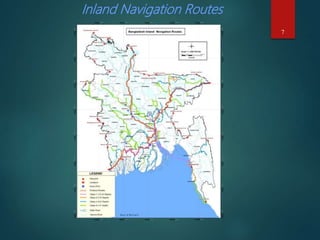
 Present Navigation Routes
 Route Classification
 Navigation in Main Rivers
 Passenger & Cargo Movement
 Navigation Around Dhaka City
 IWT Corridors (India-BD Protocol)
4
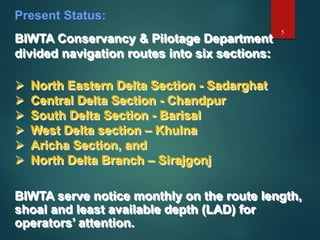
BIWTA Conservancy & Pilotage Department
divided navigation routes into six sections:
 North Eastern Delta Section - Sadarghat
 Central Delta Section - Chandpur
 South Delta Section - Barisal
 West Delta section – Khulna
 Aricha Section, and
 North Delta Branch – Sirajgonj
BIWTA serve notice monthly on the route length,
shoal and least available depth (LAD) for
operators’ attention.
5
Present Status:
6
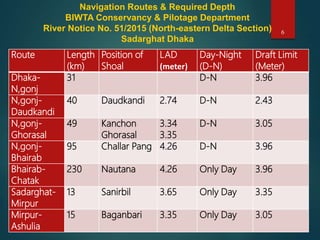
Route Length
(km)
Position of
Shoal
LAD
(meter)
Day-Night
(D-N)
Draft Limit
(Meter)
Dhaka-
N,gonj
31 D-N 3.96
N,gonj-
Daudkandi
40 Daudkandi 2.74 D-N 2.43
N,gonj-
Ghorasal
49 Kanchon
Ghorasal
3.34
3.35
D-N 3.05
N,gonj-
Bhairab
95 Challar Pang 4.26 D-N 3.96
Bhairab-
Chatak
230 Nautana 4.26 Only Day 3.96
Sadarghat-
Mirpur
13 Sanirbil 3.65 Only Day 3.35
Mirpur-
Ashulia
15 Baganbari 3.35 Only Day 3.05
Navigation Routes & Required Depth
BIWTA Conservancy & Pilotage Department
River Notice No. 51/2015 (North-eastern Delta Section)
Sadarghat Dhaka
7
Inland Navigation Routes
8Route Classification:
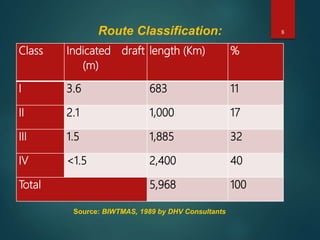
Class Indicated draft
(m)
length (Km) %
I 3.6 683 11
II 2.1 1,000 17
III 1.5 1,885 32
IV <1.5 2,400 40
Total 5,968 100
Source: BIWTMAS, 1989 by DHV Consultants
9
Route Classification:
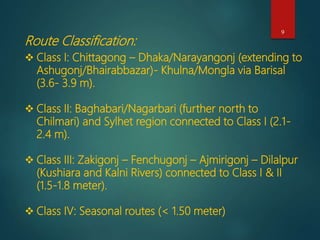
 Class I: Chittagong – Dhaka/Narayangonj (extending to
Ashugonj/Bhairabbazar)- Khulna/Mongla via Barisal
(3.6- 3.9 m).
 Class II: Baghabari/Nagarbari (further north to
Chilmari) and Sylhet region connected to Class I (2.1-
2.4 m).
 Class III: Zakigonj – Fenchugonj – Ajmirigonj – Dilalpur
(Kushiara and Kalni Rivers) connected to Class I & II
(1.5-1.8 meter).
 Class IV: Seasonal routes (< 1.50 meter)
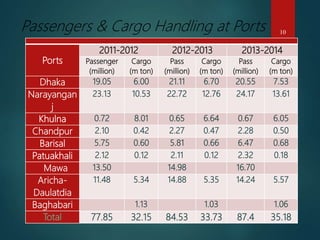
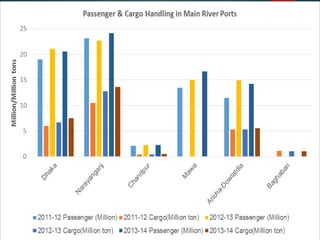
10Passengers & Cargo Handling at Ports
Ports
2011-2012 2012-2013 2013-2014
Passenger
(million)
Cargo
(m ton)
Pass
(million)
Cargo
(m ton)
Pass
(million)
Cargo
(m ton)
Dhaka 19.05 6.00 21.11 6.70 20.55 7.53
Narayangan
j
23.13 10.53 22.72 12.76 24.17 13.61
Khulna 0.72 8.01 0.65 6.64 0.67 6.05
Chandpur 2.10 0.42 2.27 0.47 2.28 0.50
Barisal 5.75 0.60 5.81 0.66 6.47 0.68
Patuakhali 2.12 0.12 2.11 0.12 2.32 0.18
Mawa 13.50 14.98 16.70
Aricha-
Daulatdia
11.48 5.34 14.88 5.35 14.24 5.57
Baghabari 1.13 1.03 1.06
Total 77.85 32.15 84.53 33.73 87.4 35.18
11Route Classification:
around Dhaka.
12
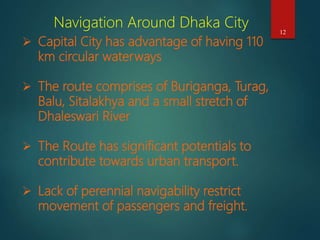
Navigation Around Dhaka City
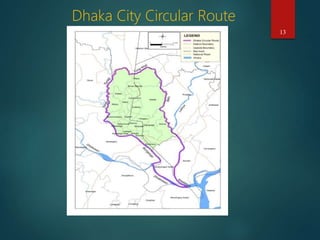
 Capital City has advantage of having 110
km circular waterways
 The route comprises of Buriganga, Turag,
Balu, Sitalakhya and a small stretch of
Dhaleswari River
 The Route has significant potentials to
contribute towards urban transport.
 Lack of perennial navigability restrict
movement of passengers and freight.
13
Dhaka City Circular Route
14
Circular Route Navigability Problem
 There are around 21 bridges along the circular
route with restricted navigation clearance.
 Government constituted a committee headed by
CE, RHD with members from BWDB, BIWTA,
BIWTC, LGED and Railway.
 Mr. Abdul Hye, BIWTA Director, C&P, on 20 March
informed that at least 11 (eleven) bridges needs to
be rebuilt / remodeled to make the circular route
operational.
 No decision yet on clearing the route for
uninterrupted navigation.
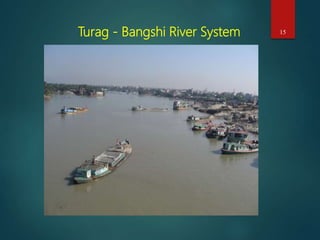
15Turag - Bangshi River System
16
Navigation in Main Rivers:
 Ganges/Padma, Jamuna, Meghna provide a
vast network,
 Navigation in Main Rivers started early in 1800,
 Main route was Kolkata to Dibrugarh through
Padma – Jamuna Rivers during British time,
 Inter-country navigation was suspended after
the war with India in 1965
17
India-BD Protocol Agreement
To facilitate trade and commerce Protocol
Agreement was signed in 1972 to use IWT
through the routes:
 Bangladesh – India,
 India to India through Bangladesh (Transit
Route)
18
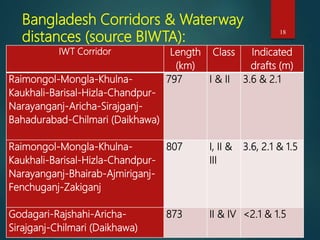
Bangladesh Corridors & Waterway
distances (source BIWTA):
IWT Corridor Length
(km)
Class Indicated
drafts (m)
Raimongol-Mongla-Khulna-
Kaukhali-Barisal-Hizla-Chandpur-
Narayanganj-Aricha-Sirajganj-
Bahadurabad-Chilmari (Daikhawa)
797 I & II 3.6 & 2.1
Raimongol-Mongla-Khulna-
Kaukhali-Barisal-Hizla-Chandpur-
Narayanganj-Bhairab-Ajmiriganj-
Fenchuganj-Zakiganj
807 I, II &
III
3.6, 2.1 & 1.5
Godagari-Rajshahi-Aricha-
Sirajganj-Chilmari (Daikhawa)
873 II & IV <2.1 & 1.5
19
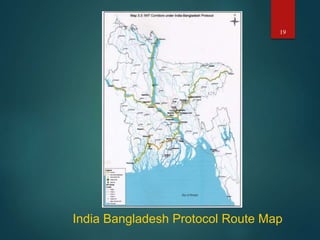
India Bangladesh Protocol Route Map
20
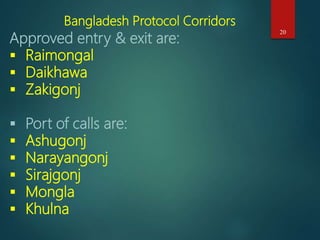
Bangladesh Protocol Corridors
Approved entry & exit are:
 Raimongal
 Daikhawa
 Zakigonj
 Port of calls are:
 Ashugonj
 Narayangonj
 Sirajgonj
 Mongla
 Khulna
21
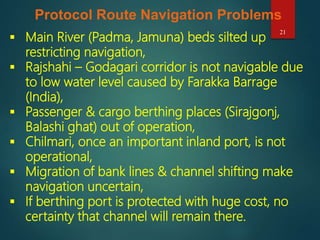
Protocol Route Navigation Problems
 Main River (Padma, Jamuna) beds silted up
restricting navigation,
 Rajshahi – Godagari corridor is not navigable due
to low water level caused by Farakka Barrage
(India),
 Passenger & cargo berthing places (Sirajgonj,
Balashi ghat) out of operation,
 Chilmari, once an important inland port, is not
operational,
 Migration of bank lines & channel shifting make
navigation uncertain,
 If berthing port is protected with huge cost, no
certainty that channel will remain there.
22
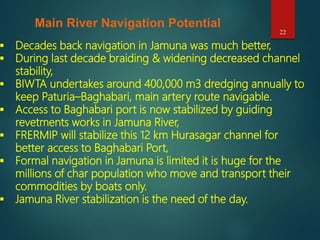
Main River Navigation Potential
 Decades back navigation in Jamuna was much better,
 During last decade braiding & widening decreased channel
stability,
 BIWTA undertakes around 400,000 m3 dredging annually to
keep Paturia–Baghabari, main artery route navigable.
 Access to Baghabari port is now stabilized by guiding
revetments works in Jamuna River,
 FRERMIP will stabilize this 12 km Hurasagar channel for
better access to Baghabari Port,
 Formal navigation in Jamuna is limited it is huge for the
millions of char population who move and transport their
commodities by boats only.
 Jamuna River stabilization is the need of the day.
23
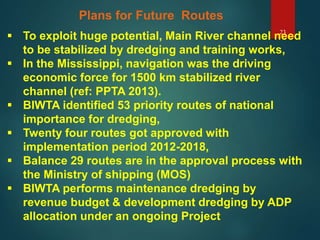
Plans for Future Routes
 To exploit huge potential, Main River channel need
to be stabilized by dredging and training works,
 In the Mississippi, navigation was the driving
economic force for 1500 km stabilized river
channel (ref: PPTA 2013).
 BIWTA identified 53 priority routes of national
importance for dredging,
 Twenty four routes got approved with
implementation period 2012-2018,
 Balance 29 routes are in the approval process with
the Ministry of shipping (MOS)
 BIWTA performs maintenance dredging by
revenue budget & development dredging by ADP
allocation under an ongoing Project
24
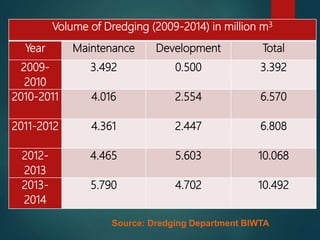
Volume of Dredging (2009-2014) in million m3
Year Maintenance Development Total
2009-
2010
3.492 0.500 3.392
2010-2011 4.016 2.554 6.570
2011-2012 4.361 2.447 6.808
2012-
2013
4.465 5.603 10.068
2013-
2014
5.790 4.702 10.492
Source: Dredging Department BIWTA
25
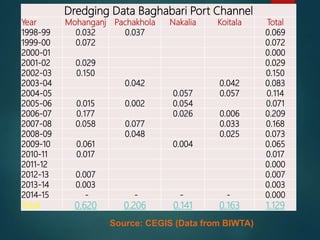
Source: CEGIS (Data from BIWTA)
Dredging Data Baghabari Port Channel
Year Mohanganj Pachakhola Nakalia Koitala Total
1998-99 0.032 0.037 0.069
1999-00 0.072 0.072
2000-01 0.000
2001-02 0.029 0.029
2002-03 0.150 0.150
2003-04 0.042 0.042 0.083
2004-05 0.057 0.057 0.114
2005-06 0.015 0.002 0.054 0.071
2006-07 0.177 0.026 0.006 0.209
2007-08 0.058 0.077 0.033 0.168
2008-09 0.048 0.025 0.073
2009-10 0.061 0.004 0.065
2010-11 0.017 0.017
2011-12 0.000
2012-13 0.007 0.007
2013-14 0.003 0.003
2014-15 - - - - 0.000
Total 0.620 0.206 0.141 0.163 1.129
26
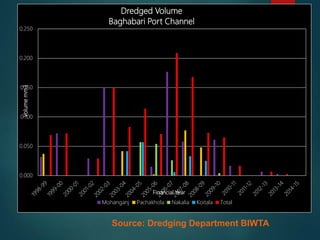
Source: Dredging Department BIWTA
0.000
0.050
0.100
0.150
0.200
0.250
Volumemm3
Financial Year
Dredged Volume
Baghabari Port Channel
Mohanganj Pachakhola Nakalia Koitala Total
27
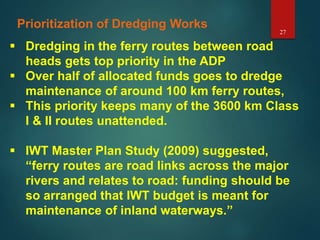
Prioritization of Dredging Works
 Dredging in the ferry routes between road
heads gets top priority in the ADP
 Over half of allocated funds goes to dredge
maintenance of around 100 km ferry routes,
 This priority keeps many of the 3600 km Class
I & II routes unattended.
 IWT Master Plan Study (2009) suggested,
“ferry routes are road links across the major
rivers and relates to road: funding should be
so arranged that IWT budget is meant for
maintenance of inland waterways.”
28
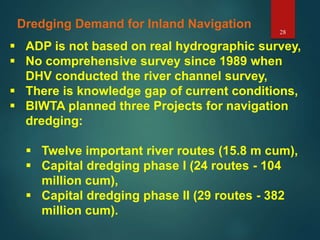
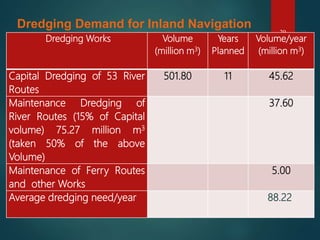
Dredging Demand for Inland Navigation
 ADP is not based on real hydrographic survey,
 No comprehensive survey since 1989 when
DHV conducted the river channel survey,
 There is knowledge gap of current conditions,
 BIWTA planned three Projects for navigation
dredging:
 Twelve important river routes (15.8 m cum),
 Capital dredging phase I (24 routes - 104
million cum),
 Capital dredging phase II (29 routes - 382
million cum).
29
Dredging Demand for Inland Navigation
Dredging Works Volume
(million m3)
Years
Planned
Volume/year
(million m3)
Capital Dredging of 53 River
Routes
501.80 11 45.62
Maintenance Dredging of
River Routes (15% of Capital
volume) 75.27 million m3
(taken 50% of the above
Volume)
37.60
Maintenance of Ferry Routes
and other Works
5.00
Average dredging need/year 88.22
30
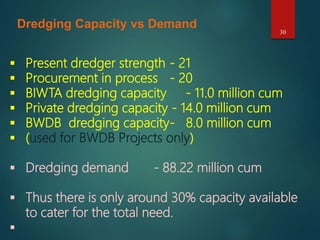
Dredging Capacity vs Demand
 Present dredger strength - 21
 Procurement in process - 20
 BIWTA dredging capacity - 11.0 million cum
 Private dredging capacity - 14.0 million cum
 BWDB dredging capacity- 8.0 million cum
 (used for BWDB Projects only)
 Dredging demand - 88.22 million cum
 Thus there is only around 30% capacity available
to cater for the total need.

31
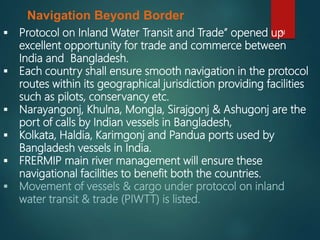
Navigation Beyond Border
 Protocol on Inland Water Transit and Trade” opened up
excellent opportunity for trade and commerce between
India and Bangladesh.
 Each country shall ensure smooth navigation in the protocol
routes within its geographical jurisdiction providing facilities
such as pilots, conservancy etc.
 Narayangonj, Khulna, Mongla, Sirajgonj & Ashugonj are the
port of calls by Indian vessels in Bangladesh,
 Kolkata, Haldia, Karimgonj and Pandua ports used by
Bangladesh vessels in India.
 FRERMIP main river management will ensure these
navigational facilities to benefit both the countries.
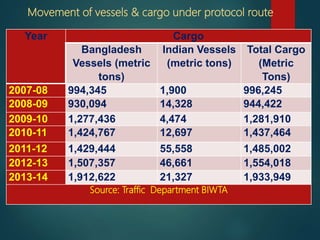
 Movement of vessels & cargo under protocol on inland
water transit & trade (PIWTT) is listed.
32
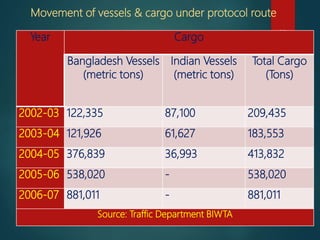
Movement of vessels & cargo under protocol route
Year Cargo
Bangladesh Vessels
(metric tons)
Indian Vessels
(metric tons)
Total Cargo
(Tons)
2002-03 122,335 87,100 209,435
2003-04 121,926 61,627 183,553
2004-05 376,839 36,993 413,832
2005-06 538,020 - 538,020
2006-07 881,011 - 881,011
Source: Traffic Department BIWTA
33
Movement of vessels & cargo under protocol route
Year Cargo
Bangladesh
Vessels (metric
tons)
Indian Vessels
(metric tons)
Total Cargo
(Metric
Tons)
2007-08 994,345 1,900 996,245
2008-09 930,094 14,328 944,422
2009-10 1,277,436 4,474 1,281,910
2010-11 1,424,767 12,697 1,437,464
2011-12 1,429,444 55,558 1,485,002
2012-13 1,507,357 46,661 1,554,018
2013-14 1,912,622 21,327 1,933,949
Source: Traffic Department BIWTA
34
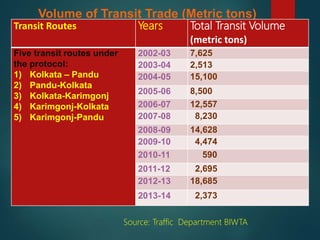
Volume of Transit Trade (Metric tons)
Transit Routes Years Total Transit Volume
(metric tons)
Five transit routes under
the protocol:
1) Kolkata – Pandu
2) Pandu-Kolkata
3) Kolkata-Karimgonj
4) Karimgonj-Kolkata
5) Karimgonj-Pandu
2002-03 7,625
2003-04 2,513
2004-05 15,100
2005-06 8,500
2006-07 12,557
2007-08 8,230
2008-09 14,628
2009-10 4,474
2010-11 590
2011-12 2,695
2012-13 18,685
2013-14 2,373
Source: Traffic Department BIWTA
35
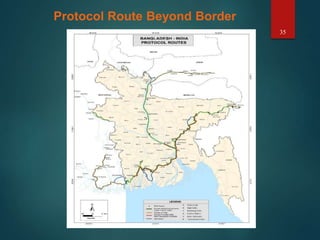
Protocol Route Beyond Border
Source: Dev. of Transport Corridor, Phase-1, Vol II, STUP Consultants, 2007
36
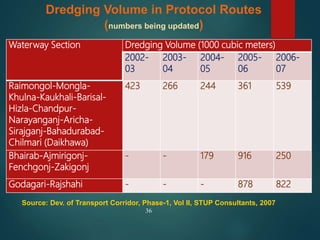
Dredging Volume in Protocol Routes
(numbers being updated)
Waterway Section Dredging Volume (1000 cubic meters)
2002-
03
2003-
04
2004-
05
2005-
06
2006-
07
Raimongol-Mongla-
Khulna-Kaukhali-Barisal-
Hizla-Chandpur-
Narayanganj-Aricha-
Sirajganj-Bahadurabad-
Chilmari (Daikhawa)
423 266 244 361 539
Bhairab-Ajmirigonj-
Fenchgonj-Zakigonj
- - 179 916 250
Godagari-Rajshahi - - - 878 822
Source: Dev. of Transport Corridor, Phase-1, Vol II, STUP Consultants, 2007
37
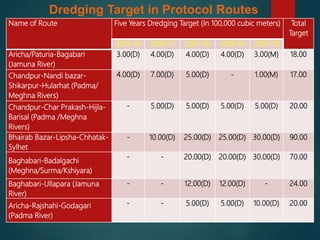
Dredging Target in Protocol Routes
Name of Route Five Years Dredging Target (In 100,000 cubic meters) Total
Target
2015-16 2016-17 2017-18 2018-19 2019-20
Aricha/Paturia-Bagabari
(Jamuna River)
3.00(D) 4.00(D) 4.00(D) 4.00(D) 3.00(M) 18.00
Chandpur-Nandi bazar-
Shikarpur-Hularhat (Padma/
Meghna Rivers)
4.00(D) 7.00(D) 5.00(D) - 1.00(M) 17.00
Chandpur-Char Prakash-Hijla-
Barisal (Padma /Meghna
Rivers)
- 5.00(D) 5.00(D) 5.00(D) 5.00(D) 20.00
Bhairab Bazar-Lipsha-Chhatak-
Sylhet
- 10.00(D) 25.00(D) 25.00(D) 30.00(D) 90.00
Baghabari-Badalgachi
(Meghna/Surma/Kshiyara)
- - 20.00(D) 20.00(D) 30.00(D) 70.00
Baghabari-Ullapara (Jamuna
River)
- - 12.00(D) 12.00(D) - 24.00
Aricha-Rajshahi-Godagari
(Padma River)
- - 5.00(D) 5.00(D) 10.00(D) 20.00
Navigation Potential Beyond Border
 There is significant potential for IWT development in the
northeastern India through Bangladesh,
 India designated 1,800 km navigable waterways of
Brahmaputra and Barak system as NW-2 for the transport
of long distance bulk goods.
 Expansion of the sector is limited by natural restrictions in
river system due to siltation and shallow water levels
 IWT competes favorably with road & rail for bulk transport
and could play important role in promoting bilateral trade
in an expanding regional economy.
(Source: strategy report, June 2008, Natural Resources, Water , Environment, Nexus for Development
and Growth in Northeast India)
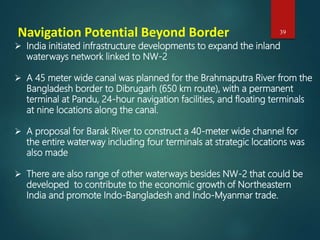
Navigation Potential Beyond Border
 India initiated infrastructure developments to expand the inland
waterways network linked to NW-2
 A 45 meter wide canal was planned for the Brahmaputra River from the
Bangladesh border to Dibrugarh (650 km route), with a permanent
terminal at Pandu, 24-hour navigation facilities, and floating terminals
at nine locations along the canal.
 A proposal for Barak River to construct a 40-meter wide channel for
the entire waterway including four terminals at strategic locations was
also made
 There are also range of other waterways besides NW-2 that could be
developed to contribute to the economic growth of Northeastern
India and promote Indo-Bangladesh and Indo-Myanmar trade.
39
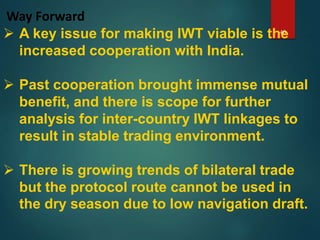
Way Forward
 A key issue for making IWT viable is the
increased cooperation with India.
 Past cooperation brought immense mutual
benefit, and there is scope for further
analysis for inter-country IWT linkages to
result in stable trading environment.
 There is growing trends of bilateral trade
but the protocol route cannot be used in
the dry season due to low navigation draft.
40
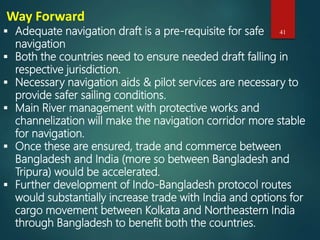
Way Forward
 Adequate navigation draft is a pre-requisite for safe
navigation
 Both the countries need to ensure needed draft falling in
respective jurisdiction.
 Necessary navigation aids & pilot services are necessary to
provide safer sailing conditions.
 Main River management with protective works and
channelization will make the navigation corridor more stable
for navigation.
 Once these are ensured, trade and commerce between
Bangladesh and India (more so between Bangladesh and
Tripura) would be accelerated.
 Further development of Indo-Bangladesh protocol routes
would substantially increase trade with India and options for
cargo movement between Kolkata and Northeastern India
through Bangladesh to benefit both the countries.
41
Thanks you for Listening!
Have a Wonderful Weekend
42

Frermip presentation navigation in main rivers .ppt v4

  • 1.
    Flood and RiverbankErosion Risk Management Investment Program (FRERMIP) Navigation in Main Rivers - Impact on River Management Nazmul Hasan Diptu Stamford university Bangladesh 30 Nov 2020 1
  • 2.
    Flood and RiverbankErosion Risk Management Investment Program (FRERMIP) Navigation in Main Rivers  Background  Present Status,  Future Prospects,  Navigation Beyond Border  Way Forward 2
  • 3.
    Navigation in MainRivers Background:  British Rail Companies began sailing mechanized vessels around 1840  Lord William Bentinck is the first steamer that propelled River Ganges in 1834  Country’s Inland waterways network is around 24000 km  BIWTA established in 1958 under an ordinance  BIWTA maintains 6000 km main river artery 3
  • 4.
    Navigation in MainRivers Present Status:  Present Navigation Routes  Route Classification  Navigation in Main Rivers  Passenger & Cargo Movement  Navigation Around Dhaka City  IWT Corridors (India-BD Protocol) 4
  • 5.
    BIWTA Conservancy &Pilotage Department divided navigation routes into six sections:  North Eastern Delta Section - Sadarghat  Central Delta Section - Chandpur  South Delta Section - Barisal  West Delta section – Khulna  Aricha Section, and  North Delta Branch – Sirajgonj BIWTA serve notice monthly on the route length, shoal and least available depth (LAD) for operators’ attention. 5 Present Status:
  • 6.
    6 Route Length (km) Position of Shoal LAD (meter) Day-Night (D-N) DraftLimit (Meter) Dhaka- N,gonj 31 D-N 3.96 N,gonj- Daudkandi 40 Daudkandi 2.74 D-N 2.43 N,gonj- Ghorasal 49 Kanchon Ghorasal 3.34 3.35 D-N 3.05 N,gonj- Bhairab 95 Challar Pang 4.26 D-N 3.96 Bhairab- Chatak 230 Nautana 4.26 Only Day 3.96 Sadarghat- Mirpur 13 Sanirbil 3.65 Only Day 3.35 Mirpur- Ashulia 15 Baganbari 3.35 Only Day 3.05 Navigation Routes & Required Depth BIWTA Conservancy & Pilotage Department River Notice No. 51/2015 (North-eastern Delta Section) Sadarghat Dhaka
  • 7.
  • 8.
    8Route Classification: Class Indicateddraft (m) length (Km) % I 3.6 683 11 II 2.1 1,000 17 III 1.5 1,885 32 IV <1.5 2,400 40 Total 5,968 100 Source: BIWTMAS, 1989 by DHV Consultants
  • 9.
    9 Route Classification:  ClassI: Chittagong – Dhaka/Narayangonj (extending to Ashugonj/Bhairabbazar)- Khulna/Mongla via Barisal (3.6- 3.9 m).  Class II: Baghabari/Nagarbari (further north to Chilmari) and Sylhet region connected to Class I (2.1- 2.4 m).  Class III: Zakigonj – Fenchugonj – Ajmirigonj – Dilalpur (Kushiara and Kalni Rivers) connected to Class I & II (1.5-1.8 meter).  Class IV: Seasonal routes (< 1.50 meter)
  • 10.
    10Passengers & CargoHandling at Ports Ports 2011-2012 2012-2013 2013-2014 Passenger (million) Cargo (m ton) Pass (million) Cargo (m ton) Pass (million) Cargo (m ton) Dhaka 19.05 6.00 21.11 6.70 20.55 7.53 Narayangan j 23.13 10.53 22.72 12.76 24.17 13.61 Khulna 0.72 8.01 0.65 6.64 0.67 6.05 Chandpur 2.10 0.42 2.27 0.47 2.28 0.50 Barisal 5.75 0.60 5.81 0.66 6.47 0.68 Patuakhali 2.12 0.12 2.11 0.12 2.32 0.18 Mawa 13.50 14.98 16.70 Aricha- Daulatdia 11.48 5.34 14.88 5.35 14.24 5.57 Baghabari 1.13 1.03 1.06 Total 77.85 32.15 84.53 33.73 87.4 35.18
  • 11.
  • 12.
    12 Navigation Around DhakaCity  Capital City has advantage of having 110 km circular waterways  The route comprises of Buriganga, Turag, Balu, Sitalakhya and a small stretch of Dhaleswari River  The Route has significant potentials to contribute towards urban transport.  Lack of perennial navigability restrict movement of passengers and freight.
  • 13.
  • 14.
    14 Circular Route NavigabilityProblem  There are around 21 bridges along the circular route with restricted navigation clearance.  Government constituted a committee headed by CE, RHD with members from BWDB, BIWTA, BIWTC, LGED and Railway.  Mr. Abdul Hye, BIWTA Director, C&P, on 20 March informed that at least 11 (eleven) bridges needs to be rebuilt / remodeled to make the circular route operational.  No decision yet on clearing the route for uninterrupted navigation.
  • 15.
    15Turag - BangshiRiver System
  • 16.
    16 Navigation in MainRivers:  Ganges/Padma, Jamuna, Meghna provide a vast network,  Navigation in Main Rivers started early in 1800,  Main route was Kolkata to Dibrugarh through Padma – Jamuna Rivers during British time,  Inter-country navigation was suspended after the war with India in 1965
  • 17.
    17 India-BD Protocol Agreement Tofacilitate trade and commerce Protocol Agreement was signed in 1972 to use IWT through the routes:  Bangladesh – India,  India to India through Bangladesh (Transit Route)
  • 18.
    18 Bangladesh Corridors &Waterway distances (source BIWTA): IWT Corridor Length (km) Class Indicated drafts (m) Raimongol-Mongla-Khulna- Kaukhali-Barisal-Hizla-Chandpur- Narayanganj-Aricha-Sirajganj- Bahadurabad-Chilmari (Daikhawa) 797 I & II 3.6 & 2.1 Raimongol-Mongla-Khulna- Kaukhali-Barisal-Hizla-Chandpur- Narayanganj-Bhairab-Ajmiriganj- Fenchuganj-Zakiganj 807 I, II & III 3.6, 2.1 & 1.5 Godagari-Rajshahi-Aricha- Sirajganj-Chilmari (Daikhawa) 873 II & IV <2.1 & 1.5
  • 19.
  • 20.
    20 Bangladesh Protocol Corridors Approvedentry & exit are:  Raimongal  Daikhawa  Zakigonj  Port of calls are:  Ashugonj  Narayangonj  Sirajgonj  Mongla  Khulna
  • 21.
    21 Protocol Route NavigationProblems  Main River (Padma, Jamuna) beds silted up restricting navigation,  Rajshahi – Godagari corridor is not navigable due to low water level caused by Farakka Barrage (India),  Passenger & cargo berthing places (Sirajgonj, Balashi ghat) out of operation,  Chilmari, once an important inland port, is not operational,  Migration of bank lines & channel shifting make navigation uncertain,  If berthing port is protected with huge cost, no certainty that channel will remain there.
  • 22.
    22 Main River NavigationPotential  Decades back navigation in Jamuna was much better,  During last decade braiding & widening decreased channel stability,  BIWTA undertakes around 400,000 m3 dredging annually to keep Paturia–Baghabari, main artery route navigable.  Access to Baghabari port is now stabilized by guiding revetments works in Jamuna River,  FRERMIP will stabilize this 12 km Hurasagar channel for better access to Baghabari Port,  Formal navigation in Jamuna is limited it is huge for the millions of char population who move and transport their commodities by boats only.  Jamuna River stabilization is the need of the day.
  • 23.
    23 Plans for FutureRoutes  To exploit huge potential, Main River channel need to be stabilized by dredging and training works,  In the Mississippi, navigation was the driving economic force for 1500 km stabilized river channel (ref: PPTA 2013).  BIWTA identified 53 priority routes of national importance for dredging,  Twenty four routes got approved with implementation period 2012-2018,  Balance 29 routes are in the approval process with the Ministry of shipping (MOS)  BIWTA performs maintenance dredging by revenue budget & development dredging by ADP allocation under an ongoing Project
  • 24.
    24 Volume of Dredging(2009-2014) in million m3 Year Maintenance Development Total 2009- 2010 3.492 0.500 3.392 2010-2011 4.016 2.554 6.570 2011-2012 4.361 2.447 6.808 2012- 2013 4.465 5.603 10.068 2013- 2014 5.790 4.702 10.492 Source: Dredging Department BIWTA
  • 25.
    25 Source: CEGIS (Datafrom BIWTA) Dredging Data Baghabari Port Channel Year Mohanganj Pachakhola Nakalia Koitala Total 1998-99 0.032 0.037 0.069 1999-00 0.072 0.072 2000-01 0.000 2001-02 0.029 0.029 2002-03 0.150 0.150 2003-04 0.042 0.042 0.083 2004-05 0.057 0.057 0.114 2005-06 0.015 0.002 0.054 0.071 2006-07 0.177 0.026 0.006 0.209 2007-08 0.058 0.077 0.033 0.168 2008-09 0.048 0.025 0.073 2009-10 0.061 0.004 0.065 2010-11 0.017 0.017 2011-12 0.000 2012-13 0.007 0.007 2013-14 0.003 0.003 2014-15 - - - - 0.000 Total 0.620 0.206 0.141 0.163 1.129
  • 26.
    26 Source: Dredging DepartmentBIWTA 0.000 0.050 0.100 0.150 0.200 0.250 Volumemm3 Financial Year Dredged Volume Baghabari Port Channel Mohanganj Pachakhola Nakalia Koitala Total
  • 27.
    27 Prioritization of DredgingWorks  Dredging in the ferry routes between road heads gets top priority in the ADP  Over half of allocated funds goes to dredge maintenance of around 100 km ferry routes,  This priority keeps many of the 3600 km Class I & II routes unattended.  IWT Master Plan Study (2009) suggested, “ferry routes are road links across the major rivers and relates to road: funding should be so arranged that IWT budget is meant for maintenance of inland waterways.”
  • 28.
    28 Dredging Demand forInland Navigation  ADP is not based on real hydrographic survey,  No comprehensive survey since 1989 when DHV conducted the river channel survey,  There is knowledge gap of current conditions,  BIWTA planned three Projects for navigation dredging:  Twelve important river routes (15.8 m cum),  Capital dredging phase I (24 routes - 104 million cum),  Capital dredging phase II (29 routes - 382 million cum).
  • 29.
    29 Dredging Demand forInland Navigation Dredging Works Volume (million m3) Years Planned Volume/year (million m3) Capital Dredging of 53 River Routes 501.80 11 45.62 Maintenance Dredging of River Routes (15% of Capital volume) 75.27 million m3 (taken 50% of the above Volume) 37.60 Maintenance of Ferry Routes and other Works 5.00 Average dredging need/year 88.22
  • 30.
    30 Dredging Capacity vsDemand  Present dredger strength - 21  Procurement in process - 20  BIWTA dredging capacity - 11.0 million cum  Private dredging capacity - 14.0 million cum  BWDB dredging capacity- 8.0 million cum  (used for BWDB Projects only)  Dredging demand - 88.22 million cum  Thus there is only around 30% capacity available to cater for the total need. 
  • 31.
    31 Navigation Beyond Border Protocol on Inland Water Transit and Trade” opened up excellent opportunity for trade and commerce between India and Bangladesh.  Each country shall ensure smooth navigation in the protocol routes within its geographical jurisdiction providing facilities such as pilots, conservancy etc.  Narayangonj, Khulna, Mongla, Sirajgonj & Ashugonj are the port of calls by Indian vessels in Bangladesh,  Kolkata, Haldia, Karimgonj and Pandua ports used by Bangladesh vessels in India.  FRERMIP main river management will ensure these navigational facilities to benefit both the countries.  Movement of vessels & cargo under protocol on inland water transit & trade (PIWTT) is listed.
  • 32.
    32 Movement of vessels& cargo under protocol route Year Cargo Bangladesh Vessels (metric tons) Indian Vessels (metric tons) Total Cargo (Tons) 2002-03 122,335 87,100 209,435 2003-04 121,926 61,627 183,553 2004-05 376,839 36,993 413,832 2005-06 538,020 - 538,020 2006-07 881,011 - 881,011 Source: Traffic Department BIWTA
  • 33.
    33 Movement of vessels& cargo under protocol route Year Cargo Bangladesh Vessels (metric tons) Indian Vessels (metric tons) Total Cargo (Metric Tons) 2007-08 994,345 1,900 996,245 2008-09 930,094 14,328 944,422 2009-10 1,277,436 4,474 1,281,910 2010-11 1,424,767 12,697 1,437,464 2011-12 1,429,444 55,558 1,485,002 2012-13 1,507,357 46,661 1,554,018 2013-14 1,912,622 21,327 1,933,949 Source: Traffic Department BIWTA
  • 34.
    34 Volume of TransitTrade (Metric tons) Transit Routes Years Total Transit Volume (metric tons) Five transit routes under the protocol: 1) Kolkata – Pandu 2) Pandu-Kolkata 3) Kolkata-Karimgonj 4) Karimgonj-Kolkata 5) Karimgonj-Pandu 2002-03 7,625 2003-04 2,513 2004-05 15,100 2005-06 8,500 2006-07 12,557 2007-08 8,230 2008-09 14,628 2009-10 4,474 2010-11 590 2011-12 2,695 2012-13 18,685 2013-14 2,373 Source: Traffic Department BIWTA
  • 35.
  • 36.
    Source: Dev. ofTransport Corridor, Phase-1, Vol II, STUP Consultants, 2007 36 Dredging Volume in Protocol Routes (numbers being updated) Waterway Section Dredging Volume (1000 cubic meters) 2002- 03 2003- 04 2004- 05 2005- 06 2006- 07 Raimongol-Mongla- Khulna-Kaukhali-Barisal- Hizla-Chandpur- Narayanganj-Aricha- Sirajganj-Bahadurabad- Chilmari (Daikhawa) 423 266 244 361 539 Bhairab-Ajmirigonj- Fenchgonj-Zakigonj - - 179 916 250 Godagari-Rajshahi - - - 878 822
  • 37.
    Source: Dev. ofTransport Corridor, Phase-1, Vol II, STUP Consultants, 2007 37 Dredging Target in Protocol Routes Name of Route Five Years Dredging Target (In 100,000 cubic meters) Total Target 2015-16 2016-17 2017-18 2018-19 2019-20 Aricha/Paturia-Bagabari (Jamuna River) 3.00(D) 4.00(D) 4.00(D) 4.00(D) 3.00(M) 18.00 Chandpur-Nandi bazar- Shikarpur-Hularhat (Padma/ Meghna Rivers) 4.00(D) 7.00(D) 5.00(D) - 1.00(M) 17.00 Chandpur-Char Prakash-Hijla- Barisal (Padma /Meghna Rivers) - 5.00(D) 5.00(D) 5.00(D) 5.00(D) 20.00 Bhairab Bazar-Lipsha-Chhatak- Sylhet - 10.00(D) 25.00(D) 25.00(D) 30.00(D) 90.00 Baghabari-Badalgachi (Meghna/Surma/Kshiyara) - - 20.00(D) 20.00(D) 30.00(D) 70.00 Baghabari-Ullapara (Jamuna River) - - 12.00(D) 12.00(D) - 24.00 Aricha-Rajshahi-Godagari (Padma River) - - 5.00(D) 5.00(D) 10.00(D) 20.00
  • 38.
    Navigation Potential BeyondBorder  There is significant potential for IWT development in the northeastern India through Bangladesh,  India designated 1,800 km navigable waterways of Brahmaputra and Barak system as NW-2 for the transport of long distance bulk goods.  Expansion of the sector is limited by natural restrictions in river system due to siltation and shallow water levels  IWT competes favorably with road & rail for bulk transport and could play important role in promoting bilateral trade in an expanding regional economy. (Source: strategy report, June 2008, Natural Resources, Water , Environment, Nexus for Development and Growth in Northeast India)
  • 39.
    Navigation Potential BeyondBorder  India initiated infrastructure developments to expand the inland waterways network linked to NW-2  A 45 meter wide canal was planned for the Brahmaputra River from the Bangladesh border to Dibrugarh (650 km route), with a permanent terminal at Pandu, 24-hour navigation facilities, and floating terminals at nine locations along the canal.  A proposal for Barak River to construct a 40-meter wide channel for the entire waterway including four terminals at strategic locations was also made  There are also range of other waterways besides NW-2 that could be developed to contribute to the economic growth of Northeastern India and promote Indo-Bangladesh and Indo-Myanmar trade. 39
  • 40.
    Way Forward  Akey issue for making IWT viable is the increased cooperation with India.  Past cooperation brought immense mutual benefit, and there is scope for further analysis for inter-country IWT linkages to result in stable trading environment.  There is growing trends of bilateral trade but the protocol route cannot be used in the dry season due to low navigation draft. 40
  • 41.
    Way Forward  Adequatenavigation draft is a pre-requisite for safe navigation  Both the countries need to ensure needed draft falling in respective jurisdiction.  Necessary navigation aids & pilot services are necessary to provide safer sailing conditions.  Main River management with protective works and channelization will make the navigation corridor more stable for navigation.  Once these are ensured, trade and commerce between Bangladesh and India (more so between Bangladesh and Tripura) would be accelerated.  Further development of Indo-Bangladesh protocol routes would substantially increase trade with India and options for cargo movement between Kolkata and Northeastern India through Bangladesh to benefit both the countries. 41
  • 42.
    Thanks you forListening! Have a Wonderful Weekend 42