Co-simulation of Electromagnetic Transients
and Phasor Models of Electric Power Systems
Frédéric Plumier
Department of Electrical Engineering and Computer Science
University of Liège
Liège, 29 January 2015
2
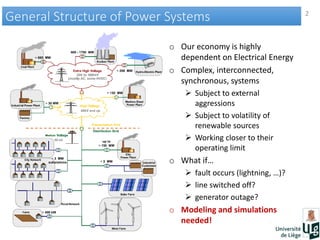
General Structure of Power SystemsGeneral Structure of Power Systems
o Our economy is highly
dependent on Electrical Energy
o Complex, interconnected,
synchronous, systems
 Subject to external
aggressions
 Subject to volatility of
renewable sources
 Working closer to their
operating limit
o What if…
 fault occurs (lightning, …)?
 line switched off?
 generator outage?
o Modeling and simulations
needed!
3
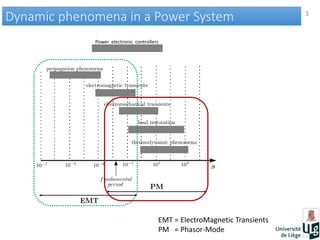
Dynamic phenomena in a Power SystemDynamic phenomena in a Power System
Power electronic controllers
EMT = ElectroMagnetic Transients
PM = Phasor-Mode
4
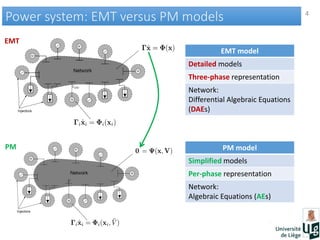
Power system: EMT versus PM modelsPower system: EMT versus PM models
EMT model
Detailed models
Three-phase representation
Network:
Differential Algebraic Equations
(DAEs)
PM model
Simplified models
Per-phase representation
Network:
Algebraic Equations (AEs)
EMT
PM
5
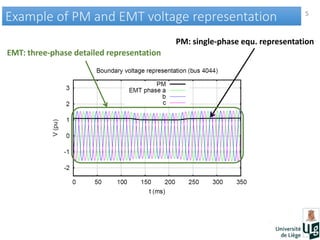
Example of PM and EMT voltage representationExample of PM and EMT voltage representation
PM: single-phase equ. representation
EMT: three-phase detailed representation
6
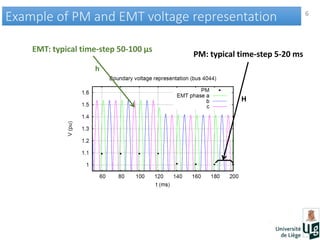
Example of PM and EMT voltage representationExample of PM and EMT voltage representation
PM: typical time-step 5-20 ms
EMT: typical time-step 50-100 µs
H
h
7
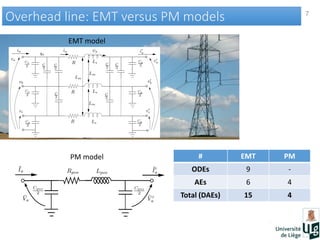
Overhead line: EMT versus PM modelsOverhead line: EMT versus PM models
# EMT PM
ODEs 9 -
AEs 6 4
Total (DAEs) 15 4
EMT model
PM model
8
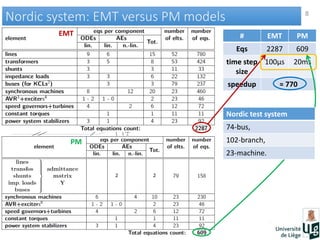
Nordic system: EMT versus PM modelsNordic system: EMT versus PM models
# EMT PM
Eqs 2287 609
time step
size
100µs 20ms
speedup ≈ 770
Nordic test system
74-bus,
102-branch,
23-machine.
EMT
PM
2 2
9
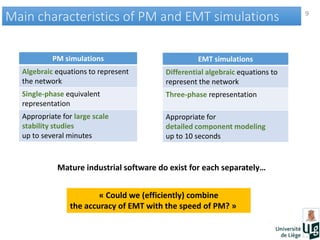
Main characteristics of PM and EMT simulationsMain characteristics of PM and EMT simulations
PM simulations
Algebraic equations to represent
the network
Single-phase equivalent
representation
Appropriate for large scale
stability studies
up to several minutes
EMT simulations
Differential algebraic equations to
represent the network
Three-phase representation
Appropriate for
detailed component modeling
up to 10 seconds
Mature industrial software do exist for each separately…
« Could we (efficiently) combine
the accuracy of EMT with the speed of PM? »
10
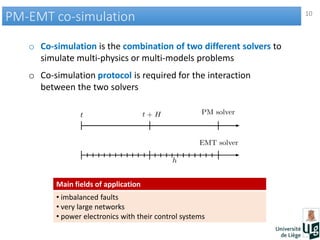
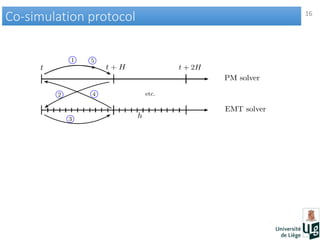
PM-EMT co-simulationPM-EMT co-simulation
o Co-simulation is the combination of two different solvers to
simulate multi-physics or multi-models problems
o Co-simulation protocol is required for the interaction
between the two solvers
Main fields of application
• imbalanced faults
• very large networks
• power electronics with their control systems
11
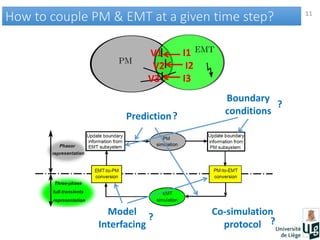
How to couple PM & EMT at a given time step?How to couple PM & EMT at a given time step?
V1
V2
V3
I1
I2
I3
Boundary
conditions
Model
Interfacing
Co-simulation
protocol
Prediction?
?
? ?
12
Outline of presentationOutline of presentation
o Coupling PM and EMT simulations
o Interfacing PM and EMT models
o Illustrative test results
o Summary of contributions
13
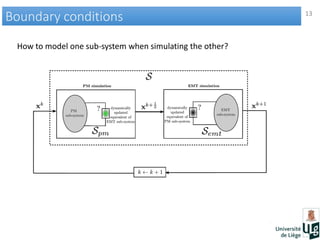
Boundary conditionsBoundary conditions
How to model one sub-system when simulating the other?
14
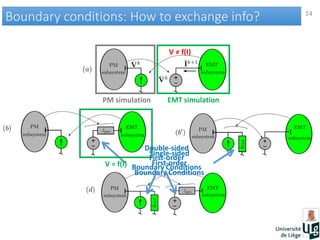
Boundary conditions: How to exchange info?Boundary conditions: How to exchange info?
Single-sided
First-order
Boundary Conditions
PM simulation EMT simulation
V = f(I)
V ≠ f(I)
Double-sided
First-order
Boundary Conditions
15
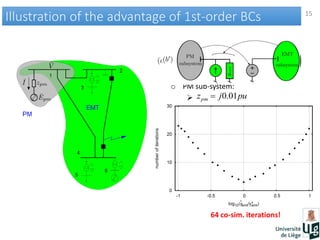
Illustration of the advantage of 1st-order BCsIllustration of the advantage of 1st-order BCs
o PM sub-system:

o EMT sub-system
 56 diff. & 63 alg. states
pujzpm 01.0
64 co-sim. iterations!
3 co-sim.
iterations!
16
Co-simulation protocolCo-simulation protocol
17
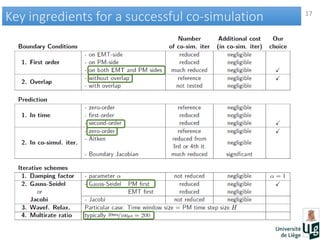
Key ingredients for a successful co-simulationKey ingredients for a successful co-simulation
18
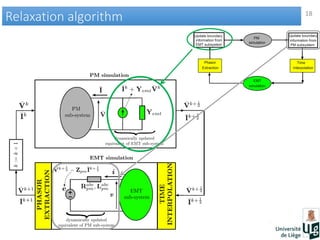
Relaxation algorithmRelaxation algorithm
19
Outline of presentationOutline of presentation
o Coupling PM and EMT simulations
o Interfacing PM and EMT models
o Illustrative test results
o Summary of contributions
20
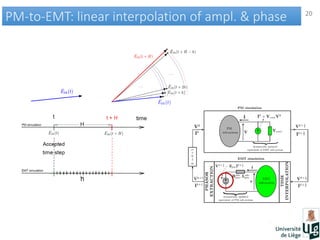
PM-to-EMT: linear interpolation of ampl. & phasePM-to-EMT: linear interpolation of ampl. & phase
21
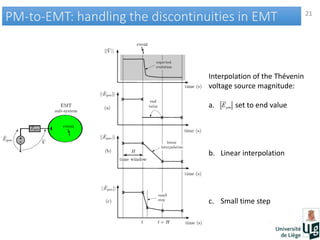
PM-to-EMT: handling the discontinuities in EMTPM-to-EMT: handling the discontinuities in EMT
Interpolation of the Thévenin
voltage source magnitude:
a. set to end value
b. Linear interpolation
c. Small time step
pmE
22
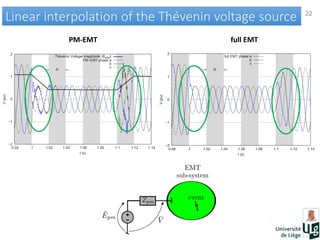
Linear interpolation of the Thévenin voltage sourceLinear interpolation of the Thévenin voltage source
PM-EMT full EMT
23
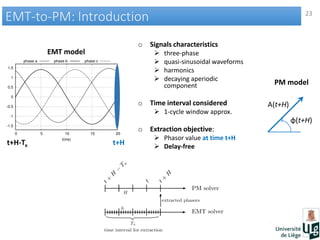
EMT-to-PM: IntroductionEMT-to-PM: Introduction
o Signals characteristics
 three-phase
 quasi-sinusoidal waveforms
 harmonics
 decaying aperiodic
component
o Time interval considered
 1-cycle window approx.
o Extraction objective:
 Phasor value at time t+H
 Delay-free
EMT model
PM model
t+Ht+H-Tx
A(t+H)
φ(t+H)
24
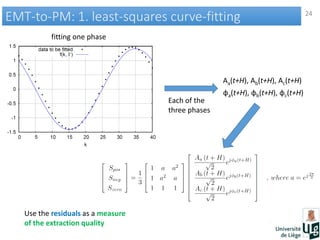
EMT-to-PM: 1. least-squares curve-fittingEMT-to-PM: 1. least-squares curve-fitting
Aa(t+H), Ab(t+H), Ac(t+H)
φa(t+H), φb(t+H), φc(t+H)
Each of the
three phases
fitting one phase
Use the residuals as a measure
of the extraction quality
25
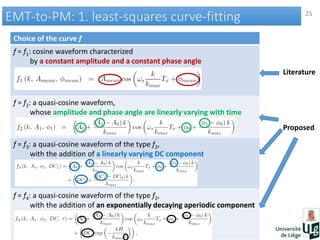
EMT-to-PM: 1. least-squares curve-fittingEMT-to-PM: 1. least-squares curve-fitting
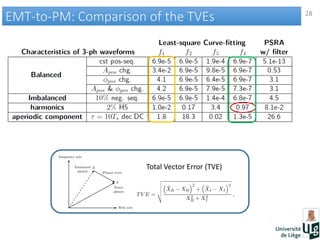
Choice of the curve f
f = f1: cosine waveform characterized
by a constant amplitude and a constant phase angle
f = f2: a quasi-cosine waveform,
whose amplitude and phase angle are linearly varying with time
f = f3: a quasi-cosine waveform of the type f2,
with the addition of a linearly varying DC component
f = f4: a quasi-cosine waveform of the type f2,
with the addition of an exponentially decaying aperiodic component
Literature
Proposed
26
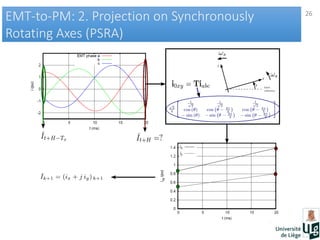
EMT-to-PM: 2. Projection on Synchronously
Rotating Axes (PSRA)
EMT-to-PM: 2. Projection on Synchronously
Rotating Axes (PSRA)
27
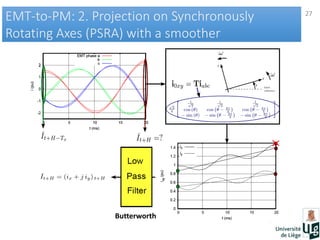
EMT-to-PM: 2. Projection on Synchronously
Rotating Axes (PSRA) with a smoother
EMT-to-PM: 2. Projection on Synchronously
Rotating Axes (PSRA) with a smoother
Butterworth
28
EMT-to-PM: Comparison of the TVEsEMT-to-PM: Comparison of the TVEs
Total Vector Error (TVE)
29
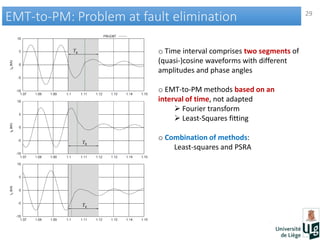
EMT-to-PM: Problem at fault eliminationEMT-to-PM: Problem at fault elimination
o Time interval comprises two segments of
(quasi-)cosine waveforms with different
amplitudes and phase angles
o EMT-to-PM methods based on an
interval of time, not adapted
 Fourier transform
 Least-Squares fitting
o Combination of methods:
Least-squares and PSRA
30
Outline of presentationOutline of presentation
o Coupling PM and EMT simulations
o Interfacing PM and EMT models
o Illustrative test results
o Summary of contributions
31
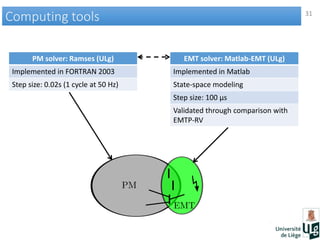
Computing toolsComputing tools
PM solver: Ramses (ULg)
Implemented in FORTRAN 2003
Step size: 0.02s (1 cycle at 50 Hz)
EMT solver: Matlab-EMT (ULg)
Implemented in Matlab
State-space modeling
Step size: 100 µs
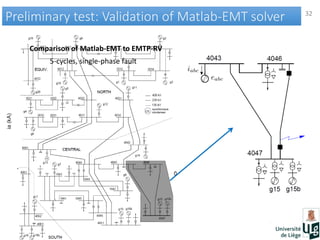
Validated through comparison with
EMTP-RV
32
Preliminary test: Validation of Matlab-EMT solverPreliminary test: Validation of Matlab-EMT solver
5-cycles, single-phase fault
Comparison of Matlab-EMT to EMTP-RV
33
Single boundary bus (4043)Single boundary bus (4043)
g15 & g15’ in EMT sub-system
thermal units,
600 MVA,
round rotor machines.
Test cases 1 & 2
Five-cycle short-circuit very near bus
4047,
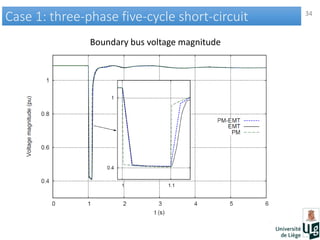
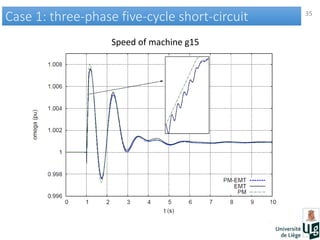
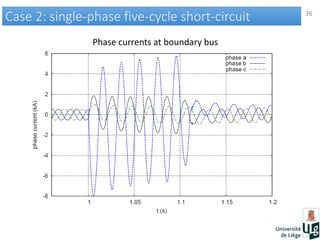
Case 1: Three-phase fault,
Case 2: Single-phase fault.
34
Case 1: three-phase five-cycle short-circuitCase 1: three-phase five-cycle short-circuit
Boundary bus voltage magnitude
35
Case 1: three-phase five-cycle short-circuitCase 1: three-phase five-cycle short-circuit
Speed of machine g15
36
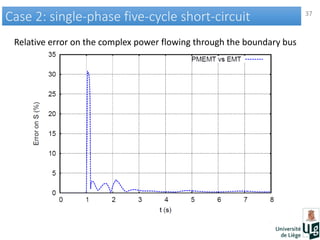
Case 2: single-phase five-cycle short-circuitCase 2: single-phase five-cycle short-circuit
Phase currents at boundary bus
37
Case 2: single-phase five-cycle short-circuitCase 2: single-phase five-cycle short-circuit
Relative error on the complex power flowing through the boundary bus
38
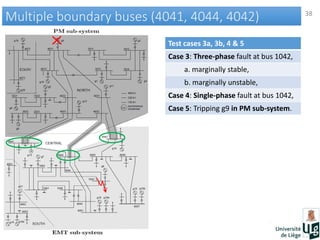
Multiple boundary buses (4041, 4044, 4042)Multiple boundary buses (4041, 4044, 4042)
Test cases 3a, 3b, 4 & 5
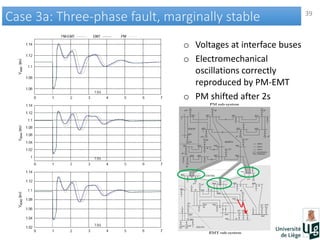
Case 3: Three-phase fault at bus 1042,
a. marginally stable,
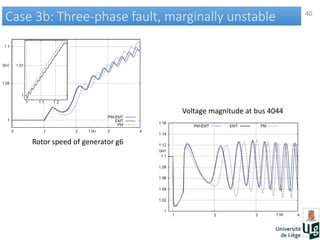
b. marginally unstable,
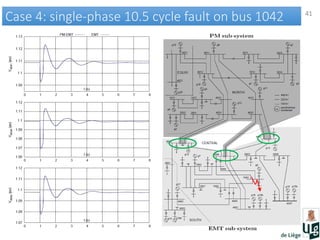
Case 4: Single-phase fault at bus 1042,
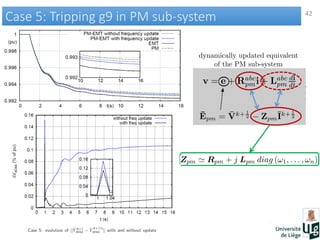
Case 5: Tripping g9 in PM sub-system.
39
Case 3a: Three-phase fault, marginally stableCase 3a: Three-phase fault, marginally stable
o Voltages at interface buses
o Electromechanical
oscillations correctly
reproduced by PM-EMT
o PM shifted after 2s
40
Case 3b: Three-phase fault, marginally unstableCase 3b: Three-phase fault, marginally unstable
Rotor speed of generator g6
Voltage magnitude at bus 4044
41
Case 4: single-phase 10.5 cycle fault on bus 1042Case 4: single-phase 10.5 cycle fault on bus 1042
42
Case 5: Tripping g9 in PM sub-systemCase 5: Tripping g9 in PM sub-system
43
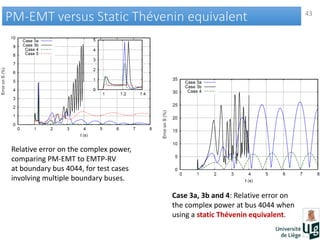
PM-EMT versus Static Thévenin equivalentPM-EMT versus Static Thévenin equivalent
Case 3a, 3b and 4: Relative error on
the complex power at bus 4044 when
using a static Thévenin equivalent.
Relative error on the complex power,
comparing PM-EMT to EMTP-RV
at boundary bus 4044, for test cases
involving multiple boundary buses.
44
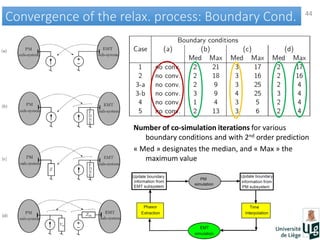
Convergence of the relax. process: Boundary Cond.Convergence of the relax. process: Boundary Cond.
Number of co-simulation iterations for various
boundary conditions and with 2nd order prediction
« Med » designates the median, and « Max » the
maximum value
45
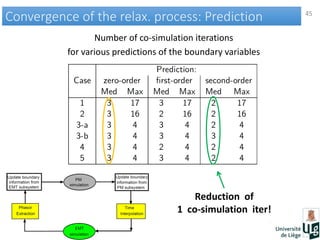
Convergence of the relax. process: PredictionConvergence of the relax. process: Prediction
Number of co-simulation iterations
for various predictions of the boundary variables
Reduction of
1 co-simulation iter!
46
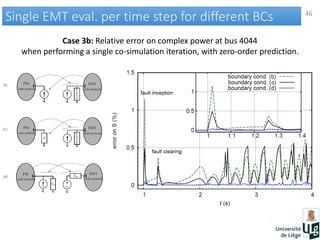
Single EMT eval. per time step for different BCsSingle EMT eval. per time step for different BCs
Case 3b: Relative error on complex power at bus 4044
when performing a single co-simulation iteration, with zero-order prediction.
47
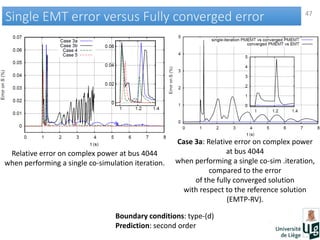
Single EMT error versus Fully converged errorSingle EMT error versus Fully converged error
Relative error on complex power at bus 4044
when performing a single co-simulation iteration.
Case 3a: Relative error on complex power
at bus 4044
when performing a single co-sim .iteration,
compared to the error
of the fully converged solution
with respect to the reference solution
(EMTP-RV).
Boundary conditions: type-(d)
Prediction: second order
48
Outline of presentationOutline of presentation
o Coupling PM and EMT simulations
o Interfacing PM and EMT models
o Illustrative test results
o Summary of contributions
49
Summary of contributionsSummary of contributions
Premise: With modern solvers, the EMT sub-system can be enlarged to the
extent that, at the interface with the PM sub-system, the three-phase
voltages and currents are almost sinusoidal and balanced
o Boundary conditions: Dynamically updated Thévenin – Norton equivalents
 Essential for good convergence
 Updating with frequency recommended
o Prediction of the boundary voltages and currents
o PM-to-EMT: linear interpolation of Thévenin voltage sources
o EMT-to-PM: Combination of
 Least-squares fitting of a quasi-cosine waveform including an
exponentially decaying aperiodic component
 Projection on Synchronously Rotating Axes (PSRA)
 Monitoring the residuals for switching between methods
50
Summary of contributionsSummary of contributions
o Assessment of single co-simulation iteration accuracy
o Tests of marginally stable/unstable case
o Results presented on a 74-bus, 23-machine test system,
 split into one EMT and one PM sub-system with
• single interface bus,
• several interface buses.
 validated through comparison with EMTP-RV.
51
Future extensions of the workFuture extensions of the work
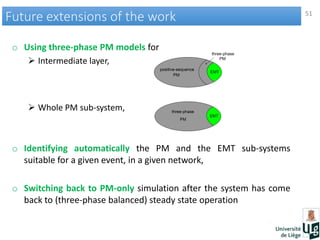
o Using three-phase PM models for
 Intermediate layer,
 Whole PM sub-system,
o Identifying automatically the PM and the EMT sub-systems
suitable for a given event, in a given network,
o Switching back to PM-only simulation after the system has come
back to (three-phase balanced) steady state operation
52
Future extensions of the workFuture extensions of the work
o Impact on the convergence of a larger number of boundary buses
to test if the convergence would be affected
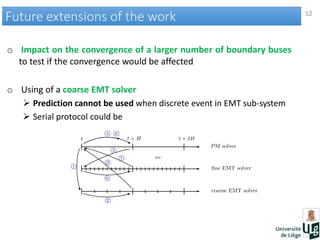
o Using of a coarse EMT solver
 Prediction cannot be used when discrete event in EMT sub-system
 Serial protocol could be

Fred_Plumier_PhD_Slides

  • 1.
    Co-simulation of ElectromagneticTransients and Phasor Models of Electric Power Systems Frédéric Plumier Department of Electrical Engineering and Computer Science University of Liège Liège, 29 January 2015
  • 2.
    2 General Structure ofPower SystemsGeneral Structure of Power Systems o Our economy is highly dependent on Electrical Energy o Complex, interconnected, synchronous, systems  Subject to external aggressions  Subject to volatility of renewable sources  Working closer to their operating limit o What if…  fault occurs (lightning, …)?  line switched off?  generator outage? o Modeling and simulations needed!
  • 3.
    3 Dynamic phenomena ina Power SystemDynamic phenomena in a Power System Power electronic controllers EMT = ElectroMagnetic Transients PM = Phasor-Mode
  • 4.
    4 Power system: EMTversus PM modelsPower system: EMT versus PM models EMT model Detailed models Three-phase representation Network: Differential Algebraic Equations (DAEs) PM model Simplified models Per-phase representation Network: Algebraic Equations (AEs) EMT PM
  • 5.
    5 Example of PMand EMT voltage representationExample of PM and EMT voltage representation PM: single-phase equ. representation EMT: three-phase detailed representation
  • 6.
    6 Example of PMand EMT voltage representationExample of PM and EMT voltage representation PM: typical time-step 5-20 ms EMT: typical time-step 50-100 µs H h
  • 7.
    7 Overhead line: EMTversus PM modelsOverhead line: EMT versus PM models # EMT PM ODEs 9 - AEs 6 4 Total (DAEs) 15 4 EMT model PM model
  • 8.
    8 Nordic system: EMTversus PM modelsNordic system: EMT versus PM models # EMT PM Eqs 2287 609 time step size 100µs 20ms speedup ≈ 770 Nordic test system 74-bus, 102-branch, 23-machine. EMT PM 2 2
  • 9.
    9 Main characteristics ofPM and EMT simulationsMain characteristics of PM and EMT simulations PM simulations Algebraic equations to represent the network Single-phase equivalent representation Appropriate for large scale stability studies up to several minutes EMT simulations Differential algebraic equations to represent the network Three-phase representation Appropriate for detailed component modeling up to 10 seconds Mature industrial software do exist for each separately… « Could we (efficiently) combine the accuracy of EMT with the speed of PM? »
  • 10.
    10 PM-EMT co-simulationPM-EMT co-simulation oCo-simulation is the combination of two different solvers to simulate multi-physics or multi-models problems o Co-simulation protocol is required for the interaction between the two solvers Main fields of application • imbalanced faults • very large networks • power electronics with their control systems
  • 11.
    11 How to couplePM & EMT at a given time step?How to couple PM & EMT at a given time step? V1 V2 V3 I1 I2 I3 Boundary conditions Model Interfacing Co-simulation protocol Prediction? ? ? ?
  • 12.
    12 Outline of presentationOutlineof presentation o Coupling PM and EMT simulations o Interfacing PM and EMT models o Illustrative test results o Summary of contributions
  • 13.
    13 Boundary conditionsBoundary conditions Howto model one sub-system when simulating the other?
  • 14.
    14 Boundary conditions: Howto exchange info?Boundary conditions: How to exchange info? Single-sided First-order Boundary Conditions PM simulation EMT simulation V = f(I) V ≠ f(I) Double-sided First-order Boundary Conditions
  • 15.
    15 Illustration of theadvantage of 1st-order BCsIllustration of the advantage of 1st-order BCs o PM sub-system:  o EMT sub-system  56 diff. & 63 alg. states pujzpm 01.0 64 co-sim. iterations! 3 co-sim. iterations!
  • 16.
  • 17.
    17 Key ingredients fora successful co-simulationKey ingredients for a successful co-simulation
  • 18.
  • 19.
    19 Outline of presentationOutlineof presentation o Coupling PM and EMT simulations o Interfacing PM and EMT models o Illustrative test results o Summary of contributions
  • 20.
    20 PM-to-EMT: linear interpolationof ampl. & phasePM-to-EMT: linear interpolation of ampl. & phase
  • 21.
    21 PM-to-EMT: handling thediscontinuities in EMTPM-to-EMT: handling the discontinuities in EMT Interpolation of the Thévenin voltage source magnitude: a. set to end value b. Linear interpolation c. Small time step pmE
  • 22.
    22 Linear interpolation ofthe Thévenin voltage sourceLinear interpolation of the Thévenin voltage source PM-EMT full EMT
  • 23.
    23 EMT-to-PM: IntroductionEMT-to-PM: Introduction oSignals characteristics  three-phase  quasi-sinusoidal waveforms  harmonics  decaying aperiodic component o Time interval considered  1-cycle window approx. o Extraction objective:  Phasor value at time t+H  Delay-free EMT model PM model t+Ht+H-Tx A(t+H) φ(t+H)
  • 24.
    24 EMT-to-PM: 1. least-squarescurve-fittingEMT-to-PM: 1. least-squares curve-fitting Aa(t+H), Ab(t+H), Ac(t+H) φa(t+H), φb(t+H), φc(t+H) Each of the three phases fitting one phase Use the residuals as a measure of the extraction quality
  • 25.
    25 EMT-to-PM: 1. least-squarescurve-fittingEMT-to-PM: 1. least-squares curve-fitting Choice of the curve f f = f1: cosine waveform characterized by a constant amplitude and a constant phase angle f = f2: a quasi-cosine waveform, whose amplitude and phase angle are linearly varying with time f = f3: a quasi-cosine waveform of the type f2, with the addition of a linearly varying DC component f = f4: a quasi-cosine waveform of the type f2, with the addition of an exponentially decaying aperiodic component Literature Proposed
  • 26.
    26 EMT-to-PM: 2. Projectionon Synchronously Rotating Axes (PSRA) EMT-to-PM: 2. Projection on Synchronously Rotating Axes (PSRA)
  • 27.
    27 EMT-to-PM: 2. Projectionon Synchronously Rotating Axes (PSRA) with a smoother EMT-to-PM: 2. Projection on Synchronously Rotating Axes (PSRA) with a smoother Butterworth
  • 28.
    28 EMT-to-PM: Comparison ofthe TVEsEMT-to-PM: Comparison of the TVEs Total Vector Error (TVE)
  • 29.
    29 EMT-to-PM: Problem atfault eliminationEMT-to-PM: Problem at fault elimination o Time interval comprises two segments of (quasi-)cosine waveforms with different amplitudes and phase angles o EMT-to-PM methods based on an interval of time, not adapted  Fourier transform  Least-Squares fitting o Combination of methods: Least-squares and PSRA
  • 30.
    30 Outline of presentationOutlineof presentation o Coupling PM and EMT simulations o Interfacing PM and EMT models o Illustrative test results o Summary of contributions
  • 31.
    31 Computing toolsComputing tools PMsolver: Ramses (ULg) Implemented in FORTRAN 2003 Step size: 0.02s (1 cycle at 50 Hz) EMT solver: Matlab-EMT (ULg) Implemented in Matlab State-space modeling Step size: 100 µs Validated through comparison with EMTP-RV
  • 32.
    32 Preliminary test: Validationof Matlab-EMT solverPreliminary test: Validation of Matlab-EMT solver 5-cycles, single-phase fault Comparison of Matlab-EMT to EMTP-RV
  • 33.
    33 Single boundary bus(4043)Single boundary bus (4043) g15 & g15’ in EMT sub-system thermal units, 600 MVA, round rotor machines. Test cases 1 & 2 Five-cycle short-circuit very near bus 4047, Case 1: Three-phase fault, Case 2: Single-phase fault.
  • 34.
    34 Case 1: three-phasefive-cycle short-circuitCase 1: three-phase five-cycle short-circuit Boundary bus voltage magnitude
  • 35.
    35 Case 1: three-phasefive-cycle short-circuitCase 1: three-phase five-cycle short-circuit Speed of machine g15
  • 36.
    36 Case 2: single-phasefive-cycle short-circuitCase 2: single-phase five-cycle short-circuit Phase currents at boundary bus
  • 37.
    37 Case 2: single-phasefive-cycle short-circuitCase 2: single-phase five-cycle short-circuit Relative error on the complex power flowing through the boundary bus
  • 38.
    38 Multiple boundary buses(4041, 4044, 4042)Multiple boundary buses (4041, 4044, 4042) Test cases 3a, 3b, 4 & 5 Case 3: Three-phase fault at bus 1042, a. marginally stable, b. marginally unstable, Case 4: Single-phase fault at bus 1042, Case 5: Tripping g9 in PM sub-system.
  • 39.
    39 Case 3a: Three-phasefault, marginally stableCase 3a: Three-phase fault, marginally stable o Voltages at interface buses o Electromechanical oscillations correctly reproduced by PM-EMT o PM shifted after 2s
  • 40.
    40 Case 3b: Three-phasefault, marginally unstableCase 3b: Three-phase fault, marginally unstable Rotor speed of generator g6 Voltage magnitude at bus 4044
  • 41.
    41 Case 4: single-phase10.5 cycle fault on bus 1042Case 4: single-phase 10.5 cycle fault on bus 1042
  • 42.
    42 Case 5: Trippingg9 in PM sub-systemCase 5: Tripping g9 in PM sub-system
  • 43.
    43 PM-EMT versus StaticThévenin equivalentPM-EMT versus Static Thévenin equivalent Case 3a, 3b and 4: Relative error on the complex power at bus 4044 when using a static Thévenin equivalent. Relative error on the complex power, comparing PM-EMT to EMTP-RV at boundary bus 4044, for test cases involving multiple boundary buses.
  • 44.
    44 Convergence of therelax. process: Boundary Cond.Convergence of the relax. process: Boundary Cond. Number of co-simulation iterations for various boundary conditions and with 2nd order prediction « Med » designates the median, and « Max » the maximum value
  • 45.
    45 Convergence of therelax. process: PredictionConvergence of the relax. process: Prediction Number of co-simulation iterations for various predictions of the boundary variables Reduction of 1 co-simulation iter!
  • 46.
    46 Single EMT eval.per time step for different BCsSingle EMT eval. per time step for different BCs Case 3b: Relative error on complex power at bus 4044 when performing a single co-simulation iteration, with zero-order prediction.
  • 47.
    47 Single EMT errorversus Fully converged errorSingle EMT error versus Fully converged error Relative error on complex power at bus 4044 when performing a single co-simulation iteration. Case 3a: Relative error on complex power at bus 4044 when performing a single co-sim .iteration, compared to the error of the fully converged solution with respect to the reference solution (EMTP-RV). Boundary conditions: type-(d) Prediction: second order
  • 48.
    48 Outline of presentationOutlineof presentation o Coupling PM and EMT simulations o Interfacing PM and EMT models o Illustrative test results o Summary of contributions
  • 49.
    49 Summary of contributionsSummaryof contributions Premise: With modern solvers, the EMT sub-system can be enlarged to the extent that, at the interface with the PM sub-system, the three-phase voltages and currents are almost sinusoidal and balanced o Boundary conditions: Dynamically updated Thévenin – Norton equivalents  Essential for good convergence  Updating with frequency recommended o Prediction of the boundary voltages and currents o PM-to-EMT: linear interpolation of Thévenin voltage sources o EMT-to-PM: Combination of  Least-squares fitting of a quasi-cosine waveform including an exponentially decaying aperiodic component  Projection on Synchronously Rotating Axes (PSRA)  Monitoring the residuals for switching between methods
  • 50.
    50 Summary of contributionsSummaryof contributions o Assessment of single co-simulation iteration accuracy o Tests of marginally stable/unstable case o Results presented on a 74-bus, 23-machine test system,  split into one EMT and one PM sub-system with • single interface bus, • several interface buses.  validated through comparison with EMTP-RV.
  • 51.
    51 Future extensions ofthe workFuture extensions of the work o Using three-phase PM models for  Intermediate layer,  Whole PM sub-system, o Identifying automatically the PM and the EMT sub-systems suitable for a given event, in a given network, o Switching back to PM-only simulation after the system has come back to (three-phase balanced) steady state operation
  • 52.
    52 Future extensions ofthe workFuture extensions of the work o Impact on the convergence of a larger number of boundary buses to test if the convergence would be affected o Using of a coarse EMT solver  Prediction cannot be used when discrete event in EMT sub-system  Serial protocol could be