Introduction to Modeling in Power Systems
Your Name
January 1, 2025
Your Name Introduction to Modeling in Power Systems January 1, 2025 1 / 26
Overview of Power System Modeling
Power systems are complex networks of electrical components.
Accurate modeling is essential for:
Analyzing performance
Ensuring stability
Preventing failures
Models are used in various applications:
Power flow analysis
Transient stability
Fault analysis and protection
System optimization and control
In this presentation, we will cover:
Types of models
Trade-offs in accuracy vs complexity
The need for simulations
RMS and EMTP simulations
Your Name Introduction to Modeling in Power Systems January 1, 2025 2 / 26
Power System Components
Power systems include:
Generation units (e.g., power plants, renewable sources)
Transmission lines
Transformers
Load centers (e.g., industrial, residential consumers)
Protection and control devices (e.g., circuit breakers, relays)
Modeling these components is necessary to understand the overall
system behavior.
Your Name Introduction to Modeling in Power Systems January 1, 2025 3 / 26
Why Do We Need Models in Power Systems?
Power systems are too large and complex to be analyzed purely by
hand calculations.
Models help simulate:
Power flow and voltage stability
Fault scenarios and system recovery
Dynamic response of generators and controllers
Models reduce the need for physical testing, which is expensive and
time-consuming.
Your Name Introduction to Modeling in Power Systems January 1, 2025 4 / 26
Types of Power System Models
Power system models can be categorized as:
White box models
Grey box models
Black box models
Each model type is used based on the trade-off between accuracy,
complexity, and available data.
Your Name Introduction to Modeling in Power Systems January 1, 2025 5 / 26
White Box Models (Detailed Models)
White box models rely on first principles and physical laws to describe
system behavior.
These models include detailed equations and parameters, such as:
Ohm’s Law for transmission lines
Kirchoff’s Laws for voltage and current
Electromagnetic field equations for generators
Example: A synchronous generator model including the rotor
dynamics, voltage equation, and governor dynamics.
Your Name Introduction to Modeling in Power Systems January 1, 2025 6 / 26
Advantages and Disadvantages of White Box Models
Advantages:
High accuracy and predictive power
Can simulate a wide range of scenarios
Useful for design and stability analysis
Disadvantages:
Computationally expensive
Requires detailed knowledge of system components
Complex to implement and validate
Your Name Introduction to Modeling in Power Systems January 1, 2025 7 / 26
Grey Box Models (Hybrid Models)
Grey box models combine physical laws with empirical data.
Example: A transformer model that uses both physical principles
(e.g., magnetic flux) and data from system behavior (e.g., voltage
and current measurements).
These models offer a balance between accuracy and complexity.
Your Name Introduction to Modeling in Power Systems January 1, 2025 8 / 26
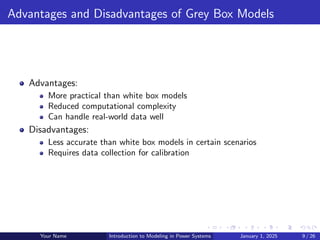
Advantages and Disadvantages of Grey Box Models
Advantages:
More practical than white box models
Reduced computational complexity
Can handle real-world data well
Disadvantages:
Less accurate than white box models in certain scenarios
Requires data collection for calibration
Your Name Introduction to Modeling in Power Systems January 1, 2025 9 / 26
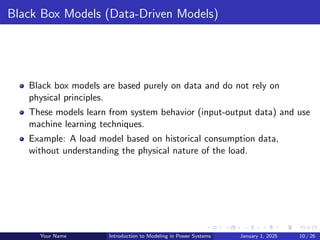
Black Box Models (Data-Driven Models)
Black box models are based purely on data and do not rely on
physical principles.
These models learn from system behavior (input-output data) and use
machine learning techniques.
Example: A load model based on historical consumption data,
without understanding the physical nature of the load.
Your Name Introduction to Modeling in Power Systems January 1, 2025 10 / 26
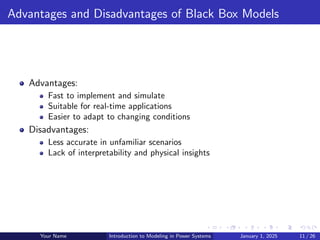
Advantages and Disadvantages of Black Box Models
Advantages:
Fast to implement and simulate
Suitable for real-time applications
Easier to adapt to changing conditions
Disadvantages:
Less accurate in unfamiliar scenarios
Lack of interpretability and physical insights
Your Name Introduction to Modeling in Power Systems January 1, 2025 11 / 26
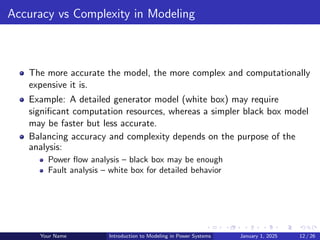
Accuracy vs Complexity in Modeling
The more accurate the model, the more complex and computationally
expensive it is.
Example: A detailed generator model (white box) may require
significant computation resources, whereas a simpler black box model
may be faster but less accurate.
Balancing accuracy and complexity depends on the purpose of the
analysis:
Power flow analysis – black box may be enough
Fault analysis – white box for detailed behavior
Your Name Introduction to Modeling in Power Systems January 1, 2025 12 / 26
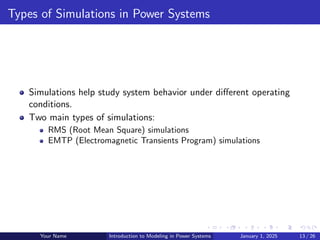
Types of Simulations in Power Systems
Simulations help study system behavior under different operating
conditions.
Two main types of simulations:
RMS (Root Mean Square) simulations
EMTP (Electromagnetic Transients Program) simulations
Your Name Introduction to Modeling in Power Systems January 1, 2025 13 / 26
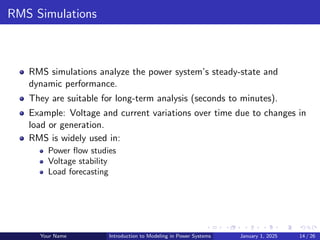
RMS Simulations
RMS simulations analyze the power system’s steady-state and
dynamic performance.
They are suitable for long-term analysis (seconds to minutes).
Example: Voltage and current variations over time due to changes in
load or generation.
RMS is widely used in:
Power flow studies
Voltage stability
Load forecasting
Your Name Introduction to Modeling in Power Systems January 1, 2025 14 / 26
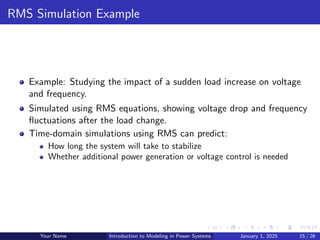
RMS Simulation Example
Example: Studying the impact of a sudden load increase on voltage
and frequency.
Simulated using RMS equations, showing voltage drop and frequency
fluctuations after the load change.
Time-domain simulations using RMS can predict:
How long the system will take to stabilize
Whether additional power generation or voltage control is needed
Your Name Introduction to Modeling in Power Systems January 1, 2025 15 / 26
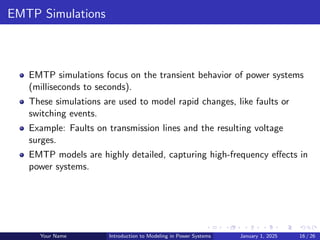
EMTP Simulations
EMTP simulations focus on the transient behavior of power systems
(milliseconds to seconds).
These simulations are used to model rapid changes, like faults or
switching events.
Example: Faults on transmission lines and the resulting voltage
surges.
EMTP models are highly detailed, capturing high-frequency effects in
power systems.
Your Name Introduction to Modeling in Power Systems January 1, 2025 16 / 26
EMTP Simulation Example
Example: A fault on a transmission line causes a voltage spike and
tripping of protective relays.
The EMTP simulation models:
Current and voltage waveforms during the fault
The protection system’s response
High-fidelity models are used to study the detailed behavior of the
power system under transient conditions.
Your Name Introduction to Modeling in Power Systems January 1, 2025 17 / 26
Comparison of RMS and EMTP Simulations
RMS Simulations:
Focus on steady-state and slow dynamics
Computationally efficient
Suitable for power flow, voltage stability, and long-term performance
studies
EMTP Simulations:
Focus on fast transients and fault conditions
Computationally intensive
Used for fault analysis, protection coordination, and transient stability
studies
Your Name Introduction to Modeling in Power Systems January 1, 2025 18 / 26
Simulation Tools for Power Systems
Several simulation software tools are available for power system
modeling:
PSS/E (Power System Simulator for Engineering): Used for power
flow, stability, and fault analysis.
DIgSILENT PowerFactory: Used for detailed power system analysis,
including dynamic and transient studies.
MATLAB/Simulink: Provides a flexible environment for both RMS
and EMTP simulations.
EMTP-RV: A specialized tool for simulating electromagnetic
transients.
Your Name Introduction to Modeling in Power Systems January 1, 2025 19 / 26
Example Simulation: Fault Analysis
A typical fault analysis involves:
Modeling the system with an accurate fault model
Running the simulation to observe voltage dips, current spikes, and
relay responses
Using EMTP, you can visualize the current and voltage waveforms
during and after the fault.
Your Name Introduction to Modeling in Power Systems January 1, 2025 20 / 26
Example Simulation: Power Flow Study
A power flow study investigates the steady-state operation of the
power system:
Modeling generation, transmission, and load
Simulating how power flows through the system
RMS simulations provide voltage, current, and power flow values
across the system.
Your Name Introduction to Modeling in Power Systems January 1, 2025 21 / 26
Challenges in Power System Modeling
Power systems are nonlinear, with complex interactions between
components.
Modeling challenges include:
High dimensionality of the system
Accurate data collection and system representation
Real-time constraints and computational limits
Your Name Introduction to Modeling in Power Systems January 1, 2025 22 / 26
Modeling Future Power Systems
Future power systems will be more dynamic due to:
Increased integration of renewable energy
Electric vehicles and smart grids
Models will need to adapt to new technologies, requiring hybrid
approaches combining physical models and data-driven techniques.
Your Name Introduction to Modeling in Power Systems January 1, 2025 23 / 26
Summary
Power system modeling is crucial for analyzing system behavior and
ensuring safe operation.
Different types of models (white box, grey box, black box) are used
depending on the application and resources.
Simulations (RMS and EMTP) help study both steady-state and
transient behaviors of power systems.
Modeling accuracy vs. complexity should be balanced based on the
study objectives.
Your Name Introduction to Modeling in Power Systems January 1, 2025 24 / 26
References
Kundur, P. (1994). Power System Stability and Control.
IEEE Standard 1547. (2003). IEEE Standard for Interconnecting
Distributed Resources with Electric Power Systems.
PSS/E User Manual.
Your Name Introduction to Modeling in Power Systems January 1, 2025 25 / 26
Questions
Any Questions?
Your Name Introduction to Modeling in Power Systems January 1, 2025 26 / 26

Power_System_Modelling_1234567890AFGBHJ.pdf

  • 1.
    Introduction to Modelingin Power Systems Your Name January 1, 2025 Your Name Introduction to Modeling in Power Systems January 1, 2025 1 / 26
  • 2.
    Overview of PowerSystem Modeling Power systems are complex networks of electrical components. Accurate modeling is essential for: Analyzing performance Ensuring stability Preventing failures Models are used in various applications: Power flow analysis Transient stability Fault analysis and protection System optimization and control In this presentation, we will cover: Types of models Trade-offs in accuracy vs complexity The need for simulations RMS and EMTP simulations Your Name Introduction to Modeling in Power Systems January 1, 2025 2 / 26
  • 3.
    Power System Components Powersystems include: Generation units (e.g., power plants, renewable sources) Transmission lines Transformers Load centers (e.g., industrial, residential consumers) Protection and control devices (e.g., circuit breakers, relays) Modeling these components is necessary to understand the overall system behavior. Your Name Introduction to Modeling in Power Systems January 1, 2025 3 / 26
  • 4.
    Why Do WeNeed Models in Power Systems? Power systems are too large and complex to be analyzed purely by hand calculations. Models help simulate: Power flow and voltage stability Fault scenarios and system recovery Dynamic response of generators and controllers Models reduce the need for physical testing, which is expensive and time-consuming. Your Name Introduction to Modeling in Power Systems January 1, 2025 4 / 26
  • 5.
    Types of PowerSystem Models Power system models can be categorized as: White box models Grey box models Black box models Each model type is used based on the trade-off between accuracy, complexity, and available data. Your Name Introduction to Modeling in Power Systems January 1, 2025 5 / 26
  • 6.
    White Box Models(Detailed Models) White box models rely on first principles and physical laws to describe system behavior. These models include detailed equations and parameters, such as: Ohm’s Law for transmission lines Kirchoff’s Laws for voltage and current Electromagnetic field equations for generators Example: A synchronous generator model including the rotor dynamics, voltage equation, and governor dynamics. Your Name Introduction to Modeling in Power Systems January 1, 2025 6 / 26
  • 7.
    Advantages and Disadvantagesof White Box Models Advantages: High accuracy and predictive power Can simulate a wide range of scenarios Useful for design and stability analysis Disadvantages: Computationally expensive Requires detailed knowledge of system components Complex to implement and validate Your Name Introduction to Modeling in Power Systems January 1, 2025 7 / 26
  • 8.
    Grey Box Models(Hybrid Models) Grey box models combine physical laws with empirical data. Example: A transformer model that uses both physical principles (e.g., magnetic flux) and data from system behavior (e.g., voltage and current measurements). These models offer a balance between accuracy and complexity. Your Name Introduction to Modeling in Power Systems January 1, 2025 8 / 26
  • 9.
    Advantages and Disadvantagesof Grey Box Models Advantages: More practical than white box models Reduced computational complexity Can handle real-world data well Disadvantages: Less accurate than white box models in certain scenarios Requires data collection for calibration Your Name Introduction to Modeling in Power Systems January 1, 2025 9 / 26
  • 10.
    Black Box Models(Data-Driven Models) Black box models are based purely on data and do not rely on physical principles. These models learn from system behavior (input-output data) and use machine learning techniques. Example: A load model based on historical consumption data, without understanding the physical nature of the load. Your Name Introduction to Modeling in Power Systems January 1, 2025 10 / 26
  • 11.
    Advantages and Disadvantagesof Black Box Models Advantages: Fast to implement and simulate Suitable for real-time applications Easier to adapt to changing conditions Disadvantages: Less accurate in unfamiliar scenarios Lack of interpretability and physical insights Your Name Introduction to Modeling in Power Systems January 1, 2025 11 / 26
  • 12.
    Accuracy vs Complexityin Modeling The more accurate the model, the more complex and computationally expensive it is. Example: A detailed generator model (white box) may require significant computation resources, whereas a simpler black box model may be faster but less accurate. Balancing accuracy and complexity depends on the purpose of the analysis: Power flow analysis – black box may be enough Fault analysis – white box for detailed behavior Your Name Introduction to Modeling in Power Systems January 1, 2025 12 / 26
  • 13.
    Types of Simulationsin Power Systems Simulations help study system behavior under different operating conditions. Two main types of simulations: RMS (Root Mean Square) simulations EMTP (Electromagnetic Transients Program) simulations Your Name Introduction to Modeling in Power Systems January 1, 2025 13 / 26
  • 14.
    RMS Simulations RMS simulationsanalyze the power system’s steady-state and dynamic performance. They are suitable for long-term analysis (seconds to minutes). Example: Voltage and current variations over time due to changes in load or generation. RMS is widely used in: Power flow studies Voltage stability Load forecasting Your Name Introduction to Modeling in Power Systems January 1, 2025 14 / 26
  • 15.
    RMS Simulation Example Example:Studying the impact of a sudden load increase on voltage and frequency. Simulated using RMS equations, showing voltage drop and frequency fluctuations after the load change. Time-domain simulations using RMS can predict: How long the system will take to stabilize Whether additional power generation or voltage control is needed Your Name Introduction to Modeling in Power Systems January 1, 2025 15 / 26
  • 16.
    EMTP Simulations EMTP simulationsfocus on the transient behavior of power systems (milliseconds to seconds). These simulations are used to model rapid changes, like faults or switching events. Example: Faults on transmission lines and the resulting voltage surges. EMTP models are highly detailed, capturing high-frequency effects in power systems. Your Name Introduction to Modeling in Power Systems January 1, 2025 16 / 26
  • 17.
    EMTP Simulation Example Example:A fault on a transmission line causes a voltage spike and tripping of protective relays. The EMTP simulation models: Current and voltage waveforms during the fault The protection system’s response High-fidelity models are used to study the detailed behavior of the power system under transient conditions. Your Name Introduction to Modeling in Power Systems January 1, 2025 17 / 26
  • 18.
    Comparison of RMSand EMTP Simulations RMS Simulations: Focus on steady-state and slow dynamics Computationally efficient Suitable for power flow, voltage stability, and long-term performance studies EMTP Simulations: Focus on fast transients and fault conditions Computationally intensive Used for fault analysis, protection coordination, and transient stability studies Your Name Introduction to Modeling in Power Systems January 1, 2025 18 / 26
  • 19.
    Simulation Tools forPower Systems Several simulation software tools are available for power system modeling: PSS/E (Power System Simulator for Engineering): Used for power flow, stability, and fault analysis. DIgSILENT PowerFactory: Used for detailed power system analysis, including dynamic and transient studies. MATLAB/Simulink: Provides a flexible environment for both RMS and EMTP simulations. EMTP-RV: A specialized tool for simulating electromagnetic transients. Your Name Introduction to Modeling in Power Systems January 1, 2025 19 / 26
  • 20.
    Example Simulation: FaultAnalysis A typical fault analysis involves: Modeling the system with an accurate fault model Running the simulation to observe voltage dips, current spikes, and relay responses Using EMTP, you can visualize the current and voltage waveforms during and after the fault. Your Name Introduction to Modeling in Power Systems January 1, 2025 20 / 26
  • 21.
    Example Simulation: PowerFlow Study A power flow study investigates the steady-state operation of the power system: Modeling generation, transmission, and load Simulating how power flows through the system RMS simulations provide voltage, current, and power flow values across the system. Your Name Introduction to Modeling in Power Systems January 1, 2025 21 / 26
  • 22.
    Challenges in PowerSystem Modeling Power systems are nonlinear, with complex interactions between components. Modeling challenges include: High dimensionality of the system Accurate data collection and system representation Real-time constraints and computational limits Your Name Introduction to Modeling in Power Systems January 1, 2025 22 / 26
  • 23.
    Modeling Future PowerSystems Future power systems will be more dynamic due to: Increased integration of renewable energy Electric vehicles and smart grids Models will need to adapt to new technologies, requiring hybrid approaches combining physical models and data-driven techniques. Your Name Introduction to Modeling in Power Systems January 1, 2025 23 / 26
  • 24.
    Summary Power system modelingis crucial for analyzing system behavior and ensuring safe operation. Different types of models (white box, grey box, black box) are used depending on the application and resources. Simulations (RMS and EMTP) help study both steady-state and transient behaviors of power systems. Modeling accuracy vs. complexity should be balanced based on the study objectives. Your Name Introduction to Modeling in Power Systems January 1, 2025 24 / 26
  • 25.
    References Kundur, P. (1994).Power System Stability and Control. IEEE Standard 1547. (2003). IEEE Standard for Interconnecting Distributed Resources with Electric Power Systems. PSS/E User Manual. Your Name Introduction to Modeling in Power Systems January 1, 2025 25 / 26
  • 26.
    Questions Any Questions? Your NameIntroduction to Modeling in Power Systems January 1, 2025 26 / 26