The Indian Retail SectorThe Indian Retail Sector FranchisingA Model for sustainable growth in organized retailingRavi Kumar Suman
Retail Industry – Current ScenarioOrganized retail still a laggard, 8% of all retailBig Brands; Big Money = But no right model yetSame Store growth Vs New Store Growth – The Suspect story of GrowthFew Chains closing down; some bankrupt; some going slow; foreign retailers still “cat-on-the-wall”The Indian Retail Story is still – an emerging story
Retail – A unique industryWorlds Largest Industry and Employer
Last Mile of every industry
Brutally competitive- in India 13 Million outlets
Live by the DayIssues with RetailingPoor supply chain management and weak support infrastructureRentals – skyrocketing to all time highCrowding in unattractive locationsInability to compete with traditional retailOver reliance on debt funding
 MerchandiseMargins Space PeopleElements of Resource Efficiency
 MerchandiseMargins People SpaceElements of Resource EfficiencyImpacted by markdowns and shrinkage.
Technology – a key optimizing tool.
Key control level : Favorable Buying
20-40% of operating expenses
Planogram and location choice – a key mgt tool.
Choose and utilise wisely
High Cost-High sensitivity
Wrong type- high cost impact –markdowns.
50-80% of working capital, 40-60% assets.
Wisely chosen through data analysis and NPI
 15-40% of expenses
Retention and engagement – difficult
Right people difficult to find.Measures of Resource EfficiencyGross Margin/InventoryGross Margin Return on InventoryGMROI=Net sales/Inventory = Stock turnInventory/ Selling feet =Merchandise EfficiencyGross Margin/Selling feetGross margin Return on Sq ft  GMROFNet Sales/ Selling feet =Sales per sq ft=Gross margin /Net sales = GM%Selling feet/ No of Employees =Service IntensityGross Margin /EmployeeGross Margin Return on labour  GMROL=Net Sales/ No of Employees =Sales per employee=
A Fresh Look at retailingCustomer Service is a complicated scienceImpossible to come up with a “right formula”; “right code of conduct & service levels”Needs authority / responsibility right at the front endRequires “ownership” mindset at the front endCreate “ownership Culture” or Franchise?
Franchising FactsSome key facts that point to the growth of the Franchising sector in India are as follows:There are over 1200 active franchisors in the country.There are over 1,00,000 franchisees (across sectors) in India today.The total investments put in by these franchisees in setting up their individual franchised businesses is over Rs.40,000 crores.The total annual turnover achieved by franchised businesses in India is in the region of Rs.8000-10,000 crores. The total manpower directly employed by these franchised businesses is around 300,000. All these facts & figures point clearly to the extent to which Franchising has been accepted in India as a way of doing business. There are an increasing number of businesses that are exploring the Franchising route to business expansion.
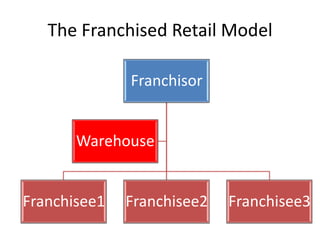
How  Franchising Works?     1. Franchising essentially works by replicating a successful and proven business model across multiple locations through a network of entrepreneurs.       2.The person who develops the business format, known as the franchisor, grants access to his business name, goodwill and business model to another person, known as the franchisee.      3.This ensures that the franchisor can extend his reach without having to invest substantial amount of money in new markets.       4.The franchisee on the other hand profits by having a readymade business model with access to backup facilities like training, marketing tools, technology etc. He hence benefits from the security provided by a tried and tested business model.       5.Many variations of franchising model exist within the sector. Some of the more popular ones include Master Franchisee, Area Development Rights and Unit Franchise. India has seen the emergence of other models also like Joint Venture cum franchise agreement, Management Contract etc.
The Franchised Retail Model

Franchising Retail

  • 1.
    The Indian RetailSectorThe Indian Retail Sector FranchisingA Model for sustainable growth in organized retailingRavi Kumar Suman
  • 2.
    Retail Industry –Current ScenarioOrganized retail still a laggard, 8% of all retailBig Brands; Big Money = But no right model yetSame Store growth Vs New Store Growth – The Suspect story of GrowthFew Chains closing down; some bankrupt; some going slow; foreign retailers still “cat-on-the-wall”The Indian Retail Story is still – an emerging story
  • 3.
    Retail – Aunique industryWorlds Largest Industry and Employer
  • 4.
    Last Mile ofevery industry
  • 5.
    Brutally competitive- inIndia 13 Million outlets
  • 6.
    Live by theDayIssues with RetailingPoor supply chain management and weak support infrastructureRentals – skyrocketing to all time highCrowding in unattractive locationsInability to compete with traditional retailOver reliance on debt funding
  • 7.
    MerchandiseMargins SpacePeopleElements of Resource Efficiency
  • 8.
    MerchandiseMargins PeopleSpaceElements of Resource EfficiencyImpacted by markdowns and shrinkage.
  • 9.
    Technology – akey optimizing tool.
  • 10.
    Key control level: Favorable Buying
  • 11.
  • 12.
    Planogram and locationchoice – a key mgt tool.
  • 13.
  • 14.
  • 15.
    Wrong type- highcost impact –markdowns.
  • 16.
    50-80% of workingcapital, 40-60% assets.
  • 17.
    Wisely chosen throughdata analysis and NPI
  • 18.
    15-40% ofexpenses
  • 19.
  • 20.
    Right people difficultto find.Measures of Resource EfficiencyGross Margin/InventoryGross Margin Return on InventoryGMROI=Net sales/Inventory = Stock turnInventory/ Selling feet =Merchandise EfficiencyGross Margin/Selling feetGross margin Return on Sq ft GMROFNet Sales/ Selling feet =Sales per sq ft=Gross margin /Net sales = GM%Selling feet/ No of Employees =Service IntensityGross Margin /EmployeeGross Margin Return on labour GMROL=Net Sales/ No of Employees =Sales per employee=
  • 21.
    A Fresh Lookat retailingCustomer Service is a complicated scienceImpossible to come up with a “right formula”; “right code of conduct & service levels”Needs authority / responsibility right at the front endRequires “ownership” mindset at the front endCreate “ownership Culture” or Franchise?
  • 22.
    Franchising FactsSome keyfacts that point to the growth of the Franchising sector in India are as follows:There are over 1200 active franchisors in the country.There are over 1,00,000 franchisees (across sectors) in India today.The total investments put in by these franchisees in setting up their individual franchised businesses is over Rs.40,000 crores.The total annual turnover achieved by franchised businesses in India is in the region of Rs.8000-10,000 crores. The total manpower directly employed by these franchised businesses is around 300,000. All these facts & figures point clearly to the extent to which Franchising has been accepted in India as a way of doing business. There are an increasing number of businesses that are exploring the Franchising route to business expansion.
  • 23.
    How FranchisingWorks? 1. Franchising essentially works by replicating a successful and proven business model across multiple locations through a network of entrepreneurs. 2.The person who develops the business format, known as the franchisor, grants access to his business name, goodwill and business model to another person, known as the franchisee. 3.This ensures that the franchisor can extend his reach without having to invest substantial amount of money in new markets. 4.The franchisee on the other hand profits by having a readymade business model with access to backup facilities like training, marketing tools, technology etc. He hence benefits from the security provided by a tried and tested business model. 5.Many variations of franchising model exist within the sector. Some of the more popular ones include Master Franchisee, Area Development Rights and Unit Franchise. India has seen the emergence of other models also like Joint Venture cum franchise agreement, Management Contract etc.
  • 24.