

Presented By:- Sudhir Singh Rajput
                       Yatish Mittal
                      Vikrant Arora
                       Amit Yadav
            Chandrashekhar Chaurasia
                     Rohit Srivastava
Concept
 Over the last two decades, the people’s republic of china has
  had the fastest growing market and GDP growth rate.

 China is hailed as one of the most important consumer
  market of 21st Century.

 Franchising is one of the booming sector in the Chinese
  economy.
Franchise in China
• China has the largest franchise systems in the world.
• China currently has more than 82000 franchisee outlets, and
  growing at the rate of 49%.
• Nearly 60 industries have applied for franchise operations in
  china.
• Industries includes catering, retailing, individual services and
  automotive care.
• Nearly half of the top 100 restaurant companies are utilizing
  franchise business model.
Evolution
 Franchising first emerged in china in the late 1980’s.

 Franchising industry in china experienced a period of disordered
  development in early days.

 In 1997, the Ministry of Internal Trade established the first
  Chinese franchise law.

 In china foreign franchising was still a grey area before the new
  rule was published.

 The new regulation on commercial franchise announced by the
  Ministry of Commerce on December 30th, 2004.
Franchising Models in
             China
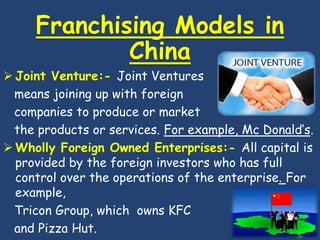
 Joint Venture:- Joint Ventures
  means joining up with foreign
  companies to produce or market
  the products or services. For example, Mc Donald’s.
 Wholly Foreign Owned Enterprises:- All capital is
  provided by the foreign investors who has full
  control over the operations of the enterprise. For
  example,
  Tricon Group, which owns KFC
  and Pizza Hut.
Cont…
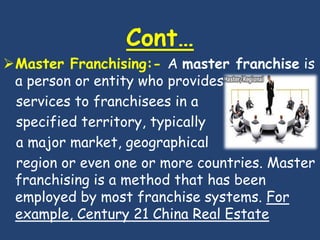
Master Franchising:- A master franchise is
 a person or entity who provides
 services to franchisees in a
 specified territory, typically
 a major market, geographical
 region or even one or more countries. Master
 franchising is a method that has been
 employed by most franchise systems. For
 example, Century 21 China Real Estate
Best Prospects of Franchising
               Sector
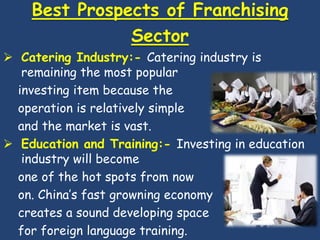
 Catering Industry:- Catering industry is
   remaining the most popular
  investing item because the
  operation is relatively simple
  and the market is vast.
 Education and Training:- Investing in education
   industry will become
  one of the hot spots from now
  on. China’s fast growning economy
  creates a sound developing space
  for foreign language training.
Cont…
 Real Estate Brokerage:- China’s economic
   reforms have ended decades
  in which homes and apartments
  were provided by the
  government.
 Network Technology:- Franchise in network
   technology sector is still a brand new model.
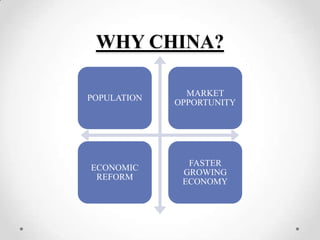
WHY CHINA?

               MARKET
POPULATION
             OPPORTUNITY


               FASTER
ECONOMIC
              GROWING
 REFORM
              ECONOMY
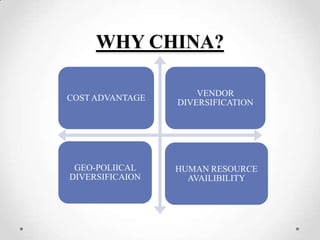
WHY CHINA?

                     VENDOR
COST ADVANTAGE
                 DIVERSIFICATION


 GEO-POLIICAL    HUMAN RESOURCE
DIVERSIFICAION     AVAILIBILITY
Yum Brands In China
Yum was the parent company of several restaurant
chains including KFC, Pizza Hut, and Taco Bell, which
improves them and expand in more area in China.
Sam Su is the Chairman and CEO of Yum! Brands
China Division and Vice-Chairman of Yum!
Yum was the largest restaurant company in the world
in terms of the number of units.
Strategies Of Yum Brands In
               China

 Quick Serve
 Non-Stop Expansion
 Traditional Cuisine
 Focus in New Generation
 Maintain Control over its Chinese Restaurant.
 Encourage the Growth of its Unit in Second – Tier
  Cities.
Pros & Cons Of Yum Brands
PROS
• Emerging Market
• Innovation
• Deal-Making
Cons
• US Business
• Costs
• Competitors
Should Yum Brands modify its menu
      to meet Chinese taste ?

YES
 Stiff Competition from McDonald and International
 & Local Players.
Growing Concern Related to lack of healthy nutrition
 value of fast food and out break of bird flu epidemics
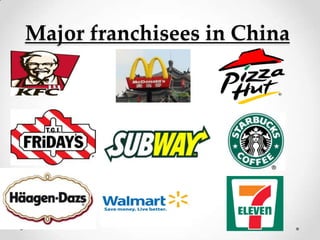
Major franchisees in China
Pros of Franchising in China
• Western brands are highly regarded.
• Second- and third-tier cities are open to franchising.
• It permits the franchiser a relatively lower cost of
  entry into China as the franchisees pay for the capital
  investments in setting up the franchising operation.
  The franchiser thus bears less business risks.
• It allows the franchiser to control the standard,
  quality and image of the operation.
Pros of Franchising in China
• It offers a fast way to expand in a vast market within
  a short period of time as the franchiser may cooperate
  with several franchisees at the same
  time.
• Marketing and promotional programs can meet with
  better support by the franchises.
• The franchiser may benefit from the franchisees local
  experience and connections.
Cons of Franchising in China
• Because the infusion of Western culture (e.g. movies,
  Internet sites, etc.) into China is controlled, many
  famous American brands are unknown.

• The language difference is another obstacle. For
  Western brand names to be effective they must be
  translated so as to be both culturally acceptable and
  easy to understand.
Cons of Franchising in China

• Older Chinese, being more tradition-bound, are a less
  attractive target market.

• Finding and evaluating licensee candidates is tough.

• Inadequate legal framework.

Franchisee in china

  • 2.
    Presented By:- SudhirSingh Rajput Yatish Mittal Vikrant Arora Amit Yadav Chandrashekhar Chaurasia Rohit Srivastava
  • 3.
    Concept  Over thelast two decades, the people’s republic of china has had the fastest growing market and GDP growth rate.  China is hailed as one of the most important consumer market of 21st Century.  Franchising is one of the booming sector in the Chinese economy.
  • 4.
    Franchise in China •China has the largest franchise systems in the world. • China currently has more than 82000 franchisee outlets, and growing at the rate of 49%. • Nearly 60 industries have applied for franchise operations in china. • Industries includes catering, retailing, individual services and automotive care. • Nearly half of the top 100 restaurant companies are utilizing franchise business model.
  • 5.
    Evolution  Franchising firstemerged in china in the late 1980’s.  Franchising industry in china experienced a period of disordered development in early days.  In 1997, the Ministry of Internal Trade established the first Chinese franchise law.  In china foreign franchising was still a grey area before the new rule was published.  The new regulation on commercial franchise announced by the Ministry of Commerce on December 30th, 2004.
  • 6.
    Franchising Models in China  Joint Venture:- Joint Ventures means joining up with foreign companies to produce or market the products or services. For example, Mc Donald’s.  Wholly Foreign Owned Enterprises:- All capital is provided by the foreign investors who has full control over the operations of the enterprise. For example, Tricon Group, which owns KFC and Pizza Hut.
  • 7.
    Cont… Master Franchising:- Amaster franchise is a person or entity who provides services to franchisees in a specified territory, typically a major market, geographical region or even one or more countries. Master franchising is a method that has been employed by most franchise systems. For example, Century 21 China Real Estate
  • 8.
    Best Prospects ofFranchising Sector  Catering Industry:- Catering industry is remaining the most popular investing item because the operation is relatively simple and the market is vast.  Education and Training:- Investing in education industry will become one of the hot spots from now on. China’s fast growning economy creates a sound developing space for foreign language training.
  • 9.
    Cont…  Real EstateBrokerage:- China’s economic reforms have ended decades in which homes and apartments were provided by the government.  Network Technology:- Franchise in network technology sector is still a brand new model.
  • 10.
    WHY CHINA? MARKET POPULATION OPPORTUNITY FASTER ECONOMIC GROWING REFORM ECONOMY
  • 11.
    WHY CHINA? VENDOR COST ADVANTAGE DIVERSIFICATION GEO-POLIICAL HUMAN RESOURCE DIVERSIFICAION AVAILIBILITY
  • 12.
    Yum Brands InChina Yum was the parent company of several restaurant chains including KFC, Pizza Hut, and Taco Bell, which improves them and expand in more area in China. Sam Su is the Chairman and CEO of Yum! Brands China Division and Vice-Chairman of Yum! Yum was the largest restaurant company in the world in terms of the number of units.
  • 13.
    Strategies Of YumBrands In China  Quick Serve  Non-Stop Expansion  Traditional Cuisine  Focus in New Generation  Maintain Control over its Chinese Restaurant.  Encourage the Growth of its Unit in Second – Tier Cities.
  • 14.
    Pros & ConsOf Yum Brands PROS • Emerging Market • Innovation • Deal-Making Cons • US Business • Costs • Competitors
  • 15.
    Should Yum Brandsmodify its menu to meet Chinese taste ? YES  Stiff Competition from McDonald and International & Local Players. Growing Concern Related to lack of healthy nutrition value of fast food and out break of bird flu epidemics
  • 16.
  • 17.
    Pros of Franchisingin China • Western brands are highly regarded. • Second- and third-tier cities are open to franchising. • It permits the franchiser a relatively lower cost of entry into China as the franchisees pay for the capital investments in setting up the franchising operation. The franchiser thus bears less business risks. • It allows the franchiser to control the standard, quality and image of the operation.
  • 18.
    Pros of Franchisingin China • It offers a fast way to expand in a vast market within a short period of time as the franchiser may cooperate with several franchisees at the same time. • Marketing and promotional programs can meet with better support by the franchises. • The franchiser may benefit from the franchisees local experience and connections.
  • 19.
    Cons of Franchisingin China • Because the infusion of Western culture (e.g. movies, Internet sites, etc.) into China is controlled, many famous American brands are unknown. • The language difference is another obstacle. For Western brand names to be effective they must be translated so as to be both culturally acceptable and easy to understand.
  • 20.
    Cons of Franchisingin China • Older Chinese, being more tradition-bound, are a less attractive target market. • Finding and evaluating licensee candidates is tough. • Inadequate legal framework.