



Study and analysis of
     business model of
International Food Chains in
            India
               Submitted By
                Ishan Tyagi

             Under the guidance of

               Mr. Vivek Arya
OBJECTIVE

To study and analyze the
business model of International
Food Chains in India.
SCOPE
 This report will cover the basic concept of International
  Marketing.


 It also covers the reasons of International Food chains for
  entering into Indian Market.


 This report will also focus on entry modes.


 The case study on McDonalds, KFC, Subway, Domino’s will cover
  all the above stated facts.
INTRODUCTION
              What is Marketing?
“It is the process by which companies create
 value for customers and build strong customer
 relationships, in order to capture value from
 customers in return”
marketing concept holds that achieving
 organizational goals depends on knowing the
 needs and wants of target markets and
 delivering the desired satisfactions.
Now, What is International Marketing?


 American Marketing Association (AMA) “international marketing
  is the multinational process of planning and executing the
  conception, pricing, promotion and distribution of ideas, goods,
  and services to create exchanges that satisfy individual and
  organizational objectives”.


 In simple words international marketing is the application of
  marketing principles to across national boundaries.
 Fast Food:
        Fast food is the term given to food that can be :
 Prepared and served very quickly.
 Has low preparation/delivery time.
 Packaged form for take-out/take-away.
 Increasing intervention of international brands in the Indian market
    has attracted attention of mass population.


 Curiosity to know :
        Why they target the Indian Market.


        How they enter into the Indian market.
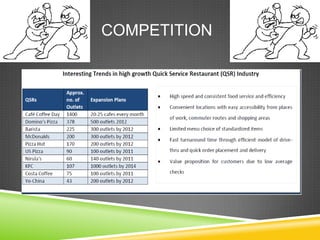
COMPETITION
ENTRY METHODS/ STRATEGIES
       Strategic alliances
     usually depends on what complimentary resources the foreign company is
      looking for in its local partner.
   Joint Ventures
 Contract Manufacturing
 Licensing
 Franchising
 Exporting


       Standalone entries
     are done by companies which perceive themselves to have adequate
      capability in taking capital risk and are ready to gain the knowledge
      associated with the new                       markets over time.
DATA COLLECTION
 Secondary data is used as the sole source of information.


 It includes the collection of data from
 Internet- 1.http://kalyan-city.blogspot.in/2011/09/what-is-
  international-         business-meaning.html
        2. http://www.thehindubusinessline.com

 Book- Mirage of Global Markets, The: How Globalizing
  Companies Can Succeed as Markets Localize
ANALYSIS
 This project will be analyzing : Why they prefer to enter into the
  Indian market,
 reasons behind choosing the particular mode to make an entry
  into market
 how they succeeded in capturing market in India, What are the
  issue associated with entry modes of international food chain.
 We will perform the comparative analysis in the basis of
  parameters like their promotion strategies, their pricing strategies
  & their customer demand for Nirula’s, Wimp, McDonald's.
CONCLUSION
 Reasons for Emergence


   Gender Role
   Paucity of Time
   Working Women
   Large population
   Relaxation in rules and regulations
   Menu diversification
 Challenges will have to face by International Food Chains.
 Food regulation and licenses
    Starting a restaurant requires all permits and licenses from local governing
      bodies and adequate insurance coverage. There are up to 10 basic licenses
      to be procured before setting up a food supply store. In addition the duration
      of these licenses vary from 1 to 3 years.
 Poor infrastructure
    A major concern for a country like India is poor infrastructure, poor
      transportation facility and erratic power supply. An indication of the severity of
      the infrastructure problem is the spoilage of 25-30% of the crops each year
      due to infrastructure bottle necks. The result of these bottle necks is that
      prices for food material tend to be on the higher side with the quality
      compromised.
 Lack of organized supply chain
    An inefficient supply chain creates hurdles in ensuring that food of the
      required quality and quantity is procured and it reaches the end customer on
      time with little or no loss.
 High price of real estate
    A majority of the restaurant players operate under leased premises. Hence,
      high real estate lease rentals impact profitability and the growth of the
      industry.
 Shortage of skilled and semi-skilled manpower
    The food services industry is highly dependent on skilled and well-trained
      manpower –especially experienced chefs and managers. With growth in other
      sectors, the hospitality industry as a career option finds few takers.
 Lack of adequate training institutes
    There is a huge imbalance as the educational institutions are producing
      managers but not workers who are required in larger numbers to run a
      business.
 Social and cultural implications of Indians switching to
  western breakfast food:
    Example MC Donald's
MC DONALD’S
 Entry in Indian Market
    The market entry strategy was Joint Venture. McDonald’s was a Wholly
      Owned Subsidiary. It incorporated to India in 1993. McDonald’s opened its
      door in India in Vasant Vihar, New Delhi in October 1996.
    It Entered into two 50:50 joint ventures with Cannaught Plaza Restaurant-
      Vikram Bakshi- North and Hardcastel Restaurant- Amit Jatia-West.
 After Joint Venture they adopt their global business strategy and
  spread their business through franchise driven business model.
   Franchise driven model
   15% owned stores, remaining 85% are operated by franchises.


They opted joint venture because
   For gaining experience in the new area of activity.
   Tax advantage was a significant factor.
   Market access and knowledge
   Need of framework for assessing industry/ market attractiveness.


An advantage to McDonald’s in Joint Venture:
   Pool of resources
   Full utilization of under-utilized resources.
   Higher rate of profits.
   Low risk factor.
   Knowledge of local taste and preferences.
   Less cost involved.


Disadvantages for choosing Joint Venture
   Diminish control over some important matter.
   Sharing of profit.
   Risk of giving control of recipes to partner.
   Joint venture does not give the management of the company complete control because the decisions are
    taken by both the companies.
DOMINO’S
 Entry into Indian market
 Domino’s entered India in1996 through a Special Franchise
  agreement with Vam Bhartia corp. (Jubilant Food Works Ltd. )
 The first outlet was opened in Delhi.
 On 2000, Domino’s had a presence in all the major cities and
  towns in India.
 Advantages to Domino’s


 Domino’s benefit from continuing royalties that are, based upon percentage of
  jublient food works ltd gross sale and paid on basis.
 Jubilant Food Work Ltd. who have invested their own capital and savings- serve
  better managers and operators than paid employees who do not possess a vested
  interest in the business.
 Minimum investment is required on the other hand they get regular income in form
  of royalties from Jubilant Food Works Ltd.
 The multi- unit expansion associated with franchising serves to supplement and
  expand the value of dominos.

 Disadvantages to Dominos


 Domino’s need to look after the trust and enthusiasm of franchisee.
 Threat from Jubilant food works ltd of becoming too independent.
 The fear of training future competitor.
 Ant management styles must be open and advisory instead of doctorial or
   hierarchical.
LIMITATION
 This project is confined only to the secondary source of data.


 The available data may not be as accurate as desired.

Minor project synopsis_ishan

  • 1.
    Study and analysisof business model of International Food Chains in India Submitted By Ishan Tyagi Under the guidance of Mr. Vivek Arya
  • 2.
    OBJECTIVE To study andanalyze the business model of International Food Chains in India.
  • 3.
    SCOPE  This reportwill cover the basic concept of International Marketing.  It also covers the reasons of International Food chains for entering into Indian Market.  This report will also focus on entry modes.  The case study on McDonalds, KFC, Subway, Domino’s will cover all the above stated facts.
  • 4.
    INTRODUCTION What is Marketing? “It is the process by which companies create value for customers and build strong customer relationships, in order to capture value from customers in return” marketing concept holds that achieving organizational goals depends on knowing the needs and wants of target markets and delivering the desired satisfactions.
  • 5.
    Now, What isInternational Marketing?  American Marketing Association (AMA) “international marketing is the multinational process of planning and executing the conception, pricing, promotion and distribution of ideas, goods, and services to create exchanges that satisfy individual and organizational objectives”.  In simple words international marketing is the application of marketing principles to across national boundaries.
  • 6.
     Fast Food: Fast food is the term given to food that can be :  Prepared and served very quickly.  Has low preparation/delivery time.  Packaged form for take-out/take-away.
  • 7.
     Increasing interventionof international brands in the Indian market has attracted attention of mass population.  Curiosity to know :  Why they target the Indian Market.  How they enter into the Indian market.
  • 8.
  • 9.
    ENTRY METHODS/ STRATEGIES  Strategic alliances  usually depends on what complimentary resources the foreign company is looking for in its local partner.  Joint Ventures  Contract Manufacturing  Licensing  Franchising  Exporting  Standalone entries  are done by companies which perceive themselves to have adequate capability in taking capital risk and are ready to gain the knowledge associated with the new markets over time.
  • 10.
    DATA COLLECTION  Secondarydata is used as the sole source of information.  It includes the collection of data from  Internet- 1.http://kalyan-city.blogspot.in/2011/09/what-is- international- business-meaning.html 2. http://www.thehindubusinessline.com  Book- Mirage of Global Markets, The: How Globalizing Companies Can Succeed as Markets Localize
  • 11.
    ANALYSIS  This projectwill be analyzing : Why they prefer to enter into the Indian market,  reasons behind choosing the particular mode to make an entry into market  how they succeeded in capturing market in India, What are the issue associated with entry modes of international food chain.  We will perform the comparative analysis in the basis of parameters like their promotion strategies, their pricing strategies & their customer demand for Nirula’s, Wimp, McDonald's.
  • 12.
    CONCLUSION  Reasons forEmergence  Gender Role  Paucity of Time  Working Women  Large population  Relaxation in rules and regulations  Menu diversification
  • 13.
     Challenges willhave to face by International Food Chains.  Food regulation and licenses  Starting a restaurant requires all permits and licenses from local governing bodies and adequate insurance coverage. There are up to 10 basic licenses to be procured before setting up a food supply store. In addition the duration of these licenses vary from 1 to 3 years.  Poor infrastructure  A major concern for a country like India is poor infrastructure, poor transportation facility and erratic power supply. An indication of the severity of the infrastructure problem is the spoilage of 25-30% of the crops each year due to infrastructure bottle necks. The result of these bottle necks is that prices for food material tend to be on the higher side with the quality compromised.  Lack of organized supply chain  An inefficient supply chain creates hurdles in ensuring that food of the required quality and quantity is procured and it reaches the end customer on time with little or no loss.
  • 14.
     High priceof real estate  A majority of the restaurant players operate under leased premises. Hence, high real estate lease rentals impact profitability and the growth of the industry.  Shortage of skilled and semi-skilled manpower  The food services industry is highly dependent on skilled and well-trained manpower –especially experienced chefs and managers. With growth in other sectors, the hospitality industry as a career option finds few takers.  Lack of adequate training institutes  There is a huge imbalance as the educational institutions are producing managers but not workers who are required in larger numbers to run a business.  Social and cultural implications of Indians switching to western breakfast food:  Example MC Donald's
  • 15.
    MC DONALD’S  Entryin Indian Market  The market entry strategy was Joint Venture. McDonald’s was a Wholly Owned Subsidiary. It incorporated to India in 1993. McDonald’s opened its door in India in Vasant Vihar, New Delhi in October 1996.  It Entered into two 50:50 joint ventures with Cannaught Plaza Restaurant- Vikram Bakshi- North and Hardcastel Restaurant- Amit Jatia-West.  After Joint Venture they adopt their global business strategy and spread their business through franchise driven business model.
  • 16.
    Franchise driven model  15% owned stores, remaining 85% are operated by franchises. They opted joint venture because  For gaining experience in the new area of activity.  Tax advantage was a significant factor.  Market access and knowledge  Need of framework for assessing industry/ market attractiveness. An advantage to McDonald’s in Joint Venture:  Pool of resources  Full utilization of under-utilized resources.  Higher rate of profits.  Low risk factor.  Knowledge of local taste and preferences.  Less cost involved. Disadvantages for choosing Joint Venture  Diminish control over some important matter.  Sharing of profit.  Risk of giving control of recipes to partner.  Joint venture does not give the management of the company complete control because the decisions are taken by both the companies.
  • 17.
    DOMINO’S  Entry intoIndian market  Domino’s entered India in1996 through a Special Franchise agreement with Vam Bhartia corp. (Jubilant Food Works Ltd. )  The first outlet was opened in Delhi.  On 2000, Domino’s had a presence in all the major cities and towns in India.
  • 18.
     Advantages toDomino’s  Domino’s benefit from continuing royalties that are, based upon percentage of jublient food works ltd gross sale and paid on basis.  Jubilant Food Work Ltd. who have invested their own capital and savings- serve better managers and operators than paid employees who do not possess a vested interest in the business.  Minimum investment is required on the other hand they get regular income in form of royalties from Jubilant Food Works Ltd.  The multi- unit expansion associated with franchising serves to supplement and expand the value of dominos.  Disadvantages to Dominos  Domino’s need to look after the trust and enthusiasm of franchisee.  Threat from Jubilant food works ltd of becoming too independent.  The fear of training future competitor.  Ant management styles must be open and advisory instead of doctorial or hierarchical.
  • 19.
    LIMITATION  This projectis confined only to the secondary source of data.  The available data may not be as accurate as desired.