FINAL YEAR PROJECT REPORT
     PGDM 2011 – 2013

     Title of the Project :- Study on Rural Marketing With
     Special Emphasis on Customer Preference For HUL in
     Rural India


Presented To:-     Prof. (Dr.) Ekta Rastogi

                               Presented By:-   Sudhir Singh Rajput
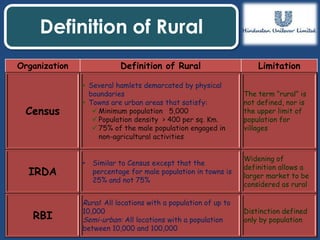
Definition of Rural
Organization               Definition of Rural                       Limitation

               • Several hamlets demarcated by physical
                 boundaries                                      The term “rural” is
               • Towns are urban areas that satisfy:             not defined, nor is
 Census            Minimum population 5,000                     the upper limit of
                   Population density > 400 per sq. Km.         population for
                   75% of the male population engaged in        villages
                    non-agricultural activities


                                                                 Widening of
               •   Similar to Census except that the
                                                                 definition allows a
  IRDA             percentage for male population in towns is
                                                                 larger market to be
                   25% and not 75%
                                                                 considered as rural

               Rural: All locations with a population of up to
               10,000                                            Distinction defined
   RBI         Semi-urban: All locations with a population       only by population
               between 10,000 and 100,000
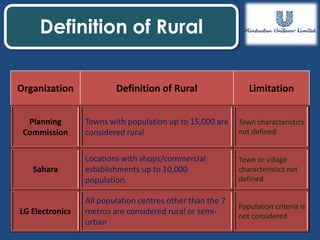
Definition of Rural

Organization             Definition of Rural                  Limitation


  Planning       Towns with population up to 15,000 are    Town characteristics
 Commission      considered rural                          not defined


                 Locations with shops/commercial           Town or village
   Sahara        establishments up to 10,000               characteristics not
                 population.                               defined

                 All population centres other than the 7
                                                           Population criteria is
LG Electronics   metros are considered rural or semi-
                                                           not considered
                 urban
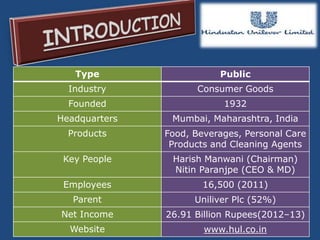
Type                   Public
  Industry           Consumer Goods
  Founded                  1932
Headquarters    Mumbai, Maharashtra, India
  Products     Food, Beverages, Personal Care
                Products and Cleaning Agents
 Key People     Harish Manwani (Chairman)
                Nitin Paranjpe (CEO & MD)
 Employees             16,500 (2011)
   Parent            Uniliver Plc (52%)
Net Income     26.91 Billion Rupees(2012–13)
  Website              www.hul.co.in
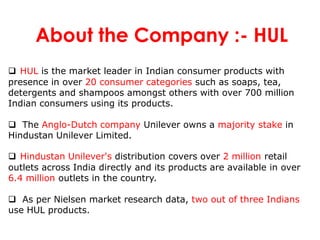
About the Company :- HUL
 HUL is the market leader in Indian consumer products with
presence in over 20 consumer categories such as soaps, tea,
detergents and shampoos amongst others with over 700 million
Indian consumers using its products.

 The Anglo-Dutch company Unilever owns a majority stake in
Hindustan Unilever Limited.

 Hindustan Unilever's distribution covers over 2 million retail
outlets across India directly and its products are available in over
6.4 million outlets in the country.

 As per Nielsen market research data, two out of three Indians
use HUL products.
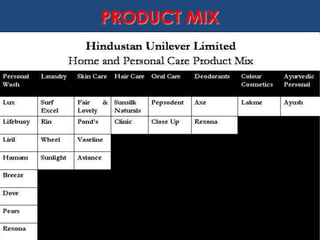
PRODUCT MIX


              6
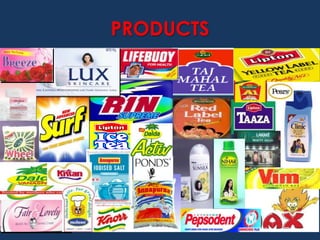
PRODUCTS
MARKETING STRATEGIES OF HUL
Rural Marketing Mix
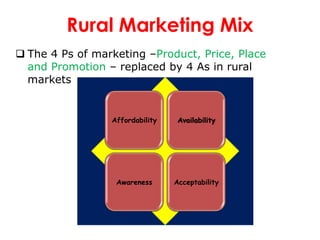
 The 4 Ps of marketing –Product, Price, Place
  and Promotion – replaced by 4 As in rural
  markets


                 Affordability    Availability


                  Awareness      Acceptability
MARKETING STRATEGIES OF HUL
        FOR RURAL INDIA
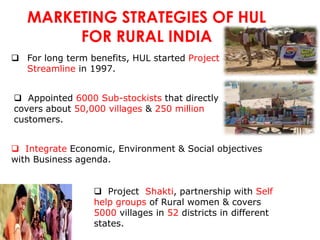
 For long term benefits, HUL started Project
  Streamline in 1997.


 Appointed 6000 Sub-stockists that directly
covers about 50,000 villages & 250 million
customers.


 Integrate Economic, Environment & Social objectives
with Business agenda.


                  Project Shakti, partnership with Self
                 help groups of Rural women & covers
                 5000 villages in 52 districts in different
                 states.
EVERYDAY I WILL
    SELL.
    EVERYDAY I WILL
    EARN.
    MONEY, RESPECT


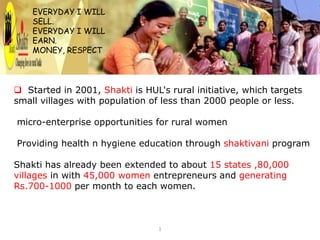
 Started in 2001, Shakti is HUL's rural initiative, which targets
small villages with population of less than 2000 people or less.

micro-enterprise opportunities for rural women

Providing health n hygiene education through shaktivani program

Shakti has already been extended to about 15 states ,80,000
villages in with 45,000 women entrepreneurs and generating
Rs.700-1000 per month to each women.


                                 1
To analyze the present promotional strategy of rural
          brands (HUL) in rural markets.


To measure the success of rural marketing campaign
     of the brands (HUL) in terms of consumer
                   appreciation.

To analyze the market opportunity and potential for
   existing and new entrants in the rural market.


To evaluate the effects of adopting the specific brand
    ambassadors in the rural marketing context.
Research Methodology

    The following sites had been identified and surveyed:


Uttar Pradesh (Unnao District)
  a) Asha Kheda
  b) Babakheda
  c) Nawabganj
  d) Sohramau
  e) Banthara
Research Methodology

   Random sampling was done for interview of the
           respondents in every village.


A sample of 4 respondents per village was interviewed.


 The research was carried out for a period of 30 days
       from 17th February to 17th March 2013.


   The total sample collected was 20 respondents.
Research Methodology
                  Data Collection

 Primary Data had collected through personal contact.

 For this purpose both Questionnaire and one-on-one
  interview was considered with the consumers.

 Secondary data had collected from magazines,
  newspaper, company literature and Websites.
Research Methodology
                      Research Approaches
 Survey Research
 Observational Research
 Close-Ended Questions


                       Analysis Methods
 Percentage method


           Methods of research data presentation
 Tabular forms
 Graphs
 Description
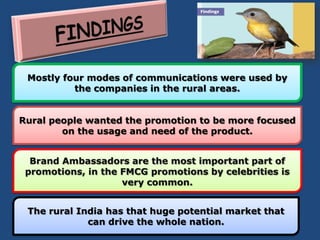
Mostly four modes of communications were used by
          the companies in the rural areas.


Rural people wanted the promotion to be more focused
        on the usage and need of the product.


  Brand Ambassadors are the most important part of
 promotions, in the FMCG promotions by celebrities is
                    very common.


 The rural India has that huge potential market that
             can drive the whole nation.
FINDINGS

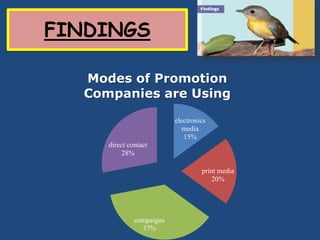
  Modes of Promotion
  Companies are Using

                          electronics
                             media
                             15%
     direct contact
          28%

                                   print media
                                      20%


              compaigns
                37%
FINDINGS

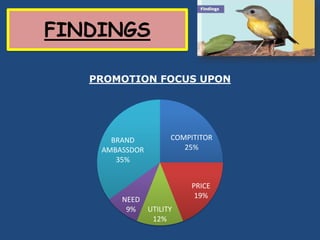
   PROMOTION FOCUS UPON


      BRAND       COMPITITOR
    AMBASSDOR        25%
       35%


                       PRICE
        NEED            19%
         9% UTILITY
             12%
FINDINGS
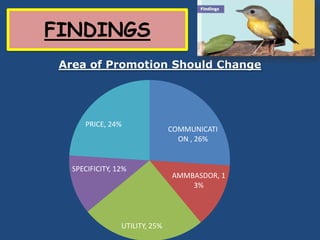
 Area of Promotion Should Change


      PRICE, 24%
                                COMMUNICATI
                                  ON , 26%


   SPECIFICITY, 12%
                                AMMBASDOR, 1
                                    3%


                 UTILITY, 25%
FINDINGS
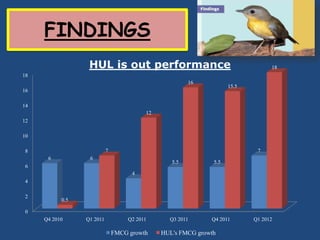
                  HUL is out performance                                          18
18
                                                        16
                                                                     15.5
16

14
                                          12
12

10

 8                         7                                                 7
      6           6
                                                  5.5          5.5
 6
                                     4
 4

 2
           0.5

 0
     Q4 2010     Q1 2011            Q2 2011      Q3 2011      Q4 2011       Q1 2012

                               FMCG growth     HUL's FMCG growth
RECOMMENDATIONS

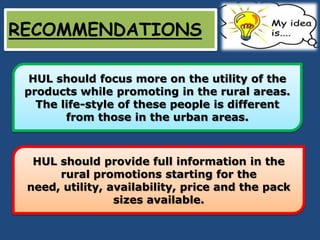
  HUL should focus more on the utility of the
 products while promoting in the rural areas.
   The life-style of these people is different
        from those in the urban areas.


  HUL should provide full information in the
      rural promotions starting for the
 need, utility, availability, price and the pack
                 sizes available.
RECOMMENDATIONS


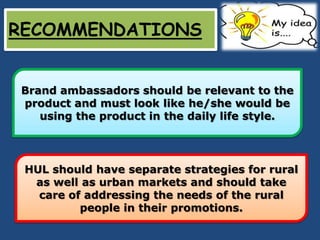
Brand ambassadors should be relevant to the
product and must look like he/she would be
   using the product in the daily life style.


 HUL should have separate strategies for rural
  as well as urban markets and should take
   care of addressing the needs of the rural
          people in their promotions.
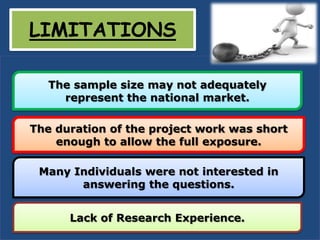
LIMITATIONS

   The sample size may not adequately
     represent the national market.

The duration of the project work was short
    enough to allow the full exposure.

 Many Individuals were not interested in
       answering the questions.


      Lack of Research Experience.
Project HUL SSR

Project HUL SSR

  • 1.
    FINAL YEAR PROJECTREPORT PGDM 2011 – 2013 Title of the Project :- Study on Rural Marketing With Special Emphasis on Customer Preference For HUL in Rural India Presented To:- Prof. (Dr.) Ekta Rastogi Presented By:- Sudhir Singh Rajput
  • 2.
    Definition of Rural Organization Definition of Rural Limitation • Several hamlets demarcated by physical boundaries The term “rural” is • Towns are urban areas that satisfy: not defined, nor is Census  Minimum population 5,000 the upper limit of  Population density > 400 per sq. Km. population for  75% of the male population engaged in villages non-agricultural activities Widening of • Similar to Census except that the definition allows a IRDA percentage for male population in towns is larger market to be 25% and not 75% considered as rural Rural: All locations with a population of up to 10,000 Distinction defined RBI Semi-urban: All locations with a population only by population between 10,000 and 100,000
  • 3.
    Definition of Rural Organization Definition of Rural Limitation Planning Towns with population up to 15,000 are Town characteristics Commission considered rural not defined Locations with shops/commercial Town or village Sahara establishments up to 10,000 characteristics not population. defined All population centres other than the 7 Population criteria is LG Electronics metros are considered rural or semi- not considered urban
  • 4.
    Type Public Industry Consumer Goods Founded 1932 Headquarters Mumbai, Maharashtra, India Products Food, Beverages, Personal Care Products and Cleaning Agents Key People Harish Manwani (Chairman) Nitin Paranjpe (CEO & MD) Employees 16,500 (2011) Parent Uniliver Plc (52%) Net Income 26.91 Billion Rupees(2012–13) Website www.hul.co.in
  • 5.
    About the Company:- HUL  HUL is the market leader in Indian consumer products with presence in over 20 consumer categories such as soaps, tea, detergents and shampoos amongst others with over 700 million Indian consumers using its products.  The Anglo-Dutch company Unilever owns a majority stake in Hindustan Unilever Limited.  Hindustan Unilever's distribution covers over 2 million retail outlets across India directly and its products are available in over 6.4 million outlets in the country.  As per Nielsen market research data, two out of three Indians use HUL products.
  • 6.
  • 7.
  • 8.
  • 9.
    Rural Marketing Mix The 4 Ps of marketing –Product, Price, Place and Promotion – replaced by 4 As in rural markets Affordability Availability Awareness Acceptability
  • 10.
    MARKETING STRATEGIES OFHUL FOR RURAL INDIA  For long term benefits, HUL started Project Streamline in 1997.  Appointed 6000 Sub-stockists that directly covers about 50,000 villages & 250 million customers.  Integrate Economic, Environment & Social objectives with Business agenda.  Project Shakti, partnership with Self help groups of Rural women & covers 5000 villages in 52 districts in different states.
  • 11.
    EVERYDAY I WILL SELL. EVERYDAY I WILL EARN. MONEY, RESPECT  Started in 2001, Shakti is HUL's rural initiative, which targets small villages with population of less than 2000 people or less. micro-enterprise opportunities for rural women Providing health n hygiene education through shaktivani program Shakti has already been extended to about 15 states ,80,000 villages in with 45,000 women entrepreneurs and generating Rs.700-1000 per month to each women. 1
  • 12.
    To analyze thepresent promotional strategy of rural brands (HUL) in rural markets. To measure the success of rural marketing campaign of the brands (HUL) in terms of consumer appreciation. To analyze the market opportunity and potential for existing and new entrants in the rural market. To evaluate the effects of adopting the specific brand ambassadors in the rural marketing context.
  • 13.
    Research Methodology The following sites had been identified and surveyed: Uttar Pradesh (Unnao District) a) Asha Kheda b) Babakheda c) Nawabganj d) Sohramau e) Banthara
  • 14.
    Research Methodology Random sampling was done for interview of the respondents in every village. A sample of 4 respondents per village was interviewed. The research was carried out for a period of 30 days from 17th February to 17th March 2013. The total sample collected was 20 respondents.
  • 15.
    Research Methodology Data Collection  Primary Data had collected through personal contact.  For this purpose both Questionnaire and one-on-one interview was considered with the consumers.  Secondary data had collected from magazines, newspaper, company literature and Websites.
  • 16.
    Research Methodology Research Approaches  Survey Research  Observational Research  Close-Ended Questions Analysis Methods  Percentage method Methods of research data presentation  Tabular forms  Graphs  Description
  • 17.
    Mostly four modesof communications were used by the companies in the rural areas. Rural people wanted the promotion to be more focused on the usage and need of the product. Brand Ambassadors are the most important part of promotions, in the FMCG promotions by celebrities is very common. The rural India has that huge potential market that can drive the whole nation.
  • 18.
    FINDINGS Modesof Promotion Companies are Using electronics media 15% direct contact 28% print media 20% compaigns 37%
  • 19.
    FINDINGS PROMOTION FOCUS UPON BRAND COMPITITOR AMBASSDOR 25% 35% PRICE NEED 19% 9% UTILITY 12%
  • 20.
    FINDINGS Area ofPromotion Should Change PRICE, 24% COMMUNICATI ON , 26% SPECIFICITY, 12% AMMBASDOR, 1 3% UTILITY, 25%
  • 21.
    FINDINGS HUL is out performance 18 18 16 15.5 16 14 12 12 10 8 7 7 6 6 5.5 5.5 6 4 4 2 0.5 0 Q4 2010 Q1 2011 Q2 2011 Q3 2011 Q4 2011 Q1 2012 FMCG growth HUL's FMCG growth
  • 22.
    RECOMMENDATIONS HULshould focus more on the utility of the products while promoting in the rural areas. The life-style of these people is different from those in the urban areas. HUL should provide full information in the rural promotions starting for the need, utility, availability, price and the pack sizes available.
  • 23.
    RECOMMENDATIONS Brand ambassadors shouldbe relevant to the product and must look like he/she would be using the product in the daily life style. HUL should have separate strategies for rural as well as urban markets and should take care of addressing the needs of the rural people in their promotions.
  • 24.
    LIMITATIONS The sample size may not adequately represent the national market. The duration of the project work was short enough to allow the full exposure. Many Individuals were not interested in answering the questions. Lack of Research Experience.