Framing & Building Basics
Architectural Drawing & Interior Design
Introduction to Framing
• Once you have your floor plan design, you are now ready to plan for
building.
• In order to accomplish this, you must know the correct methods
needed to properly frame a house.
• While this can get extremely daunting in larger homes, if you take it
bit by bit it’s manageable.
• Framing is an interdependent structural system where one piece
depends on another.
Structural Loads
• Before we get started with framing we understand structural loads.
• Structural loads are forces that get to applied to structures, e.g. wind,
gravity, snow, earthquakes, people etc.
• If your house cannot handle such loads it will collapse.
• Structural Loads include dead loads, live loads, environmental loads.
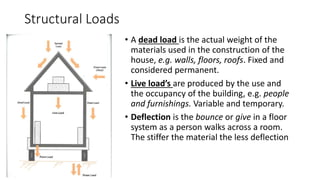
Structural Loads
• A dead load is the actual weight of the
materials used in the construction of the
house, e.g. walls, floors, roofs. Fixed and
considered permanent.
• Live load’s are produced by the use and
the occupancy of the building, e.g. people
and furnishings. Variable and temporary.
• Deflection is the bounce or give in a floor
system as a person walks across a room.
The stiffer the material the less deflection
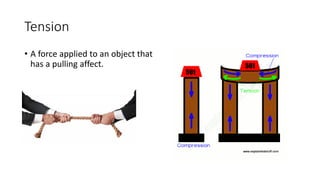
Tension
• A force applied to an object that
has a pulling affect.
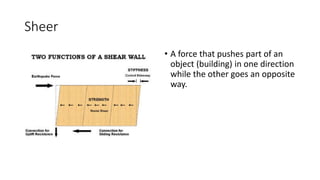
Sheer
• A force that pushes part of an
object (building) in one direction
while the other goes an opposite
way.
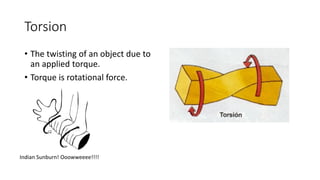
Torsion
• The twisting of an object due to
an applied torque.
• Torque is rotational force.
Indian Sunburn! Ooowweeee!!!!
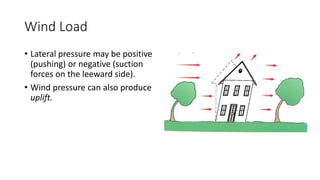
Wind Load
• Lateral pressure may be positive
(pushing) or negative (suction
forces on the leeward side).
• Wind pressure can also produce
uplift.
Hurricanes
• Hurricane prone areas are the
coastal areas of the Atlantic
Ocean and the Gulf of Mexico
where wind speed exceeds 90
mph.
• Additional protection is required
for exterior glazing where wind
blown debris might be a
problem.
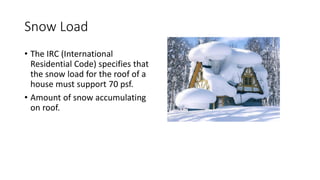
Snow Load
• The IRC (International
Residential Code) specifies that
the snow load for the roof of a
house must support 70 psf.
• Amount of snow accumulating
on roof.
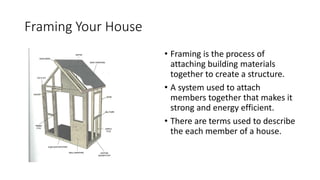
Framing Your House
• Framing is the process of
attaching building materials
together to create a structure.
• A system used to attach
members together that makes it
strong and energy efficient.
• There are terms used to describe
the each member of a house.
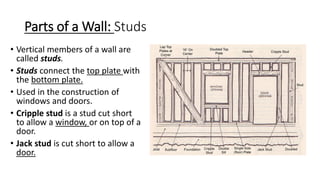
Parts of a Wall: Studs
• Vertical members of a wall are
called studs.
• Studs connect the top plate with
the bottom plate.
• Used in the construction of
windows and doors.
• Cripple stud is a stud cut short
to allow a window, or on top of a
door.
• Jack stud is cut short to allow a
door.
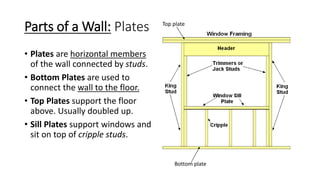
Parts of a Wall: Plates
• Plates are horizontal members
of the wall connected by studs.
• Bottom Plates are used to
connect the wall to the floor.
• Top Plates support the floor
above. Usually doubled up.
• Sill Plates support windows and
sit on top of cripple studs.
Bottom plate
Top plate
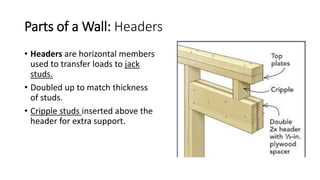
Parts of a Wall: Headers
• Headers are horizontal members
used to transfer loads to jack
studs.
• Doubled up to match thickness
of studs.
• Cripple studs inserted above the
header for extra support.
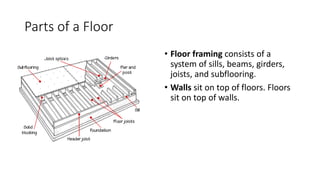
Parts of a Floor
• Floor framing consists of a
system of sills, beams, girders,
joists, and subflooring.
• Walls sit on top of floors. Floors
sit on top of walls.
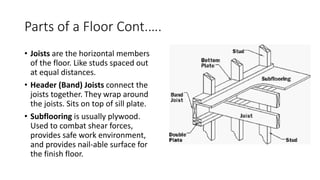
Parts of a Floor Cont.….
• Joists are the horizontal members
of the floor. Like studs spaced out
at equal distances.
• Header (Band) Joists connect the
joists together. They wrap around
the joists. Sits on top of sill plate.
• Subflooring is usually plywood.
Used to combat shear forces,
provides safe work environment,
and provides nail-able surface for
the finish floor.
Parts of a Floor
• Girders are beams used in
construction as the main
horizontal support.
• Supports the joists that sit on
top of it.
• Placed mid span of the joists to
resist deflection.
In Conclusion…
• A structure must withstand a number of forces being applied to it.
• Examples of forces are…
• Tension, shear, and torsion.
• Live loads and dead loads must be taken into account when designing
a structure.
• Framing is the process of connecting building materials together to
create a structure. Framing is a construction system.
• Studs, plates, headers, rafters, girders, flooring and joists are all terms used to
identify different components in framing.

Framing and Building Basics.pdf

  • 1.
    Framing & BuildingBasics Architectural Drawing & Interior Design
  • 2.
    Introduction to Framing •Once you have your floor plan design, you are now ready to plan for building. • In order to accomplish this, you must know the correct methods needed to properly frame a house. • While this can get extremely daunting in larger homes, if you take it bit by bit it’s manageable. • Framing is an interdependent structural system where one piece depends on another.
  • 3.
    Structural Loads • Beforewe get started with framing we understand structural loads. • Structural loads are forces that get to applied to structures, e.g. wind, gravity, snow, earthquakes, people etc. • If your house cannot handle such loads it will collapse. • Structural Loads include dead loads, live loads, environmental loads.
  • 4.
    Structural Loads • Adead load is the actual weight of the materials used in the construction of the house, e.g. walls, floors, roofs. Fixed and considered permanent. • Live load’s are produced by the use and the occupancy of the building, e.g. people and furnishings. Variable and temporary. • Deflection is the bounce or give in a floor system as a person walks across a room. The stiffer the material the less deflection
  • 5.
    Tension • A forceapplied to an object that has a pulling affect.
  • 6.
    Sheer • A forcethat pushes part of an object (building) in one direction while the other goes an opposite way.
  • 7.
    Torsion • The twistingof an object due to an applied torque. • Torque is rotational force. Indian Sunburn! Ooowweeee!!!!
  • 8.
    Wind Load • Lateralpressure may be positive (pushing) or negative (suction forces on the leeward side). • Wind pressure can also produce uplift.
  • 10.
    Hurricanes • Hurricane proneareas are the coastal areas of the Atlantic Ocean and the Gulf of Mexico where wind speed exceeds 90 mph. • Additional protection is required for exterior glazing where wind blown debris might be a problem.
  • 11.
    Snow Load • TheIRC (International Residential Code) specifies that the snow load for the roof of a house must support 70 psf. • Amount of snow accumulating on roof.
  • 12.
    Framing Your House •Framing is the process of attaching building materials together to create a structure. • A system used to attach members together that makes it strong and energy efficient. • There are terms used to describe the each member of a house.
  • 13.
    Parts of aWall: Studs • Vertical members of a wall are called studs. • Studs connect the top plate with the bottom plate. • Used in the construction of windows and doors. • Cripple stud is a stud cut short to allow a window, or on top of a door. • Jack stud is cut short to allow a door.
  • 14.
    Parts of aWall: Plates • Plates are horizontal members of the wall connected by studs. • Bottom Plates are used to connect the wall to the floor. • Top Plates support the floor above. Usually doubled up. • Sill Plates support windows and sit on top of cripple studs. Bottom plate Top plate
  • 15.
    Parts of aWall: Headers • Headers are horizontal members used to transfer loads to jack studs. • Doubled up to match thickness of studs. • Cripple studs inserted above the header for extra support.
  • 16.
    Parts of aFloor • Floor framing consists of a system of sills, beams, girders, joists, and subflooring. • Walls sit on top of floors. Floors sit on top of walls.
  • 17.
    Parts of aFloor Cont.…. • Joists are the horizontal members of the floor. Like studs spaced out at equal distances. • Header (Band) Joists connect the joists together. They wrap around the joists. Sits on top of sill plate. • Subflooring is usually plywood. Used to combat shear forces, provides safe work environment, and provides nail-able surface for the finish floor.
  • 18.
    Parts of aFloor • Girders are beams used in construction as the main horizontal support. • Supports the joists that sit on top of it. • Placed mid span of the joists to resist deflection.
  • 19.
    In Conclusion… • Astructure must withstand a number of forces being applied to it. • Examples of forces are… • Tension, shear, and torsion. • Live loads and dead loads must be taken into account when designing a structure. • Framing is the process of connecting building materials together to create a structure. Framing is a construction system. • Studs, plates, headers, rafters, girders, flooring and joists are all terms used to identify different components in framing.