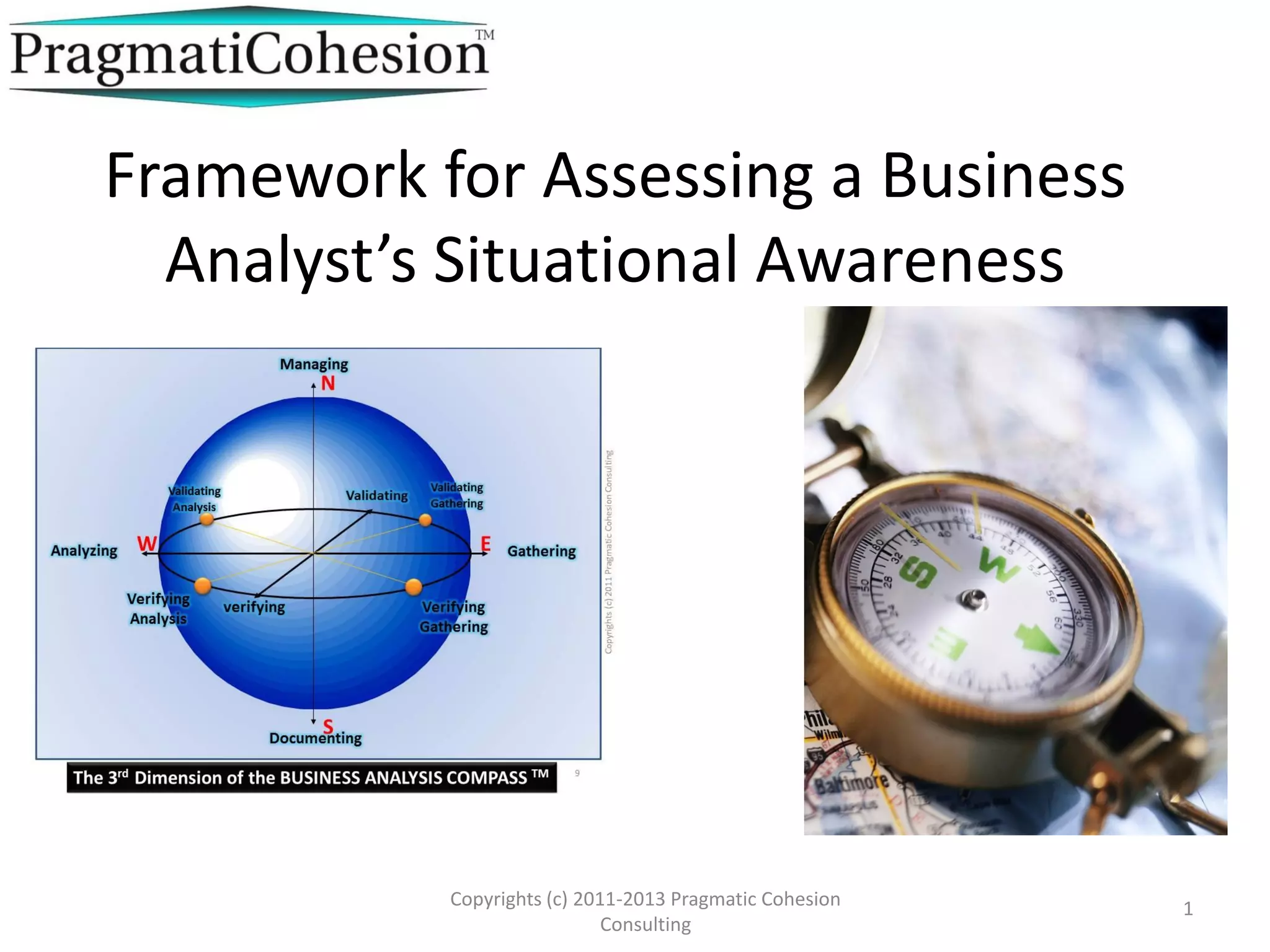
Framework for Assessing a Business Analyst’s
Situational Awareness
Copyrights (c) 2011-2013 Pragmatic Cohesion
Consulting
1
Determine the Complexity of your responsibilities
from Trivial Problems to Wicked ones
Situational Awareness Wikipedia
Definition
• Situation awareness is the perception of environmental
elements with respect to time and/or space, the
comprehension of their meaning, and the projection of their
status after some variable has changed, such as time, or some
other variable, such as a predetermined event. It is also a field
of study concerned with perception of the environment
critical to decision-makers in complex, dynamic areas from
aviation, air traffic control, power plant operations, military
command and control, and emergency services such as fire
fighting and policing; to more ordinary but nevertheless
complex tasks such as driving an automobile or bicycle. [may
this author add Business Analysis ?]
Copyrights (c) 2011-2013 Pragmatic Cohesion
Consulting
2
BA’s Situational Awareness Framework
• This presentation describes a Framework for
Assessing Business Analysts (BAs) Situational
Awareness.
• The Framework is composed of 3 dimensions of
assessment:
– The type of Pursuit that a BA is following
– The type of Endeavor that the BA is conducting
– The type of Decision that the BA is making
• These 3 dimensions were introduced by Dr. H.
Kurstedt.
Copyrights (c) 2011-2013 Pragmatic Cohesion
Consulting 3
BA’s Situational Awareness Framework
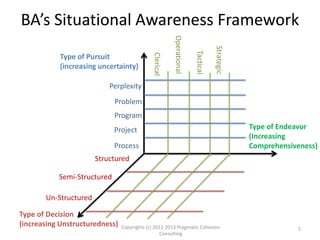
• The BA’s situational awareness is described by
where he/she is located at a specific point in
time along these 3 Axes dimensions.
• This author argues that the farther away
from the origin of each Axis, the more
complex the BA’s situation is.
• The following slide presents the Business
Analyst Situational Awareness Space
Copyrights (c) 2011-2013 Pragmatic Cohesion
Consulting 4
BA’s Situational Awareness Framework
Type of Pursuit
(increasing uncertainty)
Type of Endeavor
(Increasing
Comprehensiveness)
Type of Decision
(increasing Unstructuredness)
Process
Project
Program
Problem
Perplexity
Clerical
Operational
Tactical
Strategic
Structured
Semi-Structured
Un-Structured
Copyrights (c) 2011-2013 Pragmatic Cohesion
Consulting
5
BA’s Situational Awareness Framework
Type of Pursuit
(increasing Uncertainty)
Type of Endeavor
(Increasing
Comprehensiveness)
Type of Decision
(increasing Unstructuredness) Copyrights (c) 2011-2013 Pragmatic Cohesion
Consulting
6
Increasing
Complexity
Increasing
Complexity
Increasing
Complexity
BA’s Situational Awareness
• When finding himself or herself in more complex
situations, the BA’s experience and skill level become
more critical.
• For example:
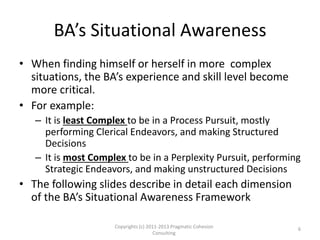
– It is least Complex (Trivial) to be in a Process Pursuit,
mostly performing Clerical Endeavors, and making
Structured Decisions
– It is most Complex (Wicked) to be in a Perplexity Pursuit,
performing Strategic Endeavors, and making unstructured
Decisions
• The following slides describe in detail each dimension
of the BA’s Situational Awareness Framework
Copyrights (c) 2011-2013 Pragmatic Cohesion
Consulting
7
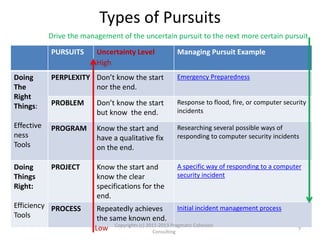
Types of Pursuits
PURSUITS Uncertainty Level Managing Pursuit Example
Doing
The
Right
Things:
Effective
ness
Tools
PERPLEXITY Don’t know the start
nor the end.
DARPA’s MISSION: maintain the technological
superiority of the U.S. military and prevent
technological surprise from harming our national
security by sponsoring revolutionary, high-payoff
research bridging the gap between fundamental
discoveries and their military use.
PROBLEM Don’t know the start
but know the end.
DARPA’s PROGRAM FAMILIES: AEO, DSO, I2O,
MTO, STO, TTO
PROGRAM Know the start and
have a qualitative fix
on the end.
DARPA’s REVOLUTINIZING PROSTHETICS
Program
Doing
Things
Right:
Efficiency
Tools
PROJECT Know the start and
know the clear
specifications for the
end.
DARPA’s REVOLUTINIZING PROSTHETICS
Program: Brain-control demonstration
project
PROCESS Repeatedly achieves
the same known end.
Transfer Brain Neural Impulses to Prosthetic
Arm.
Drive the management of the uncertain pursuit to the next more certain pursuit.
Low
High
Copyrights (c) 2011-2013 Pragmatic Cohesion
Consulting 8
Types of Pursuits
• Driving the management of the uncertain
pursuit to the next more certain pursuit is a
logical way of reducing uncertainty.
• For Pursuits that have little or no preceding
cases to draw experience from, it is critical to
approach them in a top down manner where
the more uncertain pursuit creates a scope
reference from which more certain pursuits
are derived.
Copyrights (c) 2011-2013 Pragmatic
Cohesion Consulting
9
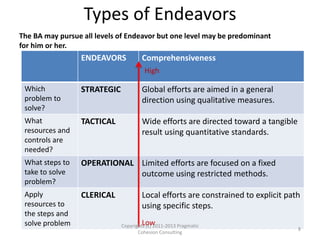
Types of Endeavors
ENDEAVORS Comprehensiveness
Which
problem to
solve?
STRATEGIC Global efforts are aimed in a general
direction using qualitative measures.
What
resources and
controls are
needed?
TACTICAL Wide efforts are directed toward a tangible
result using quantitative standards.
What steps to
take to solve
problem?
OPERATIONAL Limited efforts are focused on a fixed
outcome using restricted methods.
Apply
resources to
the steps and
solve problem
CLERICAL Local efforts are constrained to explicit path
using specific steps.
Low
High
The BA may pursue all levels of Endeavor but one level may be predominant
for him or her.
Copyrights (c) 2011-2013 Pragmatic
Cohesion Consulting
10
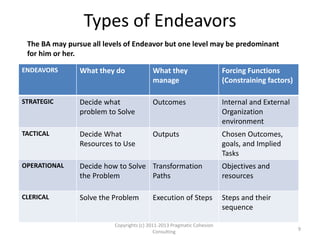
Types of Endeavors
ENDEAVORS What they do What they
manage
Forcing Functions
(Constraining factors)
STRATEGIC Decide what
problem to Solve
Outcomes Internal and External
Organization
environment
TACTICAL Decide What
Resources to Use
Outputs Chosen Outcomes,
goals, and Implied
Tasks
OPERATIONAL Decide how to Solve
the Problem
Transformation
Paths
Objectives and
resources
CLERICAL Solve the Problem Execution of Steps Steps and their
sequence
The BA may pursue all levels of Endeavor but one level may be predominant
for him or her.
Copyrights (c) 2011-2013 Pragmatic Cohesion
Consulting 11
Types of Endeavors
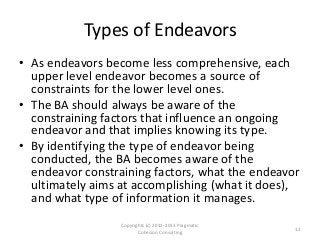
• As endeavors become less comprehensive, each
upper level endeavor becomes a source of
constraints for the lower level ones.
• The BA should always be aware of the
constraining factors that influence an ongoing
endeavor and that implies knowing its type.
• By identifying the type of endeavor being
conducted, the BA becomes aware of the
endeavor constraining factors, what the endeavor
ultimately aims at accomplishing (what it does),
and what type of information it manages.
Copyrights (c) 2011-2013 Pragmatic
Cohesion Consulting
12
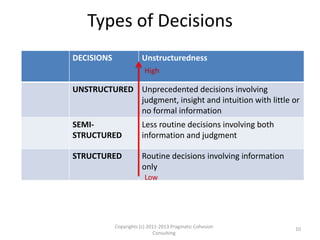
Types of Decisions
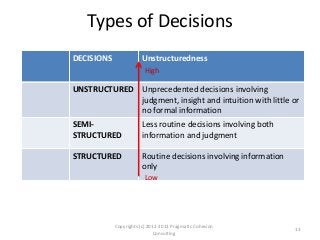
DECISIONS Unstructuredness
UNSTRUCTURED Unprecedented decisions involving
judgment, insight and intuition with little or
no formal information
SEMI-
STRUCTURED
Less routine decisions involving both
information and judgment
STRUCTURED Routine decisions involving information
only
Low
High
Copyrights (c) 2011-2013 Pragmatic Cohesion
Consulting
13
Types of Decisions
• Semi-structured decisions can be facilitated by
the use of technics such as Analytical Hierarchy
Process (AHP)
• AHP is useful for combining information and
judgment in a logical manner and it can be a
powerful tool to rationally evaluate competing
alternatives.
• AHP can be applied across the full spectrum of
Endeavor Types: from Strategic to Clerical ones.
Copyrights (c) 2011-2013 Pragmatic
Cohesion Consulting
14
Copyrights (c) 2011-2013 Pragmatic
Cohesion Consulting
15
Reference:
Dr. Harold Kurstedt book “Management Systems Theory, Applications, and Design”,
Virginia Tech ISE, 2000
Contact Didier at Pragmatic Cohesion Consulting to
receive a FREE Situational Awareness Survey
http://pragmaticohesion.com/

Framework for assessing business analysts situational awareness

  • 1.
    Framework for Assessinga Business Analyst’s Situational Awareness Copyrights (c) 2011-2013 Pragmatic Cohesion Consulting 1 Determine the Complexity of your responsibilities from Trivial Problems to Wicked ones
  • 2.
    Situational Awareness Wikipedia Definition •Situation awareness is the perception of environmental elements with respect to time and/or space, the comprehension of their meaning, and the projection of their status after some variable has changed, such as time, or some other variable, such as a predetermined event. It is also a field of study concerned with perception of the environment critical to decision-makers in complex, dynamic areas from aviation, air traffic control, power plant operations, military command and control, and emergency services such as fire fighting and policing; to more ordinary but nevertheless complex tasks such as driving an automobile or bicycle. [may this author add Business Analysis ?] Copyrights (c) 2011-2013 Pragmatic Cohesion Consulting 2
  • 3.
    BA’s Situational AwarenessFramework • This presentation describes a Framework for Assessing Business Analysts (BAs) Situational Awareness. • The Framework is composed of 3 dimensions of assessment: – The type of Pursuit that a BA is following – The type of Endeavor that the BA is conducting – The type of Decision that the BA is making • These 3 dimensions were introduced by Dr. H. Kurstedt. Copyrights (c) 2011-2013 Pragmatic Cohesion Consulting 3
  • 4.
    BA’s Situational AwarenessFramework • The BA’s situational awareness is described by where he/she is located at a specific point in time along these 3 Axes dimensions. • This author argues that the farther away from the origin of each Axis, the more complex the BA’s situation is. • The following slide presents the Business Analyst Situational Awareness Space Copyrights (c) 2011-2013 Pragmatic Cohesion Consulting 4
  • 5.
    BA’s Situational AwarenessFramework Type of Pursuit (increasing uncertainty) Type of Endeavor (Increasing Comprehensiveness) Type of Decision (increasing Unstructuredness) Process Project Program Problem Perplexity Clerical Operational Tactical Strategic Structured Semi-Structured Un-Structured Copyrights (c) 2011-2013 Pragmatic Cohesion Consulting 5
  • 6.
    BA’s Situational AwarenessFramework Type of Pursuit (increasing Uncertainty) Type of Endeavor (Increasing Comprehensiveness) Type of Decision (increasing Unstructuredness) Copyrights (c) 2011-2013 Pragmatic Cohesion Consulting 6 Increasing Complexity Increasing Complexity Increasing Complexity
  • 7.
    BA’s Situational Awareness •When finding himself or herself in more complex situations, the BA’s experience and skill level become more critical. • For example: – It is least Complex (Trivial) to be in a Process Pursuit, mostly performing Clerical Endeavors, and making Structured Decisions – It is most Complex (Wicked) to be in a Perplexity Pursuit, performing Strategic Endeavors, and making unstructured Decisions • The following slides describe in detail each dimension of the BA’s Situational Awareness Framework Copyrights (c) 2011-2013 Pragmatic Cohesion Consulting 7
  • 8.
    Types of Pursuits PURSUITSUncertainty Level Managing Pursuit Example Doing The Right Things: Effective ness Tools PERPLEXITY Don’t know the start nor the end. DARPA’s MISSION: maintain the technological superiority of the U.S. military and prevent technological surprise from harming our national security by sponsoring revolutionary, high-payoff research bridging the gap between fundamental discoveries and their military use. PROBLEM Don’t know the start but know the end. DARPA’s PROGRAM FAMILIES: AEO, DSO, I2O, MTO, STO, TTO PROGRAM Know the start and have a qualitative fix on the end. DARPA’s REVOLUTINIZING PROSTHETICS Program Doing Things Right: Efficiency Tools PROJECT Know the start and know the clear specifications for the end. DARPA’s REVOLUTINIZING PROSTHETICS Program: Brain-control demonstration project PROCESS Repeatedly achieves the same known end. Transfer Brain Neural Impulses to Prosthetic Arm. Drive the management of the uncertain pursuit to the next more certain pursuit. Low High Copyrights (c) 2011-2013 Pragmatic Cohesion Consulting 8
  • 9.
    Types of Pursuits •Driving the management of the uncertain pursuit to the next more certain pursuit is a logical way of reducing uncertainty. • For Pursuits that have little or no preceding cases to draw experience from, it is critical to approach them in a top down manner where the more uncertain pursuit creates a scope reference from which more certain pursuits are derived. Copyrights (c) 2011-2013 Pragmatic Cohesion Consulting 9
  • 10.
    Types of Endeavors ENDEAVORSComprehensiveness Which problem to solve? STRATEGIC Global efforts are aimed in a general direction using qualitative measures. What resources and controls are needed? TACTICAL Wide efforts are directed toward a tangible result using quantitative standards. What steps to take to solve problem? OPERATIONAL Limited efforts are focused on a fixed outcome using restricted methods. Apply resources to the steps and solve problem CLERICAL Local efforts are constrained to explicit path using specific steps. Low High The BA may pursue all levels of Endeavor but one level may be predominant for him or her. Copyrights (c) 2011-2013 Pragmatic Cohesion Consulting 10
  • 11.
    Types of Endeavors ENDEAVORSWhat they do What they manage Forcing Functions (Constraining factors) STRATEGIC Decide what problem to Solve Outcomes Internal and External Organization environment TACTICAL Decide What Resources to Use Outputs Chosen Outcomes, goals, and Implied Tasks OPERATIONAL Decide how to Solve the Problem Transformation Paths Objectives and resources CLERICAL Solve the Problem Execution of Steps Steps and their sequence The BA may pursue all levels of Endeavor but one level may be predominant for him or her. Copyrights (c) 2011-2013 Pragmatic Cohesion Consulting 11
  • 12.
    Types of Endeavors •As endeavors become less comprehensive, each upper level endeavor becomes a source of constraints for the lower level ones. • The BA should always be aware of the constraining factors that influence an ongoing endeavor and that implies knowing its type. • By identifying the type of endeavor being conducted, the BA becomes aware of the endeavor constraining factors, what the endeavor ultimately aims at accomplishing (what it does), and what type of information it manages. Copyrights (c) 2011-2013 Pragmatic Cohesion Consulting 12
  • 13.
    Types of Decisions DECISIONSUnstructuredness UNSTRUCTURED Unprecedented decisions involving judgment, insight and intuition with little or no formal information SEMI- STRUCTURED Less routine decisions involving both information and judgment STRUCTURED Routine decisions involving information only Low High Copyrights (c) 2011-2013 Pragmatic Cohesion Consulting 13
  • 14.
    Types of Decisions •Semi-structured decisions can be facilitated by the use of technics such as Analytical Hierarchy Process (AHP) • AHP is useful for combining information and judgment in a logical manner and it can be a powerful tool to rationally evaluate competing alternatives. • AHP can be applied across the full spectrum of Endeavor Types: from Strategic to Clerical ones. Copyrights (c) 2011-2013 Pragmatic Cohesion Consulting 14
  • 15.
    Copyrights (c) 2011-2013Pragmatic Cohesion Consulting 15 Reference: Dr. Harold Kurstedt book “Management Systems Theory, Applications, and Design”, Virginia Tech ISE, 2000 Contact Didier at Pragmatic Cohesion Consulting to receive a FREE Situational Awareness Survey http://pragmaticohesion.com/