Whitney R Harris
   Define fracture
   List fracture classifications
   Indentify and describe the three fracture types
    discussed
   Explain acute (immediate)/diagnostic care
   Basic understanding of the healing process and
    rehabilitation implications
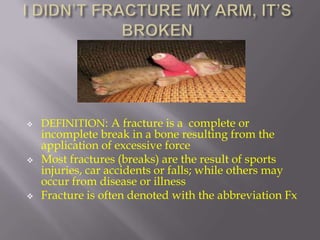
   DEFINITION: A fracture is a complete or
    incomplete break in a bone resulting from the
    application of excessive force
   Most fractures (breaks) are the result of sports
    injuries, car accidents or falls; while others may
    occur from disease or illness
   Fracture is often denoted with the abbreviation Fx
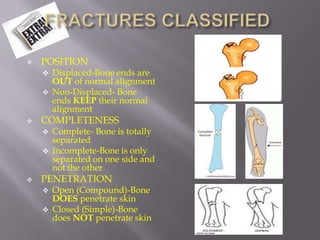
   POSITION
       Displaced-Bone ends are
        OUT of normal alignment
       Non-Displaced- Bone
        ends KEEP their normal
        alignment
   COMPLETENESS
       Complete- Bone is totally
        separated
       Incomplete-Bone is only
        separated on one side and
        not the other
   PENETRATION
       Open (Compound)-Bone
        DOES penetrate skin
       Closed (Simple)-Bone
        does NOT penetrate skin
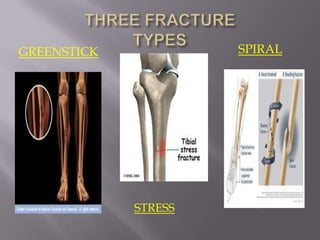
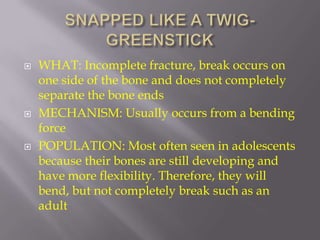
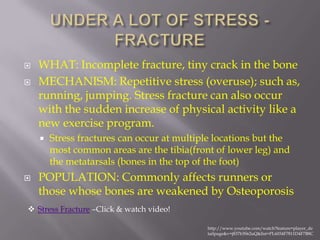
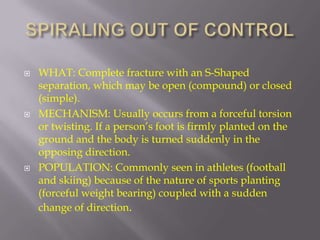
GREENSTICK            SPIRAL


             STRESS
   WHAT: Incomplete fracture, break occurs on
    one side of the bone and does not completely
    separate the bone ends
   MECHANISM: Usually occurs from a bending
    force
   POPULATION: Most often seen in adolescents
    because their bones are still developing and
    have more flexibility. Therefore, they will
    bend, but not completely break such as an
    adult
   WHAT: Incomplete fracture, tiny crack in the bone
   MECHANISM: Repetitive stress (overuse); such as,
    running, jumping. Stress fracture can also occur
    with the sudden increase of physical activity like a
    new exercise program.
       Stress fractures can occur at multiple locations but the
        most common areas are the tibia(front of lower leg) and
        the metatarsals (bones in the top of the foot)
   POPULATION: Commonly affects runners or
    those whose bones are weakened by Osteoporosis
 Stress Fracture –Click & watch video!

                                            http://www.youtube.com/watch?feature=player_de
                                            tailpage&v=j837b3S62uQ&list=PL6034F7811D4F7B8C
   WHAT: Complete fracture with an S-Shaped
    separation, which may be open (compound) or closed
    (simple).
   MECHANISM: Usually occurs from a forceful torsion
    or twisting. If a person’s foot is firmly planted on the
    ground and the body is turned suddenly in the
    opposing direction.
   POPULATION: Commonly seen in athletes (football
    and skiing) because of the nature of sports planting
    (forceful weight bearing) coupled with a sudden
    change of direction.
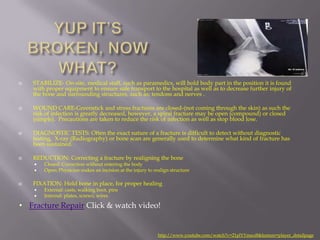
   STABILIZE- On-site, medical staff, such as paramedics, will hold body part in the position it is found
    with proper equipment to ensure safe transport to the hospital as well as to decrease further injury of
    the bone and surrounding structures, such as; tendons and nerves .

   WOUND CARE-Greenstick and stress fractures are closed-(not coming through the skin) as such the
    risk of infection is greatly decreased, however, a spiral fracture may be open (compound) or closed
    (simple). Precautions are taken to reduce the risk of infection as well as stop blood lose.

   DIAGNOSTIC TESTS: Often the exact nature of a fracture is difficult to detect without diagnostic
    testing, X-ray (Radiography) or bone scan are generally used to determine what kind of fracture has
    been sustained.

   REDUCTION: Correcting a fracture by realigning the bone
       Closed: Correction without entering the body
       Open: Physician makes an incision at the injury to realign structure

   FIXATION: Hold bone in place, for proper healing
       External: casts, walking boot, pins
       Internal: plates, screws, wires

• Fracture Repair Click & watch video!


                                                             http://www.youtube.com/watch?v=21plYYmaxi8&feature=player_detailpage
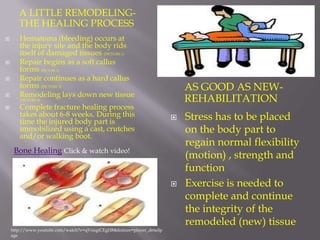
A LITTLE REMODELING-
       THE HEALING PROCESS
      Hematoma (bleeding) occurs at
       the injury site and the body rids
       itself of damaged tissues (PICTURE 1)
      Repair begins as a soft callus
       forms (PICTURE 2)
      Repair continues as a hard callus
       forms (PICTURE 3)                                                    AS GOOD AS NEW-
       Remodeling lays down new tissue

       (PICTURE 4)                                                          REHABILITATION
      Complete fracture healing process
       takes about 6-8 weeks. During this                                  Stress has to be placed
       time the injured body part is
       immobilized using a cast, crutches                                   on the body part to
       and/or walking boot.
                                                                            regain normal flexibility
     Bone Healing Click & watch video!
                                                                            (motion) , strength and
                                                                            function
                                                                           Exercise is needed to
                                                                            complete and continue
                                                                            the integrity of the
                                                                            remodeled (new) tissue
    http://www.youtube.com/watch?v=qVougiCEgH8&feature=player_detailp
    age
   Fermgen, B. F., & Frucht, S. S. (2009) Medical
    terminology: A Living language. New Jersey:
    Pearson-Prentice Hall.
   Marieb, E. N., & Hoehn, K. (2010) Human
    anatomy and physiology. San Francisco:
    Pearson.
   Prentice, W. E. (2003)Arenheim’s Principles of
    athletic training: A Competency-Based
    approach. New York: McGraw-Hill.

Fractures[1]

  • 1.
  • 2.
    Define fracture  List fracture classifications  Indentify and describe the three fracture types discussed  Explain acute (immediate)/diagnostic care  Basic understanding of the healing process and rehabilitation implications
  • 3.
    DEFINITION: A fracture is a complete or incomplete break in a bone resulting from the application of excessive force  Most fractures (breaks) are the result of sports injuries, car accidents or falls; while others may occur from disease or illness  Fracture is often denoted with the abbreviation Fx
  • 4.
    POSITION  Displaced-Bone ends are OUT of normal alignment  Non-Displaced- Bone ends KEEP their normal alignment  COMPLETENESS  Complete- Bone is totally separated  Incomplete-Bone is only separated on one side and not the other  PENETRATION  Open (Compound)-Bone DOES penetrate skin  Closed (Simple)-Bone does NOT penetrate skin
  • 5.
    GREENSTICK SPIRAL STRESS
  • 6.
    WHAT: Incomplete fracture, break occurs on one side of the bone and does not completely separate the bone ends  MECHANISM: Usually occurs from a bending force  POPULATION: Most often seen in adolescents because their bones are still developing and have more flexibility. Therefore, they will bend, but not completely break such as an adult
  • 7.
    WHAT: Incomplete fracture, tiny crack in the bone  MECHANISM: Repetitive stress (overuse); such as, running, jumping. Stress fracture can also occur with the sudden increase of physical activity like a new exercise program.  Stress fractures can occur at multiple locations but the most common areas are the tibia(front of lower leg) and the metatarsals (bones in the top of the foot)  POPULATION: Commonly affects runners or those whose bones are weakened by Osteoporosis  Stress Fracture –Click & watch video! http://www.youtube.com/watch?feature=player_de tailpage&v=j837b3S62uQ&list=PL6034F7811D4F7B8C
  • 8.
    WHAT: Complete fracture with an S-Shaped separation, which may be open (compound) or closed (simple).  MECHANISM: Usually occurs from a forceful torsion or twisting. If a person’s foot is firmly planted on the ground and the body is turned suddenly in the opposing direction.  POPULATION: Commonly seen in athletes (football and skiing) because of the nature of sports planting (forceful weight bearing) coupled with a sudden change of direction.
  • 9.
    STABILIZE- On-site, medical staff, such as paramedics, will hold body part in the position it is found with proper equipment to ensure safe transport to the hospital as well as to decrease further injury of the bone and surrounding structures, such as; tendons and nerves .  WOUND CARE-Greenstick and stress fractures are closed-(not coming through the skin) as such the risk of infection is greatly decreased, however, a spiral fracture may be open (compound) or closed (simple). Precautions are taken to reduce the risk of infection as well as stop blood lose.  DIAGNOSTIC TESTS: Often the exact nature of a fracture is difficult to detect without diagnostic testing, X-ray (Radiography) or bone scan are generally used to determine what kind of fracture has been sustained.  REDUCTION: Correcting a fracture by realigning the bone  Closed: Correction without entering the body  Open: Physician makes an incision at the injury to realign structure  FIXATION: Hold bone in place, for proper healing  External: casts, walking boot, pins  Internal: plates, screws, wires • Fracture Repair Click & watch video! http://www.youtube.com/watch?v=21plYYmaxi8&feature=player_detailpage
  • 10.
    A LITTLE REMODELING- THE HEALING PROCESS  Hematoma (bleeding) occurs at the injury site and the body rids itself of damaged tissues (PICTURE 1)  Repair begins as a soft callus forms (PICTURE 2)  Repair continues as a hard callus forms (PICTURE 3) AS GOOD AS NEW- Remodeling lays down new tissue  (PICTURE 4) REHABILITATION  Complete fracture healing process takes about 6-8 weeks. During this  Stress has to be placed time the injured body part is immobilized using a cast, crutches on the body part to and/or walking boot. regain normal flexibility Bone Healing Click & watch video! (motion) , strength and function  Exercise is needed to complete and continue the integrity of the remodeled (new) tissue http://www.youtube.com/watch?v=qVougiCEgH8&feature=player_detailp age
  • 11.
    Fermgen, B. F., & Frucht, S. S. (2009) Medical terminology: A Living language. New Jersey: Pearson-Prentice Hall.  Marieb, E. N., & Hoehn, K. (2010) Human anatomy and physiology. San Francisco: Pearson.  Prentice, W. E. (2003)Arenheim’s Principles of athletic training: A Competency-Based approach. New York: McGraw-Hill.