Understanding
  Fractions
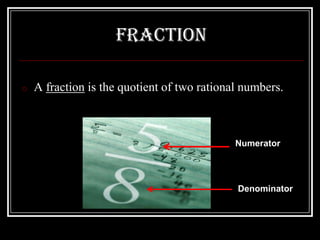
Fraction

o   A fraction is the quotient of two rational numbers.


                                             Numerator


                                             Denominator
Classification of Fractions

        Proper Fraction
       Improper Fraction
          Mixed Number
Classification of Fractions
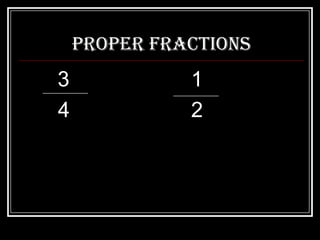
   A proper fraction is a fraction with the
    numerator less (smaller) than the
    denominator.
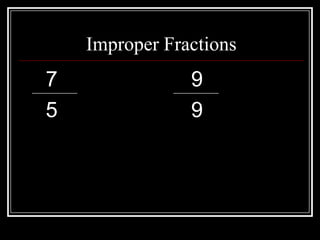
   An improper fraction is a fraction with the
    numerator great (larger) than or equal (the
    same) to the denominator.
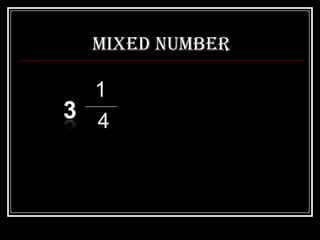
   A mixed number has a fraction and a whole
    number.
Proper Fractions
3             1
4             2
Improper Fractions
7               9
5               9
Mixed Number

1
4
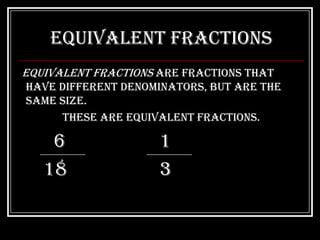
Equivalent Fractions
equivalent fractions are fractions that
have different denominators, but are the
same size.
     These are equivalent fractions.

    6                1
   18                3
Ordering Fractions
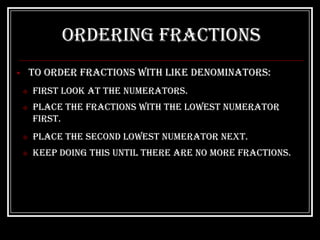
       To order fractions with like denominators:
       First look at the numerators.
       Place the fractions with the lowest numerator
        first.
       Place the second lowest numerator next.
       Keep doing this until there are no more fractions.
Ordering Fractions
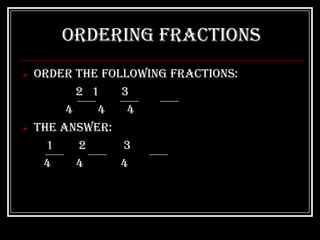
   Order the following fractions:
           2 1   3
         4    4   4
   The answer:
      1    2     3
     4     4     4
Ordering Fractions
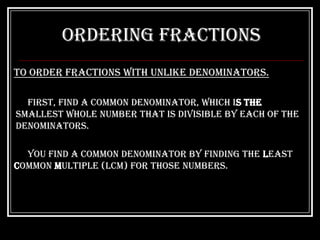
To order fractions with unlike denominators.

  First, find a common denominator, which is the
smallest whole number that is divisible by each of the
denominators.

  You find a common denominator by finding the Least
Common Multiple (LCM) for those numbers.
Least Common Multiple (LCM)

                          Method 1
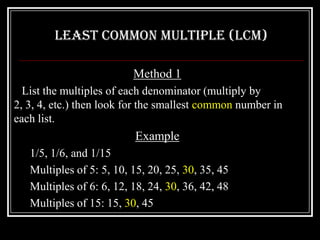
  List the multiples of each denominator (multiply by
2, 3, 4, etc.) then look for the smallest common number in
each list.
                          Example
   1/5, 1/6, and 1/15
   Multiples of 5: 5, 10, 15, 20, 25, 30, 35, 45
   Multiples of 6: 6, 12, 18, 24, 30, 36, 42, 48
   Multiples of 15: 15, 30, 45
LCM
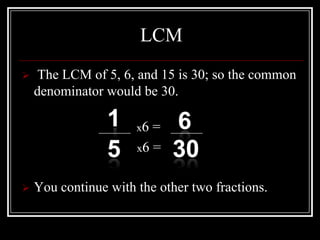
   The LCM of 5, 6, and 15 is 30; so the common
    denominator would be 30.

                      x6 =
                      x6 =


   You continue with the other two fractions.
Ordering Fractions
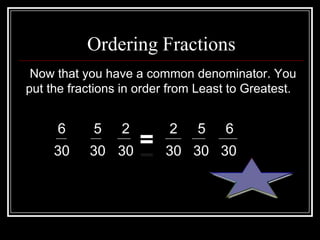
 Now that you have a common denominator. You
put the fractions in order from Least to Greatest.


     6      5    2        2    5    6
     30    30 30         30 30 30
LCM
                           Method 2:
•   Factor each of the denominators into primes.

• Then count the number of times each prime number appears in
the factorizations.

•For each prime number, take the largest of these counts. Write
down that prime number as many times as you counted.

• The product of all the prime numbers written down is the least
common denominator.
Method 2
o   Factor each of the numbers into primes.

o   Count the number of times each prime number appears in the
    factorizations.

o   For each prime number, take the largest of these counts.

o   Write down that prime number as many times as you counted
    for it in step 2.
o   The least common multiple is the product of all the prime
    numbers written down.
Method 2
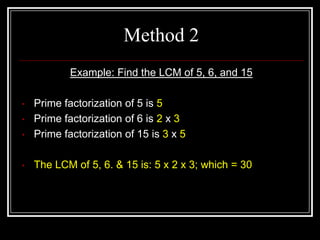
            Example: Find the LCM of 5, 6, and 15

•   Prime factorization of 5 is 5
•   Prime factorization of 6 is 2 x 3
•   Prime factorization of 15 is 3 x 5

•   The LCM of 5, 6. & 15 is: 5 x 2 x 3; which = 30
Method 2
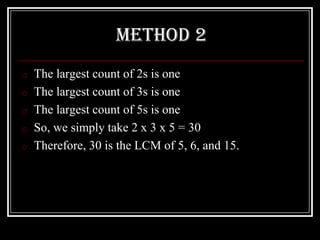
o   The largest count of 2s is one
o   The largest count of 3s is one
o   The largest count of 5s is one
o   So, we simply take 2 x 3 x 5 = 30
o   Therefore, 30 is the LCM of 5, 6, and 15.

Fraction basics

  • 1.
  • 2.
    Fraction o A fraction is the quotient of two rational numbers. Numerator Denominator
  • 3.
    Classification of Fractions Proper Fraction  Improper Fraction  Mixed Number
  • 4.
    Classification of Fractions  A proper fraction is a fraction with the numerator less (smaller) than the denominator.  An improper fraction is a fraction with the numerator great (larger) than or equal (the same) to the denominator.  A mixed number has a fraction and a whole number.
  • 5.
  • 6.
  • 7.
  • 8.
    Equivalent Fractions equivalent fractionsare fractions that have different denominators, but are the same size. These are equivalent fractions. 6 1 18 3
  • 9.
    Ordering Fractions  To order fractions with like denominators:  First look at the numerators.  Place the fractions with the lowest numerator first.  Place the second lowest numerator next.  Keep doing this until there are no more fractions.
  • 10.
    Ordering Fractions  Order the following fractions: 2 1 3 4 4 4  The answer: 1 2 3 4 4 4
  • 11.
    Ordering Fractions To orderfractions with unlike denominators. First, find a common denominator, which is the smallest whole number that is divisible by each of the denominators. You find a common denominator by finding the Least Common Multiple (LCM) for those numbers.
  • 12.
    Least Common Multiple(LCM) Method 1 List the multiples of each denominator (multiply by 2, 3, 4, etc.) then look for the smallest common number in each list. Example 1/5, 1/6, and 1/15 Multiples of 5: 5, 10, 15, 20, 25, 30, 35, 45 Multiples of 6: 6, 12, 18, 24, 30, 36, 42, 48 Multiples of 15: 15, 30, 45
  • 13.
    LCM  The LCM of 5, 6, and 15 is 30; so the common denominator would be 30. x6 = x6 =  You continue with the other two fractions.
  • 14.
    Ordering Fractions Nowthat you have a common denominator. You put the fractions in order from Least to Greatest. 6 5 2 2 5 6 30 30 30 30 30 30
  • 15.
    LCM Method 2: • Factor each of the denominators into primes. • Then count the number of times each prime number appears in the factorizations. •For each prime number, take the largest of these counts. Write down that prime number as many times as you counted. • The product of all the prime numbers written down is the least common denominator.
  • 16.
    Method 2 o Factor each of the numbers into primes. o Count the number of times each prime number appears in the factorizations. o For each prime number, take the largest of these counts. o Write down that prime number as many times as you counted for it in step 2. o The least common multiple is the product of all the prime numbers written down.
  • 17.
    Method 2 Example: Find the LCM of 5, 6, and 15 • Prime factorization of 5 is 5 • Prime factorization of 6 is 2 x 3 • Prime factorization of 15 is 3 x 5 • The LCM of 5, 6. & 15 is: 5 x 2 x 3; which = 30
  • 18.
    Method 2 o The largest count of 2s is one o The largest count of 3s is one o The largest count of 5s is one o So, we simply take 2 x 3 x 5 = 30 o Therefore, 30 is the LCM of 5, 6, and 15.