MAN 109 – Basic Mathematics
Assoc. Prof. Dr. Ozan Toprakçı
Polymer Materials Engineering Dept.
Introduction to Algebra
What is algebra?
Algebra is the language of mathematics. In algebra we use
letters to represent numbers. Then we can do several things:
 make statements that are generally true without having to
be specific. For example, if a and b represent any two
numbers then we can say that a + b = b + a rather than just
saying that for example 5 + 3 = 3 + 5.
 Second, algebra is more brief than any human language. It
is more brief to say a + b = b + a than to say “when adding
two numbers together, it does not matter which number is
added to which; the result is the same”.
What is algebra?
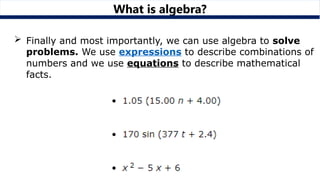
 Finally and most importantly, we can use algebra to solve
problems. We use expressions to describe combinations of
numbers and we use equations to describe mathematical
facts.
What is algebra?
 For example, suppose that we don’t know Alice and Bill’s
ages but we do know that Bill is 6 years older than Alice. We
can let a represent Alice’s age in years and b represent Bill’s
age in years and then the phrase “6 years older than Alice ”
can be written concisely as the expression:
6+a
and the fact that “Bill is 6 years older than Alice” can be written
concisely as the equation
b=a+6
What is algebra?
 Values of a and b that make this equation true are said
to satisfy the equation. For example, the ages a = 10
and b = 16 cause the equation to read 16 = 16 and thus
satisfy the equation. So do the ages a = 50 and b = 56,
which cause the equation to read 56 = 56.
 If we later learn that Bill is 3 times as old as Alice then we
can express this fact using another equation:
b=3*a
 We now have two equations that must both be satisfied. This
is called a system of equations.
b=a+6 and b=3*a
What is algebra?
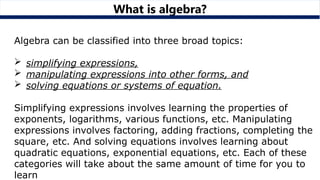
Algebra can be classified into three broad topics:
 simplifying expressions,
 manipulating expressions into other forms, and
 solving equations or systems of equation.
Simplifying expressions involves learning the properties of
exponents, logarithms, various functions, etc. Manipulating
expressions involves factoring, adding fractions, completing the
square, etc. And solving equations involves learning about
quadratic equations, exponential equations, etc. Each of these
categories will take about the same amount of time for you to
learn
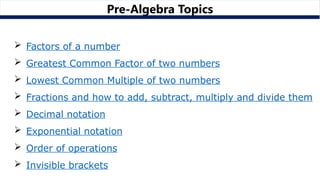
Pre-Algebra Topics
 Factors of a number
 Greatest Common Factor of two numbers
 Lowest Common Multiple of two numbers
 Fractions and how to add, subtract, multiply and divide them
 Decimal notation
 Exponential notation
 Order of operations
 Invisible brackets
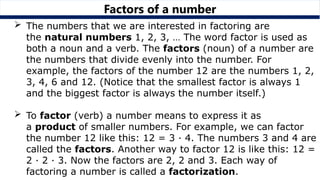
Factors of a number
 The numbers that we are interested in factoring are
the natural numbers 1, 2, 3, … The word factor is used as
both a noun and a verb. The factors (noun) of a number are
the numbers that divide evenly into the number. For
example, the factors of the number 12 are the numbers 1, 2,
3, 4, 6 and 12. (Notice that the smallest factor is always 1
and the biggest factor is always the number itself.)
 To factor (verb) a number means to express it as
a product of smaller numbers. For example, we can factor
the number 12 like this: 12 = 3 · 4. The numbers 3 and 4 are
called the factors. Another way to factor 12 is like this: 12 =
2 · 2 · 3. Now the factors are 2, 2 and 3. Each way of
factoring a number is called a factorization.
Factors of a number
 A number that cannot be factored further is called a prime
number. To factor a number completely means to write it
as a product of prime numbers. This is also called the prime
factorization.
 Here are some examples of numbers in completely factored
form:
100 = 2 · 2 · 5 · 5
18 = 2 · 3 · 3
29 = 29 (29 is a prime number)
Factors of a number
Greatest Common Factor (GCF) of two numbers
 If we look at two or more numbers then they will have
factors in common. For example:
- the factors of 40 are 1, 2, 4, 5, 8, 10, 20 and 40,
- the factors of 50 are 1, 2, 5, 10, 25 and 50.
The greatest common factor is the largest of all the common
factors. The greatest common factor of 40 and 50 is 10.
Factors of a number
Greatest Common Factor (GCF) of two numbers
 Here are some more examples of greatest common factors:
- the GCF of 24 and 30 is 6
- the GCF of 24, 30 and 33 is 3
- the GCF of 7 and 21 is 7
- the GCF of 7 and 13 is 1
Factors of a number
Greatest Common Factor (GCF) of two numbers
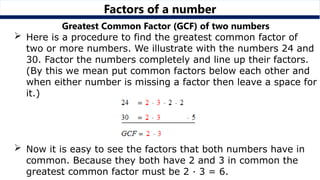
 Here is a procedure to find the greatest common factor of
two or more numbers. We illustrate with the numbers 24 and
30. Factor the numbers completely and line up their factors.
(By this we mean put common factors below each other and
when either number is missing a factor then leave a space for
it.)
 Now it is easy to see the factors that both numbers have in
common. Because they both have 2 and 3 in common the
greatest common factor must be 2 · 3 = 6.
Factors of a number
Lowest Common Multiple (LCM) of two numbers
 The multiples of a number are the numbers that have that
number as a factor. For example, the multiples of 5 are 5, 10,
15, 20, 25, …
 If we look at two or more numbers then they will have
multiples in common. For example:
- the multiples of 3 are 3, 6, 9, 12, 15, 18, 21, 24, 27, …
- and the multiples of 4 are 4, 8, 12, 16, 20, 24, 28, …
- the common multiples of 3 and 4 are 12, 24, …
 The smallest of the common multiples is called the lowest
common multiple.
Factors of a number
Lowest Common Multiple (LCM) of two numbers
 Here are some more examples of lowest common multiples:
- the LCM of 9 and 20 is 180
- the LCM of 2, 3 and 5 is 30
- the LCM of 7 and 21 is 21
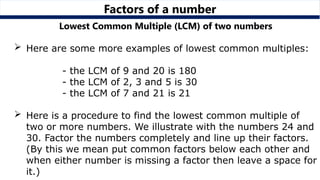
 Here is a procedure to find the lowest common multiple of
two or more numbers. We illustrate with the numbers 24 and
30. Factor the numbers completely and line up their factors.
(By this we mean put common factors below each other and
when either number is missing a factor then leave a space for
it.)
Factors of a number
Lowest Common Multiple (LCM) of two numbers
 The lowest common multiple must contain all the factors that
are in either one number or the other, but the factors are not
used twice when they are common to both numbers. Lined
up like this it is easy to spot the common factors. The lowest
common multiple must be 2 · 3 · 2 · 2 · 5 = 120.
Fractions
Fraction notation
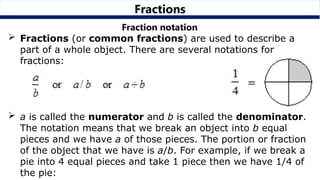
 Fractions (or common fractions) are used to describe a
part of a whole object. There are several notations for
fractions:
 a is called the numerator and b is called the denominator.
The notation means that we break an object into b equal
pieces and we have a of those pieces. The portion or fraction
of the object that we have is a/b. For example, if we break a
pie into 4 equal pieces and take 1 piece then we have 1/4 of
the pie:
Fractions
Equivalent fractions
Notice that we get the same amount of pie as in the previous
example if we divide the pie into 8 equal pieces and get 2 of
them:
Fractions like 1/4 and 2/8 that have the same value are said to
be equivalent fractions. This example suggests the following
method for testing if two fractions are equivalent.
Fractions
Equivalent fractions
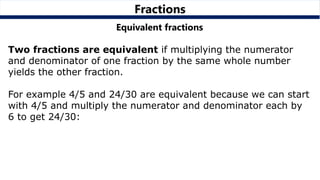
Two fractions are equivalent if multiplying the numerator
and denominator of one fraction by the same whole number
yields the other fraction.
For example 4/5 and 24/30 are equivalent because we can start
with 4/5 and multiply the numerator and denominator each by
6 to get 24/30:
Fractions
Equivalent fractions
Notice that we get the same amount of pie as in the previous
example if we divide the pie into 8 equal pieces and get 2 of
them:
Fractions like 1/4 and 2/8 that have the same value are said to
be equivalent fractions. This example suggests the following
method for testing if two fractions are equivalent.
Fractions
Equivalent fractions
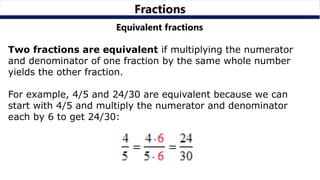
Two fractions are equivalent if multiplying the numerator
and denominator of one fraction by the same whole number
yields the other fraction.
For example, 4/5 and 24/30 are equivalent because we can
start with 4/5 and multiply the numerator and denominator
each by 6 to get 24/30:
Fractions
Equivalent fractions
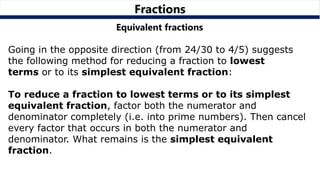
Going in the opposite direction (from 24/30 to 4/5) suggests
the following method for reducing a fraction to lowest
terms or to its simplest equivalent fraction:
To reduce a fraction to lowest terms or to its simplest
equivalent fraction, factor both the numerator and
denominator completely (i.e. into prime numbers). Then cancel
every factor that occurs in both the numerator and
denominator. What remains is the simplest equivalent
fraction.
Fractions
Improper fractions, mixed fractions and long division
A fraction where the numerator is smaller than the denominator
is called a proper fraction and a fraction where the numerator
is bigger than the denominator is called an improper fraction.
An example of an improper fraction is 7/4. Using the pie
example this means that you have broken many pies each into
4 equal pieces and you have 7 of those pieces:
Fractions
Improper fractions, mixed fractions and long division
Improper fractions are sometimes expressed in mixed fraction
notation, which is the sum of a whole number and a proper
fraction, but with the + sign omitted. For example, 7/4 in mixed
fraction notation looks like this:
Long division is the method used to convert an improper
fraction to a mixed fraction. We will illustrate the method on the
fraction 92/5:
Fractions
Some special fractions
There are several special fractions that are important to
recognize:
Any number n can be turned into a fraction by writing
it over a denominator of 1.
Anything divided by itself equals 1. We call this
a UFOO (a useful form of one).
Fractions
Some special fractions
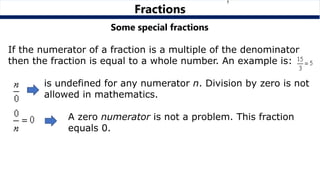
If the numerator of a fraction is a multiple of the denominator
then the fraction is equal to a whole number. An example is:
is undefined for any numerator n. Division by zero is not
allowed in mathematics.
A zero numerator is not a problem. This fraction
equals 0.
Adding or subtracting fractions
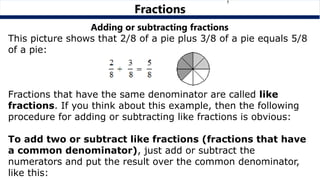
This picture shows that 2/8 of a pie plus 3/8 of a pie equals 5/8
of a pie:
Fractions that have the same denominator are called like
fractions. If you think about this example, then the following
procedure for adding or subtracting like fractions is obvious:
To add two or subtract like fractions (fractions that have
a common denominator), just add or subtract the
numerators and put the result over the common denominator,
like this:
Fractions
Adding or subtracting fractions
To add two or subtract like fractions (fractions that have
a common denominator), just add or subtract the
numerators and put the result over the common denominator,
like this:
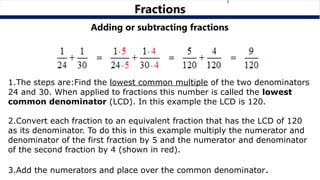
But what if the fractions don’t have a common denominator?
The answer is that they must then be converted to equivalent
fractions that do have a common denominator. The procedure is
illustrated in this example:
Fractions
Adding or subtracting fractions
1.The steps are:Find the lowest common multiple of the two denominators
24 and 30. When applied to fractions this number is called the lowest
common denominator (LCD). In this example the LCD is 120.
2.Convert each fraction to an equivalent fraction that has the LCD of 120
as its denominator. To do this in this example multiply the numerator and
denominator of the first fraction by 5 and the numerator and denominator
of the second fraction by 4 (shown in red).
3.Add the numerators and place over the common denominator.
Fractions
Adding or subtracting fractions
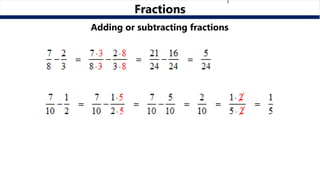
Sometimes there is one more step. The result should always be
expressed as the simplest equivalent fraction, like this:
Here are some more examples:
Fractions
Adding or subtracting fractions
Fractions
Multiplying fractions
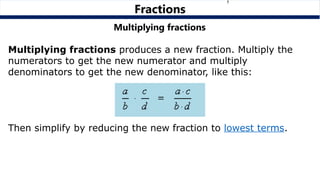
Multiplying fractions produces a new fraction. Multiply the
numerators to get the new numerator and multiply
denominators to get the new denominator, like this:
Then simplify by reducing the new fraction to lowest terms.
Fractions
Multiplying fractions
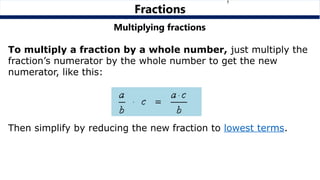
To multiply a fraction by a whole number, just multiply the
fraction’s numerator by the whole number to get the new
numerator, like this:
Then simplify by reducing the new fraction to lowest terms.
Fractions
Multiplying fractions
Here is an example of why the first procedure works. Suppose
that there is half a pie (the fraction 1/2) as shown on the left.
Now suppose that you take 2/3 of that half pie. (The word “of”
translates into the mathematical operation “multiply”.) This
means that you cut the half pie into 3 equal pieces and take 2
of them. The result is 2/6 of the pie.
Fractions
Multiplying fractions
Here is an example of why the second procedure works.
Suppose that you ate 1/4 of a pie and that your friend ate 3
times as much pie as you did. This means that your friend ate
3/4 of the pie.
Fractions
Multiplying fractions
Here are some more multiplication examples:
Fractions
Reciprocals and dividing fractions
Reciprocals play an essential role when dividing fractions. Two
numbers or fractions are said to be the reciprocals of each
other, if their product is 1. For example:
Fractions
Reciprocals and dividing fractions
Dividing fractions: The procedure is to replace a division by a
fraction by the multiplication by the reciprocal of that fraction,
like this:
Notice that you take the reciprocal of the fraction on the
bottom!
Fractions
Reciprocals and dividing fractions
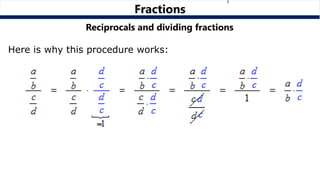
Here is why this procedure works:
Fractions
EXAMPLES
Fractions
EXAMPLES
Fractions
EXAMPLES
Fractions
The word decimal means ten. The decimal number system is
the familiar system that uses just ten symbols (numerals) to
create any whole number, no matter how big.
Those symbols are of course 0, 1, 2, 3, 4, 5, 6, 7, 8, 9. (In
contrast the binary number system uses just the two symbols
0 and 1 and the hexadecimal number system uses
the sixteen symbols 0, 1, 2, 3, 4, 5, 6, 7, 8, 9, A, B, C, D, E, F
to create any number. Binary and hexadecimal are the number
systems used in computers.)
To create numbers bigger than 9 the decimal system
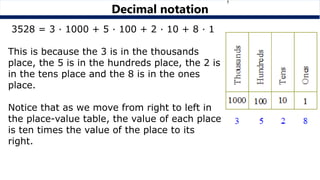
uses place-values. For example, the place-value chart shows
that 3528 means:
Decimal notation
3528 = 3 · 1000 + 5 · 100 + 2 · 10 + 8 · 1
This is because the 3 is in the thousands
place, the 5 is in the hundreds place, the 2 is
in the tens place and the 8 is in the ones
place.
Notice that as we move from right to left in
the place-value table, the value of each place
is ten times the value of the place to its
right.
Decimal notation
A decimal point is used to separate the digit in the ones place
from the digits to the right of it. The decimal number 3528.74
means:
Decimal notation
If we continue this pattern
to the right then we get the
expanded place-value chart
shown here:
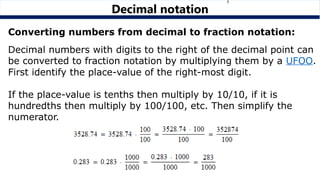
Decimal numbers with digits to the right of the decimal point can
be converted to fraction notation by multiplying them by a UFOO.
First identify the place-value of the right-most digit.
If the place-value is tenths then multiply by 10/10, if it is
hundredths then multiply by 100/100, etc. Then simplify the
numerator.
Decimal notation
Converting numbers from decimal to fraction notation:
Exponential notation
Exponential notation is a convenient shorthand for repeated
multiplication. The exponential b n
means
multiply b times itself n times:
b is called the base, n is called the exponent, and we say
that we are “raising b to the n th
power” (except when n is 2
we say that we are “squaring b” and when n is 3 we say that
we are “cubing b”).
Order of operations
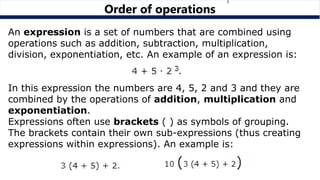
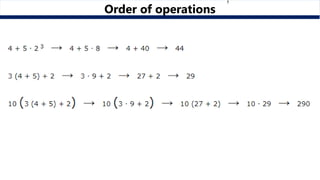
An expression is a set of numbers that are combined using
operations such as addition, subtraction, multiplication,
division, exponentiation, etc. An example of an expression is:
In this expression the numbers are 4, 5, 2 and 3 and they are
combined by the operations of addition, multiplication and
exponentiation.
Expressions often use brackets ( ) as symbols of grouping.
The brackets contain their own sub-expressions (thus creating
expressions within expressions). An example is:
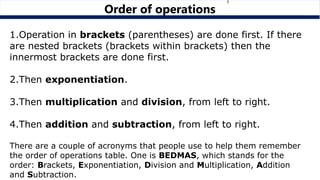
1.Operation in brackets (parentheses) are done first. If there
are nested brackets (brackets within brackets) then the
innermost brackets are done first.
2.Then exponentiation.
3.Then multiplication and division, from left to right.
4.Then addition and subtraction, from left to right.
There are a couple of acronyms that people use to help them remember
the order of operations table. One is BEDMAS, which stands for the
order: Brackets, Exponentiation, Division and Multiplication, Addition
and Subtraction.
Order of operations
Order of operations
Order of operations
Invisible brackets
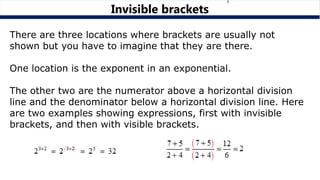
There are three locations where brackets are usually not
shown but you have to imagine that they are there.
One location is the exponent in an exponential.
The other two are the numerator above a horizontal division
line and the denominator below a horizontal division line. Here
are two examples showing expressions, first with invisible
brackets, and then with visible brackets.
Introduction to Algebra
In Mathematics numbers are classified into one of three types:
 Positive,
 Negative,
 Zero.
When using the four operations in math (addition, subtraction,
multiplication and division) rule varies for negative numbers.
As such, negative number is interpreted based on the case.
Introduction to Algebra
For instance, -4 on the temperature on a thermometer scale measured in
degrees centigrade is interpreted a degree of 4 below freezing (=zero).
On the other hand, -£100,000 signifies a loss of/ or a debt of a £100.000
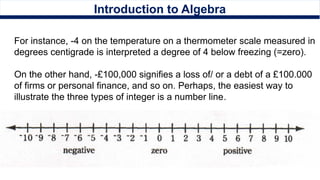
of firms or personal finance, and so on. Perhaps, the easiest way to
illustrate the three types of integer is a number line.
Introduction to Algebra
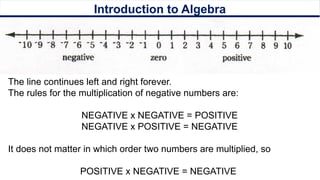
The line continues left and right forever.
The rules for the multiplication of negative numbers are:
NEGATIVE x NEGATIVE = POSITIVE
NEGATIVE x POSITIVE = NEGATIVE
It does not matter in which order two numbers are multiplied, so
POSITIVE x NEGATIVE = NEGATIVE
Introduction to Algebra
The rules produce:
(-7) x (-5) = 35
(-3) x (4) = -12
(6) x (-3) = -18
The same rules apply for division, since division is the same sort of
operation as multiplication. Thus, exactly the same rules operate when
one number is divided by another. For instance,
(-30) / (-10) = 3
(-45) / (9) = -5
(52) / (-13) = -4
Introduction to Algebra
To avoid complexity when multiplying or dividing multiple numbers, it is
perhaps simplest to ignore the signs to begin with and just to work the
answers out. The final result is negative if the total number of minus
signs is odd and positive if the total number is even.
Example (1) : Evaluate
a) (-2) x (-3) x (4) x (-1) =
b) (3) x (-2) x (-1) x (4) x (-5)
(-6) x (2) =
Introduction to Algebra
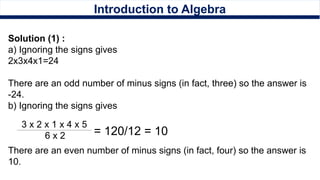
Solution (1) :
a) Ignoring the signs gives
2x3x4x1=24
There are an odd number of minus signs (in fact, three) so the answer is
-24.
b) Ignoring the signs gives
There are an even number of minus signs (in fact, four) so the answer is
10.
3 x 2 x 1 x 4 x 5
6 x 2 = 120/12 = 10
Introduction to Algebra
Practice Problem (1): Evaluate
a) 5 x (-6) =
b) (-1) x (-2) =
c) (-50) / 10 =
d) (-5) / (-1) =
e) 2 x (-1) x (-3) x 6 =
f) [ 2 x (-1) x (-3) x 6 ] / [ (-2) x (3) x 6 ] =
Introduction to Algebra
To add or subtract negative numbers it helps to think in terms of
“money/debt”:
Assume you have £100 in your pocket, but £200 debt, than you have £ 100
debt left. The money you have has a positive sign, whereas the debt you
have has a negative sign. So if you have more money than your debt, you
will have some of your money left; but if your debt is more than the money
you have you will left off with some of your debt. For example:
100 – 200 = -100 (your debt > your money)
-50 + 150 = 100 (your money > your debt)
-130 – 30 = -160 (you have debt and then more debt, your debt gets even
more)
Introduction to Algebra
Example (2) : Evaluate
a) -3+4=
b) -2-8=
c) -1-4-5=
d) -4-5+6+1=
e) -1+7-3+4=
Solution (2)
Introduction to Algebra
Example (2) : Evaluate
a) -3+4=
b) -2-8=
c) -1-4-5=
d) -4-5+6+1=
e) -1+7-3+4=
Solution (2)
f) 1 b)-10 c)-10 d)-2 e)7
On the other hand, assume a and b are positive numbers, a-(-b) is taken to
be a+b. This follows from the rule for multiplying two negative numbers,
since -(-b)= (-1)x(-b) = b
Introduction to Algebra
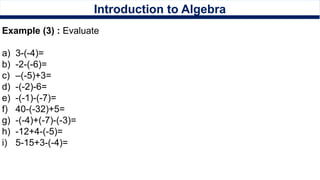
Example (3) : Evaluate
a) 3-(-4)=
b) -2-(-6)=
c) –(-5)+3=
d) -(-2)-6=
e) -(-1)-(-7)=
f) 40-(-32)+5=
g) -(-4)+(-7)-(-3)=
h) -12+4-(-5)=
i) 5-15+3-(-4)=
Introduction to Algebra
Example (3) : Evaluate
a) 3-(-4)=
b) -2-(-6)=
c) –(-5)+3=
d) -(-2)-6=
e) -(-1)-(-7)=
f) 40-(-32)+5=
g) -(-4)+(-7)-(-3)=
h) -12+4-(-5)=
i) 5-15+3-(-4)=
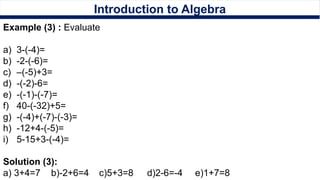
Solution (3):
a) 3+4=7 b)-2+6=4 c)5+3=8 d)2-6=-4 e)1+7=8
Expressions
In algebra, letters are used to represent numbers. In pure mathematics, the most
common letters used are x and y. However, in applications it is helpful to choose
letters that are more meaningful, so we might use Q for quantity and I for
investment. An algebraic expression is then simply a combination of these letters,
brackets and other mathematical symbols such as + or -. For example, the
expression
Can be used to work out how money in a saving account grows over a period of
time. The letters P, r and n represents the original sum invested (called the
principal- hence the use of the letter P) , the rate of interest and the number of
years, respectively. To work it all out, you not only need to replace these letters by
actual numbers, but also need to understand the various conventions that go with
algebraic expressions such as this.
Expressions
In algebra when we multiply two numbers represented by letters, we usually
suppress the multiplication sign between them. The product of a and b would
simply be written as ab without bothering to put the multiplication sign between
the symbols.
Likewise, when a number represented by Y is doubled, we write 2Y.
Here are some examples:
P x Q is written as PQ
d x 8 is written as 8d
n x 6 x t is written as 6nt
z x z is written z2
1 x t is written as t
Expressions
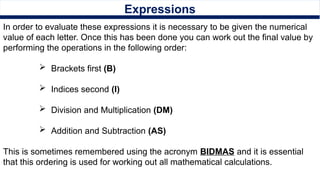
In order to evaluate these expressions it is necessary to be given the numerical
value of each letter. Once this has been done you can work out the final value by
performing the operations in the following order:
 Brackets first (B)
 Indices second (I)
 Division and Multiplication (DM)
 Addition and Subtraction (AS)
This is sometimes remembered using the acronym BIDMAS and it is essential
that this ordering is used for working out all mathematical calculations.
Expressions
For example, suppose you wish to evaluate each of the following expressions
when x= 2:
3x2
and (3x)2
Substituting x=2 into the first expression gives
3x2
=3x22
(the multiplication sign is revealed when we switch from algebra to
numbers)
=3x4
=12
whereas in the second expression we get
(3x)2
=(3x2)2
(again the multiplication sign is revealed)
=(6)2
= 36
The two answers are not the same, so the order indicated by BIDMAS does really
matters.
Expressions
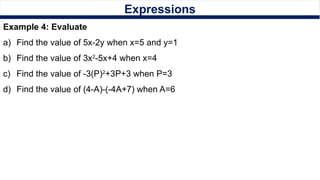
Example 4: Evaluate
a) Find the value of 5x-2y when x=5 and y=1
b) Find the value of 3x2
-5x+4 when x=4
c) Find the value of -3(P)2
+3P+3 when P=3
d) Find the value of (4-A)-(-4A+7) when A=6
Expressions
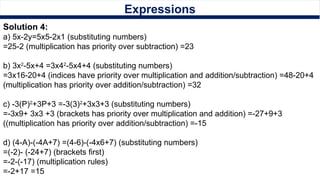
Solution 4:
a) 5x-2y=5x5-2x1 (substituting numbers)
=25-2 (multiplication has priority over subtraction) =23
b) 3x2
-5x+4 =3x42
-5x4+4 (substituting numbers)
=3x16-20+4 (indices have priority over multiplication and addition/subtraction) =48-20+4
(multiplication has priority over addition/subtraction) =32
c) -3(P)2
+3P+3 =-3(3)2
+3x3+3 (substituting numbers)
=-3x9+ 3x3 +3 (brackets has priority over multiplication and addition) =-27+9+3
((multiplication has priority over addition/subtraction) =-15
d) (4-A)-(-4A+7) =(4-6)-(-4x6+7) (substituting numbers)
=(-2)- (-24+7) (brackets first)
=-2-(-17) (multiplication rules)
=-2+17 =15
Expressions
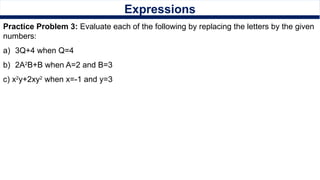
Practice Problem 3: Evaluate each of the following by replacing the letters by the given
numbers:
a) 3Q+4 when Q=4
b) 2A2
B+B when A=2 and B=3
c) x2
y+2xy2
when x=-1 and y=3
Expressions
Like terms are multiples of the same letters (or letters).
For example, 3a, -4a, 6a, -a are all multiples of a and so are like terms.
If an algebraic expression contains like terms which are added or subtracted together
then it can be simplified to produce an equivalent shorter expression.
For example:
a) a+4a-2a = 3a
b) x2
+3x2
+7x2
= 11x2
c) -3Q+4Q+Q-2Q = 0
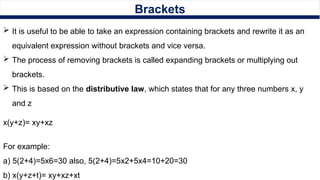
Brackets
 It is useful to be able to take an expression containing brackets and rewrite it as an
equivalent expression without brackets and vice versa.
 The process of removing brackets is called expanding brackets or multiplying out
brackets.
 This is based on the distributive law, which states that for any three numbers x, y
and z
x(y+z)= xy+xz
For example:
a) 5(2+4)=5x6=30 also, 5(2+4)=5x2+5x4=10+20=30
b) x(y+z+t)= xy+xz+xt
Brackets
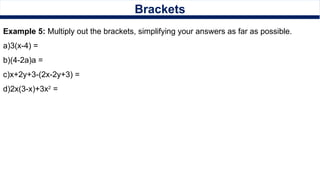
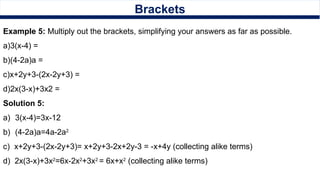
Example 5: Multiply out the brackets, simplifying your answers as far as possible.
a)3(x-4) =
b)(4-2a)a =
c)x+2y+3-(2x-2y+3) =
d)2x(3-x)+3x2
=
Brackets
Example 5: Multiply out the brackets, simplifying your answers as far as possible.
a)3(x-4) =
b)(4-2a)a =
c)x+2y+3-(2x-2y+3) =
d)2x(3-x)+3x2 =
Solution 5:
a) 3(x-4)=3x-12
b) (4-2a)a=4a-2a2
c) x+2y+3-(2x-2y+3)= x+2y+3-2x+2y-3 = -x+4y (collecting alike terms)
d) 2x(3-x)+3x2
=6x-2x2
+3x2
= 6x+x2
(collecting alike terms)

basic mathematics for bussiness -01.pptx

  • 1.
    MAN 109 –Basic Mathematics Assoc. Prof. Dr. Ozan Toprakçı Polymer Materials Engineering Dept. Introduction to Algebra
  • 2.
    What is algebra? Algebrais the language of mathematics. In algebra we use letters to represent numbers. Then we can do several things:  make statements that are generally true without having to be specific. For example, if a and b represent any two numbers then we can say that a + b = b + a rather than just saying that for example 5 + 3 = 3 + 5.  Second, algebra is more brief than any human language. It is more brief to say a + b = b + a than to say “when adding two numbers together, it does not matter which number is added to which; the result is the same”.
  • 3.
    What is algebra? Finally and most importantly, we can use algebra to solve problems. We use expressions to describe combinations of numbers and we use equations to describe mathematical facts.
  • 4.
    What is algebra? For example, suppose that we don’t know Alice and Bill’s ages but we do know that Bill is 6 years older than Alice. We can let a represent Alice’s age in years and b represent Bill’s age in years and then the phrase “6 years older than Alice ” can be written concisely as the expression: 6+a and the fact that “Bill is 6 years older than Alice” can be written concisely as the equation b=a+6
  • 5.
    What is algebra? Values of a and b that make this equation true are said to satisfy the equation. For example, the ages a = 10 and b = 16 cause the equation to read 16 = 16 and thus satisfy the equation. So do the ages a = 50 and b = 56, which cause the equation to read 56 = 56.  If we later learn that Bill is 3 times as old as Alice then we can express this fact using another equation: b=3*a  We now have two equations that must both be satisfied. This is called a system of equations. b=a+6 and b=3*a
  • 6.
    What is algebra? Algebracan be classified into three broad topics:  simplifying expressions,  manipulating expressions into other forms, and  solving equations or systems of equation. Simplifying expressions involves learning the properties of exponents, logarithms, various functions, etc. Manipulating expressions involves factoring, adding fractions, completing the square, etc. And solving equations involves learning about quadratic equations, exponential equations, etc. Each of these categories will take about the same amount of time for you to learn
  • 7.
    Pre-Algebra Topics  Factorsof a number  Greatest Common Factor of two numbers  Lowest Common Multiple of two numbers  Fractions and how to add, subtract, multiply and divide them  Decimal notation  Exponential notation  Order of operations  Invisible brackets
  • 8.
    Factors of anumber  The numbers that we are interested in factoring are the natural numbers 1, 2, 3, … The word factor is used as both a noun and a verb. The factors (noun) of a number are the numbers that divide evenly into the number. For example, the factors of the number 12 are the numbers 1, 2, 3, 4, 6 and 12. (Notice that the smallest factor is always 1 and the biggest factor is always the number itself.)  To factor (verb) a number means to express it as a product of smaller numbers. For example, we can factor the number 12 like this: 12 = 3 · 4. The numbers 3 and 4 are called the factors. Another way to factor 12 is like this: 12 = 2 · 2 · 3. Now the factors are 2, 2 and 3. Each way of factoring a number is called a factorization.
  • 9.
    Factors of anumber  A number that cannot be factored further is called a prime number. To factor a number completely means to write it as a product of prime numbers. This is also called the prime factorization.  Here are some examples of numbers in completely factored form: 100 = 2 · 2 · 5 · 5 18 = 2 · 3 · 3 29 = 29 (29 is a prime number)
  • 10.
    Factors of anumber Greatest Common Factor (GCF) of two numbers  If we look at two or more numbers then they will have factors in common. For example: - the factors of 40 are 1, 2, 4, 5, 8, 10, 20 and 40, - the factors of 50 are 1, 2, 5, 10, 25 and 50. The greatest common factor is the largest of all the common factors. The greatest common factor of 40 and 50 is 10.
  • 11.
    Factors of anumber Greatest Common Factor (GCF) of two numbers  Here are some more examples of greatest common factors: - the GCF of 24 and 30 is 6 - the GCF of 24, 30 and 33 is 3 - the GCF of 7 and 21 is 7 - the GCF of 7 and 13 is 1
  • 12.
    Factors of anumber Greatest Common Factor (GCF) of two numbers  Here is a procedure to find the greatest common factor of two or more numbers. We illustrate with the numbers 24 and 30. Factor the numbers completely and line up their factors. (By this we mean put common factors below each other and when either number is missing a factor then leave a space for it.)  Now it is easy to see the factors that both numbers have in common. Because they both have 2 and 3 in common the greatest common factor must be 2 · 3 = 6.
  • 13.
    Factors of anumber Lowest Common Multiple (LCM) of two numbers  The multiples of a number are the numbers that have that number as a factor. For example, the multiples of 5 are 5, 10, 15, 20, 25, …  If we look at two or more numbers then they will have multiples in common. For example: - the multiples of 3 are 3, 6, 9, 12, 15, 18, 21, 24, 27, … - and the multiples of 4 are 4, 8, 12, 16, 20, 24, 28, … - the common multiples of 3 and 4 are 12, 24, …  The smallest of the common multiples is called the lowest common multiple.
  • 14.
    Factors of anumber Lowest Common Multiple (LCM) of two numbers  Here are some more examples of lowest common multiples: - the LCM of 9 and 20 is 180 - the LCM of 2, 3 and 5 is 30 - the LCM of 7 and 21 is 21  Here is a procedure to find the lowest common multiple of two or more numbers. We illustrate with the numbers 24 and 30. Factor the numbers completely and line up their factors. (By this we mean put common factors below each other and when either number is missing a factor then leave a space for it.)
  • 15.
    Factors of anumber Lowest Common Multiple (LCM) of two numbers  The lowest common multiple must contain all the factors that are in either one number or the other, but the factors are not used twice when they are common to both numbers. Lined up like this it is easy to spot the common factors. The lowest common multiple must be 2 · 3 · 2 · 2 · 5 = 120.
  • 16.
    Fractions Fraction notation  Fractions(or common fractions) are used to describe a part of a whole object. There are several notations for fractions:  a is called the numerator and b is called the denominator. The notation means that we break an object into b equal pieces and we have a of those pieces. The portion or fraction of the object that we have is a/b. For example, if we break a pie into 4 equal pieces and take 1 piece then we have 1/4 of the pie:
  • 17.
    Fractions Equivalent fractions Notice thatwe get the same amount of pie as in the previous example if we divide the pie into 8 equal pieces and get 2 of them: Fractions like 1/4 and 2/8 that have the same value are said to be equivalent fractions. This example suggests the following method for testing if two fractions are equivalent.
  • 18.
    Fractions Equivalent fractions Two fractionsare equivalent if multiplying the numerator and denominator of one fraction by the same whole number yields the other fraction. For example 4/5 and 24/30 are equivalent because we can start with 4/5 and multiply the numerator and denominator each by 6 to get 24/30:
  • 19.
    Fractions Equivalent fractions Notice thatwe get the same amount of pie as in the previous example if we divide the pie into 8 equal pieces and get 2 of them: Fractions like 1/4 and 2/8 that have the same value are said to be equivalent fractions. This example suggests the following method for testing if two fractions are equivalent.
  • 20.
    Fractions Equivalent fractions Two fractionsare equivalent if multiplying the numerator and denominator of one fraction by the same whole number yields the other fraction. For example, 4/5 and 24/30 are equivalent because we can start with 4/5 and multiply the numerator and denominator each by 6 to get 24/30:
  • 21.
    Fractions Equivalent fractions Going inthe opposite direction (from 24/30 to 4/5) suggests the following method for reducing a fraction to lowest terms or to its simplest equivalent fraction: To reduce a fraction to lowest terms or to its simplest equivalent fraction, factor both the numerator and denominator completely (i.e. into prime numbers). Then cancel every factor that occurs in both the numerator and denominator. What remains is the simplest equivalent fraction.
  • 22.
    Fractions Improper fractions, mixedfractions and long division A fraction where the numerator is smaller than the denominator is called a proper fraction and a fraction where the numerator is bigger than the denominator is called an improper fraction. An example of an improper fraction is 7/4. Using the pie example this means that you have broken many pies each into 4 equal pieces and you have 7 of those pieces:
  • 23.
    Fractions Improper fractions, mixedfractions and long division Improper fractions are sometimes expressed in mixed fraction notation, which is the sum of a whole number and a proper fraction, but with the + sign omitted. For example, 7/4 in mixed fraction notation looks like this: Long division is the method used to convert an improper fraction to a mixed fraction. We will illustrate the method on the fraction 92/5:
  • 24.
    Fractions Some special fractions Thereare several special fractions that are important to recognize: Any number n can be turned into a fraction by writing it over a denominator of 1. Anything divided by itself equals 1. We call this a UFOO (a useful form of one).
  • 25.
    Fractions Some special fractions Ifthe numerator of a fraction is a multiple of the denominator then the fraction is equal to a whole number. An example is: is undefined for any numerator n. Division by zero is not allowed in mathematics. A zero numerator is not a problem. This fraction equals 0.
  • 26.
    Adding or subtractingfractions This picture shows that 2/8 of a pie plus 3/8 of a pie equals 5/8 of a pie: Fractions that have the same denominator are called like fractions. If you think about this example, then the following procedure for adding or subtracting like fractions is obvious: To add two or subtract like fractions (fractions that have a common denominator), just add or subtract the numerators and put the result over the common denominator, like this: Fractions
  • 27.
    Adding or subtractingfractions To add two or subtract like fractions (fractions that have a common denominator), just add or subtract the numerators and put the result over the common denominator, like this: But what if the fractions don’t have a common denominator? The answer is that they must then be converted to equivalent fractions that do have a common denominator. The procedure is illustrated in this example: Fractions
  • 28.
    Adding or subtractingfractions 1.The steps are:Find the lowest common multiple of the two denominators 24 and 30. When applied to fractions this number is called the lowest common denominator (LCD). In this example the LCD is 120. 2.Convert each fraction to an equivalent fraction that has the LCD of 120 as its denominator. To do this in this example multiply the numerator and denominator of the first fraction by 5 and the numerator and denominator of the second fraction by 4 (shown in red). 3.Add the numerators and place over the common denominator. Fractions
  • 29.
    Adding or subtractingfractions Sometimes there is one more step. The result should always be expressed as the simplest equivalent fraction, like this: Here are some more examples: Fractions
  • 30.
    Adding or subtractingfractions Fractions
  • 31.
    Multiplying fractions Multiplying fractionsproduces a new fraction. Multiply the numerators to get the new numerator and multiply denominators to get the new denominator, like this: Then simplify by reducing the new fraction to lowest terms. Fractions
  • 32.
    Multiplying fractions To multiplya fraction by a whole number, just multiply the fraction’s numerator by the whole number to get the new numerator, like this: Then simplify by reducing the new fraction to lowest terms. Fractions
  • 33.
    Multiplying fractions Here isan example of why the first procedure works. Suppose that there is half a pie (the fraction 1/2) as shown on the left. Now suppose that you take 2/3 of that half pie. (The word “of” translates into the mathematical operation “multiply”.) This means that you cut the half pie into 3 equal pieces and take 2 of them. The result is 2/6 of the pie. Fractions
  • 34.
    Multiplying fractions Here isan example of why the second procedure works. Suppose that you ate 1/4 of a pie and that your friend ate 3 times as much pie as you did. This means that your friend ate 3/4 of the pie. Fractions
  • 35.
    Multiplying fractions Here aresome more multiplication examples: Fractions
  • 36.
    Reciprocals and dividingfractions Reciprocals play an essential role when dividing fractions. Two numbers or fractions are said to be the reciprocals of each other, if their product is 1. For example: Fractions
  • 37.
    Reciprocals and dividingfractions Dividing fractions: The procedure is to replace a division by a fraction by the multiplication by the reciprocal of that fraction, like this: Notice that you take the reciprocal of the fraction on the bottom! Fractions
  • 38.
    Reciprocals and dividingfractions Here is why this procedure works: Fractions
  • 39.
  • 40.
  • 41.
  • 42.
    The word decimalmeans ten. The decimal number system is the familiar system that uses just ten symbols (numerals) to create any whole number, no matter how big. Those symbols are of course 0, 1, 2, 3, 4, 5, 6, 7, 8, 9. (In contrast the binary number system uses just the two symbols 0 and 1 and the hexadecimal number system uses the sixteen symbols 0, 1, 2, 3, 4, 5, 6, 7, 8, 9, A, B, C, D, E, F to create any number. Binary and hexadecimal are the number systems used in computers.) To create numbers bigger than 9 the decimal system uses place-values. For example, the place-value chart shows that 3528 means: Decimal notation
  • 43.
    3528 = 3· 1000 + 5 · 100 + 2 · 10 + 8 · 1 This is because the 3 is in the thousands place, the 5 is in the hundreds place, the 2 is in the tens place and the 8 is in the ones place. Notice that as we move from right to left in the place-value table, the value of each place is ten times the value of the place to its right. Decimal notation
  • 44.
    A decimal pointis used to separate the digit in the ones place from the digits to the right of it. The decimal number 3528.74 means: Decimal notation If we continue this pattern to the right then we get the expanded place-value chart shown here:
  • 45.
    Decimal numbers withdigits to the right of the decimal point can be converted to fraction notation by multiplying them by a UFOO. First identify the place-value of the right-most digit. If the place-value is tenths then multiply by 10/10, if it is hundredths then multiply by 100/100, etc. Then simplify the numerator. Decimal notation Converting numbers from decimal to fraction notation:
  • 46.
    Exponential notation Exponential notationis a convenient shorthand for repeated multiplication. The exponential b n means multiply b times itself n times: b is called the base, n is called the exponent, and we say that we are “raising b to the n th power” (except when n is 2 we say that we are “squaring b” and when n is 3 we say that we are “cubing b”).
  • 47.
    Order of operations Anexpression is a set of numbers that are combined using operations such as addition, subtraction, multiplication, division, exponentiation, etc. An example of an expression is: In this expression the numbers are 4, 5, 2 and 3 and they are combined by the operations of addition, multiplication and exponentiation. Expressions often use brackets ( ) as symbols of grouping. The brackets contain their own sub-expressions (thus creating expressions within expressions). An example is:
  • 48.
    1.Operation in brackets(parentheses) are done first. If there are nested brackets (brackets within brackets) then the innermost brackets are done first. 2.Then exponentiation. 3.Then multiplication and division, from left to right. 4.Then addition and subtraction, from left to right. There are a couple of acronyms that people use to help them remember the order of operations table. One is BEDMAS, which stands for the order: Brackets, Exponentiation, Division and Multiplication, Addition and Subtraction. Order of operations
  • 49.
  • 50.
  • 51.
    Invisible brackets There arethree locations where brackets are usually not shown but you have to imagine that they are there. One location is the exponent in an exponential. The other two are the numerator above a horizontal division line and the denominator below a horizontal division line. Here are two examples showing expressions, first with invisible brackets, and then with visible brackets.
  • 52.
    Introduction to Algebra InMathematics numbers are classified into one of three types:  Positive,  Negative,  Zero. When using the four operations in math (addition, subtraction, multiplication and division) rule varies for negative numbers. As such, negative number is interpreted based on the case.
  • 53.
    Introduction to Algebra Forinstance, -4 on the temperature on a thermometer scale measured in degrees centigrade is interpreted a degree of 4 below freezing (=zero). On the other hand, -£100,000 signifies a loss of/ or a debt of a £100.000 of firms or personal finance, and so on. Perhaps, the easiest way to illustrate the three types of integer is a number line.
  • 54.
    Introduction to Algebra Theline continues left and right forever. The rules for the multiplication of negative numbers are: NEGATIVE x NEGATIVE = POSITIVE NEGATIVE x POSITIVE = NEGATIVE It does not matter in which order two numbers are multiplied, so POSITIVE x NEGATIVE = NEGATIVE
  • 55.
    Introduction to Algebra Therules produce: (-7) x (-5) = 35 (-3) x (4) = -12 (6) x (-3) = -18 The same rules apply for division, since division is the same sort of operation as multiplication. Thus, exactly the same rules operate when one number is divided by another. For instance, (-30) / (-10) = 3 (-45) / (9) = -5 (52) / (-13) = -4
  • 56.
    Introduction to Algebra Toavoid complexity when multiplying or dividing multiple numbers, it is perhaps simplest to ignore the signs to begin with and just to work the answers out. The final result is negative if the total number of minus signs is odd and positive if the total number is even. Example (1) : Evaluate a) (-2) x (-3) x (4) x (-1) = b) (3) x (-2) x (-1) x (4) x (-5) (-6) x (2) =
  • 57.
    Introduction to Algebra Solution(1) : a) Ignoring the signs gives 2x3x4x1=24 There are an odd number of minus signs (in fact, three) so the answer is -24. b) Ignoring the signs gives There are an even number of minus signs (in fact, four) so the answer is 10. 3 x 2 x 1 x 4 x 5 6 x 2 = 120/12 = 10
  • 58.
    Introduction to Algebra PracticeProblem (1): Evaluate a) 5 x (-6) = b) (-1) x (-2) = c) (-50) / 10 = d) (-5) / (-1) = e) 2 x (-1) x (-3) x 6 = f) [ 2 x (-1) x (-3) x 6 ] / [ (-2) x (3) x 6 ] =
  • 59.
    Introduction to Algebra Toadd or subtract negative numbers it helps to think in terms of “money/debt”: Assume you have £100 in your pocket, but £200 debt, than you have £ 100 debt left. The money you have has a positive sign, whereas the debt you have has a negative sign. So if you have more money than your debt, you will have some of your money left; but if your debt is more than the money you have you will left off with some of your debt. For example: 100 – 200 = -100 (your debt > your money) -50 + 150 = 100 (your money > your debt) -130 – 30 = -160 (you have debt and then more debt, your debt gets even more)
  • 60.
    Introduction to Algebra Example(2) : Evaluate a) -3+4= b) -2-8= c) -1-4-5= d) -4-5+6+1= e) -1+7-3+4= Solution (2)
  • 61.
    Introduction to Algebra Example(2) : Evaluate a) -3+4= b) -2-8= c) -1-4-5= d) -4-5+6+1= e) -1+7-3+4= Solution (2) f) 1 b)-10 c)-10 d)-2 e)7 On the other hand, assume a and b are positive numbers, a-(-b) is taken to be a+b. This follows from the rule for multiplying two negative numbers, since -(-b)= (-1)x(-b) = b
  • 62.
    Introduction to Algebra Example(3) : Evaluate a) 3-(-4)= b) -2-(-6)= c) –(-5)+3= d) -(-2)-6= e) -(-1)-(-7)= f) 40-(-32)+5= g) -(-4)+(-7)-(-3)= h) -12+4-(-5)= i) 5-15+3-(-4)=
  • 63.
    Introduction to Algebra Example(3) : Evaluate a) 3-(-4)= b) -2-(-6)= c) –(-5)+3= d) -(-2)-6= e) -(-1)-(-7)= f) 40-(-32)+5= g) -(-4)+(-7)-(-3)= h) -12+4-(-5)= i) 5-15+3-(-4)= Solution (3): a) 3+4=7 b)-2+6=4 c)5+3=8 d)2-6=-4 e)1+7=8
  • 64.
    Expressions In algebra, lettersare used to represent numbers. In pure mathematics, the most common letters used are x and y. However, in applications it is helpful to choose letters that are more meaningful, so we might use Q for quantity and I for investment. An algebraic expression is then simply a combination of these letters, brackets and other mathematical symbols such as + or -. For example, the expression Can be used to work out how money in a saving account grows over a period of time. The letters P, r and n represents the original sum invested (called the principal- hence the use of the letter P) , the rate of interest and the number of years, respectively. To work it all out, you not only need to replace these letters by actual numbers, but also need to understand the various conventions that go with algebraic expressions such as this.
  • 65.
    Expressions In algebra whenwe multiply two numbers represented by letters, we usually suppress the multiplication sign between them. The product of a and b would simply be written as ab without bothering to put the multiplication sign between the symbols. Likewise, when a number represented by Y is doubled, we write 2Y. Here are some examples: P x Q is written as PQ d x 8 is written as 8d n x 6 x t is written as 6nt z x z is written z2 1 x t is written as t
  • 66.
    Expressions In order toevaluate these expressions it is necessary to be given the numerical value of each letter. Once this has been done you can work out the final value by performing the operations in the following order:  Brackets first (B)  Indices second (I)  Division and Multiplication (DM)  Addition and Subtraction (AS) This is sometimes remembered using the acronym BIDMAS and it is essential that this ordering is used for working out all mathematical calculations.
  • 67.
    Expressions For example, supposeyou wish to evaluate each of the following expressions when x= 2: 3x2 and (3x)2 Substituting x=2 into the first expression gives 3x2 =3x22 (the multiplication sign is revealed when we switch from algebra to numbers) =3x4 =12 whereas in the second expression we get (3x)2 =(3x2)2 (again the multiplication sign is revealed) =(6)2 = 36 The two answers are not the same, so the order indicated by BIDMAS does really matters.
  • 68.
    Expressions Example 4: Evaluate a)Find the value of 5x-2y when x=5 and y=1 b) Find the value of 3x2 -5x+4 when x=4 c) Find the value of -3(P)2 +3P+3 when P=3 d) Find the value of (4-A)-(-4A+7) when A=6
  • 69.
    Expressions Solution 4: a) 5x-2y=5x5-2x1(substituting numbers) =25-2 (multiplication has priority over subtraction) =23 b) 3x2 -5x+4 =3x42 -5x4+4 (substituting numbers) =3x16-20+4 (indices have priority over multiplication and addition/subtraction) =48-20+4 (multiplication has priority over addition/subtraction) =32 c) -3(P)2 +3P+3 =-3(3)2 +3x3+3 (substituting numbers) =-3x9+ 3x3 +3 (brackets has priority over multiplication and addition) =-27+9+3 ((multiplication has priority over addition/subtraction) =-15 d) (4-A)-(-4A+7) =(4-6)-(-4x6+7) (substituting numbers) =(-2)- (-24+7) (brackets first) =-2-(-17) (multiplication rules) =-2+17 =15
  • 70.
    Expressions Practice Problem 3:Evaluate each of the following by replacing the letters by the given numbers: a) 3Q+4 when Q=4 b) 2A2 B+B when A=2 and B=3 c) x2 y+2xy2 when x=-1 and y=3
  • 71.
    Expressions Like terms aremultiples of the same letters (or letters). For example, 3a, -4a, 6a, -a are all multiples of a and so are like terms. If an algebraic expression contains like terms which are added or subtracted together then it can be simplified to produce an equivalent shorter expression. For example: a) a+4a-2a = 3a b) x2 +3x2 +7x2 = 11x2 c) -3Q+4Q+Q-2Q = 0
  • 72.
    Brackets  It isuseful to be able to take an expression containing brackets and rewrite it as an equivalent expression without brackets and vice versa.  The process of removing brackets is called expanding brackets or multiplying out brackets.  This is based on the distributive law, which states that for any three numbers x, y and z x(y+z)= xy+xz For example: a) 5(2+4)=5x6=30 also, 5(2+4)=5x2+5x4=10+20=30 b) x(y+z+t)= xy+xz+xt
  • 73.
    Brackets Example 5: Multiplyout the brackets, simplifying your answers as far as possible. a)3(x-4) = b)(4-2a)a = c)x+2y+3-(2x-2y+3) = d)2x(3-x)+3x2 =
  • 74.
    Brackets Example 5: Multiplyout the brackets, simplifying your answers as far as possible. a)3(x-4) = b)(4-2a)a = c)x+2y+3-(2x-2y+3) = d)2x(3-x)+3x2 = Solution 5: a) 3(x-4)=3x-12 b) (4-2a)a=4a-2a2 c) x+2y+3-(2x-2y+3)= x+2y+3-2x+2y-3 = -x+4y (collecting alike terms) d) 2x(3-x)+3x2 =6x-2x2 +3x2 = 6x+x2 (collecting alike terms)