F2037 - PROGRAMMING
FUNDAMENTAL WITH C++
Unit 5.1 - Understand The Use Of Function
LEARNING OUTCOME
At the end of this module, students should be able to:
 Define a function
 Explain the following types of function:Built-in
  function, User-defined function
 Describe the components of function :

        a. Function header
        b. Function body
        c. Local variable
        d. Return statement
        e. Parameters declaration list
        f. Function prototypes
 Identify the function calls : call by value, call by
  reference
 Write program using functions
INTRODUCTION TO FUNCTION
   A function is a set of statements that performs a
    specific task.
   It can be called from any section in the program
    and executed.
   The main advantage in using functions is that the
    number of lines in a program can be reduced.
   One long program willl be divided into smaller parts
    and each of these parts is programmed separately
TYPES OF FUNCTIONS

   built-in function - system function.
   User-defined function - Created by the users for
    their requirements.
Built-in Function     User-defined Function
strlen(“fadzlina”)       float purata(float x, float y)
atof(s)                  void panggilan(void)

pow(x, y)                char response(char ch)
BUILT-IN FUNCTION
#include<cmath>
#include<iostream>
using namespace std;
void main()
{
    double d=100.0, d1=100.5, d2=22.0;


//find the square root of the number
    cout<<"nSquarer Root of" << d<<" is = "<<sqrt(d)<<endl;


//find log 10 of the number
    cout<<"nlog10 for" << d<<" is = "<<log10(d)<<endl;


//compute power of two number
    cout<<"n" << d<<" to the power of "<<d2;
    cout<<" is = " <<pow(d,d2)<<"nn";
}
USER-DEFINED FUNCTION
#include <iostream>
using namespace std;
void kira_luasSegiempat(int, int);


void main()
{
     int p,l;


     cout<<"Masukkan nilai panjang dan lebar: ";
     cin>>p>>l;
     kira_luasSegiempat(p,l);
}


void kira_luasSegiempat(int panjang, int lebar)
{
    double luas;
    luas = panjang * lebar;
    cout<<"Luas segiempat :"<<luas <<endl;
}
COMPONENTS OF FUNCTION
a)   Function header
b)   Function body
c)   Local variable
d)   Return statement
e)   Parameters declaration list
f)   Function prototypes
COMPONENTS OF FUNCTION
Function Header
 Has three main parts
   The name of the function
   The parameters of the function enclosed in
    paranthesis
   Return value type


Function Body
 What ever is written with in { } in the above
  example is the body of the function.
COMPONENTS OF FUNCTION
Function prototype
 The prototype of a function provides the basic
  information about a function which tells the compiler
  that the function is used correctly or not. It contains
  the same information as the function header
  contains.

Function definition
 A function must be defined before it can be used
COMPONENTS OF FUNCTION
Local variable
 Variable declared inside main() or function


Call Function
 Call another function by passing value or reference


Return statement (return)
 Return the control back to the function that invoked
  it
Parameter list
 List of parameters that can be passed to the
  function
COMPONENTS OF FUNCTION
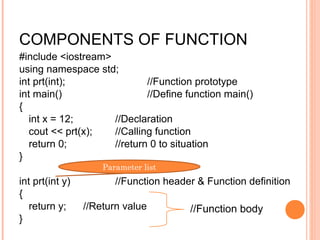
#include <iostream>
using namespace std;
int prt(int);               //Function prototype
int main()                  //Define function main()
{
   int x = 12;      //Declaration
   cout << prt(x);  //Calling function
   return 0;        //return 0 to situation
}
                     Parameter list
int prt(int y)          //Function header & Function definition
{
   return y;     //Return value         //Function body
}
FUNCTION DECLARATION
 Syntax:

   function_type function_name (parameter-list)
   {
       variable declaration;
       ……
       return expression;
   }
FUNCTION DECLARATION

 function_type = type of data in C++
 function_name = name of function

 parameter-list  passing parameter value when invoked

 return  return value or control
IDENTIFY FUNCTION CALLS
1.   Call by value
2.   Call by reference
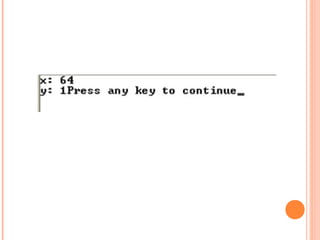
CALL BY VALUE
#include <iostream>
using namespace std;
int main()
{
        void max_min(int, int);
        int x =2,y=3;

        max_min(x,y);
        cout << "x: " << x;
        cout << "ny: " << y;

        return 0;
}
void max_min(int x, int y)
{
       x= x*x;
       y= y*y;
}
CALL BY REFERENCE
#include <iostream>
using namespace std;
int main()
{
   void max_min(int&, int&);
   int x=8,y=1;

  max_min(x,y);
  cout << "x: " << x;
  cout << "ny: " << y;

  return 0;
}
void max_min(int& x, int& y)
{
   x= x*x;
   y= y*y;
}
IN CLASS EXERCISE
   By using a function, write a program that able to
    receive two double numbers and calculate sum
    for that numbers (hint: use void function).
SUMMARY
 Function is a component of the program written
  to perform a specific task.
 By using functions, the code written once can be
  used many times anywhere in the program.
 As the program is segregated into different
  smaller modules, it is very easy to correct the
  errors.
#include<iostream>
using namespace std;
void kira_jumlah ( ); //fungsi prototype
void main ()
{

kira_jumlah ();

system(“pause”);
}
void kira_jumlah ( )
{
int num_1, num_2, JUMLAH;

cout<<“Sila masukan 2 integer :”;
cin>>num_1>>num_2;

JUMLAH=num_1 + num_2;

cout<<“
}
FUNGSI YANG TIDAK MEMULANGKAN NILAI
        TETAPI MENERIMA NILAI
#include<iostream>
using namespace std;
void kira_jumlah ( int, int ); //fungsi prototype
void main ()
{
int num_1, num_2;


cout<<“Sila masukan 2 integer :”;
cin>>num_1>>num_2;


kira_jumlah (num_1,num_2);


system(“pause”);
}
void kira_jumlah ( int num_1, int num_2) )
{
int JUMLAH;

JUMLAH=num_1 + num_2;

cout<<“JUMLAH 2 integer adalah : “ << JUMLAH;

}
Fp201 unit5 1
Fp201 unit5 1
Fp201 unit5 1

Fp201 unit5 1

  • 1.
    F2037 - PROGRAMMING FUNDAMENTALWITH C++ Unit 5.1 - Understand The Use Of Function
  • 2.
    LEARNING OUTCOME At theend of this module, students should be able to:  Define a function  Explain the following types of function:Built-in function, User-defined function  Describe the components of function : a. Function header b. Function body c. Local variable d. Return statement e. Parameters declaration list f. Function prototypes  Identify the function calls : call by value, call by reference  Write program using functions
  • 3.
    INTRODUCTION TO FUNCTION  A function is a set of statements that performs a specific task.  It can be called from any section in the program and executed.  The main advantage in using functions is that the number of lines in a program can be reduced.  One long program willl be divided into smaller parts and each of these parts is programmed separately
  • 4.
    TYPES OF FUNCTIONS  built-in function - system function.  User-defined function - Created by the users for their requirements.
  • 5.
    Built-in Function User-defined Function strlen(“fadzlina”) float purata(float x, float y) atof(s) void panggilan(void) pow(x, y) char response(char ch)
  • 6.
    BUILT-IN FUNCTION #include<cmath> #include<iostream> using namespacestd; void main() { double d=100.0, d1=100.5, d2=22.0; //find the square root of the number cout<<"nSquarer Root of" << d<<" is = "<<sqrt(d)<<endl; //find log 10 of the number cout<<"nlog10 for" << d<<" is = "<<log10(d)<<endl; //compute power of two number cout<<"n" << d<<" to the power of "<<d2; cout<<" is = " <<pow(d,d2)<<"nn"; }
  • 8.
    USER-DEFINED FUNCTION #include <iostream> usingnamespace std; void kira_luasSegiempat(int, int); void main() { int p,l; cout<<"Masukkan nilai panjang dan lebar: "; cin>>p>>l; kira_luasSegiempat(p,l); } void kira_luasSegiempat(int panjang, int lebar) { double luas; luas = panjang * lebar; cout<<"Luas segiempat :"<<luas <<endl; }
  • 10.
    COMPONENTS OF FUNCTION a) Function header b) Function body c) Local variable d) Return statement e) Parameters declaration list f) Function prototypes
  • 11.
    COMPONENTS OF FUNCTION FunctionHeader  Has three main parts  The name of the function  The parameters of the function enclosed in paranthesis  Return value type Function Body  What ever is written with in { } in the above example is the body of the function.
  • 12.
    COMPONENTS OF FUNCTION Functionprototype  The prototype of a function provides the basic information about a function which tells the compiler that the function is used correctly or not. It contains the same information as the function header contains. Function definition  A function must be defined before it can be used
  • 13.
    COMPONENTS OF FUNCTION Localvariable  Variable declared inside main() or function Call Function  Call another function by passing value or reference Return statement (return)  Return the control back to the function that invoked it
  • 14.
    Parameter list  Listof parameters that can be passed to the function
  • 15.
    COMPONENTS OF FUNCTION #include<iostream> using namespace std; int prt(int); //Function prototype int main() //Define function main() { int x = 12; //Declaration cout << prt(x); //Calling function return 0; //return 0 to situation } Parameter list int prt(int y) //Function header & Function definition { return y; //Return value //Function body }
  • 17.
    FUNCTION DECLARATION  Syntax: function_type function_name (parameter-list) { variable declaration; …… return expression; }
  • 18.
    FUNCTION DECLARATION  function_type= type of data in C++  function_name = name of function  parameter-list  passing parameter value when invoked  return  return value or control
  • 19.
    IDENTIFY FUNCTION CALLS 1. Call by value 2. Call by reference
  • 20.
    CALL BY VALUE #include<iostream> using namespace std; int main() { void max_min(int, int); int x =2,y=3; max_min(x,y); cout << "x: " << x; cout << "ny: " << y; return 0; } void max_min(int x, int y) { x= x*x; y= y*y; }
  • 22.
    CALL BY REFERENCE #include<iostream> using namespace std; int main() { void max_min(int&, int&); int x=8,y=1; max_min(x,y); cout << "x: " << x; cout << "ny: " << y; return 0; } void max_min(int& x, int& y) { x= x*x; y= y*y; }
  • 24.
    IN CLASS EXERCISE  By using a function, write a program that able to receive two double numbers and calculate sum for that numbers (hint: use void function).
  • 26.
    SUMMARY  Function isa component of the program written to perform a specific task.  By using functions, the code written once can be used many times anywhere in the program.  As the program is segregated into different smaller modules, it is very easy to correct the errors.
  • 27.
    #include<iostream> using namespace std; voidkira_jumlah ( ); //fungsi prototype void main () { kira_jumlah (); system(“pause”); }
  • 28.
    void kira_jumlah () { int num_1, num_2, JUMLAH; cout<<“Sila masukan 2 integer :”; cin>>num_1>>num_2; JUMLAH=num_1 + num_2; cout<<“ }
  • 29.
    FUNGSI YANG TIDAKMEMULANGKAN NILAI TETAPI MENERIMA NILAI #include<iostream> using namespace std; void kira_jumlah ( int, int ); //fungsi prototype void main () { int num_1, num_2; cout<<“Sila masukan 2 integer :”; cin>>num_1>>num_2; kira_jumlah (num_1,num_2); system(“pause”); }
  • 30.
    void kira_jumlah (int num_1, int num_2) ) { int JUMLAH; JUMLAH=num_1 + num_2; cout<<“JUMLAH 2 integer adalah : “ << JUMLAH; }