Slide 1
Click to edit Master title style
Four Quadrant
Metering
Prepared by Tom Lawton, TESCO
For Mississippi Meter School
Thursday, October 24, 2019
Slide 2
• What does four Quadrant metering mean?
• When am I interested in four quadrant
metering?
• How is this information used if not for billing?
• How will I use this as a meter tech/engineer?
• Why will this be important in the future?
Concepts to be Discussed
Slide 3
Four Quadrant Metering
Four quadrant metering can be used to understand
individually or collectively;
• Real Power consumed by the end user
• Apparent Power delivered by the Utility
• Real Power delivered to the utility by an end user’s generation
source
• Apparent Power generated by the end user’s generation source
Having these measurements allows for the calculation of Reactive
Power, VA and VARS as well as providing kWh for billing purposes.
Slide 4
Power and Energy
There are 3 factors that make up what is called “Power and Energy”.
- “Apparent” Power and Energy
- “Real” Power and Energy
- “Reactive” Power and Energy
Real Power
• The practical unit of active power which is defined as the rate at which
energy is delivered to a circuit. Sometimes called Watts or Power. Also
known as potential/available power.
Apparent Power
• The product of the volts and the total current which flows because of the
voltage. Sometimes called volt-amperes
Reactive Power
• The out-of-phase component of the total volt-amperes in a circuit which
includes inductive or capacitive reactance. Sometimes called reactive
volt-amperes or vars.
Slide 5
Real Power Working Power
(Performs work)
Measured in Watts
Apparent Power Power supplied by the utility
(The full effort)
Measured in VA
Reactive Power Magnetizing Power
(Performs no work, imaginary)
Measured in Vars
VAR
VA
Watt
22
VARWVAV 
Review of the Power Triangle
Reactive Metering – Definitions
Slide 6
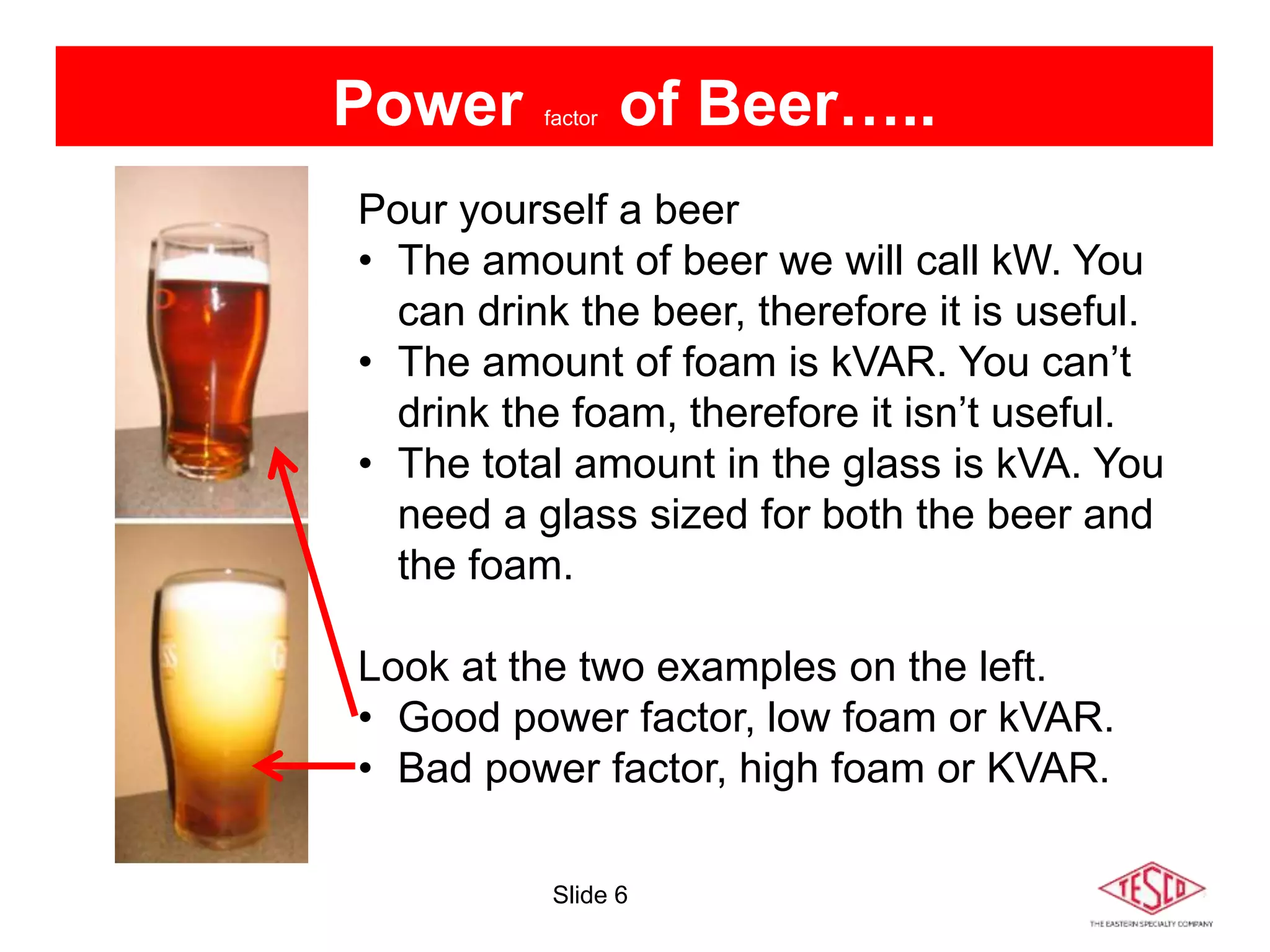
Power factor of Beer…..
Pour yourself a beer
• The amount of beer we will call kW. You
can drink the beer, therefore it is useful.
• The amount of foam is kVAR. You can’t
drink the foam, therefore it isn’t useful.
• The total amount in the glass is kVA. You
need a glass sized for both the beer and
the foam.
Look at the two examples on the left.
• Good power factor, low foam or kVAR.
• Bad power factor, high foam or KVAR.
Slide 7
Energy Components
• Voltage associated with Current produces Power applied over Time is
Energy: Volts (V) X Amps (A) X Time (H) = Energy (VAH)
• Volts (V) X Working Current (A) X Time (H) = Real Energy
- kWh- Does Real Work, this is typically customer billing register.
- 240v x 48 amps x 3 hours = 34.56 kilowatt hours (kWh)
• Volts (V) X Total Current (A) X Time (H) = Apparent Energy
- VAh - Supplied by Utilities.
- 240v x 48 amps/0.95 PF x 3 hours = 36.38 VAh
• Volts (V) X Reactive Current (A) X Time (H) = Reactive Energy
- VARh - Magnetizing Energy, system loss.
- 240v x 48 amps x .05 x 3 hours = 1.82 VARh
- 36.38 kWh – 34.56 kWh = 1.82 VARh
Slide 8
What is your Power Factor?
• Defined to be active power divided by apparent power
• Watts divided by volt-amperes
• KW/KVA (11.52 kW/12.13 kVA = .95 PF)
• Measure of power system delivery/consumption
efficiency
So…
Reactive Metering – Definitions
Slide 9
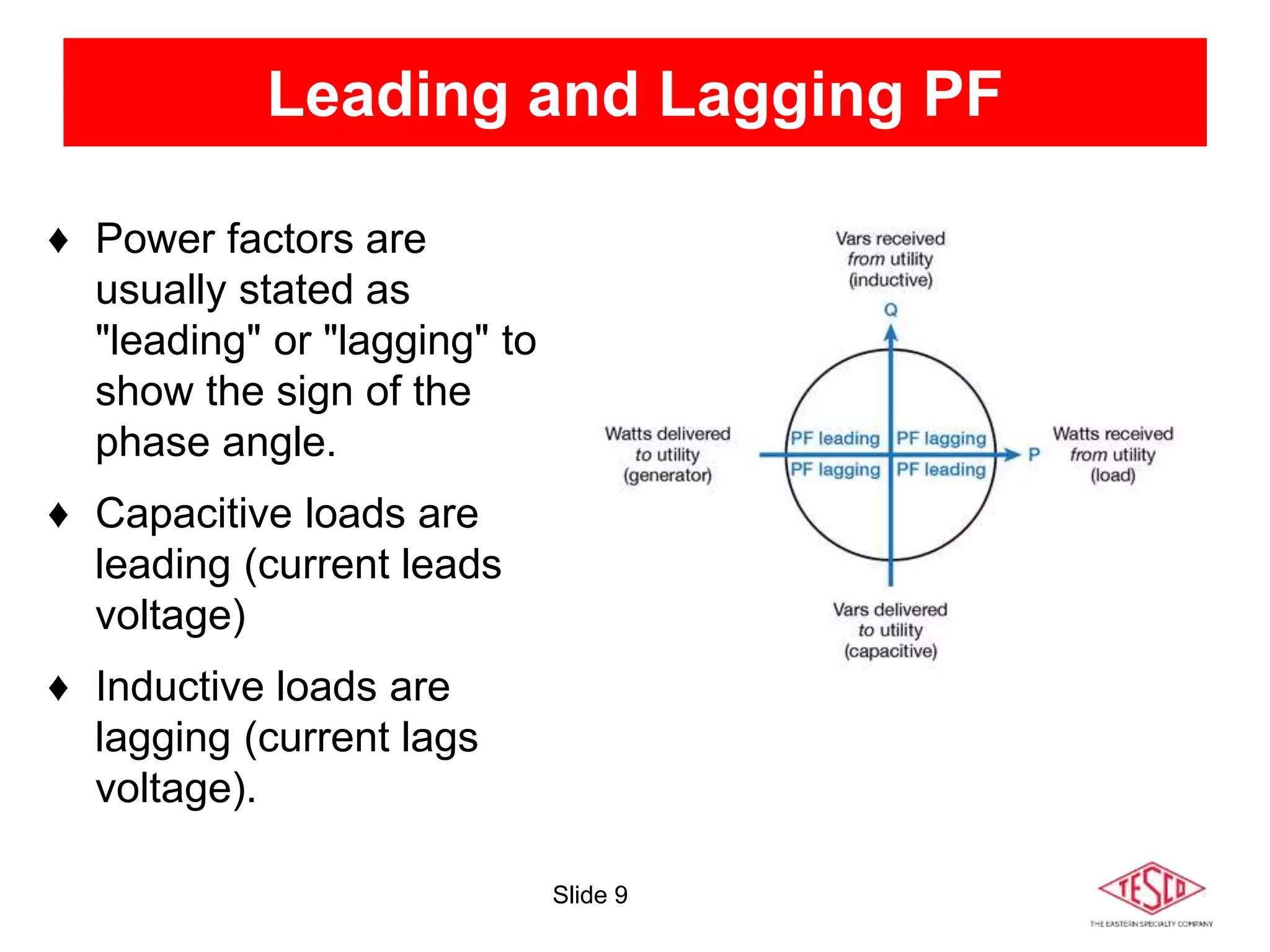
Leading and Lagging PF
♦ Power factors are
usually stated as
"leading" or "lagging" to
show the sign of the
phase angle.
♦ Capacitive loads are
leading (current leads
voltage)
♦ Inductive loads are
lagging (current lags
voltage).
Slide 10
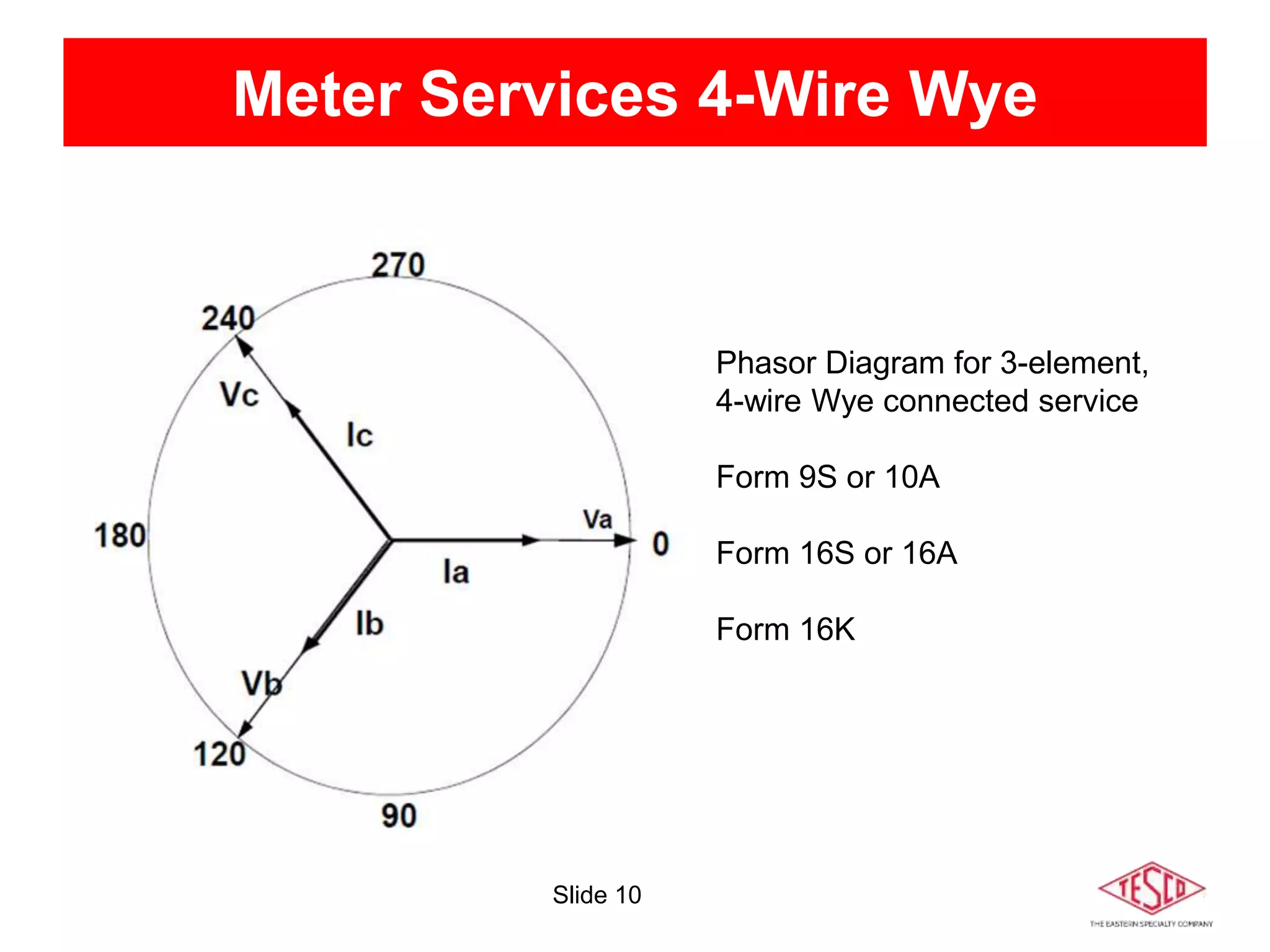
Meter Services 4-Wire Wye
Phasor Diagram for 3-element,
4-wire Wye connected service
Form 9S or 10A
Form 16S or 16A
Form 16K
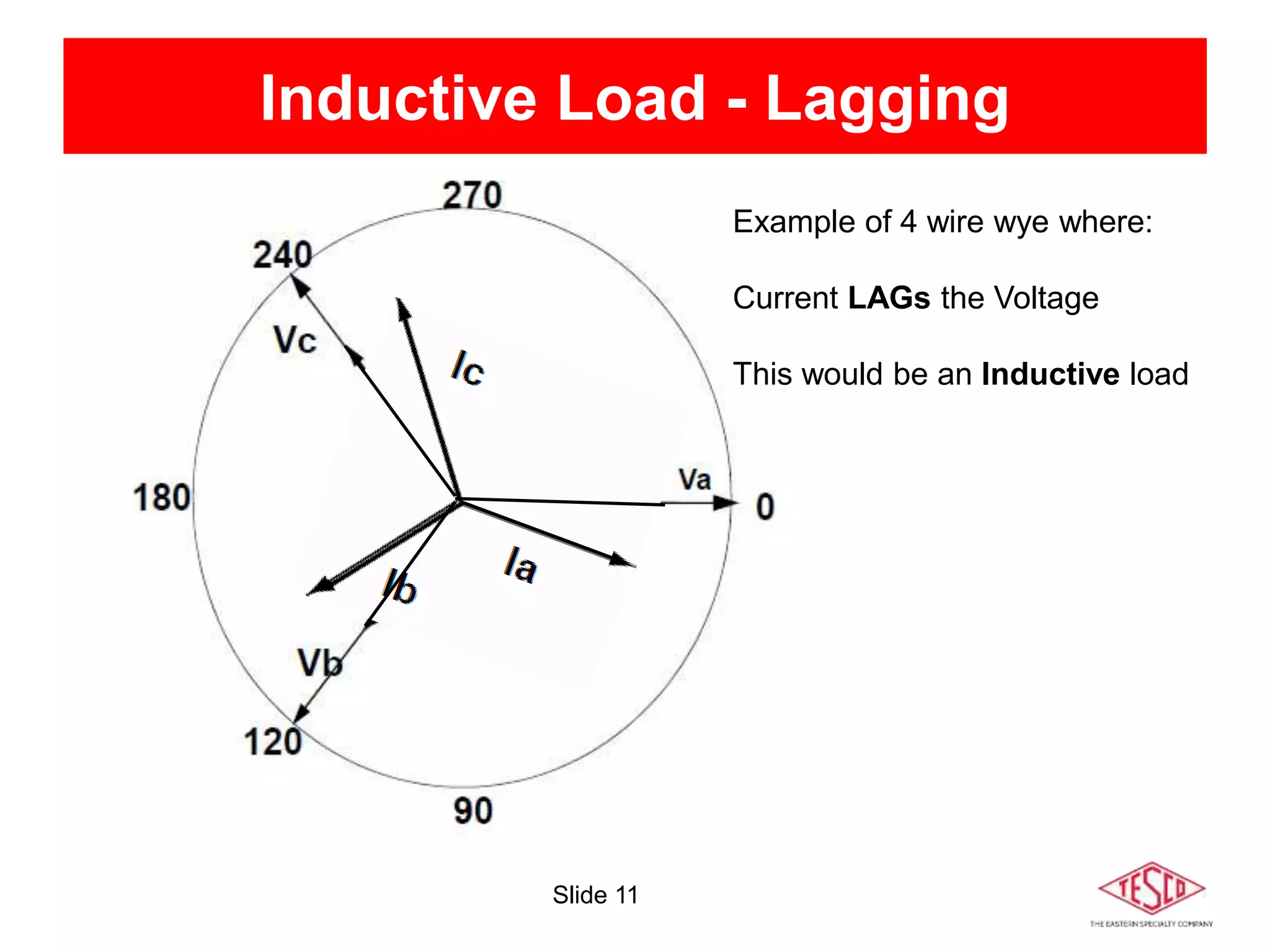
Slide 11
Example of 4 wire wye where:
Current LAGs the Voltage
This would be an Inductive load
Inductive Load - Lagging
Slide 12
Example of 4 wire wye where:
Current LEADS the Voltage
This would be an CAPACITIVE
load
Capacitive Load - Leading
Slide 13
Solid State Metering Technology
Two methods of developing KVA: Vectorial or Arithmetic
Arithmetic RMSRMSRMS IVVA 
Vectorial
i.e. TDM
VAR
VA
Watt
Slide 14
KVA 4 Wire ‘Y’ Unbalanced Loads
•For an unbalanced Polyphase load is VAV or VARMS correct?
•Both are correct, they just measure different quantities.
•Vector VA (VAV)
• Measures load characteristics, “Load Efficiency“
• An accurate indicator of load VA
• The end user controls the load and hence controls VAV
•Arithmetic VA (VARMS)
• Measures source characteristics, “Source Efficiency”
• An accurate indicator of the VA needed to supply the load
• The utility controls the source used to supply the load hence
VARMS
• VARMS ≥ VAV
Slide 15
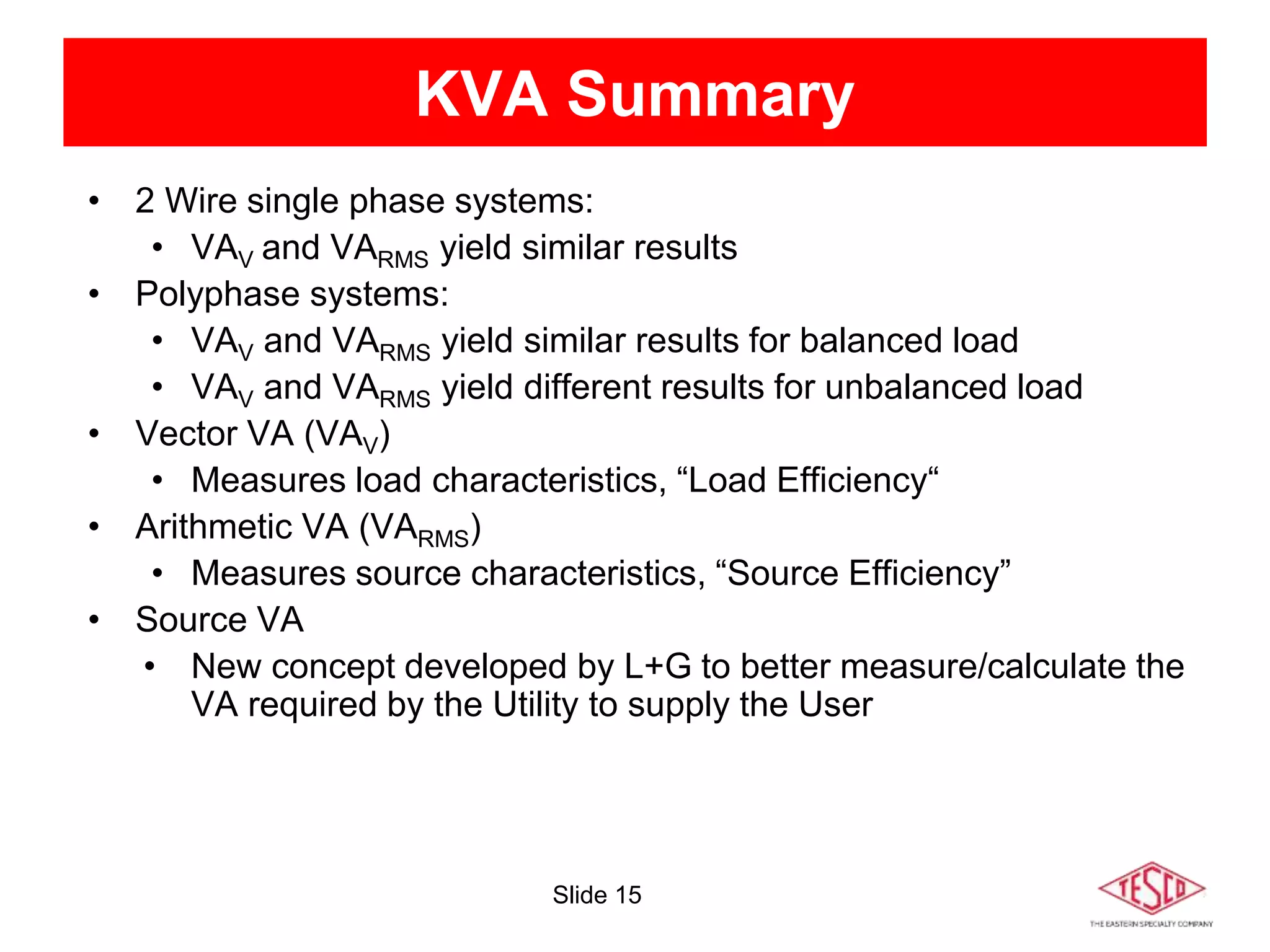
• 2 Wire single phase systems:
• VAV and VARMS yield similar results
• Polyphase systems:
• VAV and VARMS yield similar results for balanced load
• VAV and VARMS yield different results for unbalanced load
• Vector VA (VAV)
• Measures load characteristics, “Load Efficiency“
• Arithmetic VA (VARMS)
• Measures source characteristics, “Source Efficiency”
• Source VA
• New concept developed by L+G to better measure/calculate the
VA required by the Utility to supply the User
KVA Summary
Slide 16
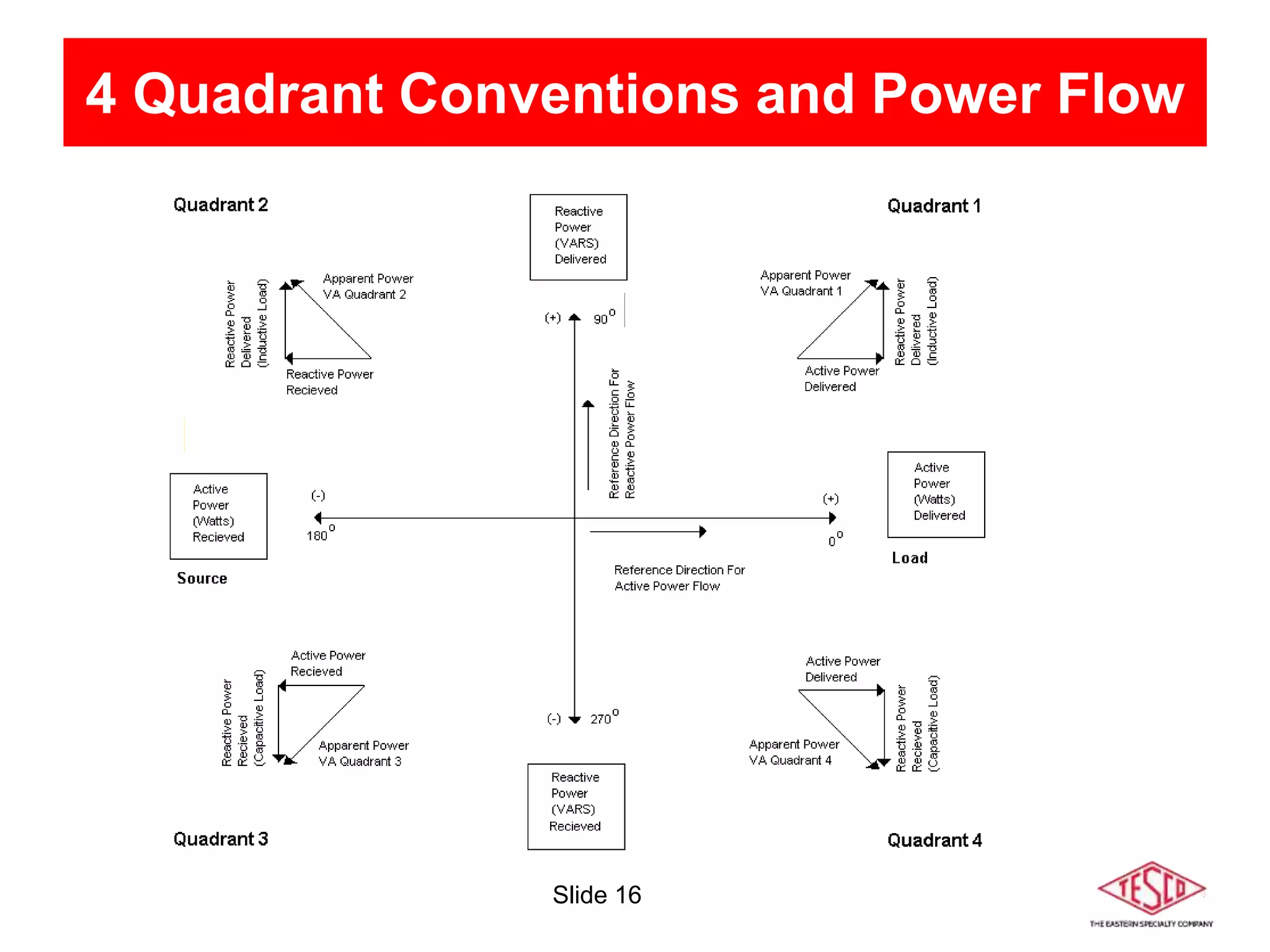
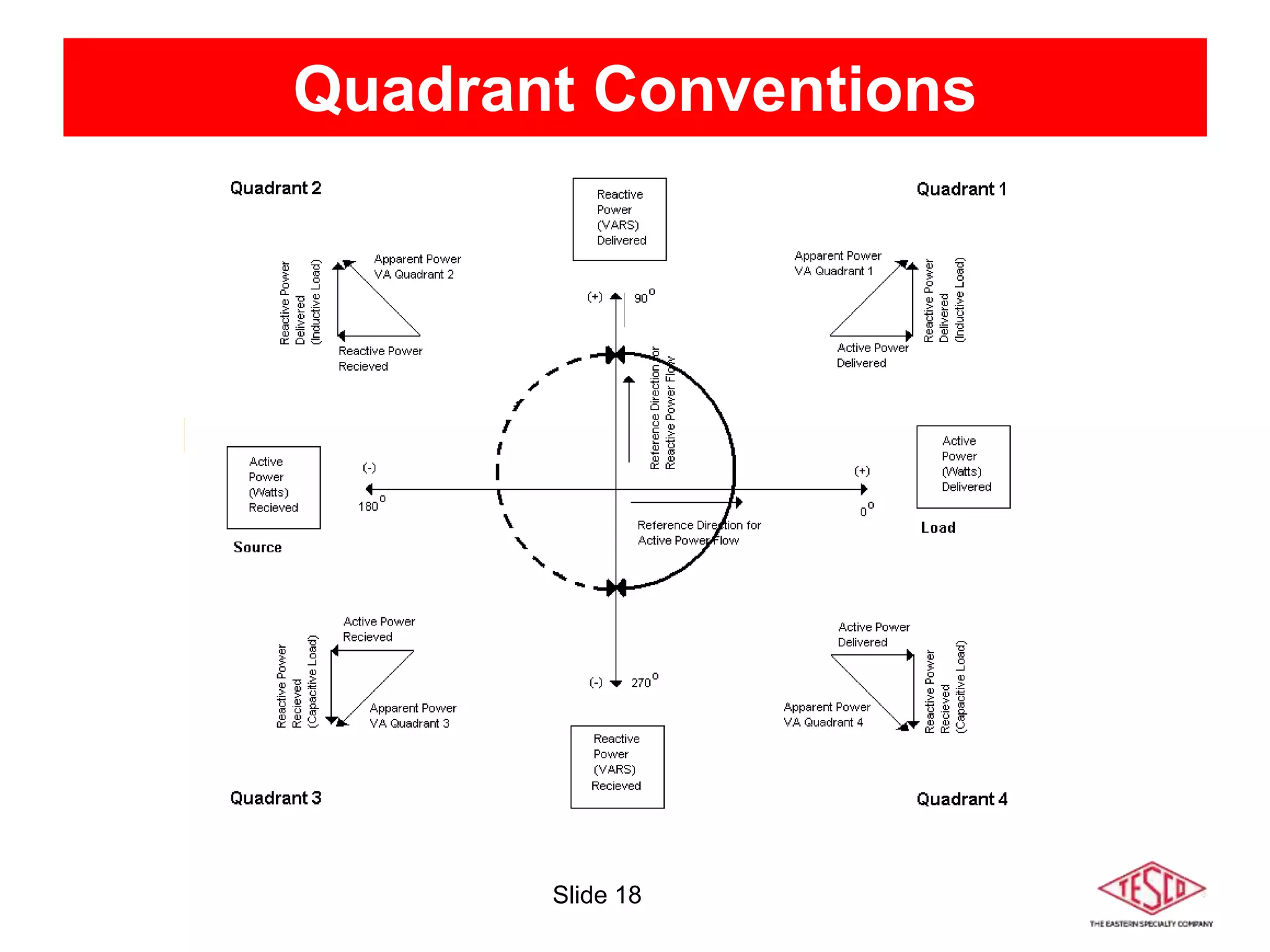
4 Quadrant Conventions and Power
Flow
4 Quadrant Conventions and Power Flow
Slide 17
Active Power (True Power): Watts
When the Active Power (Watts) flow from the “SOURCE” through the metering point and into the “LOAD” we say the Active
Power (Watts) are being DELIVERED. Therefore when the Active Power is being supplied by the “SOURCE” into the load it will
be referred to as Delivered Power (Watts) and has a positive sign. Standard billing determinant's would be Delivered
kW/kWh.
When the Active Power (Watts) flow from the “LOAD” through the metering point and into the “SOURCE” we say the Active
Power (Watts) are being RECEIVED. Therefore when the Active Power is being supplied by the “LOAD” into the source it will
be referred to as Received Power (Watts) and has a negative sign. Standard billing determinant's would be Received
kW/kWh.
Terms (Standard from the above illustration):
Delivered Kw/kWh (Q1 + Q4)
Received kW/kWh (Q2 + Q3)
Note: The Active Power is always on the x axis and does not fall into any of the four quadrants. Active power does not lead or
lag it is delivered or received.
KWH Power Flow (x) Axis
Slide 18
Quadrant Conventions
Slide 19
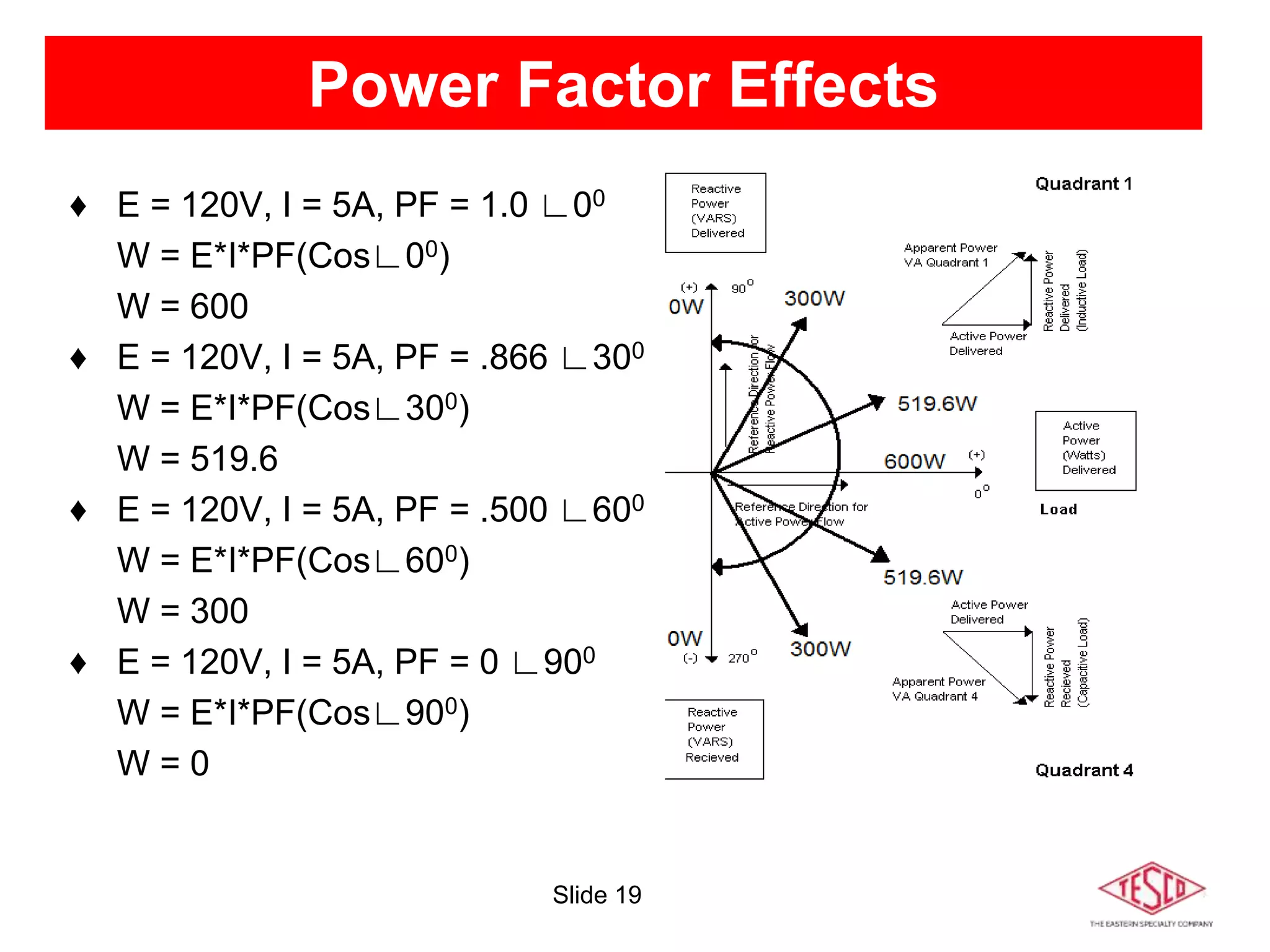
Power Factor Effects
♦ E = 120V, I = 5A, PF = 1.0 ∟00
W = E*I*PF(Cos∟00)
W = 600
♦ E = 120V, I = 5A, PF = .866 ∟300
W = E*I*PF(Cos∟300)
W = 519.6
♦ E = 120V, I = 5A, PF = .500 ∟600
W = E*I*PF(Cos∟600)
W = 300
♦ E = 120V, I = 5A, PF = 0 ∟900
W = E*I*PF(Cos∟900)
W = 0
Slide 20
KVARHKVARH Reactive Power: Vars
When the Reactive Power (Vars) flow from the “SOURCE” through
the metering point and into the “LOAD” we say the Reactive Power
(Vars) are being DELIVERED. Therefore when the Reactive Power
is being supplied by the “SOURCE” into the load it will be referred to
as Delivered Reactive Power (Vars) and have a positive sign.
When the Reactive Power (Vars) flow from the “LOAD” through the
metering point and into the “SOURCE” we say the Reactive Power
(Vars) are being RECEIVED. Therefore when the Reactive Power is
being supplied by the “LOAD” into the source it will be referred to as
Received Reactive Power (Vars) and have a negative sign.
Note: The Reactive Power is always on the y axis and does not fall
into any of the four quadrants. Reactive power does not lead or lag
it is delivered or received.
Terms (Standard from the above illustration):
Delivered Kvar/Kvarh (Q1 + Q2)
Received Kvar/Kvarh (Q3 + Q4)
KVARH Power Flow (Y Axis)
Slide 21
Quadrant Conventions
Slide 22
PF effect on KVARH Energy
22
Slide 23
Summary
Power Values (Kw/kwh, Kvar/Kvarh, and Kva/Kvah): The best
naming convention would be to stay with Delivered and
Received.
Leading and Lagging: Use these terms for describing the
relationship of current to voltage. Leading and Lagging is
normally viewed from the perspective of the supplier of active
energy.
Power Factor: Is the ratio between true and apparent power.
Power factor does not lead or lag and has no sign. Power factor
is normally viewed from the perspective of the supplier of active
energy.
Slide 2424
Reactive Power Delivered to
the Load
Active Power Delivered
from the Load
Active Power Delivered to
the Load
Reactive Power Received
from the Load
Lagging
Current
Leading
Current
Leading
Current
Lagging
Current
LOAD Delivered
Power
SOURCE
Received Power
Current Lead/Lag
Slide 25
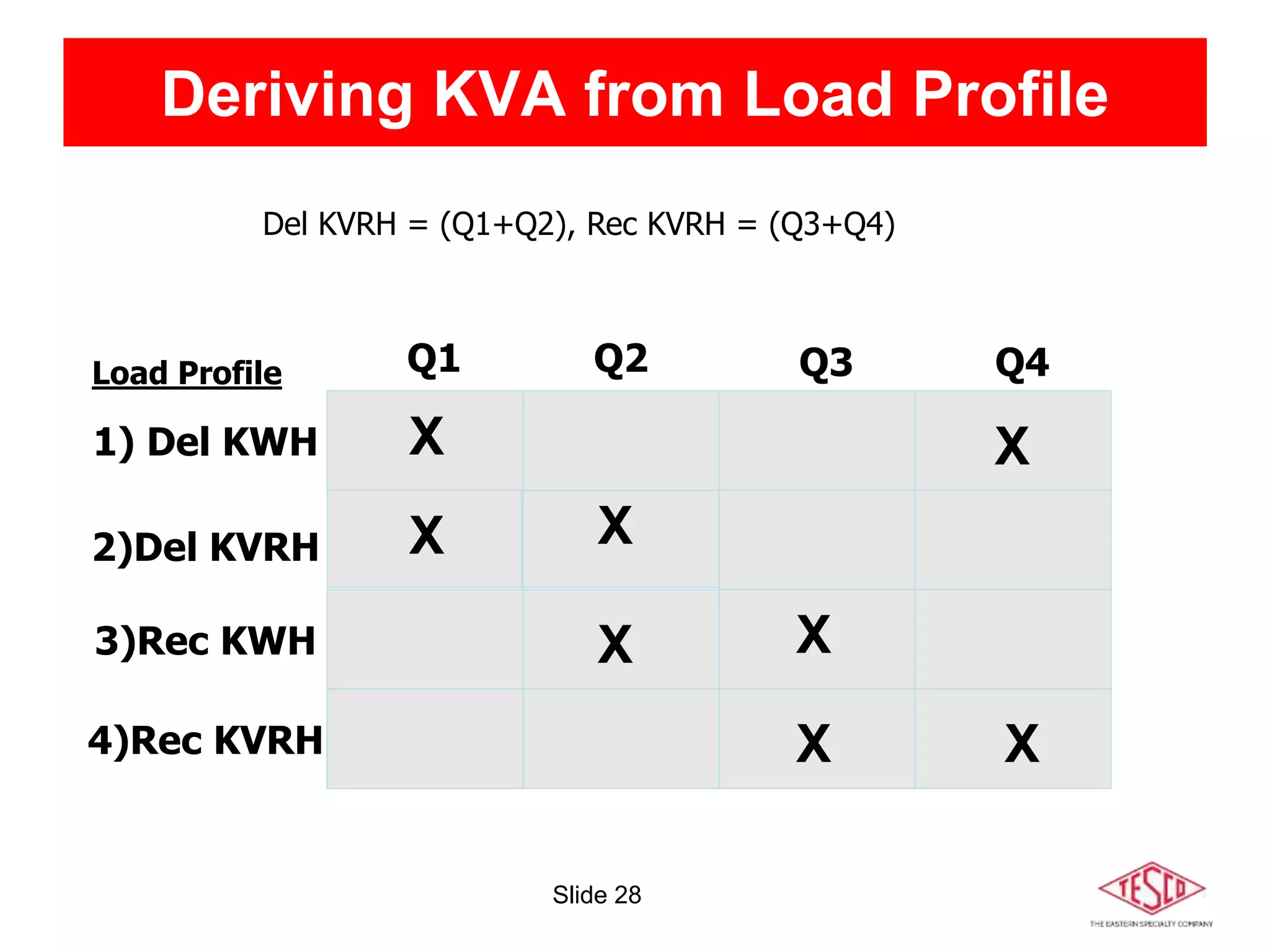
Deriving KVA from KWH and KVRH Data?
First BIG question, What does the Billing RATE require?
The meter can record Delivered and Received KWH
1) Delivered KWH
2) Received KWH
The meter can record all/any of the 4 KVRH quadrants individually
1) Quadrant 1 KVRH
2) Quadrant 2 KVRH
3) Quadrant 3 KVRH
4) Quadrant 4 KVRH
Or, the meter can “qualify” what quadrants make up Received and
Delivered KVRH definitions thru program definitions.
Slide 26
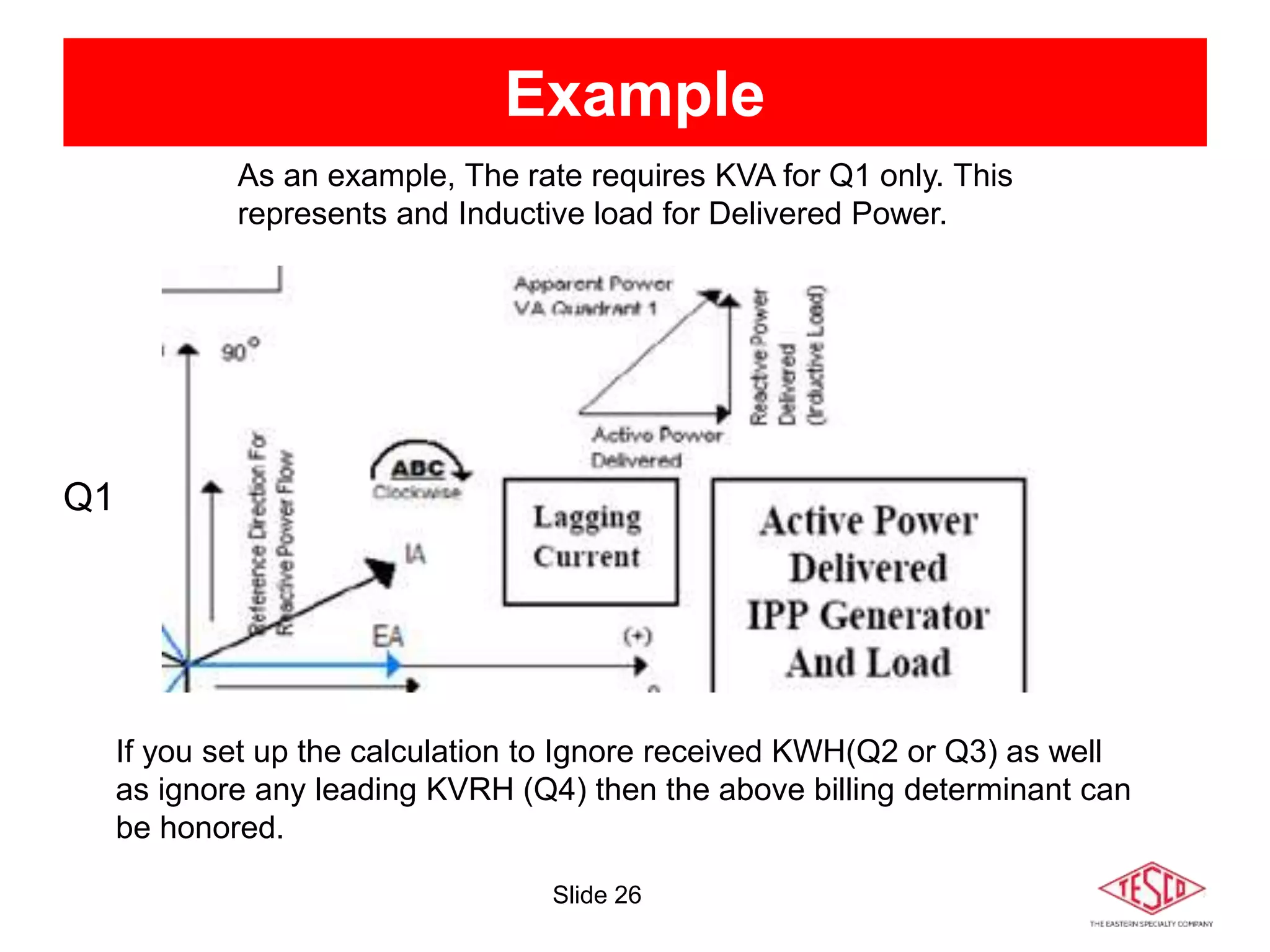
Example
As an example, The rate requires KVA for Q1 only. This
represents and Inductive load for Delivered Power.
If you set up the calculation to Ignore received KWH(Q2 or Q3) as well
as ignore any leading KVRH (Q4) then the above billing determinant can
be honored.
Q1
Slide 27
KVRH Terms and “Qualifications” of Concern
Program definitions for meter software needs to be understood. Most
programming software allows the user to make choices of how KVRH’s are
measured and utilized. Below are some of the terms and their meanings.
Delivered KVRH – usually a choice of (Q1+Q2) or (Q1+Q4)
Received KVRH – usually a choice of (Q3+Q4) or (Q2+Q3)
Leading – This refers to a Capacitive load, Q4 for Delivered, Q2 for Received
Lagging - This refers to a Inductive load, Q1 for Delivered, Q3 for Received
Ignore - This is usually a choice to ignore any leading KVRH
Add – This allows the leading and lagging KVRH to be added together.
Net – This choice will allow the lagging KVRH to be subtracted from leading KVRH
Slide 28
x
Q1 Q2 Q3 Q4
2)Del KVRH
1) Del KWH
3)Rec KWH
4)Rec KVRH
Load Profile
Del KVRH = (Q1+Q2), Rec KVRH = (Q3+Q4)
X
X
X
X
X
X
X
X
Deriving KVA from Load Profile
Slide 29
KVARH Loads are not going to get
better….
• Virtually every device we now use has a switching power supply.
NOTE: There is some talk of moving to DC only power and
metering for households as virtually everything we run in our house
could be powered through DC.
• Industrial controllers for manufacturing and HVAC are forcing us
away from a Unity PF. Everywhere we turn there is an increasing
difference between Apparent Power and Delivered Power. We
need to identify and quantify these “losses” and correct or meter
them appropriately.
Slide 30
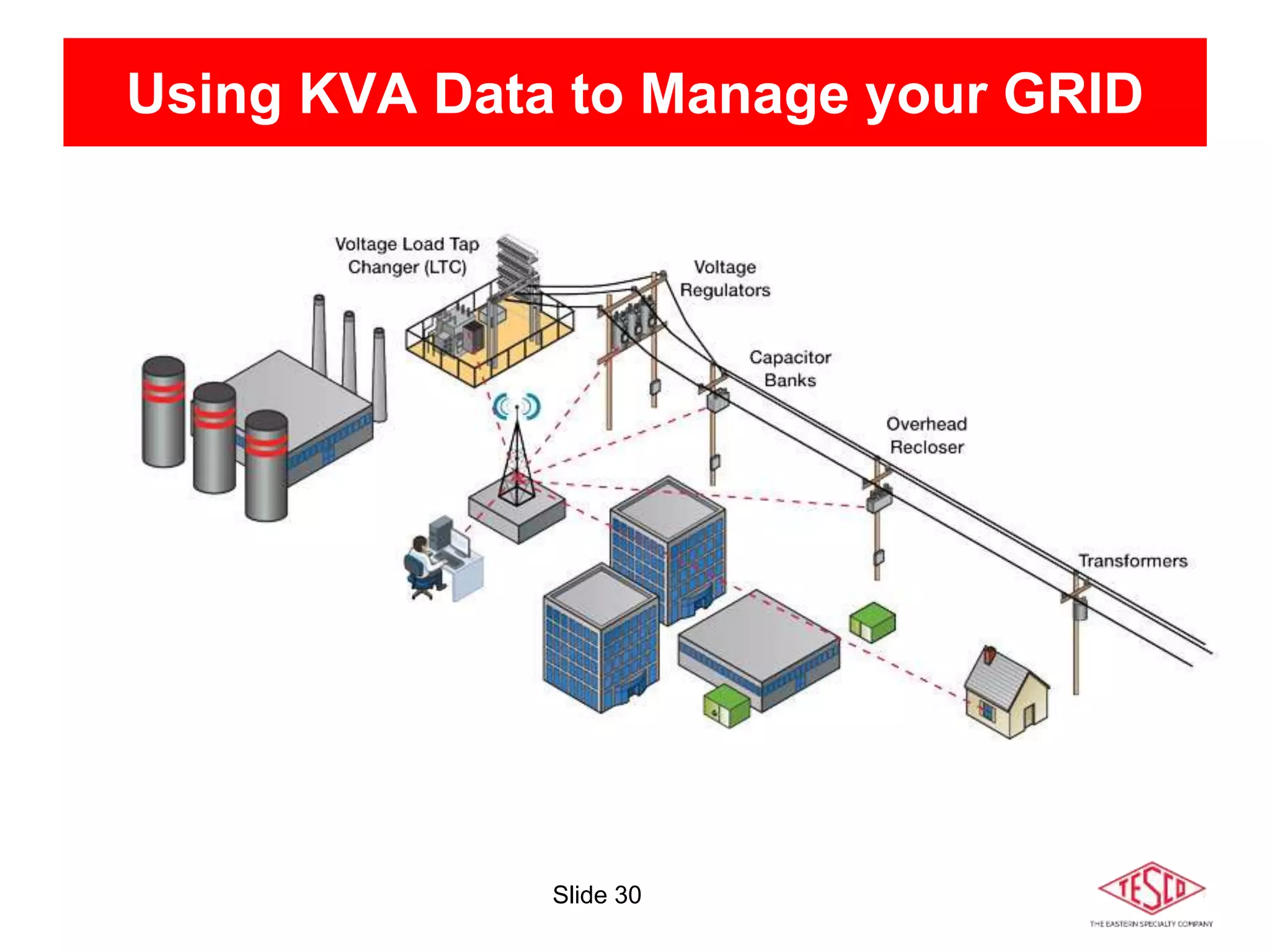
Using KVA Data to Manage your GRID
Slide 31
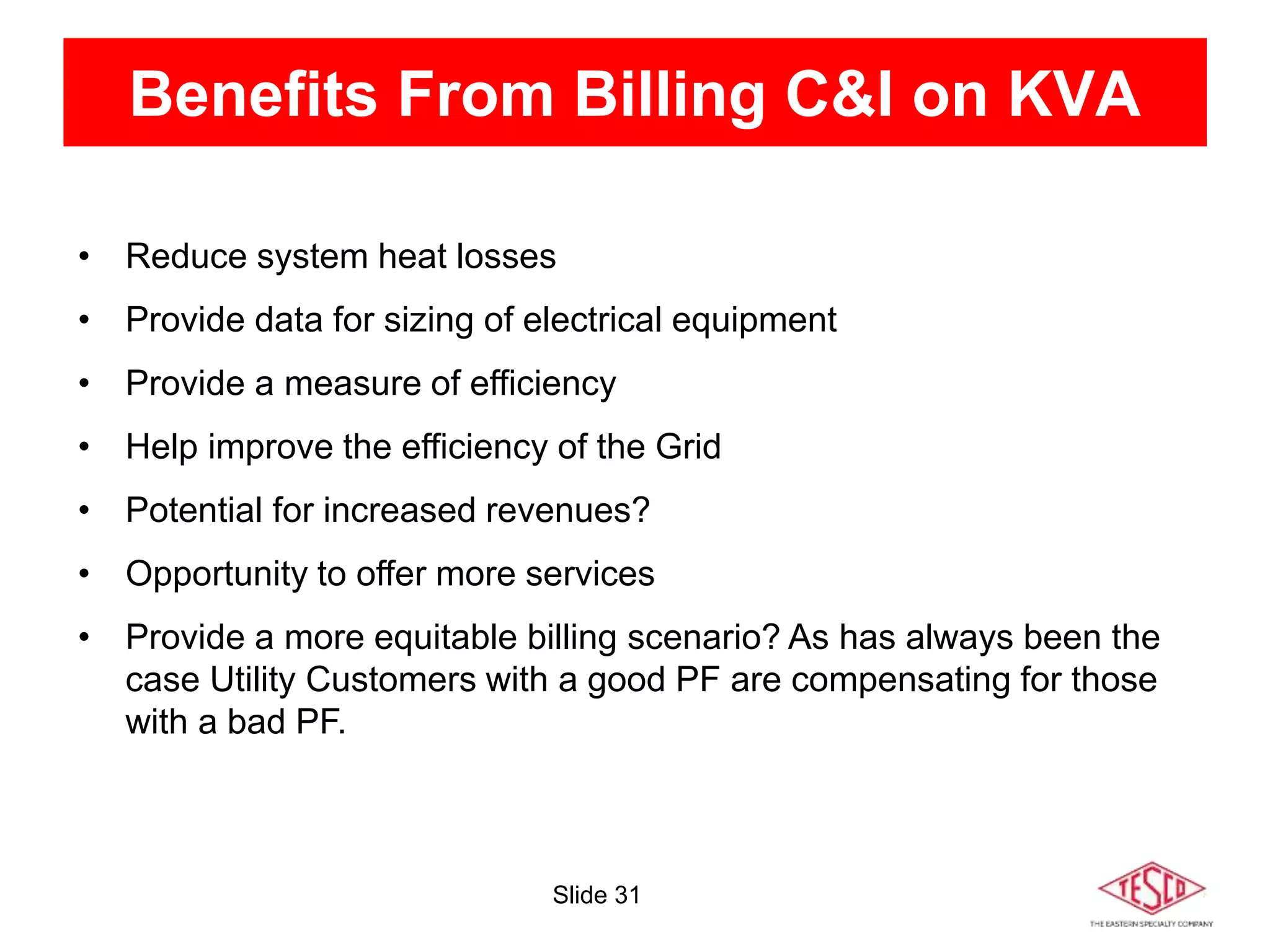
Benefits From Billing C&I on KVA
• Reduce system heat losses
• Provide data for sizing of electrical equipment
• Provide a measure of efficiency
• Help improve the efficiency of the Grid
• Potential for increased revenues?
• Opportunity to offer more services
• Provide a more equitable billing scenario? As has always been the
case Utility Customers with a good PF are compensating for those
with a bad PF.
Slide 32
• What does four Quadrant metering mean?
• When am I interested in four quadrant
metering?
• How is this information used if not for billing?
• How will I use this as a meter tech/engineer?
• Why will this be important in the future?
Concepts Covered
Slide 33
Questions and Discussion
Tom Lawton
tom.lawton@tescometering.com
TESCO – The Eastern Specialty Company
Bristol, PA
215-785-2338
This presentation can also be found under Meter Conferences
and Schools on the TESCO website:
www.tescometering.com

Four Quadrant Metering

  • 1.
    Slide 1 Click toedit Master title style Four Quadrant Metering Prepared by Tom Lawton, TESCO For Mississippi Meter School Thursday, October 24, 2019
  • 2.
    Slide 2 • Whatdoes four Quadrant metering mean? • When am I interested in four quadrant metering? • How is this information used if not for billing? • How will I use this as a meter tech/engineer? • Why will this be important in the future? Concepts to be Discussed
  • 3.
    Slide 3 Four QuadrantMetering Four quadrant metering can be used to understand individually or collectively; • Real Power consumed by the end user • Apparent Power delivered by the Utility • Real Power delivered to the utility by an end user’s generation source • Apparent Power generated by the end user’s generation source Having these measurements allows for the calculation of Reactive Power, VA and VARS as well as providing kWh for billing purposes.
  • 4.
    Slide 4 Power andEnergy There are 3 factors that make up what is called “Power and Energy”. - “Apparent” Power and Energy - “Real” Power and Energy - “Reactive” Power and Energy Real Power • The practical unit of active power which is defined as the rate at which energy is delivered to a circuit. Sometimes called Watts or Power. Also known as potential/available power. Apparent Power • The product of the volts and the total current which flows because of the voltage. Sometimes called volt-amperes Reactive Power • The out-of-phase component of the total volt-amperes in a circuit which includes inductive or capacitive reactance. Sometimes called reactive volt-amperes or vars.
  • 5.
    Slide 5 Real PowerWorking Power (Performs work) Measured in Watts Apparent Power Power supplied by the utility (The full effort) Measured in VA Reactive Power Magnetizing Power (Performs no work, imaginary) Measured in Vars VAR VA Watt 22 VARWVAV  Review of the Power Triangle Reactive Metering – Definitions
  • 6.
    Slide 6 Power factorof Beer….. Pour yourself a beer • The amount of beer we will call kW. You can drink the beer, therefore it is useful. • The amount of foam is kVAR. You can’t drink the foam, therefore it isn’t useful. • The total amount in the glass is kVA. You need a glass sized for both the beer and the foam. Look at the two examples on the left. • Good power factor, low foam or kVAR. • Bad power factor, high foam or KVAR.
  • 7.
    Slide 7 Energy Components •Voltage associated with Current produces Power applied over Time is Energy: Volts (V) X Amps (A) X Time (H) = Energy (VAH) • Volts (V) X Working Current (A) X Time (H) = Real Energy - kWh- Does Real Work, this is typically customer billing register. - 240v x 48 amps x 3 hours = 34.56 kilowatt hours (kWh) • Volts (V) X Total Current (A) X Time (H) = Apparent Energy - VAh - Supplied by Utilities. - 240v x 48 amps/0.95 PF x 3 hours = 36.38 VAh • Volts (V) X Reactive Current (A) X Time (H) = Reactive Energy - VARh - Magnetizing Energy, system loss. - 240v x 48 amps x .05 x 3 hours = 1.82 VARh - 36.38 kWh – 34.56 kWh = 1.82 VARh
  • 8.
    Slide 8 What isyour Power Factor? • Defined to be active power divided by apparent power • Watts divided by volt-amperes • KW/KVA (11.52 kW/12.13 kVA = .95 PF) • Measure of power system delivery/consumption efficiency So… Reactive Metering – Definitions
  • 9.
    Slide 9 Leading andLagging PF ♦ Power factors are usually stated as "leading" or "lagging" to show the sign of the phase angle. ♦ Capacitive loads are leading (current leads voltage) ♦ Inductive loads are lagging (current lags voltage).
  • 10.
    Slide 10 Meter Services4-Wire Wye Phasor Diagram for 3-element, 4-wire Wye connected service Form 9S or 10A Form 16S or 16A Form 16K
  • 11.
    Slide 11 Example of4 wire wye where: Current LAGs the Voltage This would be an Inductive load Inductive Load - Lagging
  • 12.
    Slide 12 Example of4 wire wye where: Current LEADS the Voltage This would be an CAPACITIVE load Capacitive Load - Leading
  • 13.
    Slide 13 Solid StateMetering Technology Two methods of developing KVA: Vectorial or Arithmetic Arithmetic RMSRMSRMS IVVA  Vectorial i.e. TDM VAR VA Watt
  • 14.
    Slide 14 KVA 4Wire ‘Y’ Unbalanced Loads •For an unbalanced Polyphase load is VAV or VARMS correct? •Both are correct, they just measure different quantities. •Vector VA (VAV) • Measures load characteristics, “Load Efficiency“ • An accurate indicator of load VA • The end user controls the load and hence controls VAV •Arithmetic VA (VARMS) • Measures source characteristics, “Source Efficiency” • An accurate indicator of the VA needed to supply the load • The utility controls the source used to supply the load hence VARMS • VARMS ≥ VAV
  • 15.
    Slide 15 • 2Wire single phase systems: • VAV and VARMS yield similar results • Polyphase systems: • VAV and VARMS yield similar results for balanced load • VAV and VARMS yield different results for unbalanced load • Vector VA (VAV) • Measures load characteristics, “Load Efficiency“ • Arithmetic VA (VARMS) • Measures source characteristics, “Source Efficiency” • Source VA • New concept developed by L+G to better measure/calculate the VA required by the Utility to supply the User KVA Summary
  • 16.
    Slide 16 4 QuadrantConventions and Power Flow 4 Quadrant Conventions and Power Flow
  • 17.
    Slide 17 Active Power(True Power): Watts When the Active Power (Watts) flow from the “SOURCE” through the metering point and into the “LOAD” we say the Active Power (Watts) are being DELIVERED. Therefore when the Active Power is being supplied by the “SOURCE” into the load it will be referred to as Delivered Power (Watts) and has a positive sign. Standard billing determinant's would be Delivered kW/kWh. When the Active Power (Watts) flow from the “LOAD” through the metering point and into the “SOURCE” we say the Active Power (Watts) are being RECEIVED. Therefore when the Active Power is being supplied by the “LOAD” into the source it will be referred to as Received Power (Watts) and has a negative sign. Standard billing determinant's would be Received kW/kWh. Terms (Standard from the above illustration): Delivered Kw/kWh (Q1 + Q4) Received kW/kWh (Q2 + Q3) Note: The Active Power is always on the x axis and does not fall into any of the four quadrants. Active power does not lead or lag it is delivered or received. KWH Power Flow (x) Axis
  • 18.
  • 19.
    Slide 19 Power FactorEffects ♦ E = 120V, I = 5A, PF = 1.0 ∟00 W = E*I*PF(Cos∟00) W = 600 ♦ E = 120V, I = 5A, PF = .866 ∟300 W = E*I*PF(Cos∟300) W = 519.6 ♦ E = 120V, I = 5A, PF = .500 ∟600 W = E*I*PF(Cos∟600) W = 300 ♦ E = 120V, I = 5A, PF = 0 ∟900 W = E*I*PF(Cos∟900) W = 0
  • 20.
    Slide 20 KVARHKVARH ReactivePower: Vars When the Reactive Power (Vars) flow from the “SOURCE” through the metering point and into the “LOAD” we say the Reactive Power (Vars) are being DELIVERED. Therefore when the Reactive Power is being supplied by the “SOURCE” into the load it will be referred to as Delivered Reactive Power (Vars) and have a positive sign. When the Reactive Power (Vars) flow from the “LOAD” through the metering point and into the “SOURCE” we say the Reactive Power (Vars) are being RECEIVED. Therefore when the Reactive Power is being supplied by the “LOAD” into the source it will be referred to as Received Reactive Power (Vars) and have a negative sign. Note: The Reactive Power is always on the y axis and does not fall into any of the four quadrants. Reactive power does not lead or lag it is delivered or received. Terms (Standard from the above illustration): Delivered Kvar/Kvarh (Q1 + Q2) Received Kvar/Kvarh (Q3 + Q4) KVARH Power Flow (Y Axis)
  • 21.
  • 22.
    Slide 22 PF effecton KVARH Energy 22
  • 23.
    Slide 23 Summary Power Values(Kw/kwh, Kvar/Kvarh, and Kva/Kvah): The best naming convention would be to stay with Delivered and Received. Leading and Lagging: Use these terms for describing the relationship of current to voltage. Leading and Lagging is normally viewed from the perspective of the supplier of active energy. Power Factor: Is the ratio between true and apparent power. Power factor does not lead or lag and has no sign. Power factor is normally viewed from the perspective of the supplier of active energy.
  • 24.
    Slide 2424 Reactive PowerDelivered to the Load Active Power Delivered from the Load Active Power Delivered to the Load Reactive Power Received from the Load Lagging Current Leading Current Leading Current Lagging Current LOAD Delivered Power SOURCE Received Power Current Lead/Lag
  • 25.
    Slide 25 Deriving KVAfrom KWH and KVRH Data? First BIG question, What does the Billing RATE require? The meter can record Delivered and Received KWH 1) Delivered KWH 2) Received KWH The meter can record all/any of the 4 KVRH quadrants individually 1) Quadrant 1 KVRH 2) Quadrant 2 KVRH 3) Quadrant 3 KVRH 4) Quadrant 4 KVRH Or, the meter can “qualify” what quadrants make up Received and Delivered KVRH definitions thru program definitions.
  • 26.
    Slide 26 Example As anexample, The rate requires KVA for Q1 only. This represents and Inductive load for Delivered Power. If you set up the calculation to Ignore received KWH(Q2 or Q3) as well as ignore any leading KVRH (Q4) then the above billing determinant can be honored. Q1
  • 27.
    Slide 27 KVRH Termsand “Qualifications” of Concern Program definitions for meter software needs to be understood. Most programming software allows the user to make choices of how KVRH’s are measured and utilized. Below are some of the terms and their meanings. Delivered KVRH – usually a choice of (Q1+Q2) or (Q1+Q4) Received KVRH – usually a choice of (Q3+Q4) or (Q2+Q3) Leading – This refers to a Capacitive load, Q4 for Delivered, Q2 for Received Lagging - This refers to a Inductive load, Q1 for Delivered, Q3 for Received Ignore - This is usually a choice to ignore any leading KVRH Add – This allows the leading and lagging KVRH to be added together. Net – This choice will allow the lagging KVRH to be subtracted from leading KVRH
  • 28.
    Slide 28 x Q1 Q2Q3 Q4 2)Del KVRH 1) Del KWH 3)Rec KWH 4)Rec KVRH Load Profile Del KVRH = (Q1+Q2), Rec KVRH = (Q3+Q4) X X X X X X X X Deriving KVA from Load Profile
  • 29.
    Slide 29 KVARH Loadsare not going to get better…. • Virtually every device we now use has a switching power supply. NOTE: There is some talk of moving to DC only power and metering for households as virtually everything we run in our house could be powered through DC. • Industrial controllers for manufacturing and HVAC are forcing us away from a Unity PF. Everywhere we turn there is an increasing difference between Apparent Power and Delivered Power. We need to identify and quantify these “losses” and correct or meter them appropriately.
  • 30.
    Slide 30 Using KVAData to Manage your GRID
  • 31.
    Slide 31 Benefits FromBilling C&I on KVA • Reduce system heat losses • Provide data for sizing of electrical equipment • Provide a measure of efficiency • Help improve the efficiency of the Grid • Potential for increased revenues? • Opportunity to offer more services • Provide a more equitable billing scenario? As has always been the case Utility Customers with a good PF are compensating for those with a bad PF.
  • 32.
    Slide 32 • Whatdoes four Quadrant metering mean? • When am I interested in four quadrant metering? • How is this information used if not for billing? • How will I use this as a meter tech/engineer? • Why will this be important in the future? Concepts Covered
  • 33.
    Slide 33 Questions andDiscussion Tom Lawton tom.lawton@tescometering.com TESCO – The Eastern Specialty Company Bristol, PA 215-785-2338 This presentation can also be found under Meter Conferences and Schools on the TESCO website: www.tescometering.com