International Research Journal of Engineering and Technology (IRJET) e-ISSN: 2395-0056
Volume: 04 Issue: 08 | Aug -2017 www.irjet.net p-ISSN: 2395-0072
© 2017, IRJET | Impact Factor value: 5.181 | ISO 9001:2008 Certified Journal | Page 1760
EXPERIMENTAL AND ANLYTICAL BEHAVIOR OF REINFORCED
CONCRETE BEAMS WITH OPENING USING FOUNDRY SAND
M.V.Nirmala1, Pandian Jayalakshmi2,Naveen Kumar.B.M3
1,2 Student, Dept. of CIVIL Engineering, SVCE Bengaluru, Karnataka,India.
3Assistant Professor, Dept of Civil Engineering, SVCE Bengaluru, Karnataka,India.
---------------------------------------------------------------------***---------------------------------------------------------------------
Abstract - There are number of ferrous and non ferrous steel
casting industries around the world from which hundred
million ton of foundry sand has produced in which40%isused
for land filling. Foundry sand is a byproduct of metal casting
fields. The research had been carried out in the concrete field
by the incorporation of the foundry as a component in the
concrete.
This experimental investigation has performed to utilize the
foundry sand as fine aggregate in the concrete of M30 grade.
This experiment is carried out with different mixes i.e., the
replacement of the foundry sand is replaced with 0%-100% in
the interval of 10%. Using these mixes the optimization is
carried out. The cubes are casted with these mixes and the
compressive strength is carried out for 28 days. For the mix
with 40% of the replacement of the foundry sand obtainedthe
maximum strength. The beams of the dimension 230mm x
150mm x 2000mm of 6 in number are casted with the
optimized percentage of foundry sand. In this experiment the
beams are casted with rounded rectangular opening. The
beams are tested in the loading frame under two point
loading. The test results showed appropriate increase in the
strength with the use of the foundry sand as fine aggregates.
Key Words: Foundry sand, steel castings, compressive
strength, flexural behavior.
1.INTRODUCTION
The versatility,sustainability,durability, economyproperties
of concrete has made concrete the world’s most widely used
construction material. Due to the several advantages of the
concrete over the past few decades the demand for the
concrete has been increasing drastically as the growth in
infrastructure development is growing rapidly.
Concrete is a composite material composed of cement,
aggregates, water and several admixtures. Here the river
sand is one of the most important ingredients in the
production of concrete which is used as fine aggregate. Due
to the massive production of concrete the massive use of
river sand has went up. Due to which there is environmental
hazards like increasing in the depth of the river bed,
lowering of the water table and the intrusion of salinity into
the rivers.
There is restriction in the extraction of sand from the river
that has lead to the increase in the price of sand and has
several terms affected the stability of the construction
industry. Keeping all theseconsequencesinconsiderationan
alternative materials are found to be used in the place of
river sand.
An industry will have to face some of the circumstances and
to overcome the industrial challenges. One of the major
challenges with the environment awareness is land filling of
the byproducts/wastes. An alternative to dispose the waste
is the utilization of the waste. Introducing the concept of
using industrial byproducts such as foundry sand, fly ash,
ground granulated blast furnace, slag can results in
significant improvements in all industriesandimprovement
in environmental performances.
In the construction of the multifacility,modernbuildings the
network of pipes, ducts are necessary to accommodate the
essential facilities, services like sewage, water supply, air
conditioning, electricity, computer networks, telephone.
Generally all these connections will be beneath beam soffit
for the aesthetic reason, but in critical conditions the
provision of transverse opening in floor beams to facilitate
the passage of utility pipes and ducts, hence to investigate
the behavior of beams with openings and with the partial
replacement of foundry sand for fine aggregates, this
experiment is carried out.
Foundry sand is high quality sand with uniform physical
characteristics. It is a byproduct of ferrous and non ferrous
metal casting industries. Foundries can be recycled and
reused. When the sand can no longer be reused it is called as
foundry sand. Using the foundry sand as fine aggregates
instead of land filling. The volume of waste sand going to
landfill can be reduced.
The raw sand is normally of a higher quality than that of the
natural sand or typical bank run used in fill construction
sites. The sands form the outer shape of the mold cavity.
These sands normally rely upon a small amountofbentonite
clay to act as the binder material. Chemical binders are also
used to create sand “cores”. Dependinguponthegeometryof
the casting, sands cores are inserted into the mouldcavityto
form internal passages for the molten metal. Once the metal
has solidified, the casting is separated from the molding and
core sands in the shakeout process. In the casting process,
International Research Journal of Engineering and Technology (IRJET) e-ISSN: 2395-0056
Volume: 04 Issue: 08 | Aug -2017 www.irjet.net p-ISSN: 2395-0072
© 2017, IRJET | Impact Factor value: 5.181 | ISO 9001:2008 Certified Journal | Page 1761
molding sands are recycled and reused multiple times.
Eventually, the recycled sand degrades to the point that it
can no longer be reused in the casing process. At that point,
the old sand is displaced from the cycle as byproduct, new
sand is introduced, and the old sand is displaced from the
cycle as byproduct, new sand is introduced, and the cycle
begins again.
2. OBJECTIVE
The main objective of this experimental work is the
utilization of the waste foundry sand as fine aggregate
1. To study the behavior of concrete in flexure with the
foundry sand as the fine aggregates for M30 grade concrete.
2. To study the behavior of the beams with rounded
rectangular opening with fine aggregates as foundry sand.
3. To study the compressive strength, flexural strength of
concrete for 7 and 28 days with partial replacement of
foundry sand.
4. To investigate the strength of the replaced concrete with
that of the conventional concrete.
5. To study the beam with opening by replacement of fine
aggregate compared withthatoftheconventional beamwith
opening.
3. METHODOLOGY
Material and Testing
The materials used for the concrete are selected from the
concrete industry. The materials used in the concrete are
fine aggregates, coarse aggregates, cement, water, mineral
admixture (foundry sand), chemical admixtures (super
plasticizer - BASF 8333).
A). FOUNDRY SAND
The sample foundry sand is collected from Emerald steel
works, Bengaluru. The foundry sand is categorized as a fine
aggregate in concrete study and also the manufacturedsand
is used in the concrete to study its behavior.
Taking the cement content 340kg/m3, these materials are
used with the foundry sand in different percentages as 10%,
20%, 30%, 40%, 50%,60%, 70%, 80%, 90%, 100%. The mix
proportion is obtained from the characterization of all the
materials.
As the preliminary stage certain tests are conducted on the
materials used in concrete as per the guidelines of Indian
Standard (IS). The tests on materials were conducted as
follows, specific gravity of cement, fine aggregates, coarse
aggregates, and the water absorption test forfineandcoarse
aggregate. The normal consistencyofcement,initial andfinal
setting time of cement. The test on concrete were conducted
as follows, compressive strength.
Table -1: Physical properties of foundry sand
Sl No Property Results Sl No
1. Specific Gravity 2.45 1.
2. Water absorption, % 0.46 2.
3. Bulk density, Kg/m3 2582 3.
4. Fineness modulus % 3.9 4.
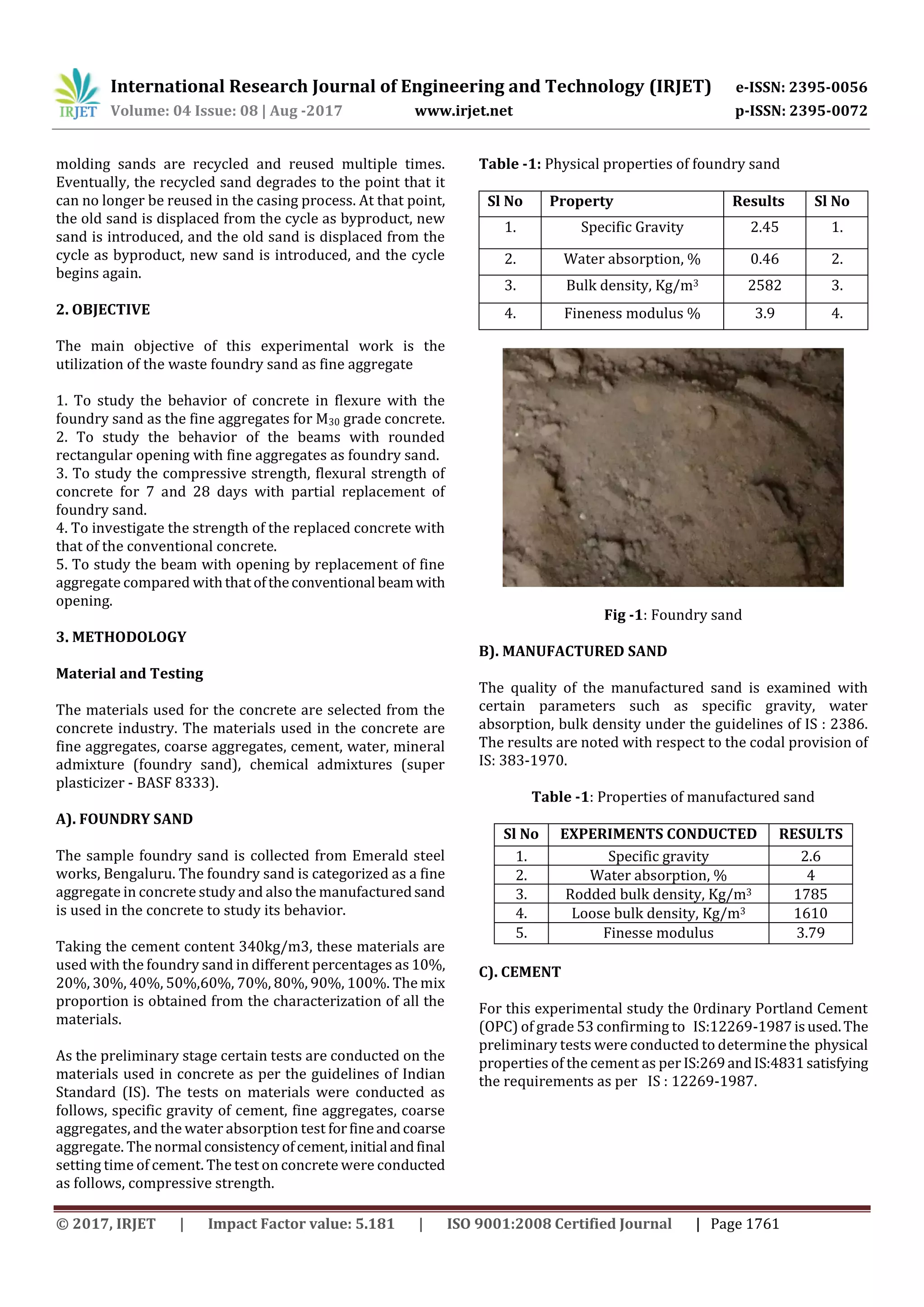
Fig -1: Foundry sand
B). MANUFACTURED SAND
The quality of the manufactured sand is examined with
certain parameters such as specific gravity, water
absorption, bulk density under the guidelines of IS : 2386.
The results are noted with respect to the codal provision of
IS: 383-1970.
Table -1: Properties of manufactured sand
Sl No EXPERIMENTS CONDUCTED RESULTS
1. Specific gravity 2.6
2. Water absorption, % 4
3. Rodded bulk density, Kg/m3 1785
4. Loose bulk density, Kg/m3 1610
5. Finesse modulus 3.79
C). CEMENT
For this experimental study the 0rdinary Portland Cement
(OPC) of grade 53 confirming to IS:12269-1987isused.The
preliminary tests were conducted to determinethe physical
properties of the cement as per IS:269andIS:4831satisfying
the requirements as per IS : 12269-1987.
International Research Journal of Engineering and Technology (IRJET) e-ISSN: 2395-0056
Volume: 04 Issue: 08 | Aug -2017 www.irjet.net p-ISSN: 2395-0072
© 2017, IRJET | Impact Factor value: 5.181 | ISO 9001:2008 Certified Journal | Page 1762
Table -2: Properties of Cement
Sl
No
DESCRIPTION RESULTS
ATTAINED
NECESSITIES
AS PER
IS:12269-2013
1. Standard
uniformity(%)
29% -
2. Initial setting
time
210 min 30 min
3. Final setting
time
315 min 600 min
4. Fineness,
Kg/m2
280 Min 225
4. MIX DESIGN
Under the guidelines of IS: 10262-2009 considering the
cement content of 340 Kg/m3. Based on this the different
properties are considered for the mix proportioning. The
presented mix design is for M30 grade utilizing the fine
aggregates as foundry sand with the different percentages.
Table -3: Design mix for FA manufactured sand, Cement
content 340 Kg/m3
MATERIA
LS
BATCH
MIX
‘Kg/m3
’
AFTER
WATER
CORRECTI
-ON
SPECIF
I-C
GRAVI
T-Y
Batch
quantity
for
0.035m3
Cement 340 340 3.15 11.9 kg
FA foundry
sand
382 380.28 2.6 13.4 kg
Manufactu
red sand
573 570.42 2.66 20.1 kg
CA - 20mm 751.2 748.2 2.57 26.3 kg
Water 166 - 1.0 17.53 kg
Admixture 2 % - 1.08 0.3 lt
Table -4: Design mix for FA manufactured sand, Cement
content 340 Kg/m3
MATERIA-
LS
BATCH
MIX
‘Kg/m3’
AFTER
WATER
CORREC
TION
SPECIF
IC
GRAVI
TY
BATCH
QUANT-
ITY
Cement 340 340 3.15 11.9 kg
FA 955 950.7 2.66 33.4 kg
CA - 20mm 751.2 748.2 2.57 26.3 kg
CA-
12.5mm
500.8 498.8 2.57 17.53 kg
Water 166 - 1.0 5.82 lt
Admixture 2 % - 1.08 0.3 lt
5. EXPERIMENTAL METHODOLOGY
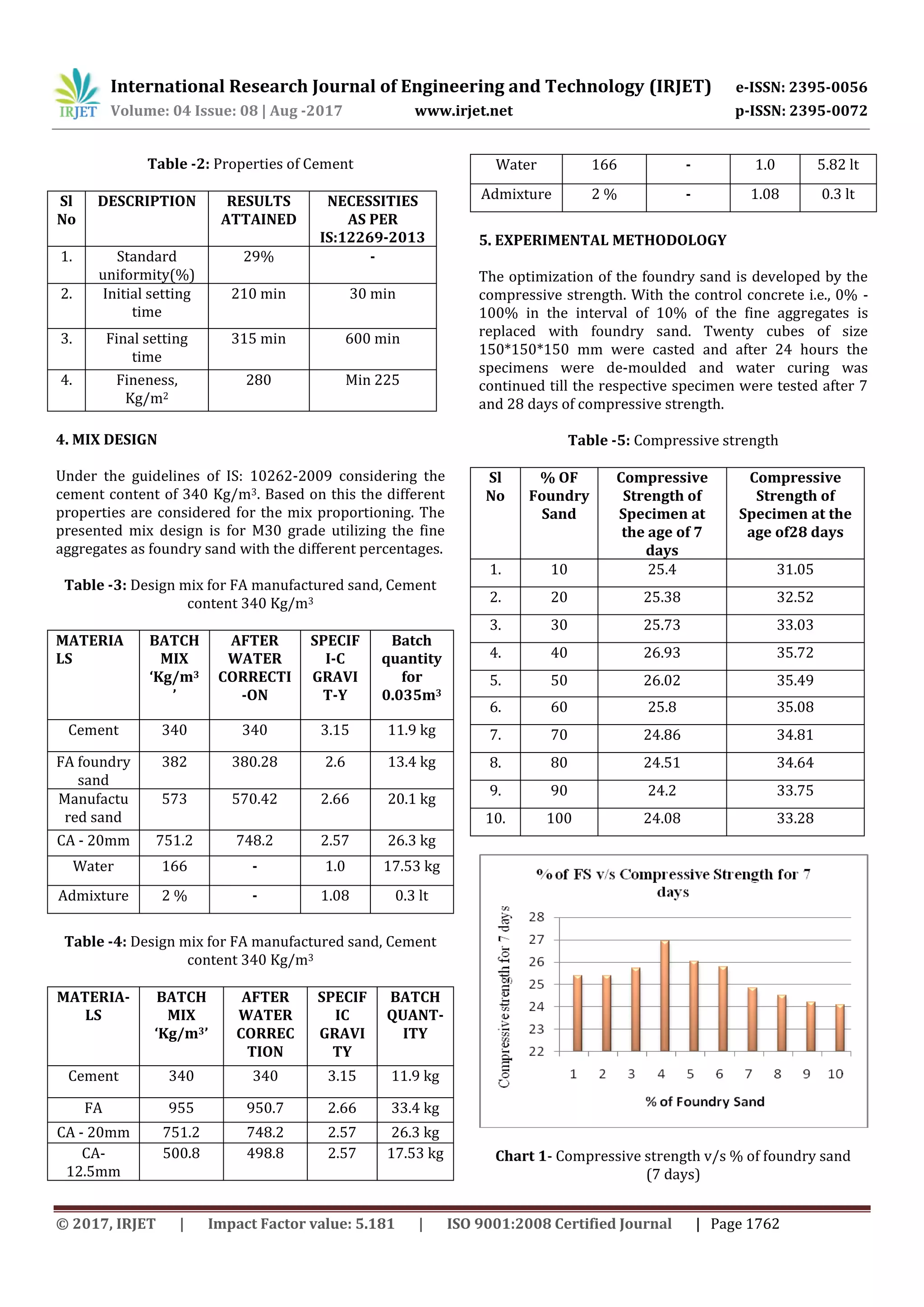
The optimization of the foundry sand is developed by the
compressive strength. With the control concrete i.e., 0% -
100% in the interval of 10% of the fine aggregates is
replaced with foundry sand. Twenty cubes of size
150*150*150 mm were casted and after 24 hours the
specimens were de-moulded and water curing was
continued till the respective specimen were tested after 7
and 28 days of compressive strength.
Table -5: Compressive strength
Sl
No
% OF
Foundry
Sand
Compressive
Strength of
Specimen at
the age of 7
days
Compressive
Strength of
Specimen at the
age of28 days
1. 10 25.4 31.05
2. 20 25.38 32.52
3. 30 25.73 33.03
4. 40 26.93 35.72
5. 50 26.02 35.49
6. 60 25.8 35.08
7. 70 24.86 34.81
8. 80 24.51 34.64
9. 90 24.2 33.75
10. 100 24.08 33.28
Chart 1- Compressive strength v/s % of foundry sand
(7 days)
International Research Journal of Engineering and Technology (IRJET) e-ISSN: 2395-0056
Volume: 04 Issue: 08 | Aug -2017 www.irjet.net p-ISSN: 2395-0072
© 2017, IRJET | Impact Factor value: 5.181 | ISO 9001:2008 Certified Journal | Page 1763
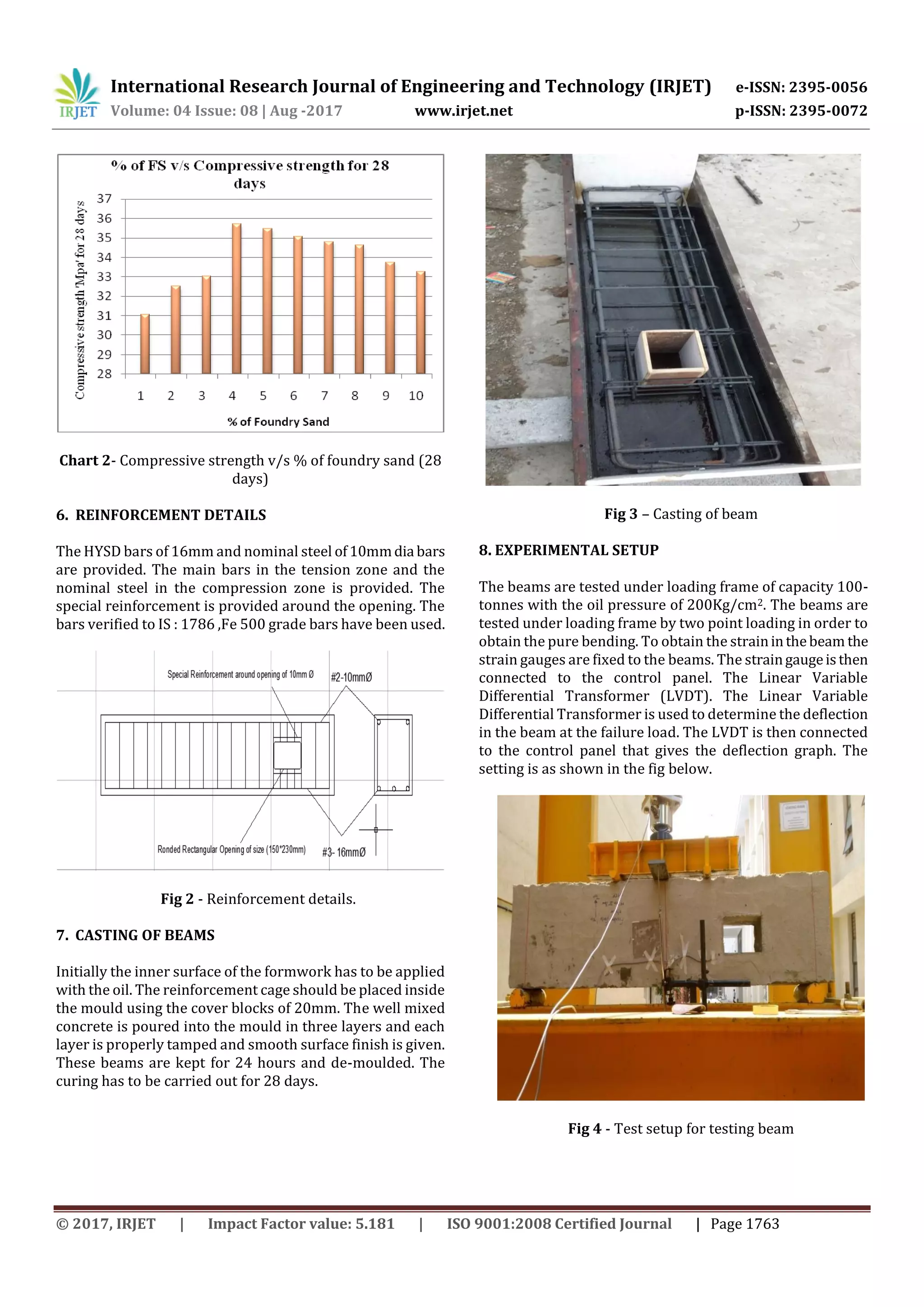
Chart 2- Compressive strength v/s % of foundry sand (28
days)
6. REINFORCEMENT DETAILS
The HYSD bars of 16mm and nominal steel of10mmdia bars
are provided. The main bars in the tension zone and the
nominal steel in the compression zone is provided. The
special reinforcement is provided around the opening. The
bars verified to IS : 1786 ,Fe 500 grade bars have been used.
Fig 2 - Reinforcement details.
7. CASTING OF BEAMS
Initially the inner surface of the formwork has to be applied
with the oil. The reinforcement cage should be placed inside
the mould using the cover blocks of 20mm. The well mixed
concrete is poured into the mould in three layers and each
layer is properly tamped and smooth surface finish is given.
These beams are kept for 24 hours and de-moulded. The
curing has to be carried out for 28 days.
Fig 3 – Casting of beam
8. EXPERIMENTAL SETUP
The beams are tested under loading frame of capacity 100-
tonnes with the oil pressure of 200Kg/cm2. The beams are
tested under loading frame by two point loading in order to
obtain the pure bending. To obtain the straininthebeam the
strain gauges are fixed to the beams. The straingaugeisthen
connected to the control panel. The Linear Variable
Differential Transformer (LVDT). The Linear Variable
Differential Transformer is used to determine the deflection
in the beam at the failure load. The LVDT is then connected
to the control panel that gives the deflection graph. The
setting is as shown in the fig below.
Fig 4 - Test setup for testing beam
International Research Journal of Engineering and Technology (IRJET) e-ISSN: 2395-0056
Volume: 04 Issue: 08 | Aug -2017 www.irjet.net p-ISSN: 2395-0072
© 2017, IRJET | Impact Factor value: 5.181 | ISO 9001:2008 Certified Journal | Page 1764
Fig 5 - The failure of beam after the test
Chart 3- Load v/s Deflection with replacement
Chart 4- Load v/s Deflection with replacement
9. CONCLUSION
From the experimental resultsobtainedfromthiswork on
the beams of M30 grade the subsequent conclusion were
established.
1. The optimized value of foundry sand obtained as 40%
for 28 days of compressive strength. The compressive
strength obtained was in and around to the conventional
concrete.
2. The compressive strength gradually increased with the
addition of the foundry sand.
3. From the compressive strengthresults,thereplacementof
foundry sand material gives highest strength for 40%.
4. The use of the foundry sand used in concrete in other
word is known as green sand obtained from steel industries
reduces the landfilling and hazardous effects on nature.
REFERENCES
[1] “Replacement of fine aggregates with in concrete” by
Deepak Chaurasiya, Kiran Koli, Suraj Chaudhari –
International Journal on Theoretical and Applied
Research in mechanical Engineering. Volume 5, Issue 1,
February 2016.
[2] “Flexural behavior of RC beams using as partial
replacement of fine aggregates” by Umashankar A,
Shashikumar A. International Journal of Research in
Engineering and Technology. Volume 5, Issue 8, August
2016.
[3] “Effects of as a fine aggregate in concrete production”
entitled by G.GaneshPrabhu, JungHwanHyun, YunYong
Kim - Science Direct, September 2014.
[4] “Effect of on the mechanical properties of concrete” by
Rafat Siddique, Geert de Schutter – Science Direct.
[5] Gurpreet Singh, Rafat Siddique as “Effect of waste as
partial replacement of sand on the strength,ultrasonic
pulse velocity and permeability of concrete” – Science
Direct.
[6] “Waste foundry sand as a replacementforfineaggregate
in high strength solid masonary blocks”, by Mahima
Ganeshan, Dr.Sreevidya V. International Journal of
InnovativeResearchinScience,EngineeringTechnology.
[7] “Flexure behavior of reinforced concrete beams with
opening” by Saeed Ahmed Sheikh, Concrete Research,
Volume 5(2), June 2014.
[8] “Flexure behavior of reinforced concrete beams with
opening” by Saeed Ahmed Sheikh, Concrete Research,
Volume 5(2), June 2014.
International Research Journal of Engineering and Technology (IRJET) e-ISSN: 2395-0056
Volume: 04 Issue: 08 | Aug -2017 www.irjet.net p-ISSN: 2395-0072
© 2017, IRJET | Impact Factor value: 5.181 | ISO 9001:2008 Certified Journal | Page 1765
BIOGRAPHIES
M.V.Nirmala : Persuing her M-
Tech studies at department of
Structural Engineering, SVCE,
Bengaluru. Her research area
includes experimental and
anlytical behavior of reinforced
concrete beams with opening
using foundry sand.
Pandian Jayalakshmi:Persuingher
M-Tech studies at department of
Structural Engineering, SVCE,
Bengaluru.
Naveen Kumar.B.M. : Assistant
Professor at department of civil
engineering,SVCE,Bengaluru

Experimental and Anlytical Behavior of Reinforced Concrete Beams with Opening using Foundry Sand

  • 1.
    International Research Journalof Engineering and Technology (IRJET) e-ISSN: 2395-0056 Volume: 04 Issue: 08 | Aug -2017 www.irjet.net p-ISSN: 2395-0072 © 2017, IRJET | Impact Factor value: 5.181 | ISO 9001:2008 Certified Journal | Page 1760 EXPERIMENTAL AND ANLYTICAL BEHAVIOR OF REINFORCED CONCRETE BEAMS WITH OPENING USING FOUNDRY SAND M.V.Nirmala1, Pandian Jayalakshmi2,Naveen Kumar.B.M3 1,2 Student, Dept. of CIVIL Engineering, SVCE Bengaluru, Karnataka,India. 3Assistant Professor, Dept of Civil Engineering, SVCE Bengaluru, Karnataka,India. ---------------------------------------------------------------------***--------------------------------------------------------------------- Abstract - There are number of ferrous and non ferrous steel casting industries around the world from which hundred million ton of foundry sand has produced in which40%isused for land filling. Foundry sand is a byproduct of metal casting fields. The research had been carried out in the concrete field by the incorporation of the foundry as a component in the concrete. This experimental investigation has performed to utilize the foundry sand as fine aggregate in the concrete of M30 grade. This experiment is carried out with different mixes i.e., the replacement of the foundry sand is replaced with 0%-100% in the interval of 10%. Using these mixes the optimization is carried out. The cubes are casted with these mixes and the compressive strength is carried out for 28 days. For the mix with 40% of the replacement of the foundry sand obtainedthe maximum strength. The beams of the dimension 230mm x 150mm x 2000mm of 6 in number are casted with the optimized percentage of foundry sand. In this experiment the beams are casted with rounded rectangular opening. The beams are tested in the loading frame under two point loading. The test results showed appropriate increase in the strength with the use of the foundry sand as fine aggregates. Key Words: Foundry sand, steel castings, compressive strength, flexural behavior. 1.INTRODUCTION The versatility,sustainability,durability, economyproperties of concrete has made concrete the world’s most widely used construction material. Due to the several advantages of the concrete over the past few decades the demand for the concrete has been increasing drastically as the growth in infrastructure development is growing rapidly. Concrete is a composite material composed of cement, aggregates, water and several admixtures. Here the river sand is one of the most important ingredients in the production of concrete which is used as fine aggregate. Due to the massive production of concrete the massive use of river sand has went up. Due to which there is environmental hazards like increasing in the depth of the river bed, lowering of the water table and the intrusion of salinity into the rivers. There is restriction in the extraction of sand from the river that has lead to the increase in the price of sand and has several terms affected the stability of the construction industry. Keeping all theseconsequencesinconsiderationan alternative materials are found to be used in the place of river sand. An industry will have to face some of the circumstances and to overcome the industrial challenges. One of the major challenges with the environment awareness is land filling of the byproducts/wastes. An alternative to dispose the waste is the utilization of the waste. Introducing the concept of using industrial byproducts such as foundry sand, fly ash, ground granulated blast furnace, slag can results in significant improvements in all industriesandimprovement in environmental performances. In the construction of the multifacility,modernbuildings the network of pipes, ducts are necessary to accommodate the essential facilities, services like sewage, water supply, air conditioning, electricity, computer networks, telephone. Generally all these connections will be beneath beam soffit for the aesthetic reason, but in critical conditions the provision of transverse opening in floor beams to facilitate the passage of utility pipes and ducts, hence to investigate the behavior of beams with openings and with the partial replacement of foundry sand for fine aggregates, this experiment is carried out. Foundry sand is high quality sand with uniform physical characteristics. It is a byproduct of ferrous and non ferrous metal casting industries. Foundries can be recycled and reused. When the sand can no longer be reused it is called as foundry sand. Using the foundry sand as fine aggregates instead of land filling. The volume of waste sand going to landfill can be reduced. The raw sand is normally of a higher quality than that of the natural sand or typical bank run used in fill construction sites. The sands form the outer shape of the mold cavity. These sands normally rely upon a small amountofbentonite clay to act as the binder material. Chemical binders are also used to create sand “cores”. Dependinguponthegeometryof the casting, sands cores are inserted into the mouldcavityto form internal passages for the molten metal. Once the metal has solidified, the casting is separated from the molding and core sands in the shakeout process. In the casting process,
  • 2.
    International Research Journalof Engineering and Technology (IRJET) e-ISSN: 2395-0056 Volume: 04 Issue: 08 | Aug -2017 www.irjet.net p-ISSN: 2395-0072 © 2017, IRJET | Impact Factor value: 5.181 | ISO 9001:2008 Certified Journal | Page 1761 molding sands are recycled and reused multiple times. Eventually, the recycled sand degrades to the point that it can no longer be reused in the casing process. At that point, the old sand is displaced from the cycle as byproduct, new sand is introduced, and the old sand is displaced from the cycle as byproduct, new sand is introduced, and the cycle begins again. 2. OBJECTIVE The main objective of this experimental work is the utilization of the waste foundry sand as fine aggregate 1. To study the behavior of concrete in flexure with the foundry sand as the fine aggregates for M30 grade concrete. 2. To study the behavior of the beams with rounded rectangular opening with fine aggregates as foundry sand. 3. To study the compressive strength, flexural strength of concrete for 7 and 28 days with partial replacement of foundry sand. 4. To investigate the strength of the replaced concrete with that of the conventional concrete. 5. To study the beam with opening by replacement of fine aggregate compared withthatoftheconventional beamwith opening. 3. METHODOLOGY Material and Testing The materials used for the concrete are selected from the concrete industry. The materials used in the concrete are fine aggregates, coarse aggregates, cement, water, mineral admixture (foundry sand), chemical admixtures (super plasticizer - BASF 8333). A). FOUNDRY SAND The sample foundry sand is collected from Emerald steel works, Bengaluru. The foundry sand is categorized as a fine aggregate in concrete study and also the manufacturedsand is used in the concrete to study its behavior. Taking the cement content 340kg/m3, these materials are used with the foundry sand in different percentages as 10%, 20%, 30%, 40%, 50%,60%, 70%, 80%, 90%, 100%. The mix proportion is obtained from the characterization of all the materials. As the preliminary stage certain tests are conducted on the materials used in concrete as per the guidelines of Indian Standard (IS). The tests on materials were conducted as follows, specific gravity of cement, fine aggregates, coarse aggregates, and the water absorption test forfineandcoarse aggregate. The normal consistencyofcement,initial andfinal setting time of cement. The test on concrete were conducted as follows, compressive strength. Table -1: Physical properties of foundry sand Sl No Property Results Sl No 1. Specific Gravity 2.45 1. 2. Water absorption, % 0.46 2. 3. Bulk density, Kg/m3 2582 3. 4. Fineness modulus % 3.9 4. Fig -1: Foundry sand B). MANUFACTURED SAND The quality of the manufactured sand is examined with certain parameters such as specific gravity, water absorption, bulk density under the guidelines of IS : 2386. The results are noted with respect to the codal provision of IS: 383-1970. Table -1: Properties of manufactured sand Sl No EXPERIMENTS CONDUCTED RESULTS 1. Specific gravity 2.6 2. Water absorption, % 4 3. Rodded bulk density, Kg/m3 1785 4. Loose bulk density, Kg/m3 1610 5. Finesse modulus 3.79 C). CEMENT For this experimental study the 0rdinary Portland Cement (OPC) of grade 53 confirming to IS:12269-1987isused.The preliminary tests were conducted to determinethe physical properties of the cement as per IS:269andIS:4831satisfying the requirements as per IS : 12269-1987.
  • 3.
    International Research Journalof Engineering and Technology (IRJET) e-ISSN: 2395-0056 Volume: 04 Issue: 08 | Aug -2017 www.irjet.net p-ISSN: 2395-0072 © 2017, IRJET | Impact Factor value: 5.181 | ISO 9001:2008 Certified Journal | Page 1762 Table -2: Properties of Cement Sl No DESCRIPTION RESULTS ATTAINED NECESSITIES AS PER IS:12269-2013 1. Standard uniformity(%) 29% - 2. Initial setting time 210 min 30 min 3. Final setting time 315 min 600 min 4. Fineness, Kg/m2 280 Min 225 4. MIX DESIGN Under the guidelines of IS: 10262-2009 considering the cement content of 340 Kg/m3. Based on this the different properties are considered for the mix proportioning. The presented mix design is for M30 grade utilizing the fine aggregates as foundry sand with the different percentages. Table -3: Design mix for FA manufactured sand, Cement content 340 Kg/m3 MATERIA LS BATCH MIX ‘Kg/m3 ’ AFTER WATER CORRECTI -ON SPECIF I-C GRAVI T-Y Batch quantity for 0.035m3 Cement 340 340 3.15 11.9 kg FA foundry sand 382 380.28 2.6 13.4 kg Manufactu red sand 573 570.42 2.66 20.1 kg CA - 20mm 751.2 748.2 2.57 26.3 kg Water 166 - 1.0 17.53 kg Admixture 2 % - 1.08 0.3 lt Table -4: Design mix for FA manufactured sand, Cement content 340 Kg/m3 MATERIA- LS BATCH MIX ‘Kg/m3’ AFTER WATER CORREC TION SPECIF IC GRAVI TY BATCH QUANT- ITY Cement 340 340 3.15 11.9 kg FA 955 950.7 2.66 33.4 kg CA - 20mm 751.2 748.2 2.57 26.3 kg CA- 12.5mm 500.8 498.8 2.57 17.53 kg Water 166 - 1.0 5.82 lt Admixture 2 % - 1.08 0.3 lt 5. EXPERIMENTAL METHODOLOGY The optimization of the foundry sand is developed by the compressive strength. With the control concrete i.e., 0% - 100% in the interval of 10% of the fine aggregates is replaced with foundry sand. Twenty cubes of size 150*150*150 mm were casted and after 24 hours the specimens were de-moulded and water curing was continued till the respective specimen were tested after 7 and 28 days of compressive strength. Table -5: Compressive strength Sl No % OF Foundry Sand Compressive Strength of Specimen at the age of 7 days Compressive Strength of Specimen at the age of28 days 1. 10 25.4 31.05 2. 20 25.38 32.52 3. 30 25.73 33.03 4. 40 26.93 35.72 5. 50 26.02 35.49 6. 60 25.8 35.08 7. 70 24.86 34.81 8. 80 24.51 34.64 9. 90 24.2 33.75 10. 100 24.08 33.28 Chart 1- Compressive strength v/s % of foundry sand (7 days)
  • 4.
    International Research Journalof Engineering and Technology (IRJET) e-ISSN: 2395-0056 Volume: 04 Issue: 08 | Aug -2017 www.irjet.net p-ISSN: 2395-0072 © 2017, IRJET | Impact Factor value: 5.181 | ISO 9001:2008 Certified Journal | Page 1763 Chart 2- Compressive strength v/s % of foundry sand (28 days) 6. REINFORCEMENT DETAILS The HYSD bars of 16mm and nominal steel of10mmdia bars are provided. The main bars in the tension zone and the nominal steel in the compression zone is provided. The special reinforcement is provided around the opening. The bars verified to IS : 1786 ,Fe 500 grade bars have been used. Fig 2 - Reinforcement details. 7. CASTING OF BEAMS Initially the inner surface of the formwork has to be applied with the oil. The reinforcement cage should be placed inside the mould using the cover blocks of 20mm. The well mixed concrete is poured into the mould in three layers and each layer is properly tamped and smooth surface finish is given. These beams are kept for 24 hours and de-moulded. The curing has to be carried out for 28 days. Fig 3 – Casting of beam 8. EXPERIMENTAL SETUP The beams are tested under loading frame of capacity 100- tonnes with the oil pressure of 200Kg/cm2. The beams are tested under loading frame by two point loading in order to obtain the pure bending. To obtain the straininthebeam the strain gauges are fixed to the beams. The straingaugeisthen connected to the control panel. The Linear Variable Differential Transformer (LVDT). The Linear Variable Differential Transformer is used to determine the deflection in the beam at the failure load. The LVDT is then connected to the control panel that gives the deflection graph. The setting is as shown in the fig below. Fig 4 - Test setup for testing beam
  • 5.
    International Research Journalof Engineering and Technology (IRJET) e-ISSN: 2395-0056 Volume: 04 Issue: 08 | Aug -2017 www.irjet.net p-ISSN: 2395-0072 © 2017, IRJET | Impact Factor value: 5.181 | ISO 9001:2008 Certified Journal | Page 1764 Fig 5 - The failure of beam after the test Chart 3- Load v/s Deflection with replacement Chart 4- Load v/s Deflection with replacement 9. CONCLUSION From the experimental resultsobtainedfromthiswork on the beams of M30 grade the subsequent conclusion were established. 1. The optimized value of foundry sand obtained as 40% for 28 days of compressive strength. The compressive strength obtained was in and around to the conventional concrete. 2. The compressive strength gradually increased with the addition of the foundry sand. 3. From the compressive strengthresults,thereplacementof foundry sand material gives highest strength for 40%. 4. The use of the foundry sand used in concrete in other word is known as green sand obtained from steel industries reduces the landfilling and hazardous effects on nature. REFERENCES [1] “Replacement of fine aggregates with in concrete” by Deepak Chaurasiya, Kiran Koli, Suraj Chaudhari – International Journal on Theoretical and Applied Research in mechanical Engineering. Volume 5, Issue 1, February 2016. [2] “Flexural behavior of RC beams using as partial replacement of fine aggregates” by Umashankar A, Shashikumar A. International Journal of Research in Engineering and Technology. Volume 5, Issue 8, August 2016. [3] “Effects of as a fine aggregate in concrete production” entitled by G.GaneshPrabhu, JungHwanHyun, YunYong Kim - Science Direct, September 2014. [4] “Effect of on the mechanical properties of concrete” by Rafat Siddique, Geert de Schutter – Science Direct. [5] Gurpreet Singh, Rafat Siddique as “Effect of waste as partial replacement of sand on the strength,ultrasonic pulse velocity and permeability of concrete” – Science Direct. [6] “Waste foundry sand as a replacementforfineaggregate in high strength solid masonary blocks”, by Mahima Ganeshan, Dr.Sreevidya V. International Journal of InnovativeResearchinScience,EngineeringTechnology. [7] “Flexure behavior of reinforced concrete beams with opening” by Saeed Ahmed Sheikh, Concrete Research, Volume 5(2), June 2014. [8] “Flexure behavior of reinforced concrete beams with opening” by Saeed Ahmed Sheikh, Concrete Research, Volume 5(2), June 2014.
  • 6.
    International Research Journalof Engineering and Technology (IRJET) e-ISSN: 2395-0056 Volume: 04 Issue: 08 | Aug -2017 www.irjet.net p-ISSN: 2395-0072 © 2017, IRJET | Impact Factor value: 5.181 | ISO 9001:2008 Certified Journal | Page 1765 BIOGRAPHIES M.V.Nirmala : Persuing her M- Tech studies at department of Structural Engineering, SVCE, Bengaluru. Her research area includes experimental and anlytical behavior of reinforced concrete beams with opening using foundry sand. Pandian Jayalakshmi:Persuingher M-Tech studies at department of Structural Engineering, SVCE, Bengaluru. Naveen Kumar.B.M. : Assistant Professor at department of civil engineering,SVCE,Bengaluru