Foundation of Knowledge
Lateral Thinking
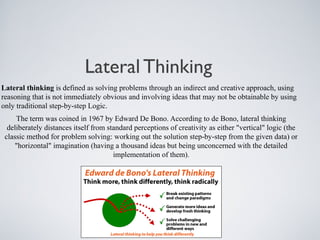
Lateral thinking is defined as solving problems through an indirect and creative approach, using
reasoning that is not immediately obvious and involving ideas that may not be obtainable by using
only traditional step-by-step Logic.
The term was coined in 1967 by Edward De Bono. According to de Bono, lateral thinking
deliberately distances itself from standard perceptions of creativity as either "vertical" logic (the
classic method for problem solving: working out the solution step-by-step from the given data) or
"horizontal" imagination (having a thousand ideas but being unconcerned with the detailed
implementation of them).
Breaking Down LateralThinking
Edward De Bono breaks down multiple ways was of Lateral Thinking
There are several ways of defining lateral thinking, ranging from the technical to the illustrative.
1. "You cannot dig a hole in a different place by digging the same hole deeper"
This means that trying harder in the same direction may not be as useful as changing direction. Effort in the same direction
(approach) will not necessarily succeed.
2. "Lateral Thinking is for changing concepts and perceptions"
With logic you start out with certain ingredients just as in playing chess you start out with given pieces. But what are those pieces?
In most real life situations the pieces are not given, we just assume they are there. We assume certain perceptions, certain concepts
and certain boundaries. Lateral thinking is concerned not with playing with the existing pieces but with seeking to change those very
pieces. Lateral thinking is concerned with the perception part of thinking. This is where we organise the external world into the
pieces we can then 'process'.
Lateral thinking Cont.
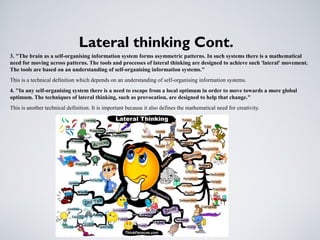
3. "The brain as a self-organising information system forms asymmetric patterns. In such systems there is a mathematical
need for moving across patterns. The tools and processes of lateral thinking are designed to achieve such 'lateral' movement.
The tools are based on an understanding of self-organising information systems."
This is a technical definition which depends on an understanding of self-organising information systems.
4. "In any self-organising system there is a need to escape from a local optimum in order to move towards a more global
optimum. The techniques of lateral thinking, such as provocation, are designed to help that change."
This is another technical definition. It is important because it also defines the mathematical need for creativity.
ParallelThinking
Parallel thinking is best understood in
contrast to traditional argument or
adversarial thinking.
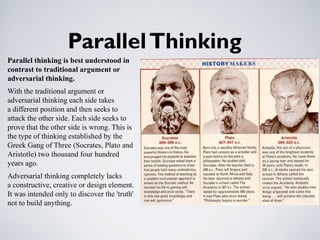
With the traditional argument or
adversarial thinking each side takes
a different position and then seeks to
attack the other side. Each side seeks to
prove that the other side is wrong. This is
the type of thinking established by the
Greek Gang of Three (Socrates, Plato and
Aristotle) two thousand four hundred
years ago.
Adversarial thinking completely lacks
a constructive, creative or design element.
It was intended only to discover the 'truth'
not to build anything.
ParallelThinking Cont
With 'parallel thinking' both sides (or all parties are thinking in parallel in the same direction. There is co-operative and co-ordinated
thinking. The direction itself can be changed in order to give a full scan of the situation. But at every moment each thinker is
thinking in parallel with all the other thinkers. There does not have to be agreement. Statements or thoughts which are indeed
contradictory are not argued out but laid down in parallel.In the final stage the way forward is 'designed' from the parallel thought
that have been laid out.
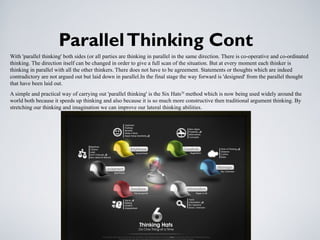
A simple and practical way of carrying out 'parallel thinking' is the Six HatsTM
method which is now being used widely around the
world both because it speeds up thinking and also because it is so much more constructive then traditional argument thinking. By
stretching our thinking and imagination we can improve our lateral thinking abilities.
Howard Gardner’sTheory of Multiple Intelligence
Howard Gardner initially formulated a list of seven
intelligences. His listing was provisional. The first two
have been typically valued in schools; the next three
are usually associated with the arts; and the final two
are what Howard Gardner called ‘personal
intelligences’. In the following is a breakdown of each
individual intelligence:
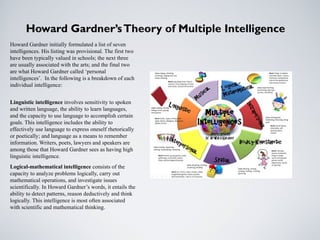
Linguistic intelligence involves sensitivity to spoken
and written language, the ability to learn languages,
and the capacity to use language to accomplish certain
goals. This intelligence includes the ability to
effectively use language to express oneself rhetorically
or poetically; and language as a means to remember
information. Writers, poets, lawyers and speakers are
among those that Howard Gardner sees as having high
linguistic intelligence.
Logical-mathematical intelligence consists of the
capacity to analyze problems logically, carry out
mathematical operations, and investigate issues
scientifically. In Howard Gardner’s words, it entails the
ability to detect patterns, reason deductively and think
logically. This intelligence is most often associated
with scientific and mathematical thinking.
Theory of Intelligence Cont.
Musical intelligence involves skill in the performance, composition, and appreciation of musical
patterns. It encompasses the capacity to recognize and compose musical pitches, tones, and
rhythms. According to Howard Gardner musical intelligence runs in an almost structural parallel to
linguistic intelligence.
Bodily-kinesthetic intelligence entails the potential of using one’s whole body or parts of the body
to solve problems. It is the ability to use mental abilities to coordinate bodily movements. Howard
Gardner sees mental and physical activity as related.
Spatial intelligence involves the potential to recognize and use the patterns of wide space and
more confined areas.
Theory of Intelligence Cont.
Interpersonal intelligence is concerned with the
capacity to understand the intentions,
motivations and desires of other people. It allows
people to work effectively with others.
Educators, salespeople, religious and political
leaders and counsellors all need a well-
developed interpersonal intelligence.
Intrapersonal intelligence entails the capacity
to understand oneself, to appreciate one’s
feelings, fears and motivations. In Howard
Gardner’s view it involves having an effective
working model of ourselves, and to be able to
use such information to regulate our lives.
In Frames of Mind Howard Gardner treated the
personal intelligences ‘as a piece’. Because of
their close association in most cultures, they are
often linked together. However, he still argues
that it makes sense to think of two forms of
personal intelligence. Gardner claimed that the
seven intelligences rarely operate independently.
They are used at the same time and tend to
complement each other as people develop skills
or solve problems.
TheORY OF INTELLIGENCE CONT.
In essence Howard Gardner argued that
he was making two essential claims
about multiple intelligences. That:
The theory is an account of human
cognition in its fullness. The
intelligences provided ‘a new definition
of human nature, cognitively speaking’.
Human beings are organisms who
possess a basic set of intelligences.
People have a unique blend of
intelligences. Howard Gardner argues
that the big challenge facing the
deployment of human resources ‘is how
to best take advantage of the uniqueness
conferred on us as a species exhibiting
several intelligences’.
These intelligences, according to
Howard Gardner, are amoral – they can
be put to constructive or destructive use.
Emotional IntelligenceEmotional intelligence can be defined as the ability to monitor one's own and other people's emotions, to discriminate between
different emotions and label them appropriately, and to use emotional information to guide thinking and behavior.
The ability-based model views emotions as useful sources of information that help one to make sense of and navigate the social
environment. The model proposes that individuals vary in their ability to process information of an emotional nature and in their
ability to relate emotional processing to a wider cognition. This ability is seen to manifest itself in certain adaptive behaviors. The
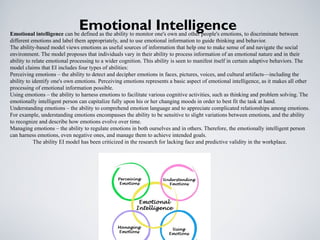
model claims that EI includes four types of abilities:
Perceiving emotions – the ability to detect and decipher emotions in faces, pictures, voices, and cultural artifacts—including the
ability to identify one's own emotions. Perceiving emotions represents a basic aspect of emotional intelligence, as it makes all other
processing of emotional information possible.
Using emotions – the ability to harness emotions to facilitate various cognitive activities, such as thinking and problem solving. The
emotionally intelligent person can capitalize fully upon his or her changing moods in order to best fit the task at hand.
Understanding emotions – the ability to comprehend emotion language and to appreciate complicated relationships among emotions.
For example, understanding emotions encompasses the ability to be sensitive to slight variations between emotions, and the ability
to recognize and describe how emotions evolve over time.
Managing emotions – the ability to regulate emotions in both ourselves and in others. Therefore, the emotionally intelligent person
can harness emotions, even negative ones, and manage them to achieve intended goals.
The ability EI model has been criticized in the research for lacking face and predictive validity in the workplace.

Foundations of Knowledge

  • 1.
  • 2.
    Lateral Thinking Lateral thinkingis defined as solving problems through an indirect and creative approach, using reasoning that is not immediately obvious and involving ideas that may not be obtainable by using only traditional step-by-step Logic. The term was coined in 1967 by Edward De Bono. According to de Bono, lateral thinking deliberately distances itself from standard perceptions of creativity as either "vertical" logic (the classic method for problem solving: working out the solution step-by-step from the given data) or "horizontal" imagination (having a thousand ideas but being unconcerned with the detailed implementation of them).
  • 3.
    Breaking Down LateralThinking EdwardDe Bono breaks down multiple ways was of Lateral Thinking There are several ways of defining lateral thinking, ranging from the technical to the illustrative. 1. "You cannot dig a hole in a different place by digging the same hole deeper" This means that trying harder in the same direction may not be as useful as changing direction. Effort in the same direction (approach) will not necessarily succeed. 2. "Lateral Thinking is for changing concepts and perceptions" With logic you start out with certain ingredients just as in playing chess you start out with given pieces. But what are those pieces? In most real life situations the pieces are not given, we just assume they are there. We assume certain perceptions, certain concepts and certain boundaries. Lateral thinking is concerned not with playing with the existing pieces but with seeking to change those very pieces. Lateral thinking is concerned with the perception part of thinking. This is where we organise the external world into the pieces we can then 'process'.
  • 4.
    Lateral thinking Cont. 3."The brain as a self-organising information system forms asymmetric patterns. In such systems there is a mathematical need for moving across patterns. The tools and processes of lateral thinking are designed to achieve such 'lateral' movement. The tools are based on an understanding of self-organising information systems." This is a technical definition which depends on an understanding of self-organising information systems. 4. "In any self-organising system there is a need to escape from a local optimum in order to move towards a more global optimum. The techniques of lateral thinking, such as provocation, are designed to help that change." This is another technical definition. It is important because it also defines the mathematical need for creativity.
  • 5.
    ParallelThinking Parallel thinking isbest understood in contrast to traditional argument or adversarial thinking. With the traditional argument or adversarial thinking each side takes a different position and then seeks to attack the other side. Each side seeks to prove that the other side is wrong. This is the type of thinking established by the Greek Gang of Three (Socrates, Plato and Aristotle) two thousand four hundred years ago. Adversarial thinking completely lacks a constructive, creative or design element. It was intended only to discover the 'truth' not to build anything.
  • 6.
    ParallelThinking Cont With 'parallelthinking' both sides (or all parties are thinking in parallel in the same direction. There is co-operative and co-ordinated thinking. The direction itself can be changed in order to give a full scan of the situation. But at every moment each thinker is thinking in parallel with all the other thinkers. There does not have to be agreement. Statements or thoughts which are indeed contradictory are not argued out but laid down in parallel.In the final stage the way forward is 'designed' from the parallel thought that have been laid out. A simple and practical way of carrying out 'parallel thinking' is the Six HatsTM method which is now being used widely around the world both because it speeds up thinking and also because it is so much more constructive then traditional argument thinking. By stretching our thinking and imagination we can improve our lateral thinking abilities.
  • 7.
    Howard Gardner’sTheory ofMultiple Intelligence Howard Gardner initially formulated a list of seven intelligences. His listing was provisional. The first two have been typically valued in schools; the next three are usually associated with the arts; and the final two are what Howard Gardner called ‘personal intelligences’. In the following is a breakdown of each individual intelligence: Linguistic intelligence involves sensitivity to spoken and written language, the ability to learn languages, and the capacity to use language to accomplish certain goals. This intelligence includes the ability to effectively use language to express oneself rhetorically or poetically; and language as a means to remember information. Writers, poets, lawyers and speakers are among those that Howard Gardner sees as having high linguistic intelligence. Logical-mathematical intelligence consists of the capacity to analyze problems logically, carry out mathematical operations, and investigate issues scientifically. In Howard Gardner’s words, it entails the ability to detect patterns, reason deductively and think logically. This intelligence is most often associated with scientific and mathematical thinking.
  • 8.
    Theory of IntelligenceCont. Musical intelligence involves skill in the performance, composition, and appreciation of musical patterns. It encompasses the capacity to recognize and compose musical pitches, tones, and rhythms. According to Howard Gardner musical intelligence runs in an almost structural parallel to linguistic intelligence. Bodily-kinesthetic intelligence entails the potential of using one’s whole body or parts of the body to solve problems. It is the ability to use mental abilities to coordinate bodily movements. Howard Gardner sees mental and physical activity as related. Spatial intelligence involves the potential to recognize and use the patterns of wide space and more confined areas.
  • 9.
    Theory of IntelligenceCont. Interpersonal intelligence is concerned with the capacity to understand the intentions, motivations and desires of other people. It allows people to work effectively with others. Educators, salespeople, religious and political leaders and counsellors all need a well- developed interpersonal intelligence. Intrapersonal intelligence entails the capacity to understand oneself, to appreciate one’s feelings, fears and motivations. In Howard Gardner’s view it involves having an effective working model of ourselves, and to be able to use such information to regulate our lives. In Frames of Mind Howard Gardner treated the personal intelligences ‘as a piece’. Because of their close association in most cultures, they are often linked together. However, he still argues that it makes sense to think of two forms of personal intelligence. Gardner claimed that the seven intelligences rarely operate independently. They are used at the same time and tend to complement each other as people develop skills or solve problems.
  • 10.
    TheORY OF INTELLIGENCECONT. In essence Howard Gardner argued that he was making two essential claims about multiple intelligences. That: The theory is an account of human cognition in its fullness. The intelligences provided ‘a new definition of human nature, cognitively speaking’. Human beings are organisms who possess a basic set of intelligences. People have a unique blend of intelligences. Howard Gardner argues that the big challenge facing the deployment of human resources ‘is how to best take advantage of the uniqueness conferred on us as a species exhibiting several intelligences’. These intelligences, according to Howard Gardner, are amoral – they can be put to constructive or destructive use.
  • 11.
    Emotional IntelligenceEmotional intelligencecan be defined as the ability to monitor one's own and other people's emotions, to discriminate between different emotions and label them appropriately, and to use emotional information to guide thinking and behavior. The ability-based model views emotions as useful sources of information that help one to make sense of and navigate the social environment. The model proposes that individuals vary in their ability to process information of an emotional nature and in their ability to relate emotional processing to a wider cognition. This ability is seen to manifest itself in certain adaptive behaviors. The model claims that EI includes four types of abilities: Perceiving emotions – the ability to detect and decipher emotions in faces, pictures, voices, and cultural artifacts—including the ability to identify one's own emotions. Perceiving emotions represents a basic aspect of emotional intelligence, as it makes all other processing of emotional information possible. Using emotions – the ability to harness emotions to facilitate various cognitive activities, such as thinking and problem solving. The emotionally intelligent person can capitalize fully upon his or her changing moods in order to best fit the task at hand. Understanding emotions – the ability to comprehend emotion language and to appreciate complicated relationships among emotions. For example, understanding emotions encompasses the ability to be sensitive to slight variations between emotions, and the ability to recognize and describe how emotions evolve over time. Managing emotions – the ability to regulate emotions in both ourselves and in others. Therefore, the emotionally intelligent person can harness emotions, even negative ones, and manage them to achieve intended goals. The ability EI model has been criticized in the research for lacking face and predictive validity in the workplace.