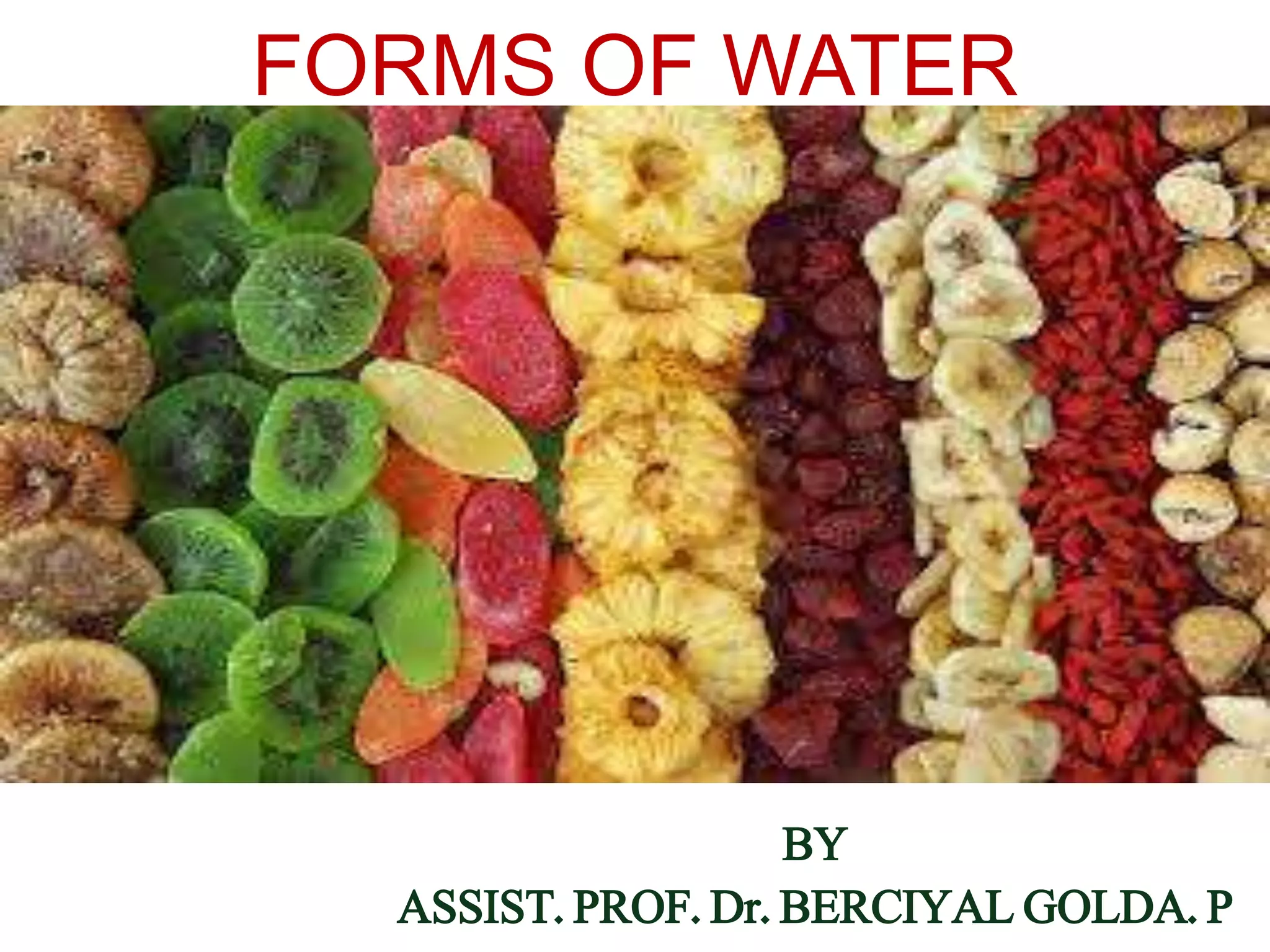
FORMS OF WATER
BY
ASSIST. PROF. Dr. BERCIYAL GOLDA. P
CONTENTS
Introduction
Water
Watercontentof someselectedfoods
Formsof waterinfoods
Freewater
Absorbedwater
Boundwater
Determinationof moisturecontent
 ovendryingmethod
 vaccum oven
 distillationmethod
Water plays many very important roles in food. It affects
texture (dry and brittle versus moist and soft), enables the
activity of enzymes and chemical reactions to occur (acts as a
solvent), supports the growth of microorganisms, makes it possible
for large molecules like polysaccharides and proteins to move
about and interact, and conducts heat within food.
Many foods such as meat, poultry, seafood, fruits and
vegetables are composed of 75% and more water, so water is the
most abundant component in many fresh foods. Other foods such
as dairy products, and fresh baked goods also contain high levels
of water (about 35% or more). Foods that are high in moisture
are at
risk of contamination from the growth of microorganisms such as
bacteria, yeast and mold, while dry foods like pasta generally
have long shelf lives.
INTRODUCTION
All foods contain at least some water.
Most natural foods contain water up to 70% of their weight. Water in
foods is classified in to three types:
Forms of water
Free water Absorbed water Bound water
Water are lightly
entrapped
Water are held
tightly
Less than 6%
unfreezable
water
Free water is the water that can literally be squeezed
out of a food, like the juice in an orange, or the water that
sometimes separates in sour cream or yogurt.
Free water can promote the growth of microorganisms.
Most water in foods is called free water
 Free water is lightly entrapped & therefore easily
pressed from food
 It acts as a dispersing agent & solvent & can be removed
by drying foods
oAdsorbed water (spelled with a “d”) is water that is
attached to the surface of molecules like
polysaccharides and proteins.
o It is not readily squeezed out of the food. When
food scientists refer to the hydration of proteins, such
as gluten, and carbohydrates, such as starch, they are
referring to adsorbed water.
oAdsorbed water can promote the growth of
Microorganisms.
 Bound water is water that is physically trapped
within crystals, such as crystalline starch, or other
substances in food (some food scientists prefer to
define just the free and bound forms of water).
 Bound water cannot promote the growth of
microorganisms.
 Bound water is the equilibrium water content of a
sample at some temperature and low relative humidity.
It does not freeze at low temperature (-40Cº or lower).
 It is unavailable as a solvent for additional solutes.
 It moves with a macromolecule in experiments
involving sedimentation rates, viscosity or diffusion.
 It exixts in the vicinity of solutes and other
nonaqueous substances and has properties differing
significantly from those of bulkwater in the same
system.
THANK YOU

FORMS OF WATER

  • 1.
    FORMS OF WATER BY ASSIST.PROF. Dr. BERCIYAL GOLDA. P
  • 2.
  • 3.
    Water plays manyvery important roles in food. It affects texture (dry and brittle versus moist and soft), enables the activity of enzymes and chemical reactions to occur (acts as a solvent), supports the growth of microorganisms, makes it possible for large molecules like polysaccharides and proteins to move about and interact, and conducts heat within food. Many foods such as meat, poultry, seafood, fruits and vegetables are composed of 75% and more water, so water is the most abundant component in many fresh foods. Other foods such as dairy products, and fresh baked goods also contain high levels of water (about 35% or more). Foods that are high in moisture are at risk of contamination from the growth of microorganisms such as bacteria, yeast and mold, while dry foods like pasta generally have long shelf lives. INTRODUCTION
  • 9.
    All foods containat least some water. Most natural foods contain water up to 70% of their weight. Water in foods is classified in to three types: Forms of water Free water Absorbed water Bound water Water are lightly entrapped Water are held tightly Less than 6% unfreezable water
  • 11.
    Free water isthe water that can literally be squeezed out of a food, like the juice in an orange, or the water that sometimes separates in sour cream or yogurt. Free water can promote the growth of microorganisms. Most water in foods is called free water  Free water is lightly entrapped & therefore easily pressed from food  It acts as a dispersing agent & solvent & can be removed by drying foods
  • 13.
    oAdsorbed water (spelledwith a “d”) is water that is attached to the surface of molecules like polysaccharides and proteins. o It is not readily squeezed out of the food. When food scientists refer to the hydration of proteins, such as gluten, and carbohydrates, such as starch, they are referring to adsorbed water. oAdsorbed water can promote the growth of Microorganisms.
  • 15.
     Bound wateris water that is physically trapped within crystals, such as crystalline starch, or other substances in food (some food scientists prefer to define just the free and bound forms of water).  Bound water cannot promote the growth of microorganisms.  Bound water is the equilibrium water content of a sample at some temperature and low relative humidity. It does not freeze at low temperature (-40Cº or lower).  It is unavailable as a solvent for additional solutes.  It moves with a macromolecule in experiments involving sedimentation rates, viscosity or diffusion.  It exixts in the vicinity of solutes and other nonaqueous substances and has properties differing significantly from those of bulkwater in the same system.
  • 27.