Introduction
to
Business
Enterprises
Course Co-Ordinator:
Ms. Neetu Kushwaha
UNIT – II
Business Enterprises
Forms of Business Organization: Sole Proprietorship,
Joint Hindu Family Firm, Partnership firm, Joint Stock
Company, Cooperative society; Limited Liability
Partnership;
Choice of Form of Organization
International Business
Multinational Corporations
Forms of Organization
-If one is planning to start a business or is interested in
expanding an existing one, an important decision
relates to the choice of the form of organization.
-There are various forms of business organizations
from which one can choose the right one include:
(a) Sole proprietorship
(b) Joint Hindu family business
(c) Partnership
(d) Cooperative societies
(e) Joint stock company.
SOLE
PROPRIETORSHIP
-Sole proprietorship is a popular form of business
organization and is the most suitable form for small
businesses, especially in their initial years of operation.
-Sole proprietorship refers to a form of business
organization which is owned, managed and controlled by an
individual who is the recipient of all profits and bearer of all
risks
Advantages Disadvantages
(i) Quick decision making
(ii)Confidentiality of information
(iii) Direct incentive
(iv)Sense of accomplishment
(v)Ease of formation and closure
(i) Limited resources
(ii)Limited life of a business
concern
(iii)Unlimited liability
(iv)Limited managerial ability
JOINT HINDU FAMILY BUSINESS
• Joint Hindu family business is a specific form of business
organization found only in India.
• It is one of the oldest forms of business organization in the
country.
• It refers to a form of organization wherein the business is
owned and carried on by the members of the Hindu
Undivided Family (HUF).
• It is governed by the Hindu Law
• The business is controlled by the head of the family who is
the eldest member and is called karta.
• All members have equal ownership right over the property
of an ancestor and they are known as co-parceners.
Advantages:
(i) Effective control: The karta has absolute decision making
power.
(ii) Continued business existence: The death of the karta will not
affect the business as the next eldest member will then take up
the position.
(iii) Limited liability of members: The liability of all the co-
parceners except the karta is limited to their share in the
business.
(iv) Increased loyalty and cooperation: Since the business is run
by the members of a family, there is a greater sense of loyalty
towards one other.
Disadvantages:
(i) Limited resources
(ii)Unlimited liability of karta
(iii)Dominance of karta
(iv)Limited managerial skills
PARTNERSHIP
• “Partnership is the relation which subsists
between persons who have agreed to combine
their property, labour or skill in some business
and to share the profits therefrom between
them.” -The Indian Contract Act 1872
• The Indian Partnership Act, 1932 defines
partnership as “the relation between persons
who have agreed to share the profit of the
business carried on by all or any one of them
acting for all.”
Advantages:
(i) Ease of formation and closure
(ii) Balanced decision making
(iii)More funds
(iv) Sharing of risks
(v) Secrecy
Disadvantages:
(i) Unlimited liability
(ii) Limited resources
(iii) Possibility of conflicts
(iv) Lack of continuity
(v) Lack of public confidence: A partnership firm is
not legally required to publish its financial reports
or make other related information public. It is,
therefore, difficult for any member of the public to
ascertain the true financial status of a partnership
firm. As a result, the confidence of the public in
partnership firms is generally low
Type of Partners
COOPERATIVE SOCIETY
• Cooperative organization is “a society
which has its objectives for the
promotion of economic interests of its
members in accordance with
cooperative principles.”- The Indian
Cooperative Societies Act 1912
(i) Equality in voting status
(ii) Limited liability
(iii) Stable existence
(iv) Economy in operations: The members generally
offer honorary services to the society. As the
focus is on elimination of middlemen, this helps
in reducing costs.
(v) Support from government
(vi) Ease of formation
Advantages:
(i) Limited resources
(ii) Inefficiency in management
(iii)Lack of secrecy
(iv) Government control
(v) Differences of opinion
Disadvantages:
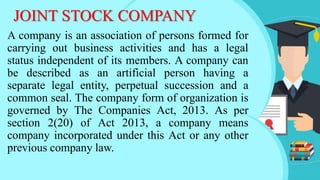
JOINT STOCK COMPANY
A company is an association of persons formed for
carrying out business activities and has a legal
status independent of its members. A company can
be described as an artificial person having a
separate legal entity, perpetual succession and a
common seal. The company form of organization is
governed by The Companies Act, 2013. As per
section 2(20) of Act 2013, a company means
company incorporated under this Act or any other
previous company law.
Advantages:
(i) Limited liability
(ii) Transfer of interest
(iii)Perpetual existence: Existence of a
company is not affected by the death,
retirement, resignation, insolvency or
insanity of its members as it has a
separate entity from its members.
(iv) Scope for expansion
(v) Professional management
Disadvantages:
(i) Complexity in formation
(ii) Lack of secrecy
(iii) Impersonal work environment: Separation of
ownership and management leads to
situations in which there is lack of effort as
well as personal involvement on the part of
the officers of a company.
(iv) Numerous regulations
(v) Delay in decision making
(vi) Conflict in interests
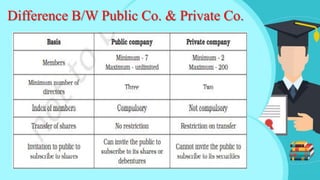
Difference B/W Public Co. & Private Co.
CHOICE OF FORM OF BUSINESS
ORGANISATION
(i) Cost and ease in setting up the
organization
(ii) Liability
(iii) Continuity
(iv) Management ability
(v) Degree of control
(vi) Capital considerations
(vii) Nature of business
Factors influencing the choice of form of
Business Organization
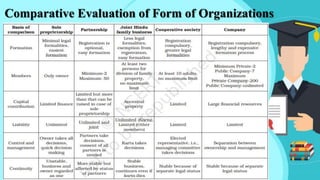
Comparative Evaluation of Form of Organizations
Thanking You!!

Forms of organizations

  • 1.
  • 2.
    UNIT – II BusinessEnterprises Forms of Business Organization: Sole Proprietorship, Joint Hindu Family Firm, Partnership firm, Joint Stock Company, Cooperative society; Limited Liability Partnership; Choice of Form of Organization International Business Multinational Corporations
  • 3.
    Forms of Organization -Ifone is planning to start a business or is interested in expanding an existing one, an important decision relates to the choice of the form of organization. -There are various forms of business organizations from which one can choose the right one include: (a) Sole proprietorship (b) Joint Hindu family business (c) Partnership (d) Cooperative societies (e) Joint stock company.
  • 4.
    SOLE PROPRIETORSHIP -Sole proprietorship isa popular form of business organization and is the most suitable form for small businesses, especially in their initial years of operation. -Sole proprietorship refers to a form of business organization which is owned, managed and controlled by an individual who is the recipient of all profits and bearer of all risks
  • 5.
    Advantages Disadvantages (i) Quickdecision making (ii)Confidentiality of information (iii) Direct incentive (iv)Sense of accomplishment (v)Ease of formation and closure (i) Limited resources (ii)Limited life of a business concern (iii)Unlimited liability (iv)Limited managerial ability
  • 6.
    JOINT HINDU FAMILYBUSINESS • Joint Hindu family business is a specific form of business organization found only in India. • It is one of the oldest forms of business organization in the country. • It refers to a form of organization wherein the business is owned and carried on by the members of the Hindu Undivided Family (HUF). • It is governed by the Hindu Law • The business is controlled by the head of the family who is the eldest member and is called karta. • All members have equal ownership right over the property of an ancestor and they are known as co-parceners.
  • 7.
    Advantages: (i) Effective control:The karta has absolute decision making power. (ii) Continued business existence: The death of the karta will not affect the business as the next eldest member will then take up the position. (iii) Limited liability of members: The liability of all the co- parceners except the karta is limited to their share in the business. (iv) Increased loyalty and cooperation: Since the business is run by the members of a family, there is a greater sense of loyalty towards one other.
  • 8.
    Disadvantages: (i) Limited resources (ii)Unlimitedliability of karta (iii)Dominance of karta (iv)Limited managerial skills
  • 9.
    PARTNERSHIP • “Partnership isthe relation which subsists between persons who have agreed to combine their property, labour or skill in some business and to share the profits therefrom between them.” -The Indian Contract Act 1872 • The Indian Partnership Act, 1932 defines partnership as “the relation between persons who have agreed to share the profit of the business carried on by all or any one of them acting for all.”
  • 10.
    Advantages: (i) Ease offormation and closure (ii) Balanced decision making (iii)More funds (iv) Sharing of risks (v) Secrecy
  • 11.
    Disadvantages: (i) Unlimited liability (ii)Limited resources (iii) Possibility of conflicts (iv) Lack of continuity (v) Lack of public confidence: A partnership firm is not legally required to publish its financial reports or make other related information public. It is, therefore, difficult for any member of the public to ascertain the true financial status of a partnership firm. As a result, the confidence of the public in partnership firms is generally low
  • 12.
  • 13.
    COOPERATIVE SOCIETY • Cooperativeorganization is “a society which has its objectives for the promotion of economic interests of its members in accordance with cooperative principles.”- The Indian Cooperative Societies Act 1912
  • 14.
    (i) Equality invoting status (ii) Limited liability (iii) Stable existence (iv) Economy in operations: The members generally offer honorary services to the society. As the focus is on elimination of middlemen, this helps in reducing costs. (v) Support from government (vi) Ease of formation Advantages:
  • 15.
    (i) Limited resources (ii)Inefficiency in management (iii)Lack of secrecy (iv) Government control (v) Differences of opinion Disadvantages:
  • 16.
    JOINT STOCK COMPANY Acompany is an association of persons formed for carrying out business activities and has a legal status independent of its members. A company can be described as an artificial person having a separate legal entity, perpetual succession and a common seal. The company form of organization is governed by The Companies Act, 2013. As per section 2(20) of Act 2013, a company means company incorporated under this Act or any other previous company law.
  • 17.
    Advantages: (i) Limited liability (ii)Transfer of interest (iii)Perpetual existence: Existence of a company is not affected by the death, retirement, resignation, insolvency or insanity of its members as it has a separate entity from its members. (iv) Scope for expansion (v) Professional management
  • 18.
    Disadvantages: (i) Complexity information (ii) Lack of secrecy (iii) Impersonal work environment: Separation of ownership and management leads to situations in which there is lack of effort as well as personal involvement on the part of the officers of a company. (iv) Numerous regulations (v) Delay in decision making (vi) Conflict in interests
  • 19.
    Difference B/W PublicCo. & Private Co.
  • 20.
    CHOICE OF FORMOF BUSINESS ORGANISATION (i) Cost and ease in setting up the organization (ii) Liability (iii) Continuity (iv) Management ability (v) Degree of control (vi) Capital considerations (vii) Nature of business
  • 21.
    Factors influencing thechoice of form of Business Organization
  • 22.
    Comparative Evaluation ofForm of Organizations
  • 23.