The Evolution of
              Cooperative Principles
   Rockdale
   Pioneers             ICA         ICA           ICA
    14                   4            6            7
Principles           Principles   Principles   Principles
   1844                 1937         1966         1995


Lecture presentation for
Cooperative Basic Course
         By: Jo B. Bitonio
         June 2012
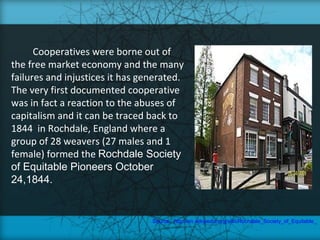
Cooperatives were borne out of
the free market economy and the many
failures and injustices it has generated.
The very first documented cooperative
was in fact a reaction to the abuses of
capitalism and it can be traced back to
1844 in Rochdale, England where a
group of 28 weavers (27 males and 1
female) formed the Rochdale Society
of Equitable Pioneers October
24,1844.


                                 Source: http://en.wikipedia.org/wiki/Rochdale_Society_of_Equitable_P
As the mechanization of the industrial Revolution was forcing more and
more skilled workers into poverty, these tradesmen decided to band
together to open their own store selling food items they could not
otherwise afford. With lessons from prior failed attempts at co-
operation in mind, they designed the now famous Rockdale Principles,
and over a period of four months they struggled to pool one pound
sterling per person for a total of 28 pounds of capital.

On 21 December 1844, they opened their store with a very meager
selection of butter, sugar, flour, oatmeal and a few candles. Within
three months, they expanded their selection to include tea and tobacco,
and they were soon known for providing high quality, unadulterated
goods.


                                  Source: http://en.wikipedia.org/wiki/Rochdale_Society_of_Equitable_P
Little did the Rochdale Pioneers know in 1844 that their
humble efforts to help themselves would have such
impact. From the little shop which still stands on Toad
Lane, the modern cooperative began its journey.


One of the lessons learned from the Rochdale Pioneers is
that "helping people help themselves" is a strong and most
enduring form of economic development. The world has
certainly changed a great deal in 150 years, but the need for
cooperation among people remains.


                              http://www.cooperativegrocer.coop/articles/2004-01-09/co
In 1844,1845, and 1854 the Society published a
series of "practices," which were the basis for
what became known decades later as the
Rochdale Principles:

       Open membership.
       Democratic control (one man, one vote).
      Distribution of surplus in proportion to
      trade.
       Payment of limited interest on capital.
       Political and religious neutrality.
       Cash trading
       Promotion of education
Cooperative societies had     1. Voting is by members on
existed before Rochdale has failed.      a democratic (one
 It was to the credit of Rochdale        member, one vote) basis.
Pioneers that they formulated a       2. Membership is open.
method that was capable of being      3. Equity is provided by
standardized and became a “code          members.
of conduct” for succeeding            4. Equity ownership share of
cooperatives. The principles which       individual members is
they codified were as timely as          limited.
ever and are still the standards      5. Net income is distributed
with which present cooperative           to members as patronage
principles are based:                    refund on a cost basis.
6. Dividends on equity capital are limited.
7. Exchange of goods and services at market prices.
 8. Duty to educate.
 9. Cash trading only.
10. No unusual risk assumption.
11. Political and religious neutrality.
12. Equity in membership (no discrimination by
    gender)
When the International
Cooperative Alliance (ICA) was          The 1937 review
founded in 1895 it took upon itself     affirmed four vital
that task of refining the               principles:
cooperative principles and the
                                        2.open membership;
further consolidation and
expansion of the Cooperative            3.democratic control;
Movement. The Alliance                  4.dividend paid
periodically reviewed the               according to business
cooperative principles laid down in     done; and
Rochdale and made two formal            5.limited interest on
declarations of principles, the first
                                        capital
in 1937
The 1966 review declared six essential principles:

   •   voluntary membership;
   •   democracy;
   •   limited interest on share capital;
   •   distribution of surplus;
   •   provision for education; and
   •   cooperation among cooperatives.
The third and final review was done in
September 1995, at ICA’s 100th anniversary meeting
produced the most comprehensive statement to date
on the cooperative identity. The statement defines
cooperatives, identifies shared values of cooperators
worldwide and refines, restates and expands the
1966 principles. These principles are intended to
guide cooperative organizations at the beginning of
the 21st century.
The Statement of identity defines:

        A cooperative as “an autonomous
association of persons united voluntarily to meet
their common economic, social and cultural needs
and aspirations through a jointly owned and
democratically- controlled enterprise.”
The statement emphasizes important characteristics of
cooperative enterprise which are:

 a) Autonomy: the cooperative is as independent of
government and private enterprise as possible;
 b) Association of persons: the definition deliberately does read
an association of individuals. The term person embraces any
legal definition of “person” which includes companies as well
as individuals;
c) Voluntary: members are free to join and leave at will, within
the purposes and resources of the cooperative;.
d) Meet needs: the central purpose of the cooperative is to
   meet member needs, which can be purely economic, social
   and cultural;
e) Joint ownership and democratic control:
f) The members own the cooperative on a mutual basis.
   Decisions are made democratically by the members and
   are not controlled by capital or by government; and
g) Enterprise: the cooperative is an organized entity that
   typically functions in the marketplace and engages in the
   exchange of goods and services.
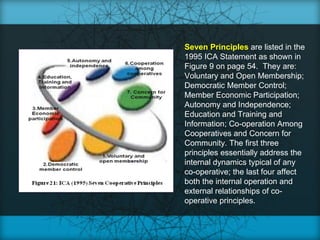
Seven Principles are listed in the
1995 ICA Statement as shown in
Figure 9 on page 54. They are:
Voluntary and Open Membership;
Democratic Member Control;
Member Economic Participation;
Autonomy and Independence;
Education and Training and
Information; Co-operation Among
Cooperatives and Concern for
Community. The first three
principles essentially address the
internal dynamics typical of any
co-operative; the last four affect
both the internal operation and
external relationships of co-
operative principles.
1. Voluntary and Open Membership

Cooperatives are voluntary organizations, open to all persons able to use
their services and willing to accept the responsibilities of membership
without gender, social, racial, political or religious discrimination.

2. Democratic Member Control
            Cooperatives are democratic organizations controlled by their
members, who actively participate in setting their policies and making
decisions. Men and women serving as elected representatives are
accountable to the membership. In primary cooperatives, members have
equal voting rights (one member, one vote) and cooperatives at other levels
are also organized in a democratic manner.
3. Member Economic Participation
Cooperatives contribute equitably to, and democratically control, the capital
of their cooperative. At least part of that capital is usually the common
property of the cooperative. Members allocate surpluses for any of the
following purposes; developing their cooperative, possibly by setting up
reserves, part of which would at least be indivisible; benefiting members in
proportion to their transactions with the cooperative; and supporting other
activities approved by the membership.

4. Education, Training and Information
Cooperatives provide education and training for their members, elected
representatives, managers and employees so they can contribute effectively to
the development of their cooperatives. They inform the general public –
particularly young people and opinion leaders-about the nature and
benefits of cooperation.
5. Autonomy and Independence
Cooperatives are autonomous, self-help organizations controlled by their
members. If they enter into agreements with other organizations, including
governments, they do so on terms to ensure democratic control by their
members and maintain their cooperative autonomy.

6. Cooperative among Cooperatives
Cooperatives service their members most efficiently and strengthen the
cooperative movement by working together through local, national and
international structures.

7. Concern for Community
Cooperatives have a special responsibility to ensure that the development of
communities- economically, socially and culturally- is sustained. They have a
responsibility to work steadily for the environmental protection of their
communities.
Reference:
 International Cooperative Alliance. Cooperatives
 Principles Alive: The ICA’s Seven Principles of
 Cooperative Identity in the Experience of
 Cooperatives in Metro Manila. Union of Metro
 Manila Cooperatives, Manila, Philippines, 2003.

Evolution of Cooperative Principles

  • 1.
    The Evolution of Cooperative Principles Rockdale Pioneers ICA ICA ICA 14 4 6 7 Principles Principles Principles Principles 1844 1937 1966 1995 Lecture presentation for Cooperative Basic Course By: Jo B. Bitonio June 2012
  • 2.
    Cooperatives were borneout of the free market economy and the many failures and injustices it has generated. The very first documented cooperative was in fact a reaction to the abuses of capitalism and it can be traced back to 1844 in Rochdale, England where a group of 28 weavers (27 males and 1 female) formed the Rochdale Society of Equitable Pioneers October 24,1844. Source: http://en.wikipedia.org/wiki/Rochdale_Society_of_Equitable_P
  • 3.
    As the mechanizationof the industrial Revolution was forcing more and more skilled workers into poverty, these tradesmen decided to band together to open their own store selling food items they could not otherwise afford. With lessons from prior failed attempts at co- operation in mind, they designed the now famous Rockdale Principles, and over a period of four months they struggled to pool one pound sterling per person for a total of 28 pounds of capital. On 21 December 1844, they opened their store with a very meager selection of butter, sugar, flour, oatmeal and a few candles. Within three months, they expanded their selection to include tea and tobacco, and they were soon known for providing high quality, unadulterated goods. Source: http://en.wikipedia.org/wiki/Rochdale_Society_of_Equitable_P
  • 4.
    Little did theRochdale Pioneers know in 1844 that their humble efforts to help themselves would have such impact. From the little shop which still stands on Toad Lane, the modern cooperative began its journey. One of the lessons learned from the Rochdale Pioneers is that "helping people help themselves" is a strong and most enduring form of economic development. The world has certainly changed a great deal in 150 years, but the need for cooperation among people remains. http://www.cooperativegrocer.coop/articles/2004-01-09/co
  • 5.
    In 1844,1845, and1854 the Society published a series of "practices," which were the basis for what became known decades later as the Rochdale Principles:  Open membership.  Democratic control (one man, one vote). Distribution of surplus in proportion to trade.  Payment of limited interest on capital.  Political and religious neutrality.  Cash trading  Promotion of education
  • 6.
    Cooperative societies had 1. Voting is by members on existed before Rochdale has failed. a democratic (one It was to the credit of Rochdale member, one vote) basis. Pioneers that they formulated a 2. Membership is open. method that was capable of being 3. Equity is provided by standardized and became a “code members. of conduct” for succeeding 4. Equity ownership share of cooperatives. The principles which individual members is they codified were as timely as limited. ever and are still the standards 5. Net income is distributed with which present cooperative to members as patronage principles are based: refund on a cost basis.
  • 7.
    6. Dividends onequity capital are limited. 7. Exchange of goods and services at market prices. 8. Duty to educate. 9. Cash trading only. 10. No unusual risk assumption. 11. Political and religious neutrality. 12. Equity in membership (no discrimination by gender)
  • 8.
    When the International CooperativeAlliance (ICA) was The 1937 review founded in 1895 it took upon itself affirmed four vital that task of refining the principles: cooperative principles and the 2.open membership; further consolidation and expansion of the Cooperative 3.democratic control; Movement. The Alliance 4.dividend paid periodically reviewed the according to business cooperative principles laid down in done; and Rochdale and made two formal 5.limited interest on declarations of principles, the first capital in 1937
  • 9.
    The 1966 reviewdeclared six essential principles: • voluntary membership; • democracy; • limited interest on share capital; • distribution of surplus; • provision for education; and • cooperation among cooperatives.
  • 10.
    The third andfinal review was done in September 1995, at ICA’s 100th anniversary meeting produced the most comprehensive statement to date on the cooperative identity. The statement defines cooperatives, identifies shared values of cooperators worldwide and refines, restates and expands the 1966 principles. These principles are intended to guide cooperative organizations at the beginning of the 21st century.
  • 11.
    The Statement ofidentity defines: A cooperative as “an autonomous association of persons united voluntarily to meet their common economic, social and cultural needs and aspirations through a jointly owned and democratically- controlled enterprise.”
  • 12.
    The statement emphasizesimportant characteristics of cooperative enterprise which are: a) Autonomy: the cooperative is as independent of government and private enterprise as possible; b) Association of persons: the definition deliberately does read an association of individuals. The term person embraces any legal definition of “person” which includes companies as well as individuals; c) Voluntary: members are free to join and leave at will, within the purposes and resources of the cooperative;.
  • 13.
    d) Meet needs:the central purpose of the cooperative is to meet member needs, which can be purely economic, social and cultural; e) Joint ownership and democratic control: f) The members own the cooperative on a mutual basis. Decisions are made democratically by the members and are not controlled by capital or by government; and g) Enterprise: the cooperative is an organized entity that typically functions in the marketplace and engages in the exchange of goods and services.
  • 14.
    Seven Principles arelisted in the 1995 ICA Statement as shown in Figure 9 on page 54. They are: Voluntary and Open Membership; Democratic Member Control; Member Economic Participation; Autonomy and Independence; Education and Training and Information; Co-operation Among Cooperatives and Concern for Community. The first three principles essentially address the internal dynamics typical of any co-operative; the last four affect both the internal operation and external relationships of co- operative principles.
  • 15.
    1. Voluntary andOpen Membership Cooperatives are voluntary organizations, open to all persons able to use their services and willing to accept the responsibilities of membership without gender, social, racial, political or religious discrimination. 2. Democratic Member Control Cooperatives are democratic organizations controlled by their members, who actively participate in setting their policies and making decisions. Men and women serving as elected representatives are accountable to the membership. In primary cooperatives, members have equal voting rights (one member, one vote) and cooperatives at other levels are also organized in a democratic manner.
  • 16.
    3. Member EconomicParticipation Cooperatives contribute equitably to, and democratically control, the capital of their cooperative. At least part of that capital is usually the common property of the cooperative. Members allocate surpluses for any of the following purposes; developing their cooperative, possibly by setting up reserves, part of which would at least be indivisible; benefiting members in proportion to their transactions with the cooperative; and supporting other activities approved by the membership. 4. Education, Training and Information Cooperatives provide education and training for their members, elected representatives, managers and employees so they can contribute effectively to the development of their cooperatives. They inform the general public – particularly young people and opinion leaders-about the nature and benefits of cooperation.
  • 17.
    5. Autonomy andIndependence Cooperatives are autonomous, self-help organizations controlled by their members. If they enter into agreements with other organizations, including governments, they do so on terms to ensure democratic control by their members and maintain their cooperative autonomy. 6. Cooperative among Cooperatives Cooperatives service their members most efficiently and strengthen the cooperative movement by working together through local, national and international structures. 7. Concern for Community Cooperatives have a special responsibility to ensure that the development of communities- economically, socially and culturally- is sustained. They have a responsibility to work steadily for the environmental protection of their communities.
  • 18.
    Reference: International CooperativeAlliance. Cooperatives Principles Alive: The ICA’s Seven Principles of Cooperative Identity in the Experience of Cooperatives in Metro Manila. Union of Metro Manila Cooperatives, Manila, Philippines, 2003.